A single-work corpus dive on Tolstoy’s religious treatise Что такое религия и в чём сущность её? (What Is Religion and What Is Its Essence?), written August 1901 – January 1902. It reads the treatise from its own text in the tolstoydigital TEI corpus (PSS Tom 35), reconstructs its composition at Gaspra during Tolstoy’s gravest illness from the Jubilee-Edition editorial commentary and the 1900–1902 diaries and letters, and maps its central manoeuvre — the structural critique of all false religion against the positive definition of true religion as a relation to the infinite. The keystone is the definitional moment of 8 February 1901, written about two weeks before the Holy Synod excommunication, in which Tolstoy rejects Chicherin’s Science and Religion and sets down his own formula for the first time.
The dive prepares ingestion-ready material (this index.md, a machine-readable dossier.yaml, byte-faithful extracts/, and a draft dev-blog note). It does not create vault pages; it plans them.
Key findings
- The treatise defines religion as a relation to the infinite. The central definition — “True religion is such an establishment by man, in accord with his reason and knowledge, of his relation to the infinite life surrounding him, which binds his life to that infinity and guides his actions” — was first articulated on 8 February 1901, about two weeks before the Holy Synod excommunication decree (22–24 February 1901, Old Style). The decree did not prompt the argument; it sharpened the urgency of publishing it.
- The argument has two movements: structural and positive. The first movement (Chs I–IX) traces how all historical religions, including Christianity, share three corruption mechanisms — priesthood, miracles, and scripture — and how the Church adds a fourth: the claim of institutional infallibility (“the Church truc”). The second movement (Chs X–XVII) identifies the four propositions shared by all authentic religions (God as source; a divine particle in man; subdue passion, increase love; the Golden Rule) and argues their recovery is the only escape from the vicious circle of false religion and state violence.
- Equality is the structural constant. “The recognition of the equality of people is the inevitable, fundamental property of every religion.” Tolstoy’s taxonomy of religious corruption is at bottom a taxonomy of how equality gets hidden or inverted, and his positive universalism is the recovery of it.
- The work was composed under mortal urgency. Written at the Panina estate at Gaspra, Crimea, while Tolstoy suffered severe illness (pleurisy, typhoid, pneumonia) through the winter of 1901–02, the treatise is one of two works he explicitly told Chertkov he would be “guilty” of leaving unfinished at death. The phrase «Надо торопиться» (I must hurry), in the start-of-composition announcement of 12 August 1901, is one of the most compact self-descriptions of purpose in the late corpus.
- The published title was still in flux at completion. On 30 November 1901 Tolstoy called it «Что такое религия и ее назначение» (“its purpose”); the full published title uses «сущность» (“essence”). The definitional shift is not merely stylistic: «назначение» grounds the work in teleology; «сущность» grounds it in ontology.
- The treatise was banned in Russia and published abroad. First published by Chertkov’s Free Word press (Christchurch, England, 1902); first legal Russian publication not until 1906 (Zemlya i Trud, A. E. Belyaev). Tolstoy’s December 1902 attempt to place it in the journal Obrazovanie was blocked by the censor.
- The composition-window interlocutor network is unusually dense. Eleven correspondents received progress reports, completion announcements, or programme statements across the four-month drafting window. The letters to Rusanov (5 Sept 1901) and Chertkov (12 Aug, 30 Nov 1901) are the most precise first-person accounts of the work’s purpose and self-assessment.
- 82 manuscripts survive, totalling 1,449 units. Held at the Tolstoy Museum / Chertkov archive; the printer’s copy is MS 82. This is one of the densest manuscript sequences in the late corpus for a work of this length.
Why this matters
Что такое религия is Tolstoy’s most systematic treatment of a question that had driven his writing since A Confession (1879–82): what is the difference between the institutional religion that lied to him his whole life and the authentic religious relation he recovered after his conversion crisis. Where A Confession and What I Believe (1882–84) narrate and defend his personal break with Orthodoxy, and The Kingdom of God Is Within You (1890–93) extends the argument to the political order, this treatise does something formally different: it builds a comparative theology, surveying Brahmanism, Judaism, Confucianism, Taoism, Buddhism, Christianity, and Islam in order to extract the four propositions they share — and then argues that the Church’s specific innovation (institutional infallibility, the “Church truc”) is the mechanism that hides those propositions from the people who most need them.
The treatise was written about six months after the Holy Synod excommunication and during Tolstoy’s gravest illness. The excommunication is the institutional backdrop: the treatise’s critique of the Church as a self-authorising, infallible body (the “Church truc” of chapter VI) bears on exactly the kind of authority the Synod had just exercised against him — though the text nowhere names the decree, and its argument was already taking shape before it (see Genesis and Scholarly context). The illness leaves its own trace, in the recurring note of urgency and self-justification that runs through the composition-window letters.
For this project the essay sits at the centre of a cluster of Prophet-period works: the ethical ground cleared in What Is Art? (1897–98) and The Slavery of Our Times (1900) makes the universalism of this treatise structurally possible; the near-contemporary On Religious Tolerance («О веротерпимости», Nov–Dec 1901) is its political companion-piece, written in the same Gaspra weeks (no dedicated dive yet); A Confession (1879–82) is its biographical precursor.
Genesis & composition
(The composition narrative below is drawn from V. S. Mishin’s editorial history of writing and printing in PSS Tom 35, extracts/v35_670_675_history.txt, and from the 1900–1902 diaries and letters. Editorial commentary is attributed; Tolstoy’s own words are cited from the diary/letter extracts.)
The project’s beginning can be dated precisely. In his diary on 7 November 1900 Tolstoy noted three planned articles:
Думал о трех статьях: 1) Письмо Китайцам, 2) О том, что все на убийстве, и 3) что у нас quasi христиан нет никакой религии.
(working English) Thought about three articles: (1) A letter to the Chinese, (2) On the fact that everything rests on murder, and (3) that we, quasi-Christians, have no religion at all.
Diary, 7 November 1900 · PSS Tom 54 · TEI v54_053_054_1900_11_07.
The three were never written separately. By 11 February 1901 Tolstoy was planning to merge them into a single work and had found his first candidate title:
Еще думал, что обращение к китайцам надо оставить. А прямо озаглавить: Безбожное время или новое падение Рима. И прямо начать с указания на отсутствие религии.
(working English) Also thought that the address to the Chinese should be dropped. Instead simply title it: A Godless Time, or the New Fall of Rome. And open directly with pointing to the absence of religion.
Diary, 11 February 1901 · PSS Tom 54 · TEI v54_089_090_1901_02_11.
Three days earlier — on 8 February 1901, about two weeks before the Holy Synod excommunication decree (22–24 February 1901, Old Style) — Tolstoy wrote the first articulation of the definitional formula that would become the treatise’s centre:
Искал определение религии, взял книгу Чичерина — Религия и Наука. Искусственные построения на заданную тему. Мое определение такое: Это — такое установление человеком отношения к бесконечному, которым определяется цель его жизни.
(working English) Sought a definition of religion, took Chicherin’s book Religion and Science. Artificial constructions on a set theme. My definition is: It is such an establishment by man of his relation to the infinite, by which the purpose of his life is determined.
Diary, 8 February 1901 · PSS Tom 54 · TEI v54_086_089_1901_02_08.
The rejection of Chicherin is the hinge: “artificial constructions on a set theme” is Tolstoy’s verdict on the tradition he is about to supersede. The definition is already functional at this stage — “relation to the infinite” — though the final text will refine the formulation twice more.
Actual drafting began at Yasnaya Polyana in August 1901. The start-of-composition announcement to Chertkov on 12 August 1901 has the work’s tone in a sentence:
начал о религии, о ее значении и об отсутствии ее в нашем мире. Надеюсь и чувствую, что эта статья увлечет меня и даст возможность высказать многое, что хочется высказать. Надо торопиться.
(working English) I have begun [writing] about religion, about its significance and about its absence in our world. I hope and feel that this article will carry me away and will make it possible to say much that I want to say. I must hurry.
To V. G. Chertkov, 12 August 1901 · PSS Tom 88 · TEI v88_636_avgusta12.
On 5 September 1901, the day of departure from Yasnaya Polyana for Crimea, Tolstoy wrote Rusanov the clearest statement of the work’s programme:
Теперь я занят статьей о религии: определение ее и выяснение ее отсутствия в нашем мире и ужасных последствиях этого. Очень меня занимает эта работа.
(working English) I am now occupied with an article on religion: defining it and elucidating its absence in our world and the terrible consequences of this. This work absorbs me greatly.
To G. A. Rusanov, 5 September 1901 · PSS Tom 73 · TEI v73_154_G_A_Rusanovu.
Three parts in sequence — definition, diagnosis of absence, account of consequences — map directly onto the treatise’s architecture.
The family arrived at Gaspra on 8 September. The drafts had been left behind at Yasnaya Polyana. Tolstoy told Chertkov on 14 September that this did not trouble him — he ranked the essay among the two things he would be “guilty” of leaving unfinished:
Две, включая и О религии, у меня есть вещи, которые я буду виноват, если не кончу до смерти. Виноват, потому что мог сделать это прежде.
(working English) Two things — including On Religion — are works for which I shall be guilty if I do not finish them before death. Guilty, because I could have done it earlier.
To V. G. Chertkov, 14 September 1901 · PSS Tom 88 · TEI v88_637_sentyabrya14.
By 10 October the work was again active despite deteriorating health:
За все это время работаю над Религией. Кажется подвигается, но и умственно стал слабее, меньше времени могу работать.
(working English) All this time I have been working on Religion. It seems to be progressing, but mentally I have grown weaker, less time to work.
Diary, 10 October 1901 · PSS Tom 54 · TEI v54_110_112_1901_10_10.
By 6 November 1901 twelve chapters had been written and multiply revised, with approximately six remaining:
Пишу я, как вы знаете, о религии, «Что такое религия?». Написано и много раз пересмотрено 12 глав, — остается едва ли 6.
(working English) I am writing, as you know, about religion, ‘What is religion?’ Twelve chapters have been written and many times reviewed — barely 6 remain.
To V. G. Chertkov, 6 November 1901 · PSS Tom 88 · TEI v88_641_noyabrya6.
The same letter records Tolstoy reading Mikhailovsky on religion — “arbitrary, frivolous, empty nonsense” — and Kuno Fischer on Kant; he was working comparatively throughout. On 29 November he entered the first “I think I have finished”:
Я думаю, что кончил о религии. Как всегда сомневаюсь в важности и доброте этого сочинения, но кажется теперь более основательно, чем в прежних случаях.
(working English) I think I have finished On religion. As always I doubt the importance and quality of this work, but it seems now more well-grounded than in previous cases.
Diary, 29 November 1901 · PSS Tom 54 · TEI v54_113_115_1901_11_29.
The qualifier “more well-grounded” (более основательно) is the rarest register in Tolstoy’s post-completion self-descriptions — a qualified positive amid the habitual self-doubt.
On 30 November he told Chertkov the same thing, with the title still in flux:
надеюсь, что кончил о религии (Что такое религия и ее назначение). Нечто придется переменить, прибавить кое-что в последней 16-й главе... Одно знаю, что написать это мне было нужно, и я сделал, что мог.
(working English) I hope I have finished On Religion (What is religion and its purpose). Something will need to be changed, a little added in the last, 16th chapter… One thing I know: it was necessary for me to write this, and I did what I could.
To V. G. Chertkov, 30 November 1901 · PSS Tom 88 · TEI v88_644_noyabrya30.
On 26 December the diary records the definitive completion: “Кончил о религии. Но должно быть пересмотрю еще.” (Finished On religion. But I will probably review it again.) The same entry contains a late alternative definition — “Religion is such a state in which actions are conditioned not by considerations of this temporal life alone, but by considerations of the whole eternal, infinite life” — a consequence-oriented formulation that complements the February relational formula without replacing it.
On 31 December Tolstoy told Biryukov: “О религии кончил и на днях отправлю.” The manuscript reached Chertkov in early January 1902. Post-despatch, during the pneumonia crisis of late January and early February 1902, Boulanger took dictation of late additions — the composition never entirely stopped.
By 17 January 1902 Tolstoy wrote Rusanov: “Кончил о религии.” By 20 January he told Grauberger the essay was “probably printing at Chertkov’s” and named it by its full published title for the first and only time in the correspondence: «Что такое религия и в чём её сущность?».
The people around the work
- V. G. Chertkov (major) — the publisher; Tolstoy’s primary correspondent throughout composition; received the manuscript for typesetting at the Free Word press. Four letters across August–November 1901 constitute the most precise chapter-by-chapter account of the composition.
- G. A. Rusanov (major) — Tolstoyan correspondent in Voronezh; received the clearest early programme statement (5 Sept 1901) and the post-despatch completion confirmation (17 Jan 1902).
- P. A. Boulanger (supporting) — accompanied the family to Gaspra; took dictation of late additions during the pneumonia crisis, January–February 1902.
- P. I. Biryukov (supporting) — received the New Year’s Eve completion announcement (31 Dec 1901); co-translated the French edition with J.-W. Bienstock (Paris, Stock, 1902).
- Aylmer Maude (peripheral) — received a progress report from Gaspra (23 Sept 1901); was also managing the ongoing Resurrection correspondence.
- F. Kh. Grauberger (peripheral) — received the only letter that names the full published title and confirms it is at press (20 Jan 1902).
- N. N. Ge (son), V. V. Stasov, V. A. Lebrun, I. M. Tregubov, A. Ya. Ostrogorsky — further composition-window correspondents; the Tregubov letter (2 Dec 1901) contains Tolstoy’s sharpest statement of the moral obligation behind the essay: “I am in duty bound to use the last remnant of my powers to say what I know.”
What the work says
A structural map of the treatise’s keystone passages, read chapter by chapter from the full text (extracts/v35_157_198_Chto_takoe_religiya.txt, PSS Tom 35, pp. 157–198). The treatise moves in three blocks: Chs I–II (indictment); Chs III–IX (structural analysis — definition, equality, corruption mechanisms, the Church truc, faith redefined, the irreligious present); Chs X–XVII (the universal religion — shared propositions, what education should do, the vicious circle, and who breaks it).
1 — The definition: religion as relation to the infinite (Ch III)
The opening argument clears the field of all substitute definitions — art, science, philosophy, law — and arrives at:
Истинная религия есть такое согласное с разумом и знаниями человека установленное им отношение к окружающей его бесконечной жизни, которое связывает его жизнь с этой бесконечностью и руководит его поступками.
(working English) True religion is such a relation, established by man in accord with his reason and knowledge, to the infinite life surrounding him, which binds his life to that infinity and guides his actions.
Chapter III · PSS Tom 35 · TEI v35_157_198_Chto_takoe_religiya.
The structural statement of the same point, arriving via the survey of definitions from Vauvenargues, Bayle, and Benjamin Constant (all sourced from the notebook’s French-language выписки, extracts/v54_211_240_Zapisnaja_knizhka.txt):
Всякая религия есть установление отношения человека к бесконечному существованию, которому он чувствует себя причастным и из которого он выводит руководство своей деятельности.
(working English) Every religion is an establishment of man’s relation to the infinite existence of which he feels himself a part and from which he draws guidance for his activity.
Chapter III · PSS Tom 35 · TEI v35_157_198_Chto_takoe_religiya.
2 — Equality as religion’s structural constant (Ch IV)
Before turning to corruption, Tolstoy establishes the one property all authentic religion shares:
Признание равенства людей есть неизбежное, основное свойство всякой религии.
(working English) The recognition of the equality of people is the inevitable, fundamental property of every religion.
Chapter IV · PSS Tom 35 · TEI v35_157_198_Chto_takoe_religiya.
This is the premise from which the corruption analysis follows: every corruption mechanism is a way of negating or hiding equality; every institutional religion is, in proportion to its institutionalisation, a mechanism for restoring hierarchy.
3 — The three corruption mechanisms (Ch V)
Tolstoy identifies the same three instruments of religious corruption across all historical religions:
Нужно было внушать во всех религиях одни и те же три положения, служащие основанием всех тех извращений, которым подвергались стареющие религии. Во-первых, то, что есть особенного рода люди, которые одни могут быть посредниками между людьми и Богом или богами; во-вторых, то, что совершились и совершаются чудеса... и, в-третьих, то, что есть известные слова... которые выражают неизменную волю Бога.
(working English) In all religions it was necessary to instil the same three propositions that underlie all the corruptions to which ageing religions are subjected: first, that there exist special people who alone can mediate between humans and God; second, that miracles occurred and occur; and third, that there exist certain words that express the unchanging will of God.
Chapter V · PSS Tom 35 · TEI v35_157_198_Chto_takoe_religiya.
Priesthood, miracles, scripture — the triad is presented as universal, not specific to Orthodoxy or Christianity. Tolstoy applies it to all the religions he surveys, including Buddhism, Brahmanism, Judaism, and Islam.
4 — The Christian innovation: the Church truc (Ch VI)
Christianity’s specific contribution to the corruption sequence is the concept of the Church as an infallible body:
Truc этот состоит в том, что приписывается непогрешимость не только известной букве, но и известному собранию людей, называемому церковью и имеющему право передавать эту непогрешимость избираемым ими людям.
(working English) The trick consists in attributing infallibility not only to certain written texts but to a certain assembly of people called the Church, which has the right to transfer that infallibility to people of its own choosing.
Chapter VI · PSS Tom 35 · TEI v35_157_198_Chto_takoe_religiya.
This is the most concentrated anti-Church passage in the treatise, and the one most directly addressed to the institutional context of the 1901 excommunication. The Church’s claim to institutional infallibility makes all the safeguards Christ built against the three corruption mechanisms (against priesthood, miraculous authority, written letter) void: the Church can override them by claiming its own authority is prior to all of them.
5 — Faith redefined (Ch VII)
Tolstoy offers his own definition of faith against the Hebrews epistle (“faith is the substance of things hoped for, the evidence of things not seen”) and the catechism:
Вера есть сознание человеком такого своего положения в мире, которое обязывает его к известным поступкам.
(working English) Faith is a person’s awareness of such a position in the world as obliges him to certain actions.
Chapter VII · PSS Tom 35 · TEI v35_157_198_Chto_takoe_religiya.
Faith is not credence in propositions (what the catechism defines) or hope (what Hebrews defines) but a defining awareness of one’s situatedness that is inseparable from conduct. This repositions faith from an epistemic to an ethical category.
6 — The four propositions of the universal religion (Ch XIV)
The positive culmination of the comparative theology:
Положения эти в том, что есть Бог, начало всего; что в человеке есть частица этого божественного начала, которую он может уменьшить или увеличить в себе своей жизнью; что для увеличения этого начала человек должен подавлять свои страсти и увеличивать в себе любовь; и что практическое средство достижения этого состоит в том, чтобы поступать с другими так же, как хочешь, чтобы поступали с тобою.
(working English) These propositions are: that there is God, the source of all; that in man there is a particle of this divine principle, which he can diminish or increase in himself through his life; that to increase this principle man must subdue his passions and increase love in himself; and that the practical means of achieving this is to act toward others as one wishes them to act toward oneself.
Chapter XIV · PSS Tom 35 · TEI v35_157_198_Chto_takoe_religiya.
These four propositions — Tolstoy argues — appear in all seven religions he surveys (Brahmanism, Judaism, Confucianism, Taoism, Buddhism, Christianity, Islam), and constitute the deposit of universal religion that institutional corruption has successively buried.
7 — The vicious circle and who breaks it (Ch XVII)
The treatise closes with a structural argument about how false religion perpetuates itself (the state needs a religious sanction; the church supplies it in exchange for state enforcement; the circle has no institutional break point) and ends with a prophetic image of who breaks it:
Как ни мало таких людей, как ни низко их общественное положение, как ни слабы они образованием или умом, люди эти так же верно, как огонь зажигает сухую степь, зажгут весь мир, все высохшие от долгой безрелигиозной жизни сердца людей, жаждущие обновления.
(working English) However few such people are, however low their social position, however weak in education or mind — these people, just as surely as fire ignites the dry steppe, will kindle the whole world, all the hearts dried out by a long irreligious life that thirst for renewal.
Chapter XVII · PSS Tom 35 · TEI v35_157_198_Chto_takoe_religiya.
The fire-on-dry-steppe image is one of the few moments of eschatological confidence in Tolstoy’s late religious prose — the vicious circle can be broken, not institutionally, but by persons who refuse it.
Textual history
Mishin’s editorial history (extracts/v35_670_675_history.txt) and the manuscript description (extracts/v35_675_676_primechanija.txt) together give the fullest account of the textual record.
The 82 manuscripts (1,449 units) are held at the Manuscript Department of the Tolstoy Museum (AN USSR) and in the Chertkov archive. Manuscripts 1–2 cover the opening; manuscripts 1–9 cover chapters I–IV. The key cover dates are 10 August 1901, 23 August 1901, and 7 December 1901. MS 82 is the printer’s copy — the fair copy that went to Chertkov and served as the base text for PSS Tom 35. The manuscript record for a work of this length (42 pages in PSS) is unusually dense.
Chapter count. The PSS Tom 35 manuscript description states the critical text comprises eighteen chapters — «Рукопись № 82… заключает в себе текст всей статьи, главы I—XVIII» (and it is in MS 76 that Tolstoy “finishes it with the XVIII chapter”). Tolstoy’s own composition notes track a lower, still-growing count: twelve chapters with “barely six” remaining on 6 November 1901, and work on “the last, 16th chapter” on 30 November — before he carried on into December (the diary’s “Finished On religion” is 26 December, with more revision after). The tolstoydigital TEI used for this dive presents the treatise in seventeen numbered heads (I–XVII) — one short of the description’s eighteen. The cause is not resolvable from the corpus alone (most likely a chapter break not carried through into the digitised heads); the local PSS Tom 35 scan has no usable text layer for an independent count. The quotations in this dive are byte-faithful to the TEI, and the chapter numbers cited above follow the TEI’s heads. Flagged in the dossier needsReview.
Late additions. Boulanger took dictation during the pneumonia crisis of late January – early February 1902. The PSS apparatus records three places where the Free Word edition preserves material Tolstoy had struck in the fair copy; whether these struck passages were restored or represent Chertkov’s editorial choice is not resolved in the corpus extracts.
Publication, censorship & translation
Tolstoy knew from the start that the essay would not pass the Russian censorship and directed it to Chertkov. By 20 January 1902 he told Grauberger it was “probably printing at Chertkov’s now.” The Free Word press published it as No. 75 in its series (Christchurch, Hants, England, 1902).
The first Russian publication appeared four years later: A. E. Belyaev, Zemlya i Trud, vyp. 2 (1906). Between 1902 and 1906 Tolstoy made one attempt to place it legally in Russia: in December 1902 he granted the journal Obrazovanie permission to print it (letter to A. Ya. Ostrogorsky, 9 December 1902), but the censor blocked it in January 1903.
The French translation — Qu’est-ce la Religion? — appeared from P.-V. Stock (Paris) in 1902, translated by J.-W. Bienstock and P. Biryukov. Tolstoy’s verdict on the translation was recorded as “ужасным” (terrible); his corrected copy, if it survived, has not been located in this corpus.
Reception
The institutional ecclesiastical reaction to this treatise specifically — as distinct from the accumulating weight of Tolstoy’s religious writing that drove the 1901 excommunication — is not documented in the corpus and is a notCovered gap. The excommunication decree predates the essay’s publication; the Synod’s action was not a response to this text. Whether the Synod or the clerical press reacted to the published essay (1902 onward) is not known from the materials gathered here.
The secular Russian reception (1902–1906 press, the Tolstoyan circle’s response, the intelligentsia reaction) is similarly not in the corpus and would require targeted newspaper archive research.
In the West, the essay did not achieve the circulation of What Is Art? (1898) or The Kingdom of God Is Within You (1894). Aylmer Maude’s biography (1911) notes the essay and its relation to the excommunication. The most sustained modern engagement is the scholarly tradition that reads the treatise as Tolstoy’s fullest statement of religious universalism — the thesis that all major religions converge on a common ethical core (see Scholarly context below).
Scholarly context
The dominant scholarly reading treats Что такое религия as Tolstoy’s mature doctrinal synthesis: the clearest and most systematic of his religious writings, written in full command of his comparative religious learning and in direct response to the institutional challenge of the excommunication.
Simmons (Introduction to Tolstoy’s Writings, 1968) calls it “perhaps his most conclusive, best-tempered, and persuasive treatment of the subject.” Maude (1911) notes the essay’s place in the sequence that begins with A Confession and ends here — a more than twenty-year arc of religious thought arriving at a stable systematic statement. Bartlett (Tolstoy: A Russian Life, 2010) situates the composition at Gaspra and the excommunication context but does not develop the structural argument.
The most illuminating secondary framing is the “universalism” reading: Daniel Moulin’s “Tolstoy, Universalism and the World Religions” (Journal of Ecclesiastical History 68:3, 2017) treats the treatise as the fullest expression of Tolstoy’s programme of convergent universalism — the argument that all major religions share a common ethical core obscured by institutional accretion. This reading broadly confirms what the primary sources show, while stopping short of the structural precision of the three-corruption-mechanism argument.
Where the corpus evidence meets or diverges from the conventional view:
- The comparative religious survey — confirms, then extends. Scholarship correctly identifies the comparative survey (Brahmanism, Judaism, etc.) as central. The primary text shows the survey is not primarily descriptive but structural: Tolstoy is looking for the corruption mechanism in each religion, not cataloguing its doctrines. Scholarship rarely makes this move explicit.
- The excommunication as motive — complicates. The received framing (Bartlett, Maude) reads the essay as a response to the 1901 excommunication. The primary sources show the definitional kernel formed in February 1901, about two weeks before the decree, and the conceptual genesis in November 1900. The excommunication sharpened urgency; it did not determine the argument.
- The three corruption mechanisms — extends. Scholarship identifies the anti-clericalism broadly but does not name the three-mechanism model (priesthood, miracles, scripture) as a structural claim applied universally. The primary text makes it explicit.
- The Church truc as Christianity’s specific contribution — extends. No secondary source consulted develops the “institutional infallibility” argument as Tolstoy’s precise claim about what Christianity adds to the universal corruption template. The primary text states it plainly in Chapter VI.
- The four propositions of universal religion — confirms. The universalism reading (Moulin 2017) is broadly correct. The primary text is more explicit and more systematically comparative than the scholarly summary suggests: the four propositions are named, not merely implied, and are attributed to all seven named religions.
One genuine gap (flagged, not papered over): the claim that the treatise is Tolstoy’s “most conclusive” religious statement (Simmons) cannot be tested from within this dive alone; it would require a cross-dive comparison with A Confession, What I Believe, and The Kingdom of God. The description is plausible from the internal evidence of this text — it is more systematic than the earlier works — but the “most conclusive” judgement is an external attribution, not a finding.
Place in the cluster
- A Confession (1879–82) — the biographical and existential precursor; the crisis of faith that the treatise’s positive definition finally resolves systematically.
- What I Believe (1882–84) — the personal creed; where the anti-Church argument first takes written form.
- Examination of Dogmatic Theology (1879–80) — the negative critique of church doctrine whose positive counterpart this treatise supplies.
- The Kingdom of God Is Within You (1890–93) — the political-theological extension; non-violence as the consequence of the same religious universalism.
- What Is Art? (1897–98) — the aesthetic companion-treatise; the “religious consciousness of the age” that grounds good art is the same relation-to-the-infinite worked out here.
- The Slavery of Our Times (1900) — the immediately preceding treatise in the cluster; the economic argument clears the ground for the religious one.
- Christianity and Patriotism (1893–94) — an earlier essay whose anti-institutional critique the Church-truc chapter extends.
The wider thematic field is mapped by the project’s theme dives: the christian dive (the religious thread overall) and — where the mainstream files this work under contested movement-labels — Christian anarchism and Christian communism / socialism; the latter already lists this treatise as re-grounding the political question in religious terms, so it is cross-linked here rather than repeated.
Author’s later verdict
On 30 November 1901, on laying the essay down, Tolstoy called it “утомившую меня одностороннюю работу о религии” — the one-sided work on religion that had worn me out. The qualifier “one-sided” (одностороннюю) is notable: it appears in the same letter as “it was necessary for me to write this, and I did what I could.” The self-characterisation oscillates between necessity and inadequacy in a single sentence.
The January 1902 letter to Grauberger takes the more settled register: “I was gradually coming to this conviction and have now arrived at it definitively” — the essay is the terminus, not a moment in an ongoing argument.
No post-publication retrospective statement from Tolstoy specifically assessing this essay has been found in the corpus. The self-assessments embedded in the composition-window letters are the closest primary record of his judgement of it.
Material not covered
- Contemporary Russian press and clerical reaction to the published essay (1902–1906) — requires newspaper archive research (Новое время, Русское слово, clerical journals).
- Biryukov’s French translation correspondence — the letters exchanged about the “ужасным” verdict on the Bienstock translation; Tolstoy’s partially corrected copy of the French text.
- Chertkov’s reply to the essay’s substance — his letters to Tolstoy in this period are not in the local corpus (T. 88 holds Tolstoy-to-Chertkov only).
- Full manuscript collation of the 82 drafts (1,449 units) — requires GTM Manuscript Department access.
- The Образование / Ostrogorsky censorship episode (1902–03) — the censor committee’s reasoning is not documented.
Visual & manuscript record
Eight public-domain images are catalogued in dossier.yaml → visuals, each with provenance and licence; they live in the git-ignored visuals/ cache (repopulate a fresh clone with python3 docs/fetch_visuals.py 1901-1902-what-is-religion).
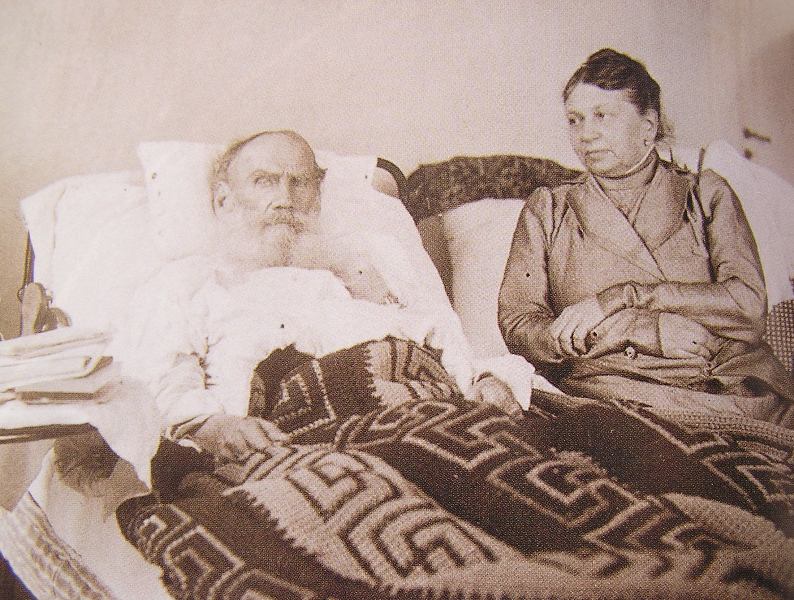
- Tolstoy and Sofia at Gaspra, May 1902 (keystone) — photograph, PD.
visuals/commons-tolstoy-sofia-crimea-1902.jpg. - The Panina estate at Gaspra — photograph by Sherer, Nabgolts & Co., 1911, PD. The composition site.
visuals/commons-gaspra-house-1901-1902.jpg. - Tolstoy and Chekhov at the Panina dacha, 1901 — photograph by P. A. Sergenko, PD. The 29 Nov 1901 diary notes Gorky and Chekhov visited.
visuals/commons-tolstoy-chekhov-yalta-1901.jpg. - Tolstoy, formal portrait, 1901 — Scherer & Nabholz, Moscow, PD. The year of the excommunication.
visuals/commons-tolstoy-scherer-nabholz-1901.jpg. - Vladimir Chertkov and Tolstoy, 1909 — photograph, PD. The publisher relationship.
visuals/commons-chertkov-tolstoy-1909.jpg. - Vladimir Chertkov, portrait by Repin, 1890s — oil study, PD. Individual likeness.
visuals/commons-chertkov-portrait-repin-1890s.jpg. - Pavel Biryukov, 1916 — photograph, PD. The French co-translator; completion correspondent.
visuals/commons-biryukov-1916.jpg. - Konstantin Pobedonostsev, study by Repin, 1903 — oil study, PD. Ober-Procurator of the Holy Synod who drove the excommunication decree; contextual to the reception frame, not named in the treatise.
visuals/commons-pobedonostsev-repin-1903.jpg.
Method
A corpus-dive (work-dive) run on 2026-06-07, continued across two sessions following context exhaustion.
- Scope. Subject: the single work Что такое религия и в чём сущность её? (PSS Tom 35, pp. 157–198). Slug
1901-1902-what-is-religion(composition window Aug 1901 – Jan 1902; conceptual genesis Nov 1900). Corpus surface: PSS Tom 35 (main text + editorial apparatus: history of writing, manuscript description), PSS Tom 54 (diaries 1900–1901 + notebook 1900–1901), PSS Tom 73 (letters to correspondents 1901–1902), PSS Tom 88 (letters to Chertkov 1901). - Extraction.
python3 docs/research/lib/extract_tei.py <xml> --choice=regon all pre-1918 texts. Pre-reform<choice><orig>/<reg>pairs resolved to modern orthography throughout. - Visual sweep. Wikimedia Commons API (
generator=search+prop=imageinfo&iiprop=url|extmetadata); eight public-domain images downloaded into the git-ignoredvisuals/cache and catalogued indossier.yaml → visualswith a per-image licence; items not openly available (Free Word imprint scans, manuscript facsimiles) are noted for later request. - Verification.
python3 docs/research/lib/verify_quotes.py dossier.yaml(mechanical byte-fidelity gate) before a separate verifier pass. - Voice. Simple, factual, minimal editorial; working-English translations labelled; mainstream scholarship attributed as a foil, never asserted as baseline.
References
Primary (tolstoydigital TEI corpus, PSS Toms 35, 54, 73, 88)
- Что такое религия и в чём сущность её? —
v35_157_198_Chto_takoe_religiya(main text, PSS T. 35, pp. 157–198). - V. S. Mishin, История писания и печатания —
extracts/v35_670_675_history.txt(PSS T. 35, pp. 670–675, editorial). - Manuscript description —
extracts/v35_675_676_primechanija.txt(PSS T. 35, pp. 675–676, editorial). - Diaries 1900–1901 —
v54_053_054_1900_11_07,v54_086_089_1901_02_08,v54_089_090_1901_02_11,v54_110_112_1901_10_10,v54_113_115_1901_11_29,v54_115_115_1901_12_01,v54_115_117_1901_12_26. - Notebook 1900–1901 —
v54_211_240_Zapisnaja_knizhka(French-language выписки for chapter II survey). - Letters Tom 73 —
v73_146,v73_151,v73_154,v73_160,v73_162,v73_170,v73_181,v73_187,v73_197,v73_202,v73_206,v73_209,v73_406. - Letters Tom 88 —
v88_636_avgusta12,v88_637_sentyabrya14,v88_641_noyabrya6,v88_644_noyabrya30.
Background (secondary scholarship)
- Maude, Aylmer. The Life of Tolstoy: Later Years. London: Oxford University Press, 1911.
- Bartlett, Rosamund. Tolstoy: A Russian Life. London: Profile Books, 2010.
- Simmons, Ernest J. Introduction to Tolstoy’s Writings. Chicago: University of Chicago Press, 1968. Chapter 7 (Tolstoy’s Religious, Moral, and Didactic Writings). https://www.ourcivilisation.com/smartboard/shop/smmnsej/tolstoy/chap7.htm
- Moulin, Daniel. “Tolstoy, Universalism and the World Religions.” Journal of Ecclesiastical History 68, no. 3 (2017): 570–587. https://doi.org/10.1017/S0022046916001469
A draft dev-blog note accompanies this dive: see website/src/posts/notes/2026-06-07-what-is-religion.md (draft: true).