A single-work corpus dive on Tolstoy’s aesthetics treatise What Is Art? (Что такое искусство?), written 1897–1898. It reads the treatise from its own text in the tolstoydigital TEI corpus (PSS Tom 30), reconstructs its long gestation and agonised composition from the Jubilee-Edition editorial commentary and the 1896–1898 diaries and letters, and maps its central manoeuvre — the survey-and-demolition of Western aesthetics — against the philosophers Tolstoy catalogues. The keystone is the preface Tolstoy wrote for the English edition, in which he tells how the Russian censor mangled the book.
The dive prepares ingestion-ready material (this index.md, a machine-readable dossier.yaml, byte-faithful extracts/, and a draft dev-blog note). It does not create vault pages; it plans them.
Key findings
- The treatise redefines art away from beauty. Tolstoy rejects красота (beauty) — which he equates with pleasure — as the criterion of art (Chs III–VI), and replaces it with “infection” (заражение): art is the transmission of a felt feeling from one person to others, who are “infected” by it (Ch V). This is his single positive definition, and заразительность (infectiousness) is its one test (Ch XV).
- “Good” art is judged by a second, religious criterion. Infection makes something art; the religious consciousness of the age — for Tolstoy’s time, the brotherhood and loving union of all people — makes it good art (Ch XVI). Good art is of two kinds: religious (love of God and neighbour) and universal (the simplest feelings common to everyone).
- Most of European high culture is condemned as “counterfeit.” Four devices — borrowing, imitation, strikingness, and interest (Ch XI) — fabricate the semblance of art without feeling. By this measure Tolstoy convicts Wagner’s Ring as the model counterfeit (Ch XIII), Beethoven’s Ninth Symphony as bad art (Ch XVI), the French Decadents (Baudelaire, Verlaine, Mallarmé) (Ch X), and much of Dante, Shakespeare, Goethe, and Raphael.
- Tolstoy condemns his own novels too. In a footnote he assigns his own artistic works “to the domain of bad art,” excepting only the two short stories God Sees the Truth, But Waits and A Prisoner of the Caucasus.
- The treatise is the culmination of a 16-year gestation. A cycle of art-essays (1882–1896) and the 1894 Maupassant preface are its preparatory stages; the treatise proper was begun in January 1897 and reduced from 40-odd chapters to twenty across a year of intense, often despairing revision, helped by V. V. Stasov (bibliography, the Decadent journal Pan) and the proof-checker V. F. Lazursky.
- Every Russian edition in Tolstoy’s lifetime was censored. The editor N. Ya. Grot softened wordings to pass the secular censor; the spiritual censor then cut whole passages and inserted the redemption dogma Tolstoy rejected. The first complete, uncensored text was Aylmer Maude’s English translation (1898). This contradicts the work record’s stub (
publishedInRussiaDuringLifetime: false): a censored Russian text was published in his lifetime (the journal serial 1897–1898; S. A. Tolstaya’s Collected Works, April 1898). - The book is a juxtaposition machine. Its spine (Chs III–V) catalogues ~70 definitions of beauty/art from Baumgarten onward in order to reject them. The dive’s centrepiece is a concept/philosopher map showing where Tolstoy summarises a thinker faithfully (Baumgarten, Schelling, Hegel, Véron) and where he flattens or caricatures one (Kant, Schopenhauer, Helmholtz, Nietzsche, Guyau — his nearest unacknowledged predecessor).
Why this matters
What Is Art? is Tolstoy’s fullest statement of the aesthetic theory that his post-1880 conversion made unavoidable: if a life must be justified morally, so must art. It is the text in which he draws the line through his own career, putting War and Peace and Anna Karenina on the far side of it. It is also his most-read work of theory in the West — almost entirely through Maude’s translation — and one of the few places where a major novelist sets out a complete, combative philosophy of art. For this project it sits at the centre of the Prophet-period cluster: the religious consciousness that grounds “good art” here is the one worked out in What I Believe and The Kingdom of God Is Within You, and the “art as transmission of religious feeling” thesis overlaps the fire-metaphor dive.
Genesis & composition
(The composition narrative below is drawn from N. K. Gudzy’s editorial history of writing and printing in PSS Tom 30, comments/v30_509_555, and from the 1896–1898 diaries and letters. Editorial commentary is attributed; Tolstoy’s own words are cited from the diary/letter extracts.)
The treatise was the last and largest stage of a project Tolstoy had circled for fifteen years. Gudzy’s history opens by stating the frame plainly:
Весь цикл статей Толстого об искусстве, начиная с первой статьи 1882 года и кончая статьей 1896 года, следует рассматривать как подготовительные этапы к трактату «Что такое искусство?».
(working English) The whole cycle of Tolstoy’s articles on art, beginning with the first article of 1882 and ending with the article of 1896, should be regarded as preparatory stages to the treatise What Is Art?
N. K. Gudzy, history of writing & printing, PSS Tom 30, comments/v30_509_555 (editorial).
Tolstoy began the treatise proper in early January 1897. He reported it to P. I. Birukoff on 11 January 1897, and the work went badly at first; he complained to Chertkov on 12 January 1897 that the work was “ученая и не захватывающая” (scholarly and not gripping — see the evidence ledger). Across 1897 he read widely in aesthetics — by the commentary’s account some seventy extracts from the sources he surveyed, and Chekhov, in a letter to A. I. Ertel of 17 April 1897 quoted in Gudzy’s history, reported that Tolstoy had “read sixty books on art” — cut the manuscript from more than forty chapters down to twenty, and revised so heavily that his wife and daughter Tatyana recopied chapters again and again. He noted “Вижу конец в статье об искусстве” (“I see the end of the article on art”) on 15 March 1897, then kept finding it unfinished for another year. The final journal proofs were corrected through February 1898.
The composition-window diaries and letters (1896–1898) record an unusual ambivalence. To Chertkov, his most intimate correspondent, Tolstoy confided on 12 January 1897 that the treatise was not the kind of work that sustained him:
нет того, что спасало прежде: напряженной, увлекающей, поглощающей работы. Пишу об искусстве, но эта работа отчасти, особенно теперь, ученая и не захватывающая, а на другие работы нет энергии.
(working English) Gone is what used to save me: intense, gripping, absorbing work. I am writing about art, but this work is partly — especially now — scholarly and not engaging, and I have no energy for other work.
To V. G. Chertkov, 12 January 1897 · TEI v88_431.
By July 1897 the book held him against his own judgement of its worth:
Иногда мне кажется, что очень хорошо, но чаще кажется, что ничтожно, что я не имею права свои последние силы класть на такое неважное дело, хочется делать другое, а не могу оторваться от этого.
(working English) Sometimes it seems to me very good, but more often it seems trivial, that I have no right to lay my last strength on such an unimportant matter; I want to do something else, but cannot tear myself away.
To V. G. Chertkov, 12 July 1897 · TEI v88_455.
The diaries trace the same arc — “Пишу об искусстве плохо” (I am writing about art badly, 4 Feb 1897), “запутался” (got muddled, 4 Apr 1897), three separate “кажется, кончил” (“it seems I have finished,” Nov–Dec 1897, each followed by more revision), and at the last stage “исправлял и дополнял и портил последние главы” (correcting, adding to, and spoiling the last chapters, 19 Feb 1898). The rawest formulation of the treatise’s thesis first surfaces in that same February diary note: “Наше искусство… не только похоже на проституцию, но есть не что иное, как проституция” (Our art… is not merely similar to prostitution — it is nothing other than prostitution).
The people around the work
- V. V. Stasov (major) — critic at the St Petersburg Public Library who supplied Tolstoy the aesthetics bibliography he then demolishes. Across 1896–1898 Tolstoy repeatedly asks him for books (Bénard on Aristotle, a book on Plato’s aesthetics, the German Aesthetische Zeitfragen) and apologises for holding them so long: “так совестно, что держу еще ваши книги” (
v70_157, 3 Sep 1897). They disagreed fundamentally — Stasov defended high culture, Tolstoy was dismantling it — and Tolstoy recorded a January 1898 visit as a “глупый разговор об искусстве” (a stupid conversation about art,v53_176_176), yet Stasov supplied the materials regardless. - N. Ya. Grot (major) — editor of Вопросы философии и психологии, who published the censored Russian serial. Tolstoy instructs him to begin typesetting (10 Nov 1897), coordinates chapter dispatch against Maude’s translation (
v70_237, 28 Nov 1897), records a “нелепое раздраженное письмо от Грота” (a senseless, irritated letter from Grot, 2 Dec 1897), and goes in person to his editorial office to restore an omitted passage on the Trinity (3 Feb 1898). - Aylmer Maude (major; “Алексей Францович” / Эйлмер Моод) — the English translator. Tolstoy actively chose him over Chertkov’s preferred arrangement (
v70_158, 3 Sep 1897), then worked through his translation queries page by page (Kant, Hegel, “народное искусство,” Kaspar Hauser), praising his care: “вы делаете этот перевод с большим вниманием” (v70_206). It was to Maude that he confirmed the title change from Об искусстве to Что такое искусство? (v70_244). - V. G. Chertkov (major) — in English exile from 1897; the channel that made the complete, uncensored text possible, and the recipient of Tolstoy’s most candid composition letters and of the draft censorship preface (
v88_476, 27 Dec 1897). - Sofia Tolstaya (supporting) — copyist during the October 1897 Yasnaya Polyana revision: “Она переписывает. Очень помогает” (
v53_152_157). - N. N. Strakhov (peripheral) — a long-standing earlier art-philosophy interlocutor whose death in January 1896 closed that channel just as the writing began; a January 1896 letter (
v69_009) already shows the anti-Shakespeare strand active. S. I. Taneyev the composer (frequently named as a music-as-art presence at Yasnaya Polyana) appears only once in passing in this corpus window; the “А. С. Танеев” letters are to a court official, not the composer, and concern other matters — so the dive does not assert a treatise tie. A. Ya. Garkavi (peripheral) supplied Oriental-language aesthetics material through Stasov.
What the work says
A structural map of the treatise’s keystone passages, read chapter by chapter from its own text (works/v30_027_203, PSS Tom 30, pp. 27–203). The treatise moves in blocks: I–II indict the human cost of “art”; III–IV survey and reject the aesthetics of beauty; V gives the positive definition; VI–IX narrate how upper-class unbelief replaced the religious criterion with pleasure; X–XIII anatomise upper-class “bad art”; XIV–XV restate the infection-test; XVI–XVII define good art; XVIII–XX bind art to religion and science.
1 — The definition: art as the “infection” of feeling (Ch V)
Искусство есть деятельность человеческая, состоящая в том, что один человек сознательно известными внешними знаками передает другим испытываемые им чувства, а другие люди заражаются этими чувствами и переживают их.
(working English) Art is a human activity consisting in this, that one person consciously, by certain external signs, transmits to others feelings he has lived through, and other people are infected by these feelings and also experience them.
Chapter V · PSS Tom 30 · TEI v30_027_203.
2 — The rejection of beauty as the criterion (Ch IV)
Точно так же и красота, или то, что нам нравится, никак не может служить основанием определения искусства, и ряд предметов, доставляющих нам удовольствие, никак не может быть образцом того, чем должно быть искусство.
(working English) In just the same way beauty, or that which pleases us, can in no way serve as the basis for a definition of art, and a series of objects that give us pleasure can in no way be a model of what art ought to be.
Chapter IV · PSS Tom 30 · TEI v30_027_203.
Beauty, Tolstoy argues, is not merely a wrong definition but the wrong kind of criterion — it names our enjoyment, not the activity. In Chapter VI he presses the point to its sharpest form:
Понятие красоты не только не совпадает с добром, но скорее противоположно ему... Чем больше мы отдаемся красоте, тем больше мы удаляемся от добра.
(working English) The concept of beauty not only does not coincide with the good, but is rather opposed to it... The more we give ourselves to beauty, the further we move from the good.
Chapter VI · PSS Tom 30 · TEI v30_027_203.
3 — The test of real art: infectiousness (Ch XV)
Признак, выделяющий настоящее искусство от поддельного, есть один несомненный — заразительность искусства.
(working English) The one indubitable sign distinguishing real art from counterfeit is the infectiousness of art.
Chapter XV · PSS Tom 30 · TEI v30_027_203. — and the strongest of its three conditions (особенность, ясность, искренность) is sincerity: the receiver must feel that the artist made the work for himself, not to act upon others.
4 — The four counterfeits of art (Ch XI)
Приемы эти следующие: 1) заимствование, 2) подражательность, 3) поразительность и 4) занимательность.
(working English) These techniques are the following: (1) borrowing, (2) imitativeness, (3) strikingness [/effect], and (4) interest [/diversion].
Chapter XI · PSS Tom 30 · TEI v30_027_203.
5 — The criterion of good art: the religious consciousness of the age (Ch XVI)
Религиозное сознание нашего времени в самом общем практическом приложении его есть сознание того, что наше благо, и материальное и духовное, и отдельное и общее, и временное и вечное, заключается в братской жизни всех людей, в любовном единении нашем между собой.
(working English) The religious consciousness of our time, in its most general practical application, is the consciousness that our good — material and spiritual, individual and common, temporal and eternal — lies in the brotherly life of all people, in our loving union with one another.
Chapter XVI · PSS Tom 30 · TEI v30_027_203.
Good art is therefore of two kinds — religious (the feelings flowing from this consciousness) and universal (the simplest everyday feelings accessible to all). Only these two count as good art “в наше время” (in our time).
6 — The verdicts: Wagner, the Decadents, Beethoven
Wagner’s Ring is enthroned as the model counterfeit (Ch XIII):
И вот бессмысленное, грубое, фальшивое произведение, не имеющее ничего общего с искусством, благодаря мастерству подделки под искусство, обходит весь мир, стоит миллионы своей постановкой и всё более и более извращает вкусы людей высших классов и их понятие о том, что есть искусство.
(working English) And so a senseless, crude, false work, having nothing in common with art, thanks to the mastery of its counterfeiting of art, travels round the whole world, costs millions to stage, and more and more perverts the tastes of the upper classes and their notion of what art is.
Chapter XIII · PSS Tom 30 · TEI v30_027_203.
And Beethoven’s Ninth Symphony fails the universality test (Ch XVI):
«Как, девятая симфония принадлежит к дурному роду искусства?!» слышу я возмущенные голоса. «Без всякого сомнения», отвечаю я.
(working English) “What, the Ninth Symphony belongs to the bad kind of art?!” I hear indignant voices. “Without any doubt,” I answer.
Chapter XVI · PSS Tom 30 · TEI v30_027_203.
7 — Tolstoy condemns his own art (footnote, Ch XVI)
In a footnote — stripped by the standard TEI extractor and recovered here from the raw XML (extracts/v30_027_203_notes.txt) — Tolstoy turns the criterion on himself:
При этом еще должен заметить, что свои художественные произведения я причисляю к области дурного искусства, за исключением рассказа «Бог правду видит», желающего принадлежать к первому роду, и «Кавказского пленника», принадлежащего ко второму.
(working English) I must also note that I assign my own artistic works to the domain of bad art, with the exception of the story God Sees the Truth [But Waits], which wishes to belong to the first kind, and A Prisoner of the Caucasus, which belongs to the second.
Footnote to Chapter XVI · PSS Tom 30 · TEI v30_027_203 (note apparatus).
8 — Examples of good art (Ch XVI)
Tolstoy’s positive canon is strikingly narrow: in literature Schiller’s Die Räuber, Hugo’s Les pauvres gens and Les Misérables, Dickens, Uncle Tom’s Cabin, Dostoevsky’s House of the Dead, George Eliot’s Adam Bede; in painting Millet, and Ge’s (Гe’s) religious canvases; in music almost nothing of the “great” repertoire — folk songs of all peoples, Bach’s violin aria, a Chopin nocturne, and “perhaps a dozen” passages from Haydn, Mozart, Beethoven, Chopin.
Mainstream aesthetics vs Tolstoy — the concept/philosopher map
The treatise’s spine (Chs III–V) is a survey-and-demolition: Tolstoy catalogues the European aesthetic tradition in order to clear the ground for his own definition. The table below juxtaposes, for each thinker or concept, the received reading (the scholarly-consensus understanding, offered as an attributed foil — not a truth Tolstoy “got wrong”) against Tolstoy’s own rendering and verdict (cited verbatim from the treatise), plus a judgement of whether he summarises faithfully or flattens. The primary source leads; the mainstream column is the contrast to read it against. (Full quotes and per-row analysis: extracts/_concept_map.md.)
| Thinker / concept | Received reading (attributed foil) | Tolstoy’s rendering & verdict (Ch) | Faithful or flattened? |
|---|---|---|---|
| Baumgarten (coined “aesthetics”) | Founded aesthetica (1750) as the science of sensory cognition; beauty = perfection of sensible knowledge. | Beauty “cognized by feeling”; the founding error that installs beauty + the triad Truth–Beauty–Good (III). | Faithful précis, but framed as pedantic class-flattery. |
| Kant (most-cited) | The judgement of taste rests on disinterested pleasure — “purposiveness without purpose,” free of desire. | Rates Kant the clearest, then re-reads “pleasure without desire” as merely what pleases us (III–IV). | Flattened — turns disinterestedness into hedonism, the very move Kant built it to block. |
| Schelling | Art as the organon of philosophy; beauty = the infinite in finite form. | “Unconscious infinity”; filed as objective-mystical, foggy (III–IV). | Faithful summary, dismissed by category. |
| Hegel | Beauty = the sensuous shining-forth of the Idea; art with religion and philosophy. | Renders Schein and the triad correctly; “the most fog-bound” yet still ruling (III). | Faithful content, dismissive treatment. |
| Schopenhauer | Aesthetic contemplation = will-less perception of Ideas, release from the Will; music copies the Will. | One-line objectification scheme; the music-as-Will doctrine “нелепый” (absurd), by association with Wagner (III, XIII). | Flattened — drops the release-from-Will core. |
| Guyau (“art as expansion of life”) | Sociological aesthetics: art expands life, widens shared feeling — an anticipation of Tolstoy’s own thesis. | Admired (“raises man from personal to universal life by shared feeling”) yet filed under beauty-as-pleasure for admitting cookery/perfume (II–III). | Partly flattened — caricatures the sensory edge while absorbing the communication core; his nearest unacknowledged predecessor. |
| Spencer / Darwin / Helmholtz / Grant Allen (the empirical school) | Play/surplus-energy (Spencer); sexual selection (Darwin); acoustic law (Helmholtz) — beauty made scientific. | Play “explains origin not essence” (V); Helmholtz glossed as “laws unknown to the artist… cannot be analysed” (III). | Spencer/Darwin faithful; Helmholtz inverted into a mystic of the unconscious. |
| Véron | L’esthétique (1878): art = expression of emotion; drops “absolute beauty.” | Singled out as the clear-headed exception; still “неточно” because one can express without infecting (III, V). | Faithful and sympathetic — the least flattened; Tolstoy patches Véron’s gap with infection. |
| Nietzsche | Apollonian/Dionysian; art as the justification of existence; a critique of herd morality. | No aesthetic summary at all — invoked only as patron of the “сверх-человеки” elite and “пророк” of the immoralists (VIII, XVII). | Flattened to a label — a bogeyman, not a thinker engaged. |
| Wagner (33 mentions) | The Gesamtkunstwerk fuses music, poetry, drama; the Ring and leitmotif are landmarks. | The museum specimen of counterfeit: all four counterfeit-devices “with such mastery”; hypnotism, not art (XIII). | Flattened / hostile — convicted by the infection-criterion, not by engagement with the music. |
| Baudelaire (14) | Les Fleurs du mal reshaped modern verse; artifice, correspondances, the modern city. | Chief Decadent exhibit: “crude egoism elevated into a theory,” beauty “necessarily artificial” (X). | Flattened / hostile — the artifice creed read as moral degeneracy. |
| красота / beauty | A distinctive value of aesthetic judgement, not reducible to liking. | “Beauty is nothing other than what pleases us” — defined downward, then rejected (VI). | The decisive but question-begging pivot: every richer account is pre-collapsed into “liking.” |
| заражение / infection | Tolstoy’s original contribution — the communication/expression theory of art. | The positive definition (V); заразительность the one test (XV). | Tolstoy’s own; its weakness (infectiousness is itself subjective) mirrors the “liking” he condemns. |
| религиозное сознание / religious consciousness | The second-tier test: good art transmits the highest religious feeling of an age. | Determines the worth of what is infected (VI, XVI). | Tolstoy’s own normative lever — lets him rank Beethoven, the Ring, Fleurs du mal as bad even where infectious. |
The pattern: Tolstoy is most accurate on the writers nearest his own conclusion (Véron, Guyau, Baumgarten’s scheme) and most distorting on those whose autonomy of the aesthetic most threatens his moral criterion (Kant, Schopenhauer, Helmholtz, Nietzsche). The catalogue exists to be cleared away.
Redactions & textual history
The treatise sits atop a long sediment of abandoned art-essays, all preserved in PSS Tom 30 and extracted for this dive:
- 1882 — Письмо к Н. А. Александрову (
works/v30_209_212), the first printed expression of Tolstoy’s views on art, prompted by conversations at the Moscow School of Painting (with the painters Perov and Pryanishnikov). - 1889 — Об искусстве (
works/v30_213_215), dictated to V. A. Goltsev for a public lecture “О прекрасном в искусстве.” - 1890s — a sequence of attempts: О том, что есть и чего нет искусство… (
v30_216_225), Об искусстве. В мире так называемых образованных людей (v30_226_230), Наука и искусство (v30_231_239), О науке и искусстве (v30_240_242), and the substantial 1896 О том, что называют искусством (v30_243_270). - 1894 — the Maupassant preface (
works/v30_003_024), the treatise’s true “вступительная часть” (introductory part). It already formulates the criterion the treatise will refine — the three conditions of a true work of art:
Из этих трех условий: 1) правильного, т. е. нравственного, отношения автора к предмету, 2) ясности изложения или красоты формы, что одно и то же, и 3) искренности, т. е. непритворного чувства любви или ненависти к тому, что изображает художник, из этих трех условий Мопассан обладал только двумя последними и был совершенно лишен первого.
(working English) Of these three conditions — (1) a correct, i.e. moral, relation of the author to his subject, (2) clarity of exposition, or beauty of form, which is the same thing, and (3) sincerity, i.e. an unfeigned feeling of love or hatred for what the artist depicts — of these three conditions Maupassant possessed only the last two and was entirely without the first.
Preface to Maupassant (1894) · PSS Tom 30 · TEI v30_003_024.
The shift from 1894 to 1898 is the dive’s textual-history point: the Maupassant preface still measures art by a moral relation + beauty of form + sincerity; the treatise drops “beauty of form” as a criterion entirely and relocates the centre to infection. The treatise’s own variant drafts survive as works/v30_303_426_…_Varianty; Gudzy’s manuscript description (comments/v30_555_570) and textological commentary (comments/v30_571_582) trace the chapter-by-chapter compression from 40-odd chapters to twenty.
Publication, censorship & translation
This is the keystone of the dive. Tolstoy had resolved not to submit his writing to the censorship; he meant to publish the treatise abroad first, in English. But Grot, editor of the Moscow journal Вопросы философии и психологии (Questions of Philosophy and Psychology), pressed him to give it to the journal and promised to carry it through the censorship intact. Tolstoy, in his own words from the preface to the English edition (the famous one), “имел слабость согласиться” — had the weakness to agree. The result he tells in full:
Книга эта моя «Что такое искусство?» выходит теперь в первый раз в ее настоящем виде. Она вышла в России в нескольких изданиях, но во всех в таком изуродованном цензурою виде, что я прошу всех тех, кого интересуют мои взгляды на искусство, судить о них только по книге в ее настоящем виде.
(working English) This book of mine, What Is Art?, now comes out for the first time in its true form. It came out in Russia in several editions, but in all of them in a form so mangled by the censorship that I ask all those interested in my views on art to judge them only by the book in its true form.
Preface to the English edition · PSS Tom 30 · TEI v30_204_206.
The mangling came in two stages. First Grot softened the wording:
Сначала Грот смягчал мои выражения, иногда ослабляя их, напр. заменял слова «всегда» — словами «иногда»; слова «все» — словами «некоторые»; слово «церковное» — словом «католическое»; слово «богородица» — словом «мадонна»; слово «патриотизм» — словом «лжепатриотизм»; слово «дворцы» — словом «палаты» и т. п.
(working English) At first Grot softened my expressions, sometimes weakening them — e.g. he replaced the word “always” with “sometimes”; “all” with “some”; “ecclesiastical/church” with “Catholic”; “the Mother of God” with “the Madonna”; “patriotism” with “false patriotism”; “palaces” with “mansions,” and so on.
Preface to the English edition · PSS Tom 30 · TEI v30_204_206.
Then, after the book was arrested and handed to the spiritual censorship, the cuts became substantive — and an alien doctrine was put in Tolstoy’s mouth:
…там, где я говорю о Христе, шедшем на крест за исповедуемую им истину, цензор вычеркнул это и поставил «за род человеческий», т. е. приписал мне таким образом утверждение догмата искупления, который я считаю одним из самых неверных и вредных церковных догматов.
(working English) …where I speak of Christ going to the cross for the truth he professed, the censor struck this out and put “for the human race” — thus ascribing to me an affirmation of the dogma of redemption, which I consider one of the most false and harmful of the church’s dogmas.
Preface to the English edition · PSS Tom 30 · TEI v30_204_206.
Tolstoy frames the whole episode as a moral exhibit, not a literary grievance:
Я так подробно рассказал всю эту историю потому, что она поразительно иллюстрирует ту несомненную истину, что всякий компромисс с учреждением, не согласным с вашей совестью… неизбежно затягивает вас, вместо пользы… в участие в том вреде, который производит это учреждение.
(working English) I have told this whole story in such detail because it strikingly illustrates the indubitable truth that any compromise with an institution not in accord with your conscience… inevitably drags you, instead of into benefit… into participation in the harm that institution produces.
Preface to the English edition · PSS Tom 30 · TEI v30_204_206.
The publication sequence (from Gudzy’s history, comments/v30_509_555):
- Russia, journal. The first five chapters appeared in Вопросы философии и психологии No. 5 (Nov–Dec 1897, out at the end of December 1897); the remaining chapters in Book 1 (Jan–Feb 1898), which was sent to the spiritual censorship, heavily cut, and released on 17 March 1898.
- England, first complete text. Aylmer Maude’s translation, What Is Art?, appeared from the Brotherhood Publishing Co. as a supplement to the journal The New Order in three instalments — chapters I–IX (January 1898), X–XIV (March 1898), XV–XX (May 1898). This was the first complete, uncensored text.
- Russia, book. The treatise then appeared in the 15th part of S. A. Tolstaya’s Collected Works (Kushnerev, early April 1898), also censored; the Posrednik edition (Moscow 1898) is closest to her text. The fullest Russian texts of his lifetime are S. A. Tolstaya’s 1911 edition (which restored many censored passages) and Biryukov’s 1913 edition in Sytin’s Collected Works.
- The preface itself was first published in the collection Свободное слово No. 1 (Chertkov’s Free Word Press, Purleigh 1898).
Work-record correction. The stub record marks both publishedDuringLifetime and publishedInRussiaDuringLifetime as false. The first is clearly true (Maude’s English, the journal serial). The second is also true in the sense the schema defines (legally published in Russia before 1910) — though only ever in censored form. The dive proposes both as true, with a censoredVersionExists: true flag and a note (see dossier.yaml → workRecord).
Reception & afterlife
Russia first
The Russian reception was crippled before the book could be read on its own terms: the only text available in Russia was the censored serial, which Tolstoy publicly disowned in his preface, directing readers to the English edition. The PSS editorial apparatus (Tom 30, pp. 487–582) documents the full censorship history.
A point worth stating carefully, against a common assumption: there is little evidence of a distinct church reaction to this work. The 1901 Holy Synod act declaring Tolstoy fallen away from the Church was driven by Resurrection (1899) and the cumulative weight of his religious treatises (A Confession, What I Believe, The Kingdom of God Is Within You); the surviving decree names no specific works, and no secondary source consulted treats the aesthetics treatise as a driver of it (Wikisource, Decree of Excommunication, 1901). What is documented is the spiritual censor’s mutilation of the text — a censorship-bureaucracy episode, not a mobilisation of the Church against the theory. The dive does not overstate it.
The sharpest Russian engagement came from the milieu Tolstoy attacked. The Symbolists and Decadents answered with their own defence of art’s autonomy from moral imperatives: Valery Bryusov’s essay “On Art” (1899) and, comparatively, Dmitry Merezhkovsky’s L. Tolstoy and Dostoevsky (serialised 1900–01 in Мир искусства), which reads Tolstoy as the artist of “earthly” truth against Dostoevsky’s spiritual depths — implicitly rejecting the reduction of art to moral infection. The Мир искусства movement (Diaghilev, Benois, 1898–1904) institutionalised the art-for-art’s-sake counter-position in the same years; a documented direct response to the treatise from that circle was not recovered (needsReview). V. V. Stasov, who had supplied the bibliography, shared Tolstoy’s hostility to Western “decadence” but not his condemnation of Beethoven and Wagner; his reaction to the published text is not in the letters recovered here, and would need an archival check of his 1898–1900 criticism (needsReview).
Then the West
Maude’s translation, the first complete text in any language, made What Is Art? Tolstoy’s most-read aesthetics work in the West. Contemporary reviews split sharply, and the dive reports them as attributed opinion, not verdict: Émile Faguet (France, 1898) dismissed it as the work of “an opinionated, impassioned moralist… a narrow-minded man”; Rilke called it “a disgraceful and silly pamphlet”; George Bernard Shaw (Daily Chronicle, 1898) called it “a most effective booby trap” — qualified praise he later cooled into “the inevitable obsolescence of an old man’s taste in art”; the drama critic A. B. Walkley called it “a literary event of the first importance.” William B. Edgerton’s “The Critical Reception Abroad of Tolstoy’s What Is Art?” (1978) surveys the episode (not retrieved in full). The work’s durable Western afterlife has been as the canonical classroom example of an expression/transmission theory of art — a teaching text and a provocation more than a thesis widely defended.
Scholarly context
The scholarly consensus treats What Is Art? as philosophically serious but flawed. Aesthetics handbooks classify it as a version of the expression theory — more precisely a transmission theory, distinct from Collingwood (1938) in insisting that the completed outward transmission to an audience is constitutive of art. Gary R. Jahn (1975) gives the most technical critique — that the central term “emotion” is never adequately defined and the religious/universal/counterfeit categorisation is “often confusing.” John Bayley (1986) offers the standard respectful-negative line: the treatise’s force “lies not so much in its positive assertions as in its rejection of much that was taken for granted.” Aylmer Maude — translator, friend, biographer — is the warmest major voice, calling it “probably the most masterly of all Tolstoy’s works”; Rimvydas Šilbajoris (Tolstoy’s Aesthetics and His Art, 1991) mounts the most sustained sympathetic case, arguing the aesthetic views are consistent across Tolstoy’s whole career and embodied in the novels; H. O. Mounce (2001) frames the treatise as a principled, Plato-like denial of the autonomy of art rather than a naïve error.
Where the corpus evidence meets that consensus (full ledger in dossier.yaml → scholarship.triangulation):
- Art as transmission, not beauty — confirms. The least-contested reading; no source dissents from the description (Jahn 1975; Šilbajoris 1991; Mounce 2001), though Jahn faults the under-defined “emotion.”
- Good art = the religious consciousness of the age; the two kinds; the counterfeits — complicates. Jahn reads the scheme as internally confused (it conflates moral and aesthetic “good”); Šilbajoris defends it as coherent once read alongside the fiction; Mounce treats the denial of aesthetic autonomy as the point, not a flaw.
- The condemnation of high culture and of his own novels — confirms, with a caution. Every source registers the dismissals of Wagner, Beethoven, Shakespeare and of War and Peace / Anna Karenina as the book’s most provocative feature, and the mainstream (Bayley; Simmons) tends to read them as moralistic excess. But here the dive’s voice-rule bites: those condemnations are not arbitrary — they follow rigorously from the infection-criterion, and scholarship that calls them “arbitrary” is largely judging by the very beauty-criterion Tolstoy rejects. Šilbajoris (1991) makes the same point — the self-condemnation is the theory’s logic, not a spasm of self-flagellation.
- The long gestation; ~70 sources; Stasov’s bibliography — confirms / extends. The PSS correspondence in this dive (
v70_145,v70_157) supplies the primary grounding — the Pan journal, the borrowed books — for a collaboration scholarship mentions only thematically. - The censorship and Maude’s first complete text — confirms. Tolstoy’s own preface is the fullest first-person account; Maude’s translation as the first unexpurgated version “in any language” is uncontested.
One genuine gap in the secondary record (flagged, not papered over): the charge that Tolstoy caricatures Kant, Schopenhauer and Helmholtz circulates widely in aesthetics teaching but no single authoritative monograph was found that argues it at length — so the dive’s concept/philosopher map above advances that reading on its own analysis of the primary text, attributed as such, rather than leaning on a scholarly authority (needsReview).
Place in the cluster
What Is Art? is the aesthetics keystone of the Prophet-period cluster:
- What I Believe and The Kingdom of God Is Within You — the “religious consciousness” that grounds good art here is the brotherhood-of-all worked out in those works.
- fire-metaphor — the “infection” thesis (art as transmission of feeling, especially religious feeling) is the aesthetic face of the fire/transmission imagery traced there.
- tolstoy-in-art — the visual record of Tolstoy and his circle (Repin, Ge, Kramskoy). That dive quotes this treatise (
v30_027_203) for Tolstoy’s opinions of specific artists; this dive owns the theory. The two are complementary: cross-link, do not merge. - A Confession, Examination of Dogmatic Theology, What Then Must We Do?, On Life — the surrounding treatises of the same conversion.
The author’s later verdict
The treatise is Tolstoy’s verdict on his own art (the self-condemnation footnote above). Beyond the book, the diaries of the composition window record both his absorption in it and his recurring doubt that it was worth his last strength — “не имею права свои последние силы класть на такое неважное дело” (I have no right to lay my last strength on so unimportant a matter, to Chertkov, 12 July 1897). (Composition-window self-assessments collected in the witness sweep below.)
Material not covered
- The full chapter-by-chapter collation of the censored journal text against the uncensored English — only the headline cuts (the Christ/redemption passage, the Trinity passage in Ch VII, the “art = prostitution” addition to Ch XVIII) are documented here from Gudzy’s commentary.
- A Russian first-edition title-page / manuscript facsimile (the local PSS PDF is the printed 1951 Tom 30, not a first edition); flagged in the visual record.
- The treatise’s reception among the Russian Symbolists/Decadents it attacked, beyond the headline of Stasov’s reaction (see Scholarly context).
- Maude’s own framing in his biography and the translation’s textual history (a
translator/editionfollow-up).
Visual & manuscript record
A light visual sweep (this is a theory dive; the visual record of Tolstoy proper is the separate tolstoy-in-art dive). Five public-domain images were cached locally; full provenance and rights in dossier.yaml → visuals and extracts/_visuals.md.
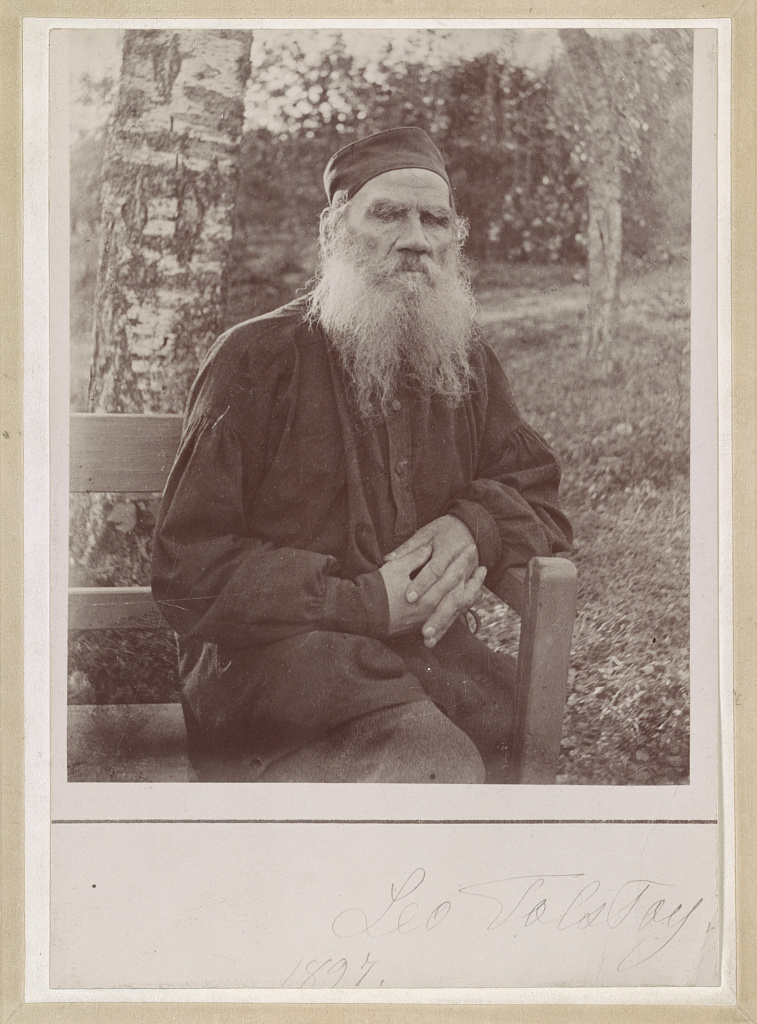
- Tolstoy, 1897 (keystone) — LOC photograph, PD.
visuals/commons-tolstoy-1897.jpg. - V. V. Stasov, Repin’s 1889 portrait — PD. The critic who supplied Tolstoy his aesthetics bibliography.
visuals/commons-stasov-repin-1889.jpg. - S. I. Taneyev — PD photograph (Commons record lacks author metadata; verify before external use).
visuals/commons-taneyev.jpg. - N. Ya. Grot — PD studio photograph. The journal editor of the censored serial.
visuals/commons-grot.jpg. - V. G. Chertkov (1883) — PD; the abroad-publishing channel.
visuals/commons-chertkov.jpg. - Aylmer Maude — a 1919 V&A/Lafayette portrait exists but is CC-BY-SA (not PD); recorded, not cached.
- Gaps (needsReview): a PD Russian first-edition title page (1898); a date-precise Repin/Nesterov painting of Tolstoy from the writing window; a pre-1927 PD photograph of Maude.
Method
A corpus-dive (work-dive) run interactively on 2026-06-07.
- Scope. Subject: the single work What Is Art? Slug
1897-1898-what-is-art(composition window; the 1882–1896 art-essays are preparatory redactions, not the work’s window). Corpus surface: PSS Tom 30 (the treatise, its prefaces, the precursor essays, the variants, and the editorial commentary), plus the 1896–1898 diaries (Tom 53) and letters (Toms 69–71). Scope confirmed in prose from the handoff (_generated/sessions/2026-06-07-what-is-art-dive-scope-handoff.md); no scope picker needed. - Extraction.
python3 ../lib/extract_tei.py <xml> --choice=reg --notes=auto(the--choice=regflag is mandatory for pre-1918 orthography). The famous self-condemnation footnote is an inline<note>thatextract_tei.pystrips; it was recovered byte-faithfully with a one-off helper (extracts/_recover_notes.py→extracts/v30_027_203_notes.txt). Tooling note:extract_tei.pyhas no mode to recover authorial inline footnotes — seedossier.yaml → needsReview. - Sub-steps. Parallel subagents (opus for the deep read, the concept/philosopher map, synthesis; sonnet for the witness sweep, the visual sweep, and the scholarship/reception sweep), each writing a deliverable to
extracts/and returning a confirmation line. - Verification.
python3 ../lib/verify_quotes.py dossier.yaml(mechanical byte-fidelity gate, must exit 0) before a separate opus verifier pass. - Voice. Simple, factual, minimal editorial; working-English translations labelled; foreign titles verbatim; mainstream scholarship attributed as a foil, never asserted as the baseline.
- Links. Sibling dives cross-linked above; the shared extractor is
../lib/extract_tei.py.
References
Primary (tolstoydigital TEI corpus, PSS Tom 30 unless noted)
- Что такое искусство? —
works/v30_027_203(treatise, Chs I–XX + Прибавления). - Предисловие к английскому изданию трактата «Что такое искусство?» —
works/v30_204_206. - Предисловие к сочинениям Гюи де Мопассана (1894) —
works/v30_003_024. - Precursor art-essays 1882–1896 —
works/v30_209_212,v30_213_215,v30_216_225,v30_226_230,v30_231_239,v30_240_242,v30_243_270. - N. K. Gudzy, История писания и печатания статей об искусстве и трактата «Что такое искусство?» —
comments/v30_509_555(editorial history); manuscript descriptioncomments/v30_555_570; textological commentarycomments/v30_571_582. - Diaries (Tom 53, 1896–1898) and letters (Toms 69–71) — see
dossier.yaml → evidencefor the per-file ids.
Background (secondary scholarship)
- Aylmer Maude, Tolstoy on Art and Its Critics (1925) — with G. B. Shaw’s preface; calls the treatise “probably the most masterly of all Tolstoy’s works.”
- Gary R. Jahn, “The Aesthetic Theory of Leo Tolstoy’s What Is Art?”, Journal of Aesthetics and Art Criticism 34 (1975), 59–65.
- Rimvydas Šilbajoris, Tolstoy’s Aesthetics and His Art (Slavica, 1991).
- H. O. Mounce, Tolstoy on Aesthetics: What Is Art? (Routledge, 2001).
- John Bayley, Leo Tolstoy (1986); Ernest J. Simmons, Introduction to Tolstoy’s Writings (1973); G. R. Noyes (1918).
- Valery Bryusov, “On Art” (1899); Dmitry Merezhkovsky, L. Tolstoy and Dostoevsky (1902) — Russian Symbolist counter-positioning.
- William B. Edgerton, “The Critical Reception Abroad of Tolstoy’s What Is Art?” (Indiana University, 1978).
- Tolstoy, Author’s Preface to What Is Art? (English-edition preface), PSS Tom 30.
- Decree of Excommunication of Leo Tolstoy (Holy Synod, 1901), Wikisource.
Full source list with URLs: extracts/_scholarship.md.
A draft dev-blog note accompanies this dive: see website/src/posts/notes/2026-06-07-what-is-art.md (draft: true).