What Then Must We Do? (Так что же нам делать?)
A work-focused dive across the local Tolstoy corpus: the PSS (Jubilee Edition) Tom 25 text and its editorial commentary, the forerunner census appeal «О переписи в Москве», the composition-window diaries (Tom 49, 1882–87) and letters (Toms 63–64), and the project’s prior dives. All Russian quotations are byte-faithful extracts (verified, 21/21); English renderings are working translations; dates are Old Style (Julian) unless noted. Secondary scholarship is attributed, not asserted.
Key findings
- What Then Must We Do? is the economic and social application of the What I Believe ethic — the fourth panel of the Prophet-period project. The bridge is documented in the corpus: in December 1884, finishing one book and printing the next, Tolstoy wrote to V. I. Alekseev «Я теперь печатаю статью (ее не пропустят ) о собственности» (I am now printing an article — it will not be passed — about property).
- Its genesis is a single event: the January 1882 Moscow census, in which Tolstoy volunteered for the Khamovniki ward and confronted the urban poverty of the Lyapinsky night-shelter and the Rzhanov house. He tried to turn the census into an act of organized charity, and the failure of that plan is the book’s emotional engine. The book was begun in early 1882 (not 1884, as the lifetime collected editions dated it) and written stop-start through 1886.
- The argument moves from narrative to a structural verdict. Charity is impossible because the rich man’s money is taken from the very poor he means to help — the keystone image of the rider who will do anything for the man he rides «но только не тем, чтобы слезть с него» (except get off his back). From there: money is a bloodless modern form of slavery, structurally identical to serfdom because it rests on the state’s coercive demand for taxes (illustrated by the Fiji-islands parable); and the «scientific» (Comte/Spencer) organic theory of the division of labour is a fiction dressing up «захват чужого труда» — the seizure of others’ labour — with science now occupying the office the church and philosophy held before it.
- The positive doctrine is bread-labour (хлебный труд): everyone must do physical labour to win their own bread, and specialization is a sacrifice rather than a privilege. Tolstoy credits the idea, by name and against the learned world, to the Siberian exile peasant T. M. Bondarev, and to the sectarian V. K. Sutaev; Henry George’s Progress and Poverty (read in early 1885) reinforced it. The book’s three answers to its own title question are: do not lie to yourself; renounce your supposed privilege and own your guilt; and fulfil the law of labour.
- The contested final chapter assigns the world’s salvation to self-sacrificing mothers, reading the man’s law as labour and the woman’s as childbearing, and attacking the «женский вопрос» (woman question) and contraception. It is the book’s most contested chapter — and the primary record of the family conflict over the book (S. A. Tolstaya objected to its critical naming of family members, not to its argument, and rewrote those passages while she petitioned the censors to print it) complicates the standard “guilt-ridden patriarch” reading.
- Unlike What I Believe, the work was never cleanly banned: serialization was refused at Русская мысль (1885), fragments passed heavily cut in Русское богатство (1885), and the full text appeared only in cut form in the collected works (1886) after Pobedonostsev’s Synod refusal. As with the earlier books, it has no
works/record yet — so this dive doubles as the source-grounded basis for creating it.
Why this matters
What I Believe set the Gospel against the army, the courts and the oath; What Then Must We Do? turns the same ethic on property, money and labour, and so completes the Prophet-period turn from private conversion to a verdict on the whole social order. It is the book in which Tolstoy stops asking what he believes and asks what he must do — and answers that the educated, propertied class to which he belongs lives by consuming the labour of others, that its charity is a way of keeping its seat, and that the only honest response is to get off the man’s back and earn one’s own bread. It is also the most concrete of the early religious works: where A Confession persuades by confession and What I Believe by exegesis, this one persuades by reportage — the census slums, the bank clerks, the night-shelter — before it argues.
The shape of the question
The title is a question Tolstoy says he heard from every side, and the book is his attempt to answer it without lying. It opens not with doctrine but with a move to the city.
Я всю жизнь прожил не в городе. Когда я в 1881 году переехал на житье в Москву, меня удивила городская бедность.
I lived my whole life away from the city. When in 1881 I moved to Moscow to live, the city poverty astonished me. (working English — PSS Tom 25, ch. I)
The crisis crystallizes at the Lyapinsky free night-shelter, where Tolstoy gives away what he has and then goes home to a five-course dinner — and recognizes, as once before at a Paris guillotine, that he is not a spectator of the misery but a participant in it.
есть преступление, не один раз совершенное, но постоянно совершающееся, и что я, с своей роскошью, не только попуститель, но прямой участник его.
[it] is a crime, committed not once but constantly committed, and that I, with my luxury, am not only its condoner but its direct participant. (working English — PSS Tom 25, ch. II)
The forerunner of the whole book is the short appeal Tolstoy printed at the census — «О переписи в Москве» — which already carries the thesis the treatise will build out, that money-charity cannot be the good it pretends to be.
Деньги сами по себе зло. И потому кто дает деньги, тот дает зло.
Money is in itself an evil. And therefore he who gives money gives evil. (working English — «О переписи в Москве», PSS Tom 25)
Genesis & composition
The book has a precise birthday. Tolstoy moved to Moscow in 1881; in January 1882 he volunteered as a census-taker, was assigned the Khamovniki ward around the Rzhanov house, and proposed in print that the census be used for «дело любовного общения богатых… с нищими» — an act of loving contact between the rich and the destitute. The plan collapsed: the rich offered money but would not go into the slums, and Tolstoy came away ashamed. The Jubilee apparatus shows that he began writing almost at once — a first draft titled «О помощи при переписи» — and that the work, usually dated 1884 in his lifetime editions, was in fact begun in early 1882, on the evidence of S. A. Tolstaya’s note to a 4 February 1882 letter («Л. Н. тогда писал статью „Так что же нам делать?”»).
What followed was four years of stop-start work, set aside for the whole of the What I Believe labour and resumed each winter the Moscow streets pressed on him again. The conceptual seed is already in the 1883 diary, where Tolstoy works out the distinction the book will turn on — between property as the natural fruit of one’s own work and property held by force.
Но собственность, ограждаемая насилием — городовым с пистолетом — это зло.
But property guarded by violence — by a policeman with a pistol — is an evil. (working English — diary, 1 January 1883 OS, PSS Tom 49)
The same diary catches the moral architecture of the later chapters in a single roadside scene: the idle money-counters, the labouring peasants, and the starving wanderers, set side by side.
В банках чистенькие, щелкают счетами и моча о губку, считают, постукивая, бумажки; а по дороге бабы навивают, мужики косят, скородят. Нищие и странники слабые, голодные идут.
In the banks, clean people click their abacuses and, wetting their fingers on a sponge, count the banknotes, tapping; while along the road women bind sheaves, men mow and harrow. Beggars and wanderers, weak and hungry, walk by. (working English — diary, 6 July 1883 OS, PSS Tom 49)
The diary witness for the main writing years 1884–86 is, by contrast, almost silent: the corpus holds only two undated 1884 notebook entries and scattered 1885–86 fragments, none of which names the book, the census, Bondarev or bread-labour. The one direct compositional document is an undated 1884 estate-reform plan — Tolstoy working out privately the household reform the book would argue publicly: hand the land to the peasants, reduce the household to essentials, teach the children manual labour alongside study, Sunday dinners for the poor.
Цель одна — счастье, свое и семьи — зная, что счастье это в том, чтобы довольствоваться малым и делать добро другим.
The single aim — the happiness of oneself and one’s family — knowing that this happiness lies in being content with little and doing good to others. (working English — diary, 1884 OS, PSS Tom 49)
The book’s network is in the letters rather than the diary. The keystone «I sit on a man’s back» passage was first drafted in a 5–7 September 1884 letter to V. G. Chertkov, the chief correspondent of these years. The December 1884 letter to the children’s tutor V. I. Alekseev is the bridge from What I Believe: Tolstoy is sending the manuscript to the printer, and states the book’s property ethic in private.
Собственность есть самый прочный и страшный соблазн — я постоянно о нем думаю и борюсь с его хитростями.
Property is the most durable and terrible temptation — I think about it constantly and struggle with its cunning. (working English — letter to V. I. Alekseev, December 1884 OS, PSS Tom 63; the same letter contains «Я теперь печатаю статью (ее не пропустят ) о собственности» and integrates Sutaev’s radical position on property.)
The peasant T. M. Bondarev enters in 1885: his bread-labour treatise reached Tolstoy that July, and by March 1886 — the book still unfinished — Tolstoy could tell him it would carry his name.
упомянул о том, что я почерпнул это не от ученых и мудрых мира сего, но от крестьянина Т. М. Бондарева.
[in the book I am writing on this same subject] I mentioned that I drew this not from the learned and wise of this world, but from the peasant T. M. Bondarev. (working English — letter to T. M. Bondarev, 1–20 March 1886 OS, PSS Tom 63)
One thread of the composition bears directly on the book’s reception of itself. The apparatus records that S. A. Tolstaya objected to the chapter (the ball and cigarette-rolling episodes) in which Tolstoy criticized his own family by name; he conceded the personal forms and rewrote so that family members no longer figured, while holding the argument itself — «каюсь в них и прошу тебя простить меня, но… отстаиваю самую мысль, выраженную во всей статье». She made this objection while she was herself preparing the collected edition that would carry the book and petitioning the censorship to print it — a fuller picture than the familiar image of a wife simply opposed to her husband’s renunciation. (The objection concerned naming the family, not the doctrine; see the Biryukov–Sofia dive on the Sofia-centred frame.)
What the work says
The forty chapters fall into four movements: a reportage of the Moscow poor and the failure of charity (roughly I–XV); the analysis of money (XVI–XXII); the critique of science and the division of labour (XXIII–XXXIV); and the positive doctrine of labour, closing on the chapter about women (XXXV–XL).
The first movement ends in a discovery Tolstoy reaches by arithmetic: comparing his own gift of twenty kopecks to a beggar with the peasant Semyon’s gift of three from a purse of six hundred, he sees that his money is not his labour at all but a draft on others’ — and that charity from such money only reproduces the poverty it relieves. The keystone states it as an image.
Я сижу на шее у человека, задавил его и требую, чтобы он вез меня, и, не слезая о него, уверяю себя и других, что я очень жалею и хочу облегчить его положение всеми возможными средствами, но только не тем, чтобы слезть с него.
I sit on a man’s back, choking him and making him carry me, and yet assure myself and others that I am very sorry for him and wish to ease his lot by every possible means — except by getting off his back. (working English — PSS Tom 25, ch. XVI)
That recognition turns the book from the failed-charity narrative to its theoretical core: the question «what is money?»
И я почувствовал, что в деньгах, в самых деньгах, в обладании ими есть что-то гадкое, безнравственное, что самые деньги и то, что я имею их, есть одна из главных причин тех зол, которые я видел перед собой, и я спросил себя: что такое деньги?
And I felt that in money, in money itself, in the possession of it, there is something vile and immoral — that money itself, and my having it, is one of the chief causes of the evils I saw before me — and I asked myself: what is money? (working English — PSS Tom 25, ch. XVI)
His answer rejects the political economists’ account of money as a neutral medium of exchange. Through a long retelling of how taxation enslaved the Fiji islanders, he argues that money becomes an instrument of bondage precisely when a power can demand it by force — and that this makes it the modern equivalent of serfdom.
Говорить о том, что деньги не производят порабощения — это всё равно, что было бы говорить полстолетия тому назад, что крепостное право не производит порабощения.
To say that money does not produce enslavement is exactly like saying, half a century ago, that serfdom does not produce enslavement. (working English — PSS Tom 25, ch. XX)
The third movement turns on the educated class’s defence of itself — that the inequality is simply the «division of labour», a law of nature affirmed by science. Tolstoy answers that this is the old priestly move in new dress: what is called the organic division of labour is in fact the seizure of others’ work by the strong.
а будет, как оно и есть, один только захват чужого труда сильным; тот самый захват чужого труда сильным, который прежде богословы называли божеским назначением, потом философы — необходимыми формами жизни, а теперь научная наука называет органическим разделением труда.
it will be, as it really is, simply the seizure of another’s labour by the strong — that very seizure of another’s labour by the strong which theologians once called a divine ordinance, then philosophers called necessary forms of life, and which scientific science now calls the organic division of labour. (working English — PSS Tom 25, ch. XXXII)
в толпе же ходят принимаемые на веру выводы о том, что разделение труда есть закон, утвержденный наукой, и что так и надо: одним умирать с голода и работать, а другим вечно праздновать, и что эта-то самая гибель одних и празднование других и есть несомненный закон жизни человечества, которому должно подчиняться.
and among the crowd circulate, taken on faith, the conclusions that the division of labour is a law affirmed by science, and that this is how it must be: that some are to die of hunger and toil while others feast forever, and that this very perishing of some and feasting of others is the indubitable law of human life, to which one must submit. (working English — PSS Tom 25, ch. XXVIII)
The positive doctrine is bread-labour, which Tolstoy says he learned not from the wise but from a peasant, pairing the man’s law of labour with the woman’s law of childbearing from Genesis.
В Библии сказано, как закон человека: «в поте лица снеси хлеб, и в муках родиши чада». Мужик Бондарев, написавший об этом статью, осветил для меня мудрость этого изречения.
In the Bible it is said, as a law for man: “in the sweat of thy face shalt thou eat bread, and in pain shalt thou bear children”. The peasant Bondarev, who wrote an article about this, illuminated for me the wisdom of this saying. (working English — PSS Tom 25, ch. XXXVIII)
The book offers three answers to its title question — do not lie to yourself; renounce your supposed privilege and own your guilt; and the third and decisive one:
исполнять тот вечный, несомненный закон человека — трудом всего существа своего, не стыдясь никакого труда, бороться с природою для поддержания жизни своей и других людей.
to fulfil that eternal, indubitable law of man — to struggle with nature, with the labour of one’s whole being, ashamed of no labour, for the support of one’s own life and the lives of others. (working English — PSS Tom 25, ch. XXXVIII)
The final chapter extends bread-labour to women — and is the book’s most contested. Reading the woman’s law as childbearing, Tolstoy treats the contemporary «woman question» as a symptom of men’s flight from real labour, attacks contraception, and ends by placing the salvation of the world in the hands of self-sacrificing mothers.
Так называемый женский вопрос возник и мог возникнуть только среди мужчин, отступивших от закона настоящего труда.
The so-called woman question arose and could only have arisen among men who have fallen away from the law of real labour. (working English — PSS Tom 25, ch. XL)
Да, женщины-матери, в ваших руках, больше чем в чьих-нибудь других, спасение мира!
Yes, women-mothers, in your hands, more than in anyone else’s, lies the salvation of the world! (working English — PSS Tom 25, ch. XL, closing words)
Redactions & textual history
The textual history is unusually tangled, and only summarized here from the Tom 25 commentary (the 765 KB variants file was not collated). The work grew from the small 1882 sketch «О помощи при переписи» into a book whose boundaries Tolstoy himself could not fix; he gave it to the printer unfinished in April 1884 and then rewrote what he had sent. Three distinct recensions survive: the censored galleys set for Русская мысль (twenty chapters, January 1885); the cut fragments printed in Русское богатство during 1885; and the cut full text in the fifth edition of the collected works (1886), which the Jubilee editors take as the textually authoritative base, supplemented from the corrected proofs and the manuscripts. The money chapters and the science chapters were the most heavily reworked — the first printed variant of chapter XVII (the money chapter) is preserved separately (Tom 25, pp. 503–507) — and the final chapter on women was revised again for Elpidine’s corrected 1901 edition. The commentary also documents Tolstoy’s own self-censorship in the 1886 proofs, where «богословы» becomes «старинные учители» and references to church and dogma are softened to clear the censor.
Publication, censorship & translation
The book was not banned outright, as What I Believe had been; it was refused, cut and dispersed. The plan to serialize it in Русская мысль (S. A. Yuryev’s journal), where twenty chapters were set for the January 1885 issue, was stopped by the Petersburg censorship — Tolstoy to L. D. Urusov, around 19 January 1885: «Статья моя запрещена.» He then placed fragments in L. E. Obolensky’s Русское богатство, which passed them only with heavy cuts: «Жизнь в городе» (the censor struck the word «христианском» from the title) in spring 1885, «Из воспоминаний о переписи» in the autumn, and «Деревня и город» in December. The whole text reached Russian readers only through S. A. Tolstaya’s fifth edition of the collected works (vol. 12), and only after a fight: she went to Petersburg to petition the censorship; E. M. Feoktistov referred the religious-philosophical contents to the Synod; the liberal archpriest A. M. Ivantsov-Platonov supplied neutralizing footnotes; and K. P. Pobedonostsev refused the uncut text outright.
Я немедленно вытребовал из канцелярии синода корректурные листы и прочел их… нет никакой надежды, чтобы они были пропущены к печатанию… книга, которая произведет вредное действие на умы.
I at once obtained the proof sheets from the Synod chancellery and read them… there is no hope whatever that they will be passed for printing… a book that will have a harmful effect on minds. (working English — K. P. Pobedonostsev to S. A. Tolstaya, 16 December 1885 OS, quoted in the PSS Tom 25 commentary)
Volume 12, carrying the work in cut form (chapters XVII–XXI on money excised, among much else), appeared by 10 April 1886. The uncensored text appeared abroad: in Geneva, M. Elpidine printed a fuller version under the variant title «Какова моя жизнь?» (1886), then «Деньги» (1887) and «Что же нам делать?» (not before 1889), with a corrected edition in 1901; the first complete text was V. G. Chertkov’s «Свободное слово» edition (Christchurch, 1902). In English the work first appeared as Isabel Hapgood’s What to Do? Thoughts evoked by the census of Moscow (Crowell, New York, 1887), made from a censored text obtained through a Geneva firm; Leo Wiener’s What Is to Be Done? followed in 1904, and the now-standard title comes from Aylmer and Louise Maude’s What Then Must We Do? (Oxford, The World’s Classics, 1925).
Reception & afterlife — the Russian society and Church reaction
Because the text circulated first in fragments and copies, its early reception is best caught in the letters. N. N. Strakhov, who read the suppressed article in 1885, praised it warmly while disagreeing with its conclusions, and Tolstoy’s reply set the terms by which he wanted it judged.
Ведь я не дорожу тем, чтò есть моего в этой статье, […] тем, чтò в ней есть божеского, и мне радостно видеть, что я не так еще попортил его, чтобы нельзя было узнать.
For I do not value what is mine in this article, but what is God’s in it, and I am glad to see that I have not yet spoiled it so far that it cannot be recognized. (working English — letter to N. N. Strakhov, 31 March 1885 OS, PSS Tom 63)
Inside the book Tolstoy records a more typical reception — a doctor who reads the article, declares it «a new era», then goes through the slum quarters examining and prescribing exactly as before, helping no one — and the official verdict was Pobedonostsev’s. The work’s lasting afterlife, though, was practical: its bread-labour conclusion seeded the Tolstoyan agricultural colonies of the later 1880s, and Tolstoy’s letters to Alekseev follow that experiment into the Sibiryakov-funded ventures and the Alekhin commune, where he applies the book’s own measure — the shame of eating a rouble’s worth while earning thirty kopecks. The wider critical and press reception, and any tie to the 1901 Synod edict (which named no individual works), are left here to the dossier’s open queue.
Place in the cluster
What Then Must We Do? is the fourth panel of the Prophet-period enterprise, and the one that carries the ethic into economics. It stands to What I Believe as application to principle: where that book read «не противься злу» as forbidding the violence of the state, this one finds the same violence in money and property and answers it with bread-labour. For the conversion that began the sequence see the dive on A Confession; for the gospel scholarship behind it, the gospel-translation dive; for the political teaching, christian-anarchism. Forward, the book opens the economic cluster: the renunciation of literary property in copyright-renunciation, the questions of christian-communism-socialism, and the colony experiments that connect to the Doukhobors. The movement-label later attached to Tolstoy’s followers is interrogated in the tolstoyanism dive, and is to be attributed to its users rather than adopted here.
Scholarly context
English-language scholarship treats What Then Must We Do? as the document of Tolstoy’s turn from art to social prophecy — the census eyewitness converted into a wholesale attack on charity, property, money and the division of labour, ending in a bread-labour doctrine from Bondarev and reinforced by Henry George. The standard biography (Simmons 1946; Bartlett 2011; the Maude translation, 1925) registers the census trigger, the rejection of charity, and the «get off his back» image. Set against the corpus, the findings fall out as follows.
- Genesis in the 1882 census — confirms. The census trigger and the «О переписи» appeal are settled in the literature; the corpus adds only the earlier (1882, not 1884) start date, which the biographies do not emphasize.
- Money as a form of slavery — complicates. Scholarship registers the conclusion (money is evil; charity is futile) but not the mechanism: that money’s violence is, in Tolstoy’s argument, structurally identical to serfdom because it is backed by the state’s fiscal coercion (the point of the long Fiji parable). The precision of that argument is not developed in the secondary literature surveyed.
- The division-of-labour critique — extends. That Tolstoy attacks “science” as a justification for idleness is noted; the specific charge that the Comte/Spencer organic theory is the church’s successor in sanctifying inequality — «захват чужого труда» under a new name — is not unpacked in the English-language work found.
- Bondarev and Sutaev — confirms / extends. Bondarev’s role is well established (Donskov 2019); Sutaev’s parallel place in the property argument, integrated into the December 1884 Alekseev letter, is much sparser in scholarship and is supplied here from the primary letter.
- The final chapter on women — complicates. The retrograde reading is the scholarly consensus (Cruise 2002; Lounsbery 2022), and this dive does not dispute that the chapter is reactionary on gender. What the literature does not register is the primary family-conflict record: S. A. Tolstaya objected to the naming of family members, not to the argument about women, and rewrote those passages while petitioning to print the book. That nuance tends to collapse into the broader Sofia-centred “guilt-ridden patriarch” frame (most explicit in the Popoff / The Last Station tradition; see the Biryukov–Sofia dive), which this project attributes rather than adopts.
- The slum chapters — extends. The newest scholarship (Riccardo Nicolosi, Russian Review, 2024) reads the Moscow-slum passages as a deliberate intervention in Russian “slum literature,” individualizing the poor against the period’s degeneration-discourse — an angle neither the biographical nor the economic tradition had developed.
Material not covered
- The 765 KB variants file (Tom 25, pp. 614–652) and a full redaction collation — summarized from the commentary, not deep-read.
- The Elpidine émigré printings «Деньги» (1887) and «Что же нам делать?» (≥1889), and the corrected 1901 final chapter — named from the apparatus, not seen.
- The wider contemporary critical and press reception (named critics, reviews) beyond the letter-network and the censorship verdicts.
- Tolstoy’s later explicit verdict on the work; «О жизни» (1887) is the philosophical successor but was not swept.
- The full Bondarev and Sutaev correspondence and Bondarev’s «Торжество земледельца» itself — the relationship is documented here from the 1885–86 letters and the book’s own acknowledgement.
- The precise dating of the «О переписи в Москве» printing (Sovremennye Izvestiya, 20 January 1882) rests on the scholarship sweep, not the PSS bibl.
Visual & manuscript record
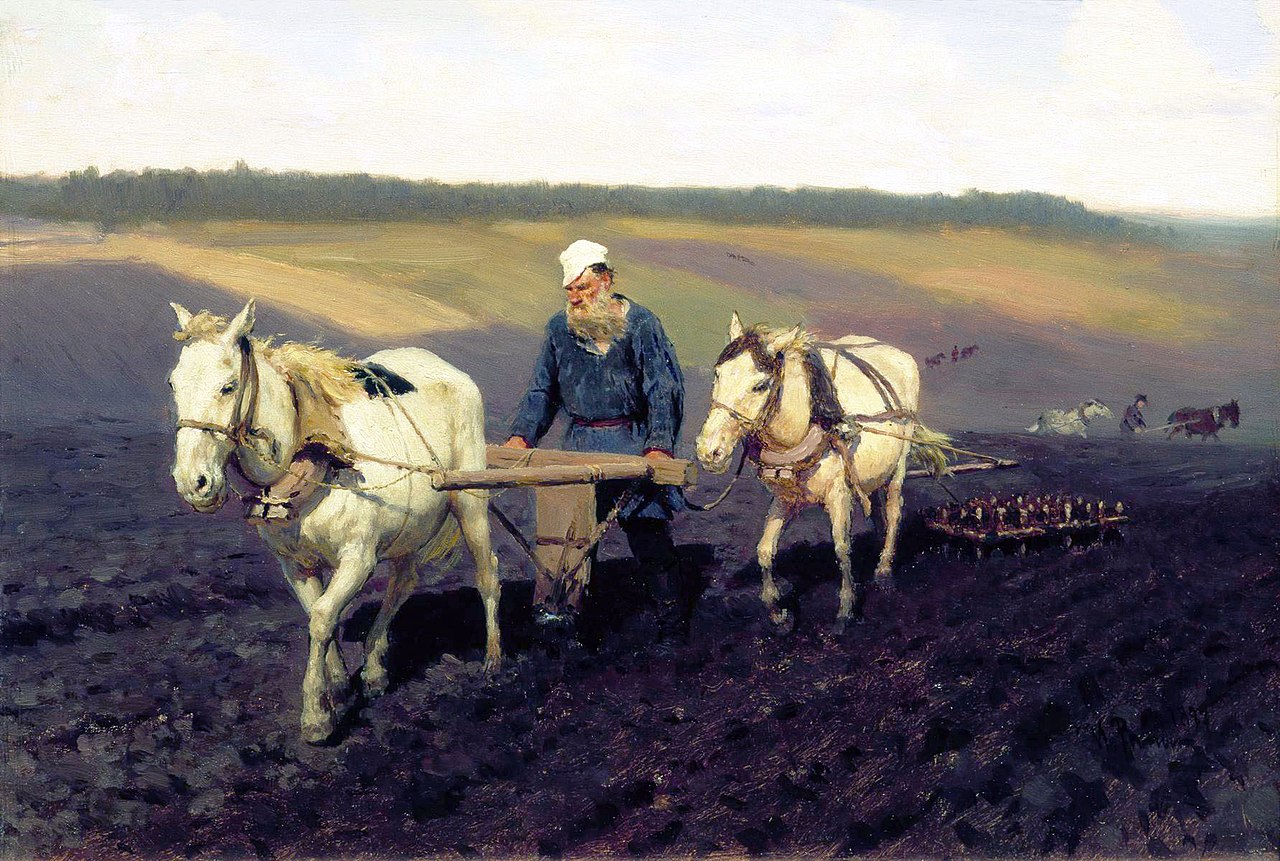
The visual record divides into images of Tolstoy across the composition window, the Moscow poverty the book describes, and the publication artefacts. A medium sweep retrieved eight public-domain images into the dive’s local cache (visuals/, git-ignored). The keystone is thematic rather than contemporaneous: Ilya Repin’s Tolstoy Ploughing, painted in 1887, the year after the book was finished, is the visual emblem of the bread-labour doctrine the treatise founds.
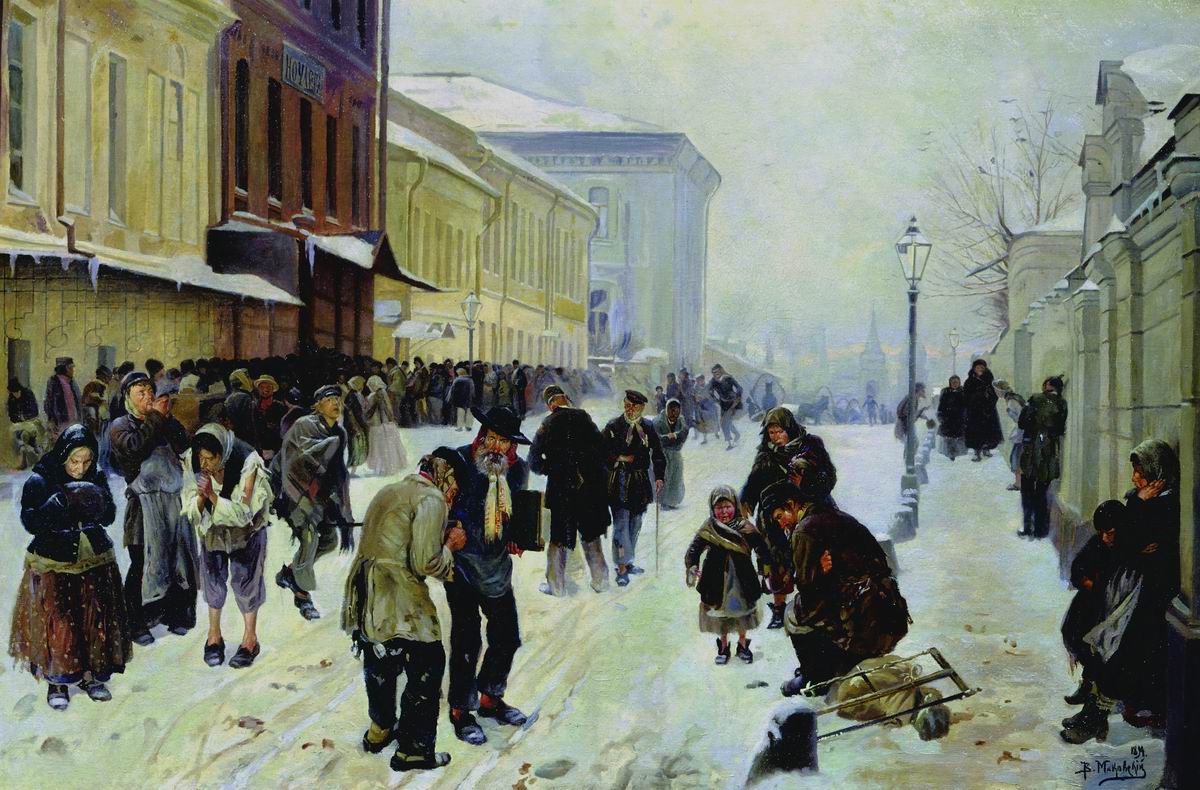
The composition window itself is documented by Nikolai Ge’s 1884 portrait and a Library-of-Congress photograph of about 1880, just before the census. For the poverty the book reports, no open image of the Lyapinsky house was found; the nearest is Vladimir Makovsky’s painting of a Moscow night-shelter interior — the institution type of the Lyapinsky and Rzhanov houses Tolstoy entered.
The book’s first printed face in English was Isabel Hapgood’s What to Do? (New York, 1887), made from a censored text; portraits of Chertkov (1883) and Repin’s seated Tolstoy (1887) round out the cached set. What is not openly available is the Russian material around the book: no portrait of V. I. Alekseev, T. M. Bondarev or V. K. Sutaev was found, nor any photograph of the Lyapinsky house — all logged in the dossier to request from the State Tolstoy Museum, the Tretyakov Gallery, and Moscow photographic archives.
Method
This was an in-session work-dive on the A-Confession-pilot model, run to medium visual intensity. Phase 0 pinned the subject to PSS Tom 25 (text pp. 182–411; first printed variant of ch. XVII pp. 503–507; variants pp. 614–652; commentary pp. 740–839) and the forerunner «О переписи в Москве» (pp. 173–181), with the composition window 1882–1886. Phase 1 deep-read the work’s forty chapters inline and ran three background sweeps — the Tom 49 diaries (1882–87, found near-silent for the 1884–86 writing years), the Tom 63–64 letters (the Alekseev bridge, the Bondarev letters, the composition network and reception), and the visual sweep. Phase 2 extracted finalists with extract_tei.py --choice=reg (pre-reform orthography resolved; diary and letter bodies recovered via --notes=auto); every cited Russian quotation was checked byte-for-byte against its extract (verify_quotes.py, 21/21 pass, two superscript-marker fixes). Phase 3 added the secondary scholarship and reception layer (web). Phase 4 synthesized this page, the dossier.yaml and the draft note. Genuine uncertainties — the excommunicationRelated value, which event dateFirstPublished should carry, the new record’s folder, a cross-dive diary-dating ambiguity, and the un-extracted primary letter behind the family-conflict quotes — are routed to the dossier’s needsReview, not asserted here.
Links: predecessor dive What I Believe; sibling dives A Confession, gospel-translation, christian-anarchism, copyright-renunciation, christian-communism-socialism, doukhobors, biryukov-sofia-relationship, tolstoyanism.
References
Primary: L. N. Tolstoy, «Так что же нам делать?», PSS (Jubilee Edition) Tom 25, pp. 182–411 (text; first printed variant of ch. XVII pp. 503–507; variants pp. 614–652; commentary pp. 740–839); «О переписи в Москве», Tom 25, pp. 173–181; tolstoydigital-TEI corpus — diaries Tom 49 (1882–87); letters Tom 63 (to V. I. Alekseev no. 286, T. M. Bondarev no. 486, N. N. Strakhov no. 337, and others) and Tom 64 (1887–89).
Background: Aylmer Maude & Louise Maude (trans.), What Then Must We Do? (Oxford, 1925); Isabel F. Hapgood (trans.), What to Do? (Crowell, New York, 1887); Ernest J. Simmons, Leo Tolstoy (1946); Rosamund Bartlett, Tolstoy: A Russian Life (2011); Inessa Medzhibovskaya, Tolstoy and the Religious Culture of His Time (2008); Andrew Donskov, Leo Tolstoy in Conversation with Four Peasant Sectarian Writers (2019); Edwina Cruise, “Women, Sexuality, and the Family in Tolstoy” (2002); Anne Lounsbery, “The Woman Question” (2022); Riccardo Nicolosi, “Slum Bodies…”, The Russian Review 83 (2024). (Phase-3 sources detailed in the dossier references.background.)
Companion dev-blog note: 2026-06-06-what-then-must-we-do (draft). Structured evidence, entity routing, the work-record proposal and the coverage ledger are in dossier.yaml.