Date: 2026-05-10
Context: A survey of where Leo Tolstoy discusses copyright, ownership of his writings, and the free dissemination of texts across the 90-volume Jubilee Edition (PSS). The survey was prompted by the editorial need on tolstoy.life to ground its public-domain license — the Soli Deo Gloria dedication that gives all the site’s text away — in Tolstoy’s own words rather than in editorial framing alone.
1. Key findings
- Not one declaration but an evolving position, c. 1881–1910. Six staged moments form the spine: the 1883 diary groundwork, the 1891 public declaration, the 1891 redacted household conflict, the 1895 will-as-diary-entry, the six successive formal wills of 1909–1910, and the 1910 Explanatory Note to the Will.
- The conceptual core (1883): property is not in itself evil; property defended by violence — “by the policeman with a pistol” — is. “Make a spoon and eat with it, but only until another needs it.”
- The 1891 open letter renounces copyright on everything written «с 1881 года» — from 1881 inclusive; the secondary-literature paraphrase “after 1880” is slightly inaccurate. The renunciation therefore covers A Confession (1882) and the religious-philosophical writings of the early 1880s.
- The most personal line is the 1895 diary-will: that his writings had been sold over the last ten years «было самым тяжелым для меня делом в жизни» — the heaviest thing in his life — reading not as a public statement but as a confession to whoever opens the diary after his death.
- The binding legal form was hard-won. Imperial civil law allowed no bequest “to the people,” so six wills were drafted across eighteen months; the 1910 Explanatory Note (drafted by Chertkov, signed by Tolstoy) finally gave the renunciation binding form. The household cost is visible in the source itself — the 1891 diary’s fullest account of the conflict survives only as «[Вымарано 19 строк]», nineteen lines erased by Sofya Andreyevna.
- For the vault. Grounds tolstoy.life’s public-domain dedication (Soli Deo Gloria) in Tolstoy’s own words rather than editorial framing, and seeds the wiki pages on the wills, on Chertkov, and on the household conflict. Ingestion is a separate, human step.
2. Why this matters for tolstoy.life
The license under which everything tolstoy.life publishes is dedicated to the public domain. The dedication is informed by a conviction Tolstoy held and acted on across the last three decades of his life: that his writings should not be private property. The history of how he reached, declared, defended, and finally legally secured that conviction is itself substantial — and it sits in primary sources that are not always trivially accessible.
This document is the result of one focused sweep across those sources, primarily the structured TEI/XML edition of the Jubilee Edition produced by the Слово Толстого (Word of Tolstoy) project at HSE Moscow. The findings are organised so that any future research session — by the project, by a contributor, or by anyone else — can pick up where this one stops.
A companion file, pss-volume-mapping.md, resolves Tom-number citations in this document to the local PDF paths under primary-sources/jubilee-edition/.
3. The shape of the question in Tolstoy’s life
The renunciation of literary property is not a single declaration. It is an evolving position that runs from the early 1880s to Tolstoy’s death in 1910. Six staged moments form the spine.
3.1. 1883 — The philosophical groundwork
The diary entries from 1883 onward work out the underlying ethic: property is not in itself evil; property defended by violence is. From the diary entry of 1 January 1883 (PSS Tom 49, p. 59):
Так на днях — собственность. Я всё не мог себе уяснить, что она. Собственность, как она теперь — зло. А собственность сама по себе — радость на то, что тем, что я сделал, добро. И мне стало ясно. Не было ложки, было полено, — я выдумал, потрудился и вырезал ложку. Какое же сомненье, что она моя? Как гнездо этой птицы ее гнездо. Она хочет им пользоваться, как хочет. Но собственность, ограждаемая насилием — городовым с пистолетом — это зло. Сделай ложку и ешь ею, но пока она другому не нужна.
Property as it is now — is evil. Property in itself — is joy in the good one has made. There was no spoon, there was a piece of wood — I conceived it, I worked at it and carved a spoon. What doubt is there that it is mine? As the bird’s nest is its nest. It wants to use it as it wishes. But property defended by violence — by the policeman with a pistol — that is evil. Make a spoon and eat with it, but only until another needs it.
(Working English; full Russian extract: extracts/v49_059_059_1883_01_01.txt.)
This is the conceptual foundation that the later, more practical statements rest on.
3.2. 1891 (16 September) — The public declaration
Open letter to the editors of Russkie vedomosti and Novoye vremya, published in both papers on 19 September 1891, renouncing the copyright on all Tolstoy’s writings written from 1881 onward. PSS Tom 66, letter 36, pp. 47–48. Local PDF: primary-sources/jubilee-edition/vol32/vol32.pdf.
The operative sentence:
Предоставляю всем желающим право безвозмездно издавать в России и за границей, по-русски и в переводах, а равно и ставить на сценах все те из моих сочинений, которые были написаны мною с 1881 года и напечатаны в XII томе моих полных сочинений издания 1886 года, и в XIII томе, изданном в нынешнем 1891 году, равно и все мои неизданные в России и могущие вновь появиться после нынешнего дня сочинения.
I grant to all who so wish the right to publish gratis, in Russia and abroad, in Russian and in translations, and likewise to perform on stage, all those of my writings which were written by me from 1881 onward…
The English paraphrase that circulates in secondary literature — “any of my works written after 1880” — is slightly inaccurate. The Russian reads “с 1881 года”: from 1881 onward, inclusive of 1881. The earliest works covered by the renunciation include A Confession (1882) and the religious-philosophical writings of the early 1880s.
Full extract: extracts/v66_036_RedaktoramgazetRusskievedomosti.txt.
3.3. 1891 (July) — The household conflict, partly redacted
The 1891 declaration was published only after a protracted disagreement within Tolstoy’s household. Sofya Andreyevna refused for years to assent. The diary entry of 22 July 1891 (PSS Tom 52, pp. 45–47) records the first major confrontation, but the most detailed description was physically removed from the diary before the modern edition could transcribe it. The TEI text marks this at the relevant point:
Вчера уехал Гинзбург, и вчера же уехали Гельбиги. И вчера же был разговор с женой о напечатании письма в газетах об отказе от права авторской собственности. Трудно вспомнить, а главное, описать всё, что тут было:
[Вымарано 19 строк.]
Yesterday Gintsburg left, and yesterday too the Helbigs left. And yesterday too there was a conversation with my wife about printing in the newspapers the letter renouncing the right of literary property. It is difficult to recall, and chiefly to describe, everything that was said:
[19 lines erased.]
The editorial annotation [Вымарано 19 строк] records that nineteen lines of the manuscript page were deleted by Sofya Andreyevna at some point after the entry was written. The most direct family-conflict record on the very topic Tolstoy was preparing to make public was suppressed within the source itself. The fact of the redaction is preserved in the modern edition; the redacted text is not.
Full extract: extracts/v52_045_047_1891_07_22.txt.
3.4. 1895 (27 March) — The will-as-diary-entry
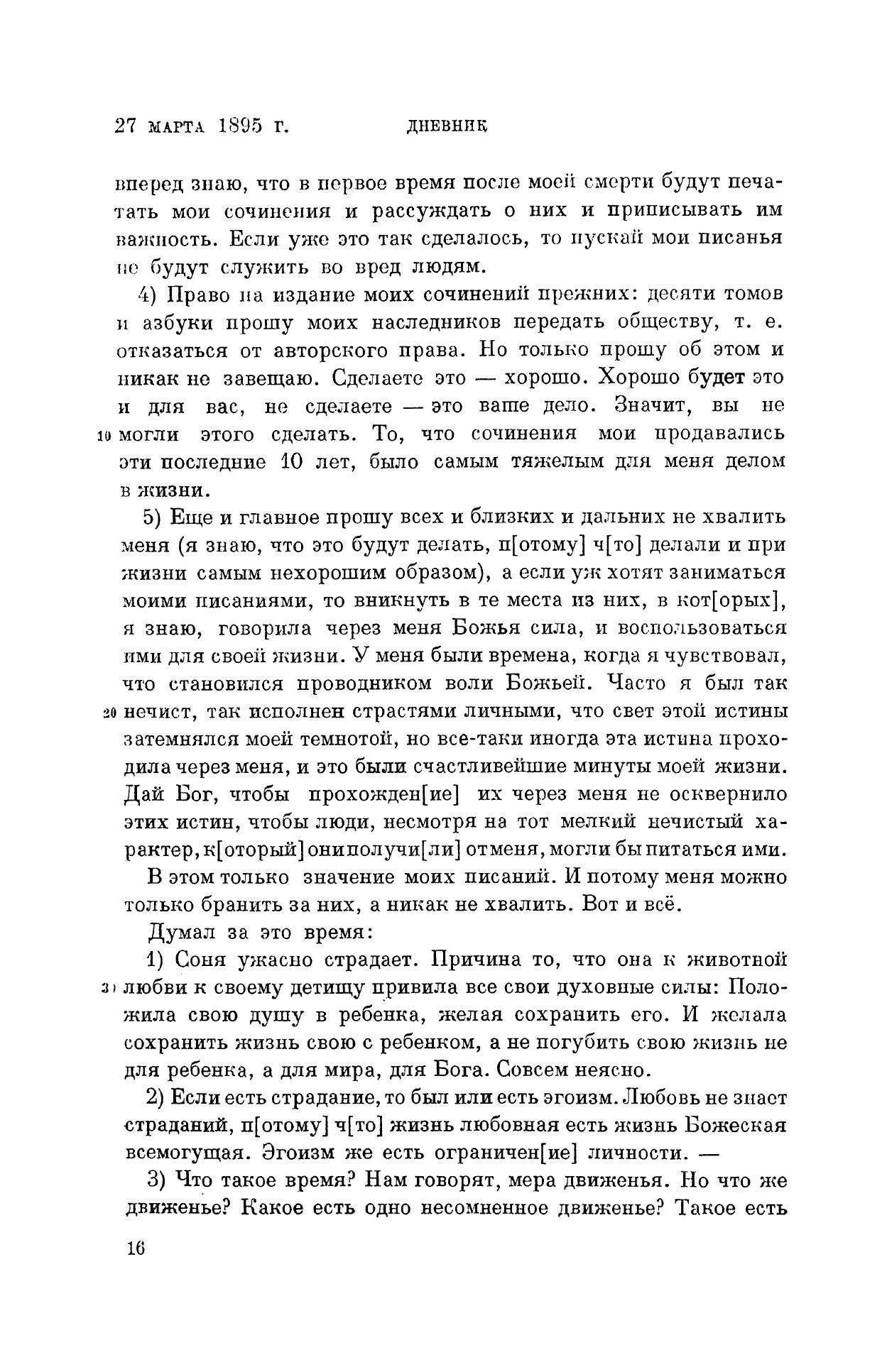
PSS Tom 53, pp. 14–18; TEI id v53_014_018_1895_03_27. Local PDF: primary-sources/jubilee-edition/vol19/vol19.pdf. Of the materials this survey covers, this is the most plainly written first-person statement.
The diary entry of 27 March 1895 was conceived by Tolstoy as a private will, framing his last wishes for his burial, his papers, and his writings. It precedes the six formal wills of 1909–1910 by fourteen years and stands as the personal-voice version of what the later legal documents codified. Point 4 is the relevant section here:
4) Право на издание моих сочинений прежних: десяти томов и азбуки прошу моих наследников передать обществу, т. е. отказаться от авторского права. Но только прошу об этом и никак не завещаю. Сделаете это — хорошо. Хорошо будет это и для вас, не сделаете — это ваше дело. Значит, вы не могли этого сделать. То, что сочинения мои продавались эти последние 10 лет, было самым тяжелым для меня делом в жизни.
4) I ask my heirs to hand over to the public the right of publication of my earlier works — the ten volumes and the Azbuka — that is, to renounce the copyright. But I only ask this and in no way bequeath it. If you do it — good. It will be good for you too. If you do not — that is your affair. It means you could not have done it. That my writings have been sold during these last ten years was the heaviest thing in my life.
The closing sentence — То, что сочинения мои продавались эти последние 10 лет, было самым тяжелым для меня делом в жизни — is the most plainly affecting line in the survey. It reads not as a public statement but as a confession to whoever reads the diary after his death.
Full extract: extracts/v53_014_018_1895_03_27.txt. The printed page from the Jubilee Edition (PSS Tom 53, p. 16) is reproduced at extracts/pss-vol53-pages/page-054.png.
3.5. 1909–1910 — Six successive formal wills
Tolstoy and V. G. Chertkov drew up six wills in eighteen months to find a legally binding form for the renunciation. The principal obstacle was that imperial Russian civil law did not allow bequeathing property “to the people”; only physical or juridical persons could be designated heirs. The successive drafts are recorded in PSS Tom 80 (1909 wills, including the fourth and fifth) and PSS Tom 82 (1910 sixth and final will, plus the Explanatory Note).
The final formal will of 22 July 1910 was written in the woods near Yasnaya Polyana, away from the household, because the situation at home made open work on the document impossible.
3.6. 1910 (31 July) — The Explanatory Note to the Will
PSS Tom 82, pp. 227–231. TEI id v82_305_Obyasnitelnayazapiskakzaveshhaniyu. Local PDF: primary-sources/jubilee-edition/vol58/vol58.pdf.
Drafted by V. G. Chertkov in the third person at Tolstoy’s request and signed by him with a holograph closing paragraph. This is the most legally precise statement of the renunciation and the document that finally gave it binding form. The operative provision:
1) Все его сочинения, литературные произведения и писания всякого рода, как уже где-либо напечатанные, так и еще не изданные, не составляли после его смерти ничьей частной собственности, а могли бы быть издаваемы и перепечатываемы всеми, кто этого захочет.
1) All his compositions, literary works, and writings of every kind — both those already printed somewhere and those still unpublished — shall after his death constitute no one’s private property, but may be published and reprinted by all who wish it.
The Explanatory Note also contains a chronology of the six successive wills and the legal reasoning behind each — useful as a primary source for the textual-historical question of when and how the renunciation became binding.
Full extract: extracts/v82_305_Obyasnitelnayazapiskakzaveshhaniyu.txt.
4. Where the theme clusters in the Jubilee Edition
The keyword sweep that produced this survey hit roughly 60 letter files and 25 diary entries directly on the topic, plus a smaller number of pages in published works and notebooks. The map below points to clusters that reward further reading.
Diaries
| Date | TEI id | Material |
|---|---|---|
| 1883-01-01 | v49_059_059_1883_01_01 | Philosophical groundwork on property |
| 1888-12-05 | v50_009_010_1888_12_05 | Property and economic structure (cheap bread, refusal of land ownership) |
| 1889-03-30 | v50_059_060_1889_03_30 | Christian life requires complete renunciation of property — written after a meeting with American visitors |
| 1890-03-17 | v51_027_029_1890_03_17 | The order of renunciation: first the desire that wants property, then the vanity that wants approval |
| 1891-07-22 | v52_045_047_1891_07_22 | First detailed diary account of the household conflict over the 1891 declaration. 19 lines redacted. |
| 1891-07-31 to 1891-08-13 | v52_047 to v52_050 | Continuing reflections through the standoff; the public declaration finally goes out on 16 September |
| 1895-03-27 | v53_014_018_1895_03_27 | Will-as-diary-entry; most plainly written first-person statement in the survey |
A broader sweep across the 1888–1891 entries on the keyword собственность (property) returned approximately 25 entries. The material rewards a systematic reading of these years specifically.
Letters
| PSS Tom, letter id | Addressee, date | Material |
|---|---|---|
| Tom 66, letter 036 | Editors of Russkie vedomosti / Novoye vremya, 1891-09-16 | The public declaration |
| Tom 66, letter 253 | N. N. Strakhov, 1892-04-24 | Aftermath of the declaration |
| Tom 63, letter 430 | P. I. Birjukov, 1885 | Earliest sustained discussion in the letters |
| Tom 68, letter 043 | N. N. Gesyn | Practical: gratis publishing arrangements |
| Tom 72, letter 010 | Aylmer Maude, 1899-01-12 | Translation rights for Resurrection; correspondence with the principal English translator |
| Tom 72, letter 075 | A. F. Marks, 1899 | The Niva publishing arrangement for Resurrection — the one work for which Tolstoy accepted payment, to fund Doukhobor emigration |
| Tom 72, letters 389, 412 | A. C. Fifield, 1901–1902 | Correspondence with the English publisher who reprinted Tolstoy’s late works for free distribution |
| Tom 72, letter 403 | A. V. Yushko, 1901 | Permission grant |
| Tom 73, letter 153 | Albert Langen, 1902 | German publisher correspondence |
| Tom 75, letter 131 | Saratov Publishing Society, 1905 | Permission grant |
| Tom 76, letter 107 | Albert Škarvan, 1907 | Slovak translator and disciple — likely the deepest doctrinal statement to a non-Russian correspondent |
| Tom 77, letter 192 | P. A. Stolypin, 1907 | Letter to the Prime Minister referencing the renunciation |
| Tom 78, letter 199 | P. A. Sergeenko, 1908 | Sergeenko later chronicled the will-drafting process |
| Tom 80, letter 001 | F. A. Abramov, 1909 | Permission grant, late period |
| Tom 80, letters 394–395 | The 1909 fourth and fifth wills | |
| Tom 82, letter 287 | A. L. Tolstaya, 1910 | To his daughter Aleksandra — internal-family articulation of the bequest |
| Tom 82, letter 305 | Explanatory Note to the Will, 1910-07-31 | The legal culmination |
| Tom 83, 84, 85, 86, 87, 88, 89 | Various drafts and apparatus | The editorial volumes contain working drafts and appendix material |
Polemical works
| PSS Tom | Work | Note |
|---|---|---|
| Tom 8 | On the Publication of a New Journal | Practical statement of editorial principle |
| Tom 26 | On Life — variant editions of last chapters | Bears on what counts as “his” text vs free for adaptation |
| Tom 28 | Tsarstvo Bozhie vnutri vas (The Kingdom of God Is Within You) | The major polemical work of the renunciation period. An English translation is held at primary-sources/standard-ebooks/leo-tolstoy_the-kingdom-of-god-is-within-you_leo-wiener.epub |
| Tom 5 | Early articles on Russian military criminal law and on peasant emancipation | Foundation: property and law before 1880 |
| Tom 91 | Index volume | Cross-reference all the above via index.tolstoy.ru |
Notebooks
| PSS Tom | Material |
|---|---|
| Tom 51 — Записная книжка №2, 1890 | Working notebook from the year before the declaration |
| Tom 56 — Listy zapisnoj knizhki, 1908 | Late period |
| Tom 58 — Listy iz zapisnoj knizhki, 1910 | Last year of life |
5. Material not covered by this survey
The survey was time-boxed and did not cover:
- The Krug chteniya / Put’ zhizni anthologies. Tolstoy’s two anthology projects of the late period contain his curated thinking on possession, money, and labour. The keyword sweep returned a few hits but full coverage was out of scope.
- The commentary apparatus (
texts/comments/, 807 TEI files). The editorial commentary in PSS volumes is often as illuminating as the primary texts. - Incoming letters to Tolstoy. The TEI corpus appears to hold only Tolstoy’s outgoing letters; the incoming correspondence — particularly from Chertkov and from Sofya Andreyevna — would round out the family-conflict picture.
- Goldenweiser and Makovický conversation transcripts. The two doctors and disciples kept verbatim daily logs of conversations from the late years. Plain text is held at
primary-sources/tolstoydigital-TEI/texts_txt/Goldenweiser/andtexts_txt/Makovitski/. They almost certainly contain spoken statements on copyright.
6. The manuscript record
The original manuscripts of the diary entries and letters cited in this survey are held by the State Tolstoy Museum (Государственный музей-заповедник Л.Н. Толстого, GMT) in Moscow. The L. N. Tolstoy fond comprises 71 492 documents and is the world’s largest collection of Tolstoy manuscript material; it is stored in the museum’s “стальная комната” (steel room).
A high-resolution facsimile of the 27 March 1895 diary page does not appear to be available on the open web at the time of writing. Two relevant digitisation projects exist, neither covering the manuscript pages themselves:
- Весь Толстой в один клик (All Tolstoy in One Click), 2014. ABBYY OCR + crowdsourced proofreading, run by the Tolstoy Museum and Yasnaya Polyana with support from the Mellon Foundation and the British Council. Produced the digitised printed text now hosted at tolstoy.ru. The input was scans of the printed 90 volumes; the underlying handwritten manuscripts were not part of the project’s scope.
- The State Tolstoy Museum’s online collection at tolstoy-iss.kamiscloud.ru, a curated exhibition browser. It is not a full archive and does not appear to expose individual diary pages by date.
The state museum-fund catalogue Госкаталог catalogues museum holdings administratively but typically does not expose high-resolution image files of working manuscripts.
The State Tolstoy Museum’s website footer at the time of writing reads:
Использование любых находящихся на сайте материалов без официального разрешения запрещено © 2026 Государственный музей-заповедник Л.Н. Толстого. Все права защищены
The use of any materials found on the site without official permission is prohibited. © 2026 State L.N. Tolstoy Museum-Reserve. All rights reserved.
A digital photograph of the 1895 diary page at the resolution and licence required for a public-facing reference site would need to be requested from the museum’s manuscripts department directly.
Openly-licensed period imagery
The manuscripts are rights-reserved, but much of the photographic record of Tolstoy’s last decades is in the public domain — including photographs by V. G. Chertkov, the chief photographer of Tolstoy’s final years and the co-protagonist of the renunciation. Three usable examples (public domain on Wikimedia Commons; file pages and licence tags verified 2026-05-29):
| Subject | Author, year | Licence | Source |
|---|---|---|---|
| Leo Tolstoy | V. G. Chertkov, 1906 | Public domain (PD-old-70-expired) | Wikimedia Commons |
| Tolstoy and Chertkov, Yasnaya Polyana | V. G. Chertkov, 29 March 1909 | Public domain (PD-RusEmpire) | Wikimedia Commons |
| V. G. Chertkov | A. F. Eichenvald, 1883 | Public domain (PD-RusEmpire) | Wikimedia Commons |


The full visual map — provenance, access, rights, and licence for each item, including the rights-reserved manuscript above — is in the companion dossier.yaml.
7. Method
- The TEI corpus from
primary-sources/tolstoydigital-TEI/texts/was used as the primary search surface: 9 087 letter files, 4 584 diary files, 767 published-works files, plus notes and Krug chteniya. - A layered Russian keyword set was used, from high-confidence anchors (
авторск[ое],литературн[ая собственность],безвозмездн[о],перепечат[ывать],гонорар,после 1881) to broader terms used in combination (собственност[ь],Чертков). - Every TEI filename encodes the PSS Tom number and, for diaries, the entry date (
vXX_NNN_..._YYYY_MM_DD.xml). Every TEI file contains a<title type="bibl">element giving the formal PSS citation. Both were preserved verbatim through the extraction so all citations in this document are anchored to their TEI source. - A small lxml-based extractor —
extract_tei.py, the shared copy indocs/research/lib/— resolves the heavy editorial markup in the TEI body. The<choice>/<sic>/<corr>editorial-correction wrappers are resolved in favour of the corrected/expanded reading;<note>footnote bodies are stripped. The result is readable Russian prose suitable for grep with context, matching the printed PSS modulo the orthographic conventions of 1953 typesetting. - The finalist passages were cross-checked against the printed PSS by extracting the relevant pages from the local PDFs at 220 dpi (
pdftoppm). The 27 March 1895 entry was verified against PSS Tom 53 (= local filevol19/vol19.pdf), pages 14–18 of the printed book.
The companion file pss-volume-mapping.md documents the local-file naming convention that made the cross-check non-trivial: PDFs are named in publication-order, not by Tom number.
8. References
Primary:
- Толстой Л. Н. Полное собрание сочинений: в 90 тт. — Москва: Гос. изд. «Художественная литература», 1928–1958. (PSS, the 90-volume Jubilee Edition. Local copies at
primary-sources/jubilee-edition/.) - tolstoydigital TEI corpus, Слово Толстого project, HSE Moscow. CC BY-SA. https://github.com/tolstoydigital/TEI. Local copy at
primary-sources/tolstoydigital-TEI/.
Background:
- Orekhov, B. V. (2020). “Volume 91”: an Electronic Index to the Complete Works of Leo Tolstoy. Journal of Siberian Federal University. Humanities & Social Sciences, 13(12), 2049–2055. DOI: 10.17516/1997-1370-0703. Local copy at
primary-sources/jubilee-edition/91vol.pdf. - Tolstoy Digitized for Future Generations. ABBYY blog, on the Весь Толстой в один клик project. https://www.abbyy.com/blog/tolstoy-digitized-for-future-generations/.
- Tolstoy, Leo. The Journal of Leo Tolstoi (First Volume — 1895–1899). Project Gutenberg. https://www.gutenberg.org/ebooks/46272. (Older English translation, public domain. Quoted line is not in this edition.)
- Christian, R. F. (ed.). Tolstoy’s Diaries Volume II: 1895–1910. Faber, 2010. (Modern English scholarly edition; not held locally.)
Companion documents:
- extract_tei.py — the shared lxml-based TEI extractor (in
docs/research/lib/) used to produce the readable Russian prose quoted in this document. - pss-volume-mapping.md — Tom number → local PDF file lookup.
- tolstoydigital-tei-reference.md — Reference for the TEI corpus and its relationship to the Jubilee Edition.
- dossier.yaml — machine-readable dossier (evidence ledger, entity routing map, visuals map) for this survey; ingestion-ready, added 2026-05-29.
- doukhobors — the Doukhobor relief campaign, the one cause for which Tolstoy broke this renunciation (Resurrection, 1898).
- biryukov-sofia-relationship — the 1895 diary-will and the household conflict over the diaries, read through Biryukov and Sofia.
- crisis — the 1879–1882 transformation behind the post-1881 renunciation.
A dev-blog recap of the session that produced this survey is at 2026-05-10 — Tolstoy on copyright and the renunciation of literary property.