Date: 2026-05-31
Context: A primary-source dive prompted by two photographed pages from Pavel Biryukov’s authorized biography of Tolstoy in its Swedish edition (Leo Tolstoj: Hans liv och verk, Norstedt), Vol II: the warm dedication (TILLÄGNAN) to Countess Sofia Andreevna Tolstaya, dated Kostroma, 11 January 1908, and the closing SLUTORD (p. 453), dated village Ivanskoye, 27 August 1908. The reader asked four things: the story behind the warm dedication; whether it connects to Biryukov’s withholding the name of a pre-marriage lover of Tolstoy; the (perhaps strained) relationship between Biryukov and Sofia; and the lines Sofia is said to have removed from a diary note about the will, and how Biryukov handled this as Tolstoy’s biographer. The dive reads the dedication and afterword against Tolstoy’s own letters to Biryukov (173 of them in PSS Toms 63–82), his diaries (the 1895 testament, the 1862 bachelor-diary handover, the 1897 “Sonya reads the diary” entries, and the 1910 “Diary for myself alone”), the PSS editorial apparatus on how the diaries were first published, and the conventional biographical scholarship. This is a research prototype: primary citations are byte-faithful; secondary claims are attributed.
1. Key findings
- The dedication and the afterword are both dated 1908 (11 January; 27 August) — Vol II’s front and back matter were finished the same year. Biryukov — Tolstoy’s friend and biographer, editor of the Posrednik (“Intermediary”) press, and an ally of Vladimir Chertkov, the editor to whom Tolstoy had entrusted his manuscripts and the figure on the opposing side of Sofia in the conflict over the diaries and copyright — nonetheless opens Vol II with an unguarded tribute to Sofia: “You have held — and you still hold — a great and important place in your husband’s eventful and anxiety-filled life. You have also averted much misfortune from his head.”
- The warmth rests on real dependence and real collaboration, not courtesy. Sofia controlled the manuscript archive (her decades as Tolstoy’s copyist; her deposit of papers in the Moscow Historical/Rumyantsev Museum), so any authorized biography needed her goodwill; the Slutord’s closing quotation is itself footnoted to “the archive of S. A. Tolstaya.” The dedication is best read as both strategic and sincere.
- The withheld lover is Valeria Vladimirovna Arsenyeva — Tolstoy’s near-fiancée of 1856–57 (the seed of Family Happiness). The dive confirms this from inside the project: in 1903 Tolstoy himself named her to Biryukov as “the most serious” of his pre-marriage loves and sent his letters to her; in 1905 he wrote that he was sorry Sofia had protested against publishing the Arsenyeva letters. Sofia’s objection kept the chapter out of editions I–II (1906, 1911); it first appeared in the Berlin 1921 edition, after her 1919 death.
- So the dedication and the discretion are two faces of the same deference. Biryukov honoured Sofia in print and honoured her veto over the most intimate pre-marital material — scholarship reads both as the conduct of a family friend who “would not have wished to embarrass any of them” (Russian Dinosaur, 2017). The peasant Aksinya Bazykina (mother of Tolstoy’s illegitimate son; the seed of The Devil) belongs to the same “what the authorized life softened” question, but the documented, name-level suppression is Arsenyeva.
- The relationship was mixed, not simply strained. Personally cordial and collaborative — in the 1897 exile years Tolstoy reports “Sofia Andreevna loves you just as before” — but structurally on opposite sides of the conflict between Sofia and the circle around Chertkov. Bartlett (2010) notes Sofia tolerated the meek Biryukov where she could not abide the harder-line disciples. The biography’s own candor (the Arsenyeva letters) became the first real friction, and by July 1910 Tolstoy is writing to Biryukov that Sofia is “agitated, irritated, almost mentally ill — hatred of Chertkov, jealousy of him.”
- On the “lines Sofia removed from the diary note about the will”: the premise needs correcting. In the primary record there is no documented instance of Sofia excising will-lines from a diary note. The 27 March 1895 testament’s one conspicuous break (an ellipsis «…представляют.....») is Tolstoy’s own trailing-off, and its one deletion (his daughters’ names as executors) is his own (“что замарано, то замарал сам” — “what is blotted out, I blotted out myself”). What is documented is threefold and different: (a) Sofia vetoed the Arsenyeva letters from the biography; (b) Sofia seized Tolstoy’s secret diary in October 1910, fearing it confirmed a copyright will to Chertkov; (c) the diaries’ will/copyright passages were cut not by Sofia but by Chertkov, whose 1916 edition printed the 1895–99 diaries “с многими купюрами” (with many excisions) from a copy. The complete, uncensored text first appeared only in PSS Tom 53 (1953).
- Biryukov’s handling of the will: he was the named translator/publisher of the 1895 testament (slated for Vol III) and printed the copyright-renunciation material; but he narrated the 1909–10 will crisis obliquely — through diary and letter, not the legal documents — consistent with sparing the family. The formal renunciation of post-1881 copyright was public from 19 September 1891; the secret will assigning copyright to Alexandra (and, through Chertkov, to the public) was signed 22 July 1910.
2. Why this matters for tolstoy.life
Biryukov (1860–1931) — “Posha” — is the project’s first source for vault ingestion, and his four-volume biography is the documentary spine for much of Tolstoy’s life. Understanding how that biography was made — under whose goodwill, with what vetoes, and with what discretions — is a prerequisite for citing it well. This dive establishes three things the vault needs: that Vol II was produced in 1908 with Sofia’s cooperation and a dedication to her; that the biography’s silences (the Arsenyeva chapter) are documented editorial choices made out of deference to Sofia, not gaps in the record; and that the “will” material the reader asked about is anchored in a specific, fully preserved primary text — the 27 March 1895 diary testament — whose later suppression belongs to Chertkov’s editions and the 1910 marital crisis, not to a quiet excision by Sofia. It also corrects, on the evidence, a piece of received framing (Sofia “removing will-lines from the diary”), which is exactly the kind of accuracy-both-ways the project aims for.
A companion file, pss-volume-mapping.md, resolves the Tom citations here to the local PDF paths under primary-sources/jubilee-edition/ (Tom 53 = vol19; Tom 58 = vol24).
3. The shape of the question in the sources
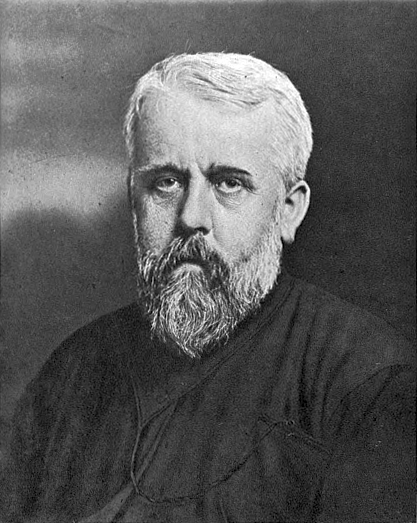
3.1. The dedication (Kostroma, 11 January 1908)
The dedication of Vol II is addressed to Sofia by name and in the second person. Verbatim Swedish (from the reader’s photograph), with working English:
Ni har intagit — och Ni intager ännu — en stor och viktig plats i Er mans växlingsrika och orosfyllda lif. Ni har ock afvärjt mycken ofärd från hans hufvud.
You have held — and you still hold — a great and important place in your husband’s eventful and anxiety-filled life. You have also averted much misfortune from his head. (working English)
The signature and date: PAUL BIRUKOFF. Kostroma den 11 januari 1908. The afterword closes the volume eight months later — Byn Ivanskoje, den 27 augusti 1908 — so the reader’s observation is exact: the dedication and the Slutord are both 1908, the front and back matter of a volume completed and published that year. (Biryukov’s Russian Vol II also appeared in 1908. The Swedish title page credits the work as compiled by Biryukov and reviewed by Tolstoy — samlade af Paul Birukoff samt granskade af Leo Tolstoj — in a separately credited bemyndigad översättning från ryska originalet af Erik Nordenström (“authorized translation from the Russian original by Erik Nordenström”). Tolstoy’s review therefore attaches to Biryukov’s Russian text, not to the Swedish: he did not read Swedish, and the translation is Nordenström’s.)
Two things make the warmth notable. First, the date: 1908 was the eve of the open conflict over Tolstoy’s diaries and copyright that consumed 1909–10. Second, the author: Biryukov was Chertkov’s ally, and Sofia and Chertkov stood on opposite sides of that conflict. That a biographer from Chertkov’s side should write “you still hold a great place” — the “still” (ännu) carrying the weight — and credit Sofia with averting “much misfortune from his head” is the puzzle the rest of the dive answers.
The backstory is cooperation. Russian-language descriptions of the biography record that Biryukov drew on “the archive of Sofia Andreevna Tolstaya, including her correspondence with L. N. Tolstoy and her memoirs,” and thanked her for opening “valuable collections of biographical material that she had gathered and deposited in the Moscow Historical Museum” (tolstoy-lit.ru; Russian Wikipedia). The Slutord makes the dependence visible on the page: the volume’s closing quotation — a luminous winter-sledge passage dated 8 December 1884, the day Biryukov says his bond with Tolstoy turned from reverence into friendship — carries the footnote “S. A. Tolstojs arkiv” (“the archive of S. A. Tolstaya”). The biographer ends Vol II on a document held in Sofia’s keeping. The dedication is the public acknowledgement of a private dependence.
3.2. The withheld lover: Valeria Arsenyeva
The reader asked whether the dedication was “about” Biryukov’s withholding the name of a pre-marriage lover. Not literally — but the two belong to the same posture, and the dive can now name the lover and document the withholding from inside the project.
The lover is Valeria Vladimirovna Arsenyeva. The decisive evidence is Tolstoy’s own. Writing to Biryukov on 27 November 1903 (PSS Tom 74), he lists his pre-marriage attachments in order and singles her out (verbatim Russian, working English):
Потом главное, наиболее серьезное — это была Арсеньева Валерия. Она теперь жива, за Волковым была, живет в Париже. Я был почти женихом («Семейное счастье»), и есть целая пачка моих писем к ней. Я просил Таню переписать их и послать вам.
Then the main one, the most serious — that was Arsenyeva, Valeria. She is alive now, was married to Volkov, lives in Paris. I was almost her fiancé (“Family Happiness”), and there is a whole packet of my letters to her. I asked Tanya to copy them out and send them to you. (working English)
In the same letter he offers Biryukov even the bachelor diaries, with a flinch: he does not let them be copied “by just anyone” because they are “слишком ужасны по своей мерзости” (“too terrible in their vileness”) — but he will share them, for the truth’s sake. The candor came from Tolstoy; the suppression came from Sofia. Two years later, on 18 October 1905 (PSS Tom 76), Tolstoy writes:
Очень мне жалко, что Софья Андреевна протестовала против писем Арсеньевой.
I am very sorry that Sofia Andreevna protested against the Arsenyeva letters. (working English)
That is the hinge. Sofia’s objection kept Tolstoy’s letters to Arsenyeva out of the first and second editions of the biography (Moscow 1906, 1911); the PSS apparatus and the 1923 Hogarth Press edition of the love-letters agree that Biryukov first published them only in the third (Berlin, Ladyzhnikov, 1921), after Sofia’s death — the Hogarth volume’s front matter stating that Biryukov “did not include them … at the request of Countess Sophie Tolstoi, but she gave him permission to do what he liked with them after her death.” (Mark Aldanov’s 1921 review adds that even in the Berlin edition Biryukov withheld her surname; this detail is attributed to Aldanov and not independently confirmed at the quotation level here — see Material not covered.)
So the dedication and the discretion rhyme. Biryukov honoured Sofia in the front matter of 1908 and honoured her veto over the Arsenyeva letters in the body of the same and the next editions. The peasant Aksinya Bazykina — the married serf with whom Tolstoy had a years-long affair and a son, Timofei, and whom he transmuted into The Devil — is part of the same broad question of what the authorized life softened, but no source found here documents a specifically Sofia-vetoed, later-restored Aksinya chapter; the name-level, documented case is Arsenyeva.
3.3. The relationship: cordial, then strained
The letters trace an arc. In the exile years — Biryukov was banished to Courland in 1897 for co-signing (with Chertkov) the Doukhobor appeal — Sofia is on his side. Tolstoy writes on 12 March 1897 (PSS Tom 70):
Софья Андреевна всё так же любит вас, чему я очень радуюсь.
Sofia Andreevna loves you just as before, at which I greatly rejoice. (working English)
The souring comes with the biography itself. The Arsenyeva veto (1905, §3.2) is the first documented friction — the project’s candor colliding with Sofia’s sense of what posterity should see. By the final summer the strain is total, and Tolstoy pours it out to Biryukov on 19 July 1910 (PSS Tom 82):
Софья Андреевна взволнована, раздражена, почти душевно больна — ненависть к Черткову, ревность к нему, и мне очень трудно.
Sofia Andreevna is agitated, irritated, almost mentally ill — hatred of Chertkov, jealousy of him, and it is very hard for me. (working English)
Biryukov’s own position between the camps was the softer one. Bartlett (2010) records that Sofia found him comparatively tolerable — “meek and intelligent” — where she could not accept the other disciples, and that in the biography Biryukov’s handling of Chertkov is “vague and neutral” despite his insider knowledge: he declined to take sides in print. That emollience is exactly what made the Sofia collaboration workable, and what makes the warm 1908 dedication legible rather than cynical.
3.4. The will, and the “removed lines”
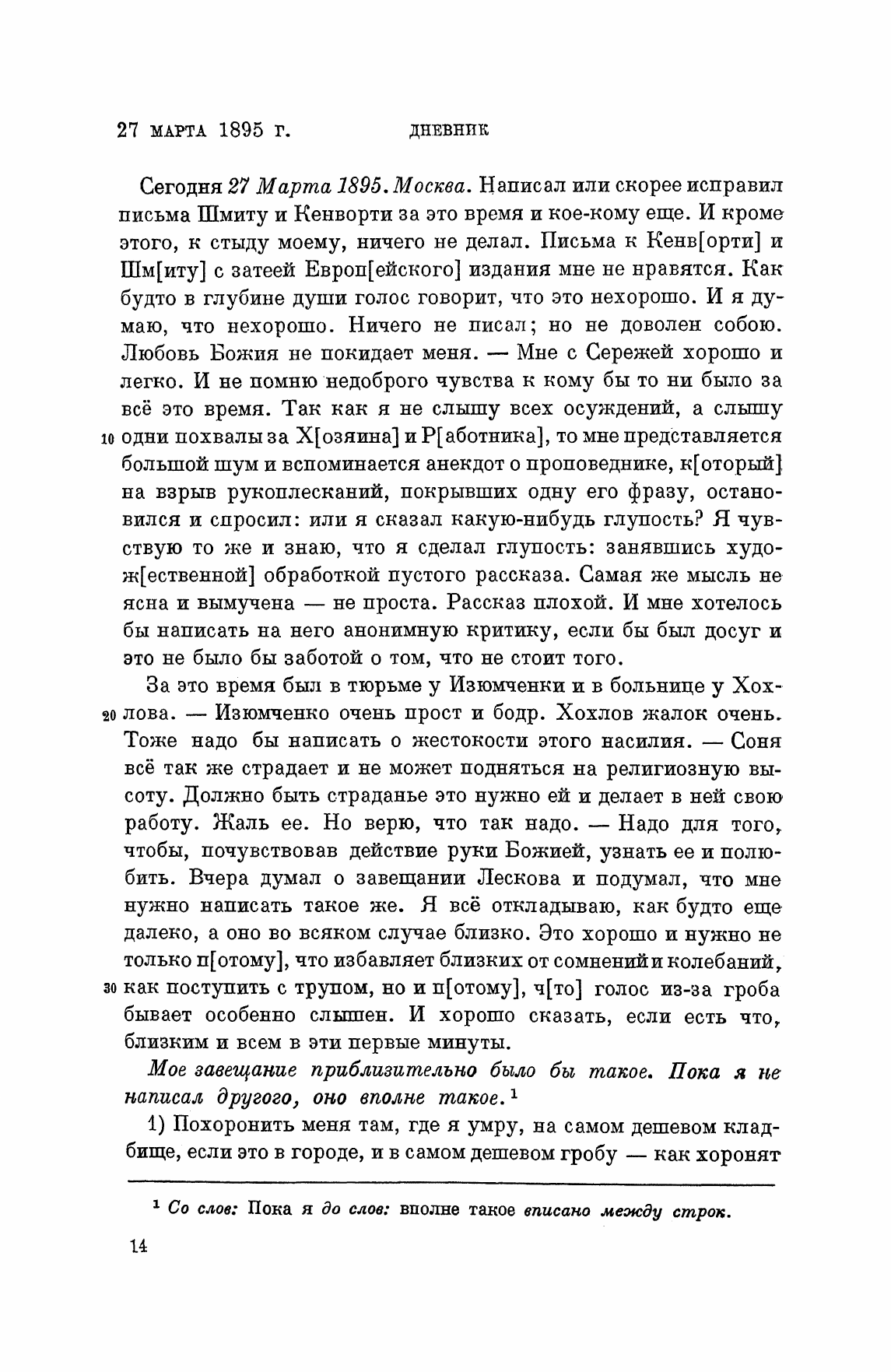
vol19). Public domain (Tolstoy's own text).The reader’s fourth question — the lines Sofia removed from a diary note about the will — turns out to need correcting on the evidence, and the correction is the interesting part.
The diary note is the testament of 27 March 1895 (PSS Tom 53), written after Tolstoy read of Leskov’s will. Its operative clauses survive complete. Point 3 assigns his papers and orders the diaries pruned (verbatim, working English):
Бумаги мои все дать пересмотреть и разобрать моей жене, Черткову В. Г., Страхову, и дочерям Тане и Маше (что замарано, то замарал сам. Дочерям не надо этим заниматься)... Дневники мои прежней холостой жизни, выбрав из них то, что стоит того, я прошу уничтожить, точно так же и в дневниках моей женатой жизни прошу уничтожить всё то, обнародование чего могло бы быть неприятно кому-нибудь. Чертков обещал мне еще при жизни моей сделать это.
All my papers I ask to be reviewed and sorted by my wife, V. G. Chertkov, Strakhov, and my daughters Tanya and Masha (what is blotted out, I blotted out myself. The daughters need not occupy themselves with this), by those of these persons who are living... My diaries of my former bachelor life, having selected from them what is worth it, I ask to be destroyed; likewise in the diaries of my married life I ask that everything be destroyed whose publication could be unpleasant to anyone. Chertkov promised me, while I am still alive, to do this. (working English)
Point 4 is the copyright renunciation:
Право на издание моих сочинений прежних: десяти томов и азбуки прошу моих наследников передать обществу, т. е. отказаться от авторского права. Но только прошу об этом и никак не завещаю.
The right to publish my earlier works — the ten volumes and the Alphabet — I ask my heirs to transfer to the public, i.e. to renounce the author’s right. But I only ask this, and in no way bequeath it. (working English)
Three points of textual history, established from the PSS apparatus, dismantle the “Sofia removed the lines” framing:
First, the one visible break in the entry is Tolstoy’s own. Where the text reads «…эти дневники… производят ложно одностороннее впечатление и представляют.....» the five dots are literal in the manuscript — there is no editorial gap or lacuna tag — and Tolstoy then abandons the thought and reverses himself in a fresh paragraph (“А впрочем, пускай остаются мои дневники, как они есть” — “But never mind, let my diaries stay as they are”). It is an author trailing off, not a censor’s cut.
Second, the one deletion in the clause is also Tolstoy’s own. The names of his daughters as executors are struck through in the manuscript, and the parenthesis he adds — “что замарано, то замарал сам” — claims the deletion explicitly. (On the separate fair-copy of the testament, the apparatus notes, Strakhov’s name was later struck too, with “умер” — “died” — written above it, after Strakhov’s death in 1896. The testament was a living document Tolstoy himself kept editing, which is part of why the executors named here differ from the wife-plus-Chertkov-plus-daughters list in the version Biryukov later translated.)
Third, the real suppression of the diaries was Chertkov’s, not Sofia’s. The PSS apparatus states flatly that the 1895–99 diaries appeared in full, from the manuscripts, for the first time only in PSS Tom 53 (1953); the earlier running text had been “опубликован В. Г. Чертковым по копии, с многими купюрами” — published by V. G. Chertkov from a copy, with many excisions — in the Sytin edition of 1916.
What, then, did Sofia actually do? Two documented things, neither of them a quiet excision of the 1895 note. She vetoed the Arsenyeva letters (§3.2). And in the last autumn she seized the secret diary. Tolstoy’s “Diary for myself alone” records it (PSS Tom 58; text reconstructed from the TEI pre-reform readings and cross-checked against the facsimile below). On 16–17 September 1910:
...мысль о том, чтобы выставить меня ослабевшим умом и потому, сделать недействительным мое завещание, если есть таковое... Не знаю, выдержу ли.
...the idea of presenting me as weak in mind, and thereby making my will invalid, if such a will exists... I do not know whether I will hold out. (working English)
And on 13 October 1910:
Оказывается она нашла и унесла мой дневник маленький. Она знает про какое-то, кому-то, о чем-то завещание — очевидно касающееся моих сочинений. Какая мука из-за денежной стоимости их — и боится, что я помешаю ее изданию.
It turns out she found and carried off my little diary. She knows about some will — to someone, about something — obviously concerning my works. What torment, over their monetary value — and she fears that I will obstruct her edition [of them]. (working English)
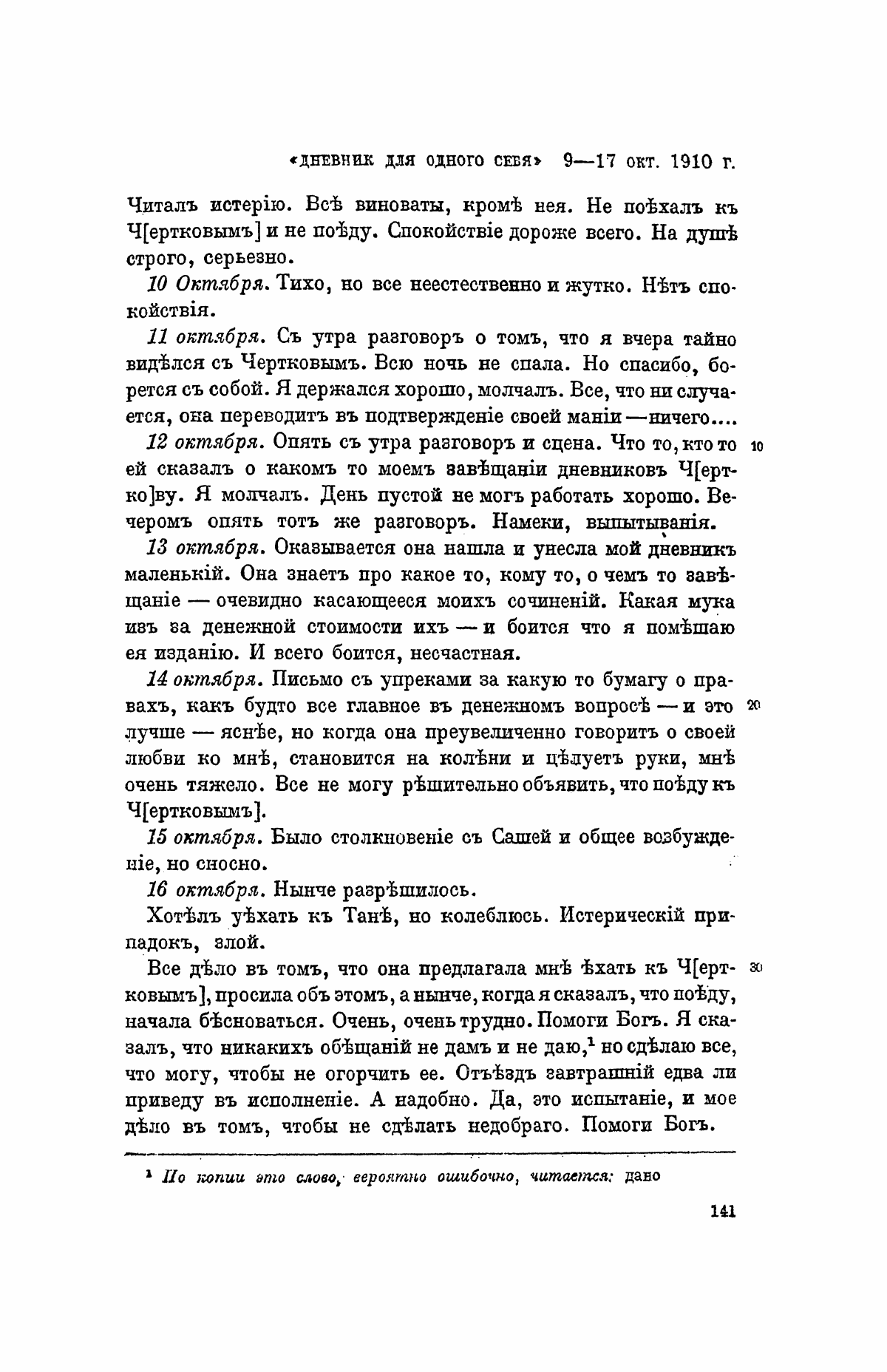
vol24). Public domain.So the “removed lines about the will” resolve, on the record, into three distinct things — Sofia’s veto of the Arsenyeva material, Sofia’s seizure of the secret diary, and Chertkov’s editorial cuts to the published diaries — rather than a single excision by Sofia from the 1895 note. The root of the anxiety, though, is genuinely a diary-and-marriage matter, and it runs back decades: in February 1897 (PSS Tom 53) Tolstoy records that “Соня без меня читала этот дневник, и ее очень огорчило то, что из него могут потом заключить о том, что она была нехорошей женой” — Sonya read this diary while I was away, and it grieved her greatly that from it people might later conclude that she had been a bad wife — the same fear of the diary’s verdict on her that would drive her, thirteen years later, to carry the little notebook off.
As for Biryukov’s handling: he was the testament’s named translator and printed the copyright-renunciation material (it was slated for Vol III), but he told the 1909–10 will story through diary and letter rather than the legal instruments, keeping the Sofia-versus-Chertkov struggle at the level of feeling rather than documentation — the same family-friend discretion visible in the dedication and the Arsenyeva silence.
4. Where the theme clusters
4.1. Letters — Tolstoy to Biryukov (PSS Toms 63–82; 173 letters)
| Tom · TEI id | Date | Theme | One line |
|---|---|---|---|
| Tom 71 · v71_005 | 9 Jan 1898 | biography | Earliest explicit approval of the biography programme (Biryukov in exile): “ничего не нашел изменить или прибавить… Делайте скорее.” |
| Tom 73 · v73_186 | 2 Dec 1901 | biography | “Очень рад позировать вам и буду категорически отвечать на ваши вопросы” — opens the active Q&A collaboration. |
| Tom 73 · v73_256 | 19 May 1902 | biography | The breakthrough: he has “found a form” that defeats autobiography’s inherent insincerity. |
| Tom 73 · v73_315 | 20 Aug 1902 | candor/diaries | The Scylla-and-Charybdis letter: be “правдивее даже, чем Руссо” without either self-whitewash or cynical exposure. |
| Tom 73 · v73_373 | 11 Nov 1902 | biography | Commits to the “before/after awakening” arc — the pre-1879 “vileness” included, not whitewashed. |
| Tom 74 · v74_174 | 3 Jun 1903 | diaries/terms | Terms of use: quote the “rough, uncorrected notes” with a disclaimer; no separate publication in his lifetime. |
| Tom 74 · v74_319 | 27 Nov 1903 | pre-marriage | Names Arsenyeva as “the most serious,” sends her letters via Tanya, offers the “too terrible” bachelor diaries. |
| Tom 75 · v75_091 | 15 Apr 1904 | biography | Fact-checks his own military chronology against his diaries for the biography. |
| Tom 76 · v76_065 | 18 Oct 1905 | Sofia/lover | “Очень мне жалко, что Софья Андреевна протестовала против писем Арсеньевой.” |
| Tom 76 · v76_097 | 24 Dec 1905 | biography | “Кроме биографии есть наша дружба” — friendship over the project. |
| Tom 78 · v78_050 | 11–12 Feb 1908 | biography | Direct editorial markup of the Vol II draft (published 1908). |
| Tom 70 · v70_017 | 15 Feb 1897 | Sofia | Sofia’s Petersburg actions over the exile praised — the warm baseline. |
| Tom 70 · v70_057 | 12 Mar 1897 | Sofia | “Софья Андреевна всё так же любит вас.” |
| Tom 82 · v82_095 | 19 Jul 1910 | Sofia/crisis | “почти душевно больна — ненависть к Черткову, ревность к нему.” |
| Tom 82 · v82_172 | 1 Sep 1910 | biography | The biography has triggered a criminal prosecution of Biryukov: “Неужели только биография?” |
(Earlier volumes, Toms 63–67, hold the friendship-formation decade: Biryukov as Posrednik editor and manuscript courier, and — striking for the relationship question — Tolstoy mediating Sofia’s opposition to Biryukov’s hoped-for marriage to their daughter Masha. No pre-marriage-past or biography material appears before the late 1890s.)
4.2. Diaries (PSS Toms 48, 53, 57, 58)
| Tom · TEI id | Date | One line |
|---|---|---|
| Tom 48 · v48_045_045_1862_09_15_1 | 14–15 Sep 1862 | A week before the wedding: “скоро у меня уже не будет тайн для одного, а тайны для двух, она будет всё читать” — the willing surrender of the private self that the bachelor-diary handover enacted. |
| Tom 48 · v48_055_057_1863_08_05 | 5 Aug 1863 | Within a year the openness collapses: “Я не дал ей читать своего дневника, но не пишу всего.” |
| Tom 53 · v53_014_018_1895_03_27 | 27 Mar 1895 | The testament: cheap burial, no rites, papers to wife + Chertkov + (struck) daughters, destroy the bachelor diaries, renounce copyright. Keystone. |
| Tom 53 · v53_132_136_1897_02_04 | 4 Feb 1897 | “Соня без меня читала этот дневник… её очень огорчило то, что из него могут потом заключить… что она была нехорошей женой.” |
| Tom 53 · v53_152_157_1897_10_14 | 14 Oct 1897 | He resolves to resume a private diary “так, чтобы никто не читал при моей жизни” — being read has killed the entries’ spiritual quality. |
| Tom 57 · v57_061_065_1909_05_10 | 10 May 1909 | Decides to withhold the diary and not publish in his lifetime; drafts a “from beyond the grave” letter to Sofia. |
| Tom 58 · v58_137 / v58_141 | Sep–Oct 1910 | “Diary for myself alone”: Sofia fears a will invalidated by declaring him senile; she finds and carries off the little secret diary. |
5. Scholarly context
The value of setting the primary record beside the scholarship here is the contrast, not corroboration — the same move the tolstoyanism dive makes with a contested label. Two framings dominate the popular and academic literature on Sofia and the last years, and both put Sofia at the centre: Alexandra Popoff’s Sophia Tolstoy: A Biography (2010) and Tolstoy’s False Disciple (2014), and — for the general audience — the novel and film The Last Station (2009). In that telling the marriage is read largely from Sofia’s side: Tolstoy turns moralistic and doctrinaire and presses to give away the family’s property, against a wife who had borne and raised his children. This dive does not take that frame as its baseline. It reads the period through the words of the three people inside it — Tolstoy, Biryukov, and Chertkov — and uses the secondary literature as a comparison to be checked against them. The sharper reader’s steer on how to read this scholarship is recorded in annotations.md.
On the dedication, the primary record and the scholarship agree on the bare fact, and the scholarship supplies a mechanism: Sofia controlled the archive and was a genuine collaborator (her copying, her museum deposit, her memoirs), so an authorized biographer both depended on her and could sincerely honour her (Bartlett, 2010). The exact wording of the dedication (Kostroma, 11 Jan 1908) is preserved here from the reader’s photograph of the Swedish edition; it is not exposed in the open digital Russian editions consulted.
On the relationship, the primary record cuts against the flat word “strained”: Tolstoy’s own letters show Sofia tolerated the mild Biryukov in particular (12 Mar 1897, §3.3) — so the accurate verdict is “cordial within a structurally adversarial frame,” not personal enmity, a reading Bartlett (2010) shares.
On the withheld lover, the case rests on Tolstoy’s own documents — his 1903 disclosure and 1905 regret to Biryukov (§3.2) — not on later testimony (Aldanov’s review; the 1923 Hogarth edition’s note). Subject (Arsenyeva), cause (Sofia’s objection), and timing (withheld in eds. 1–2; first printed Berlin 1921, after her 1919 death) lock from three independent directions in the primary record.
On the will, the primary record corrects the reader’s premise and, with it, a piece of received shorthand. The mainstream reads 1910 as “fundamentally about the struggle for control of his diaries” (Meek, LRB 2010) — which Tolstoy’s own diaries bear out — but the specific claim that Sofia excised the will-lines does not survive contact with the manuscript: the standard, Biryukov-translated testament names wife + Chertkov + daughters (not Strakhov, struck on the fair copy after his 1896 death); the only documented Sofia “removal” is the 1910 seizure of the diary, not an excision from the 1895 note; and the diaries’ will/copyright cuts were Chertkov’s own (1916 Sytin edition, “с многими купюрами”). The 1891 public copyright renunciation and the 22 July 1910 secret will are documented in the primary record and in Chertkov’s own account (The Last Days of Tolstoy).
6. Material not covered
- Verbatim Russian of the dedication and Slutord. Held here only in the Swedish (the reader’s photographs). The Russian original (Kostroma, 11 Jan 1908; Ivanskoye, 27 Aug 1908) was not retrieved from the open digital editions; worth capturing from a Berlin 1921 / Posrednik scan for the vault.
- Aldanov’s surname-withholding claim. That the Berlin 1921 edition still withheld Arsenyeva’s surname is attributed to Aldanov’s 1921 review; his Загадка Толстого (Berlin, 1923) is genuine but its full text was not parsed here. Left to confirm.
- A specifically suppressed Aksinya Bazykina chapter. Not found; only the Arsenyeva material is documented as a Sofia-vetoed, later-restored chapter.
- The reader’s source for “Sofia removed the will-lines.” The dive could not corroborate a quiet excision by Sofia from the 1895 note; if the reader has a specific source (Biryukov’s Swedish text, Sofia’s own diaries, or a biographer), it should be supplied so the claim can be traced rather than left corrected-by-default.
- PDF cross-check of the 1910 reconstructions. The Tom 58 quotations were reconstructed from the TEI
<reg>readings (the extractor drops pre-reform<choice>pairs) and cross-checked against the rendered facsimile (p. 149); a line-by-line PDF collation is still owed before any wiki ingestion treats them as fully byte-faithful.
7. Visual & manuscript record
Photographs and portraits below are public-domain items held in the local research cache (visuals/, git-ignored); facsimiles in extracts/ are rendered from the local public-domain Jubilee Edition PDFs and are committed. Rights are recorded for each in dossier.yaml; nothing here has been promoted to the public site.
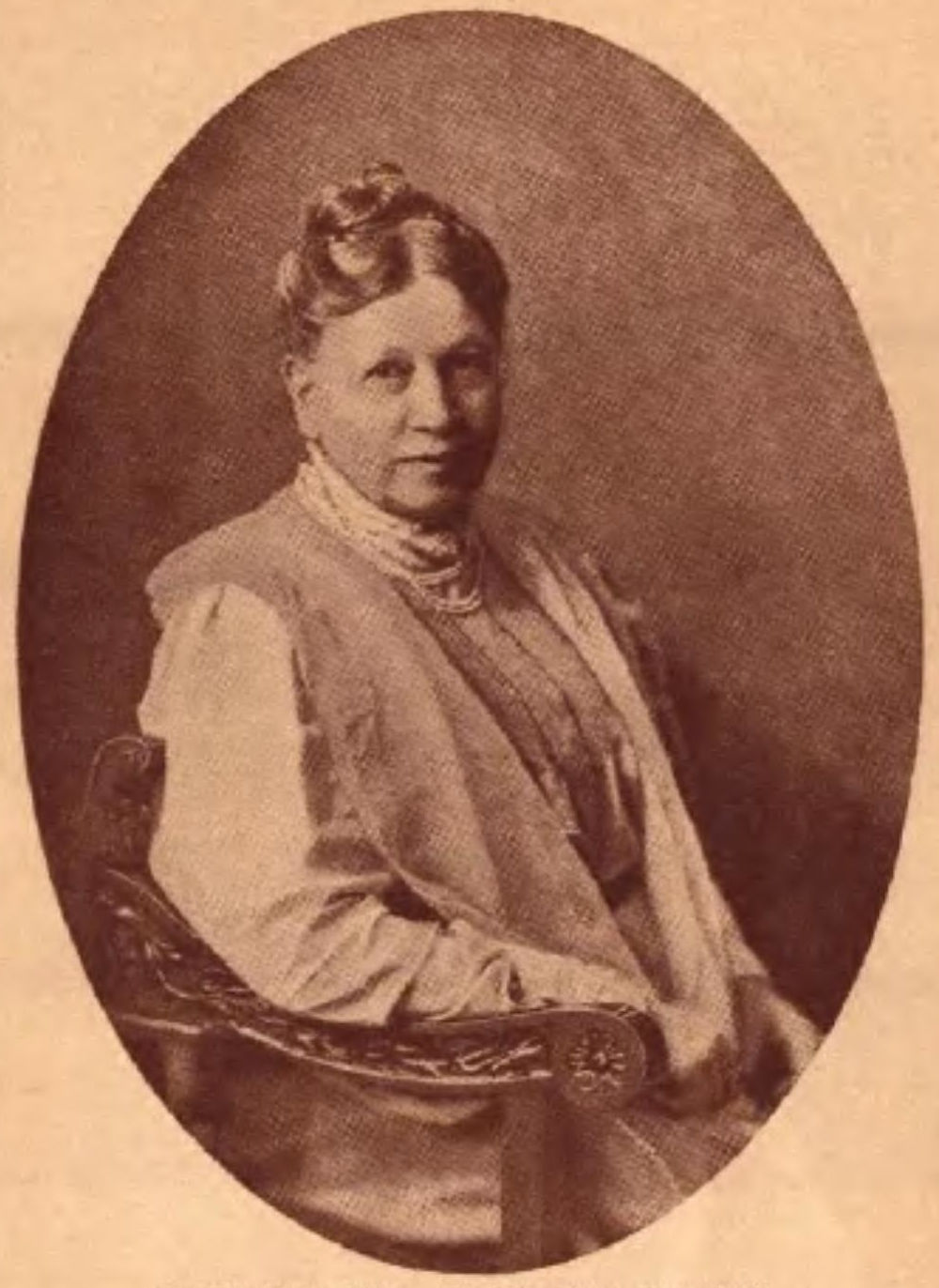
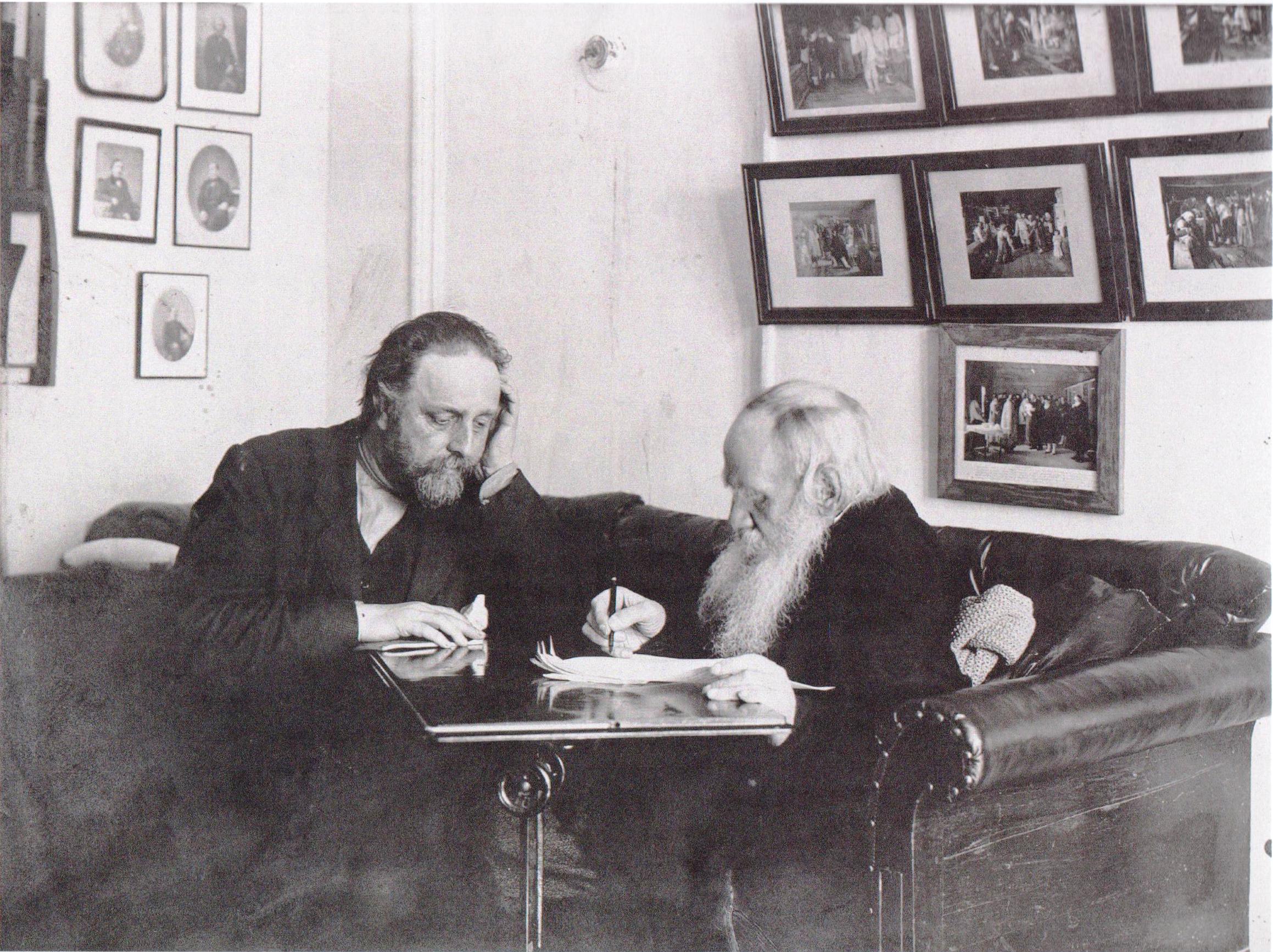
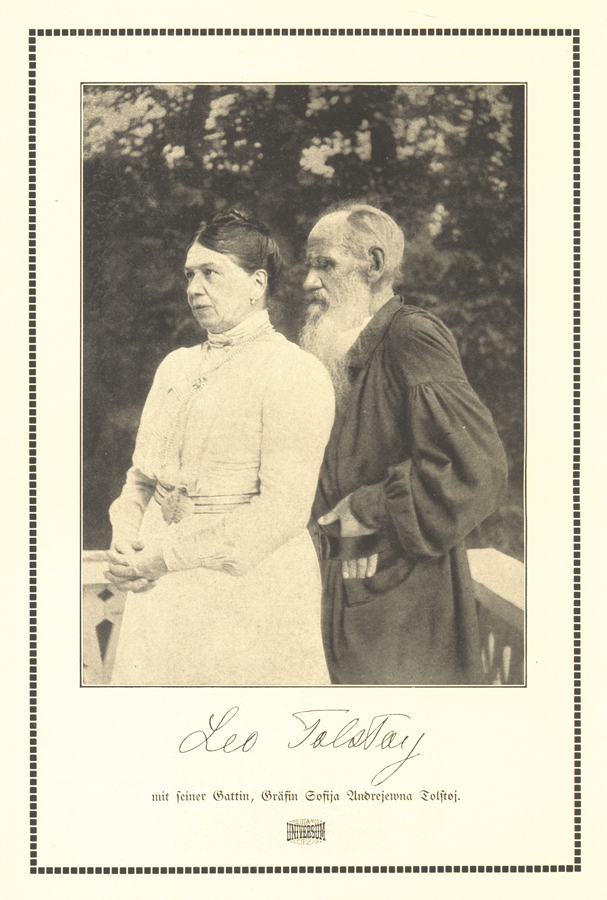
- Portraits (Wikimedia Commons, PD): Biryukov (1916, and a smaller English-captioned copy); Sofia (1908; the Cassell 1911 formal portrait; Nikolai Ge’s 1886 oil; a small undated photo); Chertkov (1883, and the 1909 photo with Tolstoy); Tolstoy-and-Sofia together (two, 1910); Yasnaya Polyana house.
- Biryukov as photographer (Commons, PD): his 1895 photograph of Maria (Masha) Lvovna Tolstaya at Yasnaya Polyana — material evidence of his presence at the estate during the period of the testament.
- Biography plates (Commons, PD): two illustration pages from Biryukov’s own Léon Tolstoï, vie et œuvre (1906).
- Edition covers (émigré / Russian archives): Tom 1 of Biryukov’s biography, 1911 Moscow (Kushnerov) and 1921 Berlin (Ladyzhnikov) covers; a Biryukov portrait from imwerden.de.
- Manuscript facsimiles (rendered locally, committed, PD): the 27 March 1895 testament (PSS Tom 53, p. 18) and the October 1910 “Diary for myself alone” (PSS Tom 58, p. 149).
- Not openly available: photographic facsimiles of the testament manuscript itself, and any photograph of Biryukov with Tolstoy, were not found on Commons; the State Tolstoy Museum (Moscow) collections are the place to request these.
8. Method
Scope (confirmed interactively, thorough + heavy-visuals): the four-part question above, period centred on the biography’s making (1897–1910) with the 1862 bachelor-diary handover and the 1895 testament as anchored back-references. Corpus surface: Tolstoy’s 173 letters to Biryukov (PSS Toms 63–82), his diaries (Toms 48, 53, 57, 58), and the diary-publication apparatus (PSS comments volumes), read alongside the reader’s two photographs of the Swedish Vol II and a secondary scholarship sweep. Sweep mode: fan-out — three letter-triage passes by Tom-range, one apparatus/textual-history pass, one diary-mentions pass, one scholarship pass, two visual-channel passes (Wikimedia Commons; Russian museums + émigré archives), deduped and synthesised here. Primary Russian quotations are byte-faithful, verified against the saved extracts/ with verify_quotes.py; the Tom 58 (1910) quotations are reconstructed from the TEI <reg> readings because extract_tei.py drops pre-reform <choice> pairs, and were cross-checked against the rendered facsimile. Secondary claims are attributed inline and listed below; genuine uncertainties are in Material not covered and in the dossier’s needsReview. This is a research prototype, not a vault page; ingestion is a separate, human step. Links: the editions question is settled separately in biryukov-biography-editions; the copyright story in copyright-renunciation; the “crisis” labelling in crisis.
9. References
Primary
- L. N. Tolstoy, diary of 27 March 1895 (the testament), PSS Tom 53, pp. 14–18 — TEI
v53_014_018_1895_03_27. - L. N. Tolstoy, “Diary for myself alone,” 1910, PSS Tom 58, pp. 137, 141 — TEI
v58_137_137_1910_09_16,v58_141_141_1910_10_12,v58_141_141_1910_10_13. - L. N. Tolstoy, letters to P. I. Biryukov, PSS Toms 63–82 (173 letters); finalists cited above (Toms 70, 71, 73, 74, 76, 78, 82).
- L. N. Tolstoy, diaries 1862–63 (Tom 48) and 1897/1909 (Toms 53, 57).
- Paul Birukoff, Leo Tolstoj: Hans liv och verk, Del II (Stockholm: Norstedt) — dedication (11 Jan 1908) and Slutord (27 Aug 1908); the reader’s photographs.
- PSS Toms 53 and 58, editorial apparatus (first-publications; manuscript descriptions) — N. N. Gusev, N. S. Rodionov, eds.
Background
- Rosamund Bartlett, Tolstoy: A Russian Life (2010) — https://erenow.org/biographies/tolstoy-a-russian-life/13.php
- V. G. Chertkov, The Last Days of Tolstoy (1922) — https://www.gutenberg.org/cache/epub/40260/pg40260-images.html
- James Meek, “Some Wild Creature: Tolstoy Leaves Home,” London Review of Books 32/14 (2010) — https://www.lrb.co.uk/the-paper/v32/n14/james-meek/some-wild-creature
- Tolstoi’s Love Letters (Hogarth Press, 1923; trans. S. S. Koteliansky and Virginia Woolf) — front-matter note on the Arsenyeva letters.
- T. R. Ybarra, “Tolstoy’s Newly Published Diary and Letters” (1922), incl. Birukoff’s translation of the 1895 testament — https://www.marxists.org/archive/tolstoy/about/1922/newly-published.html
- P. I. Biryukov, Биография Л. Н. Толстого, vol. 4 ch. 17 (“1909–1910 гг. Завещание”) — http://tolstoy-lit.ru/tolstoy/bio/biryukov/biografiya-biryukov-4-17.htm
- Mark Aldanov, Загадка Толстого (Berlin, 1923) — review claim that the Berlin 1921 edition withheld Arsenyeva’s surname (not verified at quotation level here).
- “Opportunity, Glory, and Doom: Married to Tolstoy,” Russian Dinosaur (2017) — https://russiandinosaur.blogspot.com/2017/02/opportunity-glory-and-doom-married.html
- Alexandra Popoff, Sophia Tolstoy: A Biography (2010); Tolstoy’s False Disciple (2014) — Sofia-centred portrayals, cited here as the mainstream frame the dive reads against (see §5 and annotations.md), not as authority.
A short dev-blog recap of this dive is at website/src/posts/notes/2026-05-31-biryukov-sofia-relationship.md (draft).