A Confession (Исповедь)
A work-focused dive across the local Tolstoy corpus: the PSS (Jubilee Edition) Tom 23 text, its plans and variants and editorial commentary, the composition-window diaries and letters, the sibling work, and the project’s prior dives. All Russian quotations are byte-faithful extracts (verified); English renderings are working translations; dates are Old Style (Julian) unless noted. Secondary scholarship is attributed, not asserted.
Key findings
- A Confession is the autobiographical narrative of the «переворот» — Tolstoy’s own word, an overturning — that he underwent around age fifty: the loss of any answer to “why live?”, a drift toward suicide at the summit of fame and fortune, and the recovery of a will to live through the faith of the labouring people, ending in a break with the institutional Church.
- It was not written in a single rush. A complete, untitled religious treatise of 1879 (begun «вскоре после возвращения из Москвы») was reworked, and A Confession grew out of its first chapter; the work existed in finished form by about early July 1881 (the Jubilee editors hedge the date), and was proof-corrected for print in 1882.
- The title «Исповедь» was not Tolstoy’s. The manuscripts and proofs carry working titles — «Вступление к ненапечатанному сочинению», «Что я?», «Как я потерял смысл жизни и в чем нашел его». «Исповедь» first appears in print in M. Elpidin’s 1884 Geneva edition; Tolstoy himself accepted it only by 1885.
- It was suppressed before it could appear: set in type for Русская мысль (May 1882), it was cut from the issue by the ecclesiastical censorship and the sheets sent for destruction. It then circulated in hectographed and lithographed copies, was first published abroad (Elpidin, Geneva, 1884), and was not legally printed in Russia until 1906 (Всемирный вестник, no. 1) — all within Tolstoy’s lifetime.
- The composition-window letters and diaries name the people around the work: N. N. Strakhov (chief correspondent), A. A. Fet (correspondent and neighbour), the cousin A. A. Tolstaya / “Alexandrine” (Orthodox interlocutor), and the Moscow circle of late 1881 — N. F. Fedorov, the peasant V. K. Sutaev, V. I. Alekseev, Orlov. Orlov and Fedorov read his gospel synthesis and were “of one mind” with him; with Sutaev he agreed “in everything”.
- Tolstoy’s own later verdict (a letter to Georges Dumas, 1892) is that the change A Confession describes “did not happen all at once” but was present “in embryo” in his earlier work — the gradual-not-sudden reading that specialist scholarship (Medzhibovskaya) shares and that the popular “sudden crisis after Anna Karenina” frame misses.
Why this matters
A Confession is the threshold of the Prophet period: the document in which the novelist becomes the religious writer, and the opening panel of the four-part project (Confession → Critique of Dogmatic Theology → Gospel Harmony → What I Believe) that the Church would spend two decades suppressing. For this project it is also the work whose works/ record is nearly empty — so the dive doubles as the source-grounded basis for filling it.
The shape of the question
The book stages one question and refuses every easy answer to it. Tolstoy first marks the moment the questions began to “arrest” his life.
Эти остановки жизни выражались всегда одинаковыми вопросами: Зачем? Ну, а потом?
These stoppages of life always expressed themselves in the same questions: Why? And then what? (working English — PSS Tom 23, ch. III)
The arrest comes not in adversity but at the height of good fortune.
И это сделалось со мной в то время, когда со всех сторон было у меня то, что считается совершенным счастьем: это было тогда, когда мне не было пятидесяти лет.
And this happened to me at a time when, on every side, I had what is considered perfect happiness: it was when I was not yet fifty. (working English — PSS Tom 23, ch. IV)
Then the sharpest formulation, the line the whole book turns on.
Есть ли в моей жизни такой смысл, который не уничтожался бы неизбежно предстоящей мне смертью?
Is there in my life any meaning that would not be destroyed by the death inevitably awaiting me? (working English — PSS Tom 23, ch. V)
Reason answers only that life is senseless; the answer that lets him live comes from elsewhere.
вера есть знание смысла человеческой жизни, вследствие которого человек не уничтожает себя, а живет. Вера есть сила жизни.
Faith is the knowledge of the meaning of human life, by virtue of which a person does not destroy himself but lives. Faith is the force of life. (working English — PSS Tom 23, ch. IX)
Genesis & composition
The composition is older and more diffuse than the work’s finished surface suggests. The Jubilee editors trace its roots to 1877 — the religious struggle recorded in the last part of Anna Karenina and a November 1877 letter in which Tolstoy first tried to state his faith “in catechism form.” A year before any sustained drafting, the governing question is already explicit in a letter to Strakhov.
Разум мне ничего не говорит и не может сказать на три вопроса, которые легко выразить одним: что я такое?
Reason tells me nothing, and can say nothing, to the three questions that may easily be put as one: what am I? (working English — letter to N. N. Strakhov, 27 January 1878 OS, PSS Tom 62)
The corpus diary opens the project in the spring of 1878 and then goes quiet for nearly three years — Tolstoy kept notebooks, not a diary, through the most acute years, so the corpus holds no diary between June 1878 and April 1881. The opening entry is brief.
Начал писать «свою жизнь».
Began to write “my life.” (working English — diary, 22 May 1878 OS, PSS Tom 48; the same entry: «Читал Евангелие».)
Sustained drafting began in the autumn of 1879. Tolstoy named the work to his closest correspondents only obliquely, and guarded it.
Я очень занят работой для себя, которой никогда не напечатаю
I am very busy with work for myself, which I will never print. (working English — unsent letter to N. N. Strakhov, 19 November 1879 OS, PSS Tom 62; the same week, to Fet: «Из занятия моего ничего не выйдет, кроме моего удовлетворения».)
By the summer of 1881 the surrounding theological work was finished, and Tolstoy made the Optina Pustyn pilgrimage; the Jubilee editors tie the finished form of A Confession to this moment, as the preface to the gospel synthesis.
Из большего сочинения, которое я после вас и кончил, и еще раз все прошел, я сделал еще из Евангелия извлечение без примечаний
Out of the larger work, which I finished after seeing you and have gone through once more, I have made besides an extract from the Gospel without notes. (working English — letter to N. N. Strakhov, 1–8 July 1881 OS, PSS Tom 63)
The people around the composition are named in the same letters and diaries. Strakhov is the constant interlocutor; the poet Fet a correspondent and neighbour; the cousin A. A. Tolstaya (“Alexandrine”) the Orthodox believer he argues against. After the painful move to Moscow in the autumn of 1881 — “the most agonizing month of my life,” the diary says — a circle forms.
Мне очень тяжело в Москве.
Things are very hard for me in Moscow. (working English — letter to V. I. Alekseev, November 1881 OS, PSS Tom 63; the same letter names N. F. Fedorov «святой», Orlov, and reports that Orlov and Fedorov had read his «Краткое изложение» and were «единомышленны» with him, and that he agreed with the peasant Sutaev «во всем до малейших подробностей».)
What the work says
The text moves in sixteen short chapters from autobiography to argument to a closing dream.
The first chapters are autobiography: a cradle Orthodox faith already gone by eighteen (ch. I), and a merciless catalogue of the years that followed.
Без ужаса, омерзения и боли сердечной не могу вспомнить об этих годах. Я убивал людей на войне, вызывал на дуэли, чтоб убить, проигрывал в карты, проедал труды мужиков, казнил их, блудил, обманывал.
I cannot recall those years without horror, loathing, and heartache. I killed men in war, challenged men to duels in order to kill them, lost at cards, devoured the labour of the peasants, punished them, fornicated, deceived. (working English — PSS Tom 23, ch. II)
The middle chapters are the crisis: the arrest of life (ch. IV — “I could breathe, eat, drink, sleep… but there was no life”), the parable of the traveller who clings to a branch over the dragon’s pit while two mice gnaw it through, and the search of all human knowledge, which only confirms that life is senseless.
И я пытаюсь сосать тот мед, который прежде утешал меня; но этот мед уже не радует меня, а белая и черная мышь — день и ночь — подтачивают ветку, за которую я держусь.
And I try to suck the honey that once comforted me; but this honey no longer gladdens me, while the white mouse and the black — day and night — gnaw at the branch I cling to. (working English — PSS Tom 23, ch. IV)
The turn (chs IX–XII) is not a new argument but a change of ground: the billions of ordinary, labouring people do live and act as if life has meaning, by a non-rational knowledge — faith. The error, he concludes, was in the life, not the logic.
Я заблудился не столько оттого, что неправильно мыслил, сколько оттого, что я жил дурно.
I went astray not so much because I thought wrongly as because I lived badly. (working English — PSS Tom 23, ch. XI)
The recovery is stated plainly: «Знать бога и жить — одно и то же. Бог есть жизнь» (ch. XII). The last chapters (XIII–XVI) describe joining the people’s faith and then breaking with the Church over two things he cannot accept — its hostility to other confessions, and its blessing of war and executions.
И русские стали во имя христианской любви убивать своих братьев.
And Russians began, in the name of Christian love, to kill their brothers. (working English — PSS Tom 23, ch. XV)
The book ends not on argument but on a dream: lying on woven cords over a bottomless abyss, steadied only by looking up.
Бесконечность внизу отталкивает и ужасает меня; бесконечность вверху притягивает и утверждает меня.
The infinity below repels and terrifies me; the infinity above draws me and affirms me. (working English — PSS Tom 23, ch. XVI)
Redactions & textual history
The Jubilee editors (Savodnik) distinguish a first surviving redaction (drafts, richer in autobiography, lacking ch. XII and the closing dream) from the final redaction, and print the variants («Планы и варианты», Tom 23 pp. 488–511) as thirteen numbered pieces drawn from named manuscripts and the three surviving author’s galley-proofs. Ten manuscript witnesses are enumerated in the apparatus — autograph drafts and copies in the hands of S. A. Tolstaya, T. A. Kuzminskaya, D. F. Vinogradov and A. P. Ivanov, plus the autograph of the closing dream, written after the third proof was reviewed. The most important made-up proof, from which Русская мысль actually printed, is lost; the editors reconstruct the text from the Русская мысль setting with the censor’s softenings removed from Elpidin’s edition.
Publication, censorship & translation
The work’s publication history is a history of suppression.
It was accepted by S. A. Yuryev for Русская мысль and set in type for the May 1882 issue, with an editorial introduction and five churchly footnotes added; the spiritual censorship then prohibited it, and the sheets were cut from the issue under the printing-inspector’s surveillance and sent to the Main Press Administration for destruction. The journal printing therefore never reached the public.
From the surviving proofs the text spread illicitly — hectographed and lithographed copies sold across Russia at about three rubles each. The first separate edition appeared abroad: M. Elpidin, Geneva, 1884 — where the title «Исповедь» appears in print for the first time. (Elpidin’s press was in Geneva from the 1860s; the Jubilee commentary itself localizes “Женева” only to the second Elpidin edition of 1889, so the exact 1884 title-page imprint is noted for confirmation.) V. G. Chertkov reissued it from his «Свободное слово» press at Christchurch in 1901. It was first legally printed in Russia only in 1906, in Всемирный вестник no. 1.
In English it first appeared in 1885, folded anonymously into Christ’s Christianity (ed. H. F. Battersby) under the heading “How I Came to Believe”; the title “My Confession” became standard through the Walter Scott / Dole compilation, and “A Confession” through Aylmer and Louise Maude’s translation (Oxford, 1921), still the standard. The instability of the English title mirrors the instability of the Russian one — further evidence that «Исповедь» was never Tolstoy’s fixed choice.
Reception & afterlife — the Russian society and Church reaction
Inside Russia the work was first known by reputation and in fragments. Substantial excerpts reached the public only inside hostile critical articles in the 1880s — M. S. Gromeka in Русская мысль (1884), M. Ostroumov in Вера и разум, A. F. Gusev of the Kazan Spiritual Academy in Православное обозрение (1886) — and the most anti-church passages were not reprinted. The Church’s reaction to the Confession specifically was the censorship of 1882 rather than a doctrinal condemnation by name. The Ober-Procurator of the Holy Synod, K. P. Pobedonostsev, stood behind the suppression.
The 1901 Synod edict that declared Tolstoy fallen away from the Church belongs to this longer conflict but should not be tied to A Confession directly: read in full, the edict names no individual works — «Исповедь» is not among them — and condemns the teaching as a whole. (The popular association of the excommunication with Resurrection is itself an interpretive reconstruction, not language in the edict.)
Place in the cluster
A Confession is the first of a four-part enterprise; В чём моя вера? (What I Believe), in the same Tom 23, is its doctrinal sequel and opens exactly where A Confession ends.
Пять лет тому назад я поверил в учение Христа — и жизнь моя вдруг переменилась
Five years ago I came to believe in Christ’s teaching — and my life suddenly changed. (working English — В чём моя вера?, PSS Tom 23, opening)
The doctrine that follows — the meaning of life found “in this world” through the five commandments of the Sermon on the Mount — Tolstoy set out in a long 1882 letter to M. A. Engelhardt: «значение его в том, чтобы найти смысл жизни в этом мире. Исполнение пяти заповедей дает этот смысл». For the surrounding crisis, see this project’s crisis dive, which finds that Tolstoy’s own word was «переворот», not “crisis” or “conversion”; for the gospel work that A Confession prefaces, the gospel-translation dive; and for the movement label that later attached to him — to be attributed to its users, not adopted — the tolstoyanism dive.
The author’s later verdict
Twelve years on, asked by Georges Dumas whether the change had been sudden, Tolstoy corrected the premise (the letter was written in French; the Russian is the Jubilee Edition’s).
перемена, о которой я говорю в «Исповеди», произошла не сразу, но что те же идеи, которые яснее выражены в моих последних произведениях, находятся в зародыше в более ранних.
the change I speak of in The Confession did not happen all at once, but the same ideas, expressed more clearly in my later works, are present in embryo in the earlier ones. (working English — letter to Georges Dumas, 1 April 1892 OS, PSS Tom 66)
The single extended creative-prose return to the terror that prefigured the crisis is Notes of a Madman (c.1884–86), which names the «арзамасский ужас» of 1869 — a related but distinct episode, told in different imagery from the work’s «остановка жизни», and not to be conflated with it.
Scholarly context
The mainstream English biography (Maude 1908–10; Simmons 1946; Wilson 1988; Bartlett 2011) frames A Confession as the threshold of Tolstoy’s “conversion” — a mid-life crisis after Anna Karenina, resolved into a non-dogmatic Gospel faith; Bartlett ties it tightly to Levin’s near-suicidal crisis at the end of that novel. The key specialist corrective is Inessa Medzhibovskaya’s A Biography of a Long Conversion (2008), which reframes the event as “a gigantic philosophical and religious project… rather than a crisis-begotten tragic moment,” traceable in the diaries from the 1840s — the position closest to this dive’s primary findings, and to Tolstoy’s own 1892 verdict. Gustafson (1986) and Orwin (1993) likewise stress pre-1880 continuity.
Where the dive’s findings meet the received view:
- Gradual, not sudden — the corpus (the 1892 Dumas letter) confirms and grounds Medzhibovskaya’s long-conversion thesis; it is the popular “sudden crisis” frame that is the outlier.
- The word «переворот» — English scholarship uses “crisis”/”conversion” as settled category-words; none register that Tolstoy’s own term was an overturning, not the religious-technical “conversion.” The dive treats the label as the biographers’ and translators’ overlay (complicates).
- The suppression history — reference and rare-book records confirm the spine (typeset 1882 and destroyed → Geneva 1884 → legal Russia 1906); the dive’s contribution is the precise sequencing, distinct from popular accounts that say the work simply “resurfaced in Geneva.”
Material not covered
- The «Планы и варианты» (variants) text is described from the commentary, not deeply read; a full read of What I Believe beyond its opening is deferred.
- The 1901 Synod edict and Tolstoy’s «Ответ Синоду» are summarised from scholarship, not extracted into the corpus evidence.
- The 1879–80 notebooks — the actual composition medium during the diary silence — are not in the local corpus.
- A dedicated reception sweep of the 1880s critics (Gromeka, Ostroumov, Gusev) was not run; they are named only via the commentary.
- Open scans of the émigré editions (Elpidin 1884/1889/1895; Chertkov 1901) were not located; they are held at GTM Moscow, the British Library and Helsinki University Library.
Visual & manuscript record
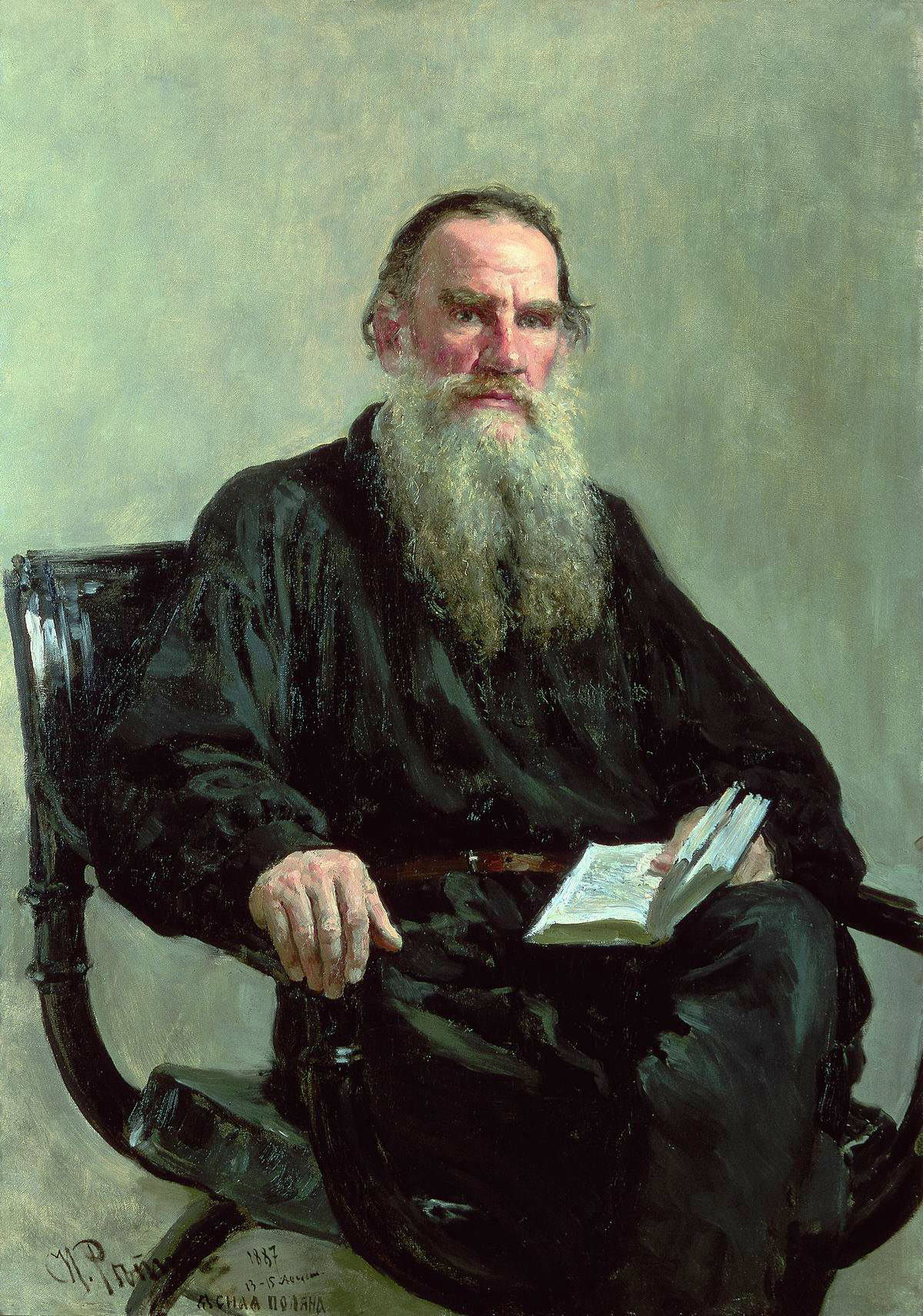
The visual record divides into contemporary images of Tolstoy, portraits of the people around the text, and the publication artefacts. Twenty-seven public-domain images were retrieved into the dive’s local cache (visuals/, git-ignored). The two most precise in time are Kramskoy’s 1873 portrait (the canonical pre-crisis face) and Repin’s 1887 portrait, painted the year the work circulated in manuscript.
The circle is documented in period portraits and photographs: Strakhov, Chertkov, Fet, the cousin Alexandrine (distinct from the daughter Alexandra Lvovna), Fedorov, the peasant Sutaev, Turgenev, and Pobedonostsev, together with Yasnaya Polyana and the Rumyantsev Museum where Tolstoy met Fedorov.
For the printed text, the title page of the first legal Russian edition (Vsemirny Vestnik, St Petersburg 1906) was retrieved, sourced from the Presidential Library of Russia via the Internet Archive, where the full 61-page scan is open-access.
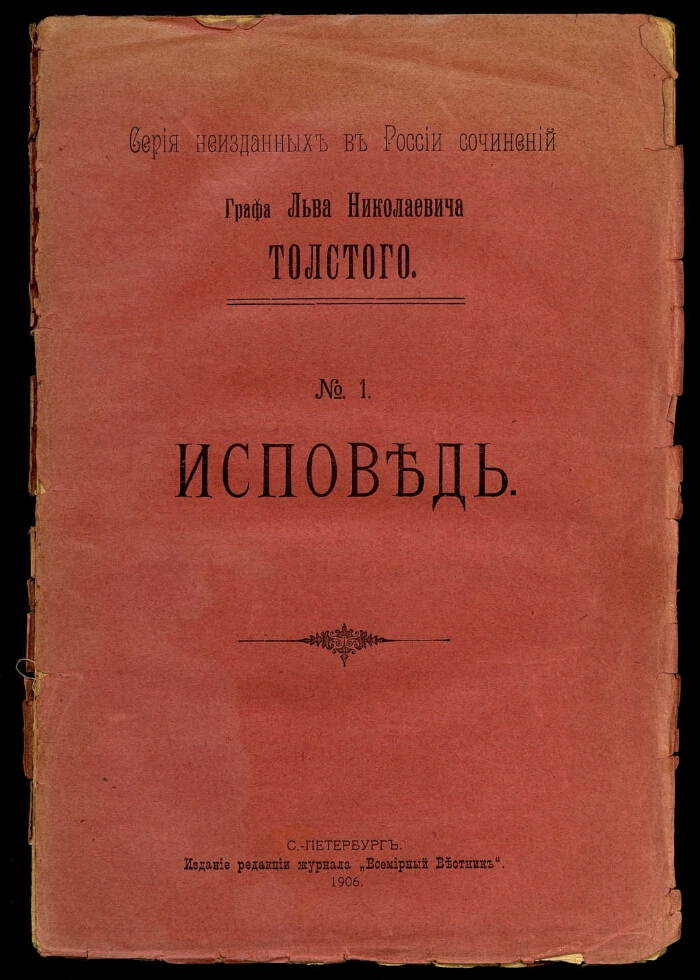
ispoved39).What is not openly available: the manuscripts (ten witnesses documented in the PSS apparatus, held at Yasnaya Polyana and the State Museum of L. N. Tolstoy in Moscow) and the émigré-edition title pages, which are public domain by age but held without open scans and must be requested from the holding institutions. A page image of the English edition opening (Wiener’s Complete Works, vol. XIII, Boston 1904) is held in extracts/ as a public-domain facsimile — but a facsimile of the Russian first edition or a manuscript leaf remains to be acquired.
Method
This was an autonomous (--auto) work-dive run deep, with a heavy visual fan-out. Phase 0 pinned the subject to PSS Tom 23 (text pp. 1–59; plans & variants pp. 488–511; commentary pp. 515–537) and the composition window ~1879–1882. Phase 1 fanned out across the 1878 and 1881–82 diaries (Tom 48–49), the composition-window letters (Tom 62–63), and a broad echo sweep (sibling work, Notes of a Madman, the Dumas letter, prior dives). Phase 2 deep-read the work’s own text and extracted finalists with extract_tei.py --choice=reg (pre-reform orthography resolved); every cited Russian quotation was checked byte-for-byte against its extract (verify_quotes.py, 27/27 pass). Phase 3 added the secondary scholarship layer (web). Phase 4 synthesized this page, the dossier.yaml (evidence, entities, work-record proposal, coverage ledger, scholarship triangulation, visuals), and the draft note. Genuine uncertainties — the 1884 Geneva imprint wording, the identity of the works named in two 1882 letters, the excommunicationRelated field value, and the distinction between the two A. A. Tolstayas — are routed to the dossier’s needsReview, not asserted here.
Links: sibling dives crisis, gospel-translation, tolstoyanism.
References
Primary: L. N. Tolstoy, «Исповедь», PSS (Jubilee Edition) Tom 23 (text, plans & variants, commentary by V. F. Savodnik); tolstoydigital-TEI corpus (diaries Tom 48–49; letters Tom 62–63, 66; В чём моя вера? and Записки сумасшедшего).
Background: Inessa Medzhibovskaya, Tolstoy and the Religious Culture of His Time: A Biography of a Long Conversion (2008); Aylmer Maude, The Life of Tolstoy (1908–10) and the Maude translation A Confession and What I Believe (Oxford, 1921); Ernest J. Simmons, Leo Tolstoy (1946); A. N. Wilson, Tolstoy (1988); Rosamund Bartlett, Tolstoy: A Russian Life (2011); Richard Gustafson, Leo Tolstoy: Resident and Stranger (1986); Donna Orwin, Tolstoy’s Art and Thought 1847–1880 (1993); H. F. Battersby (ed.), Christ’s Christianity (1885); Определение Святейшего Синода (20–22 Feb 1901).
Companion dev-blog note: 2026-06-06-a-confession (draft). Structured evidence, entity routing, the work-record proposal and the coverage ledger are in dossier.yaml.