A corpus-dive across the local Tolstoy corpus (tolstoydigital TEI + the 90-volume Jubilee Edition) and the reader’s own copy of the 1895–96 English edition, on the history of the work that consumed Tolstoy at the turn of the 1880s: his translation and harmonization of the four Gospels into a single narrative (a gospel harmony). Three questions: how and why he did it, what it meant for his family, and how it reached English. Two sibling dives own the adjacent ground and are cross-linked rather than repeated — the fire-metaphor dive for the textual rewrite of the Gospels’ fire and light language, and the Jubilee-Edition / TEI dive for how the corpus and edition are built.
The English source the reader supplied — The Four Gospels Harmonised and Translated, Brotherhood Publishing Co. / Walter Scott, 1895–96 — turns out to carry, at its very front, Tolstoy’s own handwritten authorization of the translation: a primary document for the English-lineage question.
Key findings
- The harmony is the keystone of a four-part project, not a standalone book. In the Gospel in Brief preface Tolstoy lays out the plan: (1) the autobiographical account (A Confession), (2) the critique of church dogma (Critique of Dogmatic Theology), (3) «перевод четырёх Евангелий и соединение их в одно» — the translation and harmony itself, and (4) the exposition of the recovered teaching (What I Believe). The four works of Tom 23–24 are one connected enterprise of 1879–1884.
- It is the product of the conversion, not its cause. Tolstoy says he came to Christianity “at fifty years of age,” in despair, wanting to kill himself — and only then turned to study the Gospels. Scholarship agrees (Matual 1992: “his views gave rise to his gospels”).
- The method was philological and deliberately anti-ecclesiastical. He read the Koine Greek with lexicons, departed from existing translations because they post-dated the church’s fixing of the meaning, and harmonized the four accounts not by historical chronology (as Farrar, Reuss, Grechulevich had) but by the meaning of the teaching — which he saw as a circle, structured into 12 chapters he later found mirrored in the Lord’s Prayer.
- He later judged his own philology too forced. The 1902 “Free Word” preface concedes the work contains «искусственные и, вероятно, неправильные филологические разъяснения» — artificial and probably incorrect philological explanations — a rare self-criticism that the confident Introduction hides.
- The work consumed him and produced nothing the household could use. To Strakhov: «работаю очень много и страстно, хотя ничего не пишу» and «занят работой для себя, которой никогда не напечатаю» — passionate, total labour, uncensorable, unpublishable, unpaid.
- His wife’s diaries are the primary witness to the strain. S. A. Tolstaya names the cause directly — «Он проникся христианством… Я ревную его» — and records his cry that “his most passionate thought is to leave the family” (26 Aug 1882). Yet she also calls the endless, unprintable work “God’s will.” The primary record is more ambivalent than the Sofia-as-victim / Chertkov-as-villain frame of The Last Station and the popular biographies.
- Banned in Russia, it first appeared in Geneva (1892–94), and was not legally published in Russia until 1957 — in the Soviet Jubilee Edition, Tom 24. The local PDF cover confirms the 1957 date.
- The first English translation was anonymous, incomplete, and personally authorized by Tolstoy. The Brotherhood/Walter Scott edition (1895–96) was made “at the request of the author” from the faulty Geneva text, with his autograph imprimatur in facsimile — but only Parts I–II of the projected three appeared, breaking off around chapter VIII of twelve. The one complete English harmony is Leo Wiener’s, in The Complete Works of Count Tolstoy (Dana Estes, 1904).
Why this matters
The platform already documents what Tolstoy did to the Gospel text (the fire-and-light rewrite) and where that text lives (the Jubilee Edition and TEI corpus). What this dive adds is the story of the work as an event in a life: the years 1879–1884 when the author of Anna Karenina stopped writing fiction, taught himself enough Greek to re-translate the New Testament, demolished Orthodox dogmatics, and in the same years pushed his marriage to the edge. It is the hinge between the two Tolstoys — and the primary record lets the project tell that story in its own words, and in his wife’s, rather than through the received “domestic tragedy” narrative.
For the wiki it opens a tight cluster of missing pages — the harmony and the Gospel in Brief as works, the Critique of Dogmatic Theology, Strakhov, the anonymous-then-Wiener English lineage, and the censored Geneva publication — and grounds an update to the existing Sophia Tolstaya page in her own diaries.
The shape of the question
Each stage gives the verbatim Russian (or, for the English edition, the verbatim English source), a working-English translation where needed, and the source. Translations are the dive’s own working renderings, not published ones.
1 — The crisis that sent him to the Gospels
The Gospel in Brief preface states plainly that the translation grew out of a suicidal crisis, not out of scholarship:
«Я был приведен к христианству не богословскими, не историческими исследованиями, а тем, что пятидесяти лет от роду […] я пришел в отчаяние и хотел убить себя […] И я стал изучать христианство.» “I was brought to Christianity not by theological or historical investigations, but by the fact that, at fifty years of age […] I fell into despair and wanted to kill myself […] And I began to study Christianity.” (working English) — Краткое изложение Евангелия, preface, PSS Tom 24
The turn to the Gospels is dated in his own diary to the very entry, 22 May 1878, with which he resumed diary-keeping after a thirteen-year gap:
«Читал Евангелие.» “Read the Gospel.” (working English) — Diary, 22 May 1878, PSS Tom 48
For the vocabulary of the transformation itself — Tolstoy’s own «переворот» rather than “crisis” — see the sibling crisis dive.
2 — Why a new translation: clearing the “mud and silt”
He needed a new translation because the church’s teaching, he concluded, gave no account of life at all:
«В православном вероучении я нашел изложение самых непонятных, кощунственных и безнравственных положений, не только не допускаемых разумом, но совершенно непостижимых и противных нравственности, и — никакого учения о жизни и о смысле ее.» “In the Orthodox creed I found an exposition of the most incomprehensible, blasphemous and immoral propositions — not only inadmissible to reason but utterly incomprehensible and contrary to morality — and no teaching whatever about life or its meaning.” (working English) — Соединение и перевод четырёх Евангелий, Introduction, PSS Tom 24
So he went behind the church to the text, the governing image being a clean spring choked by silt:
«нашел незаконно соединенную с ним грязь и тину, которая одна заслоняла для меня его чистоту; рядом с высоким христианским учением я нашел связанное с ним чуждое ему безобразное учение еврейское и церковное.» “I found, illegitimately joined to it, mud and silt which alone obscured its purity for me; beside the lofty Christian teaching I found bound up with it an alien, ugly Jewish and ecclesiastical teaching.” (working English) — Краткое изложение Евангелия, preface, PSS Tom 24
The polemical demolition of the dogmatic apparatus — project part 2 — is the Critique of Dogmatic Theology, where his verdict on the theologians is sharper than on the avowed sceptics:
«…кощунственные сочинения Вольтера, Юма, но никогда я не испытывал того несомненного убеждения в полном безверии человека, как то, которое я испытывал относительно составителей катехизисов и богословии.» “…the blasphemous writings of Voltaire and Hume — yet never did I feel such a certain conviction of a man’s complete unbelief as the one I felt regarding the composers of catechisms and theologies.” (working English) — Исследование догматического богословия, PSS Tom 23
3 — The method: harmonizing by meaning
He worked from the Greek with lexicons, departing from the received translations on principle:
«Читал я по-гречески, на том языке, на котором оно есть у нас, и переводил так, как указывал смысл и лексиконы.» “I read in Greek, the language in which we have it, and translated as the sense and the lexicons indicated.” (working English) — Соединение и перевод четырёх Евангелий, Introduction, PSS Tom 24
The harmony itself followed by necessity:
«я неизбежно был приведен к необходимости свести четыре Евангелия в одно, так как все они излагают, хотя и разноречиво, одни и те же события и одно и то же учение.» “I was inevitably led to the necessity of bringing the four Gospels together into one, since all of them set out, however divergently, the same events and the same teaching.” (working English) — Tom 24
His criterion was meaning, not chronology — explicitly against his predecessors:
«Попыток соединения Евангелий в одно было много, но те все, которые я знаю, — Arnolde, de Vence, Фаррара, Рейса, Гречулевича, — все они берут исторические основы соединения, и все они безуспешны.» “There have been many attempts to combine the Gospels into one, but all those I know — Arnolde, de Vence, Farrar, Reuss, Grechulevich — all take historical bases for the combination, and all are unsuccessful.” (working English) — Tom 24
«учение истинное представляет как бы круг, которого все части одинаково определяют значение друг друга и для изучения которого безразлично начинание изучения с одного или другого места.» “the true teaching presents itself as a kind of circle, all of whose parts equally define one another’s meaning, and for the study of which it is a matter of indifference where one begins.” (working English) — Tom 24
His warrant for independence from the canonical wording was textual-critical:
«…разночтений евангельских книг насчитывают до пятидесяти тысяч.» “…the variant readings of the Gospel books are counted at up to fifty thousand.” (working English) — Краткое изложение Евангелия, preface, PSS Tom 24
Two decades on, he judged his own philology too forced — the honest counterweight to the Introduction’s confidence:
«…искусственные и, вероятно, неправильные филологические разъяснения, которые не только не усиливают убедительность общего смысла, но должны ослаблять ее.» “…artificial and probably incorrect philological explanations, which not only fail to strengthen the persuasiveness of the general sense but must weaken it.” (working English) — Preface to the “Free Word” edition (1902), in PSS Tom 24
4 — The four-part project and the three redactions
The harmony was step 3 of a planned tetralogy:
«…перевод четырех Евангелий и соединение их в одно.» “…the translation of the four Gospels and their combination into one.” (working English) — Краткое изложение Евангелия, preface, PSS Tom 24
Its architecture, Tolstoy says, emerged from the teaching rather than being imposed on it — and was confirmed, to his “surprise and joy,” by the Lord’s Prayer:
«Разделение Евангелия на 12 или на 6 глав (соединяя по две главы в одну) вытекло само собою из смысла учения.» “The division of the Gospel into 12 chapters (or into 6, joining two chapters into one) emerged of itself from the meaning of the teaching.” (working English) — Tom 24
«…так называемая молитва господня есть не что иное, как в самой сжатой форме выраженное всё учение Иисуса в том самом порядке, в котором были расположены мною главы…» “…the so-called Lord’s Prayer is nothing other than the whole teaching of Jesus expressed in the most condensed form, in the very order in which I had arranged the chapters…” (working English) — Tom 24
The harmony exists in three redactions, all in Tom 24: the full harmony (Соединение и перевод четырёх Евангелий, two-column Greek-and-Russian with commentary), the condensed Gospel in Brief (Краткое изложение Евангелия), and Tolstoy’s own French Abrégé. The fire-metaphor dive shows how a single verse (Luke 12:49) fares differently across them; see its cross-language comparison.
5 — The strain at home
To his confidant Strakhov, in the thick of the work, the labour was total and invisible as output:
«…работаю очень много и страстно, хотя ничего не пишу.» “…I work very much and passionately, though I write nothing.” (working English) — to N. N. Strakhov, 13 Feb 1879, PSS Tom 62
«…занят работой для себя, которой никогда не напечатаю.» “…I am occupied with work for myself, which I shall never print.” (working English) — to N. N. Strakhov, Nov 1879, PSS Tom 62
To his cousin he described himself as a stranger in his own full house:
«…более чуждым всему этому человека трудно себе представить. […] Я счастлив женой и не несчастлив детьми.» “…it would be hard to imagine a person more a stranger to all this. […] I am happy in my wife and not unhappy in my children.” (working English) — to A. A. Tolstaya, 13 Aug 1879, PSS Tom 62
From the other side of the marriage, S. A. Tolstaya’s diaries record the withdrawal — and her own exhaustion — through the same years:
«…он вял, молчалив и сосредоточен. Все читает.» “…he is listless, silent and absorbed. He keeps reading.” (working English) — S. A. Tolstaya, diary, 18 Oct 1878
«Чувствую себя работающей машиной, хотелось бы жизни немного для себя, да нет ее.» “I feel like a working machine; I would like a little life for myself, but there is none.” (working English) — S. A. Tolstaya, diary, 10 Nov 1878
The keystone is her entry of 26 August 1882 — twenty years to the day after she began the diary of her love for him:
«Он сегодня громко вскрикнул, что самая страстная мысль его о том, чтоб уйти от семьи. […] Он проникся христианством и мыслями о самосовершенствованье. Я ревную его…» “Today he cried out aloud that his most passionate thought is to leave the family. […] He has become imbued with Christianity and with thoughts of self-perfection. I am jealous of it…” (working English) — S. A. Tolstaya, diary, 26 Aug 1882
She names the same fact Tolstoy names — that the work cannot be printed — and resigns herself to it:
«…эта работа нескончаемая, потому что не может быть напечатана.» “…this work is endless, because it cannot be printed.” (working English) — S. A. Tolstaya, diary, 5 Mar 1883
And from his side, the household’s verdict on his new conviction:
«…называли сумашедшим, и я чуть было не рассердился.» “…[they] called [me] a madman, and I almost lost my temper.” (working English) — his wife and son Sergei, in Tolstoy’s diary, 16 Apr 1883 — Diary, 16 Apr 1883, PSS Tom 49
The deeper conflict — the renunciation of copyright and property that grew out of these years — is documented in the copyright-renunciation and Biryukov–Sofia dives; here the stressor is the gospel work itself.
6 — Censored in Russia, printed in Geneva
The work could not be published in Russia. It first appeared abroad — in Geneva, through the émigré press (commonly M. K. Elpidin’s, 1892–94) — and the English translator names that censored text as his source:
“owing to the impossibility of its being published in Russia, the Genevan edition is disfigured by numerous typographical mistakes.” — The (anonymous) Translator’s Note, The Four Gospels Harmonised and Translated, Part I (1895)
The full harmony was not legally published in Russia until the Soviet Jubilee Edition — Tom 24, 1957 (confirmed from the local PDF cover). The institutional reckoning came in between: the Holy Synod excommunicated Tolstoy in 1901, citing exactly the denial of church doctrine and the supernatural that the harmony had enacted two decades earlier.
7 — Into English: the imprimatur, the anonymous translator, and Wiener’s completion
In August 1894 Tolstoy announced in the London Daily Chronicle that he would mark the translations he sanctioned:
“The right of translation I freely accord, without exception, to everyone who would like to undertake the trouble of translating. But being eager to have my ideas spread, I also wish them to be correctly interpreted.” — Tolstoy, letter to the Daily Chronicle, 30 Aug 1894 (reprinted in Part I)
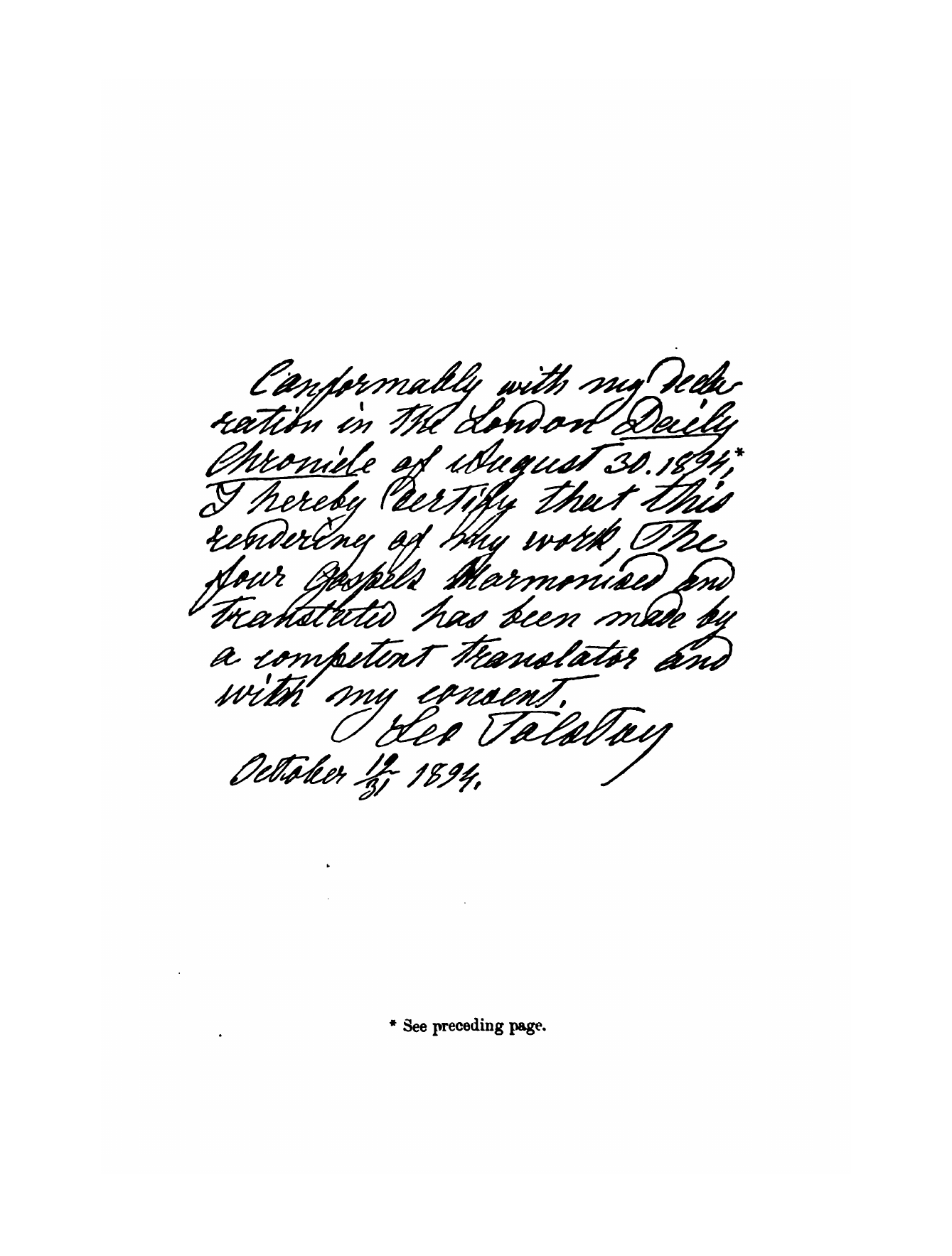
He applied that policy to this very book. At the front of Part I stands his autograph imprimatur, in facsimile:
“I hereby certify that this rendering of my work, The Four Gospels Harmonised and Translated, has been made by a competent translator and with my consent. — Leo Tolstoy. October 19/31, 1894.” — Autograph imprimatur, Part I (transcribed from the facsimile; the date is dual-style — 19 Oct Old Style / 31 Oct New Style)
The translator is named nowhere in the book — only “The Translator,” working “at the request of the author” and described in the Daily Chronicle as “one of the ablest of English scholars in Russia.” Secondary sources attribute the work to John Coleman Kenworthy, leader of the Croydon Brotherhood Church whose press issued it; that attribution is not confirmed by the title page (see Method).
“It is at Count Tolstoy’s express wish that I have undertaken the translation of his book on the Gospels. […] owing to the impossibility of its being published in Russia, the Genevan edition is disfigured by numerous typographical mistakes.” — Translator’s Note, Part I, signed “The Translator,” 21 Sep 1894
The edition was never finished: Parts I (1895) and II (1896) carry the Preface, Introduction and roughly the first eight of the twelve chapters; the projected Part III never appeared, so the Brotherhood harmony breaks off unfinished. The one complete English translation of the full harmony is Leo Wiener’s, in The Complete Works of Count Tolstoy (Boston: Dana Estes, 1904, vols XIV–XV) — whose volume XIV reprints Tolstoy’s own note “From the Author” (Yasnaya Polyana, 29 Aug 1891): the work “is far from being finished, and there are many defects in it.”
Where the theme clusters
The crisis tetralogy — the four connected works of 1879–1884 (all in PSS Tom 23–24):
| Part | Work | PSS | Role in the project | Vault |
|---|---|---|---|---|
| 1 | A Confession (Исповедь) | Tom 23 | The autobiographical account of the crisis; “an introduction to the present work” | exists |
| 2 | Critique of Dogmatic Theology (Исследование догматического богословия) | Tom 23 | Demolition of the church’s dogmatic apparatus | missing |
| 3 | Union and Translation of the Four Gospels (Соединение и перевод четырёх Евангелий) | Tom 24 | The translation + harmony itself (the dive’s subject) | missing |
| 3b | The Gospel in Brief (Краткое изложение Евангелия) + the French Abrégé | Tom 24 | The condensed redactions | missing |
| 4 | What I Believe (В чём моя вера?) | Tom 23 | Exposition of the recovered teaching | missing |
Where the family strain clusters (the household witnesses, 1878–1883):
| Source | Date | Voice | What it shows |
|---|---|---|---|
| Diary, Tom 48 | 22 May 1878 | Tolstoy | “Read the Gospel” — the work begins as the diary resumes |
| Letter, Tom 62 | 13 Feb 1879 | Tolstoy → Strakhov | “I work passionately… though I write nothing” |
| Letter, Tom 62 | Aug 1879 | Tolstoy → A. A. Tolstaya | “a stranger to all this… not unhappy in my children” |
| Letter, Tom 62 | Nov 1879 | Tolstoy → Strakhov | “work for myself, which I shall never print” |
| Diary (witness) | Oct–Nov 1878 | S. A. Tolstaya | “listless, silent… he keeps reading”; “a working machine” |
| Diary (witness) | 28 Feb 1882 | S. A. Tolstaya | his “Christian mood” incompatible with the household |
| Diary (witness) | 26 Aug 1882 | S. A. Tolstaya | the keystone: “imbued with Christianity… I am jealous of it” |
| Diary (witness) | 5 Mar 1883 | S. A. Tolstaya | “this work is endless, because it cannot be printed” |
| Diary, Tom 49 | 16 Apr 1883 | Tolstoy | the family call him “a madman” |
The English editions (the lineage):
| Edition | Translator | Publisher / place | Year | Completeness |
|---|---|---|---|---|
| The Four Gospels Harmonised and Translated, Parts I–II | Anonymous (“The Translator”; attrib. J. C. Kenworthy, unconfirmed) | Brotherhood Publishing Co., Croydon / Walter Scott, London | 1895–96 | Incomplete — Parts I–II of three; Part III never published |
| The Four Gospels Harmonized and Translated (Complete Works, vols XIV–XV) | Leo Wiener | Dana Estes, Boston | 1904 | Complete full harmony |
| The Gospel in Brief | Anonymous (sometimes attrib. Isabel Hapgood, unconfirmed) | T. Y. Crowell, New York | 1896 | The condensed redaction |
| The Gospel in Brief | Aylmer Maude | (Free Age Press / Oxford) | 1921 | The condensed redaction |
| The Gospel in Brief | Dustin Condren | HarperCollins, New York | 2011 | The condensed redaction |
Scholarly context
The dive’s spine is the primary record; conventional scholarship is read here as a contrast, not a baseline. Where the corpus and the literature meet, the picture is this.
On the project as a whole, the received view confirms the dive’s framing: David Matual’s Tolstoy’s Translation of the Gospels (1992) — the one book-length English study — states that “Tolstoy’s gospel did not lead to his religious views, but that his views gave rise to his gospels,” exactly the order the Gospel in Brief preface gives. A. N. Wilson (Tolstoy, 1988) describes how he “actually rewrote the gospels,” keeping the ethics and discarding the supernatural; Richard Gustafson (Resident and Stranger, 1986) resists the “two Tolstoys” split, making the gospel work central rather than an aberration; Inessa Medzhibovskaya (Tolstoy and the Religious Culture of His Time, 2008) reframes the turn as a long, coherent conversion rather than a breakdown — consistent with the crisis dive’s finding that Tolstoy called it a «переворот», not a “crisis.” On method, general reference works confirm the Greek-and-lexicons, harmonize-by-meaning, excise-the-supernatural account (Britannica), and note that a Greek tutor (I. M. Ivakin) assisted him.
Where the dive extends the literature is in Tolstoy’s own self-criticism: his 1902 admission of “artificial, probably incorrect” philology is rarely foregrounded, though it is printed in the work’s own preface.
On the family, the dive complicates the dominant popular frame. Alexandra Popoff’s Sophia Tolstoy (2010), William Shirer’s Love and Hatred (1994), and the film The Last Station (2009) cast the religious turn as a domestic tragedy with Chertkov as usurper and Sofia as victim. The primary record is more ambivalent: S. A. Tolstaya’s own diary both names the cause without flinching («проникся христианством… я ревную его») and accepts the endless, unprintable work as “God’s will” — and Popoff herself notes that Sofia was, for years, “remarkably supportive” and central to Tolstoy’s fame. The movement-label “Tolstoyan” that clings to this story is one Tolstoy himself rejected as “a great and gross error”; it is attributed here, not endorsed.
Material not covered
- The textual fire/light rewrite of the Gospels (John 1 Logos → разумение, the hell-fire excisions, Luke 12:49 kept and amplified) is owned by the fire-metaphor dive and only summarized here.
- The edition/corpus anatomy (how Tom 24 sits in the 90-volume PSS, the TEI document model, the digitisation chain) is owned by the Jubilee-Edition / TEI dive.
- S. A. Tolstaya’s diary is near-silent in 1879–1881 — the densest work years — so the family evidence for that window leans on Tolstoy’s letters. A fuller pass over the children’s memoirs (Ilya, Sergei, Tatyana) and Gusev’s chronicle in the witness corpus remains.
- The downstream English Gospel-in-Brief editions (Crowell 1896; Maude 1921; Condren 2011) and Wiener’s 1904 complete harmony are documented from the local copies and the web, not collated line-by-line against the Russian.
- N. N. Strakhov’s side of the correspondence (his recorded objection that the harmony bent scripture to Tolstoy’s convictions) is noted from scholarship but not read in the witness corpus.
Visual & manuscript record
Held and public-domain (committed facsimiles, rendered from the 1895 English volume):
- Tolstoy’s autograph imprimatur authorizing the English translation (Part I, 1894) — the keystone.
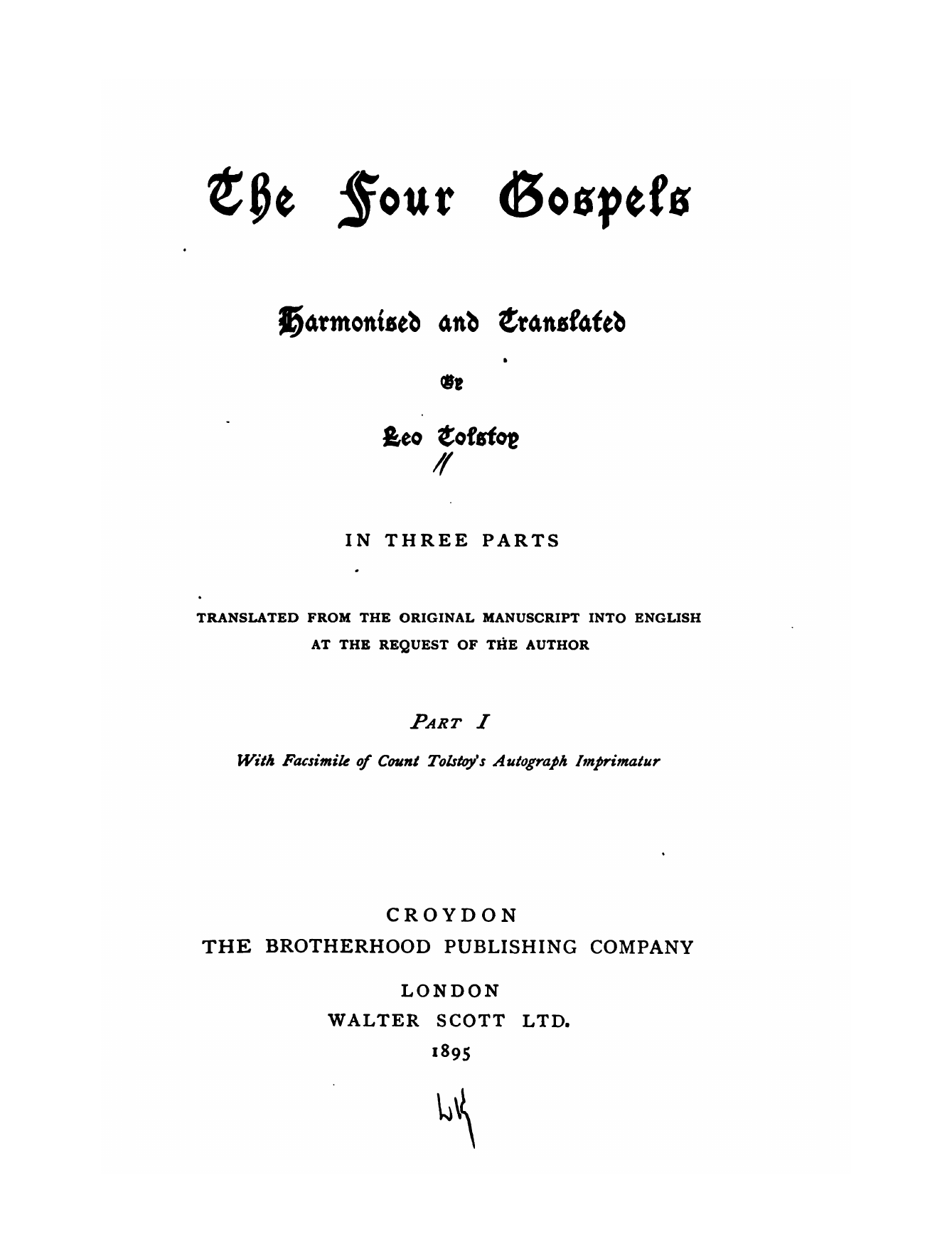
extracts/facsimile-english-imprimatur-1894.png - The title page of Part I (Brotherhood / Walter Scott, 1895).
extracts/facsimile-english-titlepage-1895.png
Public-domain photographs and portraits (local cache; refetch via docs/fetch_visuals.py gospel-translation):
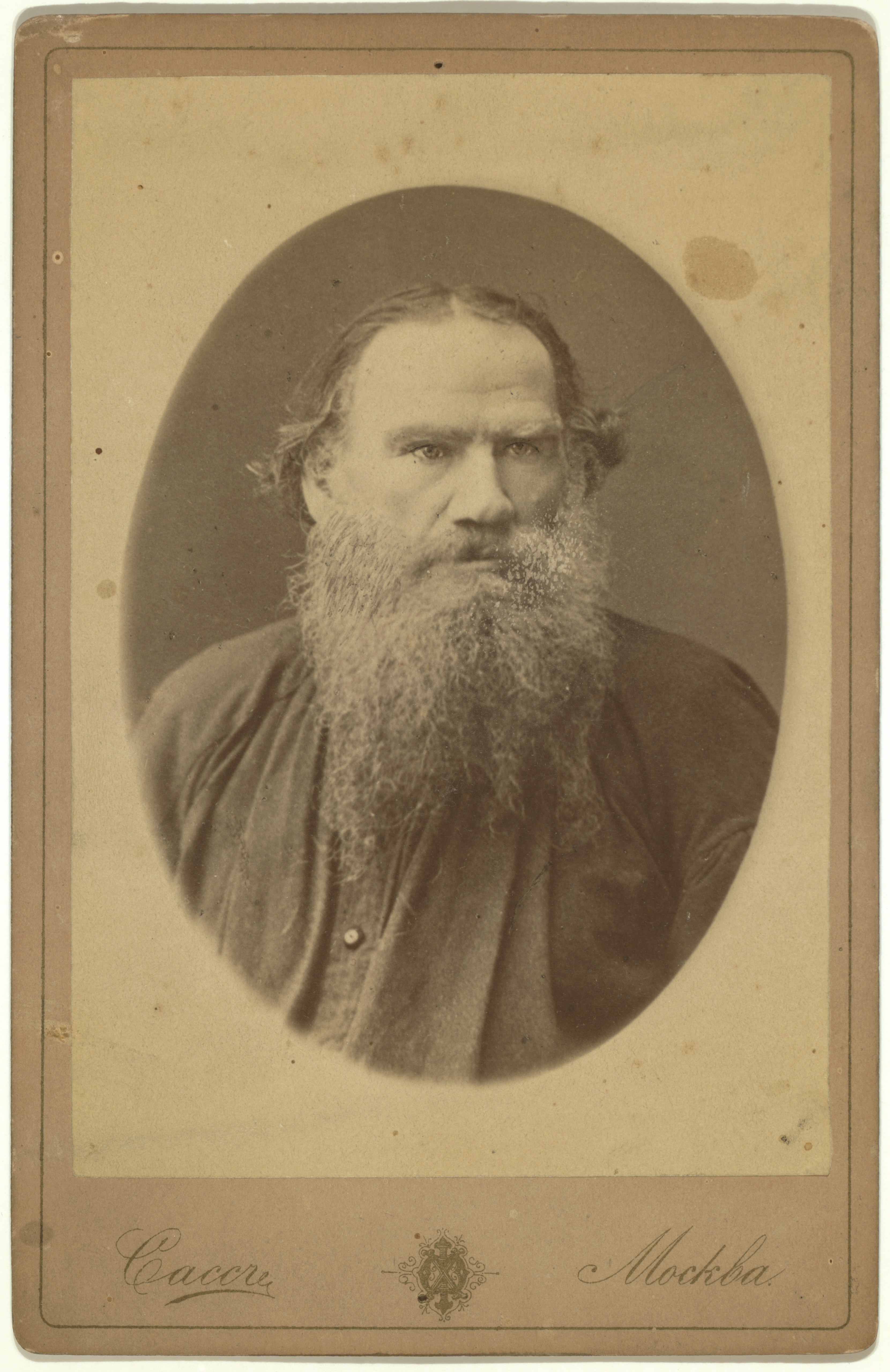
- Leo Tolstoy, 1880 — the year he began the harmony (Library of Congress / Commons).
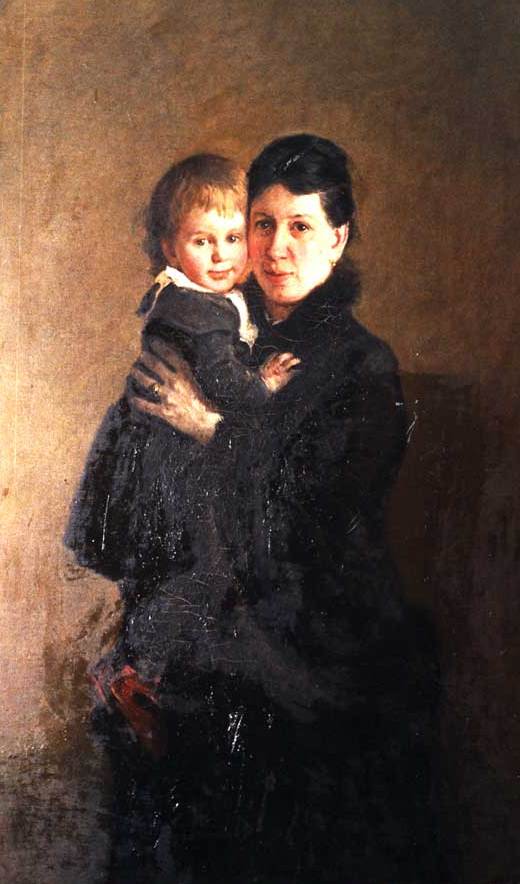
- Sofia Andreevna Tolstaya — Nikolai Ge’s 1886 portrait (Yasnaya Polyana Museum / Commons), and a c.1875 photograph (the “before”).
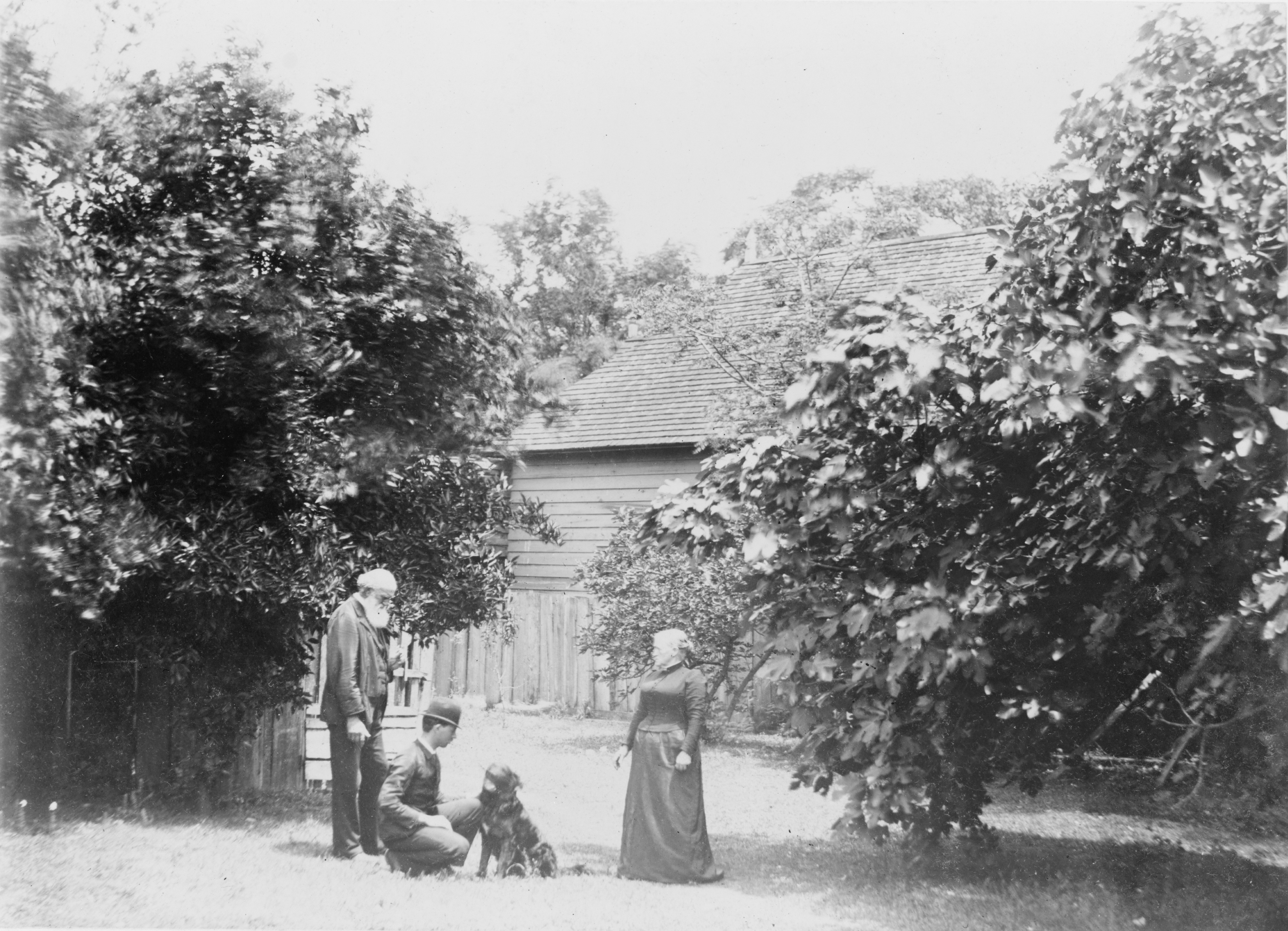
- The Tolstoy family — Ge’s 1886 group, and an informal Yasnaya Polyana snapshot of Tolstoy with his wife, a son and a dog (Library of Congress / Commons).
Not openly available — would have to be requested:
- An image of the censored Geneva (Elpidin) first edition — no PD title page or portrait of Elpidin was located.
- Autograph manuscript pages of the harmony from the State Tolstoy Museum or Goskatalog (the committed facsimiles are print-edition / printed-book pages, not autograph drafts).
Method
Scope (confirmed with the reader before the sweep): the history of the gospel-translation project, its family-life strain, and the English lineage, with the fire metaphor and the corpus/edition anatomy cross-linked to their existing dives rather than re-derived; period extended back to the 1878–79 crisis onset, with the publication afterlife to 1957/2011. Sweep mode: fan-out — three parallel read-only subagents over non-overlapping territory (family-life sweep across diaries/letters/witness-diaries; history-and-method extraction from Tom 23–24; English-lineage mining of the local 1895–96 / 1896 / 1904 editions), deduplicated centrally. Finalists were extracted with extract_tei.py; every Russian quotation was checked byte-for-byte against its extract by verify_quotes.py (28/28 verbatim, including three English-source rows verified against a transcription file). Two keystone facsimiles — the autograph imprimatur and the title page — were rendered at 220 dpi from the public-domain 1895 volume. A Wikimedia Commons visual sweep (Sofia, the family, Tolstoy 1880) had licences verified via the API. Scholarship was a separate, lighter web sweep, attributed and triangulated, never used as a baseline to confirm. A human-judgment verifier pass ran in a fresh context.
Open items carried to needsReview: the anonymous translator of the 1895–96 edition (attributed to J. C. Kenworthy by secondary sources, not confirmed by the title page); the Geneva/Elpidin first-publication details (publisher/dates standard in scholarship but not confirmed against a primary catalogue here); the translator’s-note dating (“nearly eighteen years ago,” i.e. ~1876, vs the documented 1880–81 composition — do not propagate 1876); I. M. Ivakin as Greek tutor (secondary only); the 1896 Crowell Gospel in Brief translator (anonymous; sometimes attributed to Isabel Hapgood); and the exact final chapter of the Walter Scott Part II.
Links: sibling dives — the fire metaphor (the textual rewrite of the Gospels’ fire and light), the Jubilee Edition & TEI corpus (where Tom 24 lives), the crisis (the «переворот» behind Confession), copyright renunciation and Biryukov & Sofia (the family conflict’s later, property dimension), and the “Tolstoyan” label.
References
Primary — L. N. Tolstoy, Полное собрание сочинений (Jubilee Edition, 90 vols): Соединение и перевод четырёх Евангелий, Краткое изложение Евангелия, Abrégé de l’Évangile (Tom 24, publ. 1957); Исповедь, Исследование догматического богословия, В чём моя вера? (Tom 23); Diaries (Tom 48–49); Letters to N. N. Strakhov and A. A. Tolstaya (Tom 62). S. A. Tolstaya, Дневники, 1862–1900 (witness corpus). English editions: The Four Gospels Harmonised and Translated, Parts I–II, trans. anon. (Croydon: Brotherhood Publishing Co. / London: Walter Scott, 1895–96), with Tolstoy’s autograph imprimatur; The Gospel in Brief (New York: T. Y. Crowell, 1896); The Four Gospels Harmonized and Translated, trans. Leo Wiener, in The Complete Works of Count Tolstoy, vols XIV–XV (Boston: Dana Estes, 1904).
Background — David Matual, Tolstoy’s Translation of the Gospels: A Critical Study (Edwin Mellen, 1992); Richard F. Gustafson, Leo Tolstoy: Resident and Stranger (Princeton, 1986); Inessa Medzhibovskaya, Tolstoy and the Religious Culture of His Time (Lexington, 2008); Rosamund Bartlett, Tolstoy: A Russian Life (2010); A. N. Wilson, Tolstoy (1988); Alexandra Popoff, Sophia Tolstoy: A Biography (Free Press, 2010); William L. Shirer, Love and Hatred: The Troubled Marriage of Leo and Sonya Tolstoy (1994); The Last Station (film, dir. M. Hoffman, 2009); Leo Tolstoy, The Gospel in Brief, trans. Aylmer Maude (1921) and trans. Dustin Condren (HarperCollins, 2011); Caleb Thompson, “Wittgenstein, Tolstoy and the Meaning of Life,” Philosophical Investigations (1997).
Companion dev-blog note: website/src/posts/notes/2026-06-05-gospel-translation.md (draft). Machine-readable dossier: dossier.yaml.