What I Believe (В чём моя вера?)
A work-focused dive across the local Tolstoy corpus: the PSS (Jubilee Edition) Tom 23 text, its plans and variants and editorial commentary, the composition-window diaries (Tom 49, 1883) and letters (Tom 63), the sibling works, and the project’s prior dives. All Russian quotations are byte-faithful extracts (verified, 24/24); English renderings are working translations; dates are Old Style (Julian) unless noted. Secondary scholarship is attributed, not asserted.
Key findings
- What I Believe is the doctrinal sequel to A Confession — it opens exactly where the earlier book ends («Пять лет тому назад я поверил в учение Христа») — and the third panel of the four-part Prophet-period project, whose first two members Tolstoy names inside its own first chapter: the Critique of Dogmatic Theology and the Gospel Harmony.
- Its keystone is a single verse read literally — Matthew 5:39, «не противься злу» (resist not evil) — which Tolstoy calls «центр тяжести всей мысли», the centre of gravity of the whole teaching. From the literal reading follows a total renunciation of violence («никогда не делай насилия»), and from that the rejection of law-courts, oaths, military service and the state. It is the foundational text of what would later be labelled Christian anarchism — a label to be attributed to its users, not adopted here.
- The book distils the Sermon on the Mount into five binding commandments (be not angry; commit no adultery / abandon no spouse; swear no oaths; resist not evil; love all people without national distinction), whose single aim is «мир между людьми» — peace among people. Tolstoy argues, on philological grounds, that the qualifier «напрасно» (“without cause,” Matt 5:22) is a later interpolation that guts the first commandment.
- The genesis is doubly grounded in the corpus: a long letter to M. A. Engelhardt of late 1882 (the apparatus dates it late December 1882 – mid-January 1883) already states the five commandments outright and calls non-resistance «смыкающее звено всего учения»; and V. G. Chertkov’s letter of 9 March 1883 — «вызывает написать о заповедях для народа» — is the proximate catalyst recorded in the diary. The work was written through 1883 and finished in Moscow on 22 January 1884.
- It was suppressed but not destroyed. Printed in about 50 copies (Kushnerev, Moscow) in the hope that scarcity and a 25-rouble price would slip it past the censor, it was banned unconditionally on 14 February 1884 and 39 copies were seized on 18 February — but not burned: confiscated to Petersburg, read by the very officials who banned it, and dispersed into private libraries. It then circulated in paid manuscript and lithograph copies, appeared first in print abroad (the French Ma religion, Paris 1885; full Russian text from M. Elpidine in Geneva), and was legally printed in Russia only in 1906 — all within Tolstoy’s lifetime.
- As with A Confession, the work has no
works/record yet — so this dive doubles as the source-grounded basis for creating it.
Why this matters
A Confession told how Tolstoy lost and recovered the will to live; What I Believe is where that recovered faith hardens into a binding ethic and a verdict on the whole order of the world. This is the book in which the private conversion becomes public dissent: by reading «не противься злу» as a law rather than a counsel of perfection, Tolstoy sets the Gospel directly against the army, the courts, the oath and the state — and so writes the text on which the later movement, and the long conflict with the Church, would be built. It is also the most argued and least narrative of the early religious works: where A Confession persuades by confession, this one persuades by exegesis.
The shape of the question
The title is a question, and the book is its answer. Tolstoy states at the outset that he is not interpreting Christ but reporting what changed in him.
Я не толковать хочу учение Христа, я хочу только рассказать, как я понял то, что есть самого простого, ясного, понятного и несомненного, обращенного ко всем людям в учении Христа, и как то, что я понял, перевернуло мою душу и дало мне спокойствие и счастие.
I do not want to interpret Christ’s teaching; I want only to tell how I understood what is simplest, clearest, most comprehensible and indubitable in it, addressed to all people, and how what I understood overturned my soul and gave me peace and happiness. (working English — PSS Tom 23, opening)
The whole turn rests on one verse, which he says he had for years read straight past.
Я понял в первый раз, что центр тяжести всей мысли в словах: «не противься злу», а что последующее есть только разъяснение первого положения.
I understood for the first time that the centre of gravity of the whole thought lies in the words “resist not evil,” and that what follows is only an elucidation of that first proposition. (working English — PSS Tom 23, ch. I)
Read literally, the verse forbids not suffering but violence — and admits no exception.
Не противься злому — значит не противься злому никогда, т. е. никогда не делай насилия, т. е. такого поступка, который всегда противоположен любви.
Resist not evil — means resist not evil ever, that is, never do violence, that is, never do an act that is always the opposite of love. (working English — PSS Tom 23, ch. II)
Genesis & composition
The book’s doctrine was fixed in Tolstoy’s mind before he began the book. In a long letter to the young correspondent M. A. Engelhardt at the end of 1882 — the letter the Jubilee editors identify as the work’s starting point — he had already set down its whole scaffold.
1) Не сердись; 2) Не блядуй; 3) Не клянись; 4) Не судись и 5) Не воюй. Воть в чем для меня сущность учения Христа.
1) Do not be angry; 2) Do not fornicate; 3) Do not swear oaths; 4) Do not go to law; 5) Do not make war. That is the essence of Christ’s teaching for me. (working English — letter to M. A. Engelhardt, late December 1882 – mid-January 1883 OS, PSS Tom 63; the same letter calls non-resistance «смыкающее звено всего учения» — the linking link of the whole teaching.)
The decision to turn this into a book “for the people” has a precise trigger in the diary: a letter from V. G. Chertkov, whose first sustained correspondence with Tolstoy runs all through 1883.
Письмо Черткова — вызывает написать о заповедях для народа. Кажется, что надо. Это захватило меня, но не знаю.
A letter from Chertkov — urges me to write about the commandments for the people. It seems I must. It has seized me, but I don’t know. (working English — diary, 9 March 1883 OS, PSS Tom 49)
What followed was a year of strained, stop-start drafting, recorded almost daily in the 1883 diary — the only sustained diary Tolstoy kept across the whole composition.
Утром опять попытался. И решительно — не могу продолжать свою статью. Тонкости, и потому будет ложь.
In the morning I tried again. And decisively — I cannot continue my article. Subtleties, and therefore it will be a lie. (working English — diary, 28 April 1883 OS, PSS Tom 49)
The work began as autobiographical notes — Tolstoy reused the opening of his 1881 diary «Записки христианина» (Notes of a Christian), retitled it «Записки моей жизни 1881 года», then dropped the notes form. The people around the composition are named in the same diary: Chertkov above all (by letter, and two Moscow meetings — the famous first Yasnaya visit falls just after the 1883 diary ends), the painter N. N. Ge, who stayed at Yasnaya in July and read Matthew with him, the Tula vice-governor and future translator L. D. Urusov, N. N. Strakhov, the poet Fet, and his brother Sergei, to whom in June he “for the first time in my life told the whole weight of my position.” The manuscript was given to Русская мысль in September 1883, then withdrawn for its size; Tolstoy worked the proofs through the autumn (losing a suitcase of them from a cab in November) and delivered the last sheets on 10 January 1884.
Не могу себе представить, чтò сделает цензура. Пропустить нельзя. Не пропустить тоже, мне кажется, в их видах нельзя.
I cannot imagine what the censorship will do. To pass it is impossible. Not to pass it, it seems to me, is also against their interest. (working English — letter to A. N. Pypin, 10 January 1884 OS, PSS Tom 63 — written the day he took the last sheets to the printer.)
What the work says
The text moves in twelve chapters from a personal discovery to a systematic ethic and a closing credo.
Chapters I–II set the discovery: for years Tolstoy read Matthew 5:39 with «странное затмение», a strange blindness, skipping the words «а я говорю: не противься злу»; once he reads them straight, “everything that was confused became clear.” The Church’s teaching that the commandment is divine but unfulfillable without grace he diagnoses as the mechanism that quietly cancels it — «поставить машину… но не надеть передаточного ремня» (to set up the engine but not put on the drive-belt). A Moscow rabbi (S. A. Minor, with whom he was reading Hebrew) sharpens the point by asking whether Christians actually turn the other cheek.
Chapter III makes the leap from private counsel to public order: non-resistance cannot be confined to personal life, because the state conscripts every person into courts, juries and armies.
Личная моя жизнь переплетена с общей государственной, а государственная требует от меня нехристианской деятельности, прямо противной заповеди Христа.
My personal life is interwoven with the common life of the state, and the state demands of me un-Christian activity directly contrary to Christ’s commandment. (working English — PSS Tom 23, ch. III)
Chapters IV–VI build the positive doctrine. Tolstoy reads «не судите» (Matt 7:1 / Luke 6:37) not as a rule against gossip but as a prohibition of the law-courts themselves, defends the reading philologically (κρίνω / καταδικάζω = to sentence, not to slander), and then distils the Sermon on the Mount into the five commandments, whose first he states as a textual correction.
И вот вместо туманных, подлежащих толкованиям и произволу, неопределенных и неважных выражений открылась мне с стиха 21—28 простая, ясная и определенная первая заповедь Христа: живи в мире со всеми людьми, никогда своего гнева на людей не считай справедливым.
And so, instead of vague, arbitrarily interpretable, indefinite and unimportant expressions, there opened to me from verses 21–28 the simple, clear, definite first commandment of Christ: live in peace with all people, never consider your anger at people just. (working English — PSS Tom 23, ch. VI)
И вот эти пять заповедей его действительно дают этот мир людям. Все пять заповедей имеют только одну эту цель — мира между людьми.
And these five commandments of his do really give people this peace. All five commandments have only this one aim — peace among people. (working English — PSS Tom 23, ch. VI)
The middle and late chapters (VII–XI) reground the whole: the meaning of life is not personal survival but «жизнь сына человеческого» — service of the will of the Father, here, now — and the Church’s doctrines of redemption and bodily resurrection are read as obscuring that practical teaching. The final chapter is a credo that recapitulates the five commandments as five «соблазны» (snares) renounced.
Я верю в учение Христа, и вот в чем моя вера.
I believe in Christ’s teaching, and this is what my faith consists in. (working English — PSS Tom 23, ch. XII)
The book ends not on argument but on the “little flock,” and the colophon «Москва. 22 января 1884 г.»
Не бойся, малое стадо, ибо отец ваш благоволил дать вам царство (Лук. XII, 32).
Fear not, little flock, for it is your Father’s good pleasure to give you the kingdom (Luke XII, 32). (working English — PSS Tom 23, ch. XII, closing words)
Redactions & textual history
The Jubilee apparatus (V. F. Savodnik) enumerates twenty manuscript witnesses plus surviving galleys. The work passed through a long chain of copies in the hands of the copyist A. P. Ivanov and of S. A. Tolstaya (one of four copyists of the typesetting manuscript), with Tolstoy’s corrections growing heavier toward the end: in November 1883 S. A. Tolstaya reported that “двух слов не осталось подряд из старой рукописи, всё переделано” — not two words left in a row from the old manuscript. The title itself was the last thing to settle, migrating across one manuscript from «Как мне открылось учение Христа» → «Как мне открылся смысл учения Христа» → «В чём христианское учение» → the final «В чём моя вера?». The conclusion, which Tolstoy thought the most important part, survives in four separate drafts. The complete manuscript (no. 7, 622 leaves), still headed «Записки моей жизни 1881-го года», entered the Imperial Public Library in 1884 through N. N. Strakhov. One draft is written on the back of a Tula District Court summons of 1 September 1883 calling Tolstoy to jury service — the very institution the book condemns.
Publication, censorship & translation
The publication history is a history of suppression that failed.
The plan to print in Русская мысль was dropped for the work’s length; instead about 50 copies were printed separately at Kushnerev’s Moscow press, priced at 25 roubles, in the hope that a tiny, expensive edition might be passed. It was not. On 14 January 1884 the chair of the Moscow Censorship Committee, V. Fyodorov, reported the book «крайне вредной» — extremely harmful, undermining the foundations of state and church; it went to the Spiritual Censorship Committee, whose report (Archpriest M. Bogolyubsky) charged that it presented “socialism, communism and the like” as parts of Christ’s teaching and invoked article 239 of the censorship statute. On 14 February 1884 the head of the Main Directorate for Press Affairs, E. M. Feoktistov, ordered the work’s unconditional prohibition; on 18 February the printing inspector seized 39 copies at Kushnerev’s. But the seized edition was not destroyed.
Она вышла и запрещена; но не сожжена, а увезена в Петербург, где, сколько мне известно, те, которые запретили ее, разбирают ее по экземплярам и читают. И то хорошо. У меня есть и будут рукописные экземпляры — плачу я за переписку по 15 р.
It came out and was banned; but not burned — taken to Petersburg, where, as far as I know, those who banned it are sharing the copies among themselves and reading it. That is something at least. I have and will have manuscript copies — I pay 15 roubles for the copying. (working English — letter to A. S. Buturlin, 19 February 1884 OS, PSS Tom 63)
According to N. N. Bakhmetyev’s later account, ministers, court officials and members of the Press Directorate all requested copies, and the entire banned edition dispersed into private libraries, some volumes later resold by antiquarian booksellers for hundreds of roubles. The text also spread, like A Confession, in manuscript, hectographed and lithographed copies. Tolstoy’s own image for the moment, in a letter answering a drawing by the painter Ge, was unsparing.
мы переживаем не период проповеди Христа, не период воскресения, a период распинания.
we are living through not the period of Christ’s preaching, not the period of resurrection, but the period of crucifixion. (working English — letter to N. N. Ge, 2 March 1884 OS, PSS Tom 63)
In print the work first appeared abroad and in translation. The French Ma religion (Paris, 1885), translated by L. D. Urusov and reviewed and hand-corrected by Tolstoy himself, came first; a German Worin besteht mein Glaube? (trans. Sophie Behr) and an English version — folded into Christ’s Christianity alongside A Confession and the Gospel in Brief — followed the same year. The full Russian text appeared in Geneva from M. Elpidine (undated first edition; further editions 1888, 1892, 1900), and at Christchurch in V. G. Chertkov’s «Свободное слово» series (1902). Inside Russia, readers could legally see only a fragment of chapter X (printed as «В чём счастье?» in Русское богатство, 1886) and the excerpts quoted inside hostile church refutations, until the work was at last printed legally in 1906 (Всемирный вестник; Posrednik).
Reception & afterlife — the Russian society and Church reaction
For Russian readers the strange fact is that the book was first known largely through its refutations. Because the text itself was banned, the excerpts most people saw were those quoted to be condemned, in a sustained church-polemical literature: A. F. Gusev of the Kazan Spiritual Academy («Исповедь графа Л. Н. Толстого и его мнимоновая вера», Православное обозрение, 1886), Alexander Orfano (1887), and I. A. Karyshev («Православно-христианский взгляд… на сочинение „В чём моя вера?”», 1891). The official verdicts had already named the danger precisely — the secular censor’s «крайне вредная книга… подрывает основы государственных и общественных учреждений», the spiritual censor’s charge of socialism-as-gospel — and behind the suppression stood the Ober-Procurator of the Holy Synod, K. P. Pobedonostsev, whom S. A. Tolstaya named as the likely banner even as a sympathetic archimandrite was said to admire the book.
Tolstoy himself recorded the reception in one sentence, to his Orthodox cousin, and it is a map of refusal from every direction at once.
Одни — либералы и естетики считают меня сумашедшим или слабоумным в роде Гоголя; другие — революционеры, радикалы считают меня мистиком, болтуном; правительственные люди считают меня зловредным революционером; православные считают меня диаволом.
Some — liberals and aesthetes — think me mad or feeble-minded like Gogol; others — revolutionaries, radicals — think me a mystic, a windbag; government people think me a noxious revolutionary; the Orthodox think me the devil. (working English — letter to Countess A. A. Tolstaya, 1884 OS, PSS Tom 63)
Yet the banned text was already reaching readers it would keep: by mid-1884 a serving army officer wrote to Tolstoy that the book had changed his view of life and his sense of his service — and Tolstoy answered that the truth in it «не мои (Льва Николаевича) мысли, а это истина Божеская» (not my, Lev Nikolaevich’s, thoughts, but God’s truth). The clerical hostility hardened early: already in the 1880s John of Kronstadt is reported to have called Tolstoy a heretic surpassing all heretics. The doctrine of What I Believe — non-resistance, the rejection of oaths, courts, military service and Church sacraments — is the core of the teaching the Holy Synod would condemn as a whole in its edict of February 1901. But that edict, read in full, names no individual works; What I Believe should be understood as central to the long conflict the book opened, not tied to the excommunication by name. (The roles do not even line up tidily: Pobedonostsev, who stood behind the 1884 suppression, is reported to have opposed the 1901 edict, fearing it would amplify Tolstoy’s appeal. Pål Kolstø’s Heretical Orthodoxy (2022) is the recent authoritative account.)
Place in the cluster
What I Believe is the third panel of the four-part Prophet-period enterprise (Confession → Critique of Dogmatic Theology → Gospel Harmony → What I Believe), and the one in which the project’s argument turns outward into politics. It opens on the sentence that closes the dive on its predecessor.
Пять лет тому назад я поверил в учение Христа — и жизнь моя вдруг переменилась
Five years ago I came to believe in Christ’s teaching — and my life suddenly changed. (working English — PSS Tom 23, opening)
For the conversion narrative it continues, see this project’s dive on A Confession; for the gospel scholarship it presupposes and names, the gospel-translation dive; for the surrounding upheaval, the crisis dive. The political teaching this book founds — the rejection of the state on Gospel grounds — is the subject of the christian-anarchism dive; and the movement-label that later attached to Tolstoy’s followers, to be attributed to its users rather than adopted, is interrogated in the tolstoyanism dive. By the end of 1884 Tolstoy had already moved on to the next question — «Я теперь печатаю статью… о собственности», the work that became Так что же нам делать? (What Then Must We Do?).
Scholarly context
The mainstream English biography treats What I Believe (often under its other title, My Religion) as the systematic statement of the faith A Confession announced — Aylmer Maude’s standard translation (Oxford, 1921) literally bound the two together as a unit. Two fault-lines in the scholarship bear on this dive. The first is continuity versus rupture: where Ernest Simmons (1946) and A. N. Wilson (1988) work within a “two Tolstoys” frame that makes the religious writing a symptom of a mid-life break, Inessa Medzhibovskaya’s A Biography of a Long Conversion (2008) and Richard Gustafson’s Resident and Stranger (1986) read the same material as the systematic statement a decades-long arc arrives at — the readings closest to what the corpus shows. The second is the status of non-resistance itself: Alexandre Christoyannopoulos, Elena Stepanova and others take it as a coherent programme, while Wilson frames Tolstoy’s literal Sermon-on-the-Mount as “a counsel of craziness” whose thirty-year demonstration is its own impossibility — a framing the text itself anticipates and argues against, since the “impractical counsel” objection is precisely what What I Believe sets out to refute, not concede. The movement-label “Christian anarchism” is the scholars’ taxonomy (Christoyannopoulos), not Tolstoy’s word; this dive attributes it rather than adopting it, and points to the project’s christian-anarchism dive.
Set against that received view, the corpus evidence falls out as follows.
- The doctrinal sequel — confirms. That What I Believe is the systematic continuation of A Confession is the settled scholarly reading (Maude’s paired translation); the corpus grounds it in Tolstoy’s own hand, since he names the two prior works inside chapter I.
- Non-resistance as the keystone — confirms / extends. Scholars identify Matthew 5:38–42 as the pivot; the corpus supplies Tolstoy’s own term for it — «центр тяжести всей мысли» — which the literature paraphrases without the verbal source.
- The five commandments and the «напрасно» interpolation — extends. The five commandments are recognized as the doctrinal core, but Tolstoy’s textual-critical argument that «напрасно» (Matt 5:22) is a later corruption is generally not developed at the precision the text sustains.
- The double-anchored genesis — extends. Standard biographies present the book as issuing from the 1879–82 gospel study; none identifies the December-1882 Engelhardt letter (which already lists the five commandments) and Chertkov’s 9 March 1883 prompting as the two precise anchors.
- The ban that was not a burning — complicates. Scholarship notes the ban and the Geneva publication, but the tidy “suppressed → Geneva” story passes over the documented dispersal of the seized edition into the libraries of the very officials who banned it (preserved in Bakhmetyev’s account in the PSS apparatus).
Material not covered
- О верах (Tom 26, an 1886 fragment) is a peripheral later echo, noted but not deep-read.
- The exact year and title-page wording of M. Elpidine’s first Geneva edition (undated in the apparatus).
- Tolstoy’s later (post-1884) explicit verdicts on the work itself were not extracted; the December 1884 turn to What Then Must We Do? is the nearest corpus marker.
- A full reading of the church-refutation literature (Gusev 1886; Orfano 1887; Karyshev 1891), which is named here from the PSS commentary, not read in the original.
- The first Tolstoy↔Chertkov correspondence of 1883 (PSS Tom 85) was not swept; the relationship is documented here from the 1883 diary.
Visual & manuscript record
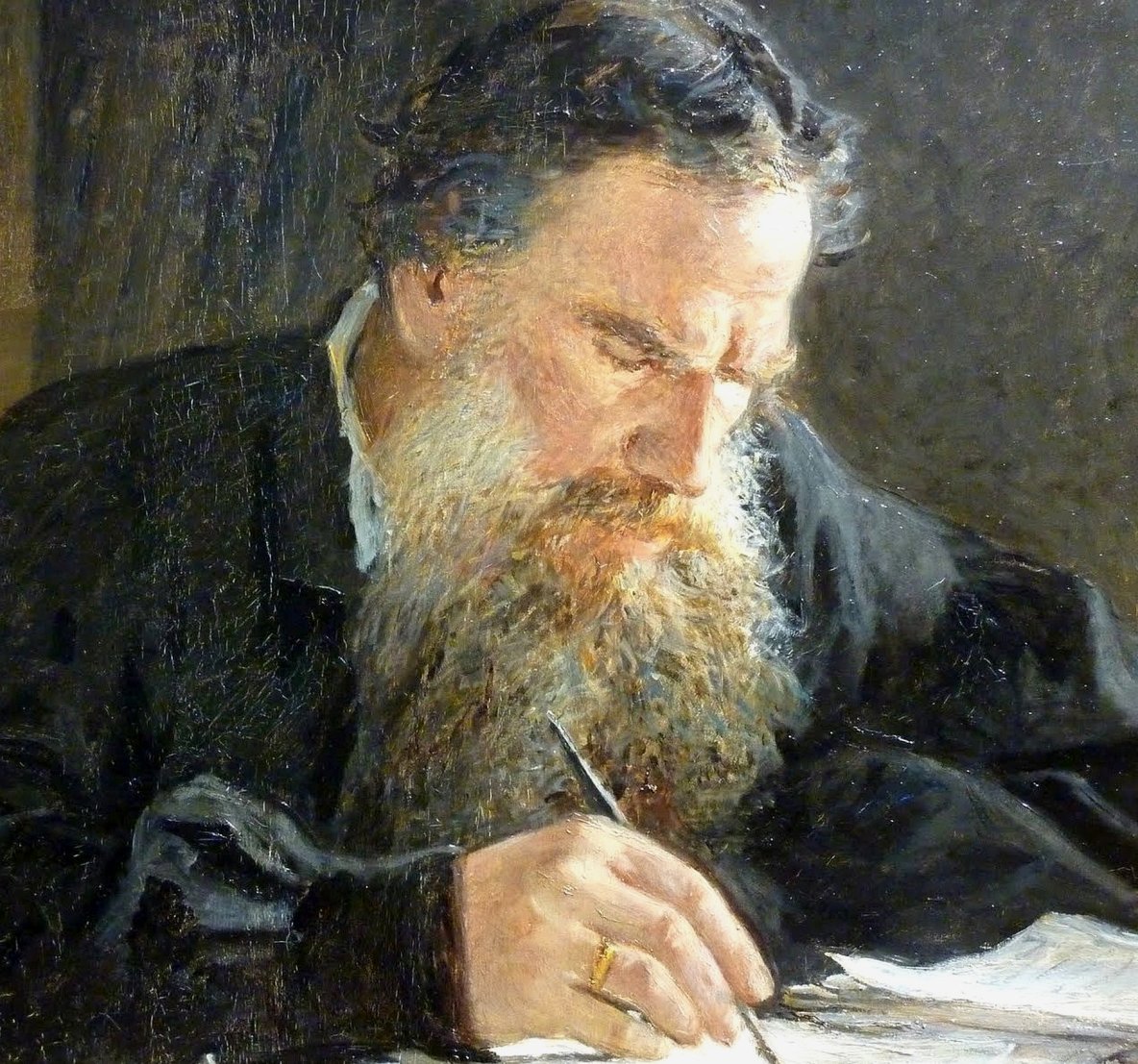
The visual record divides into images of Tolstoy in the composition window, the publication artefacts, and portraits of the people around the text. A medium sweep retrieved eleven public-domain images into the dive’s local cache (visuals/, git-ignored). The keystone is exact in time: Nikolai Ge’s 1884 portrait of Tolstoy at his desk, painted in the very year the book was set in type and seized.
The composition window is further documented by a Library-of-Congress photograph dated 1880–1886 and a Scherer-&-Nabholz studio photograph of 1885. Because the book could not appear in Russia, its first printed face was foreign: the French Ma religion, translated by Tolstoy’s friend L. D. Urusov and corrected by Tolstoy himself.
The first English editions of the same year were retrieved as well — What I Believe (trans. Constantine Popoff, E. Stock, London) and My Religion (trans. Huntington Smith, T. Y. Crowell, New York), both open-access on the Internet Archive; the visual sweep notes both were made via the French text rather than the Russian (a point to confirm). The people around the work are documented in period portraits: Chertkov (Kramskoy, 1881), Strakhov (1885), the cousin Countess A. A. Tolstaya (distinct from the daughter Alexandra Lvovna), and Ge.
What is not openly available is precisely the Russian material: no open scan was found of the 1884 Moscow first printing (the State Museum of L. N. Tolstoy holds a photocopy), of M. Elpidine’s first complete Russian Geneva edition, or of the manuscripts (twenty witnesses in the apparatus, held at the Russian State Library and the Tolstoy Museum; manuscript no. 7 entered the Imperial Public Library through Strakhov in 1884). These are public domain by age but must be requested from the holding institutions.
Method
This was an in-session work-dive on the A-Confession-pilot model, run to medium visual intensity. Phase 0 pinned the subject to PSS Tom 23 (text pp. 304–465; plans & variants p. 512; commentary pp. 548–560) and the composition window 1882–1884. Phase 1 swept the 1883 diaries (Tom 49 — 190 entries; there are no 1884 diaries in the corpus) and the 1882–84 letters (Tom 63 — 75 in-window letters) for Tolstoy’s own genesis and reaction and for the people around the work. Phase 2 deep-read the work’s own twelve chapters and extracted finalists with extract_tei.py --choice=reg (pre-reform orthography resolved; letter and diary bodies recovered via --notes=auto); every cited Russian quotation was checked byte-for-byte against its extract (verify_quotes.py, 24/24 pass). Phase 3 added the secondary scholarship and Church-reception layer (web). Phase 4 synthesized this page, the dossier.yaml, and the draft note. Genuine uncertainties — the excommunicationRelated value, which event the dateFirstPublished field should carry, the new record’s folder, and the parsing of the «Маракуев / Амфилохий» censorship aside — are routed to the dossier’s needsReview, not asserted here.
Links: predecessor dive A Confession; sibling dives gospel-translation, christian-anarchism, crisis, tolstoyanism.
References
Primary: L. N. Tolstoy, «В чём моя вера?», PSS (Jubilee Edition) Tom 23, pp. 304–465 (text; plans & variants p. 512; commentary by V. F. Savodnik pp. 548–560); tolstoydigital-TEI corpus — diaries Tom 49 (1883); letters Tom 63 (to M. A. Engelhardt no. 140, A. N. Pypin, A. S. Buturlin, N. N. Ge, Countess A. A. Tolstaya, the Kushnerev press, an unknown ensign); «О верах», Tom 26.
Background: Aylmer Maude, The Life of Tolstoy (1908–10) and the Maude translation A Confession and What I Believe (Oxford, 1921); Ernest J. Simmons, Leo Tolstoy (1946); A. N. Wilson, Tolstoy (1988); Rosamund Bartlett, Tolstoy: A Russian Life (2011); Inessa Medzhibovskaya, Tolstoy and the Religious Culture of His Time (2008); Richard Gustafson, Leo Tolstoy: Resident and Stranger (1986). (Phase-3 sources appended in the dossier references.background.)
Companion dev-blog note: 2026-06-06-what-i-believe (draft). Structured evidence, entity routing, the work-record proposal and the coverage ledger are in dossier.yaml.