Date: 2026-05-13
Context: A survey of where Leo Tolstoy himself discusses the two doctrinal labels — Christian socialism («христианский социализм») and Christian communism («христианский коммунизм») — across the 90-volume Jubilee Edition (PSS). The survey is a companion to the label dives — tolstoyanism and christian-anarchism (the dedicated successors of the original combined tolstoyanism-christian-anarchism survey) — and uses the same method. It was prompted by the editorial need on tolstoy.life to ground any use of either label on the site in Tolstoy’s own words rather than in third-party framing, and by the specific anecdote that the Swedish socialist Kata Dalström characterised Tolstoy as a “Christian communist.”
1. Key findings
- The two labels stand asymmetrically in the corpus. The phrase «христианский социализм» appears in Tolstoy’s own voice only three times (1889–1890), all descriptive / bibliographic — naming the American papers Dawn and Nationalist, and a conversation with Yanzhul — never as a self-application. «христианский коммунизм» appears zero times in his own voice anywhere in the 90-volume PSS; its only two corpus hits are 1928–1958 editors’ notes.
- His position is stable across 1889–1910: the doctrines’ diagnosis of capitalist society is correct; the means they propose (organised violence, state coercion) only reproduce the disease — “slavery in its primal form.” What they leave out is the rejection of violence on which Christian non-resistance turns.
- Eight primary-voice moments trace the arc — from the 1889 diary “germ” (“the anarchists are entirely right, only not in their violence”) through The Slavery of Our Time (1900), To Political Activists (1903) and The End of the Century (1905), to The Law of Violence and the Law of Love (1908) — which places socialism, communism and anarchism inside Christianity as “one-sided manifestations” of the violence-denying Christian consciousness — and the 1910 letter to Gandhi.
- The local trigger corrects a received label. Kata Dalström’s 1908 Karlstad pamphlet actually prints kristen samhällsreformator — “Christian social reformer,” not kristen kommunist; the “Christian communist” shorthand sometimes attached to Tolstoy is later commentary, not what the pamphlet prints.
- For the vault. Any use of either label on the site should be marked external: Tolstoy never called himself a Christian socialist or a Christian communist. Ingestion is a separate, human step.
2. Why this matters for tolstoy.life
Twentieth-century commentary placed Tolstoy in four doxographic boxes by turn — Tolstoyan, Christian anarchist, Christian socialist, Christian communist. The first two are surveyed in their own dedicated dives. This one takes the second pair.
The two labels do not stand symmetrically in Tolstoy’s own writing.
«Христианский социализм» does appear in his vocabulary, but only in a tight 1889–1890 window and only in descriptive uses — naming the American newspapers Dawn and Nationalist (the Boston-based Bellamy-Nationalist and Cincinnati-based Christian-socialist organs), naming a conversation partner. It does not appear as a self-application; it does not appear as a doctrinal name; it does not appear anywhere in the polemical works of the prophet period.
«Христианский коммунизм» does not appear in Tolstoy’s own voice anywhere in the 90-volume Jubilee Edition. The phrase shows up twice in the corpus — once in a 1928–1958 editor’s note characterising the Doukhobors of the Kars region, once in an editor’s summary of a French-Russian correspondent’s own pamphlet. Tolstoy himself never reaches for it. (File-by-file evidence behind both findings is preserved locally as working-zone byproducts under _generated/research/christian-communism-socialism/ — hits.md and negative-results.md — gitignored, held locally only.)
The local trigger for the survey was a remembered characterisation. The Swedish socialist Kata Dalström (1858–1923) — party theorist of the Social Democratic Workers’ Party (SAP), who would in 1921 join the breakaway Swedish Communist Party (SKP) — published a pamphlet Leo Tolstoj som kristen samhällsreformator (Karlstad, 1908; the characterising sentence is on p. 5), cited here through a footnote in Ben Hellman’s Hemma hos Tolstoj. The pamphlet’s framing is kristen samhällsreformator — “Christian social reformer” — not kristen kommunist. In 1908 Dalström was still a social democrat; the “Christian communist” shorthand sometimes attached to Tolstoy in later commentary is not what the pamphlet itself prints. The pamphlet stands as a 1908 Swedish-socialist reception-layer datum: a contemporary characterisation by a major Swedish socialist of Tolstoy as a religiously-grounded social reformer, two years before his death.
What this essay collects are the passages in which Tolstoy himself discussed the two doctrines — sometimes under the compound names, more often under the bare names socialist and communist, almost always against the foil of Christianity. All are from the prophet period (1881–1910), in chronological order. It does not adjudicate whether the labels are accurate. It documents what Tolstoy said about them.
A companion file, pss-volume-mapping.md, resolves Tom-number citations to the local PDF paths under primary-sources/jubilee-edition/.
3. The shape of the question in Tolstoy’s life
Eight primary-voice moments form the spine. The arc runs from 1889 to 1910 and tracks a stable position: the diagnosis the doctrines make of capitalist society is correct; the means they propose to remedy it (organised violence, legal coercion) reproduce the disease in a new form; what they leave out is the rejection of violence on which Christian non-resistance turns.
3.1. 1889 (14 January) — The germ
Diary entry of 14 January 1889 at Moscow (PSS Tom 50, p. 22). Tolstoy had spent the day reading a book on American socialism — the two parties, “international and socialist” — and recorded in one sentence the structural reaction that would hold for the next twenty-one years:
Читал и вчера и нынче книгу об Американском социализме: о двух партиях: интернациональной и социалистической. Анархисты совсем правы, только не в насилии. Удивительное затмение. Впрочем об этом предмете мне думается, как думалось, бывало, о вопросах религии, т. е. представляется необходимым и возможным решить, но решения еще нет.
Both yesterday and today I read a book about American socialism: about two parties, the international and the socialist. The anarchists are entirely right, only not in their violence. An astonishing eclipse. But about this subject I find myself thinking as I once thought about questions of religion — that is, it seems both necessary and possible to resolve, but the resolution is not yet.
The germ. The structure — “right in diagnosis, wrong in means” — that the major polemical works of 1900–1908 would unfold at length is here in one diary sentence, eleven years before Eltzbacher’s book, five years before the Davidson letter. The trigger was reading rather than correspondence, and the trigger was specifically on socialism (anarchism is mentioned only by way of the analogous critique). The note that the question presents itself “as questions of religion once did” is the marker that Tolstoy was approaching the doctrine theologically from the first.
Full extract: extracts/v50_022_022_1889_01_14.txt.
3.2. 1889 (27 August) — Reading the Christian-socialist papers
Diary entry of 27 August 1889 at Yasnaya Polyana (PSS Tom 50, pp. 128–129). Tolstoy had begun to receive the American Christian-socialist press: Dawn (Boston, ed. W. D. P. Bliss, 1889–1896) and Nationalist (Boston, the Bellamy-Nationalist organ, 1889–1891). The 27 August entry sets out for the first time the doctrinal reaction:
Спал дурно. Виноват сам. Читал вчера присланную Американскую газету Dawn и Nationalist, обе газеты христианского социализма. Программа: национализация промышленности и установление братства человечества. Программа Nationalist’а. Замена принципа борьбы соревнования и индивидуализма артельностью и установление сыновности Богу и братства людей, программа (вкратце) Dawn’a. Всё это прекрасно. Но средства, предлагаемые ими для этого, не определенны, неясны и не могут быть иными. Они предлагают проповедь всех родов и приложение к торговым делам и к жизни принципа братства, а не борьбы соревнования. Но как прилагать эти принципы в мире борьбы? Если жизнь каждого основана теперь на борьбе с другими, то борьба эта ведется до конца со всеми, как мы и видим — борьба с ребенком, женщиной, заставляя их работать сверх сил. Как только нет этого, нет обеспеченности. Другой поборет меня, и я погибну. — Как же прилагать в этом мире? Одно средство — отдавать себя и всю жизнь свою. Не противиться злу, а гибнуть самому во имя истины. Вот это-то не договаривается.
Slept badly. My own fault. Yesterday I read the American newspapers Dawn and Nationalist that had been sent to me, both newspapers of Christian socialism. The programme: nationalisation of industry and the establishment of human brotherhood. The Nationalist’s programme. The replacement of the principle of struggle, competition, and individualism by cooperation, and the establishment of filial relation to God and brotherhood of people, is — in brief — Dawn’s programme. All this is fine. But the means they propose for this are vague, unclear, and cannot be otherwise. They propose preaching of every kind and the application to trade and to life of the principle of brotherhood, not of competitive struggle. But how is one to apply these principles in a world of struggle? If each one’s life is now based on struggle with others, that struggle is fought to the end with all, as we see — struggle with the child, with the woman, forcing them to work beyond their strength. As soon as that is gone, there is no security. Another will overcome me, and I shall perish. — How then to apply them in this world? There is only one means — to give oneself and one’s whole life. Not to resist evil, but to perish oneself for the sake of truth. This is precisely what is not said.
The entry is the only LT-voice diary entry in the corpus that uses the compound phrase «христианский социализм» as a label for an existing doctrine. It is also the earliest sustained LT-voice statement on the Christian-socialist programme. The critique is already in its mature form: the programme is fine; the means are unclear and cannot be otherwise except by the way of non-resistance, which the Christian socialists do not articulate. Whatever Tolstoy adds in 1900, 1903, 1905 and 1908 is an unfolding of this 1889 diary paragraph.
Cross-checked against the printed PSS: extracts/pss-pages/tom50-1889-08-27-151.png.
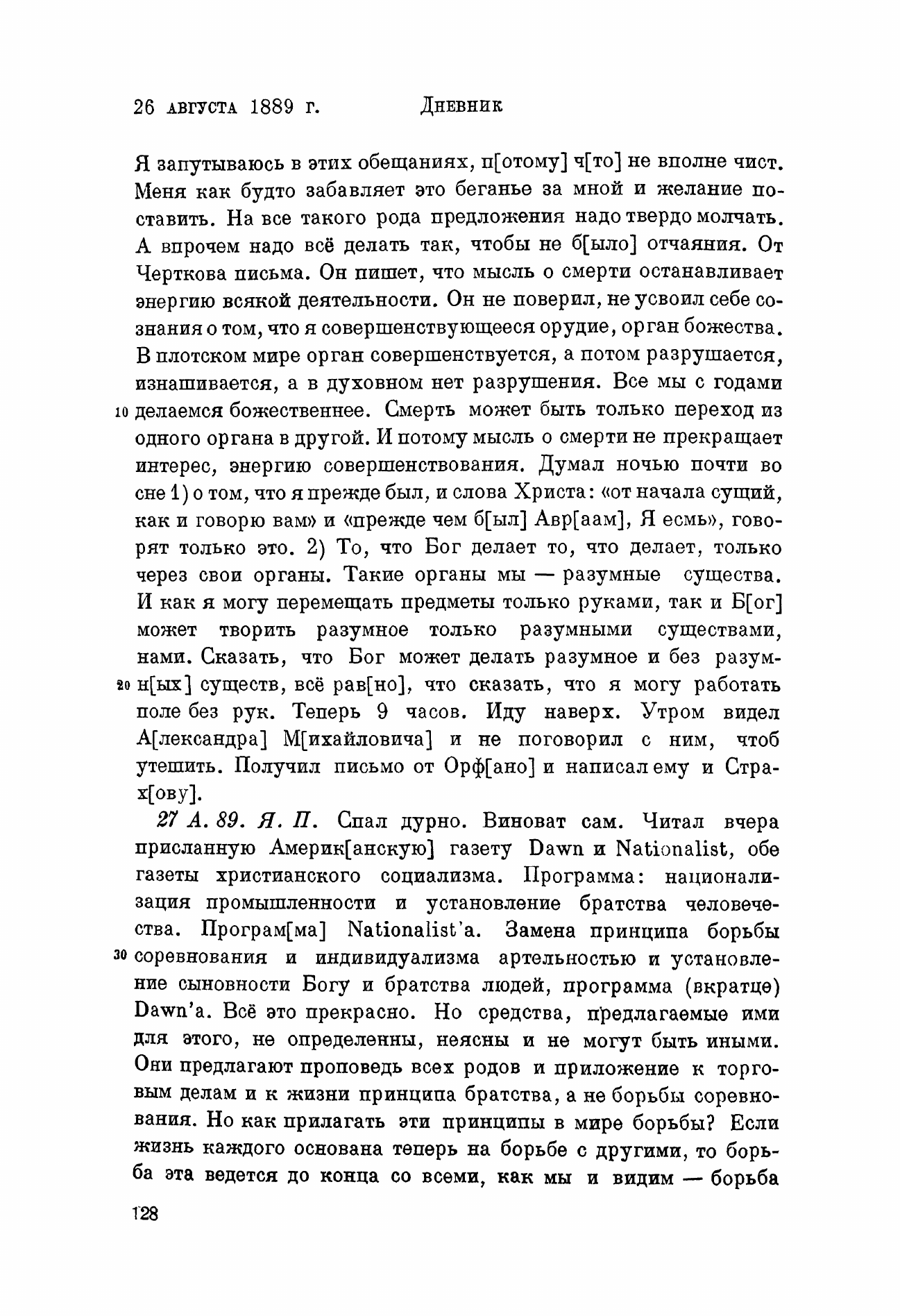
Full extract: extracts/v50_128_129_1889_08_27.txt.
Adjacent: a 15 January 1890 diary entry (Tom 51, pp. 10–11) records «Разговоры с Янжулом о христианском социализме» — “conversations with Yanzhul about Christian socialism.” Ivan Ivanovich Yanzhul (1846–1914), Moscow University economist, was the channel through which the American Christian-socialist press reached Yasnaya Polyana; he is also the addressee that Tolstoy was reading-for through the autumn of 1889. (extracts/v51_010_011_1890_01_15.txt.)
A 6–9 March 1890 letter to P. I. Birjukov (Tom 65, letter 31, p. 42) lists Tolstoy’s English-language periodical subscriptions and characterises Dawn and Sower as papers «of Christian socialism». (extracts/v65_031_P_I_Biryukovu.txt.)
These three are the only places in the entire 90-volume PSS where the compound phrase «христианский социализм» appears in Tolstoy’s own voice. All three are bibliographic / descriptive. None is a self-application.
3.3. 1894 (23–24 July) — The programmatic statement to Davidson
Letter to John Morrison Davidson, written in English and Russian from Yasnaya Polyana (PSS Tom 67, letter 179, pp. 178–180). Davidson (1843–1916), Scottish journalist and Christian socialist, had sent Tolstoy two of his books: The Old Order and the New: From Individualism to Collectivism (London, 1892) and The Gospel of the Poor (London, 1893). Tolstoy’s reply, in his own English original and his own Russian translation:
Both your books are remarkably good and I cannot give preference to either of them. In the «Old order and the New» the Christian truth serves to corroborate the truth of the Socialistic tendencies; whereas in the «Gospel of the Poor» it is the Socialistic, Communistic and Anarchistic theories that serve to corroborate the Christian truth, which occupies the most prominent part.
Обе ваши книги замечательно хороши, и я не могу ни одной из них отдать предпочтения. В книге «Старый и новый порядок» христианская истина приводится в подкрепление истины социалистических целей, тогда как в книге «Евангелие бедняка» социалистическая, коммунистическая и анархическая теории приводятся в подкрепление христианской истины, которая составляет ее главную часть.
The Davidson letter is the closest analogue in the corpus to the 1900 Eltzbacher letter, but earlier and addressing all three movements at once. The pairing of the two books gives Tolstoy the chance to articulate a doctrinal preference: not socialism corroborated by Christianity, but Christianity corroborated by socialism, communism, and anarchism. The Christian truth — for him — has to be the centre; the three social-economic theories are the corroborating periphery. He does not deny the truth of the theories themselves; he denies them the central place that one of Davidson’s two books gives them.
The letter is also a tactical document. Tolstoy treats Davidson as a “labourer of the Kingdom of God” and promises Russian translations. He aligns himself with Davidson’s project; he does not adopt Davidson’s vocabulary. The compound phrase «христианский социализм», which the volume editors (1955) use in the note on Davidson, is absent from the letter body.
Full extract (English + Russian, both in Tolstoy’s hand): extracts/v67_179_DzhonuMorrisonuDavidsonu.txt.
3.4. 1900 — The Slavery of Our Time
Rabstvo nashego vremeni (PSS Tom 34, pp. 144–199), written 1900, published in Christchurch the same year. The first sustained book-length critique of socialism in the late corpus. Section VI is titled “Несостоятельность социалистического идеала” — The Untenability of the Socialist Ideal.
The argument is structural. Tolstoy traces the chain: capitalist coercion → socialist project to abolish capitalist coercion → necessary introduction of new state coercion → the same slavery in a new form.
Те же, которые, как социалисты, в проекте отменяют узаконения о собственности земли и орудий производства, удерживают узаконения о податях и, кроме того, неизбежно должны ввести узаконения о принуждении к работе, т. е. устанавливают опять рабство в его первобытной форме.
Those who, like the socialists, would in their project abolish the laws on the ownership of land and the instruments of production, retain the laws on taxation, and beyond that must inevitably introduce laws on the compulsion to work — that is, they re-establish slavery in its primal form.
And later in the same section:
Не говоря уже о совершившихся попытках уничтожения правительств посредством насилия, предстоящее теперь, по теории социалистов, уничтожение насилия капиталистов, т. е. обобществление орудий производства и новое экономическое устройство, должно совершиться по их учению тоже через новое организованное насилие, и должно быть удерживаемо им же.
Not to mention the past attempts to destroy governments by means of violence, the present project of the socialists — the abolition of the capitalists’ violence, that is, the socialisation of the means of production and a new economic order — must, by their teaching, be accomplished through new organised violence, and must be maintained by it.
This is the structural critique the 1889 diary paragraphs had compressed into a single missing-link: not until the rejection of violence is built into the means does the programme cease to reproduce in a new form what it sought to abolish. The rabstvo (slavery) metaphor — which the title makes load-bearing for the whole essay — extends naturally from chattel slavery through the wage-labour system to the socialist organisation of compulsory work.
Full extract (filtered to socialist-passages): extracts/v34_144_199_Rabstvo_nashego_vremeni.txt.
3.5. 1903 — To Political Activists
K politicheskim deyatelyam (PSS Tom 35, pp. 199–215), written 1903. Direct address to the Russian revolutionary movement — explicitly the revolutionary-socialists (the SR party had been founded the year before) and the political opposition more broadly. The pivot:
Если же вы принадлежите к искренним людям, желающим служить народу революционно-социалистической деятельностью, то, не говоря уже о той ничтожной цели матерьяльного, никогда никого не удовлетворяющего благосостояния людей, к которой вы стремитесь, подумайте и о тех средствах, которые вы имеете для достижения ее. Средства эти, во 1-х, безнравственны, включая в себе ложь, обман, насилие, убийства; во 2-х, и главное, средства эти ни в каком случае не достигают цели.
If you belong to those sincere people who wish to serve the people through revolutionary-socialist activity, then — to say nothing of the petty material goal of human welfare you are striving for, which has never satisfied anyone — consider also the means you have for attaining it. These means, in the first place, are immoral, including in themselves lies, deception, violence, murder; in the second place, and most importantly, these means in no case attain the goal.
The two-clause argument compressed into one sentence: (1) the means are immoral; (2) the means do not work. Tolstoy is not arguing that revolutionary-socialism is wrong about the diagnosis; he is arguing that its means are unfit for their end. This is the sharpest single sentence on the method of socialism in the late corpus — the formulation that the user’s reading-of-Tolstoy was reaching for: “for their adoption of violence as a means of changing society.”
Full extract: extracts/v35_199_215_K_politicheskim_dejateljam.txt.
3.6. 1905 — The End of the Century
Konets veka (PSS Tom 36, pp. 231–277), written 1905 in the wake of the first Russian Revolution. The bluntest single sentence on socialism anywhere in the corpus:
Ничто так ясно не показывает того всё большего и большего стремления к порабощению народов, как распространение и успех социалистических теорий, то есть стремление ко всё большему и большему порабощению.
Nothing shows so clearly the ever-growing tendency toward the enslavement of peoples as the spread and success of socialist theories — that is, a tendency toward ever-greater enslavement.
The framing extends the Slavery of Our Time metaphor to its sharpest reach. Constitutional monarchy, parliamentary republic, social-democratic republic — all are forms of state coercion. The Russian liberals and revolutionaries borrow their programmes “from European and American constitutions or from socialist projects” instead of consulting conscience, and the result, whichever form they install, is to “draw the people into violent activity”:
Опасность в том, что русский народ, по своему особенному положению призванный к указанию мирного и верного пути освобождения, вместо этого будет вовлечен людьми, не понимающими всего значения совершающегося переворота, в рабское подражание прежде бывшим революциям и, бросив тот спасительный путь, на котором он стоит теперь, пойдет по тому ложному пути, по которому к своей верной погибели идут остальные народы христианского мира.
The danger is that the Russian people, called by their special position to point out the peaceful and true path of liberation, will instead be drawn by people who do not understand the meaning of the change taking place into a slavish imitation of past revolutions, and, abandoning the path of salvation on which they now stand, will follow the false path on which the other peoples of the Christian world are moving toward their certain ruin.
The post-1905 frame is the new element: Tolstoy is now writing against an actual revolutionary movement in his own country, not against books sent from Boston. Cross-checked against the printed PSS: extracts/pss-pages/tom36-1905-konets-veka-259.png.
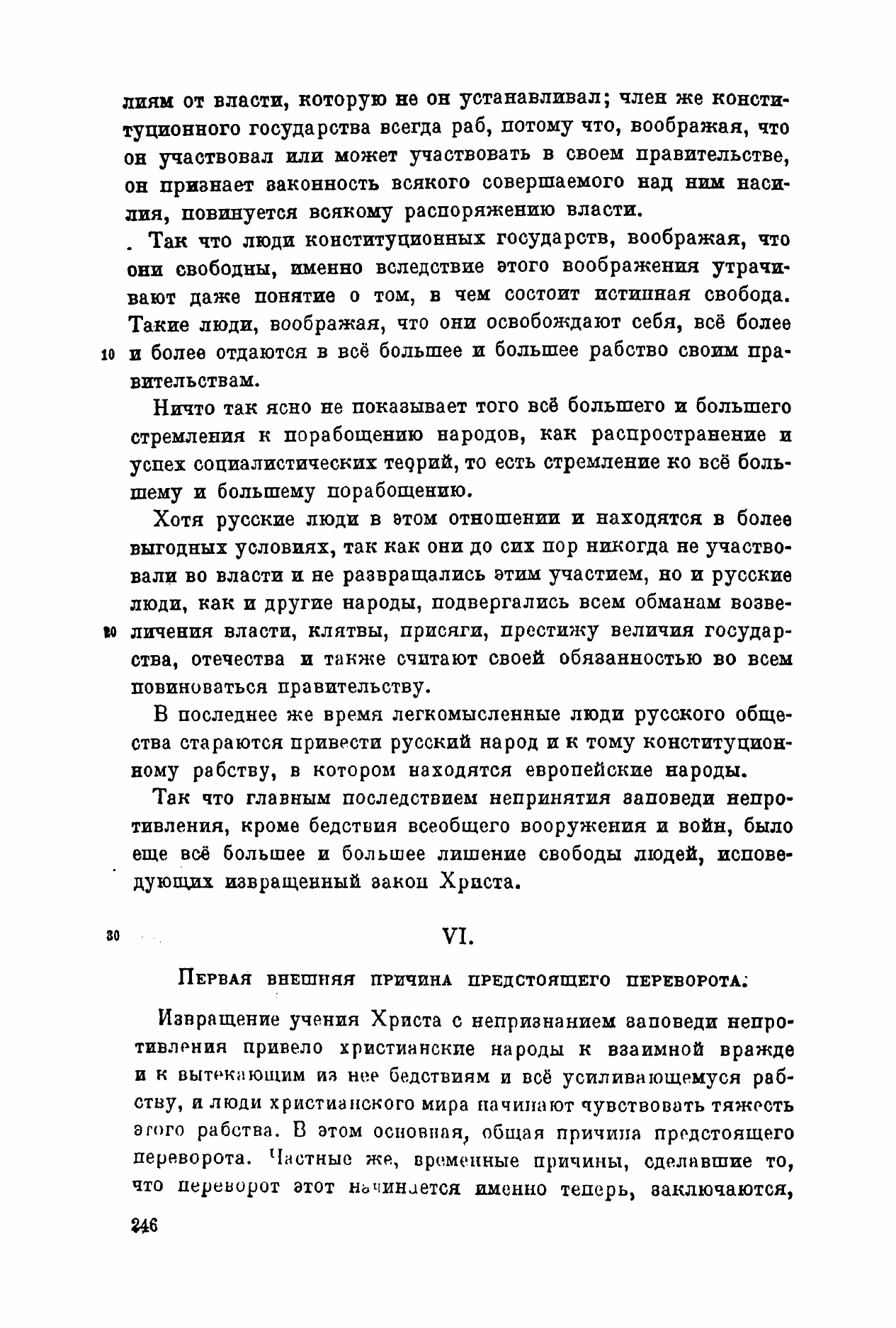
Full extract: extracts/v36_231_277_Konets_veka.txt.
3.7. 1908 — The Law of Violence and the Law of Love
Zakon nasiliya i zakon ljubvi (PSS Tom 37, pp. 149–221), written 1908. The most generous late formulation. The three movements are placed inside Christianity, not outside it:
Противоречие это сознавалось и в средние века, в новое же время выяснялось всё больше и больше и выражалось и в огромном количестве сект, отрицающих противное христианству государственное устройство с необходимым условием существования его — насилием, и в самых разнообразных гуманитарных учениях, даже не признающих себя христианскими, которые все, так же, как и особенно распространившиеся в последнее время учения социалистические, коммунистические, анархические, суть не что иное, как только односторонние проявления отрицающего насилие христианского сознания в его истинном значении.
This contradiction was recognised even in the Middle Ages; in modern times it has become ever clearer, expressing itself both in the enormous number of sects denying the state-order contrary to Christianity — with its necessary condition of existence, violence — and in the most varied humanitarian teachings, even those which do not acknowledge themselves to be Christian. All of these, like the socialist, communist, anarchist teachings which have spread especially widely in recent times, are nothing other than one-sided manifestations of the violence-denying Christian consciousness in its true meaning.
The «односторонние» — “one-sided” — does the doctrinal work. The three movements are right in what they affirm; they are partial because they leave out the rejection of violence on which the whole Christian consciousness turns. The structural critique of 1900–1905 and the diagnosis-affirmation of 1889 are reconciled. The movements are not outside the truth Tolstoy has been working on for two decades; they are partial expressions of it.
The same essay returns to the theme directly:
Не революции, хитрые, мудрые, социалистические, коммунистические устройства союзов, арбитрации и т. п. спасут человечество, а только такое духовное сознание, когда оно сделается общим.
Not revolutions, not clever, wise, socialist, communist orderings of unions, arbitrations and the like will save humanity, but only spiritual consciousness when it becomes common.
And:
Достигается это освобождение от мучащего и развращающего людей зла не тем, что люди укрепят или удержат существующее устройство: монархию, республику, какую бы то ни было, и не тем, что, уничтожив существующее устройство, установят лучшее, социалистическое, коммунистическое...
This liberation from the evil that torments and corrupts people is not attained by people propping up or retaining the existing order — monarchy, republic, whichever — and not by people destroying the existing order and installing a better one, socialist, communist...
Cross-checked against the printed PSS: extracts/pss-pages/tom37-1908-zakon-nasiliya-181.png.
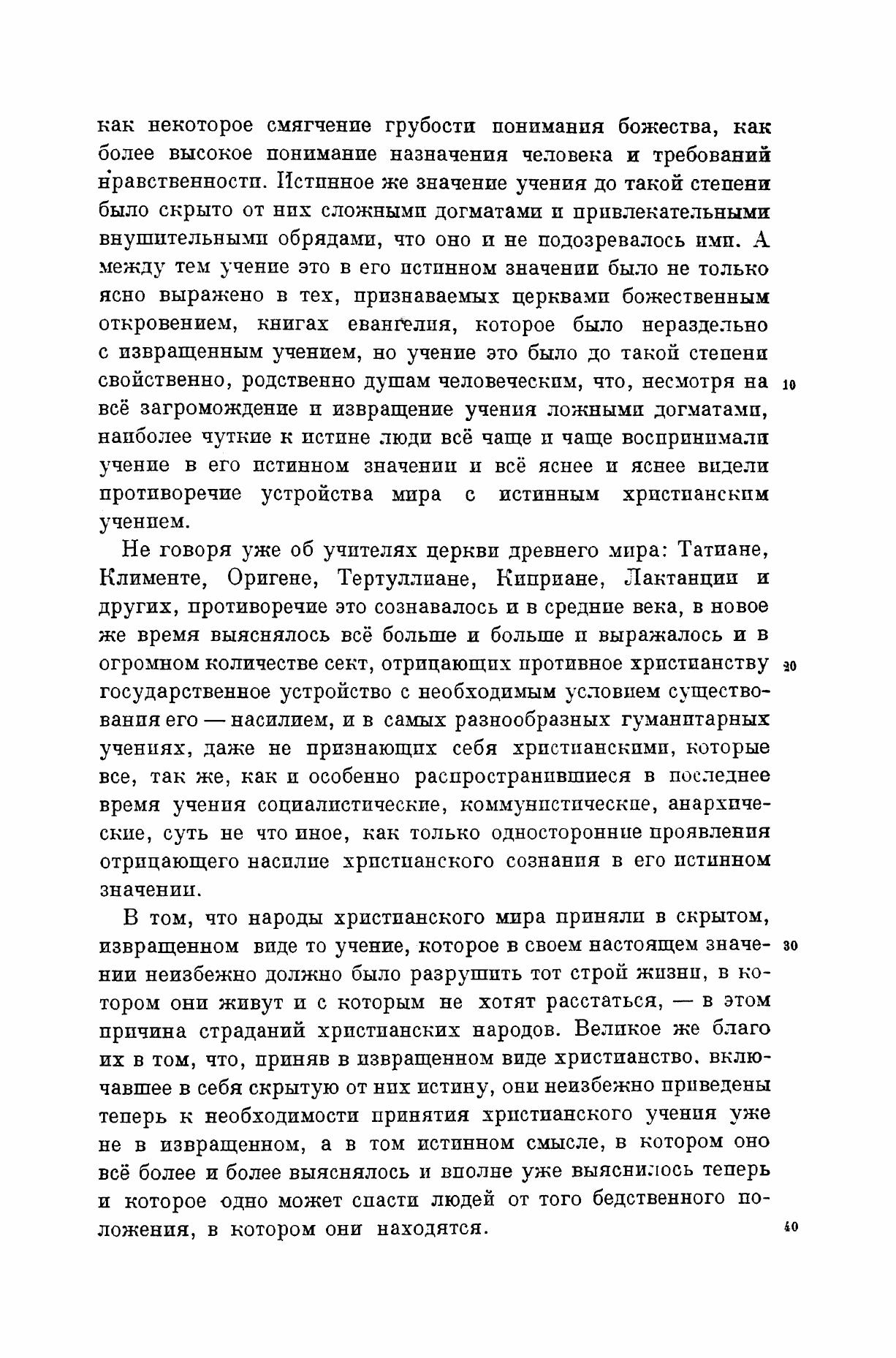
Full extract: extracts/v37_149_221_Zakon_nasilija_i_zakon_ljubvi.txt.
3.8. 1910 (7 September) — Letter to Gandhi
Letter to M. K. Gandhi, written in Russian from Kochety (PSS Tom 82, letter 178, pp. 137–140). Tolstoy’s last sustained reply to Gandhi, written six weeks before his death:
Социализм, коммунизм, анархизм, армия спасения, увеличивающаяся преступность, безработность населения, увеличивающаяся безумная роскошь богатых и нищета бедных, страшно увеличивающееся число самоубийств, всё это признаки того внутреннего противоречия, которое должно и не может² мира.
Socialism, communism, anarchism, the Salvation Army, the growing crime rate, the unemployment of the population, the ever-growing insane luxury of the rich and the poverty of the poor, the terribly growing number of suicides — all these are signs of that inner contradiction which must and cannot be ... resolved.
The same sentence is cited in the companion essay for anarchism. In its fuller form it brackets all three movements together as symptoms of the contradiction at the heart of Christian civilisation — a civilisation that “solemnly accepted the law of love and at the same time permitted itself violence and built its life on violence.” The 1889 germ has reached its final form: the three movements are right that the existing order is sick (they are symptoms in the sense of signs — they reveal the disease); they are wrong in proposing more organised violence as the cure.
Full extract: extracts/v82_178_GandiGandhi.txt.
4. The non-attestation of «христианский коммунизм»
The compound phrase «христианский коммунизм» (with all five case-inflected adjective forms) returns two unique TEI files in the entire corpus — letters/v72_008_Kn_D_A_Xilkovu.xml and letters/v78_025_ZimakoZimaco.xml. Both hits are inside <note resp="volume_editor"> editorial-commentary blocks, written by the PSS editorial team between 1928 and 1958:
- The 1900 Khilkov-letter note refers to the Doukhobors of the Kars region as «менее других готовых к проведению в жизнь идеи христианского коммунизма» — “less ready than others to put the idea of Christian communism into practice”. The phrase is the editors’ shorthand for the Doukhobor commune project (the Posrednik-supported migration to Canada), not Tolstoy’s.
- The 1906 Zimako-letter note summarises Émile Zimako’s own pamphlet, which envisages a “Christian communism” reached via the Tsar’s repentance.
Tolstoy in both letters answers the correspondent’s questions on his own terms; the compound phrase is not in either letter body. The two adjacent compounds — «христианин-коммунист» and «коммунист-христианин» — return zero hits in either direction.
The structural parallel to the christian-anarchism dive is exact, but stronger. There, the compound «христианский анархизм» has one LT-voice attestation in the corpus (the 1901 Sacy letter, where Tolstoy says Babism “has much in common with Christian anarchism” — the only place in his written voice anywhere where he names the doctrine in his own words). Here, the count for «христианский коммунизм» is zero. Whatever doctrinal content the Tolstoyan circle (Chertkov) and contemporary observers (Kata Dalström, the post-revolutionary Bolsheviks) projected into the phrase, Tolstoy never reached for it himself.
The substance the label might have named — common ownership grounded in the gospel — Tolstoy worked out under different headings: as the Doukhobor land community in the 1898–1899 correspondence on the Canadian migration, as brotherhood and non-resistance in the polemical essays, as the rejection of property in Tak chto zhe nam delat? (Tom 25, 1886). None of these uses the compound «христианский коммунизм».
5. Where the theme clusters in the Jubilee Edition
The keyword sweep behind this survey returned 49 unique TEI files for the communism family («коммунизм» + «коммунист» + «коммуни») and 279 unique files for the socialism family («социализм» + «социалист» + «социал-демократ»). The compound «христианский социализм» returns 15 unique files, of which three are LT-voice; the compound «христианский коммунизм» returns 2 unique files, of which zero are LT-voice. The full file-by-file hit list is preserved locally under _generated/research/christian-communism-socialism/ (working-zone byproduct, not published) for the next session.
Diaries
| Date | TEI id | Material |
|---|---|---|
| 1889-01-14 | v50_022_022_1889_01_14 | The germ. “The anarchists are entirely right, only not in their violence.” |
| 1889-08-27 | v50_128_129_1889_08_27 | The first programmatic critique of Christian socialism. Unique compound-phrase LT-voice diary entry. |
| 1890-01-15 | v51_010_011_1890_01_15 | “Conversations with Yanzhul about Christian socialism.” |
| 1890s scattered | v50–v51 | The diary engagement is concentrated in 1889–1890; the working-out then moves to the published works |
| 1903–1909 | v54–v57 scattered | Late re-engagement, often in the context of post-1905 revolutionary movements |
Letters — the foreign Christian-socialist correspondence
| PSS Tom, letter id | Addressee, date | Material |
|---|---|---|
| Tom 65, letter 31 | P. I. Birjukov, 1890-03-06...09 | LT lists his English-language periodical subscriptions including Dawn and Sower as Christian-socialist papers — LT-voice compound-phrase attestation |
| Tom 66, letter 23 | Laurence Gronlund, 1891-08-29...31 | LT receives Our Destiny and arranges Russian translation. Gronlund (1846–1899): Danish-American jurist, Cooperative Commonwealth (1884), principal early systematic American expositor of Christian socialism |
| Tom 67, letter 179 | John Morrison Davidson, 1894-07-23/24 | The programmatic statement. Socialism, communism, anarchism as theories corroborating Christian truth. |
| Tom 67, letters 136, 171 / Tom 69, letters 87, 141 | John Coleman Kenworthy, 1894–1896 | The English Brotherhood Church correspondence. Kenworthy published both as Christian anarchist and Christian socialist |
| Tom 68, letter 60 | Eugen Heinrich Schmitt, 1895-03-27 | The Hungarian Christian-anarchist correspondence — German-Russian bilingual letter. Contains the cascade “the competitive order must be destroyed and replaced by a communist one; the capitalist order must be destroyed and replaced by a socialist one... violence must be destroyed and replaced by free and loving union of people” |
| Tom 68, letter 104 / Tom 71, letter 50 / Tom 88, letter 485 / Tom 90, letter 180 | George Davis Herron, 1895 → 1903 | The Iowa Christian-socialist correspondence. Herron (1862–1925): American pastor and professor, The Christian Society (1894) |
| Tom 69, letter 4 | Ernest Crosby, 1896-01-04 | American Tolstoyan, also a writer in the Christian-socialist circle |
| Tom 76, letter 306 | Paul Sabatier, 1906-11-07 | French historian of Franciscanism; the letter’s editorial apparatus characterises F. Lamennais as a Christian socialist |
| Tom 82, letter 178 | M. K. Gandhi, 1910-09-07 | The famous late letter. Socialism, communism, anarchism listed as symptoms of the inner contradiction of Christian civilisation. |
Polemical works — the doctrinal grounding
| PSS Tom | Work | Date | Note |
|---|---|---|---|
| Tom 28 | Tsarstvo Bozhie vnutri vas (The Kingdom of God Is Within You) | 1893 | Foundational. An English translation is held at primary-sources/standard-ebooks/leo-tolstoy_the-kingdom-of-god-is-within-you_leo-wiener.epub |
| Tom 34 | Rabstvo nashego vremeni (The Slavery of Our Time) | 1900 | Section VI: “The Untenability of the Socialist Ideal.” The structural critique. |
| Tom 34 | Neuzheli eto tak nado (Is It Really Necessary?) | 1900 | Companion piece |
| Tom 35 | K politicheskim deyatelyam (To Political Activists) | 1903 | The two-clause sentence on revolutionary-socialist means — immoral and ineffective. |
| Tom 35 | K rabochemu narodu (To the Working People) | 1902 | Addresses Russian workers; dismisses socialism as a “fashionable teaching” foreign to the Russian agricultural majority |
| Tom 35 | Chto takoe religiya i v chem suschnost’ ee (What Is Religion and Wherein Lies Its Essence?) | 1902 | Re-grounds the political question in religious terms |
| Tom 36 | Konets veka (The End of the Century) | 1905 | “Nothing shows so clearly the ever-growing tendency toward the enslavement of peoples as the spread and success of socialist theories.” |
| Tom 36 | Edinoe na potrebu (The One Thing Needful) | 1905 | |
| Tom 36 | Ob obschestvennom dvizhenii v Rossii (On the Social Movement in Russia) | 1905 | |
| Tom 36 | Velikij greh (The Great Sin) | 1905 | The Henry-George-and-the-single-tax pamphlet — distinguishes George from the socialists |
| Tom 37 | Zakon nasiliya i zakon ljubvi (The Law of Violence and the Law of Love) | 1908 | The synthesis. Socialist, communist, anarchist teachings as “one-sided manifestations of the violence-denying Christian consciousness.” |
| Tom 38 | Neizbezhnyj perevorot (The Inevitable Revolution) | 1909 | Late re-engagement |
6. Material not covered by this survey
- Whether the 1908 Karlstad pamphlet rests on an actual Yasnaya Polyana visit, or is text-based commentary by Dalström at distance. The pamphlet’s content is cited here through Hellman’s Hemma hos Tolstoj footnote; the in-person record (if any), Goldenweiser’s Vblizi Tolstogo, Makovický’s Yasnopolianskie zapiski (1904–1910), and the Swedish socialist press of the period are not held locally.
- The TEI
comments/directory (807 editorial-commentary files). The 1928–1958 PSS editors’ framing of both labels is a separate, smaller study; the editors’ use of «христианский коммунизм» for the Doukhobors and «христианский социализм» for the Western correspondents is itself a documentary record of how mid-Soviet Tolstoy scholarship handled the question. - Goldenweiser’s and Makovický’s conversation transcripts. Almost certainly contain spoken statements on socialism and Christian variants of it. The 1897-12-02 diary entry treated in the companion essay is itself a Makovický conversation; comparable spoken material on socialism / communism likely exists in the same source but was not swept here.
- Incoming letters. TEI corpus is outgoing-only. Kata Dalström’s letters, Gronlund’s covering letter for Our Destiny, Schmitt’s letters from Budapest, the in-bound side of the Davidson and Herron exchanges — none are available locally in TEI form.
- The Krug chteniya / Put’ zhizni anthologies (Toms 41–45). LT-curated daily readings on related themes (state, property, brotherhood, violence). Excluded from the focused sweep on the two label-families.
- Chertkov’s parallel framings. The 1905 essay O khristianskom anarkhizme is referenced in the companion research; whether Chertkov wrote a parallel piece on Christian socialism is unresolved. Bibliography of Свободное слово (Christchurch, Hampshire, 1898–1908) would settle the question.
- The 1907 P. P. Nikolaev book on socialism referenced in the editorial apparatus to several Tolstoy letters. Not held locally.
- The Christian-socialist papers Tolstoy actually read — Dawn (Boston, ed. W. D. P. Bliss, 1889–1896), Nationalist (Boston, the Bellamy-Nationalist organ, 1889–1891), The Sower (cited in the Birjukov letter). The issues Tolstoy received, and any marginalia in the Yasnaya Polyana library, are not in the TEI corpus.
7. Method
- The TEI corpus from
primary-sources/tolstoydigital-TEI/texts/was used as the primary search surface: 9 087 letter files, 4 584 diary files, 767 published-works files. - Two keyword families plus three compound forms were swept:
- The communism family —
коммунизм+коммунист+коммуни(49 unique files). - The socialism family —
социализм+социалист+социал-демократ+социалдемократ(279 unique files). - The compound «христианский коммунизм» — all five case-inflected adjective forms (2 unique files, both editor-voice). Zero LT-voice attestations in the entire PSS.
- The compound «христианский социализм» — all five case-inflected adjective forms (15 unique files, three LT-voice).
- The self-rejection forms
я не социалист/я не коммунист/не есмь социалист/не есмь коммунист(one file, fictional dialogue in play variants; discarded). - A discrimination step was added to the keyword sweep: a hit on a TEI file is not an LT-voice attestation if it falls inside a
<note resp="volume_editor">editorial-commentary block. This cut the «христианский социализм» list from 15 hits to 3 LT-voice files and the «христианский коммунизм» list from 2 hits to 0 LT-voice files. - Every TEI filename encodes the PSS Tom number and, for diaries, the entry date (
vXX_NNN_..._YYYY_MM_DD.xml). Every TEI file contains a<title type="bibl">element giving the formal PSS citation. Both were preserved verbatim through the extraction so all citations in this document are anchored to their TEI source. - The shared lxml-based extractor
extract_tei.py, indocs/research/lib/, resolves the heavy editorial markup in the TEI body. The<choice>/<sic>/<corr>editorial-correction wrappers are resolved in favour of the corrected reading;<note>footnote bodies are stripped; footnote anchors are rendered as superscripts. - Three finalist passages were cross-checked against the printed PSS by extracting the relevant pages from the local PDFs at 220 dpi (
pdftoppm): - The 27 August 1889 diary entry against PSS Tom 50 (= local file
vol17/vol17.pdf), printed page 128. - The Konets veka “ever-growing enslavement” passage against PSS Tom 36 (=
vol05/vol05.pdf), printed page near 259. - The Zakon nasiliya i zakon ljubvi “one-sided manifestations” passage against PSS Tom 37 (=
vol06/vol06.pdf), printed page near 181. - Working English translations are the editor’s; the originals (English in the Davidson letter, German in the Schmitt letter, Russian everywhere else) are all in Tolstoy’s own hand. The Davidson letter is paired bilingual — Tolstoy wrote both the English and the Russian.
The companion file pss-volume-mapping.md documents the local-file naming convention (PDFs are named in publication-order, not by Tom number).
8. References
Primary:
- Толстой Л. Н. Полное собрание сочинений: в 90 тт. — Москва: Гос. изд. «Художественная литература», 1928–1958. (PSS, the 90-volume Jubilee Edition. Local copies at
primary-sources/jubilee-edition/.) - tolstoydigital TEI corpus, Слово Толстого project, HSE Moscow. CC BY-SA. https://github.com/tolstoydigital/TEI. Local copy at
primary-sources/tolstoydigital-TEI/.
Background — the foreign Christian-socialist correspondents and the publications Tolstoy read:
- Bliss, William Dwight Porter (ed.). Dawn: A Magazine of Christian Socialism and Record of Social Progress. Boston, 1889–1896. Not held locally.
- The Nationalist. Boston: Bellamy Nationalist Club, 1889–1891. Not held locally.
- Gronlund, Laurence. The Cooperative Commonwealth in its Outlines: An Exposition of Modern Socialism. Boston, 1884. The book that established Christian socialism as a systematic doctrine in the American press. Also Our Destiny: The Influence of Nationalism on Morals and Religion (Boston, 1890), the book Tolstoy received in 1891 and had translated into Russian. Not held locally.
- Davidson, John Morrison. The Old Order and the New: From Individualism to Collectivism. London, 1892. And The Gospel of the Poor. London, 1893. The two books that prompted the 23 July 1894 letter. Not held locally.
- Herron, George Davis. The Christian Society. Chicago, 1894. The book that founded the American Social Gospel as an explicit Christian-socialist programme. Not held locally.
Background — secondary scholarship:
- Christian, R. F. (ed.). Tolstoy’s Diaries Volume II: 1895–1910. Faber, 2010. Modern English scholarly edition; not held locally. Contains the diary entries of the late prophet period in English translation.
- Christoyannopoulos, Alexandre. Tolstoy’s Political Thought. Routledge, 2019. Modern scholarly survey of Tolstoy’s relation to anarchism, socialism, and Christian-political doctrines. Not held locally.
On the Dalström attribution:
- Dalström, Kata. Leo Tolstoj som kristen samhällsreformator. Karlstad, 1908. Pamphlet; the characterising sentence cited above is on p. 5. Not held locally; cited through Hellman.
- Hellman, Ben. Hemma hos Tolstoj. Nordiska möten i liv och dikt. Helsinki / Stockholm. (Date and exact publisher to confirm — Hellman is professor of Russian literature at the University of Helsinki; the book covers Scandinavian visitors to Tolstoy.) Not held locally.
Companion documents:
- extract_tei.py — the shared lxml-based TEI extractor (in
docs/research/lib/) used to produce the readable Russian prose quoted in this document. - pss-volume-mapping.md — Tom number → local PDF file lookup.
- tolstoydigital-tei-reference.md — Reference for the TEI corpus and its relationship to the Jubilee Edition.
- tolstoyanism and christian-anarchism — the dedicated dives on the other two doxographic labels (the split successors of the original combined tolstoyanism-christian-anarchism survey). Same method and extractor.
- copyright-renunciation — sibling research essay on a related theme (the renunciation of literary property).