Date: 2026-05-13
Context: A survey of where Leo Tolstoy himself discusses the two labels most often attached to his late thought — Tolstoyism («толстовство») and Christian anarchism («христианский анархизм») — across the 90-volume Jubilee Edition (PSS). The survey was prompted by the editorial need on tolstoy.life to ground any use of either label on the site in Tolstoy’s own words rather than in third-party framing.
1. Key findings
- A combined survey of two labels. This is the original combined dive; its Tolstoyism half has since been superseded by the dedicated tolstoyanism dive. Both labels are things said about Tolstoy that he repeatedly refused — the personal label, the political label, the school — while affirming the underlying substance under a different name: Christ’s teaching, the Gospel.
- Tolstoyism — the keystone is the 2 December 1897 diary (to Makovický): «Никакого толстовства и моего учения не было и нет» — the plainest denial of the label in the corpus, and the unique self-rejection of «толстовство».
- Christian anarchism — two moves. The 1900 Eltzbacher letter rejects “anarchist” as a political label while accepting the substance as a religious teaching, turning Eltzbacher’s own index — which cites no Tolstoy page under «насилие» (violence) — into the evidence. The 1901 Sacy letter is the only place in the 90-volume PSS where Tolstoy uses «христианский анархизм» in his own voice, and even there as “Babism has much in common with Christian anarchism” — one step short of self-application.
- The 1894 diary “seed” answers the Englishman’s “how to be without government” structurally — six years before Eltzbacher made the question public — by reframing it: the only question open to a person is whether to subordinate conscience to the state, not what political order to build.
- The phrase «христианский анархизм» was not Tolstoy’s coinage but a term-of-art already circulating among his correspondents (Schmitt, Kenworthy, Crosby, Ortt), given programmatic Russian form by Chertkov’s 1905 O khristianskom anarkhizme.
- For the vault. Grounds the Tolstoyism and Christian-anarchism pages; note the Tolstoyism half is now carried by the newer dedicated dive. Ingestion is a separate, human step.
2. Why this matters for tolstoy.life
Any reader who arrives at Tolstoy through twentieth-century commentary encounters him already labeled. Tolstoyism circulates as the name of a movement; Christian anarchism as the name of a doctrine; Tolstoyan as the name of a follower. Tolstoy himself dealt with all three labels in the last two decades of his life. The dealing was not casual: it was an explicit, repeated effort to refuse the personal label, the political label, and the school, while affirming the underlying substance under a different name.
This document collects the passages in which he did that, all from the prophet period (1881–1910), in chronological order. It does not adjudicate whether the labels are accurate. It documents what Tolstoy said about them.
A companion file, pss-volume-mapping.md, resolves Tom-number citations to the local PDF paths under primary-sources/jubilee-edition/.
3. The shape of the question in Tolstoy’s life
Three primary-voice moments form the spine. They are bracketed by a fourth, earlier moment that records the seed.
3.1. 1894 (10 September) — The seed
Diary entry of 10 September 1894 (PSS Tom 52, pp. 138–140). The opening lines record what Tolstoy was thinking about on waking:
Вчера утром, проснувшись, думал об ответе об анархизме, как быть без правительства, англичанину.
Yesterday morning, on waking, I was thinking about the answer about anarchism, how to be without government, to the Englishman.
What follows is a sustained worked-out reply: the question “how to be without the state, the courts, the army, etc.” cannot be answered as posed, because it is the wrong question. The relevant question for any one person is not what political order to construct but whether to subordinate one’s conscience to a government that hangs criminals, drives soldiers to kill, and dulls the people with opium and vodka — or to subordinate one’s actions to one’s conscience. That decision is the only one open. What state-form follows from it, Tolstoy says he does not know and cannot know; “what should be done, I know certainly. What will come of it, I cannot know.”
This is the structural-philosophical answer to “are you an anarchist” — given in the diary in 1894, six years before Eltzbacher published the book that made the question public.
Full extract: extracts/v52_138_140_1894_09_10.txt.
3.2. 1897 (2 December) — The denial of Tolstoyism
Diary entry of 2 December 1897 at Yasnaya Polyana (PSS Tom 53, pp. 167–169). Conversation with Dušan Makovický — the Slovak doctor and disciple who would, in 1910, be the only physician at Tolstoy’s deathbed at Astapovo. Makovický asked how he should act, having “involuntarily become Tolstoy’s representative in Hungary.” Tolstoy’s reply, as he recorded it that evening:
Я рад был случаю сказать ему и уяснить себе, что говорить о толстовстве, искать моего руководительства, спрашивать моего решения вопросов — большая и грубая ошибка. — Никакого толстовства и моего учения не было и нет, есть одно вечное, всеобщее, всемирное учение истины, для меня, для нас особенно ясно выраженное в евангелиях.
I was glad of the chance to tell him and clarify for myself, that to speak of Tolstoyism, to seek my guidance, to ask my decision of questions — is a great and crude error. There never was and there is no Tolstoyism nor any teaching of mine; there is one eternal, universal, world-encompassing teaching of truth, which for me, for us, is most clearly expressed in the Gospels.
The river image follows. Once a swimmer reaches the central current, there is no longer any guide; all are borne by the force of the stream in the same direction, and those who were behind may be ahead. A swimmer who asks “where do I go” has not yet entered the current, and the person he asks is a poor guide if he could not bring him to the point where the question stops making sense.
(Working English; full Russian extract: extracts/v53_167_169_1897_12_02.txt. Printed page reproduced at extracts/pss-pages/tom53-1897-12-02-205.png.)
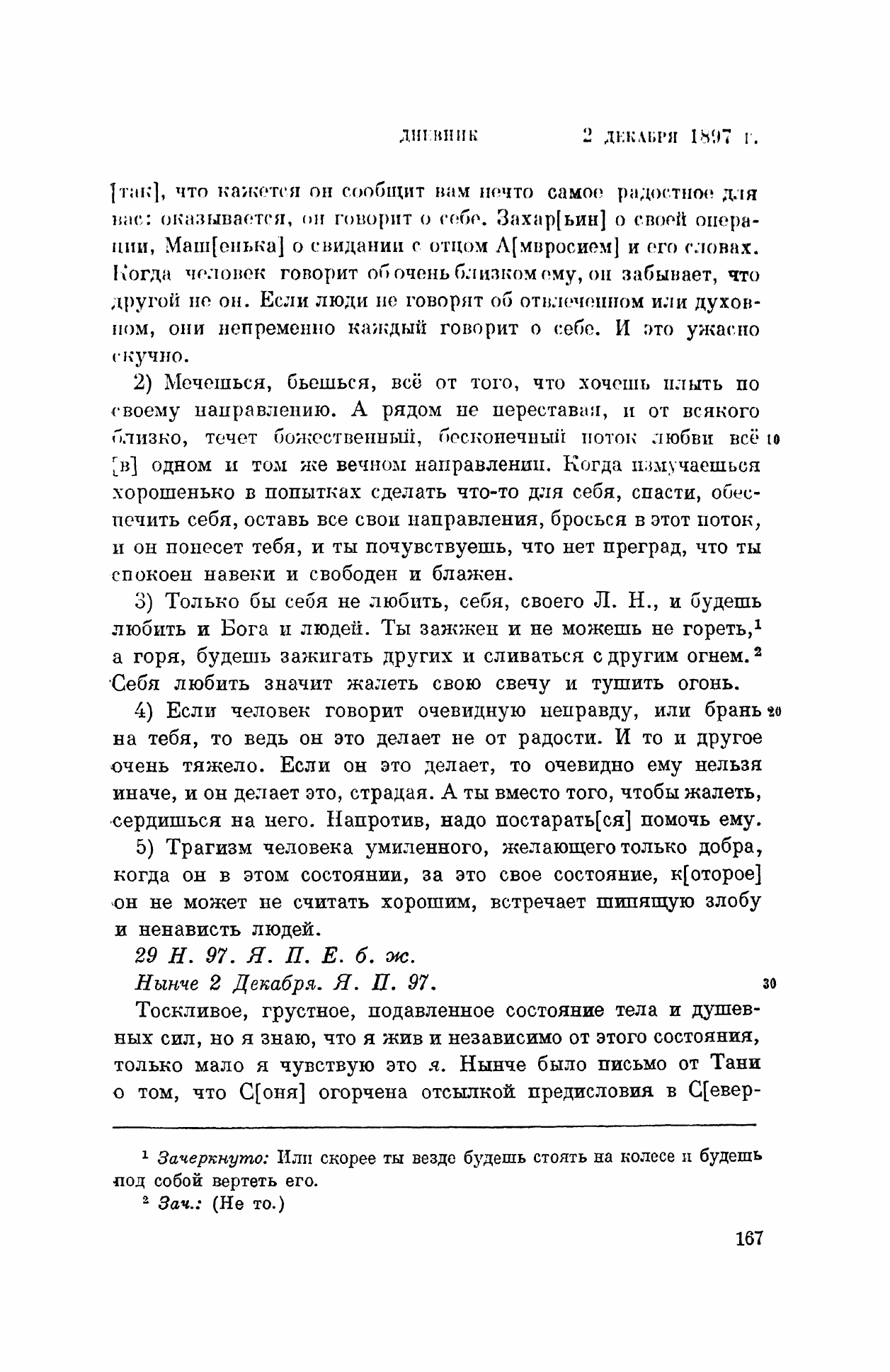
This is the most plainly written denial of “Tolstoyism” in the corpus. The “to clarify for myself” is load-bearing: the conversation was the occasion, but the formulation was a private clarification Tolstoy gave himself, set down the same day.
3.3. 1900 (1/13 August) — The rejection of “anarchist” as political
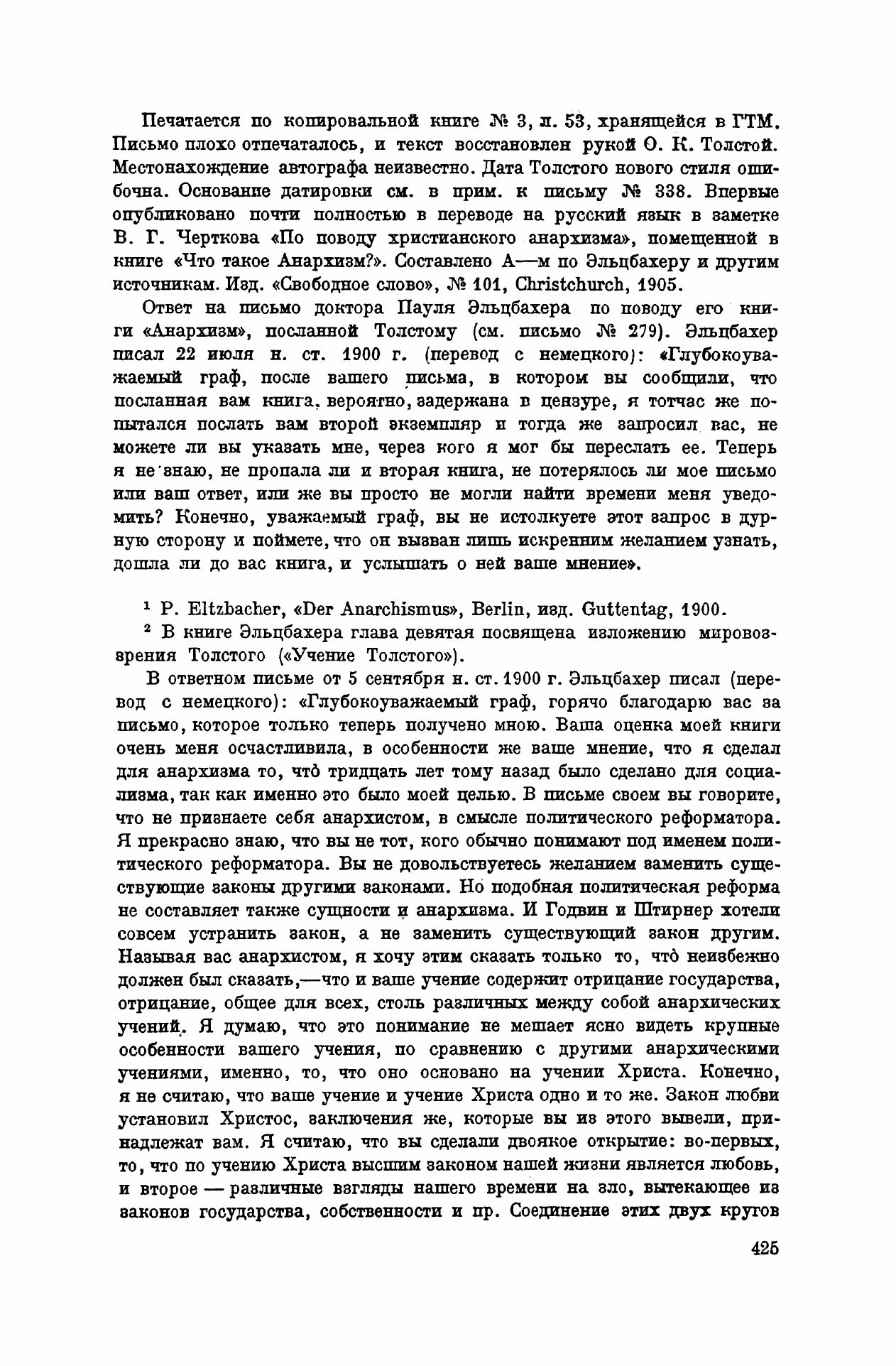
Letter to Paul Eltzbacher, written in German from Yasnaya Polyana (PSS Tom 72, letter 341, pp. 424–426). Eltzbacher (1868–1928), Berlin legal scholar, had published Der Anarchismus (Berlin: Guttentag, 1900), a systematic study that classified seven thinkers as the principal expositors of anarchism: Godwin, Proudhon, Stirner, Bakunin, Kropotkin, Tucker, and Tolstoy. He had sent Tolstoy two copies. Tolstoy’s reply opens with praise — Eltzbacher’s book does for anarchism what was done thirty years earlier for socialism, brings it into the programme of political science, is purely objective, well-sourced — and then turns:
Мне кажется только, что я не анархист в смысле политического реформатора. В оглавлении вашей книги под словом «насилие» сделаны указания на разные страницы из других сочинений, но ни одной ссылки на мои. Не доказательство ли это того, что то учение, которое вы мне приписываете и которое, в сущности, есть не что иное, как учение Христа, вовсе не политическое, а религиозное учение?
It seems to me only that I am not an anarchist in the sense of a political reformer. In the index of your book under the word “violence” references are made to various pages of the other writers, but not one to mine. Is this not proof that the teaching which you ascribe to me, and which is, in essence, nothing other than the teaching of Christ, is not a political but a religious teaching?
The move is characteristic: a qualified denial that refuses the political label while accepting the substance, and re-names the substance as Christ’s teaching. The index argument is the part that is unusually pointed. Eltzbacher’s book opens four columns of references on Gewalt / насилие for Bakunin and Kropotkin; for Tolstoy, none. Tolstoy uses Eltzbacher’s own bibliographic apparatus as the evidence: he had never written on violence as a political problem — only on non-resistance as a religious one.
Full extract (German + Russian, both in Tolstoy’s hand): extracts/v72_341_PaulyuElcbaxeruPaulEltzhacher.txt. Printed page reproduced at extracts/pss-pages/tom72-eltzbacher-442.png.
3.4. 1901 (28 July / 10 August) — The unique self-attestation
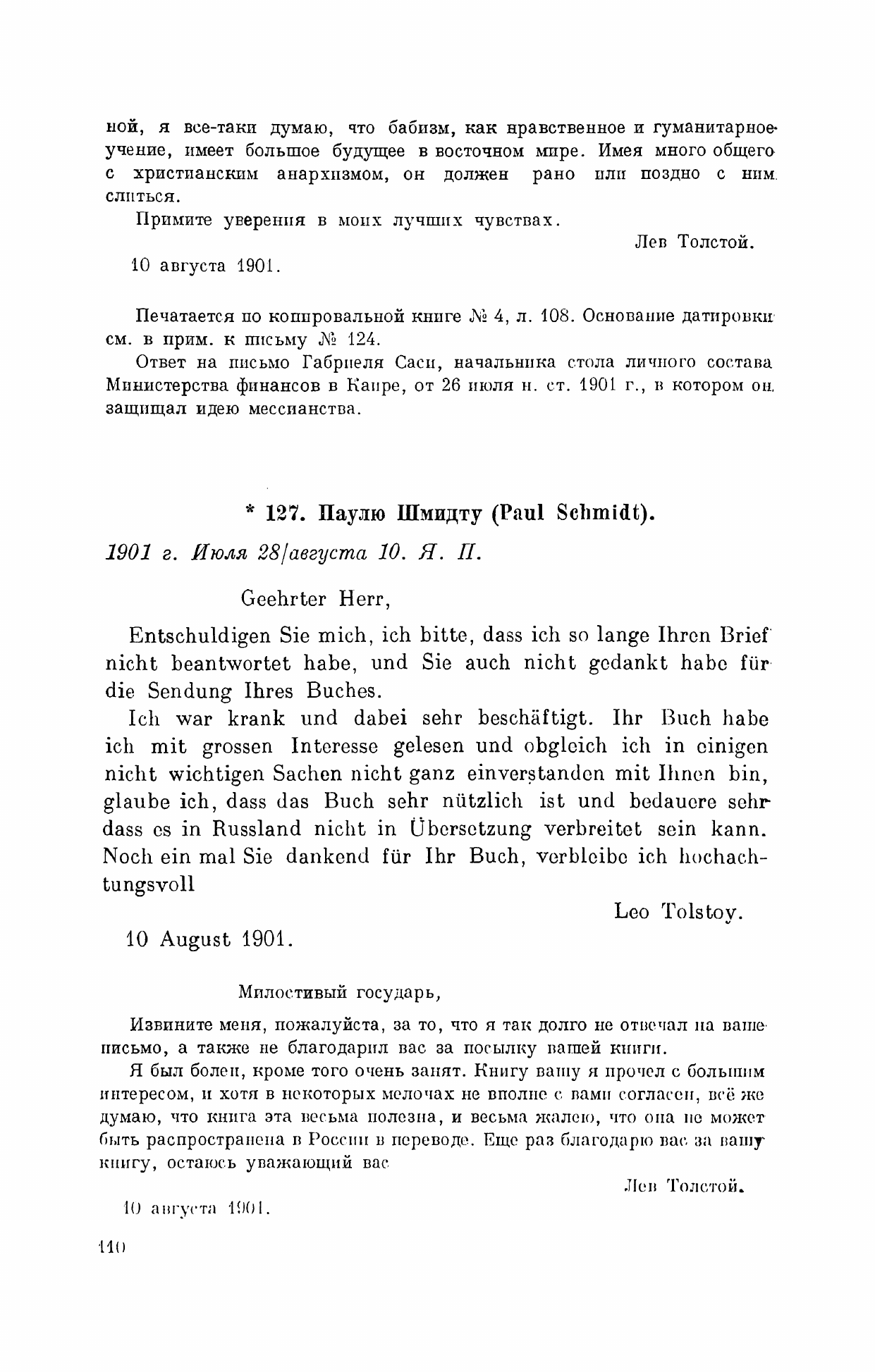
Letter to Gabriel Sacy, written in French from Yasnaya Polyana (PSS Tom 73, letter 126, pp. 109–110). Sacy was head of the personnel desk at the Ministry of Finance in Cairo and a Bábí — an adherent of the mid-nineteenth-century Persian messianic movement that would split shortly afterwards into Bábí and Baháʼí branches. He had written defending the idea of messianism. Tolstoy replies that Babism, as a moral and humanitarian doctrine, has a great future in the East. Then:
Имея много общего с христианским анархизмом, он должен рано или поздно с ним слиться.
In Tolstoy’s own French original:
ayant beaucoup de rapports avec l’anarchisme chrétien et tôt ou tard doit s’unir à lui.
Having much in common with Christian anarchism, it must sooner or later merge with it.
This is the only place in the entire 90-volume Jubilee Edition where Tolstoy uses the phrase «христианский анархизм» / «l’anarchisme chrétien» in his own voice. The phrase had been in circulation among his correspondents — Eugen Heinrich Schmitt’s Hungarian Religion des Geistes circle, John Coleman Kenworthy’s Brotherhood Church in Croydon, Felix Ortt in the Netherlands, Ernest Crosby in New York — for at least a decade by 1901, and V. G. Chertkov would in 1905 publish a programmatic essay titled O khristianskom anarkhizme. But in Tolstoy’s own written voice, the Sacy letter is the unique attestation.
The phrasing is not “I am a Christian anarchist.” It is “Babism has much in common with Christian anarchism.” Tolstoy treats Christian anarchism as the name of an already-existing body of doctrine with which a renewed Eastern messianism may converge. The implication is unmistakable — this is the doctrine he and his correspondents have been working on since the early 1890s — but the explicit self-application stops one step short.
Full extract (French + Russian, both in Tolstoy’s hand): extracts/v73_126_GabrielyuSasiGabrielSacy.txt. Printed page reproduced at extracts/pss-pages/tom73-sacy-154.png.
4. Where the theme clusters in the Jubilee Edition
The keyword sweep behind this survey returned 43 unique TEI files for the Tolstoyism family («толстовств» + «толстовц») and approximately 110 unique files for the anarchism family («анархизм» + «анархист» + «анархия»). The map below points to the clusters that reward further reading. The full file-by-file hit list is preserved locally under _generated/research/tolstoyanism-christian-anarchism/ (working-zone byproduct, not published) for the next session.
Diaries
| Date | TEI id | Material |
|---|---|---|
| 1889–1891 | v50–v52, scattered | Early occurrences of «анархизм» / «анархист» as analytical vocabulary, in the wake of The Kingdom of God Is Within You |
| 1894-09-10 | v52_138_140_1894_09_10 | The seed. Worked-out reply to the Englishman’s question about being without government. |
| 1894-07–09 | v52_125 to v52_140 | A dense cluster (six entries) preceding the 9 September letter to Morrison Davidson |
| 1898-05-04 | v53_193_194_1898_05_04 | The conversation about whether to participate in state evil or withdraw — the “what is better — anarchy?” exchange |
| 1897-12-02 | v53_167_169_1897_12_02 | The denial of Tolstoyism to Makovický. Unique self-rejection of «толстовство» in the corpus. |
| 1903–1906 | v54–v55, scattered | Post-revolution material, often in dialogue with Russian revolutionary movements |
| 1906-08-24, 09-02 | v55_236, v55_241 | Sustained engagement with the question of state collapse and what follows |
| 1909-09-16, 09-25, 09-27 | v57_140, v57_144, v57_145 | A late cluster, in the year before death |
Letters — the foreign Christian-anarchist correspondence
| PSS Tom, letter id | Addressee, date | Material |
|---|---|---|
| Tom 67, letter 179 | John Morrison Davidson, 1894-07-23 | Programmatic statement on how socialist, communist, and anarchist theories relate to Christian truth |
| Tom 67, letters 136, 171 / Tom 69, letters 87, 141 | John Coleman Kenworthy, 1894–1896 | The English Brotherhood Church correspondence |
| Tom 68, letters 24, 60, 114 / Tom 70, 46, 53 / Tom 71, 56 / Tom 90, 125 | Eugen Heinrich Schmitt, 1895–1896 | The Hungarian Christian-anarchist correspondence; “our work, your work, that is God’s work” |
| Tom 69, letter 4 | Ernest Crosby, 1896 | American Tolstoyan correspondent and translator |
| Tom 69, letter 102 | John van der Veer, 1896 | Dutch conscientious objector |
| Tom 72, letter 319 | Élisée Reclus, 1900-06-20 | French anarchist geographer; brief — permission to translate Resurrection |
| Tom 72, letter 341 | Paul Eltzbacher, 1900-08-01 | Rejection of “anarchist” as political. Unique self-rejection of «анархист» in the corpus. |
| Tom 72, letter 396 | Felix Ortt, 1900 | Dutch Christian-anarchist |
| Tom 73, letter 126 | Gabriel Sacy, 1901-07-28 | Unique LT-voice attestation of «христианский анархизм». |
| Tom 76, letter 353 | C. W. Daniel, 1907 | English publisher who reprinted Tolstoy’s late works for free distribution |
| Tom 77, letter 337 / Tom 78, letter 106 | Aylmer Maude, 1907–1908 | The principal English translator |
| Tom 82, letter 178 | M. K. Gandhi, 1910-09-07 | The famous late letter. “Anarchism” appears in a list of symptoms (socialism, communism, anarchism, Salvation Army, rising suicide rate) of the inner contradiction of Christian civilisation — context word, not self-application. |
Letters — the Russian correspondence and the state-power addressees
| PSS Tom, letter id | Addressee, date | Material |
|---|---|---|
| Tom 60, letter 193 | A. I. Herzen, early | The earliest letter in the sweep, pre-prophet period |
| Tom 63, 70, 72, 73, 74 (six letters) | P. I. Birjukov, 1885 → 1902 | The biographer correspondence; carries the working-out across years |
| Tom 67, letter 216 / Tom 76, letter 264 | V. V. Stasov | The critic correspondence |
| Tom 72, letter 426 | Tsar Nicholas II, 1902 | “Anarchism” in the context of Tolstoy’s diagnosis of Russian autocracy |
| Tom 77, letter 329 | A. F. Koni, 1907 | The jurist and reformer |
| Tom 77, letter 1 | M. A. Stakhovich, 1907-01-01 | «не есть мяса, если бы не боялся ridicul’а толстовства» — would-not-prescribe-vegetarianism-were-it-not-for-fear-of-the-ridicule-of-Tolstoyism |
| Tom 78, letter 252 | Bishop Germogen, 1908-09-13 (unsent) | Reply to Germogen’s «Архипастырское обращение» calling LT an “anathematised godless anarchist-revolutionary.” Germogen had himself been a Tolstoyan as a student. |
Polemical works — the doctrinal grounding
| PSS Tom | Work | Note |
|---|---|---|
| Tom 25 | Tak chto zhe nam delat? (What Then Must We Do?), 1886 | Pre-Eltzbacher; lays the economic-religious foundations |
| Tom 28 | Tsarstvo Bozhie vnutri vas (The Kingdom of God Is Within You), 1893 | The major polemical work of the period. Cited by Eltzbacher (1900) as the basis for the classification. An English translation is held at primary-sources/standard-ebooks/leo-tolstoy_the-kingdom-of-god-is-within-you_leo-wiener.epub |
| Tom 32 | Voskresenie (Resurrection), 1899 | Anarchism appears as analytical vocabulary in the courtroom and prison sections |
| Tom 34 | Rabstvo nashego vremeni (The Slavery of Our Time), 1900 | Companion to the Eltzbacher exchange |
| Tom 35 | Chto takoe religiya i v chem suschnost’ ee (What Is Religion and Wherein Lies Its Essence?), 1902 | Re-grounds the political question in religious terms |
| Tom 35 | K politicheskim deyatelyam (To Political Activists), 1903 | |
| Tom 36 | O znachenii russkoi revolyutsii (On the Meaning of the Russian Revolution), 1906 | Post-1905 |
| Tom 38 | Pis’mo revoljutsioneru (A Letter to a Revolutionary) | |
| Tom 38 | Neizbezhnyj perevorot (The Inevitable Revolution) | |
| Tom 39 | Khristianstvo i patriotizm (Christianity and Patriotism) | |
| Tom 43, 45 | Na kazhdyj den’ and Put’ zhizni anthologies | Late period; aphorisms organised by daily reading |
| Tom 90 | Patriotizm ili mir? and Patriotizm i pravitel’stvo | Companion to the foreign Christian-anarchist correspondence |
5. Material not covered by this survey
- The TEI
comments/directory (807 editorial-commentary files). The 1928–1958 PSS editors’ framing of both labels is a separate, smaller study. - The Goldenweiser and Makovický conversation transcripts. The 1897-12-02 diary is itself a Makovický conversation. The Yasnopolianskie zapiski (1904–1910) almost certainly contain further spoken statements but were not swept here.
- Incoming letters to Tolstoy. The TEI corpus appears to hold only outgoing letters. Eltzbacher’s letter introducing Der Anarchismus, Sacy’s letter from Cairo, Schmitt’s letters from Budapest — none are available locally in TEI form.
- Chertkov’s 1905 essay O khristianskom anarkhizme («О христианском анархизме»), published in Chto takoe Anarkhizm? (Christchurch: Свободное слово, № 101, 1905). The in-circle theological frame to which the Sacy letter’s phrase almost certainly refers. Not held locally.
- The Krug chteniya / Put’ zhizni anthologies (Toms 41–45). LT-curated daily readings on related themes (state, law, violence, brotherhood). Excluded from the focused sweep on the two label-families.
6. The genealogy of the phrase «христианский анархизм»
The Sacy letter shows the phrase already in Tolstoy’s working vocabulary by 1901. The phrase was not Tolstoy’s coinage; it was a term-of-art that had emerged among his correspondents — Schmitt, Kenworthy, Davidson, Crosby, Ortt — through the 1890s. By 1905, V. G. Chertkov had given it programmatic form in the booklet O khristianskom anarkhizme, published in Christchurch by Свободное слово press as № 101 of the series. The booklet is referenced in the editorial apparatus to the Eltzbacher letter (PSS Tom 72, comment to letter 341) as the prior place of partial publication of that very letter — the editorial chain from Tolstoy’s correspondence to Chertkov’s framing is therefore documentary, not merely thematic.
A full genealogy of the phrase in Russian and English usage, and the question of when “Christian anarchism” stabilised as a doxographic category in twentieth-century political theory, is a separate research question and was not undertaken here.
7. Method
- The TEI corpus from
primary-sources/tolstoydigital-TEI/texts/was used as the primary search surface: 9 087 letter files, 4 584 diary files, 767 published-works files. - A two-family Russian keyword set was used:
толстовств+толстовцfor the Tolstoyism family (43 unique files), andанархизм+анархист+анархияdeclensions for the anarchism family (~110 unique files). The compound phraseхристианский анарх[*](with all five case-inflected adjective forms) returned 3 files; only one (the Sacy letter) carries the phrase in Tolstoy’s own voice. The adjacent “so-called Tolstoyans” / “they call me X” verbal frames returned zero hits — Tolstoy’s refusal of the labels never takes that verbal shape. The unique-attestation searchesя не анархистandникакого толстовствeach returned exactly one file, both of which are finalists in this survey. - Every TEI filename encodes the PSS Tom number and, for diaries, the entry date (
vXX_NNN_..._YYYY_MM_DD.xml). Every TEI file contains a<title type="bibl">element giving the formal PSS citation. Both were preserved verbatim through the extraction so all citations in this document are anchored to their TEI source. - The shared lxml-based extractor
extract_tei.py, indocs/research/lib/, resolves the heavy editorial markup in the TEI body. The<choice>/<sic>/<corr>editorial-correction wrappers are resolved in favour of the corrected/expanded reading;<note>footnote bodies are stripped. The result is readable Russian prose suitable for grep with context, matching the printed PSS modulo the orthographic conventions of 1928–1958 typesetting. - The three finalist passages were cross-checked against the printed PSS by extracting the relevant pages from the local PDFs at 220 dpi (
pdftoppm): - The 1897-12-02 diary entry against PSS Tom 53 (= local file
vol19/vol19.pdf), pages 167–168. - The Eltzbacher letter against PSS Tom 72 (=
vol36/vol36.pdf), pages 424–426. - The Sacy letter against PSS Tom 73 (=
vol37/vol37.pdf), pages 108–109. - Working English translations are the editor’s; the originals (French in the Sacy letter, German in the Eltzbacher letter, Russian in the diary) are all in Tolstoy’s own hand. The Sacy and Eltzbacher letters are paired bilingual letters, written in the foreign language and then in Russian translation by Tolstoy himself.
The companion file pss-volume-mapping.md documents the local-file naming convention (PDFs are named in publication-order, not by Tom number).
8. References
Primary:
- Толстой Л. Н. Полное собрание сочинений: в 90 тт. — Москва: Гос. изд. «Художественная литература», 1928–1958. (PSS, the 90-volume Jubilee Edition. Local copies at
primary-sources/jubilee-edition/.) - tolstoydigital TEI corpus, Слово Толстого project, HSE Moscow. CC BY-SA. https://github.com/tolstoydigital/TEI. Local copy at
primary-sources/tolstoydigital-TEI/.
Background:
- Eltzbacher, Paul. Der Anarchismus. Berlin: J. Guttentag, 1900. The book that prompted the 1 August 1900 letter; classified Tolstoy as one of the seven sages of anarchism. An English translation by Steven T. Byington was published by Benjamin Tucker (New York, 1908) as Anarchism: Exponents of the Anarchistic Philosophy. Not held locally.
- Chertkov, V. G. O khristianskom anarkhizme. In Chto takoe Anarkhizm? Sostavleno A. M. po Eltzbakheru i drugim istochnikam. Christchurch: Свободное слово, № 101, 1905. The in-circle programmatic statement that gave «христианский анархизм» its consolidated Russian form. Not held locally.
- Christian, R. F. (ed.). Tolstoy’s Diaries Volume II: 1895–1910. Faber, 2010. (Modern English scholarly edition; not held locally. Contains the 2 December 1897 entry.)
Companion documents:
- extract_tei.py — the shared lxml-based TEI extractor (in
docs/research/lib/) used to produce the readable Russian prose quoted in this document. - pss-volume-mapping.md — Tom number → local PDF file lookup.
- tolstoydigital-tei-reference.md — Reference for the TEI corpus and its relationship to the Jubilee Edition.
- copyright-renunciation — sibling research essay on a related theme (the renunciation of literary property). Uses the same method and the same extractor.