Examination of Dogmatic Theology (Исследование догматического богословия)
A work-focused dive across the local Tolstoy corpus: the PSS (Jubilee Edition) Tom 23 text and its editorial commentary, the composition-window letters, the four sibling works of the religious turn, and the project’s prior dives. All Russian quotations are byte-faithful extracts (verified); English renderings are working translations; dates are Old Style (Julian) unless noted. Secondary scholarship is attributed, not asserted.
Key findings
- Examination of Dogmatic Theology is the second panel of the four-part religious project Tolstoy began as a single treatise in late 1879 — A Confession (the autobiography) → this work (the critique of Orthodox dogma) → the Gospel harmony → What I Believe. It is the project’s negative, demolishing panel, the counterpart to the constructive Gospel work.
- Tolstoy’s method is unusual: he learned Orthodox dogmatics on its own terms, “like a good seminarian,” and then dismantled it from inside, chapter by chapter, taking Metropolitan Makary (Bulgakov)’s «Православно-догматическое богословие» — the standard textbook — as the representative target.
- The governing charge is not error but design: the dogmatics is a «сознательная ложь» (a conscious lie), “a deception built up over centuries … with a definite and base aim.” Its moral core is that the Church replaces the living question how shall I live? with the fantastical one why am I bad?
- The book does not end in negation. Its conclusion turns from a deadpan paraphrase of the whole dogmatic system to Tolstoy’s own positive faith — the true Church as life-by-deeds, not doctrine — the seed of the constructive works that followed.
- The famous title «Критика догматического богословия» (A Critique of Dogmatic Theology) is not Tolstoy’s: it came from M. Elpidine’s first edition (Geneva, 1891) and passed into Leo Wiener’s 1904 English. Tolstoy’s own autograph title is «Исследование» (Examination), restored by the Jubilee editors.
- It was unpublishable in Russia: published abroad (Elpidine, Geneva 1891 / Carouge 1896; Chertkov’s «Свободное слово», Christchurch 1903) and circulated in manuscript; printed in Russia only after 1905, and then censored — the comparison of Catherine the Great to a pious harlot and Peter the Great to a pious robber-murderer was cut.
- With no diary surviving for 1879–80 (the corpus has none between 1878 and 1881), the dateable genesis rests on two 1880 letters to N. N. Strakhov and the Jubilee commentary.
Why this matters
Of Tolstoy’s four major religious works this is the one almost no one reads. It is the foundation stone of the demolition on which the constructive teaching was built: before he could write his own Gospel, Tolstoy had to clear the ground of the Church’s, and this is where he does it — the most sustained, systematic, and savage attack he ever made on Orthodox doctrine. For this project it is also the missing panel of the quartet (the A Confession, gospel-translation and What I Believe dives are done) — and a work whose works/ record does not yet exist, so the dive doubles as the source-grounded basis for creating it.
The shape of the question
The book opens by naming the necessity that drove it.
Я был приведен к исследованию учения о вере православной церкви неизбежно.
I was led to the examination of the teaching of the faith of the Orthodox Church inevitably. (working English — PSS Tom 23, Вступление)
Having found in the Church his rescue from despair, Tolstoy could not leave its doctrine unexamined once it clashed with his idea of God. He read the catechisms, the Eastern Patriarchs, John of Damascus — and chose the fullest exposition as his target.
Самая позднейшая и полнейшая и пользующаяся наибольшим распространением из этих изложений есть Богословие Макария, и потому я для разбора избрал его.
The latest and fullest and most widely circulated of these expositions is Makary’s Theology, and therefore I chose it for analysis. (working English — PSS Tom 23, Вступление)
His method was to master the system before refuting it.
достиг того, что выучил богословие, как хороший семинарист
I attained to having learned the theology like a good seminarian. (working English — PSS Tom 23, Вступление)
And the verdict the introduction reaches, before the chapter-by-chapter analysis even begins, is not that the dogmatics is mistaken but that it is dishonest.
И я понял, наконец, что всё это вероучение, то, в котором мне казалось тогда, что выражается вера народа, что всё это не только ложь, но сложившийся веками обман людей неверующих, имеющий определенную и низменную цель.
And I understood, at last, that this whole creed — the one in which it then seemed to me the faith of the people was expressed — that all of it is not only a lie, but a deception built up over centuries by unbelieving men, with a definite and base aim. (working English — PSS Tom 23, Вступление)
Genesis & composition
The work was never a separate undertaking. The Jubilee commentary (Savodnik) traces it to the single religious-philosophical treatise Tolstoy began in the last months of 1879 — the same treatise that yielded A Confession, the Gospel harmony, and What I Believe. Having drafted the whole, he set about reworking it part by part, and the dogmatic critique was the part he had to expand.
The corpus holds no diary for 1879 or 1880 — Tolstoy kept notebooks, not a diary, through these years, and the corpus diary jumps from 1878 to 1881. The dateable genesis therefore rests on two letters to N. N. Strakhov, his closest reader. The first, of 29 February 1880, is the single firm witness the commentary can point to.
Особенно тяжело мне было то, что, начав все перерабатывать сначала, я отдел обзора православного богословия должен был расширить. И я изучил хорошо богословие и теперь вот кончаю разбор его.
What weighed on me most was that, having begun to rework everything from the start, I had to expand the section surveying Orthodox theology. And I have studied theology thoroughly, and now I am finishing its analysis. (working English — letter to N. N. Strakhov, 29 February 1880 OS, PSS Tom 63; the letter goes on: «Если бы мне рассказывали то, чтò я там нашел, я бы не поверил» — “If I had been told what I found there, I would not have believed it.”)
Three weeks later the absorption — and its physical cost — continues.
и не могу оторваться и часто счастлив своей работой, но очень часто слабею головой.
and I cannot tear myself away, and am often happy with my work, but very often my head grows weak. (working English — letter to N. N. Strakhov, 23 March 1880 OS, PSS Tom 63)
(The corpus’s own editorial note on this second letter reads its “work” as the Gospel examination rather than the dogmatic critique — the two were being written in the same intense months, and even the Jubilee commentary flags that it cannot be certain which the letter means. It is taken here as a witness to the period, not decisively to this book.)
The work was not quite finished there. Around May 1882 Tolstoy wrote a separate article on the Church (first titled «Что такое Церковь?»), prompted by a press exchange between Vladimir Solovyov, Ivantsov-Platonov and D. A. Khomyakov; deciding not to print it (“I do not want a quarrel”), he shortened it, stripped its occasion, and folded it into chapter XIII. The last pass came in autumn 1884, when Chertkov asked for the manuscript, Tolstoy “glanced into it,” found it imprecise, and spent October revising — the chapter on the redemption and the divinity of Christ, he told his wife, was worth getting right because “for millions of people this question is of enormous importance.” On that basis the commentary dates the writing to the last months of 1879 – March 1880, and the final revision to September–November 1884.
What the work says
The book is a mechanical march through Makary’s dogmas in Makary’s own order — Tolstoy says it has to be mechanical, “chapter by chapter,” because the theology has no inner connection to follow. He quotes the numbered paragraphs and dismantles each. The recurring discovery drives him to the edge of abandoning the task.
Не бросить ли? Ведь это бред сумасшедшего. Но нет, я сказал себе, что прослежу строго, точно всё изложение богословия.
Should I not give it up? This, after all, is the raving of a madman. But no — I told myself I would follow strictly, exactly, the whole exposition of the theology. (working English — PSS Tom 23, ch. IV, on the attributes of God)
The dogmas of God’s nature he treats as demands to affirm contradictions. On the Trinity:
Сказать, что я понял это, я не могу, и не может никто, и потому не могу сказать, что верю.
To say that I have understood this I cannot, and no one can; and therefore I cannot say that I believe it. (working English — PSS Tom 23, ch. V)
On the reconciliation of the Fathers about the divine attributes:
Церковь учит нас признавать и то и другое, т. е. что черное есть белое, а белое есть черное.
The Church teaches us to acknowledge both the one and the other — that is, that black is white, and white is black. (working English — PSS Tom 23, ch. IV)
Reading the creation and Fall against Genesis itself, he finds the Church’s story inverted — a God who wished to keep man ignorant like the animals and feared his knowledge.
Бог этих первых глав есть не бог христианский, не бог даже пророков и Моисея, бог, любящий людей, но это — бог, ревнующий свою власть к людям, бог, боящийся людей.
The God of these first chapters is not the Christian God, not even the God of the prophets and Moses, the God who loves men — but a God jealous of his power over men, a God who fears men. (working English — PSS Tom 23, ch. VII; “the same God,” he adds, “as Zeus in relation to Prometheus.”)
The moral heart of the book is the charge against original sin: that it displaces the only real question.
Учение же церкви на место этого вопроса, как мне жить, подставляет вопрос о том, отчего я дурен.
But the teaching of the Church, in place of this question — how shall I live — substitutes the question of why I am bad. (working English — PSS Tom 23, ch. VIII)
Может ли быть изобретено другое более безнравственное учение?
Could any more immoral teaching be invented? (working English — PSS Tom 23, ch. VIII)
Against the dogma of redemption — which, unlike the unknowable attributes of God, asserts something about men, and asserts the opposite of fact — he sets the boundary that runs through the whole book: God’s affairs are God’s; mine is how to live.
Бог делает свое дело, которое я, очевидно, никогда понять не буду в силах, а мне надо делать свое.
God does His work, which I shall obviously never be able to understand; but I have to do mine. (working English — PSS Tom 23, ch. X)
The chapter on the Church he treats as the keystone of the edifice — the dogma on which all the others rest.
Церковь — то самое, на чем основано всё богословие, — есть сама себя учредившая иерархия и, в противность всем другим иерархиям, считающая одну себя святою и непогрешимою и одну себя имеющею власть проповедывать божеское откровение.
The Church — the very thing on which all theology is founded — is a self-instituted hierarchy which, against all other hierarchies, considers itself alone holy and infallible and alone having the authority to preach divine revelation. (working English — PSS Tom 23, ch. XIII)
On the doctrine of sanctification by faith he answers with one of the book’s sharpest images.
Если сумасшедший верит, что у него на носу башня, то ведь несомненно то, что ему представляется на носу башня, но никто не станет утверждать, что у него на носу действительно башня.
If a madman believes there is a tower on his nose, then it is indeed beyond doubt that a tower appears to him to be on his nose — but no one will assert that there is actually a tower on his nose. (working English — PSS Tom 23, ch. XV)
And the sacraments, once grace is said to pass by physical manipulation, fall to the level of magic.
Ясно: таинства суть чисто внешние действия, как заговоры от зубов, действующие на людей, и о духовном ни со стороны заговорщиков зубов, ни тех, которые лечатся, нечего думать и говорить.
Clearly: the sacraments are purely external acts, like spells against toothache, acting upon people, and there is nothing spiritual to think or speak of, either on the part of the toothache-charmers or of those being treated. (working English — PSS Tom 23, ch. XVI)
By the chapter on relics and hell the labour of transcribing the doctrine has become, for him, the real blasphemy.
Одно чувство, которое я испытывал, выписывая это, есть чувство ужаса и страха перед тем кощунством, которое я совершаю, переписывая и повторяя это.
The one feeling I experienced while copying this out is a feeling of horror and dread at the blasphemy I am committing in transcribing and repeating it. (working English — PSS Tom 23, ch. XVII)
The conclusion first restates the entire dogmatic system in flat, plain words — a “strange, wild, half-man, half-monster” God who makes the world on a whim — and then answers the question the whole project began with.
Смысл моей жизни, по этому учению, есть совершеннейшая бессмыслица, без сравнения худшая той, которая мне представлялась при свете одного моего разума.
The meaning of my life, according to this teaching, is the most complete nonsense — incomparably worse than the one that presented itself to me by the light of my reason alone. (working English — PSS Tom 23, Заключение)
Here too is the passage that the Russian editions could not print — the one that turns the critique against the state as well as the Church.
Велят они, чтобы на молитве дьякон половину времени кричал многая лета правоверной, благочестивой блуднице Екатерине II или благочестивейшему разбойнику, убийце Петру, который кощунствовал на Евангелии, и я должен молиться об этом.
They command that at prayer the deacon half the time cry “many years” to the orthodox, pious harlot Catherine II, or to the most pious robber and murderer Peter, who blasphemed against the Gospel — and I am to pray for this. (working English — PSS Tom 23, Заключение)
But the book does not close on demolition. Its last words are the constructive faith the four-part project was built to state.
Дело веры есть только жизнь по вере. И жизнь одна выше всего и не может быть подчинена ничему, кроме бога, познаваемого только жизнью.
The business of faith is only life according to faith. And life alone is higher than everything and cannot be subordinated to anything except God, who is known only through life. (working English — PSS Tom 23, Заключение)
Redactions & textual history
The Jubilee editors (Savodnik) enumerate four manuscript witnesses. The first is a rough autograph of 104 leaves that began — before Tolstoy crossed it out — with an analysis of Filaret’s catechism, and ends with a discussion of Khomyakov’s idea of the Church dropped from the final text; like the first redaction of A Confession, it is more personal and more passionate, speaking openly of the theologians’ “blasphemous” reasoning and using the word «попы» (priests) freely. The chapter division first appears in the third manuscript (a fair copy by S. A. Tolstaya and three other copyists, 564 leaves), which also carries the 1882 Solovyov-prompted article in chapter XIII and N. N. Strakhov’s marginal remarks on one leaf. The fourth manuscript — a 431-leaf copy partly in the hand of T. L. Tolstaya, bound, and once owned by Tolstoy’s friend M. A. Schmidt — holds the last (October 1884) redaction and is the PSS base text. The commentary notes that the copyists, seminarians among them, worked carelessly and “illiterately,” capitalising pronouns for the deity (which Tolstoy did not) and even lengthening his quotations from Makary; the émigré editions inherited and added to these corruptions, which the Jubilee edition is the first to clear.
The title is itself a textual question. Every printed edition carried «Критика догматического богословия», but Tolstoy’s own autograph title page reads «Исследование догматического богословия», and he uses the word исследование (examination, investigation) in the work’s first line and throughout. The Jubilee editors restored it; this dive follows them.
Publication, censorship & translation
The work’s publication history is, like A Confession’s, a history of suppression — but more complete, because this book was never even submitted to a Russian press. It went straight abroad.
It was first printed by the Geneva émigré publisher M. K. Elpidine, in two parts (Genève 1891; Carouge 1896), under the title «Критика догматического богословия» — the title that thereafter stuck, though its origin, the commentary notes, is unknown. Elpidine’s edition was very faulty. In 1903 it appeared, corrected of some of Elpidine’s misprints, as the second volume of Chertkov’s «Свободное слово» (Christchurch, England) series of “Complete Works … forbidden in Russia.” Inside Russia it circulated in manuscript copies made for distribution, and reached print only after the 1905 reforms — in an incomplete Askarkhanov edition and then a fuller E. V. Gertsik reprint (St Petersburg, 1908) of the «Свободное слово» text, “with very minor censorship omissions”: after “the orthodox pious harlot” the name «Екатерине» was dropped, and after “the most pious robber, murderer” the name «Петру». The 1911 S. A. Tolstaya and 1913 Sytin/Biryukov collected editions cut the whole Catherine-and-Peter clause to dots, and the S. A. Tolstaya edition softened other phrases for the censor (striking «как заговоры от зубов», removing «глупости»).
In English the work appeared once, as “A Critique of Dogmatic Theology,” translated by Leo Wiener as part of volume XIII of The Complete Works of Count Tolstoy (Boston: Dana Estes, 1904) — the edition held locally and the source of this dive’s facsimile. There has been no separate modern English edition.
Reception & afterlife — the Russian society and Church reaction
The work’s afterlife is mostly an afterlife of neglect. Because it circulated abroad and in manuscript rather than in the Russian press, it provoked nothing like the critical engagement that met A Confession; a dedicated sweep of any contemporary Russian responses was not run for this dive, and the corpus carries none. What the record shows clearly is the institutional fact: the most direct doctrinal attack Tolstoy ever made on the Orthodox Church was simply unpublishable in Russia for a quarter-century, and censored when it finally appeared.
It belongs to the long conflict that culminated in the 1901 Holy Synod edict declaring Tolstoy fallen from the Church — this book is the fullest statement of the rejection the edict responded to — but, as with A Confession, the edict should not be tied to it directly: read in full, the 1901 decree names no individual works. And the book’s quarrel is not only with the Church: the censored Catherine-and-Peter passage shows it striking at the sanctification of the imperial state as fiercely as at the hierarchy.
Place in the cluster
Examination of Dogmatic Theology is the second of the four-part enterprise, and its destructive half. A Confession (Tom 23, pp. 1–59) is the autobiographical introduction; this work clears away the Church’s answer; the Gospel harmony and What I Believe (Tom 23, pp. 304–465) build the replacement. Tolstoy described the whole, in the 1884 preface to his short Gospel, as a large work in four parts “lying in manuscript and unprintable.” The dives on the sibling panels — A Confession, the Gospel translation, What I Believe, and the later On Life and The Kingdom of God Is Within You — trace where the cleared ground was built on.
The author’s later verdict
Tolstoy never disowned the work. When A. K. Chertkova prepared the 1903 «Свободное слово» reissue, she sent him the first sheets in November 1902 and he corrected the copyists’ errors in them by hand — twenty-two years after writing it, he was still tending the text. No separate later self-assessment of this book specifically survives in the corpus; the standing verdict is the four-part-project frame of the 1884 Gospel preface, in which the demolition remains the necessary first half of the whole.
Scholarly context
English-language scholarship treats this as the least-read of Tolstoy’s major religious works, and largely as the “negative” or destructive panel of the religious turn. Ernest Simmons calls it “perhaps the least read of all these works, and undeservedly so,” and “an unusually fervent and compellingly logical attack on revealed religion” — praise for the method, with the polemic kept at arm’s length; A. N. Wilson and Rosamund Bartlett barely treat it. The one full study is Pål Kolstø’s Heretical Orthodoxy (Cambridge, 2022), whose third chapter both explains the neglect (“the stylist Tolstoi is conspicuously absent; the polemics … are so coarse and overplayed”) and reads the work “against the grain,” arguing that the crude anti-clerical demolition conceals deeply Orthodox structures in Tolstoy’s own mature theology — a dualist anthropology, an apophatic register — and that Tolstoy in fact faults Makary for abandoning apophaticism.
Where the dive’s findings meet the received view:
- “Merely negative” — the primary text complicates this: the conclusion turns from demolition to Tolstoy’s own positive faith («Дело веры есть только жизнь по вере»), so the destruction is already in the service of a construction. The book is the negative panel of a project whose constructive aim is visible inside it.
- The neglect — Kolstø’s against-the-grain reading is the high-value extension: the corpus supplies the close primary reading the older tradition skipped, and the genesis and title history (below) that the Western literature, working from Wiener’s “Critique,” does not register.
- The title — the primary record contradicts the inherited English title: «Критика» is Elpidine’s word, not Tolstoy’s; his is «Исследование», restored from his autograph.
- The 1901 excommunication — the dive complicates the easy link: the work is institutional background to the edict, not a named cause, and it attacks the imperial state as well as the Church.
Material not covered
- Contemporary Russian critical and clerical reception in the 1880s–1900s (the work circulated abroad and in manuscript; a dedicated reception sweep was not run, and the corpus carries none).
- The four manuscript variants themselves, collated only in summary from the commentary (Tom 23 carries no separate «варианты» apparatus file for this work, as it does for A Confession).
- The 1882 inserted article «По поводу статей Соловьева, Ив.-П. и Д. X.» in its own right, and the underlying «Русь» 1881–82 articles.
- Pål Kolstø’s full apophatic/cataphatic and dualist-anthropology argument, summarised at the abstract level, not read in full.
- The Wiener 1904 English translation’s text and accuracy (only its publication facts used).
- The Gospel harmony as a text — named as the constructive sibling but treated in the gospel-translation dive, not here.
Visual & manuscript record
The medium-intensity sweep returned six public-domain images into the dive’s local cache (visuals/, git-ignored), plus a committed public-domain facsimile of the first English edition. The image most particular to this work is not of Tolstoy but of his antagonist: Metropolitan Makary (Bulgakov), whose textbook the book exists to demolish.
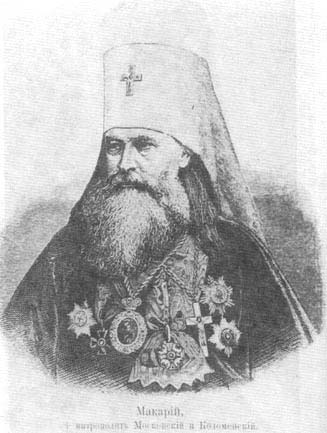
The people around the text are documented in period portraits: N. N. Strakhov (recipient of the 1880 genesis letters), V. G. Chertkov (who provoked the 1884 revision and published the 1903 edition), and Metropolitan Filaret (Drozdov), author of the catechism Tolstoy also examined; together with two period images of Tolstoy himself — Kramskoy’s 1873 portrait and a photograph of the early 1880s, contemporary with the writing.
For the printed text, a public-domain facsimile of the first English edition is held in extracts/: the title page of Leo Wiener’s translation, which carries the émigré “Critique of Dogmatic Theology” title.
myconfessioncrit00tols).What is not openly available: a title-page facsimile of the banned Elpidine «Критика» first edition (Geneva, 1891) — public domain by age but with no open scan located — and a portrait of Elpidine himself. Both are logged to acquire. The four manuscripts are described in the PSS apparatus only.
Method
This was an in-session unattended work-dive, medium visual intensity. Phase 0 pinned the subject to PSS Tom 23 (text pp. 60–303; commentary pp. 538–547) and the composition window (late 1879 – March 1880, revised 1884), and confirmed the absence of any 1879–80 diary in the corpus. Phase 1 swept the composition-window letters (Tom 63) for the genesis witnesses the commentary names. Phase 2 deep-read the work’s own text — the Вступление, all seventeen chapters, and the Заключение — and extracted the keystone passages with extract_tei.py --choice=reg (pre-reform orthography resolved); every cited Russian quotation was checked byte-for-byte against its extract (verify_quotes.py, 22/22 pass). During extraction a byte-fidelity bug in the shared extractor was found and fixed (it had been silently dropping the prose that follows inline footnote anchors — seven passages in this work alone); the fix is additive and is flagged for backfill across prior dives. Phase 3 added the secondary scholarship layer (web). Phase 4 synthesised this page, the dossier.yaml (evidence, entities, work-record proposal, coverage ledger, scholarship triangulation, visuals), and the draft note. Genuine uncertainties — the work’s genre and completion-date conventions, which Russian edition counts as “first,” the bans/excommunicationRelated encoding, the 23 March 1880 letter’s subject, and a minor Makary-bibliography discrepancy — are routed to the dossier’s needsReview, not asserted here.
Links: sibling dives A Confession, gospel-translation, What I Believe, On Life, The Kingdom of God Is Within You.
References
Primary: L. N. Tolstoy, «Исследование догматического богословия», PSS (Jubilee Edition) Tom 23, pp. 60–303 (text; commentary by V. F. Savodnik, pp. 538–547); tolstoydigital-TEI corpus (letters Tom 63 to N. N. Strakhov, 29 February and 23 March 1880).
Background: Pål Kolstø, Heretical Orthodoxy: Lev Tolstoi and the Russian Orthodox Church (Cambridge University Press, 2022), ch. 3; Ernest J. Simmons, Introduction to Tolstoy’s Writings (University of Chicago Press, 1968); Inessa Medzhibovskaya, Tolstoy and the Religious Culture of His Time: A Biography of a Long Conversion, 1845–1885 (Lexington Books, 2009); Leo Wiener (trans.), “A Critique of Dogmatic Theology,” in The Complete Works of Count Tolstoy, vol. XIII (Boston: Dana Estes, 1904); Encyclopædia Britannica, “Macarius Bulgakov” and “An Examination of Dogmatic Theology”; PY Rare Books catalogue, Kritika dogmaticheskago bogosloviia (Elpidine first edition, 1891).
Companion dev-blog note: 2026-06-07-examination-of-dogmatic-theology (draft). Structured evidence, entity routing, the work-record proposal and the coverage ledger are in dossier.yaml.