A single-work corpus dive on The Living Corpse (Живой труп), the six-act drama Tolstoy wrote in 1900, left unfinished by his own choice, and which was published and famously staged only after his death. It is run in the --novel mode with the drama flex: the whole play is read in full, act by act (a short text, unlike a 300–500-page novel), while the heaviest effort goes to genesis, the prototype network, and reception — the layers where the work’s depth lives. The text is read from its own tolstoydigital TEI (PSS Tom 34, pp. 7–99); its genesis and abandonment are reconstructed from the Tom 34 editorial apparatus (А. И. Опульский, История писания и печатания) and the 1897 + 1900 diaries and letters (Toms 53–54, 72, 88), grounded against Tolstoy’s own words before any mainstream scholarship; the reception is the staging story of the 1911 Moscow Art Theatre première.
The dive prepares ingestion-ready material (this index.md, a machine-readable dossier.yaml, byte-faithful extracts/, a heavy visual record, and a draft dev-blog note). It does not create vault pages; it plans them. No works/ record exists for the play, so the dossier proposes a record-creating workRecord (plays/drama), not a fill.
Key findings
- The play is an indictment of an institution, not of its people. Every principal acts with honour — Fedya, Liza, and Karenin all try to do the decent thing — and the marriage-and-divorce machinery destroys them anyway. The honest exit from a dead marriage is closed by design: an Orthodox divorce required one spouse to swear to fabricated adultery, and Fedya «не могу спокойно лгать» (cannot calmly lie). So he fakes his death — becomes a «живой труп» — and when the law catches him, it offers only to bind all three together again. He shoots himself rather than be re-imprisoned.
- The marquee tested two claims and the record answered both. (1) Is the play an indictment of legal marriage and its divorce courts? — confirms + extends: scholarship agrees, and the primary text shows the indictment is structural (no villain; the system alone is the agent) and rooted in Tolstoy’s own legal circle, exactly as Resurrection was. (2) Was the play abandoned mainly to spare the real Gimers? — complicates + extends: the family’s plea is documented and real, but in his own diary the abandonment (28 Nov 1900) is driven by the pull of the people’s suffering, and the dissatisfaction runs from August. The PSS itself frames the Gimer plea as «также» (also) a cause.
- A correction to the standard genesis line: Tolstoy was provoked, not charmed, into writing it. The diary of 27 January 1900 reads «Ездил смотреть Дядю Ваню и возмутился. Захотел написать драму Труп» — he saw Chekhov’s Uncle Vanya at the Art Theatre, was indignant, and therefore wanted to write his own.
- Tolstoy placed the play in a lineage, against the “about-face” reading. A popular reading frames The Living Corpse as a reversal of The Kreutzer Sonata (which condemned marriage and sexuality themselves). But in his diary of 15 December 1900 Tolstoy groups the play with Kreutzer, The Power of Darkness, and Resurrection — works he wrote «без всякой думы о проповеди» that nonetheless «много принесло пользы» — and wonders «Не то ли и с Трупом?». The target moved outward (to the institution, not desire); the lineage he claimed is continuity.
- The prototype layer is dense and documented. The plot is the real Gimer court case, given to Tolstoy by the judge N. V. Davydov; the two leads are N. S. and E. P. Gimer, the mother is E. A. Simon, the tavern “genius” is Tolstoy’s own copyist A. P. Ivanov — the same Ivanov who, drunk at the Khitrovka flophouse, leaked the plot to a reporter and helped doom the play.
- The keystone redaction shifts the moral centre. The first draft was titled simply «Труп» and opened not with Liza’s mother but with Marya Vasilyevna Kryukova, «сторонница свободной любви» (an advocate of free love). Tolstoy swapped that framing figure for the conventional mother Anna Pavlovna — and a drafted metaphysical death-speech for Fedya was cut down to the bare «Как хорошо».
- The reception is the staging story. Unpublished in his lifetime, the play opened at the Moscow Art Theatre on 23 September (OS) 1911 — directed by Nemirovich-Danchenko, with Stanislavski himself playing Prince Abrezkov and Ivan Moskvin as Fedya — within days of its first printing and within a year of Tolstoy’s death. It travelled to Berlin, Vienna, Paris, and London, reached Broadway as Redemption (John Barrymore, 1918), and has been filmed many times (the Russian Wikipedia lists seventeen screen versions).
Why this matters
The Living Corpse is the one mature work of art Tolstoy wrote and then deliberately buried. That makes it a rare instrument: it lets us watch, in a single year of diary entries, the exact moment when the seventy-two-year-old who had written What Is Art? turned against his own fiction. The play is also the sharpest dramatic statement of a theme that runs through his late work — that the institutions meant to sanctify human life (legal marriage, the divorce courts, the criminal law) can grind honest people to powder while everyone inside them behaves correctly. It belongs with The Kreutzer Sonata and The Devil on marriage, and with Resurrection on the courts — but it states the case as none of them do, because here no one is guilty and the system is the only villain.
The marquee question — honesty against the institution, and why he buried it (hypothesis tested)
This dive was set two contested claims to test, not to assert.
Claim 1 — the play is an indictment of legal/church marriage and the divorce machinery. The primary text settles this, and goes further than the scholarship. The indictment is voiced from inside the play at every level. Fedya, asked why he will not simply divorce, answers that the «условия принятия вины на себя, всей лжи, связанной с этим, очень тяжелы» — the divorce requires perjury, and «не могу спокойно лгать». His farewell letter names the machinery directly:
«Лгать, играть гнусную комедию, давая взятки в консистории, и вся эта гадость невыносима, противна мне.» (working English) “To lie, to play a vile comedy, bribing the consistory, and all this filth is unbearable, repellent to me.” (Act IV)
And the courtroom inverts the very idea of guilt. A bystanding lawyer says of the honest defendants in the dock: «Не их судят, а они судят общество» (it is not they who are on trial — it is they who judge society). The defence lawyer states the trap as a logical absurdity: Fedya is prosecuted «только за то, что вы не совершили самоубийства, то есть того, что считается преступлением по закону и гражданскому и церковному» — tried because he did not kill himself, the alternative being itself a crime; and the law’s best mercy would only «опять меня свяжут с ней» — bind them all together again. Outcome: confirms + extends. Scholarship agrees the play indicts the institution (Simmons; the Kommersant analysis); the corpus shows the indictment is structural — there is no femme fatale, no scoundrel, only a system with no honest exit — and that it is sourced, like Resurrection, from Tolstoy’s own legal circle (the judge Davydov, the jurist Koni). The mainstream “about-face from Kreutzer” reading the dive complicates: the object of attack moved outward (from sexual love itself to the legal/ecclesiastical apparatus), but Tolstoy himself filed the play in the same drawer as Kreutzer (see Key findings; diary, 15 Dec 1900).
Claim 2 — the play was abandoned chiefly to avoid wounding the real people it depicts. This is the standard account, and it is true but partial. The documented pressure is real: after the copyist Ivanov leaked the plot to a newspaper in November 1900, N. S. Gimer’s son came to Tolstoy «и просил от имени матери не публиковать драму», lest the dormant criminal case be reopened against her. But Tolstoy’s own contemporaneous record names a different, prior reason. On 28 November 1900 he wrote:
«Драму Труп надо бросить. А если писать, то ту драму и продолжение Воскресенья.» (working English) “The drama Corpse must be dropped. And if I write, then that [other] drama and the continuation of Resurrection.” (Diary, 28 Nov 1900)
— and the entry opens by recalling, after reading an article by the peasant writer Novikov, «жизнь народа: нужду, унижение и наши вины» (the life of the people: their need, humiliation, and our guilt). The dissatisfaction is older still: on 21 August, six days after finishing the draft, «Писал драму и недоволен ею совсем. Нет сознания, что это — дело Божие». To Chertkov on 12 December he called the play something written «балуясь» (fooling about) and added that «это поощряло бы меня писать легкомысленное» (it would encourage me to write frivolous things). On 31 December: «мое сочинительство кончилось». Outcome: complicates + extends. The Gimer plea is genuine and the PSS itself calls it «также» (also) a cause — but the abandonment is over-determined, and the strand dominant in Tolstoy’s own hand is the conscience-turn against art-for-amusement that the surveyed scholarship flags only as inference. The corpus supplies the grounding the literature lacks.
So the marquee verdict, taken whole, is confirms + complicates + extends — the same triple the Power of Darkness dive reached, and for a kindred reason: the strongest reading lives partly in a private diary the mainstream never reads.
Genesis & composition — the heaviest layer
The seed (1897). The play was conceived more than two years before a line of it was written. In the diary of 29 December 1897 — in the same entry that records «Думал о Хаджи-Мурате» — Tolstoy notes: «Вчера же целый день складывалась драма- комедия: Труп» (and yesterday all day long a drama-comedy was taking shape: Corpse). As with After the Ball, conceived in 1903 beside Hadji Murat’s Nicholas I, the late fiction germinates in clusters; the Corpse and Hadji Murat are seeded side by side.
The factual source — the legal circle. The plot is not invented. As the PSS commentary states, «В основу сюжета драмы „Живой труп“ положены обстоятельства судебного дела супругов Н. С. и Е. П. Гимер» — the case was brought to Tolstoy by his friend N. V. Davydov, chairman of the Moscow District Court. The real affair: E. P. Gimer, trapped in marriage to an alcoholic, wished to marry a third man; the Orthodox consistory refused a divorce; so her husband faked his suicide (clothes and passport left on the Moskva-river ice; an unidentified corpse taken for his body); she remarried in 1896; he was recognised; both were tried for bigamy and sentenced (8 December 1897) to exile, commuted — on the jurist A. F. Koni’s petition — to a year’s imprisonment that bribes ensured was never served. This is the same legal-circle channel that gave Tolstoy Resurrection (Koni’s “Konevskaya tale”).
The trigger and the writing (1900). Work began in January 1900 — and out of irritation, not inspiration. On 27 January: «Ездил смотреть Дядю Ваню и возмутился. Захотел написать драму Труп, набросал конспект» (went to see Uncle Vanya and was indignant. Wanted to write the drama Corpse, sketched an outline). The PSS confirms the start came «после просмотра пьесы А. П. Чехова „Дядя Ваня“». For local colour Tolstoy went to a fairground booth and a filthy tavern «для наблюдений» (18 February), and noted a university anatomy theatre where he could learn how drowned bodies are examined. Sustained writing came in May: at his brother Sergei’s estate Pirogovo he wrote the first two acts, and on 19 May recorded «Кончил „Рабство“ и написал два акта» — finished The Slavery of Our Times and wrote two acts of the play in the same days. The art and the polemic shared one desk; within months the polemic would win. The first full draft was finished on 15 August: «писал Труп — окончил. И втягиваюсь все дальше и дальше».
The people around the work. The composition window is thick with named figures, and several walked straight into the cast. Besides Davydov (the source) and Koni (the real-case advocate), the prototypes were people Tolstoy knew personally: E. P. Gimer had copied manuscripts for him and for Pavel Biryukov; her mother E. A. Simon often visited the Tolstoys in 1887–89. His copyist A. P. Ivanov sat for the drink-ruined “genius” Aleksandrov; a Tula neighbour, A. P. Ofrosimov, for Afremov. In October the Art Theatre’s Nemirovich-Danchenko came to Yasnaya Polyana to ask for the play, and Tolstoy recorded the refusal in a sentence — «Немирович Данченко был о драме. А у меня к ней охота прошла». He turned down V. A. Posse (the journal Жизнь), and P. P. Gnedich (the imperial theatres), telling Gnedich that on stage The Fruits of Enlightenment had betrayed him — his peasants «оказались такими же мошенниками и плутами» as the people he meant to defend. The decisive turn came at the end of November and was sealed in the 12 December letter to Chertkov; thereafter he returned to the idea only to reject it, telling Koni in 1904, «Нет, это читать не стоит: оно не кончено, да и вообще мне не нравится, и я его совсем бросил».
What the work says
The play is read in full, act by act. Its shape is six acts in twelve “pictures” (картины) — Tolstoy wrote it «не актами, а картинами», wanting a revolving stage, so the action moves in short cinematic scenes rather than long acts. Five scenes carry the argument.
The centrepiece — Fedya’s farewell letter (Act IV, picture 2). The hinge of the play, and of the marquee. Having promised to free Liza and Karenin, Fedya finds he cannot do it the legal way, and writes:
«Лгать, играть гнусную комедию, давая взятки в консистории, и вся эта гадость невыносима, противна мне. Другой выход, к которому я прихожу — самый простой: вам надо жениться, чтобы быть счастливыми. Я мешаю этому, следовательно, я должен уничтожиться…» (working English) “To lie, to play a vile comedy, bribing the consistory, and all this filth is unbearable, repellent to me. The other way out, which I arrive at, is the simplest: you must marry to be happy. I am the obstacle to that, and so I must annihilate myself…” (Act IV)
This is the title’s whole logic. He is the legal impediment to two honest people; rather than lie, he removes the impediment — not by dying, but by being thought to have died. The corpse is a moral solution to an institutional problem.
The gypsy scene — the positive pole (Act I, picture 2). Against the machinery stands the one place Fedya is not ashamed: the gypsy room, where he tells the others not to talk over the song — «Это степь, это десятый век, это не свобода, а воля» (this is the steppe, the tenth century, this is not [legal] freedom but boundless will). The Russian distinction is the play’s: «свобода» is the liberty the institution rations; «воля» is the lawless aliveness it cannot give. The act ends on a wish that is the play’s ending in miniature: «Ах, хорошо. Кабы только не просыпаться. Так и помереть» (if only one need not wake; to die just so).
The confession to Abrezkov (Act III, picture 2). Old Prince Abrezkov comes to learn Fedya’s intentions, and gets instead the moral core: Fedya is, by his own account, a «негодяй» who has wrecked his own life on wine and the gypsies out of shame — «только, когда выпьешь, перестанет быть стыдно» — and the one thing he will not do is the perjury divorce demands: «Не могу спокойно лгать». The scene establishes that the obstacle is not Fedya’s vice but his scruple.
“I am a corpse” (Act V, picture 1). Months later, sunk to a flophouse, Fedya tells the gentle drunk painter Petushkov the whole scheme, and names himself: «Нет. Я труп. Да.» He also gives the play’s widest diagnosis — the «три выбора» open to a man of his class:
«Всем ведь нам в нашем круге… три выбора — только три: служить, наживать деньги, увеличивать ту пакость, в которой живешь. […] Второй — разрушать эту пакость; для этого надо быть героем, а я не герой. Или третье: забыться — пить, гулять, петь.» (working English) “For all of us in our circle there are three choices — only three: to serve, to make money, to add to the filth one lives in. […] The second is to destroy that filth — for that one must be a hero, and I am no hero. Or the third: to forget oneself — drink, carouse, sing.” (Act V)
The indictment has widened from the marriage courts to the whole social order, and Fedya’s drunkenness is reframed as the only honest option a man without heroism has left. It is in this scene that the blackmailer Artemyev overhears him and sets the law in motion.
The courtroom (Act VI). Hauled before the investigating magistrate, Fedya turns the interrogation into the play’s verdict on the law: «я труп и со мной ничего не сделаете; нет того положения, которое было бы хуже моего» (I am a corpse, you can do nothing to me; there is no position worse than mine). Told that even acquittal means church penance and the annulment of Liza’s second marriage — «они опять меня свяжут с ней» — he shoots himself in the courthouse corridor rather than be bound again, dying on the words the gypsy scene foretold: «Как хорошо… Как хорошо. (Кончается.)»
Redactions & textual history
The play exists in many drafts (the PSS describes fourteen manuscripts and prints eight numbered variants); they are sampled here, not collated, for the one redaction that changes the reading.
Title. The working title throughout the drafts was simply «Труп» (Corpse); «Живой» (Living) was added late, appearing on the copy that is manuscript № 12. The 1897 seed and every 1900 diary entry call it «Труп».
The keystone redaction — who opens the play. The first redaction opened not with Liza’s mother and a moral frame, but with a different framing character entirely: Marya Vasilyevna Kryukova, described in the first draft’s dramatis personae as «сторонница свободной любви, весь интерес жизни всех людей полагающая в влюбленьи» (an advocate of free love, who places the whole interest of everyone’s life in being in love). Tolstoy wrote and rewrote the first act five times, and in the process replaced Kryukova with the conventional, anxious mother Anna Pavlovna — moving the play’s centre of gravity from a bohemian premise to a domestic-moral one. (Kryukova survives in one corner of the text: the PSS restores her in Act V, picture 2, where every earlier edition had wrongly substituted Anna Pavlovna for her.)
The cut death-speech. Fedya’s dying words went the opposite way — from philosophy to gesture. An early draft gave him a metaphysical monologue: «Какая странная вещь жизнь! Зачем всё это так?» (what a strange thing life is! why is it all like this?), musing on how differently everything might have been. A diary draft of 7 September 1900 had him die in doubt: «а может быть я ошибся. Ну да чтò сделано, то сделано. Несите». Tolstoy cut both, leaving only the serene «Как хорошо». The play moves, across its drafts, from talk toward image — consistent with the dramaturgical note of 31 December 1900 that characters should not all «говорят… одинаково долго».
Publication, censorship & afterlife
The play was not censored — it was withheld by its author. Tolstoy refused every request to print or stage it (Posse, Gnedich, Nemirovich-Danchenko) and never finished revising it. It first appeared posthumously: in the newspaper Русское слово on 23 September (OS) 1911, and simultaneously as a separate edition under Chertkov’s editorship (Sytin’s press), then in the Posthumous Artistic Works (vol. I, 1911) and the émigré Svobodnoe Slovo edition, and in Posrednik (1913). The base text of the PSS is the last authorised copy (manuscript № 14), made by Tolstoy’s daughter Tatyana and the copyist Ivanov, with name-unifications by another daughter, Maria Obolenskaya.
Because the play stayed in his desk, it carries no ban: there was no contemporary public or church reaction to censor, and in 1911 it was printed and staged freely, at the Art Theatre and at the imperial Alexandrinsky alike. This is the opposite shape to the two completed plays of the 1880s — The Power of Darkness and The Fruits of Enlightenment — which were printed but barred from the public stage. Here the suppression was the author’s own.
Characters & prototypes
The cast routes by what each figure is. The play is wholly fictional, but it is unusually densely modelled on real people, six of them named in the PSS commentary.
Fictional principals (→ character, with prototypes[]). Fedya Protasov (protagonist/titular — the living corpse) and Liza Protasova are, by the commentary, drawn from N. S. and E. P. Gimer — «послуживших прототипами Федора Васильевича и Елизаветы Андреевны Протасовых» (documented). Liza’s mother Anna Pavlovna carries «многие черты» of E. A. Simon (documented). The drink-ruined “genius” Ivan Petrovich Aleksandrov is modelled on Tolstoy’s copyist A. P. Ivanov (documented) — the same man who leaked the plot. Afremov depicts the Tula neighbour A. P. Ofrosimov (documented, minor — a borderline node). Two leads route with weaker edges and are flagged for review: Viktor Karenin has no prototype named in the PSS (the real Liza-figure married a third man, S. I. Chistov, but the commentary asserts no portrait — conjectured); Masha, the gypsy singer, has no documented individual model, though the Moscow gypsy-choir world was real in Tolstoy’s life (his brother Sergei married the singer M. M. Shishkina) — milieu, not a named prototype.
Real people (→ person). The prototypes (N. S. Gimer, E. P. Gimer, E. A. Simon) and the witness network: the judge N. V. Davydov (source of the plot), the jurist A. F. Koni, the copyist A. P. Ivanov, the Art Theatre’s Nemirovich-Danchenko and Stanislavski, the actor Ivan Moskvin, Chekhov (whose Uncle Vanya provoked the play), Chertkov and Biryukov, the editor Posse. Of these only Chertkov and Biryukov have vault pages; the rest route missing.
A real community (→ group). The Moscow gypsy choirs — the play’s image of «воля» — route as a group, distinct from a concept.
The tiering and routing are set out in the dossier entities map; the borderline calls (Karenin’s and Masha’s prototypes; whether Kryukova and Afremov earn their own nodes) are in needsReview.
Themes
- Honesty against the institution. The play’s engine: good people destroyed by an apparatus that has no slot for an honest exit. Marriage, divorce, the criminal law, and the Church are one machine.
- Marriage and divorce. The legal/ecclesiastical dissolution of a dead marriage required perjured adultery; the play dramatises the trap precisely. This is where it both joins and departs from The Kreutzer Sonata and The Devil: the indictment is of the institution, not (as there) of desire.
- «Воля» versus «свобода». The gypsy song as boundless aliveness against rationed civic liberty — the play’s positive pole and Fedya’s only un-ashamed ground.
- Self-sacrifice and the “superfluous man.” Fedya removes himself for others’ happiness; his own “three choices” speech names him a man with no heroic option, the late-century лишний человек turned moral.
- The courts. The magistrate and the trial put the law itself on trial — the same nerve struck in Resurrection.
Reception & afterlife — the staging story
Because the play was unpublished and unstaged in Tolstoy’s lifetime, it had no contemporary public or clerical reception; the only living reaction is the Gimer family’s plea (above). Its reception is therefore posthumous — and it is the staging story.
The 1911 Moscow Art Theatre première. The play opened at the MAT on 23 September (OS) / 6 October (NS) 1911 — within days of its first printing and within a year of Tolstoy’s death. It was directed principally by Vladimir Nemirovich-Danchenko, with Konstantin Stanislavski co-directing and himself playing Prince Abrezkov; Ivan Moskvin played Fedya Protasov, M. N. Germanova played Liza, V. I. Kachalov played Karenin, and Alisa Koonen the gypsy Masha (cast per Russian Wikipedia). The production was an immediate success and travelled to Berlin, Vienna, Paris, and London. Almost simultaneously, a rival Petersburg production opened at the imperial Alexandrinsky Theatre under Vsevolod Meyerhold; contemporary critics generally preferred the MAT version (Alexandrinsky Theatre collection record).
The English-language afterlife. The play reached London in December 1912 as The Man Who Was Dead (trans. Z. Vengerova and J. Pollock), and Broadway in 1918 as Redemption, in Arthur Hopkins’s production at the Plymouth Theatre, with John Barrymore as Fedya — a run of 204 performances (per EN Wikipedia / IBDB). Redemption became the standard Anglophone stage and screen title (the 1930 MGM sound film of that name, with John Gilbert, derives from Hopkins’s play, not directly from Tolstoy).
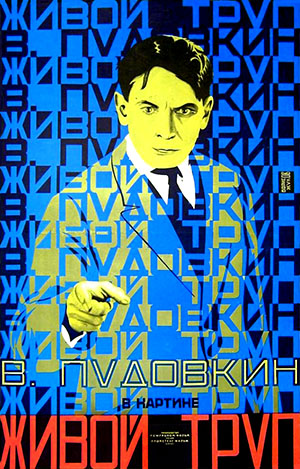
On film. The play has been filmed many times — a Russian silent as early as 1911; Fyodor Otsep’s German-Soviet Живой труп (1929), with Vsevolod Pudovkin acting Fedya; a Soviet feature (1968, dir. Vengerov, with Aleksey Batalov). The Russian Wikipedia lists seventeen screen versions across nine countries.
Scholarly context
This section is a divergence map, not corroboration; the dive’s spine is the primary record, and the scholarship is read against it.
The major English biographers treat the play lightly as a text; Rosamund Bartlett (2010) lists it among the late “works of genius,” and Donald Rayfield, reviewing her, calls it “the most free-thinking of Russian dramas,” but neither develops an argument. Two sources are substantive. Ernest Simmons (1968) pairs The Living Corpse with Resurrection as the two works Tolstoy built from court cases supplied by his legal circle (Davydov here, Koni there), and resists the view that moral didacticism disfigures it — a placement the corpus confirms. Andrew Wachtel (PMLA, 1992) is the major article: he reads the fake-suicide-and-resurrection “knot” as a cultural paradigm, tracing its subtexts to the Gimer trial, a polemic with Chernyshevsky’s What Is to Be Done?, and a dialogue with Nikolai Fedorov, and its influence forward to Mayakovsky, Erdman, Nabokov, and Bulgakov. The dive confirms the Chernyshevsky strand and extends it: the intertext is not only thematic but explicit in the play — Masha proposes the staged drowning by citing «Что делать?» outright («Рахманов взял да и сделал вид, что он утопился»).
On the divorce-law background, popular and scholarly sources agree the play dramatises a real trap (Orthodox dissolution required perjured adultery; the 1913 divorce rate was about 0.0038%) — confirms. Two mainstream readings the dive pushes back on: the Kommersant analysis’s framing of the play as an “about-face” from The Kreutzer Sonata — complicates, since Tolstoy himself grouped the two (diary, 15 Dec 1900); and the standard “he spared the Gimers” account of the abandonment — complicates + extends, since the diary names the conscience-turn the literature only infers. (On the contested late-Tolstoy labels the scholarship attaches, see Tolstoyanism.) Attribution detail is in the dossier scholarship block.
Where the material clusters
Works & apparatus (PSS Tom 34).
| TEI id | Material | Pages |
|---|---|---|
v34_007_099_Zhivoj_trup |
The play (6 acts / 12 pictures) | 7–99 |
v34_407_410_…_Plany_zametki |
Plans & notes (4 plans + the cut death-speech) | 407–410 |
v34_411_483_…_Varianty |
Variants (8 numbered, рук. №№ 1–14) | 411–483 |
v34_533_543_…_Istorija_pisanija |
Commentary: history of writing & printing | 533–543 |
v34_543_545_…_Opisanie_rukopisej |
Commentary: description of the manuscripts | 543–545 |
Diaries (Toms 53–54).
| Date (OS) | TEI id | One-line material |
|---|---|---|
| 1897-12-29 | v53_172_174_1897_12_29 |
The seed: «складывалась драма-комедия: Труп», beside Hadji Murat |
| 1900-01-27 | v54_010_010_1900_01_27 |
Uncle Vanya «возмутился»; outline sketched |
| 1900-05-19 | v54_026_026_1900_05_19 |
«Кончил „Рабство“ и написал два акта» (Pirogovo) |
| 1900-08-15 | v54_033_035_1900_08_15 |
First draft finished; «втягиваюсь все дальше» |
| 1900-08-21 | v54_035_037_1900_08_21 |
«недоволен… Нет сознания, что это — дело Божие» |
| 1900-09-07 | v54_039_042_1900_09_07 |
Draft dying words («а может быть я ошибся») |
| 1900-10-16 | v54_048_049_1900_10_16 |
Nemirovich-Danchenko visit; «охота прошла» |
| 1900-11-28 | v54_065_066_1900_11_28 |
«Драму Труп надо бросить» (the people’s need) |
| 1900-12-15 | v54_071_073_1900_12_15 |
Lineage with Kreutzer / Power of Darkness / Resurrection |
| 1900-12-31 | v54_079_079_1900_12_31 |
«мое сочинительство кончилось» |
Letters (Toms 72, 88).
| Tom | Date (OS) | Addressee | Material |
|---|---|---|---|
| 72 | 1900-10-06 | V. A. Posse | Refusal: «не обещал драмы, которой у меня нет» |
| 72 | 1900-10-14 | V. A. Posse | Second refusal, cordial |
| 88 | 1900-12-12 | V. G. Chertkov | «балуясь… написал начерно»; «писать легкомысленное» |
The author’s later verdict
Tolstoy never recanted the play and never finished it. He kept returning to the idea and turning away: he listed it in 1903 among subjects to take up, and in 1904 imagined it as a weekly reading for Круг чтения — but wrote no more of it. His settled judgment is the one he gave Koni in the spring of 1904, refusing to let him read it: «Нет, это читать не стоит: оно не кончено, да и вообще мне не нравится, и я его совсем бросил» (no, it’s not worth reading: it’s not finished, and anyway I don’t like it, and I’ve dropped it altogether). The verdict the public would overturn — twice over, in print and on the stage — within a year of his death.
Material not covered
Derived from the dossier coverage ledger. Covered: genesis, the witness network, the full close-read, the keystone redaction, the prototype edges, themes, the marquee, the 1911 staging story, the scholarly map. Partial: the contemporary Russian/church reaction (there was none — the play was unpublished until 1911; the only living reaction is the Gimer plea); the variant collation (sampled, not full). Not covered: a PD manuscript or first-edition facsimile (none found on Commons; the State Tolstoy Museum and RGB collections were not searched, and the local archive-org PDFs are Wiener’s English edition, not the Russian PSS); the full European tour and Meyerhold’s Alexandrinsky staging in depth; the complete English-translation lineage. Open judgment calls (Karenin’s and Masha’s prototypes; the Koni “14 Jan 1900 self-sacrifice letter” claim; any incidental 1911 stage-censorship) are in needsReview.
Visual & manuscript record
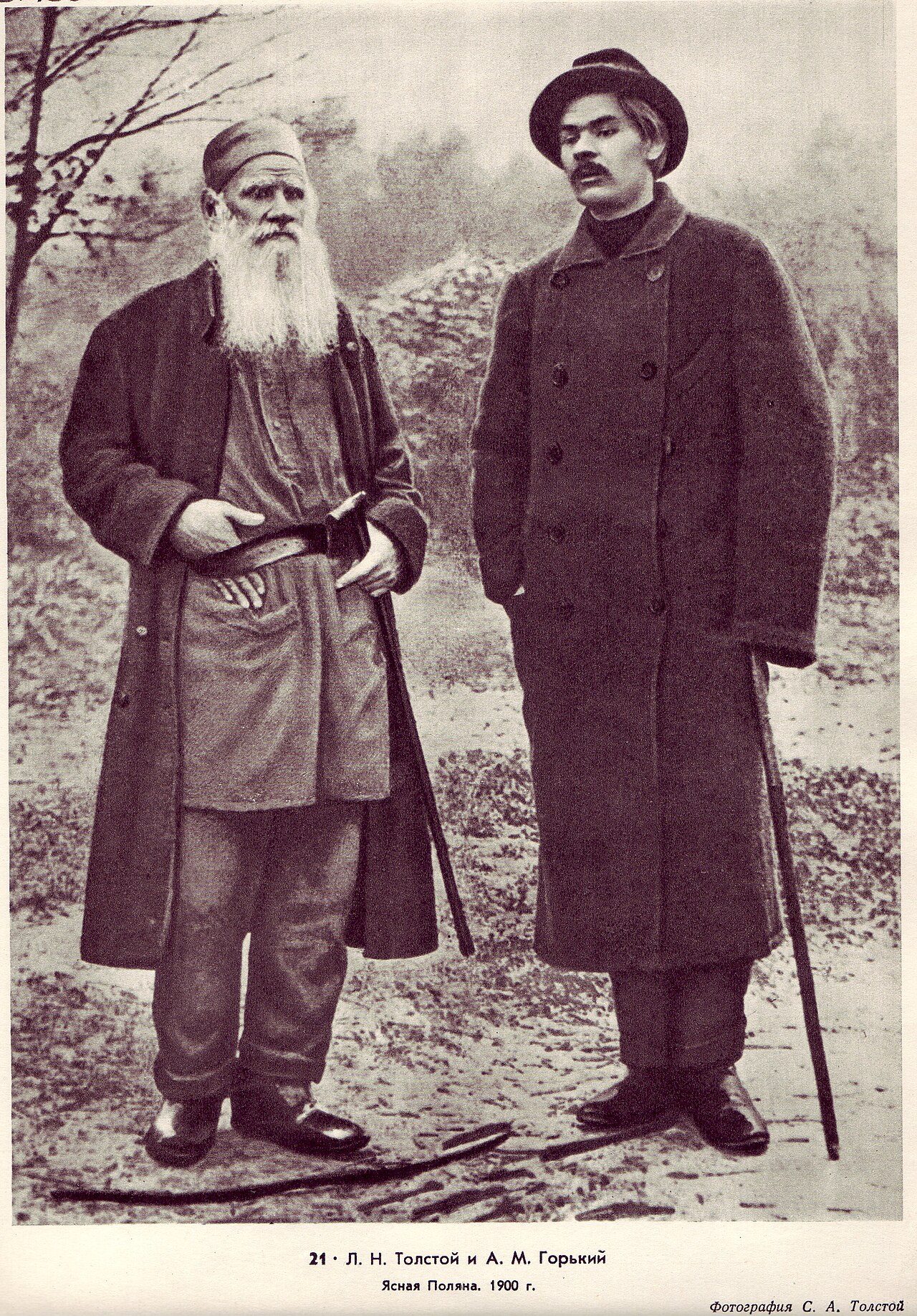
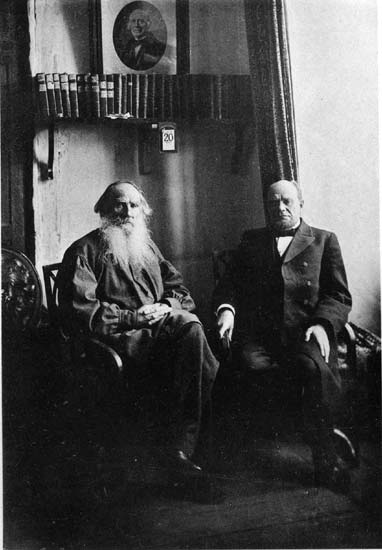
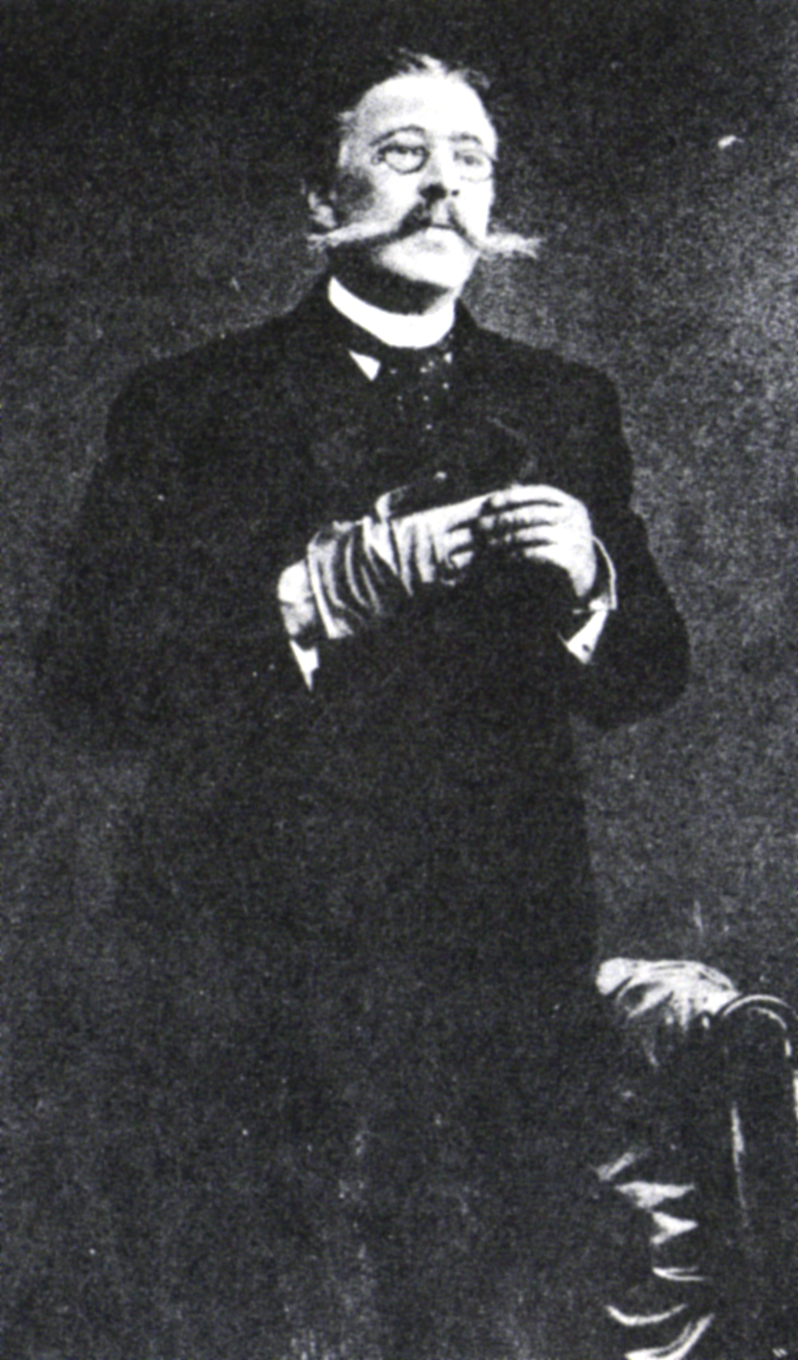
A heavy visuals sweep returned twelve public-domain images, all from Wikimedia Commons, cached locally in the git-ignored visuals/ directory (rights metadata in the dossier visuals block). They fall in five groups: Tolstoy c. 1900 (the Kazakov portrait made that year; with Gorky at Yasnaya Polyana; with Makovický, Chertkov-circle); the 1911 MAT première (Stanislavski as Abrezkov — the one confirmed Commons scene photograph; the 1911 film promo; Moskvin’s 1912 portrait); the prototypes and witnesses (Koni by Repin; Koni with Tolstoy; Nemirovich-Danchenko by Kustodiev; Stanislavski by Serov); and the afterlife (the New York Times notice of Redemption, 1918; the 1929 Otsep film poster).
Gaps (visuals work-order). No manuscript or first-edition facsimile was found on Commons — the State Tolstoy Museum (kamiscloud) and RGB digital collections are the next place to ask. No photograph of Moskvin as Fedya, no N. V. Davydov portrait, and no John Barrymore production still were located on Commons; these may be held in the MAT Museum and Russian institutional archives. Because no Russian PSS facsimile is held locally, the committed extracts/ contain text only.
Method
A --novel work-subject dive (drama flex): the full six-act play read act by act (a short text, unlike a 300–500-page novel), with the heaviest effort on genesis, the prototype network, and reception. Pre-reform orthography resolved with extract_tei.py --choice=reg --notes=auto. The composition-years witness sweep ran across the 1897 + 1900 diaries (Toms 53–54) and the 1900 letters (Toms 72, 88); genesis, prototypes, and the abandonment were reconstructed from the PSS Tom 34 editorial apparatus and grounded against Tolstoy’s own diary and letters before any mainstream scholarship. The marquee was stated up front and tested as a two-pronged hypothesis. Every primary quotation is byte-verified against its extract (verify_quotes.py, 40/40 PASS) before a separate-pass verifier; secondary claims are attributed. A heavy visuals sweep (twelve PD images). No works/ record exists, so the dossier proposes a record-creating workRecord (plays/drama). No vault pages were created — that is the separate, human-in-the-loop ingestion step.
Links. Sibling dives interlinked above: The Kreutzer Sonata and The Devil (marriage); Resurrection (the courts, the legal circle); The Power of Darkness and The Fruits of Enlightenment (the drama flex, the stage-ban contrast); The Slavery of Our Times (the twin work of the same days); Hadji Murat and After the Ball (the 1897/1903 seed-clusters); Krug chtenija tales (the 1904 weekly-reading plan).
References
Primary.
- L. N. Tolstoy, Живой труп, PSS (Jubilee Edition) Tom 34, Moscow 1952: play pp. 7–99; plans & notes 407–410; variants 411–483; commentary (А. И. Опульский, История писания и печатания / Описание рукописей) 533–545.
- L. N. Tolstoy, Diaries 1897 & 1900, PSS Toms 53–54.
- L. N. Tolstoy, Letters to V. A. Posse (6 & 14 Oct 1900), PSS Tom 72; to V. G. Chertkov (12 Dec 1900), PSS Tom 88.
Background (secondary; attributed, read critically).
- Wachtel, Andrew. “Resurrection à la Russe: Tolstoy’s The Living Corpse as Cultural Paradigm.” PMLA 107:2 (1992), 261–273.
- Simmons, Ernest J. Introduction to Tolstoy’s Writings (1968), chapter on the dramatic writings.
- A. F. Koni, «Живой труп в действительности», Ежегодник императорских театров, 1911, вып. VI.
- Russia Beyond, “The trouble with divorce in Old Russia” (2019); UNI ScholarWorks, pre-1917 Russian Orthodox divorce-law digest.
- Kommersant (2024), «„Живой труп“ Толстого — сюжет, анализ и тема развода».
- EN & RU Wikipedia, “The Living Corpse” / «Живой труп» (première cast, afterlife); Alexandrinsky Theatre collection (Meyerhold 1911 record).
Draft dev-blog note: website/src/posts/notes/2026-06-12-the-living-corpse.md (draft).