A work-subject dive (novel mode, short-work flex) on Leo Tolstoy’s 1903 story «После бала» — read in full, act by act, since the whole text is only ten pages. Primary record first: the story and its variants in PSS Tom 34, the two commentary apparatuses, the 1903 diary, and the 1903 letters to Sholom Aleichem; the sibling dives The народные рассказы of 1903 and Hadji Murat before the mainstream.
Key findings
- The story is the fourth Kishinev contribution that could not be encoded. It was conceived for the same relief almanac as the 1903 folk tales — Sholom Aleichem’s collection for the victims of the Kishinev pogrom — but where the three legends hid their politics in parable, «После бала» put the state’s violence on the page directly, and so stayed unprintable in Tolstoy’s lifetime (E12, E13).
- One day’s conception holds both Nicholas-era works. On 9 June 1903 Tolstoy conceived «Рассказ о бале и сквозь строй» in the same diary breath as «подвигаюсь в Николае Павловиче» — the Nicholas I material of Hadji Murat (E13). The two studies of military cruelty under «Николай Палкин» were alive on the same day.
- The plot is a memory seventeen years old. Its whole structure — a colonel who dances a mazurka with his daughter, then at dawn flogs a Tatar deserter to death — is already in Tolstoy’s 1886 essay «Николай Палкин» (E15). The 1903 story is that Kazan-period recollection finally written out.
- The prototype is the brother’s, not Tolstoy’s own. The love plot is Sergei Nikolaevich Tolstoy’s Kazan courtship of Varvara Koreysh, daughter of the military commander; Tolstoy’s own sujet note names «бал в Казани, влюблен в Корейшу красавицу, дочь воинского начальника» (E14). The dancing father and the flogging officer were, per the Tolstoy State Museum, one real man.
- The ending was deliberately moved from complicity to refusal. The first draft has the narrator submit to the cruelty as «необходимо … стихийно вроде как грозы» (E09); two later drafts have him enter the army and either think it «хорошее дело» (E10) or become like the colonel and grasp the horror only in old age (E11). The published version cuts both: Ivan refuses to serve at all — «нигде не служил … никуда … не годился» (E07). The variants are the primary proof of a reading scholarship only gestures at.
- The marquee «случай» is a decoy. The frame asserts that a life turns on chance; the text, the genesis, and the redaction history show the real claim is conscience and non-participation. The dive’s hypothesis is complicated and extended, not confirmed (see below).
Why this matters
«После бала» is taught — in Russia, almost universally — as a tidy lesson: two contrasting scenes, a ball and a flogging, proving the hypocrisy of tsarist society. That frame is true as far as it goes, and it is where most readings stop. The primary record shows something the lesson loses. First, the story is not a free-standing parable of contrast but the open, unencodable twin of the 1903 folk tales: the same Kishinev commission, the same conviction that «одно правительство» was the culprit, but said too plainly to print. Second, its moral verdict was not given — it was built, across twelve manuscripts, by Tolstoy steadily removing the narrator’s complicity until only refusal was left. The story we read is the last and hardest version of an argument Tolstoy had with himself on paper. Reading the variants is reading him decide what the story means.
The marquee question — is it really about «случай»?
Hypothesis (to test, not assert): the story’s own thesis — Ivan Vasilyevich’s «всё дело в случае», a life turned by chance — is what «После бала» is about.
The frame installs the claim cleanly. The company has been arguing that self-improvement requires first changing the conditions people live in — «среда заедает», the environment devours one. Ivan rejects it:
что всё дело в среде, что среда заедает. А я думаю, что всё дело в случае. (E01)
(working English) that it is all a matter of environment, that the environment devours one. But I think it is all a matter of chance.
Three things test the hypothesis against the corpus, and all three push the same way.
The genesis pushes back. The story was not born as a meditation on chance. It was born (E12, E13) as Tolstoy’s answer to the Kishinev pogrom — an indictment of the state he could not print as statement. The «случай» frame is a vessel, not the cargo.
The text pushes back. What undoes Ivan is not chance but knowledge he cannot find. He keeps trying to understand what the colonel «knows» that makes the cruelty bearable, and the failure is the point:
«Очевидно, он что-то знает такое, чего я не знаю», думал я про полковника. «Если бы я знал то, что он знает, я бы понимал и то, что я видел, и это не мучило бы меня». (E06)
(working English) “Evidently he knows something that I do not know,” I thought about the colonel. “If I knew what he knows, I would understand what I saw, and it would not torment me.”
Conscience here is not an argument the narrator wins; it is an absence he cannot fill. That is not the operation of chance.
The redaction history pushes back hardest. If the story were about chance, the ending would not matter — a chance encounter could leave a life anywhere. But Tolstoy reworked the ending more than anything else (E20), and the direction of the reworking is unambiguous: from a narrator who submits (E09), through one who serves and only later repents (E10, E11), to one who refuses to participate at all (E07). The verdict is not «it was chance»; it is «having seen this, I could take no part in the world that does it».
Outcome — complicates + extends. The hypothesis fails: «случай» is a decoy the story sets up to bypass. This complicates the surface reading (and the anti-determinist «not environment, but chance» gloss): chance is only the occasion of moral sight, not the cause of anything. And it extends the scholarship, which notes the ending was «altered and expanded» but does not reach the earlier endings (E10, E11) where the narrator becomes an officer. The corpus supplies the primary proof — Tolstoy built the non-participation reading by hand — and answers the open question scholars left: yes, in two drafts, Ivan once served.
Genesis & composition — the Kishinev commission and the two-day draft
The seed is the pogrom. In April 1903 Sholom Aleichem (S. N. Rabinovich) asked Tolstoy for something for a Yiddish relief almanac for the victims of the Kishinev pogrom. Tolstoy agreed on 6 May, and in the same letter named the limit that would keep this particular story in a drawer for eight years:
Date: 6 May 1903, Yasnaya Polyana.
Context: to Sholom Aleichem, on what he could and could not write for the almanac.
виновник не только кишиневских ужасов, но всего того разлада, который поселяется в некоторой малой части — и не народной — русского населения[…]одно правительство. К сожалению, этого-то я не могу сказать в русском легальном издании. (E12)
(working English) the culprit not only of the Kishinev horrors but of all the discord that settles into a certain small — and not popular — part of the Russian population … is the government alone. Unfortunately, this is just what I cannot say in a legal Russian publication.
The same constraint that drove the folk tales into parable drove «После бала» out of print: it says the unsayable thing too directly. A month later, on 9 June, the story appears in the diary — and, tellingly, beside the other Nicholas-era work on military cruelty:
Немного подвигаюсь в Николае Павловиче. Задумал три новые вещи. Умирать пора, а я задумываю. 1) Рассказ о бале и сквозь строй (E13)
(working English) Making a little progress on Nikolai Pavlovich [Nicholas I, i.e. Hadji Murat]. Conceived three new things. It is time to die, and I am conceiving things. 1) A story about a ball and running the gauntlet.
The working idea is already the whole story: a ball plus the gauntlet. The notebook sujet that follows names the real ground — Kazan, the Koreysh family, the commander who is both the tender dancing father and the man who orders harder beating:
веселый бал в Казани, влюблен в Корейшу красавицу, дочь воинского начальника[…]ее красавец старик-отец ласково берет ее и идет мазурку. И на утро после влюбленной бессонной ночи звуки барабана и сквозь строй гонит татарина, и воинский начальник велит больней бить. (Очень бы хорошо) (E14)
(working English) a gay ball in Kazan, in love with a Koreysh beauty, daughter of the military commander … her handsome old father tenderly takes her and dances the mazurka. And in the morning, after the love-struck sleepless night, the sounds of a drum, and he drives a Tatar through the gauntlet, and the military commander orders them to beat harder. (Would be very good.)
The memory is old. The same scene — a colonel who danced a mazurka with his daughter and left early to flog a soldier to death the next morning — is already in Tolstoy’s 1886 essay «Николай Палкин», a recollection the commentary places in his Kazan student years:
я знал одного такого, который накануне с красавицей дочерью танцовал мазурку на бале и уезжал раньше, чтобы на завтра рано утром распорядиться прогонянием на смерть сквозь строй бежавшего солдата татарина, засекал этого солдата до смерти и возвращался обедать в семью (E15)
(working English) I knew one such man, who the evening before had danced the mazurka with his beautiful daughter at a ball and left early so as to give orders the next morning for a runaway Tatar soldier to be driven to death through the gauntlet — flogged the soldier to death and returned to dine with his family.
Tolstoy never saw the punishment himself. The eyewitness detail came from the writer I. N. Zakharyin-Yakunin, whom he met in Moscow in 1898–99:
Самой экзекуции Толстой, однако, не наблюдал. В 1898—1899 гг. он встретился в Москве с писателем И. Н. Захарьиным (Якуниным), который рассказал, как ему пришлось по наряду присутствовать при наказании солдата (E16)
(working English) Tolstoy did not, however, witness the execution itself. In 1898–1899 he met in Moscow the writer I. N. Zakharyin (Yakunin), who told him how he had been ordered to attend the punishment of a soldier.
Then it came fast. The first draft, titled «Дочь и отец», was written in a single day. The witness is Goldenweiser, present at Yasnaya Polyana on 6–7 August, and Tolstoy’s own diary:
Написал в один день Дочь и отец. Не дурно. Сказки кончил. (E17)
(working English) Wrote “Daughter and Father” in one day. Not bad. Finished the tales.
The story and the three Kishinev tales were the same midsummer’s work — finished in the same diary line. Tolstoy then spent two weeks reworking it, and on 20 August, with the last copy dated, gave his own modest verdict, naming the story by its then-title «А вы говорите»:
За то «А вы говорите» недурно. (E18)
The people around the work are few and named: Sholom Aleichem the commissioning editor; Alexander Goldenweiser the witness to the two days; I. N. Zakharyin-Yakunin the eyewitness informant; the brother Sergei Nikolaevich, whose Kazan romance the love plot is; N. L. Obolensky, who wrote out and dated the final copy; and Chertkov, who printed it in 1911.
What the work says — the ball, the dawn, and the one suede glove
The story is a frame and a single night. Read in full, its argument is carried by one image: the colonel’s suede glove, worn in both halves.
At the ball, the glove is courtliness. The colonel, refusing at first, is coaxed into the mazurka with his daughter, and pulls on the glove with a smile and a phrase that will return:
натянув замшевую перчатку на правую руку, — «надо всё по закону», — улыбаясь сказал он (E02)
(working English) drawing a suede glove onto his right hand, “everything must be done according to the rules,” he said, smiling.
«Надо всё по закону» — by the rules. The narrator’s love overflows; watching the father dance in old home-made boots (he will not buy fashionable ones, so as to dress his daughter), he loves the whole world.
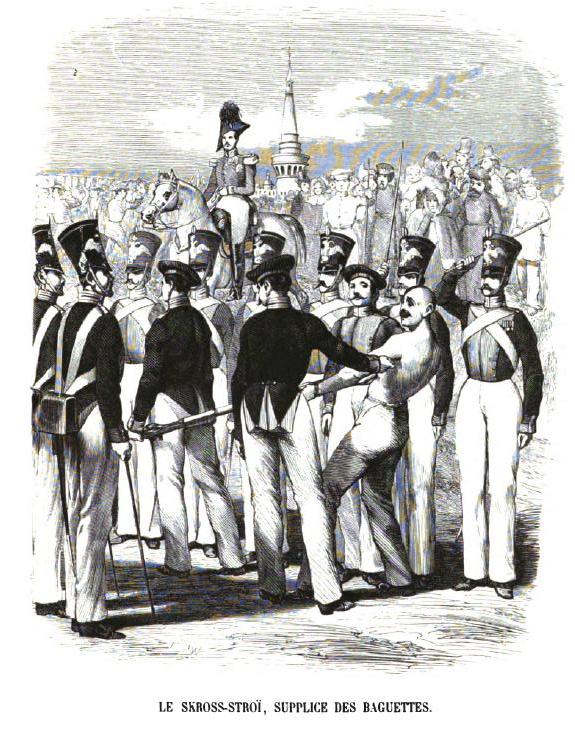
At dawn, the same code runs the gauntlet. Unable to sleep, the narrator wanders out and finds a Tatar deserter being driven between two files of soldiers, beaten with rods. The centrepiece, quoted in full:
При каждом ударе наказываемый, как бы удивляясь, поворачивал сморщенное от страдания лицо в ту сторону, с которой падал удар, и, оскаливая белые зубы, повторял какие-то одни и те же слова. Только, когда он был совсем близко, я расслышал эти слова. Он не говорил, а всхлипывал: «Братцы, помилосердуйте. Братцы, помилосердуйте». Но братцы не милосердовали (E03)
(working English) At each blow the punished man, as if in surprise, turned his face — wrinkled with suffering — toward the side from which the blow fell, and, baring his white teeth, repeated the same words over and over. Only when he was quite close did I make them out. He did not speak but sobbed: “Brothers, have mercy. Brothers, have mercy.” But the brothers showed no mercy.
The flogged back is the passage the Formalists made famous — the body made unrecognisable so the horror cannot be normalised:
Это было что-то такое пестрое, мокрое, красное, неестественное, что я не поверил, чтобы это было тело человека. (E04)
(working English) It was something so mottled, wet, red, unnatural, that I could not believe it was the body of a man.
And the glove returns. The colonel — the same loving father — strikes a weak soldier across the face for not beating hard enough, with the same hand in the same suede glove:
он своей сильной рукой в замшевой перчатке бил по лицу испуганного малорослого слабосильного солдата за то, что он недостаточно сильно опустил свою палку (E05)
(working English) with his strong hand in its suede glove he struck the face of a frightened, undersized, weak soldier because he had not brought his stick down hard enough.
The «по закону» of the ballroom and the «по закону» of the gauntlet are one man’s single code. The narrator cannot reconcile them, and does not try to; he finds only that the colonel must «know» something he himself does not (E06). The love fades from that day (E08), and the life turns — not toward understanding, but away from participation (E07).
Redactions & textual history — how the ending was built
The manuscript record is twelve copies and 104 leaves, and the title walked the whole way: «Дочь и отец» → «Отец и дочь» → «А вы говорите» → «Дочь» → «После бала» (E19). The final choice moves the centre of gravity off the father-daughter pair and onto the morning «after». The commentary names where the work went:
Особенно сильным переделкам подверглась вторая часть рассказа (сцена экзекуции), в первом наброске очень сжатая, и заключение. Однако окончательной отделки рассказ не получил и при жизни Толстого напечатан не был. (E20)
(working English) The second part of the story (the execution scene) — very compressed in the first draft — and the conclusion underwent especially heavy reworking. The story did not, however, receive its final polish and was not printed in Tolstoy’s lifetime.
The keystone is the ending’s evolution, visible in the printed variants. The first draft (6 August, «Дочь и отец») ends in submission — the cruelty is dreadful but elemental, like weather, and cannot be argued with:
Это было ужасно, но если оно делалось, значит оно было необходимо, оно было стихийно вроде как грозы, бури, и спорить с этим нельзя было (E09)
(working English) It was terrible, but if it was being done, then it was necessary; it was elemental, like a thunderstorm or a gale, and one could not argue with it.
Two intermediate drafts go further into complicity. In one, the narrator enters the army and thinks it a good thing:
после университета поступил в военную службу и хотя и не сумел выработать в себе такой же твердости, как у полковника, как видите, вышел в отставку поручиком, все-таки считал, что военная служба хорошее дело (E10)
(working English) after university I entered military service, and although I did not manage to develop the same firmness as the colonel, I retired, as you see, a lieutenant — and still considered military service a good thing.
In another, he becomes like the colonel and understands the horror only in old age:
я поступил, как хотел, в военную службу и старался выработать в себе такое же твердое сознание своего долга, — я так называл это, — как у полковника, и отчасти достигал этого. И только к старости теперь понял весь ужас того, что я видел и что сам делал (E11)
(working English) I entered military service, as I had wished, and tried to develop in myself the same firm sense of duty — so I called it — as the colonel had, and partly succeeded. And only now, in old age, have I understood the full horror of what I saw and what I myself did.
The published ending cuts both. The narrator does not serve, does not repent in old age, does not become the colonel — he simply will not take part:
не мог поступить в военную службу, как хотел прежде, и не только не служил в военной, но нигде не служил и никуда, как видите, не годился (E07)
(working English) I could not enter military service, as I had meant to before, and not only did not serve in the army but served nowhere at all and, as you see, was good for nothing.
The story’s meaning is the difference between these drafts. Tolstoy did not start with non-participation and illustrate it; he wrote his way to it, removing every softer ending until only refusal remained.
Publication, censorship & afterlife
There was no ban — and no lifetime publication. «После бала» was never submitted and refused; Tolstoy withheld it, knowing (E12) that its plain indictment of state violence could not pass a legal Russian press. It was first printed posthumously, in Chertkov’s collection:
Впервые рассказ «После бала» был напечатан в издании: «Посмертные художественные произведения Льва Николаевича Толстого под редакцией В. Черткова», I, М. 1911, стр. 117—128. (E21)
(working English) The story “After the Ball” was first printed in the edition: “Posthumous Artistic Works of Lev Nikolaevich Tolstoy, edited by V. Chertkov,” vol. I, Moscow, 1911, pp. 117–128.
The reception that followed is the reverse of the folk tales’ censorship history: there, the obstacle was the living censor; here, the obstacle was Tolstoy’s own self-withholding, and once he was dead the story passed into print and then into the schoolroom without resistance. There is a fitting irony in the timing — the gauntlet the story depicts had been abolished in the Russian army in 1863, and corporal punishment fully in 1904, the year after Tolstoy wrote it.
Characters & prototypes
The cast is small and routes cleanly. Three fictional figures carry the story and each carries a documented or attributed prototype; the rest are real people around the work.
Ivan Vasilyevich (character) — the old, respected frame-narrator. His lived experience is the brother Sergei Nikolaevich’s; the narrator is a fictional frame, not a portrait (prototype: probable).
The Colonel, Pyotr Vladislavich B. (character) — Varenka’s father, the doubled centre of the story. Prototype: Andrei Petrovich Koreysh, the Kazan military commander — per the Tolstoy State Museum the same real man was both the dancing father and the flogging officer, and the «Николай Палкин» colonel is apparently the same recollection. Documented for the love-plot father; the dancing/flogging fusion rests on a single source, so the dossier keeps it probable, not documented.
Varenka B. (character) — the beloved, eighteen, in white with a rose sash. Prototype: Varvara Andreevna Koreysh (later Khvoshchinskaya), the commander’s daughter courted by Sergei.
The real people route as person: Sergei Nikolaevich Tolstoy (1826–1904), the elder brother — a new page, distinct from the existing vault page for Tolstoy’s son Sergei Lvovich; Andrei Petrovich and Varvara Andreevna Koreysh; Sholom Aleichem and Alexander Goldenweiser (already routed by the folk-tales dive); I. N. Zakharyin-Yakunin and N. L. Obolensky (both minor — borderline mints, flagged for review); Vladimir Chertkov; and Nicholas I, whose reign the story indicts and who is already routed by the Hadji Murat dive. The gauntlet itself routes as a concept (Running the gauntlet / сквозь строй), and the Kishinev pogrom as the event that occasioned the work.
Themes
- The loving father and the torturer are one. The story’s whole force is that these are not two men but one, joined by the suede glove and the phrase «надо всё по закону» (E02, E05). Tenderness and cruelty share a single code.
- Conscience as an absence, not an argument. Ivan is undone not by reasoning but by his failure to find the «knowledge» that would let him accept what he saw (E06). Moral knowledge here is innate and negative — it refuses, without being able to explain.
- Non-participation. The story’s conclusion is the late-Tolstoyan refusal to take part in state violence (E07) — built into the text by revision, and best read alongside the non-resistance the mainstream labels «Tolstoyan».
- «По закону» — legality as moral alibi. The recurring phrase makes the law itself the thing that licenses the cruelty; the colonel is not breaking rules but keeping them.
- Chance versus environment. The opening debate (E01) is the theme the story raises only to step around — see the marquee.
Reception & afterlife — Russia first
Published in 1911, the story drew little immediate critical notice, but it became, in Soviet and later Russian schooling, one of the most-taught of all Tolstoy’s short works. Attribute, don’t assert. The dominant Russian frame is «контраст как основа композиции» — composition by contrast, the ball and the flogging as a mirror — and the story is read as an anti-tsarist, anti-militarist indictment (Trostnikov 1965, Zhdanov 1971, via Zholkovsky). The flogged back (E04) is a standard textbook illustration of Shklovsky’s «остранение» (defamiliarization); Odintsov (1969) catalogued the devices that foreground the punishment. No stand-alone Eikhenbaum essay on the story was located, and the «contrast» reading appears to rest on his general Tolstoy monographs rather than a single piece (flagged in the dossier). The fullest English-accessible reading is Alexander Zholkovsky’s, which sets the story against fairy-tale and initiation patterns and reads Ivan’s withdrawal as «principled non-participation characteristic of late Tolstoy» — closest of the mainstream to what the variants show.
Scholarly context — a divergence map
Where the mainstream and the corpus meet, and part:
confirms— the prototype. The brother-Sergei / Koreysh love plot and the commander-as-both-figures are confirmed by Russian biography and the Tolstoy State Museum (2024); the corpus adds Tolstoy’s own author-stated sujet (E14) and the 1886 «Николай Палкин» source (E15).confirms— the defamiliarized flogging. The Formalist reading of E04 is corroborated, not contested.complicates— the «chance» frame. The Soviet reading treats «случай» as irony over systemic evil; the corpus shows it is a decoy the story bypasses entirely, the genesis and the redaction history pointing past sociology to conscience and refusal (E06, E07, E12).extends— the ending’s evolution. Scholarship knows the ending was «altered and expanded» and that a confessional phrase was cut, but does not reach the earlier endings. The variants (E09–E11) supply the primary proof — the narrator once served, once became the colonel — and resolve the open question. This is the dive’s highest-value contribution.
The contested label «Tolstoyan» belongs to the mainstream, not to this dive’s voice; it is linked here to the project’s dive on the term, which interrogates it.
Where the material clusters
Works & commentary (PSS Tom 34):
| Item | PSS т.34 | What it holds |
|---|---|---|
| После бала | 116–125 | The story (E01–E08) |
| Планы и варианты | 484–490 | Six variants incl. the three endings (E09–E11) |
| История писания и печатания | 550–551 | Genesis, prototype, first publication (E12, E14–E16, E20–E21) |
| Описание рукописей | 551–553 | 12 manuscripts, 104 leaves, title evolution (E19) |
Diaries (PSS Tom 54, 1903):
| Date (OS) | Page | Material |
|---|---|---|
| 9 June 1903 | 177 | Conception, beside «Николае Павловиче» (E13) |
| 9 Aug 1903 | 189 | First draft in one day; «Сказки кончил» (E17) |
| 20 Aug 1903 | 189 | Last copy dated; «А вы говорите» (E18) |
Letters (PSS Tom 74, 1903):
| Tom / № | Date (OS) | Addressee | Material |
|---|---|---|---|
| 74 / 144 | 6 May 1903 | S. N. Rabinovich (Sholom Aleichem) | «одно правительство» — the genesis & the censorship limit (E12) |
The author’s later verdict
Tolstoy’s recorded judgments on the story are sparse and modest. Writing the first draft, he noted only «Не дурно» (E17); naming it on the last day, «недурно» (E18). He left it unpolished and unpublished, and seems not to have returned to it. The story’s own «verdict», then, is the one its hero gives and the one the variants enact: having seen the flogging, a person of conscience is «good for nothing» (E07) — and that uselessness is the point.
Material not covered
- The English translation lineage (Aylmer Maude’s «After the Ball» and later versions) is not collated.
- Full variant collation beyond the keystone endings — the cut praise of provincial universities (variants №2/№3) is read but not transcribed in full.
- Whether the «Николай Палкин» colonel and the Koreysh commander are provably the same man is left
probable(the commentary says the recollection «relates apparently to the Kazan period»; the museum fuses them). - A photograph of Tolstoy dated specifically to 1903, and a scan of the 1911 «Посмертные художественные произведения» title page — both open work-orders.
Visual & manuscript record
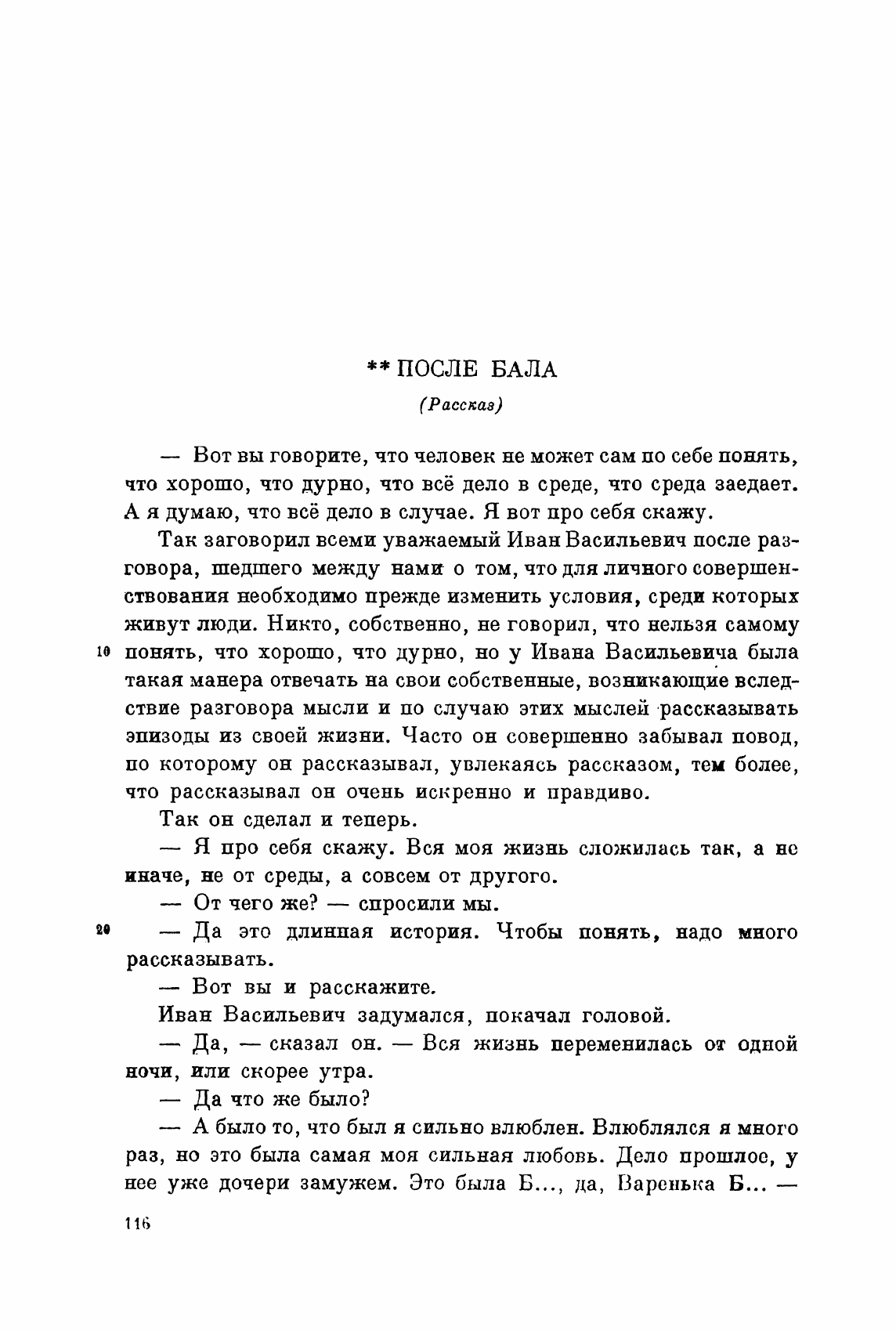
The committed facsimile is the story’s opening page (above), PSS Tom 34 p.116, rendered from the local jubilee-edition PDF — public domain (Tolstoy’s text).
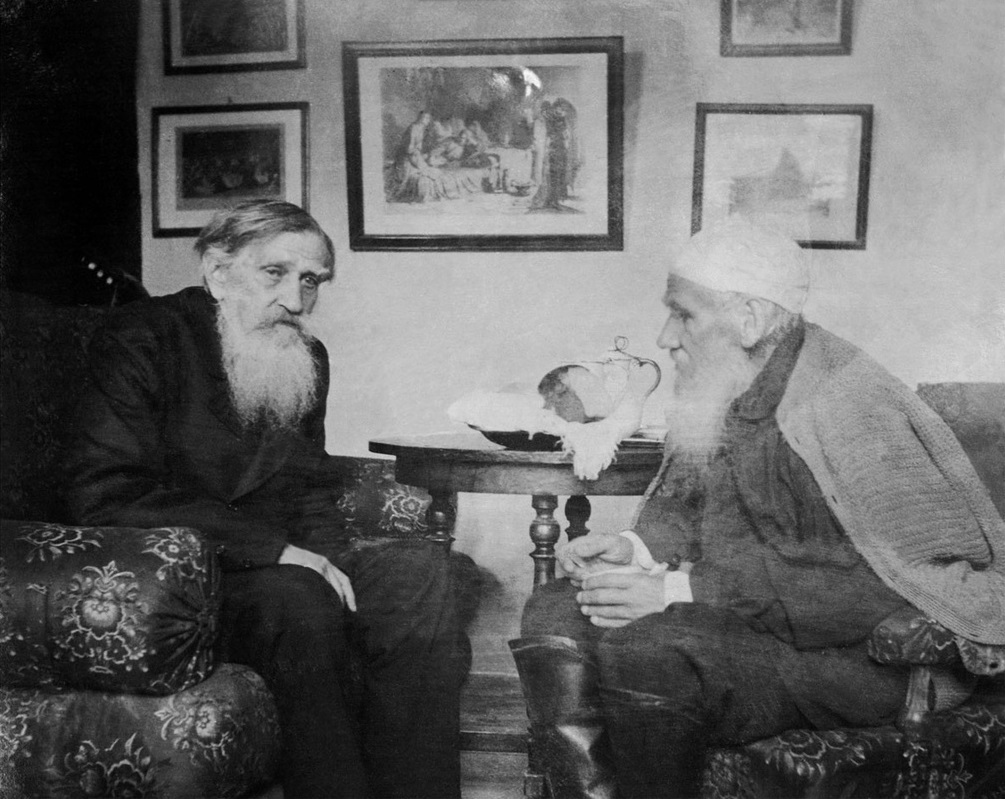
Seven public-domain images were cached for local viewing (git-ignored visuals/; python3 docs/fetch_visuals.py 1903-after-the-ball repopulates a fresh clone): a 1897 photograph of Tolstoy (the closest cleanly-dated PD image to the 1903 writing); a portrait of the elder brother Sergei Nikolaevich and the 1902 photograph of the two brothers together (the love-plot prototype); an 1834 lithograph of Kazan University (the setting); Geoffroy’s 1845 engraving of the Russian «сквозь строй» and Oscar Rex’s c.1900 painting of the gauntlet (the central scene, documentary and painted); and a view of Yasnaya Polyana. Three targets are logged as work-orders: the 1911 «Посмертные художественные произведения» title page (request from RGB / prlib.ru), a mid-19th-century Russian ball scene (Tretyakov / Hermitage open-access), and a 1903-dated Tolstoy photograph (Yasnaya Polyana museum / RGAKFD). Full provenance, rights and URLs are in the dossier visuals block.
Method
Scope contract (Phase 0): novel mode (--novel) with the short-work flex — the whole ~10-page story read in full, act by act, rather than located-and-sampled. Subject = a single work with no existing works/ record, so the dossier workRecord proposes the record’s creation (fiction → short-stories). Corpus surface = PSS Tom 34 (story + variants + the two commentary apparatuses), the 1903 diary (Tom 54), the 1903 letters to Sholom Aleichem (Tom 74). Marquee named up front: is the story really about «случай»? Visuals intensity: medium (a short story’s illustration record), seven PD images plus the facsimile. What actually happened: the story and all six variants read in full; the genesis apparatus mined; three keystone diary entries and the 6 May letter extracted for byte-fidelity; the prototype disentangled into its love-plot and flogging streams; a medium scholarship + reception sweep, grounded in the primary record and the sibling dives before the mainstream. All 21 dossier quotes pass verify_quotes.py (exit 0). All extraction used extract_tei.py --choice=reg --notes=auto. PSS Tom 34 = jubilee-edition/vol03/ (the jubilee directory names are offset from the PSS Tom numbers).
Links: sibling dives The народные рассказы of 1903 (the shared Kishinev commission) and Hadji Murat (the Nicholas I military world, same composition years); Tolstoyanism (the contested label behind the non-participation reading).
References
Primary — Л. Н. Толстой, ПСС: т. 34 («После бала» с.116–125; Планы и варианты с.484–490; История писания и печатания с.550–551; Описание рукописей с.551–553); т. 54 (Дневник 1903 — 9 июня с.177; 9 и 20 августа с.189); т. 74 (письмо С. Н. Рабиновичу/Шолом-Алейхему №144, 6 мая 1903); т. 26 («Николай Палкин», 1886, с.559, via the commentary).
Background — Tolstoy State Museum (2024), prototype exhibition note (tolstoymuseum.ru); A. Zholkovsky, “After the Ball” (USC Dornsife) — English chapter + Russian «Морфология и исторические корни рассказа Толстого „После бала“»; V. Shklovsky (defamiliarization/остранение), via Russian pedagogy; A. Odintsov (1969); Trostnikov (1965), Zhdanov (1971) — Soviet standard interpretation (via Zholkovsky); A. B. Goldenweiser, «Вблизи Толстого» I (М. 1922); I. N. Zakharyin-Yakunin, «Встречи и воспоминания» (СПб. 1903).
Companion dev-blog note: 2026-06-12-after-the-ball (draft).