A theme-dive across the five народные рассказы Tolstoy wrote in 1903 — «Ассирийский царь Асархадон», «Труд, смерть и болезнь», «Три вопроса», «Это ты», and the satirical legend «Разрушение ада и восстановление его» — sixteen years after the Posrednik cycle of the parent dive. Primary record first: the tales and their PSS Tom 34 «История писания» apparatus, the 1903 diary, and the 1903 letters — the five to Sholom Aleichem and the collective letter to the Kishinev mayor.
Key findings
- The three central tales are a single commissioned unit. The PSS groups «Асархадон», «Труд, смерть и болезнь» and «Три вопроса» under one heading, «Три сказки» — written together in three weeks of July–August 1903 (E06, E08) for the Yiddish relief almanac «Гилф» that Sholom Aleichem was assembling for the victims of the Kishinev pogrom (E09).
- The tales are the encrypted form of a political truth Tolstoy was forbidden to print. On 6 May 1903 he told Sholom Aleichem that the pogrom’s true culprit «одно правительство» — the government — «этого-то я не могу сказать в русском легальном издании» (E03). What he could not say as statement he published as legend.
- One doctrine runs through all five: the unity of all life — «это ты» / tat tvam asi. Asarhadon IS his victim Lailie (E14); the tyrant IS the criminal (E16); the title names itself on the formula «это ты» (E17). The 1903 diary states the same insight bare: the error is «когда считаю каждого отдельным существом» (E29).
- «Это ты» and «Асархадон» are twins from one German theosophical source. Both descend from the anonymous parable «Das bist du» in Theosophischer Wegweiser (1903 №5): «Это ты» is Tolstoy’s near word-for-word translation, «Асархадон» his original elaboration of the same kernel — by his own attribution (E11, E24).
- «Разрушение ада» reaches back twenty years and forward to the censors. Conceived as a companion-illustration to the treatise «Обращение к духовенству», its source is an 1879 oral legend from the skazitel’ V. P. Shchegolyonok — the same reciter who fed the 1880s tales of the parent dive (E22). The legend was banned in Russia in 1906, 1910 and 1913, and printed there only in 1917 (E23) — the one tale of the cluster Tolstoy never saw in legal Russian print.
- The copyright renunciation governs the gift. Tolstoy could give the relief fund only «право первого печатания» — the right of first printing — because he had renounced exclusive rights in 1891 (E13). The 1903 cluster runs on the same machinery as the 1880s one.
Why this matters
English scholarship classifies the trio from the start as occasioned charity: Maude’s 1906 preface calls them “stories Tolstoy contributed in aid of the Jews,” and says no more (see Scholarly context). That framing absorbs the tales into their occasion and loses what the primary record shows — that the folk-tale form was the instrument Tolstoy reached for to answer a political atrocity he was legally barred from naming, and that into it he compressed the most concentrated statement of his late metaphysics. The народный рассказ here is not a charming minor genre and not didactic decline; it is the encrypted form of a forbidden truth. The cluster is also the lived practice that What Is Art? theorised and the parent cycle began — the народный рассказ revived one last time, now for a Jewish readership, under censorship, on the doctrine that all life is one.
The shape of the question — one doctrine across five tales
The cluster is held together by a single idea, stated and re-stated. The stages below move from its plainest form to its dramatisation and its satirical inverse.
Stage 1 — the doctrine as bare proposition. «Это ты» (a near-translation of the theosophical «Das bist du») states it as dialogue:
Все люди — братья, то есть все люди по существу своему один и тот же человек. (E16)
(working English) All people are brothers — that is, all people are in essence one and the same person.
And names itself on it:
Это та истина, которую я хотел внушить тебе и которая выражается словами: это ты. (E17)
(working English) This is the truth I wished to instil in you, and which is expressed in the words: this is you.
Stage 2 — the doctrine dramatised. «Ассирийский царь Асархадон» makes a tyrant live his victim’s death by immersion, then hear the teaching:
— Да ведь Лаилиэ это ты, — сказал старец. (E14)
(working English) “But Lailie is you,” said the old man.
Жизнь одна во всем, и ты проявляешь в себе только часть этой одной жизни. (E15)
(working English) Life is one in all things, and you manifest in yourself only a part of this one life.
Stage 3 — the doctrine as ethics. «Труд, смерть и болезнь» and «Три вопроса» turn the unity into conduct — labour that should unite, and love-in-the-present:
труд не должен быть пугалом для одних и принудительной каторгой для других, а должен быть общим радостным делом, соединяющим людей (E18)
(working English) labour should not be a bugbear for some and forced penal toil for others, but a common joyful undertaking that unites people.
самое важное дело — ему добро сделать, потому что только для этого послан человек в жизнь. (E19)
(working English) the most important task is to do him good, because that alone is what a person is sent into life for.
Stage 4 — the inverse: a world that refuses the unity. «Разрушение ада» shows the doctrine’s negation — Beelzebub’s devils explaining how they rebuilt hell after Christ destroyed it, chiefly by inventing the Church:
Так переделал, что люди верят не в его ученье, а в мое, которое они называют его именем. (E20)
(working English) I reworked it so that people believe not in his teaching but in mine, which they call by his name.
Дело шло хорошо, но я боялся, как бы они не увидали слишком очевидного обмана, и тогда я выдумал церковь. (E21)
(working English) Things were going well, but I feared they might notice the too-obvious deception — and so I invented the Church.
The diary substrate. The 1903 diary is saturated with exactly this metaphysics, written alongside the tales — death as the dissolution of limits (E27), the окошечко parable of one God seen through many windows (E28), and the insight in its sharpest form:
я ошибаюсь не тогда, когда называю одного вместо другого, а тогда, когда считаю каждого отдельным существом. (E29)
(working English) I err not when I name one person instead of another, but when I count each as a separate being.
Genesis & composition — the Kishinev commission and the three weeks
The pogrom of 6–7 April 1903 came first. Tolstoy signed a collective protest to the Kishinev mayor — «глубоко потрясенные совершенным недавно в городе Кишиневе злодеянием … безмерное негодование против попустителей этого ужасного дела» (E01) — and noted the civic act in his diary on 29 April (E04). When Sholom Aleichem (S. N. Rabinovich) asked him to contribute to a Yiddish relief almanac, Tolstoy agreed on 6 May — «постараюсь написать что-либо соответствующее обстоятельствам» (E02) — but added the constraint that defines the cluster: the real culprit was the government, and «этого-то я не могу сказать в русском легальном издании» (E03).
The tales themselves came hard and fast in midsummer. The diary records the attempt that would not come on 21 July, «Пытался написать сказку, но не пошло» (E05); the breakthrough on 25 July, «Написал три сказки. Еще плохо, но может быть порядочно» (E06); and completion on 9 August, «Сказки кончил» (E07) — after which the count briefly wavered to two («не три, a две» in the 20 August diary) before the third tale was restored to the set. The PSS frames the three as one unit, written that summer in parallel with «После бала» (E08). Tolstoy then sent them out in three letters: the first two for translation «на жаргон» on 20 August (E09); the third — «Труд, смерть и болезнь», which he had held back «из боязни, что она будет запрещена» — on 22 August (E10); and on 25 August a preface crediting the «Das bist du» source and the Leskov priority, together with «Это ты» itself, which he had also translated for the almanac (E11, E12).
The people around the work are named in the record: Sholom Aleichem the editor-translator; A. B. Goldenweiser, whose memoir «Вблизи Толстого» preserves Tolstoy’s account of the tales and their sources; Pavel Boulanger, who wrote to Sholom Aleichem on Tolstoy’s behalf about the Russian editions and the copyright; and Chertkov, who printed them abroad. The copyright terms tie the gift to the renunciation of 1891 — Tolstoy gives only «право первого печатания» (E13).
What the five tales say
| Tale | PSS т.34 | Form | Keystone |
|---|---|---|---|
| Ассирийский царь Асархадон | 126–130 | parable (legend) | A tyrant is made to live his victim’s torture and death; the unity of all life revealed (E14–E15) |
| Труд, смерть и болезнь | 131–133 | parable («Легенда») | God’s three gifts — labour, death, sickness — all meant to unite, all subverted by separateness (E18) |
| Три вопроса | 134–137 | parable | A king’s three questions answered by a hermit: now, the person before you, to do them good (E19) |
| Это ты | 138–140 | parable (dialogue) | A near-translation of «Das bist du»: the criminal is the tyrant himself; tat tvam asi (E16–E17) |
| Разрушение ада и восстановление его | 100–115 | satirical legend | Beelzebub’s devils explain how the Church, the state, science and the modern professions rebuilt hell (E20–E21) |
Four are moral parables on the one doctrine. The fifth, «Разрушение ада», is the satirical inverse and the longest — a furious anatomy of the institutions (the Church first, then anointed rulers, war, and a «дьявол в мантии» who invented науку as a distraction) that keep people from the simple teaching. It is the loosest fit for the народный рассказ form, and it is the one the censors would not allow.
Publication, censorship & translation
The trio appeared first in Yiddish, in the «Гилф» almanac (Warsaw; Folksbildung / Tushiya), the relief collection itself (E25). In Russian the reception was asymmetric: «Асархадон» and «Три вопроса» were printed by Posrednik in late 1903 — «для интеллигентных читателей», with nine illustrations by N. I. Zhivoy, and in a cheaper lubok edition — while «Труд, смерть и болезнь» «была запрещена цензурой» and reached Russian print only in 1906 (E26). «Это ты» followed via Posrednik in 1906. «Разрушение ада» was published abroad in 1903 by Chertkov’s «Свободное слово» (Christchurch, England), banned in Russia in 1906, 1910 and 1913, and printed there only in 1917 (E23) — the one tale Tolstoy never saw in legal Russian print.
| Tale | First publication | First in Russia |
|---|---|---|
| Асархадон | «Гилф», Warsaw 1903 (Yiddish) | Posrednik СХV, 1903 |
| Три вопроса | «Гилф», Warsaw 1903 (Yiddish) | Posrednik СХV, 1903 |
| Труд, смерть и болезнь | «Гилф», Warsaw 1903 (Yiddish) | Posrednik №615, 1906 (banned 1903) |
| Это ты | Posrednik №638, 1906 | Posrednik №638, 1906 |
| Разрушение ада | «Свободное слово», England 1903 | 1917 (banned 1906, 1910, 1913) |
(The PSS gives the «Гилф» censorship date as 4 August 1903 — earlier than Tolstoy’s own dispatch of the tales on 20–25 August; an internal inconsistency noted for verification.)
Scholarly context
The 1903 tales are almost never the object of a study; they surface inside discussions of the pogrom response, nonviolence, or anticlericalism. Attribute, don’t assert. Aylmer Maude’s 1906 preface to Twenty-Three Tales classifies the trio as occasioned charity (“stories Tolstoy contributed in aid of the Jews”), and the framing has stuck — the corpus shows the tales are simultaneously the most compressed statement of Tolstoy’s unity-of-life doctrine, so the “aid literature” frame complicates rather than confirms (E25). Alexandra Popoff (2013) rightly corrects accounts that paint Tolstoy as reluctant, but the corpus finding — that he said he could not print in legal Russian what he told Sholom Aleichem (E03) — adds the censorship constraint her “active engagement” framing elides. Harold Schefski (1982, via Ivry 2014) notes the standing tension that Tolstoy engaged Jews non-fictionally and never inhabited a Jewish character in his fiction; it sits alongside the tales, not against them.
On the rest, English scholarship mostly does not reach the corpus’s findings — the relation is extends. The «Das bist du» → «Это ты»/«Асархадон» source chain is noted as fact but given no literary reading (E24); the Leskov relay behind «Три вопроса» is a biographical footnote (E11); «Разрушение ада» is read only through the 1901 excommunication, never as a literary object whose roots run to an 1879 oral legend (E22); and the unity-of-life metaphysics is treated as “Hindu scripture via Schopenhauer” without examining the theosophical-journal mediation (E15). The full sweep (20 sources) and the framing flags are in the dossier’s scholarship block. The mainstream “didactic decline” reading of the late tales — which the corpus does not support for these five — is the Tolstoyan-adjacent soft-dismissal to read critically, not inherit.
Place in the cluster & the author’s later verdict
The 1903 tales are the second movement of the народный рассказ project. They share the parent dive’s machinery (Posrednik, the copyright renunciation) and one of its people — the skazitel’ V. P. Shchegolyonok, whose 1879 legend seeds «Разрушение ада» (E22) as his recitations seeded the 1880s tales. They are also the practice the What Is Art? treatise theorised. The parent dive’s marquee — the 24 October 1910 letter to Gorbunov-Posadov grading the народные рассказы — reaches forward to this cluster: «Асархадон» sits in that letter’s second tier, graded by its author two weeks before his death (cross-referenced from the parent dive, not re-extracted here). The cluster is the next folk-tale dive’s parent in turn: the 1905–06 Круг чтения tales (Алёша Горшок and others) are its natural sequel.
Material not covered
- Variant collation — the manuscript-description apparatus (v34_548, v34_557) and the «Свободное слово»/«Гилф» textual variants are not collated.
- Yiddish reception — the «Гилф» almanac’s reception among Jewish readers, and Sholom Aleichem’s own framing, lie outside the local corpus.
- Gary Jahn’s 1990 Russian Language Journal article on Tolstoy and folklore — the likeliest English specialist treatment of the genre — was paywalled and unretrieved.
- The 1905–06 Круг чтения недельные чтения (Алёша Горшок and Что я видел во сне are in the corpus; Корней Васильев, Божеское и человеческое, За что?, Молитва, Ягоды are absent) — the natural third folk-tale dive.
Visual & manuscript record
The single committed facsimile is the opening page of «Ассирийский царь Асархадон» (PSS Tom 34, printed p.126), rendered from the local jubilee-edition PDF:
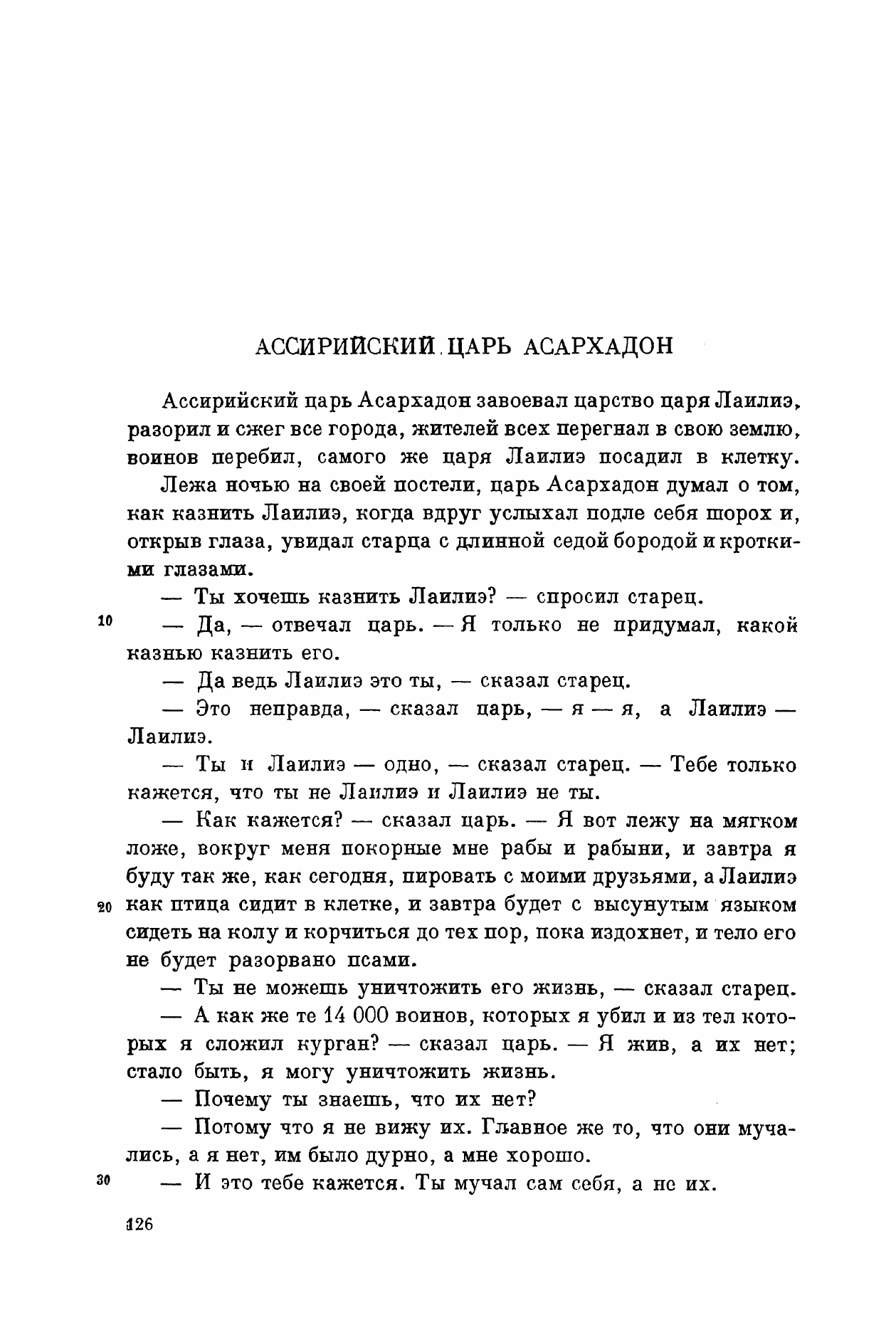
Seven public-domain images were cached for local viewing (git-ignored visuals/; python3 docs/fetch_visuals.py 1903-folk-tales repopulates a fresh clone): two portraits of Sholom Aleichem (1907), two photographs of Tolstoy dated 1903, and three from the Kishinev pogrom of April 1903 (including the Sefer Torah funeral procession — a sensitive image, to caption with care). Two targets are not openly digitised and are logged as work-orders: the «Гилф»/«Hilf» almanac cover (request from YIVO, the Center for Jewish History, or the National Library of Israel) and N. I. Zhivoy’s nine Posrednik illustrations (request from the RSL Posrednik archive / RGALI). V. P. Shchegolyonok’s photo and Repin portrait were already sourced in the parent dive and are cross-referenced rather than re-fetched. Full provenance, rights and URLs are in the dossier visuals block.
Method
Scope contract (Phase 0): plain theme-dive (no --novel), in-session, interactive. Subject = the tight 1903 cluster (five tales complete in PSS Tom 34), chosen over a “parables only” or a broad “1903–06” framing because the 1905–06 Круг чтения tales are mostly absent from the local corpus. Genre decision (confirmed with the reader): parable for all five — the best fit for legend/parable/Vedanta-dialogue, with the народный-рассказ identity carried as a concept entity rather than a new genre value. Corpus surface = the five tale TEIs + their per-tale «История писания» commentary; the 1903 diary (Tom 54); the 1903 letters (Tom 74). What actually happened: all five tales read in full; the genesis apparatus mined; the 1903 diary swept (68 entries, 23 relevant) for the composition and the people-network; eight keystone diary entries extracted individually for byte-fidelity; a medium-intensity visuals sweep (7 PD downloads, 2 work-orders); a 20-source scholarship sweep, grounded in the primary record and the parent dive before the mainstream. All 29 dossier quotes pass verify_quotes.py (exit 0). All extraction used extract_tei.py --choice=reg --notes=auto. PSS Tom 34 = jubilee-edition/vol03/ (the jubilee directory names are offset from the PSS Tom numbers).
Links: parent dive Stories for the People; What Is Art?; Tolstoyanism.
References
Primary — Л. Н. Толстой, ПСС: т. 34 (the five tales + История писания, с. 100–115, 126–140, 546–561); т. 54 (Дневник 1903); т. 74 (письма 1903 — С. Н. Рабиновичу/Шолом-Алейхему №144, 217, 219, 222, 241; Кишиневскому городскому голове №134); т. 88 (письма к Черткову, via commentary).
Background — Maude, A. (1906), preface to Twenty-Three Tales; Popoff, A. (2013), “Tolstoy and Anti-Semitism”; Ivry, B. (2014), The Forward (citing Schefski 1982, Barats 1961); Love, J., “Eastern Religion,” in Tolstoy in Context, ed. Orwin; del Olmo (2023), “Tolstoy’s ‘Esarhaddon, King of Assyria’,” IPOA Barcelona; Tishchenko, I. Y. (2017) (abstract only); Vahabzadeh, P. (2019), Violence and Nonviolence.
Companion dev-blog note: 2026-06-11-1903-folk-tales (draft).