A theme-dive across the six original tales Tolstoy wrote in 1905–06 for the weekly-reading (недельное чтение) slot of his anthology Круг чтения — «Алёша Горшок», «Корней Васильев», «Ягоды», «Молитва», «За что?» and «Божеское и человеческое». It is the third movement of the народный рассказ project, after the 1880s Posrednik cycle and the 1903 Kishinev tales. Primary record first: the tales themselves (PSS Toms 36, 41, 42), their per-tale «История писания» apparatus, the Круг чтения general history of writing and printing, the 1904–06 diary (Tom 55), and the 1905–06 letters to Gorbunov-Posadov and Chertkov (Toms 75–76, 89).
Key findings
- The народный рассказ swings back to realism. Where the 1903 cluster was all legend and parable, five of these six are realist short fiction — «Алёша Горшок» a character study drawn from a real servant, «Корней Васильев» a domestic tragedy across forty years, «Ягоды» a social-contrast tale of the 1905 gentry, «За что?» historical fiction, «Божеское и человеческое» a realist multi-plot tale. Only «Молитва» keeps the older shape, wrapping a dream-vision in a realist grief-frame. The realist/parabolic split runs inside the late tales themselves.
- Tolstoy built the anthology to hold what the censor would cut. The weekly readings are 52 narrative slots, one every seven days, renamed from «воскресные чтения» on Abrikosov’s advice (E01). Tolstoy said plainly that in composing Круг чтения he had «в виду именно нецензурное» — the uncensorable — and would «сохранить то, что вычеркнет цензура» (E02). The surplus «месячные чтения» could not pass the Russian censor at all and survived only in the 1907 German Dresden edition (E03).
- Two of the six carry, as fiction, what a treatise could not print. «За что?» names and condemns Nicholas I and shows state torture — the gauntlet of «высочайше утвержденной толщины» (E20–E22); «Божеское и человеческое» indicts capital punishment and the church-as-state-servant (E26–E28). Both were written amid the 1905 revolution and its executions (E35–E36) — the same matter as «Не могу молчать» (1908), but routed through fiction in an anthology.
- The strategy half-failed. After Tolstoy’s death the anthology’s editor I. I. Gorbunov-Posadov was tried — on 8 November 1911, the day after the first anniversary of Tolstoy’s death — and «признан виновным и присужден к заключению в крепости на один год», with twelve passages ordered destroyed (E07).
- All six come from somewhere real. «Алёша Горшок» is a «живое лицо», a Yasnaya Polyana servant of the 1860s (E10); «Корней Васильев» and «Молитва» grow from legends the skazitel’ Shchegolenok told Tolstoy in 1879 (E14, E17 — the same oral source as the 1880s tales); «За что?» is built on S. V. Maximov’s «Сибирь и каторга» and the real Polish exiles Migurski and Albina (E23); «Божеское и человеческое» on the real Dmitri Lizogub, hanged in Odessa in 1879 (E29).
- The cluster is not only political. «Алёша Горшок» — pulled by Tolstoy from the anthology and printed only posthumously in 1911 (E11) — is the What Is Art? ideal of «infection» made flesh: a tale that carries its meaning through one uncomplaining life, with no statement. «Корней Васильев» is a study of repentance. The народный рассказ here does several things at once.
- They are the slot English readers never met. Sekirin’s A Calendar of Wisdom (1997) — the only English Круг чтения — omits all 52 weekly stories. Of these six tales, only «Алёша Горшок» had an English translation before 2000; the other five first appeared in English in two parallel 2000 editions (Sekirin, Spence), both titled Divine and Human and Other Stories.
Why this matters
English scholarship, when it notices these tales at all, treats them as a minor moral appendage to the anthology’s aphorisms, and tends to flatten the whole late sequence into uniform «didactic» or «parabolic» prose (see Scholarly context). That framing loses two things the primary record makes plain. First, the form changed: this third movement of the народный рассказ is mostly realist fiction, not parable — a genre fault-line that runs inside the 1905–06 group and that English criticism has not named. Second, the politics is not incidental: «За что?» and «Божеское и человеческое» were Tolstoy’s way of getting an indictment of the autocracy, of capital punishment, and of the state-church past a wall he otherwise could not pass — and he said as much about the anthology that carried them. The народный рассказ here is the late voice’s genre-as-encryption applied to realist fiction and aimed at the present moment; the parent cycle began the form and the 1903 tales compressed it into legend, but here it carries the 1905 revolution and its gallows.
The shape of the question — six tales, two modes, one channel
The six readings move between two modes — the realist sketch and the political tale — held together by the anthology channel that carried them. The stages below give each tale’s keystone: a verbatim Russian passage, a working-English translation, and the TEI id with PSS Tom.
Stage 1 — the doctrine carried by a life, not a statement. «Алёша Горшок» (PSS Tom 36, v36_054_058) is the uncomplaining peasant lad whose single revelation is that he himself, not his labour, is needed by another person:
есть еще отношения совсем особенные: не то чтобы нужно было человеку вычистить сапоги, или снести покупку, или запречь лошадь, а то, что человек так, ни зачем нужен другому человеку, нужно ему послужить, его приласкать, и что он, Алеша, тот самый человек. (E08)
(working English) there are also quite special relations: not that a person needs his boots cleaned, or a purchase carried, or a horse harnessed, but that a man is simply needed by another man for no reason at all, that one should serve him, show him tenderness — and that he, Alyosha, is that very man.
He dies without protest or fear — «Удивился чему-то, потянулся и помер»:
А в сердце у него было то, что как здесь хорошо, коли слушаешь и не обижаешь, так и там хорошо будет. (E09)
(working English) And in his heart there was this: that just as it is good here, if you obey and do not wrong anyone, so it will be good there too.
Stage 2 — repentance without a sermon. «Корней Васильев» (PSS Tom 41, v41_205_220) follows a man forty years from the night he beats his wife and maims his small daughter to the day he returns a broken beggar. The lifelong hatred simply falls away:
Корней привалился спиной к стене и, упираясь на клюку, пристально смотрел на нее и с удивлением чувствовал, что у него не было в душе той злобы на нее, которую он столько лет носил в себе, но какая-то умиленная слабость вдруг овладела им. (E12)
(working English) Korney leaned his back against the wall and, propping himself on his staff, looked at her intently, and felt with surprise that the malice towards her he had carried in himself for so many years was no longer in his soul — but some tender weakness suddenly came over him.
Reconciliation arrives one hour too late, and the realist tale refuses to resolve it: «А по строгому, прекрасному, старому лицу Корнея нельзя было понять, прощает ли он, или еще гневается» (E13).
Stage 3 — the social contrast of 1905. «Ягоды» (PSS Tom 41, v41_450_460) sets the dacha gentry, debating Russia’s constitutional future through the night, against the peasant children gathering berries at dawn. The political talk goes nowhere:
но собеседники всё курили и разговаривали, разговаривали и курили. (E18)
(working English) but the companions kept on smoking and talking, talking and smoking.
Tolstoy noted the tale’s nerve in his diary the day he finished it — «болею своим довольством и окружающей нуждою» (I am sick with my own comfort amid the surrounding need) — and the tale ends with the whole gentry household «доволен», down to the boy who has eaten the children’s plate of berries (E19).
Stage 4 — theodicy in a dream. «Молитва» (PSS Tom 41, v41_128_133), the one hybrid, frames a realist grief — a mother whose three-year-old dies of «водянка в голове» — around a dream-vision in which an angel-being shows her the corrupt old man her boy would have become:
Ты ведь не знаешь, чем он был бы, если бы остался жив. А я знаю. (E15)
(working English) You do not know what he would have been, had he lived. But I know.
Stage 5 — the state named. «За что?» (PSS Tom 42, v42_084_106), historical fiction drawn from a documented Polish-exile case, makes its title-question a cry against the autocracy. At the grave of the Migurskis’ two dead children:
За что? за что? — думала она (E21)
(working English) For what? for what? — she thought
The tale shows the running of the gauntlet in documentary close-up («высочайше утвержденной толщины» — a thickness approved at the very top), indicts the regime as senseless coercion (E20), and closes on Nicholas I by name, rejoicing that he has «задавил гидру революции» while believing himself a benefactor (E22).
Stage 6 — the divine and the human. «Божеское и человеческое» (PSS Tom 42, v42_194_227) sets the condemned revolutionary Svetlogub, transformed by the Gospel in his cell, against the state that hangs him and the terrorist who would kill the «злодеи». Svetlogub’s turn:
именно, отдать душу свою; не сберечь, а отдать. В этом радость, в этом жизнь. (E26)
(working English) precisely, to give up one’s soul; not to save it, but to give it. In this is joy, in this is life.
He forgives both comrades and executioners — «прости им, они не знают, что творят» (E27) — and the tale’s whole argument closes in one image, the revolutionary who hanged himself laid beside the believer who died in vision:
Тело Меженецкого снесли в мертвецкую и положили на нары рядом с телом старика раскольника. (E28)
(working English) Mezhenetsky’s body was carried to the mortuary and laid on the boards beside the body of the old Old-Believer.
The channel that carried them. The thread joining the six is the anthology and its censorship logic. Tolstoy built Круг чтения to keep what the censor would strike:
я имею в виду именно нецензурное и постараюсь сохранить то, что вычеркнет цензура (E02)
(working English) I have in mind precisely the uncensorable, and shall try to preserve what the censor would strike out.
He told Chertkov in April 1905 that the anthology material «вероятно, не пройдет в России, но может быть напечатано за границей» (E04), and told Gorbunov-Posadov in September that it would be «недурно бы в Чтения выбирать из запрещенных моих, когда нужно заменить» (E05) — the weekly-reading slot as a re-entry route for banned work.
Where the tales cluster
| Tale | PSS Tom | Mode | Keystone | Source |
|---|---|---|---|---|
| Алёша Горшок | 36 (с.54–58) | realist sketch | the man needed for himself, not his labour (E08–E09) | a real Yasnaya Polyana servant (E10) |
| Корней Васильев | 41 (с.205–220) | realist tragedy | the hatred falls away; forgiveness an hour too late (E12–E13) | a Shchegolenok legend, 1879 (E14) |
| Ягоды | 41 (с.450–460) | realist satire | gentry talk vs the children’s berries (E18) | none stated |
| Молитва | 41 (с.128–133) | realist + dream-vision | the unknowable future; death as mercy (E15) | a Shchegolenok angel-legend (E17) |
| За что? | 42 (с.84–106) | historical fiction | «За что?»; Nicholas I named; the gauntlet (E20–E22) | Maximov, «Сибирь и каторга»; the real Migurskis (E23) |
| Божеское и человеческое | 42 (с.194–227) | realist multi-plot | the divine and the human laid side by side (E26–E28) | the real Dmitri Lizogub, Odessa 1879 (E29) |
The composition-years letters (the editorial channel).
| Tom | Letter | Date | Addressee | Material |
|---|---|---|---|---|
| 89 | v89_738 |
1905-04-17 | V. G. Chertkov | the anthology «не пройдет в России… за границей» (E04) |
| 76 | v76_053 |
1905-09-25 | I. I. Gorbunov-Posadov | «Ягоды — поправил»; fill the slots from «запрещенных моих» (E05) |
| 89 | v89_747 |
1905-10-18 | V. G. Chertkov | halts printing to rewrite the Svetlogub death-scene (E31) |
| 76 | v76_179 |
1906-04-01 | E. V. Gertsik | the 1891 copyright renunciation; Chertkov keeps the originals (E06) |
| 76 | v76_139 |
1906-02-13 | A. L. Tolstaya | «Я написал маленький рассказ «За что»» (E25) |
| 89 | v89_770 |
1906-11-26 | V. G. Chertkov | regrets placing Божеское in the anthology (E34) |
Genesis & composition — the weekly-reading slot, written amid the revolution
The anthology came first. Tolstoy had wanted a «Круг чтения» — selected reading for every day of the year — since the mid-1880s, and acted on it only after 1903, first as «Мысли мудрых людей», then as the larger anthology compiled through 1904 and printed across 1905–06. Within it he placed a longer narrative every seventh day:
Толстой сначала называл эти выдержки «воскресными чтениями», но потом по совету помогавшего ему в работе Х. Н. Абрикосова решил называть их «недельными чтениями». Таких «недельных чтений» должно было быть всего, по числу недель в году, пятьдесят два. (E01)
(working English) Tolstoy first called these excerpts “Sunday readings”, but then, on the advice of his helper Kh. N. Abrikosov, decided to call them “weekly readings”. There were to be fifty-two such “weekly readings” in all, one for each week of the year.
The tales were written into this slot through 1905–06, mostly fast and amid the revolution. The 1905 group came first: «Корней Васильев» begun 22 February (a Shchegolenok plot first listed as «ушедший странствовать от жены»); «Алёша Горшок» the same late-February week; «Молитва» in early May (replacing the already-set legend «Три старца»); «Ягоды» in two days, 10–11 June — the diary that day carries the tale’s own moral nerve. The two big tales came in 1906, as the December uprising and the executions ran on around them. Tolstoy worked at «Божеское и человеческое» the week he wrote in his diary:
Во всей теперешней революции нет идеала. И потому не революция, а бунт. (E35)
(working English) In the whole present revolution there is no ideal. And therefore it is not a revolution but a riot.
«За что?» he began after reading Maximov in January 1906; in October that year, the same political violence pressed directly: «чтение газет с 22 казненными, и я начал писать об этом» (E36) — a draft that would grow into «Не могу молчать» (1908).
The people around the work are named in the record: I. I. Gorbunov-Posadov, the Посредник editor who placed the tales in their slots and coordinated printing; V. G. Chertkov, who handled the abroad channel, shaped «Божеское и человеческое» in proof, and would edit the 1911 posthumous edition that first printed «Алёша Горшок»; Kh. N. Abrikosov, who named the weekly readings; F. A. Strakhov, who redacted the proofs; and the household copyists (M. L. Obolenskaya, A. L. Tolstaya, Yu. I. Igumnova). For «За что?» Tolstoy drew on a research network — Baudouin de Courtenay, Shakhmatov, and Stasov, who sent seventeen volumes on the 1830 uprising.
Redactions & textual history
The realist tales were heavily reworked. «Корней Васильев» «переделывался автором тринадцать раз» (E14); «За что?» «был переделан Толстым пятнадцать раз», its centre «обличение деспотизма николаевской эпохи», sharpened in proof («русские» → «москали») (E24); «Божеское и человеческое» survives in 49 manuscript and proof units. «Алёша Горшок», by contrast, was written in four days and barely revised — two manuscripts only.
Two textual facts carry weight. First, the title of «Божеское и человеческое» was reversed: the first written form (30 December 1903, on the blank end-pages of the diary, Tom 54) put the human first, «Человеческое и божеское» (E30); the order inverted only in reworking — which cycled through the title «Еще три смерти» — so that the final divine-first order is the verdict the tale reaches. Second, the censor’s one cut to the cluster is locatable to the line: in the second edition of Круг чтения «подверглось цензурному изъятию одно место в «Молитве» — от слов: «Вот сейчас» кончая словами: «Японцы тоже молятся, чтобы им победить»» (E17) — the Russo-Japanese war prayer (E16), the tale’s sharpest anticlerical-pacifist edge. The first edition (1906) was uncut.
Publication, censorship & translation
Four of the six (Корней, Ягоды, Молитва — vol. I, 1906; За что? — the September reading, so vol. II) appeared as weekly readings in the first edition of Круг чтения, изд. «Посредник» (the apparatus specifies the first edition; the volume for «За что?» is inferred from its September slot). «Божеское и человеческое» is the exception in two ways. Because vol. II was delayed, it appeared first abroad, in émigré-channel translations made under Chertkov’s supervision:
С английского в переводе А. Грена рассказ под заглавием «Божеское и человеческое, или Еще три смерти» был напечатан в №№ 8 —14 газеты «Новая жизнь» от 16—22 июня 1906 г. (E32)
(working English) From the English, in A. Gren’s translation, the story — under the title “The Divine and the Human, or Three More Deaths” — was printed in nos. 8–14 of the newspaper “Novaya zhizn”, 16–22 June 1906.
Its Russian first printing followed in vol. II part 2 of Круг чтения, late November 1906 (spine-dated 1907) (E33) — a placement Tolstoy then regretted (E34). «Алёша Горшок» was the one tale Tolstoy never saw in print: excluded from the anthology and «впервые… напечатан в I томе «Посмертных художественных произведений Л. Н. Толстого» под редакцией В. Г. Черткова, Москва 1911» (E11).
Translation. These six are precisely the slot the English Круг чтения omits — Sekirin’s A Calendar of Wisdom (1997) drops all 52 weekly stories, as the late-voice dive records. But the individual tales are not wholly untranslated, and the dive does not claim its working glosses are «first English». The accurate picture: only «Алёша Горшок» had a published English translation before 2000 (C. T. Hagberg Wright 1912; the Maudes c. 1922; Clarence Brown 1985). The other five first appeared in English in 2000, in two parallel editions both titled Divine and Human and Other Stories — Peter Sekirin (Zondervan) and Gordon Spence (Northwestern University Press). None of the six is in Maude’s Twenty-Three Tales.
Reception & afterlife — the censorship that caught up
The sharpest reception was the state’s, and it came after Tolstoy’s death. In December 1910 «Посредник» reprinted Круг чтения; the second half-volume of vol. II was seized by the Moscow Press Committee, and the anthology’s editor was put on trial — on 8 November 1911, the day after the first anniversary of Tolstoy’s death:
И. И. Горбунов-Посадов был признан виновным и присужден к заключению в крепости на один год. (E07)
(working English) I. I. Gorbunov-Posadov was found guilty and sentenced to one year of imprisonment in a fortress.
Twelve passages were ordered destroyed before the book could be sold; the defence (V. A. Maklakov, N. K. Muravyov) failed despite witnesses confirming Tolstoy alone had edited the anthology. A parallel prosecution (December 1911, St Petersburg) tried the «Ясная Поляна» publisher V. A. Maximov over a 30,000-copy edition. The same censorship pressure had already shaped the book during Tolstoy’s life: the surplus «месячные чтения» could not pass the Russian censor and appeared only in the 1907 German Dresden edition (E03). The strategy of E02 — keeping the uncensorable — bought the anthology a wide life and cost its editor a year in a fortress.
Scholarly context
English scholarship rarely treats these tales as objects in their own right, and where it does, it tends to spiritualise and homogenise them. Attribute, don’t assert. Kirkus (2000) calls the late tales «heavily moralistic… many structured as parables»; Publishers Weekly (2000) calls them «lovely artifacts» of spiritual insight — a frame that, set against the primary record, complicates rather than confirms, because it flattens a genre split the corpus makes legible: «Корней Васильев», «За что?» and «Божеское и человеческое» are realist in ways the 1880s parables are not, and that fault-line within the late tales is not named in the English criticism the dive found (the relation here is extends). On the politics the relation is also extends: Gordon Spence’s 2000 Northwestern edition is the one English framing to foreground «the political import and allegory» of tales written «around the Russian revolution of 1905», but the fuller claim — that Tolstoy chose the anthology to carry what a signed treatise could not legally print, and said so (E02) — is not made as a named thesis in English. The Gorbunov-Posadov trial likewise extends the record: it is effectively undocumented in English (the English Wikipedia article omits it; the standard biographies do not use it). The one finding scholarship confirms is the stature of «Алёша Горшок» — D. S. Mirsky (1926) calls it «one of his most perfect creations», and Andrew Pine (2020) links it to the What Is Art? «infection» ideal; the corpus extends this with the compositional record (four days, excluded from the anthology, and T. A. Kuzminskaya’s protest that the fictional Alyosha bore little resemblance to the real «полуидиот» she remembered). The mainstream «didactic decline» reading of the late tales — which the corpus does not support for these six — is the Tolstoyan-adjacent soft-dismissal to read critically, not inherit. Full sweep, sources, and the per-tale translation table are in the dossier’s scholarship block and extracts/_scholarship.md.
Place in the cluster & the author’s later verdict
These tales are the third movement of the народный рассказ project. They share the parent dive’s machinery — Посредник, the copyright renunciation of 1891 (E06) — and one of its people, the skazitel’ Shchegolenok, whose 1879 legends seed «Корней Васильев» and «Молитва» as they seeded the 1880s tales. They are the practice the What Is Art? treatise theorised, and the realist, present-tense extension of the genre-as-encryption the late-voice dive maps. The 1903 dive’s closing marquee — the 24 October 1910 letter to Gorbunov-Posadov grading the народные рассказы two weeks before Tolstoy’s death — reaches this cluster too: it graded the Посредник leaflets, and none of these six (issued as Круг чтения weekly readings, not leaflets) appears on that list (cross-referenced from the 1903 dive, not re-extracted here). On «Алёша Горшок» Tolstoy left his own verdict in the diary — «совсем плохо. Бросил» — and then excluded it from the anthology; the tale survived to become, in Mirsky’s judgement (1926), one of his most perfect.
Material not covered
- Variant collation: the reworking counts (Корней 13×, За что? 15×, Божеское 49 manuscript units) are summarised, but the variants are not collated line by line.
- Круг чтения itself as a work: the anthology merits its own works record (genre: anthology) and a fuller account of its daily-thoughts architecture — out of this dive’s scope (the dive proposes the six tale records).
- Contemporary critical/press reception of the individual tales, beyond the censorship and the 1911 trial — largely out of the local corpus.
- The 1909 «На каждый день» and 1910 «Путь жизни» anthologies (the later compression stages) — cross-referenced via the late-voice dive, not dived.
- The Polish-language reception of «За что?» (Tolstoy wanted it known to Polish readers) and the Anglo-American reception of Stepnyak-Kravchinsky’s Lizogub — flagged by the scholarship pass, outside the English-first scope.
Visual & manuscript record
The committed facsimile is the first page of Tolstoy’s autograph manuscript of «Алёша Горшок», rendered from the local public-domain jubilee edition:
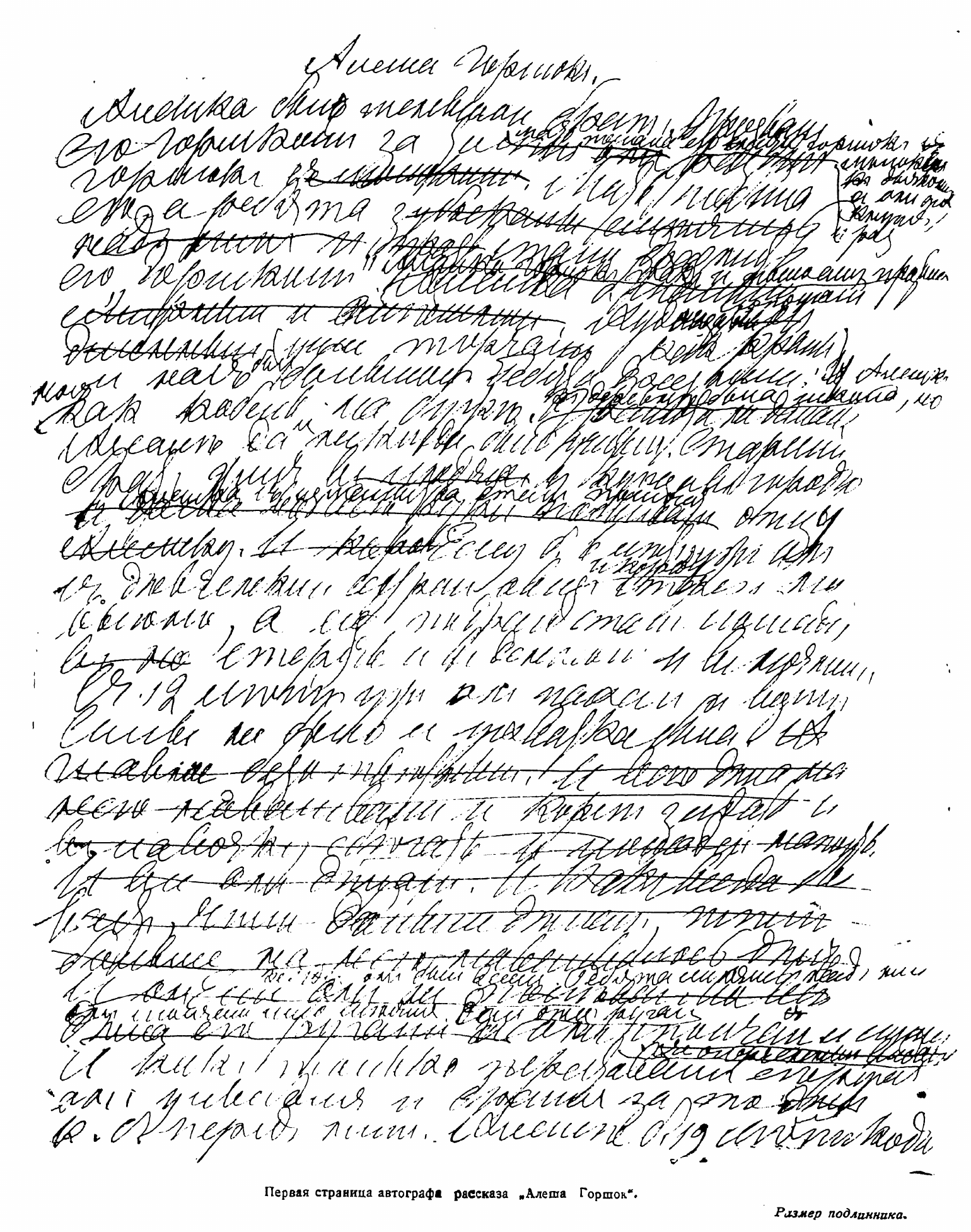
Eight public-domain images were cached for local viewing (git-ignored visuals/; python3 docs/fetch_visuals.py 1905-1906-krug-chtenija-tales repopulates a fresh clone): a portrait of Tolstoy in 1906 and a Chertkov photograph of him with his daughter at Yasnaya Polyana in July 1906 (the weeks the proofs circulated); a portrait of I. I. Gorbunov-Posadov (1898) and a Tolstovtsy group photograph; the only known portrait of Dmitri Lizogub (1877), the real face behind Svetlogub; S. V. Maximov by Repin (1890) and in a photograph; and a contemporary 1831 proclamation from the November Uprising that begins the action of «За что?». Shchegolenok’s photo and Repin portrait, and Chertkov’s portraits, are cross-referenced from the parent dive rather than re-fetched. Five targets are not openly digitised and are logged as work-orders: a title page of the 1906 Круг чтения (request from РГБ / НЭБ / the State Tolstoy Museum); a period «running the gauntlet» illustration for «За что?» (BnF Gallica / the State Historical Museum); portraits of the real Migurskis (Polish archives); a title page of Maximov’s «Сибирь и каторга»; and a press image or court record of the 1911 Gorbunov-Posadov trial. Full provenance, rights and URLs are in the dossier visuals block.
Method
Scope contract (Phase 0): a plain multi-work theme-dive (not --novel), in-session, interactive — the third movement of the народный рассказ project, all six tales Johan-confirmed. Genre was decided per-tale after reading (Johan-confirmed approach): five realist short_story proposals, with «Молитва» (short_story vs parable) and «Божеское и человеческое» (short_story vs novella) flagged in needsReview. Visuals were run at medium intensity. Corpus surface = the six tale TEIs + their per-tale «История писания» + the Круг чтения general history (Tom 42); the reversed-title draft (Tom 54); the 1904–06 diary (Tom 55); the 1905–06 letters (Toms 75–76, 89). What actually happened: all six tales read in full + the draft; the apparatus mined for genesis, redaction, publication and censorship; the diary swept (124 entries in window, 15 relevant) and the letters swept (Toms 75/76/89, 17 relevant); a medium visuals sweep (8 PD downloads, 5 work-orders); an English-first scholarship sweep grounded in the primary record and the sibling dives before the mainstream. All 36 dossier quotes pass verify_quotes.py (exit 0). All extraction used extract_tei.py --choice=reg --notes=auto. PSS Tom 36 = jubilee-edition/vol05/, Tom 41 = vol09/, Tom 42 = vol10/ (the jubilee directory names are offset from the PSS Tom numbers).
Links: parent dive Stories for the People; the second movement 1903 folk tales; the late voice — encryption & compression; What Is Art?; copyright renunciation; the contested-label dive Tolstoyanism.
References
Primary — Л. Н. Толстой, ПСС: т. 36 («Алёша Горшок», с. 54–58, + История писания); т. 41 (Круг чтения, т. I: «Корней Васильев», «Ягоды», «Молитва»); т. 42 (Круг чтения, т. II: «За что?», «Божеское и человеческое», + История писания и печатания всех шести рассказов, с. 557–665); т. 54 («Человеческое и Божеское. Наброски», с. 204–208); т. 55 (Дневник 1904–1906); тт. 75–76, 89 (письма 1905–1906 — И. И. Горбунову-Посадову, В. Г. Черткову, А. Л. Толстой, Е. В. Герцик).
Background — Mirsky, D. S. (1926), A History of Russian Literature (on «Alyosha the Pot»); Spence, G. (2000), intro to Divine and Human and Other Stories (Northwestern UP); Sekirin, P. (2000), Divine and Human and Other Stories (Zondervan); Hagberg Wright, C. T. (1912), …Alyosha the Pot: Miscellaneous Stories; Semmens, E. J. (1968), Tolstoy’s Later Short Stories; Pine, A. (2020), “The Singular Character of Tolstoy’s Alyosha”, Ploughshares; Kirkus (2000) and Publishers Weekly (2000) reviews; the Marxists Internet Archive Tolstoy missing-works list. Full list in the dossier references.background.
Companion dev-blog note: 2026-06-12-1905-1906-krug-chtenija-tales (draft).