A primary-source dive on the novella Tolstoy drafted in two weeks of November 1889 — in the same fortnight he was finishing The Kreutzer Sonata — set aside for almost twenty years, gave a second ending and its title to around 1909, and never printed. A landowner, Evgeny Irtenev, is destroyed by an involuntary sexual obsession with the peasant woman Stepanida; the story exists in two endings, one in which he shoots himself and one in which he shoots her. The dive reads the work against its own composition record — the November 1889 diaries, the 1858–60 diaries of Tolstoy’s own affair with the peasant woman Aksinya Bazykina, the 1898 and 1909 letters and diaries, and the PSS Tom 27 commentary — to test the claim its title invites and the work itself withholds: that the “devil” is the woman.
The dive leads with Tolstoy’s own words and treats the mainstream framings (the peasant temptress; the misogynist’s confession) as positions to attribute, not baselines to confirm. Working-English translations are labelled and provisional; the Russian is byte-verified against the corpus extracts.
Key findings
- The title names a delusion the work diagnoses, not a verdict the work endorses. In the second (murder) ending, the exact sentence in which Evgeny calls Stepanida “the devil” is the sentence in which he denies God and kills her: «Да нет никакого Бога. Есть дьявол. И это она. Он овладел мной» — there is no God; there is a devil, and it is she; he has taken possession of me. The epigraph (Matthew V:28–30: pluck out your own offending eye), the first (suicide) ending in which Evgeny turns the gun on himself, and the novella’s relentless language of a divided, involuntary will all locate the destroying force inside the man. The “devil” is Evgeny’s projection.
- The two endings are not indecision but the marquee enacted twice. The diary worked out the structure on 18 November 1889 — «две жизни представляются ему и два выхода. И наконец 3-й. Себя убить» (two lives present themselves to him and two exits; and finally a third: to kill himself). Suicide turns the verdict inward (the man is the problem); murder projects it outward (it is her). Tolstoy wrote the suicide ending in 1889 and the murder ending around 1909; both close on the same words — that the truly insane are those who see madness in others and not themselves.
- It is Tolstoy’s most directly autobiographical fiction, built on his 1858–60 affair with the married peasant Aksinya Bazykina — whose alternation of attraction and revulsion in his own diaries («Я влюблен, как никогда в жизни» → «она мне постыла» → «продолжаю видать исключительно») is the mechanism the novella dramatizes — and on an 1880s temptation (the cook Domna) he confessed to Chertkov in 1884. He named the affair to his biographer Birukoff: “на это есть намек в моем рассказе «Дьявол».”
- The plot’s external frame is a real crime. The protagonist was first called Irtenev, briefly renamed Tveretinov to mask the autobiography, then returned to Irtenev. The story is also tied to N. N. Fridrikhs, a Tula investigator who shot his peasant lover Stepanida and later died under a train — the crime supplying the murder ending, the ambiguous death the suicide.
- He suppressed it himself. Written secretly («это секрет», to Birukoff, 17 Jan 1890), kept in Petersburg away from Yasnaya Polyana, and in 1898 — when he sold Resurrection and Father Sergius to fund the Doukhobor emigration — withdrawn from the sale in his own hand: «Иртенева нехорошо печатать, потому что мотив один и тот же, что в Отце Сергие.» Sofia Tolstaya found the manuscript in 1909; «в ней поднялись старые дрожжи.»
- Marquee verdict:
contradicts+extends. The dive contradicts the mainstream literal reading of the title (Stepanida as a “femme fatale” who is the devil) and extends the scholarship, which — where it treats the novella at all — has not argued that the title is the protagonist’s self-deceiving projection. The primary record supplies that grounding: the two-ending structure and the murder ending’s God-denial make the projection visible as projection.
Why this matters
The Devil is the third panel of a triptych Tolstoy wrote in a single burst of 1889 — beside The Kreutzer Sonata and Father Sergius — and the one he never let out. Of the three it is the most exposed: not a murderer’s monologue or an ironic saint’s-life but a third-person account of an ordinary good man undone by a desire he does not choose and cannot govern, set in the register of Tolstoy’s own life. Because he hid it for two decades, gave it a second ending and its accusing title only at the very end, and withdrew it from print rather than wound his wife, the work sits at the intersection of his fiction, his doctrine of sexual abstinence, and the most guarded episode of his biography. And because the title points at the woman while the text points at the man, the novella is a test case for the project’s standing rule — to read Tolstoy against the frame, not into it.
The marquee question
Hypothesis. The “devil” of the title is not Stepanida but Evgeny’s own divided, involuntary will; the two endings are two enactments of the same split, and the work locates moral catastrophe in the desire within the man, not in the woman’s seduction. The title is the protagonist’s self-deceiving projection, offered by the author to be seen through.
This is an interpretive marquee, not a causal one, and it is contested: the popular and much of the critical reception reads the title literally — Stepanida as an elemental female force, a peasant femme fatale (see Scholarly context). The dive stages the primary evidence and reports the outcome.
The epigraph frames the sin as the man’s own. The novella opens on Matthew V:28–30 — not only «всякий, кто смотрит на женщину с вожделением, уже прелюбодействовал с нею в сердце своем», but the remedy that follows:
Если же правый глаз твой соблазняет тебя, вырви его и брось от себя, ибо лучше для тебя, чтобы погиб один из членов твоих, а не всё тело твое было ввержено в геенну.
(working English) “And if your right eye causes you to stumble, pluck it out and cast it from you; for it is better for you that one of your members perish, than that your whole body be cast into hell.”
The offending member is the looker’s own; the excision is the looker’s own to perform. This is the same Gospel verse Tolstoy set over The Kreutzer Sonata (chosen 23 August 1889, a few weeks before he drafted The Devil). The epigraph addresses the man.
The text names the involuntary force, repeatedly, as his own. Evgeny does not pursue Stepanida so much as get seized — the prose returns again and again to a will that is not his: «как будто по чьей-то чуждой ему воле»; «точно кто-то другой из него сказал эти слова»; «есть другая сила, двигающая им». In chapter XX, alone, he states the whole problem as a possession from inside:
Я думал, что я ее взял, а она взяла меня, взяла и не пустила. Ведь я думал, что я свободен, а я не был свободен.
(working English) “I thought I had taken her, but she had taken me — taken me and not let go. I thought I was free, and I was not free.”
The two endings test where the verdict falls. In the canonical (suicide) ending, Evgeny calls her «чорт» but draws the only conclusion that turns the violence on its true source — himself:
Только два выхода: убить жену или ее. Да еще… Ах, да, третий есть: себя, — сказал он тихо вслух, и вдруг мороз пробежал у него по коже. — Да, себя, тогда не нужно их убивать.
(working English) “Only two ways out: to kill my wife or her. And besides… Ah, yes, there is a third: myself, he said quietly aloud, and suddenly a chill ran over his skin. — Yes, myself; then there is no need to kill them.”
In the variant (murder) ending — written around 1909, and the source of the title — the projection becomes total, and is itself the crime (see What the work says and Redactions). Naming her the devil is the act of a man who has stopped believing he is responsible.
Outcome: contradicts + extends. Against the literal reading of the title — Stepanida as the devil, the woman as the destroying agent — the primary text pushes back: the destroying agent is named, inside the work, as Evgeny’s own ungoverned will, and the one place the title’s accusation is voiced as truth is the deluded interior of a man committing murder. So the marquee contradicts the femme-fatale frame. It extends the scholarship because the critical literature that does engage the novella has largely either taken the title at face value or read the misogyny as Tolstoy’s own unexamined pathology (Rancour-Laferriere); the dive’s contribution is to show, from the two-ending structure and the murder ending’s God-denial, that the work stages the projection as projection. The reading does not deny the novella’s harshness toward sexuality — that it shares fully with its siblings — but it relocates the harshness from the woman to the desire.
Genesis & composition
This is the layer a novel-dive weights most heavily, and The Devil has two genesis stories running twenty years apart: a two-week burst of writing in 1889, and a brief, decisive return around 1909.
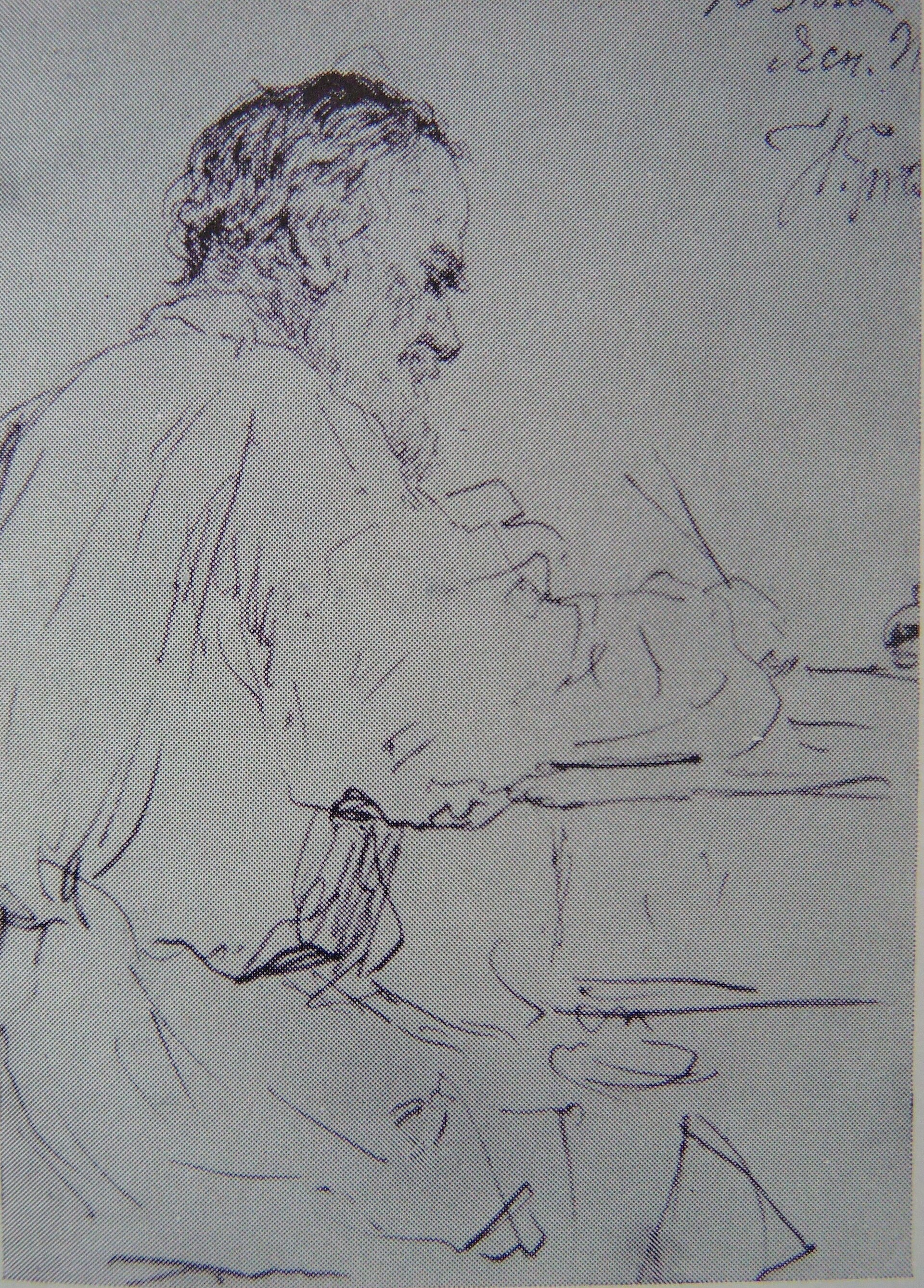
Written inside the Kreutzer fortnight (10–24 November 1889). The novella was drafted, in the PSS editor V. I. Sreznevsky’s words, «начерно в течение двух недель, в промежуток между окончанием предпоследней редакции «Крейцеровой сонаты» и началом работы над последней ее редакцией» — in rough over two weeks, in the gap between the penultimate and final redactions of The Kreutzer Sonata. In the diaries the work is never called «Дьявол» but «История Фредерикса» (or «Фридрихса»). The start is dated to the day, 10 November 1889:
После обеда неожиданно стал писать историю Фредерикса.
(working English) “After dinner unexpectedly began writing the story of Frederiks.”
The two works were literally interleaved: on 12 November the diary records «Писал Фредерикса, вписал в Крейцерову Сонату» — wrote Frederiks, inserted [something] into the Kreutzer Sonata. Work is noted on 11, 13 and 14 November; on the 19th, «Целое утро писал, кончил кое-как Фридрихса» (finished Friedrichs somehow), the date Tolstoy wrote at the end of the autograph; and revisions follow on 20–24 November.
The double ending was conceived in the diary, not improvised on the page. On 18 November 1889, before the draft was finished, Tolstoy worked out the structure that would become the work’s defining formal feature:
К Фридрихсу думал, гуляя перед обедом — две жизни представляются ему и два выхода. И наконец 3-й. Себя убить.
(working English) “Thinking about Friedrichs while walking before dinner — two lives present themselves to him and two ways out. And finally a third: to kill himself.”
The “two lives / two exits / a third — suicide” schema is exactly the monologue of chapter XX. At this stage the only ending was suicide; a diary note of 25–30 April 1890 still imagines only «раздвоение: хочу я или не хочу?» before self-destruction — the murder of Stepanida was not yet conceived.
The three real sources
The PSS commentary documents three separate strands of life that fed the work — and the dive routes each as a person (see Characters & prototypes).
Aksinya Bazykina — the autobiographical core. Near the end of his life Tolstoy told his biographer Birukoff to record «связь с крестьянской женщиной из нашей деревни, до моей женитьбы, — на это есть намек в моем рассказе «Дьявол»» — a liaison with a peasant woman of our village, before my marriage, hinted at in my story The Devil. The woman was the married peasant Aksinya Bazykina, and his diaries of 1858–60 track the same oscillation the novella gives Evgeny. 13 May 1858:
Я влюблен, как никогда в жизни. Нет другой мысли. Мучаюсь.
(working English) “I am in love as never before in my life. No other thought. I am tormented.”
A month later, 16 June 1858, after consummation: «Имел Аксинью….; но она мне постыла» (Had Aksinya…; but she has become repugnant to me). Then revulsion gives way again — 9 October 1859, «Аксинью продолжаю видать исключительно» (I continue to see Aksinya exclusively) — and by 25–26 May 1860 the feeling has changed register entirely:
Уж не чувство оленя, а мужа к жене.
(working English) “No longer the feeling of a stag, but of a husband to his wife.”
This attraction–revulsion–re-flaring cycle, and the change from animal to quasi-conjugal feeling, is the precise interior Tolstoy gave to Irtenev’s relation to Stepanida. The guilt did not fade: in his intimate diary of 9 July 1908 he writes that his biographers will say nothing of his breaches of the seventh commandment «и так до связи с крестьянкой Акс. — она жива» (and so on up to the liaison with the peasant woman Aks. — she is alive), and in a notebook of 13 June 1909, as quoted in the PSS commentary, he names the consequence: «вспомнил Аксинью, то, что она жива, и, говорят, Ермил мой сын» — remembered Aksinya, that she is alive, and that, they say, Ermil is my son.
Domna — the 1880s temptation. A second confession underlies the work. On 24 July 1884 Tolstoy wrote Chertkov of a sensual temptation he had told no one — the Yasnaya Polyana kitchen-cook Domna — and of his rescue by chance:
я назначил ей свиданье и пошел на него. В этот день у меня был урок со 2-м сыном. Я шел мимо его окна в сад, и вдруг, чего никогда не бывало, он окликнул меня и напомнил, что нынче урок. Я очнулся и не пошел на свиданье.
(working English) “I arranged an assignation with her and went toward it. That day I had a lesson with my second son. I was walking past his window into the garden, and suddenly — something that had never happened before — he called out to me and reminded me of the lesson. I came to my senses and did not go.”
The detail of an interruption that arrives like a reprieve from outside is the structure of Evgeny’s two near-escapes in the novella («Боже мой, второй раз Ты спасаешь меня»).
N. N. Fridrikhs — the external crime. The work’s outward frame is a Tula case. Per the commentary (from the testimony of Fridrikhs’s sister), N. N. Fridrikhs, a judicial investigator, soft and weak by nature and near-sighted, took up with a peasant woman named Stepanida, then married; three months later he shot Stepanida during threshing, was acquitted on the grounds of a tapeworm disordering his mind, and two months later died beneath a train at Zhitovo station — possibly an accident, possibly suicide. Evgeny’s near-sightedness and softness, the lover’s name Stepanida, and the two deaths are drawn from here: Fridrikhs’s ambiguous death suggested the first (suicide) ending, the murder that preceded it the second.
The people around the work
The genesis network is small and tightly held. V. G. Chertkov carried the autograph from Yasnaya Polyana to Petersburg in late January 1890, copied it with I. I. Gorbunov, and returned the copy on 20 February 1890; he twice urged Tolstoy to publish (Feb and Oct 1890), reporting that translators in Berlin and Sweden had got wind of a Tolstoy «Roman du mariage». The autograph was deliberately kept at Chertkov’s mother E. I. Chertkova’s house in Petersburg, away from Yasnaya Polyana. P. I. Birukoff received the secret in January 1890 and, decades later, the author’s own statement of the work’s autobiography. N. L. Obolensky — who married Tolstoy’s daughter Maria Lvovna in 1897 — copied the variant ending into the manuscript around 1909. Sofia Andreevna Tolstaya is the figure the secrecy was built around (below). Each is carried into the entity routing.
The 1909 return — the second ending and the title
Tolstoy left the work untouched for years but never considered it finished. He returned to it around 1909: the diary of 19 January 1909 records «Просмотрел «Дьявола». Тяжело, неприятно» (Read through “The Devil.” Heavy, unpleasant) — and by Sreznevsky’s analysis of the handwriting, the corrected copy, the new murder ending, and the title «Дьявол» itself all belong to this moment, nearly twenty years after the main text. The title was taken from the murder ending’s own line — Evgeny’s «Есть дьявол. И это она.» (The commentary dates this entry to 19 February; the corpus and PSS file metadata date it 19 January — see Method.)
The secret, and Sofia
Tolstoy hid the work because it touched the most guarded episode of his life and would wound his wife. To Birukoff, 17 January 1890:
у меня начаты еще другие художественные работы всё на тему половой любви (это секрет), я и своим не говорю.
(working English) “I have also begun other artistic works, all on the theme of sexual love (this is a secret) — I don’t even tell my own family.”
Sofia had long known of the Aksinya affair from his diaries, and her own diary of 16 December 1862 — months after the wedding, on seeing Aksinya wash the floors at Yasnaya Polyana — records a violence of jealousy («Я с таким удовольствием смотрела на кинжал, ружья. Один удар — легко»). When she finally read The Devil in the spring of 1909, the wound reopened. Tolstoy’s diary, 13 May 1909:
За завтраком Соня была ужасна. Оказывается, она читала «Дьявол», и в ней поднялись старые дрожжи, и мне было очень тяжело.
(working English) “At breakfast Sonya was dreadful. It turns out she had read ‘The Devil,’ and the old yeast rose in her, and it was very hard for me.”
(The popular story that Tolstoy sewed the manuscript into the upholstery of a chair to hide it from her is not supported by the primary record, which says only that the autograph was kept in Petersburg — see Scholarly context.)
What the work says
Novel mode reads the text by locating its pivotal scenes, not marching through it. The twenty-one chapters trace one arc: Evgeny Irtenev, a capable young landowner restoring his late father’s estate, arranges «для здоровья» a secret liaison with the peasant Stepanida; he marries the gentle Liza and believes the thing finished; a chance sight of Stepanida washing the floors reignites an obsession he cannot will away; and, certain he will «погибнуть» either by betraying his wife or by going mad, he reaches one of two ends — a bullet for himself, or three for Stepanida.
The centrepiece (chapter XX) — the divided will and the three exits. Alone after a relapse, Evgeny states the marquee in his own voice: first that he is possessed («она взяла меня, взяла и не пустила»), then that he is the devil’s, then — crucially — that he is the only thing that can be removed:
Ведь она чорт. Прямо чорт. Ведь она против воли моей завладела мною. Убить? да. Только два выхода: убить жену или ее. […] Ах, да, третий есть: себя, — сказал он тихо вслух, и вдруг мороз пробежал у него по коже. — Да, себя, тогда не нужно их убивать.
(working English) “She is the devil. Simply the devil. She has taken possession of me against my will. Kill? yes. Only two ways out: to kill my wife or her. […] Ah, yes, there is a third: myself, he said quietly aloud, and suddenly a chill ran over his skin. — Yes, myself; then there is no need to kill them.”
Here the title-word «чорт» is in Evgeny’s mouth — and in the same breath he reasons his way to suicide, the choice that names the will as the thing to be destroyed. The chapter is the hinge on which the two endings turn.
The first fall (chapter III). The seduction is brief, almost without event — and the prose withholds Stepanida’s interiority on purpose; she is barely seen:
В белой вышитой занавеске, красно-бурой паневе, красном ярком платке, с босыми ногами, свежая, твердая, красивая, она стояла и робко улыбалась. […] Он подошел к ней и, оглядываясь, коснулся ее. Через четверть часа они разошлись.
(working English) “In a white embroidered apron, a reddish-brown homespun skirt, a bright red kerchief, barefoot, fresh, firm, beautiful, she stood and smiled shyly. […] He went up to her and, looking around, touched her. A quarter of an hour later they parted.”
The reignition (chapters IX–XII). A year of marriage has, Evgeny believes, freed him; then Stepanida is hired to wash the floors and he meets her in his own doorway. The relapse is involuntary and total — «он чувствовал, что он побежден, что у него нет своей воли, есть другая сила, двигающая им» — and it drives him, like Tolstoy with Domna, to confess to another man and beg to be watched.
The burned finger (chapter XIII). The work’s clearest tie to its sibling Father Sergius: to master the desire, Evgeny recalls a hagiographic story and burns himself —
Он вспомнил, что читал про старца, который от соблазна перед женщиной, на которую должен был наложить руку, чтоб лечить ее, положил другую руку на жаровню и сжег пальцы. […] зажег спичку и положил палец в огонь. «Ну, думай о ней теперь», — иронически обратился он к себе.
(working English) “He remembered reading of an elder who, tempted by a woman on whom he had to lay his hand to heal her, put his other hand on a brazier and burned his fingers. […] He struck a match and held his finger in the flame. ‘Well, think about her now,’ he said to himself ironically.”
Where Father Sergius cuts off a finger with an axe and (for a time) wins, Evgeny burns one with a match and laughs at himself — and loses. The same self-mutilation image, written within a year, in two registers.
The two ends. The canonical chapter XXI: interrupted by his wife as he opens the cabinet, Evgeny sends her out and shoots himself —
Он приставил к виску, замялся было, но как только вспомнил Степаниду, решение не видеть, борьбу, соблазн, падение, опять борьбу, так вздрогнул от ужаса. «Нет, лучше это». И пожал гашетку.
(working English) “He put it to his temple, hesitated a moment, but the instant he remembered Stepanida — the resolve not to see her, the struggle, the temptation, the fall, the struggle again — he shuddered with horror. ‘No, better this.’ And he pulled the trigger.”
The variant ending replaces this with murder (see Redactions). Both versions close on the same sentence — that if Evgeny was insane, so is everyone, and «самые же душевно-больные это несомненно те, которые в других людях видят признаки сумасшествия, которых в себе не видят» (the most insane of all are surely those who see the signs of madness in others and not in themselves) — a closing that turns the diagnosis back on the reader who would call Evgeny mad.
Redactions & textual history
The novella exists in essentially one manuscript redaction with two endings; the dive samples the variant rather than collating the whole. The autograph (10–19 November 1889, 48 leaves, 22 chapters) is held at IRLI (Pushkin House), shifr 22.5.5; the corrected Chertkov–Gorbunov copy carries Tolstoy’s title and his late corrections. The PSS prints the main text (with the suicide ending) and the variant ending separately.
The keystone variant — the murder ending (c. 1909). This is the one variant the dive extracts as a first-class text, because it changes the reading. In place of the suicide, Evgeny prays for deliverance, fails, and at the threshing-barn frames the whole catastrophe as the woman’s doing — the sentence that gave the work its title:
Да неужели я не могу овладеть собою? — говорил он себе. — Неужели я погиб? Господи! Да нет никакого Бога. Есть дьявол. И это она. Он овладел мной. А я не хочу, не хочу. Дьявол, да, дьявол. Он подошел вплоть к ней, вынул из кармана револьвер и раз, два, три раза выстрелил ей в спину.
(working English) “Can I really not master myself? he said to himself. Am I really lost? Lord! No — there is no God. There is a devil, and it is she. He has taken possession of me. And I do not want this, I do not want it. The devil, yes, the devil. He went right up to her, took the revolver from his pocket, and fired into her back — one, two, three times.”
The murder ending is darker than the suicide and, on the dive’s reading, more damning of Evgeny: he is acquitted as «временно душевно-больной», sentenced only to church penance, and degenerates into «расслабленным, невменяемым алкоголиком» — survival without redemption. Crucially, the title is its product: the work is named «Дьявол» after the word a murderer uses to disown his act. Tolstoy made one telling correction here, recorded in the commentary — in the copy he inserted, after «если Евгений Иртенев был душевно-больной», the words «тогда, когда он совершил свое преступление» (at the time he committed his crime), fitting the closing meditation to the murder rather than the suicide.
The surname. Tolstoy first wrote Irtenev — the autobiographically loaded name of the narrator of Childhood / Boyhood / Youth — then, in a reworked opening, twice changed it to Tveretinov «с целью устранить возможность автобиографического толкования повести» (to remove the possibility of an autobiographical reading), but reverted to Irtenev in the body and the variant ending. The PSS, and this dive, use Irtenev. (Stepanida’s husband appears as both Pechnikov and Pchelnikov; the editors leave both, unable to know which Tolstoy would have kept.)
Publication, censorship & afterlife
Unlike its sibling The Kreutzer Sonata, The Devil met no living-author censorship — because Tolstoy suppressed it himself, and it appeared only after his death (bans: []).
Withdrawn from the Doukhobor sale (1898). In the summer of 1898, raising money for the Doukhobors’ emigration to Canada, Tolstoy proposed to sell three manuscript works to English and American newspapers. To Chertkov, 14 July 1898:
у меня есть три повести: Иртенев, Воскресение и О. Сергий […] я хотел бы продать их […] и употребить вырученное на переселение духоборов.
(working English) “I have three novellas — Irtenev, Resurrection, and Father Sergius — […] I would like to sell them […] and use the proceeds for the resettlement of the Doukhobors.”
The same day, rereading it, he withdrew The Devil from the plan — the only one of the three he held back:
Иртенева нехорошо печатать, потому что мотив один и тот же, что в Отце Сергие.
(working English) “It is not good to publish Irtenev, because the motif is the same as in Father Sergius.”
Resurrection and Father Sergius went to the fund; The Devil stayed secret. (The duplication he names is real but partial: the two works share a theme of carnal struggle, but Father Sergius subordinates it to vainglory while The Devil keeps it bare — see Place in the cluster.)
First publication (1911). The Devil was first printed posthumously in volume 1 of «Посмертные художественные произведения Л. Н. Толстого», edited by V. G. Chertkov, published by his daughter A. L. Tolstaya (Moscow, 1911) — from the corrected Chertkov–Gorbunov copy, the variant ending from N. L. Obolensky’s list. The Berlin 1912 edition («Свободное слово», V. and A. Chertkov) and the 1928 Eikhenbaum–Khalabaev collation followed. (One catalogue describes the volume as vol. II; the PSS apparatus says vol. 1 — see Method.)
Translation. The standard English translation, “The Devil,” is by Aylmer and Louise Maude, completed by Aylmer Maude on 12 September 1925 (“translated into English for the first time”). It is reprinted in the Oxford World’s Classics The Devil and Other Stories (intro. Richard F. Gustafson) and in the Melville House Art of the Novella edition, which prints both endings.
Characters & prototypes
The cast is small and, but for the prototype edges, mostly folds into the work’s prose. Applying the wiki-schema v1.4 tiering rule, the dive mints standalone nodes only where a figure is principal/titular or carries a documented prototype.
Evgeny Irtenev (character, protagonist) — the landowner. His prototype edge is double and well-attested: autobiographical (Tolstoy’s own pre-marriage life and the Domna temptation; certainty probable — Tolstoy acknowledged “a hint” of himself, not a portrait) and contemporary/editorial for N. N. Fridrikhs, the Tula investigator whose crime and death the plot borrows (certainty documented for the borrowing, per the PSS commentary). The Irtenev/Tveretinov name-change is itself the evidence that Tolstoy felt the autobiography as a danger to be masked.
Stepanida (character, principal) — the peasant woman. Prototype: Aksinya Bazykina (autobiographical/author-stated via the Birukoff statement; certainty documented that she is the model, since Tolstoy named the connection). The shared first name with Fridrikhs’s victim folds the two sources into one figure. The dive’s reading turns on not reading Stepanida as the title’s “devil”: the text withholds her interiority precisely so that the “devil” remains Evgeny’s projection.
Liza Irteneva (character, secondary) — the wife, whose love is rendered as a kind of clairvoyant self-erasure. No documented prototype; the jealousy-and-discovery material draws on Sofia, but the dive does not assert Liza ↔ Sofia as a portrait (routed to needsReview). Likely folds into the work’s prose rather than a standalone node.
The three real models route as person, not character: Aksinya Bazykina (missing from the vault; central, ingestionPriority: 1), Domna (the 1880s cook; peripheral), and N. N. Fridrikhs (the external crime; supporting). Tolstoy himself, the autobiographical source, already has a page and takes no new node here.
Themes
- Involuntary desire and the divided will (раздвоение). The novella’s true subject: a desire the man does not choose, cannot reason away, and experiences as a foreign power. The vocabulary is consistent — «против воли», «другая сила», «не свободен» — and it is the autobiographical mechanism (Tolstoy’s own attraction–revulsion cycle with Aksinya) raised to a structural principle.
- The internal vs. the external “devil.” The book’s central ambiguity, encoded in the two endings: is the destroyer the man’s own will (suicide) or the woman (murder)? The dive reads the title as the protagonist’s projection; the text supplies the evidence by making the naming-her-devil coincide with the murder.
- The Gospel of excision. The Matthew V epigraph — pluck out your own eye — is the doctrinal frame The Devil shares with The Kreutzer Sonata: the remedy for lust is self-amputation, not the removal of the woman. Evgeny’s burned finger is the epigraph attempted and failed.
- Autobiography and confession. More than any other Tolstoy fiction, the work is a veiled confession — of Aksinya, of Domna — which is why he hid it, masked the name, and reached for it again only as he was settling accounts near the end.
- Class. The catastrophe is also a gentry-and-peasant story: the «для здоровья» arrangement assumes Stepanida’s availability as a thing his father’s generation took for granted, and the moral reckoning never extends to her personhood — a limit the dive marks rather than smooths.
Reception & afterlife
Because it appeared only posthumously, The Devil had no contemporary public reception and no censorship history; its first “reader” in any charged sense was Sofia Tolstaya in 1909, whose jealous distress is recorded above and is, in effect, the work’s earliest reception.
In the criticism that followed publication, the novella has been read overwhelmingly as autobiography and as the bleakest member of the 1889 sexual-morality cluster. Its peculiar formal feature — the two endings — is usually described as Tolstoy’s personal indecision rather than as an argument; and the title is often taken at face value, Stepanida read as an elemental peasant femme fatale. The dive treats these as the mainstream’s frame, to attribute and read against (see Scholarly context). The work has no significant stage or film life of its own; it is known in English chiefly through the Maude translation and the Oxford and Melville House editions.
Scholarly context
The dive’s spine is the primary record; mainstream scholarship is a contrast to read critically, not a baseline. Four divergences:
The femme-fatale frame — contradicts. Popular editions and a strand of criticism read the title literally: Stepanida as an irresistible elemental force, the woman as the devil (the framing announced in titles like “From the Ideal to Femme Fatale”). The primary text contradicts the literal reading: it locates the destroying force in Evgeny’s own will and stages the title’s accusation as the self-justifying thought of a murderer. Attribute the frame; do not adopt it.
The misogyny reading — complicates. Daniel Rancour-Laferriere (Tolstoy on the Couch, 1998) reads Tolstoy’s anti-sexual fiction, including the projection of evil onto women, as symptomatic of the author’s own pathology. This is close to the dive’s observation that the title is a projection — but it attributes the projection to Tolstoy, where the dive attributes it to the character, offered by the author to be seen through. The same care applies as in The Kreutzer Sonata: rendering the work merely as “misogyny” and rendering it merely as “moral idealism” both flatten it. Pozdnyshev’s target was male sensuality; so is Evgeny’s catastrophe.
The autobiographical reading — confirms + extends. That the novella is built on the Aksinya affair is universal scholarly consensus (Wilson, Troyat, the Maude preface, which also names the Domna incident). The dive confirms this and extends it by grounding it byte-for-byte in the 1858–60 diaries — showing that the mechanism (attraction → revulsion → re-flaring; «чувство оленя» → «мужа к жене») and not merely the fact of the affair is what the fiction transposes, and that the guilt was still live in 1908–09 as he returned to the work.
The triptych — complicates. English criticism pairs The Devil with The Kreutzer Sonata (sexual obsession) and rarely with Father Sergius. But Tolstoy’s own ground for suppressing it — «мотив один и тот же, что в Отце Сергии» — pairs it with the third work, and the burned-finger / cut-finger echo confirms the kinship at the level of the image. The dive reads all three as one project (see Place in the cluster); the withdrawal-quote’s near-absence from English scholarship is a genuine gap the corpus fills.
Place in the cluster
The Devil is the autobiographical panel of the 1889 triptych. The Kreutzer Sonata argues the doctrine (a murderer’s monologue on carnal love as ruin); Father Sergius displaces it (the carnal struggle is «одна ступень», the real subject vainglory); The Devil dramatizes the bare mechanism — involuntary desire in an ordinary man — in Tolstoy’s own register, and refuses, through its two endings, to settle whether the man is guilty (murder) or doomed (suicide). The three share the Matthew V epigraph-logic of self-excision, the November-1889 composition window, and a single conviction: that the danger of sex is the man’s own.
Where the material clusters
Works & commentary (PSS Tom 27).
| TEI id | Pages | Material |
|---|---|---|
v27_481_515_Djavol |
481–515 | Main text (basic redaction, suicide ending), 21 chs |
v27_516_517_Djavol_Varianty_kontsa_povesti |
516–517 | The variant (murder) ending, c. 1909 — keystone variant |
v27_518_519_Varianty_k_povesti_Djavol |
518–519 | Draft variants (cancelled openings № 1–2) |
comments/v27_714_728_Djavol |
714–728 | Sreznevsky, «История писания» — genesis, prototypes, publication |
Diaries.
| TEI id | Date | Material |
|---|---|---|
v50_177_177_1889_11_10_2 |
10 Nov 1889 | Start: «неожиданно стал писать историю Фредерикса» |
v50_177_177_1889_11_12 |
12 Nov 1889 | «Писал Фредерикса, вписал в Крейцерову Сонату» |
v50_179_180_1889_11_18 |
18 Nov 1889 | The two-lives / two-exits / third-suicide schema |
v50_180_180_1889_11_19 |
19 Nov 1889 | «кончил кое-как Фридрихса» |
v48_015_015_1858_05_13 |
13 May 1858 | Aksinya: «Я влюблен, как никогда в жизни» |
v48_016_016_1858_06_16 |
16 Jun 1858 | Aksinya: «Имел Аксинью….; но она мне постыла» |
v48_021_022_1859_10_09 |
9 Oct 1859 | Aksinya: «продолжаю видать исключительно» |
v48_025_025_1860_05_26 |
26 May 1860 | Aksinya: «не чувство оленя, а мужа к жене» |
v56_173_174_1908_07_09 |
9 Jul 1908 | Intimate diary: «связи с крестьянкой Акс. — она жива» |
v57_028_029_1909_01_19 |
19 Jan 1909 | The return: «Просмотрел «Дьявола». Тяжело, неприятно» |
v57_066_066_1909_05_13 |
13 May 1909 | Sofia’s discovery: «поднялись старые дрожжи» |
Letters.
| Tom | Letter | Date | Addressee | Material |
|---|---|---|---|---|
| 65 | v65_005_P_I_Biryukovu |
17 Jan 1890 | P. I. Birukoff | «на тему половой любви (это секрет)» |
| 88 | v88_506_iyulya14 |
14 Jul 1898 | V. G. Chertkov | Doukhobor sale + withdrawal of The Devil |
| 85 | v85_022_a24 |
24 Jul 1884 | V. G. Chertkov | The Domna confession |
The author’s later verdict
Tolstoy never disowned The Devil, but his late returns to it are uniformly heavy. Rereading it in January 1909: «Просмотрел «Дьявола». Тяжело, неприятно.» Withdrawing it from the Doukhobor sale in 1898 because its motif duplicated Father Sergius. And, in the same months he gave it its second ending, naming the unforgiven debt it was built on — «вспомнил Аксинью, то, что она жива, и, говорят, Ермил мой сын, и я не прошу у нее прощенья, не покаялся… и смею осуждать других» (remembered Aksinya, that she is alive, and that, they say, Ermil is my son, and I do not ask her forgiveness, have not repented… and yet dare to judge others). The verdict the late work records is not on the novella but on himself: the man who diagnosed Evgeny’s projection could still, at eighty, feel the thing the projection was built to evade.
Material not covered
- The full draft variants (
v27_518_519) are sampled, not collated; the cancelled openings (№ 1–2) are summarised, not close-read. - The genealogy of Aksinya Bazykina’s son (the diary’s «Ермил» vs. the biographers’ Timofei Bazykin) is noted but not resolved — see
needsReview. - No Russian-language manuscript facsimile of the autograph (IRLI 22.5.5) or the variant ending (GTM, Obolensky archive No. 77) was available locally; both are request-targets.
- The 1911 Posmertnye title page and an authenticated photograph of Aksinya Bazykina were not obtainable under an open licence (see Visual & manuscript record).
- Contemporary Russian critical reception of the 1911 posthumous volume was not surveyed in depth (the work drew less notice than its censored siblings).
Visual & manuscript record
Photographs and portraits of the composition period are public domain and held locally in the (git-ignored) research cache; the manuscripts and edition images are request-targets.
- Keystone: Ilya Repin, Tolstoy at work in Yasnaya Polyana, 1891 — composition-era, the exact milieu (Wikimedia Commons, PD;
visuals/commons-tolstoy-1891-repin-yasnaya.jpg). - Repin, Tolstoy Resting in a Wood, 1891 (Tretyakov Gallery; PD).
- Sofia Andreevna Tolstaya, 1908 portrait — the year before her 1909 discovery (Commons, PD).
- Tolstoy and Sofia, 1910 (V. Bulgakov; PD) — the post-discovery period.
- Yasnaya Polyana house, aerial (A. Savin, 2019; Free Art License — attribution required on publication).
- To request / not openly available: an authenticated photograph of Aksinya Bazykina (verify provenance via the Yasnaya Polyana museum before any PD claim); the 1911 Posmertnye vol. 1 title page (RGB / GTM); the autograph facsimile (IRLI 22.5.5) and the variant-ending autograph (GTM, Obolensky No. 77 — the suppressed murder ending, the textual crux).
Method
- Scope. Subject: the novella The Devil (Дьявол), PSS Tom 27. Composition window 1889 (draft) → c. 1909 (second ending + title); first publication 1911. Slug
1889-1909-the-devil. Noworks/record existed → the dossier proposes a record-creatingworkRecordatwebsite/src/works/fiction/novellas/the-devil/The Devil.md. Marquee: the internal vs. external “devil” (interpretive). Visuals: medium. - Sweep. The full text and its variants extracted once with
extract_tei.py --choice=reg --notes=auto(Prophet-period orthography); pivotal scenes located by theme and close-read; the composition-years witness sweep covered the November 1889 diaries and the 1858–60 Aksinya diaries, plus the 1898 and 1909 returns and three letters. All quoted Russian is byte-verified against the corpus extracts (verify_quotes.py). - Two source corrections. (1) The PSS commentary dates the return-to-the-work diary entry “19 February 1909”; the corpus has no February 1909 diary, and the entry «Просмотрел «Дьявола»» is filed and dated 19 January 1909 (
v57_028_029_1909_01_19). The dive uses 19 January and flags the discrepancy. (2) A bookseller catalogue places The Devil in vol. II of the 1911 Posmertnye; the PSS apparatus says vol. 1; the dive follows the PSS and routes the discrepancy toneedsReview. - Gaps. The 13 June 1909 «Ермил» entry survives only in Notebook 1 (
extract_tei.pydropped its abbreviated forms); it is cited via the PSS commentary, which quotes it verbatim. No 3 May 1859 diary file exists; the nearest Aksinya entry (9 May 1859) is used. - Links. Sibling dives: The Kreutzer Sonata · Father Sergius · Resurrection · Doukhobors. The contested labels (the “femme fatale” frame, the “misogynist” reading) are attributed to the mainstream and read against the primary record per the project’s standing rule.
References
Primary. PSS Tom 27 (the text, variants, and Sreznevsky’s «История писания»); PSS Toms 48, 50, 56, 57 (diaries 1858–1909); PSS Toms 65, 85, 88 (letters to Birukoff and Chertkov). All via the tolstoydigital TEI corpus.
Background (secondary — attributed, read critically).
- Rosamund Bartlett, Tolstoy: A Russian Life, 2010.
- A. N. Wilson, Tolstoy, 1988 (cites the Aksinya/Stepanida connection).
- Henri Troyat, Tolstoy, 1965 (trans. 1967).
- Peter Ulf Møller, Postlude to The Kreutzer Sonata: Tolstoj and the Debate on Sexual Morality in Russian Literature in the 1890s, 1988.
- Daniel Rancour-Laferriere, Tolstoy on the Couch: Misogyny, Masochism and the Absent Mother, 1998.
- Aylmer Maude, preface to The Devil (trans. 1925; Project Gutenberg).
- Richard F. Gustafson, introduction to The Devil and Other Stories (Oxford World’s Classics).
- V. Ya. Linkov, commentary on Дьявол (Russian Virtual Library).
A dev-blog note accompanies this dive: 2026-06-10-the-devil (draft).