A single-work corpus dive on Tolstoy’s May–June 1908 essay against capital punishment, Не могу молчать — written in his 80th-birthday year and provoked by a newspaper report of twenty peasants hanged at Kherson. It reads the essay from its own text in the tolstoydigital TEI corpus (PSS Tom 37, pp. 83–96), reconstructs its composition from the 1908 diary and B. M. Eikhenbaum’s editorial history, and makes two things its centre: the personal-complicity argument (Tolstoy demands to be hanged alongside the condemned, because the executions are carried out in his name) and the redaction history (the first draft named Stolypin and Nicholas II; the published text removed them, and Chertkov’s edits cut the most explicit “do the same to me” coda).
The dive prepares ingestion-ready material (this index.md, a machine-readable dossier.yaml, byte-faithful extracts/, and a draft dev-blog note). It does not create vault pages or works records; it plans them. Because no works/ record exists for this essay yet, the dossier’s workRecord is record-creating — it proposes the full field set for a new record (non-fiction / essays-and-criticism) rather than filling an existing one. The dive also seeds the project’s planned death-penalty theme-dive: its evidence and entities are meant to be reused there.
Key findings
- The essay is a single cry, written in days, against the executions of the post-1905 repression. It opens with a quoted newspaper tally of death sentences — “in every paper,” going on “not a week, not a month, not a year, but years” — and was triggered by the report of twenty (later corrected to twelve) peasants hanged at Kherson on 8 May 1908 for an armed raid on a landowner’s estate. Tolstoy tried to dictate his response into a phonograph and was too shaken to finish; he wrote the first draft two days later, on 13 May.
- Its argument falls equally on the government and on the revolutionaries. The state’s killings are the worse crime, but the revolutionaries do “exactly the same, by the same means” — they are “your pupils… your product… your children.” Suppressing them by force is “what a man does who leans with all his weight on a door that opens towards him.” The even-handedness is the same one that runs through the twin 1908 treatise.
- The marquee is personal complicity. Tolstoy argues that because the executions are done “in the name of the common good,” they are done “for me, living in Russia” — his “spacious room… dinner… leisure” are secured by them. So he asks for one of two things: prison, where he could know the horrors are no longer done for him, or — “best of all” — to be hanged with the peasants, “so that with my own weight I tighten the soaped noose on my old throat.” The title says the rest: he cannot be silent because silence is complicity.
- The first draft named the Prime Minister and the Tsar; the published essay removed them. Variant №1 (signed 14 May 1908) addressed the appeal to “the two chief hidden executioners… Pyotr Stolypin and Nikolai Romanov,” and in it Tolstoy asks to be hanged “as the twenty-first or the twenty-one-thousand-and-first.” Eikhenbaum’s editorial history states plainly that “the names of the political figures… he omitted, and all the sharp expressions… he struck out or significantly softened.” The named version could only be printed in 1917, after the Revolution.
- The published text is a Tolstoy–Chertkov text. Chertkov marked up the manuscript in red ink — new paragraphs, punctuation, “small corrections, insertions and abridgements” — and Tolstoy approved them all by telegram on 9 June (“I fully approve the changes, publish quickly”). One of Chertkov’s cuts removed the most explicit closing demand: “do the same to me too… until I die… I will not cease to denounce you.” The published essay ends more quietly.
- Publication was itself the event. Russian newspapers printed fragments on 4 July 1908 and were all fined; a Sevastopol publisher who posted the text around town was arrested. The complete text reached Russia only through an illegal Tula press and hectographed copies, and abroad through Chertkov’s Free Age Press and the Maude English translation. Per the publisher Ladyzhnikov, it appeared “simultaneously in the newspapers of almost all civilised countries on 15 July 1908.” Tolstoy invited his own prosecution; the state fined the printers instead.
Why this matters
Не могу молчать is the most direct political act of Tolstoy’s last years. Where the twin treatise states the non-resistance doctrine whole and systematically, this essay turns it on a single horror — the gallows of the Stolypin repression — and writes from the first person, fast, in grief and fury. It is the late-doctrine cluster’s sharpest point of contact with events: written in the same weeks as The Law of Violence and the Law of Love (the 12 May diary holds both), just months before A Letter to a Hindu, it is the text through which Tolstoy’s argument against violence became, for a season in 1908, world news. For this project it is the obvious seed of a death-penalty theme-dive, and — because it has no works record yet — the occasion to create one.
Genesis & composition
(The composition narrative is drawn from B. M. Eikhenbaum’s editorial history of writing and printing in PSS Tom 37 (comments/v37_425_427) and from the 1908 diary (Tom 56). Editorial commentary is attributed; Tolstoy’s own words are cited from the diary extracts. Dates are Old Style unless marked NS; in 1908, OS + 13 = NS.)
The executions were on Tolstoy’s mind for months before the essay. On 10 March 1908 the diary records: “Reading the paper Rus’. I am horrified at the executions.” On 27 March, weeks before the report that broke the dam, he shouted at a nun visiting Yasnaya Polyana — Gusev, who recorded the scene, “had never seen Lev Nikolaevich so agitated”:
«Каждый день десять казней!.. И это всё сделала церковь!.. А Христос велел не противиться злу!..»
(working English) “Every day ten executions!.. And the church has done all this!.. And Christ commanded not to resist evil!..”
Editorial history (Eikhenbaum) · TEI comments/v37_425_427.
Then came the report. Eikhenbaum reproduces the newspaper notice that struck Tolstoy “especially strongly,” which he read on 10 May in Russkie Vedomosti and on 11 May in Rus’:
«Херсон. 8 мая. Сегодня на стрельбищном поле казнены через повешение двадцать крестьян, осужденных военно-окружным судом за разбойное нападение на усадьбу землевладельца Лубенко в Елисаветградском уезде».
(working English) “Kherson, 8 May. Today on the rifle-range field twenty peasants were executed by hanging, sentenced by a military district court for an armed attack on the estate of the landowner Lubenko in the Elisavetgrad district.”
Editorial history · TEI comments/v37_425_427. — the details the essay itself would generalise away: the date, the military court, the landowner’s name. (No independent record of this specific hanging has been found beyond Tolstoy’s text and the PSS commentary — see Material not covered.)
Tolstoy reached for his new Edison phonograph and began to dictate:
«Нет, это невозможно! Нельзя так жить!.. Нельзя так жить!.. Нельзя и нельзя. Каждый день столько смертных приговоров, столько казней.
(working English) “No, this is impossible! One cannot live so!.. One cannot live so!.. One cannot and cannot. Every day so many death sentences, so many executions.”
Editorial history · TEI comments/v37_425_427. — “from agitation,” Gusev records, “he could not go on.” The diary of 12 May confirms it in his own hand:
Вчера мне было особенно мучительно тяжело от известия о 20 повешенных крестьянах. Я начал диктовать в фонограф, но не мог продолжать.
(working English) Yesterday it was especially agonisingly hard for me, from the news of the 20 hanged peasants. I began dictating into the phonograph, but could not continue.
Diary, 12 May 1908 (OS) · TEI diaries/v56_117_117_1908_05_12 · PSS Tom 56, p. 117. — the same entry’s first sentence is the twin dive’s keystone (“Read parts of my work The Law of Violence and the Law of Love… and I finished it”): the two great 1908 statements meet on one diary page.
What the phonograph could not hold he wrote out the next day. On 14 May the diary dates the first draft and, tellingly, cannot name its genre:
Вчера, 13-го, написал обращение, обличение — не знаю, что — о казнях, и еще о Молочникове. Кажется, то, что нужно.
(working English) Yesterday, the 13th, I wrote an appeal, a denunciation — I do not know what — about the executions, and also about Molochnikov. It seems to be what is needed.
Diary, 14 May 1908 (OS) · TEI diaries/v56_117_118_1908_05_14 · PSS Tom 56, pp. 117–118. — “an appeal, a denunciation — I do not know what”: the essay was born formless, between sermon and indictment.
The work then ran, by the editorial history, “from 13 May to 15 June 1908” (= 26 May–28 June NS) across seventeen manuscripts, under the working title On Capital Punishment. He thought it finished more than once. On 29 May: “In this time I finished On Capital Punishment.” On 3 June the title had changed and the essay was on its way to its publisher:
Кончил «Не могу[…]Молчать» и отослал Черткову.
(working English) Finished “I Cannot Be Silent” and sent it off to Chertkov.
Diary, 3 June 1908 (OS) · TEI diaries/v56_132_133_1908_06_03 · PSS Tom 56, p. 132. — the same entry adds “almost finished the big one too” — The Law of Violence and the Law of Love. The covering note Tolstoy sent with the manuscript names the pressure behind both:
«Это смертные казни так мучает меня, что я не могу быть спокоен, пока не выскажу всех тех чувств, которые во мне это вызывает»
(working English) “These executions so torment me that I cannot be at peace until I have expressed all the feelings they arouse in me.”
Tolstoy to V. G. Chertkov, ~1 June 1908, quoted in the editorial history · TEI comments/v37_425_427.
The people around the work
- V. G. Chertkov (central) — publisher and editorial confidant. He received the manuscript, marked it up in red ink, and published the complete text abroad through his Free Age Press / «Свободное слово». His edits, all approved by Tolstoy, are documented in the manuscript description (see Redactions). His page exists in the vault.
- N. N. Gusev (central) — Tolstoy’s secretary in 1908, copyist of the manuscripts, and the diary-witness to the phonograph attempt, the nun-scene, and Tolstoy’s mood. His cover-notes date the drafts and carry the working title. He was arrested and exiled in 1909. No vault page yet.
- B. M. Eikhenbaum (source) — the Formalist critic who wrote the PSS Tom 37 editorial history and manuscript description this section relies on. Cited as editorial history, attributed.
What the work says
A structural map of the essay, read from its own text (works/v37_083_096, PSS Tom 37, pp. 83–96): a short, seven-chapter piece that moves from forced witness (I–II) to argument (III–IV) to parable (V) to the personal turn (VI) and the direct appeal (VII).
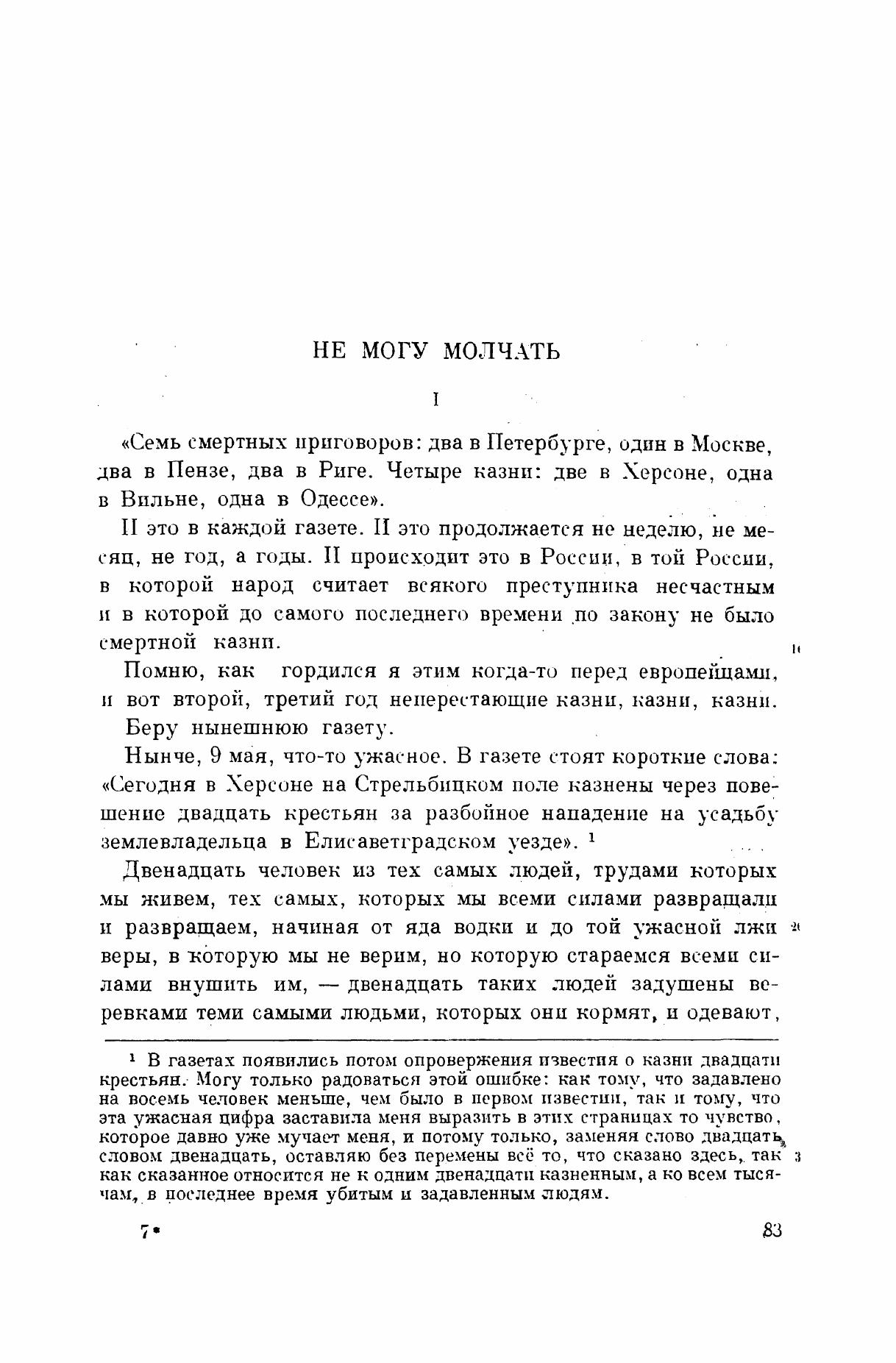
1 — The tally, and the hanging (chapters I–II)
The essay does not begin in Tolstoy’s voice but in the newspaper’s:
«Семь смертных приговоров: два в Петербурге, один в Москве, два в Пензе, два в Риге. Четыре казни: две в Херсоне, одна в Вильне, одна в Одессе».
(working English) “Seven death sentences: two in Petersburg, one in Moscow, two in Penza, two in Riga. Four executions: two in Kherson, one in Vilna, one in Odessa.”
Chapter I · PSS Tom 37 · TEI v37_083_096. — and then the report of 9 May, embedded verbatim, “twenty peasants… executed by hanging for an armed attack on the estate of a landowner in the Elisavetgrad district.” The hanging is then narrated in slow physical detail — the soaped nooses, the long-haired priest in brocade who “says something about God and Christ,” the doctor who feels the bodies — twelve “husbands, fathers, sons, those people on whose goodness, industry and simplicity Russian life alone holds together.” The method is not argument but enforced witness. Chapter II names the deeper harm: worse than the killing is the corruption it spreads —
причиняют еще большее, величайшее зло всему народу, разнося быстро распространяющееся, как пожар по сухой соломе, развращение всех сословий русского народа.
(working English) they inflict a still greater, the greatest evil on the whole people, spreading a swiftly-spreading corruption, like fire through dry straw, of all the classes of the Russian people.
Chapter II · PSS Tom 37 · TEI v37_083_096. — the “fire in dry straw” image is the keystone the fire-metaphor dive traces across the corpus. The corruption is measured by the executioners’ market (only one hangman in all Russia in the 1880s; now a Moscow shopkeeper and an Orel volunteer haggle over the rate) and by what has become ordinary:
О казнях, повешениях, убийствах, бомбах пишут и говорят теперь, как прежде говорили о погоде. Дети играют в повешение.
(working English) Of executions, hangings, murders, bombs they now write and speak as they used to speak of the weather. Children play at hanging.
Chapter II · PSS Tom 37 · TEI v37_083_096.
2 — Stop doing what you do (chapter III)
To the government’s “but what is to be done to calm the people?” the answer is a cessation, not a programme:
Ответ самый простой: перестать делать то, что вы делаете.
(working English) The answer is the simplest: to stop doing what you do.
Chapter III · PSS Tom 37 · TEI v37_083_096. — the non-resistance core in its negative, political form. The disorder, he argues, is not in material events but in the spiritual condition of the people, which violence can only worsen.
3 — The symmetric critique (chapter IV)
The essay’s most-quoted move turns the same charge on both sides of the politics of force. The revolutionaries’ crimes are real, but they are the government’s own work:
они не только ваши ученики, они — ваше произведение, они ваши дети. Не будь вас — не было бы их
(working English) they are not only your pupils, they are your product, they are your children. Were it not for you, they would not exist
Chapter IV · PSS Tom 37 · TEI v37_083_096. — and so suppression by force is self-defeating: “you do what a man does who leans with all his weight on a door that opens towards him.” Listing the mitigating circumstances for the revolutionaries (greater risk, youth, and that they at least do not invoke the Christianity whose God forbids killing), he concludes:
Если есть разница между вами и ими, то никак не в вашу, а в их пользу.
(working English) If there is a difference between you and them, it is by no means in your favour, but in theirs.
Chapter IV · PSS Tom 37 · TEI v37_083_096.
4 — The two executioners (chapter V)
A parable: a painter looking for a model’s face for a picture called The Death Penalty tracks down the man who serves as Moscow’s hangman, and finds him hiding in fear of strangers. The hands-on executioner knows his deed is evil and dreads people; the ministers and judges who order the killings feel no such shame:
как ни низко пал этот несчастный дворник, он нравственно все-таки стоит несравненно выше вас
(working English) however low this unhappy yard-keeper has fallen, morally he stands nonetheless incomparably higher than you
Chapter V · PSS Tom 37 · TEI v37_083_096.
5 — For me (chapter VI) — see The marquee question
6 — The appeal (chapter VII)
The essay ends by addressing every link in the chain of killing — “from those who put caps and nooses on people-brothers, on women, on children… up to you, the chief disposers”:
Люди-братья! Опомнитесь, одумайтесь, поймите, что вы делаете. Вспомните, кто вы.
(working English) Brother-men! Come to your senses, think again, understand what you are doing. Remember who you are.
Chapter VII · PSS Tom 37 · TEI v37_083_096. — and closes, like the whole late doctrine, on the one positive command: “And that will wants only one thing: the love of people for people.” The text is dated «31 мая 1908 г. Ясная Поляна».
The marquee question
Is the personal-complicity argument — “hang me too, because it is done for me” — the essay’s true centre? The dive states the claim and tests it against scholarship and against the work’s own drafts, rather than asserting it. The answer is yes, and the drafting both confirms and complicates how literally to read it.
The argument itself (chapter VI). Tolstoy reasons that because everything done in Russia is done “in the name of the common good,” it is done “for me, living in Russia” — and runs the word «для меня» (for me) down a whole page of horrors: the soldiers trained to kill, the false clergy, the hundreds of thousands of hungry and typhus-stricken in the prisons, “for me these gallows with women and children and peasants hanging on them.” Then the link he cannot deny:
есть несомненная зависимость между моей просторной комнатой, моим обедом, моей одеждой, моим досугом и теми страшными преступлениями, которые совершаются для устранения тех, кто желал бы отнять у меня то, чем я пользуюсь.
(working English) there is an undoubted dependence between my spacious room, my dinner, my clothing, my leisure, and those terrible crimes which are committed to remove those who would take from me what I enjoy.
Chapter VI · PSS Tom 37 · TEI v37_083_096. — from which the demand follows:
или же, что было бы лучше всего… надели на меня, так же как на тех двадцать или двенадцать крестьян, саван, колпак и так же столкнули с скамейки, чтобы я своей тяжестью затянул на своем старом горле намыленную петлю.
(working English) or — what would be best of all… put on me, just as on those twenty or twelve peasants, the shroud and cap and likewise push me off the bench, so that with my own weight I tighten the soaped noose on my old throat.
Chapter VI · PSS Tom 37 · TEI v37_083_096.
Confirms. Scholarship that engages the essay treats this first-person implication as its core. Liza Knapp (2019) reads the whole piece as the capstone of the voice Tolstoy used “for his last thirty years, from Confession to ‘I Cannot Be Silent’,” addressed outward “from the tsar to readers around the globe.” Trotsky’s 1908 tribute called it “a curse upon the heads of those who serve as hangmen”; Kropotkin (1909) cited it on the “degrading influence” of mass executions. None of the secondary sources found contradicts the personal-complicity reading. (Attributed: Knapp 2019; Trotsky 1908; Kropotkin 1909.)
Extends. The corpus supplies what scholarship does not reach: the argument was there from the very first draft. The «для меня» anaphora and the hang-me demand both appear in variant №1 (13–14 May), before any of the structural reworking — in the draft the wish is even more literal (“as the twenty-first or the twenty-one-thousand-and-first”). The personal complicity is not a late rhetorical flourish; it is the seed.
Complicates. The same drafting shows the published demand was deliberately moderated. The first draft aimed its appeal by name at “the two chief hidden executioners… Pyotr Stolypin and Nikolai Romanov”; the revision removed the names. And Chertkov’s editing — with Tolstoy’s blessing — cut the most explicit closing form of the demand:
Перестаньте, а если не хотите перестать, то делайте то же и надо мною, потому что до тех пор, пока я жив, и вы будете делать то же, я не перестану обличать вас.
(working English) Stop; and if you will not stop, then do the same to me too, because until I die, and while you go on doing the same, I will not cease to denounce you.
Manuscript description (Eikhenbaum), the cut original ending of рук. №15 · TEI comments/v37_427_432. — the published essay ends instead on the quieter “…lives in you.” So the personal-complicity argument is genuinely the centre (it survives in chapter VI, and it is what the title means), but its rhetorical temperature was tuned down in editing: the literal ultimatum at the very end was removed, and the named accusation generalised. The essay we read is the calibrated version of a more violent first cry.
Redactions & textual history
The drafting is unusually well documented, and unusually consequential — the editing changed who the essay accuses. Eikhenbaum’s manuscript description tracks seventeen manuscripts from the autograph first draft to рук. №17, the copy the edition prints.
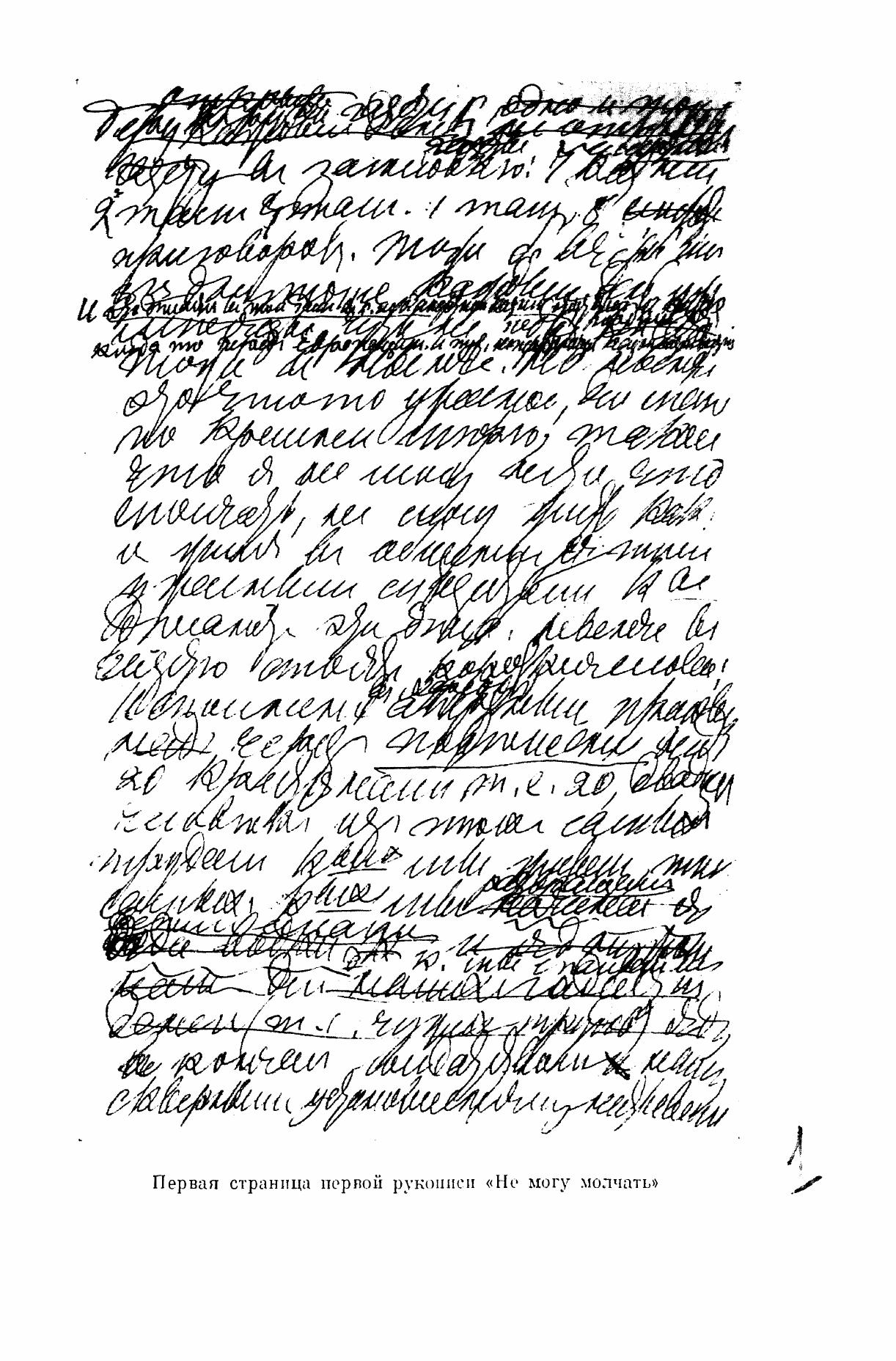
The named first draft. Variant №1 — “Autograph. 9 leaves… The first rough redaction of the article. No title” — was signed and dated by Tolstoy “Лев Толстой. 14 мая 1908.” It addressed its appeal directly to the men in charge:
до вас, двух главных скрытных палачей, своим попустительством участвующих во всех этих преступлениях: Петру Столыпину и Николаю Романову.
(working English) up to you, the two chief hidden executioners, who by your connivance take part in all these crimes: Pyotr Stolypin and Nikolai Romanov.
Variant №1 · TEI works/v37_391_399. — and the hang-me demand was more literal still:
надели бы на меня на 21-го или 21000 первого саван, колпак и так же столкнули с скамейки, чтобы я своей тяжестью затянул на своем старом горле петлю.
(working English) they would put on me, as the twenty-first or the twenty-one-thousand-and-first, the shroud and cap and likewise push me off the bench, so that with my own weight I tighten the noose on my old throat.
Variant №1 · TEI works/v37_391_399. — the draft also carried sharper flourishes the revision dropped, including the quip of Alphonse Karr (“«Que Messieurs les assassins commencent par nous donner [l’exemple]»” — “let the gentlemen assassins begin by setting us the example”) turned against the government’s “they started it.”
The depersonalisation. Eikhenbaum states the central change directly:
Имена политических деятелей, фигурирующих в нем, он опустил и все резкие выражения по их адресу вычеркнул или же значительно смягчил.
(working English) The names of the political figures appearing in it he omitted, and all the sharp expressions addressed to them he struck out or significantly softened.
Editorial history · TEI comments/v37_425_427. — the first draft had named Milyukov, Guchkov, Shcheglovitov, Stolypin and Nicholas; the published essay names no one, and the appeal is generalised to every participant “from the prison-warders up.” The named version was first printed only in 1917, after the Revolution removed the danger.
Chertkov’s hand. The manuscript Tolstoy sent out (рук. №15, dated 31 May) came back from Chertkov marked in red:
В. Г. Чертков пометил в ней красными чернилами ряд новых абзацев, исправил пунктуацию и внес значительное число мелких исправлений, вставок и сокращений.
(working English) V. G. Chertkov marked in it, in red ink, a number of new paragraphs, corrected the punctuation, and made a significant number of small corrections, insertions and abridgements.
Manuscript description · TEI comments/v37_427_432. — Tolstoy approved them by telegram on 9 June (“I fully approve the changes, publish quickly”). The description lists the edits line by line: many of Chertkov’s changes flattened Tolstoy’s “you cannot but know / you cannot but see” constructions into plain statements, softened “you fear” (боитесь) to “you are apprehensive” (опасаетесь), and — the sharpest cut — removed the defiant closing ultimatum quoted above under The marquee question. The published Не могу молчать is, in the precise sense, a Tolstoy–Chertkov text.
Publication, censorship & translation
For most of the late doctrine, the work was banned in Russia and reached the public abroad. This essay is a partial exception that proves the rule: fragments of it did appear in legal Russian newspapers — and cost every paper a fine.
Статья в отрывках впервые была напечатана 4 июля 1908 г. в газетах: «Русские ведомости», «Слово», «Речь», «Современное слово» и др. Все эти газеты, напечатавшие отрывки из «Не могу молчать», были оштрафованы.
(working English) The article was first printed in fragments on 4 July 1908 in the newspapers Russkie Vedomosti, Slovo, Rech’, Sovremennoe Slovo and others. All these papers that printed extracts from I Cannot Be Silent were fined.
Editorial history · TEI comments/v37_425_427. — and the sharpest instance of the essay as a punishable act:
севастопольский издатель расклеил по городу номер своей газеты с отрывками из «Не могу молчать». Он был арестован.
(working English) a Sevastopol publisher pasted up around the town the issue of his paper with extracts from I Cannot Be Silent. He was arrested.
Editorial history · TEI comments/v37_425_427. — Tolstoy had asked to be prosecuted; the state prosecuted his printers. The complete text could not be printed legally in Russia. It reached Russian readers through an illegal press (“In August 1908 the article was printed in full at an illegal printing-house in Tula”), in hectographed and manuscript copies, and through the émigré editions — Chertkov’s Free Age Press / «Свободное слово» and the Ladyzhnikov edition, whose publisher’s preface records the international scale:
опубликовано одновременно в газетах почти всех цивилизованных стран 15-го июля 1908 г. и произвело глубокое впечатление
(working English) published simultaneously in the newspapers of almost all civilised countries on 15 July 1908, and produced a deep impression.
Ladyzhnikov’s preface, quoted in the editorial history · TEI comments/v37_425_427. — the English text, “I Cannot Be Silent,” was translated by Aylmer and Louise Maude for the Free Age Press the same year. (The Russian fragments are dated 4 July OS = 17 July NS; the worldwide release is given as 15 July NS — about two days apart, and the sequence is not fully reconciled in the sources. See Material not covered.)
Scholarly context
(The received view is attributed, not asserted; the dive’s spine is the primary text and the corpus. Where the mainstream reaches for a contested label — “conservative anarchist” was Trotsky’s — this dive points at the project’s Christian Anarchism and Tolstoyanism dives rather than adopting the badge.)
Unlike the twin treatise, this essay has a small literature of its own, because it is legible as an event. Liza Knapp (Leo Tolstoy: A Very Short Introduction, 2019) gives it a whole chapter, “Tolstoy cannot be silent,” reading it as the high point of the first-person voice running “from Confession to ‘I Cannot Be Silent’,” and noting that it brings fiction’s “devices, techniques and subject matter” to bear on non-fiction. W. Gareth Jones titled an anthology of Tolstoy’s polemics after it (1989). Rosamund Bartlett (2010) places it in the year of Tolstoy’s most intense political engagement, when the state did “its best to silence” him. Its contemporaries cited it directly: Kropotkin in The Terror in Russia (1909), and Trotsky’s 1908 tribute. Set against the dive’s findings:
- The personal-complicity reading (
confirms). Scholarship treats the first-person implication as the essay’s core and does not contradict the dive’s reading; see The marquee question. The dive’s contribution is to ground it in the «для меня» anaphora and the hang-me passage specifically. - The depersonalisation of Stolypin and Nicholas (
extends). No secondary source found discusses the variant-level removal of the names; the published namelessness is noted but not its drafting. This is corpus-only material. - Chertkov’s editing and the cut coda (
complicates). Scholarship reads the demand-to-be-hanged as the unmediated rhetorical peak; it does not register that the most explicit form of the demand was cut in editing. The corpus complicates the “pure outburst” reading. - The Kherson execution (
complicates). The triggering hanging is confirmed only through Tolstoy’s own text (and the Maude translation, which carries the twenty→twelve footnote). No independent archival record of the 8 May 1908 Kherson / Lubenko-estate hanging was located; Kropotkin documents comparable cases but not this one. The factual base of the essay’s opening rests on a single newspaper notice.
The political context is well documented: Stolypin’s field courts-martial (introduced August 1906, empowered to sentence and execute within 24 hours) carried out the execution wave the essay protests, and the gallows had a name in the Duma by November 1907 — “Stolypin’s necktie.” (Attributed: Knapp 2019; Jones 1989; Bartlett 2010; Kropotkin 1909; Trotsky 1908; Wikipedia “Pyotr Stolypin,” “Fedor Rodichev”; full list in the dossier.)
Reception & afterlife
In Russia and the Church first
The essay’s lifetime reception in Russia was structurally shaped by the censorship: it could not be printed whole, so the censorship itself was the reception event (the fines, the Sevastopol arrest, the illegal Tula printing). What survives of the direct reader response is countable — Eikhenbaum records that Tolstoy’s archive at the State Tolstoy Museum holds “twenty-one ‘abusive’ and sixty sympathetic letters” provoked by the essay (the abusive set is the subject of a dedicated study by Gnatyuk). The essay also landed into the charged atmosphere of Tolstoy’s 80th-birthday-jubilee year (his birthday fell on 28 August 1908): the 1901 excommunication still stood, public celebrations were discouraged, and the conservative press was hostile. No Synod or government pronouncement against this essay specifically was found — the official response was to fine and arrest publishers, consistent with the state’s documented reluctance to make Tolstoy a martyr.
Contemporary intellectual reception
The leading revolutionaries of 1908 both responded to Tolstoy within months. Trotsky’s tribute (September 1908) read the essay as the clearest proof of Tolstoy’s moral courage — “a curse upon the heads of those who serve as hangmen” — while judging that his rejection of revolutionary politics left him a “conservative anarchist,” unable to take the next step. Lenin’s “Leo Tolstoy as the Mirror of the Russian Revolution” (September 1908), written for the same jubilee occasion, became the template for all Soviet criticism of Tolstoy. The essay thus sits at the exact point where the secular-radical left prized Tolstoy’s attack on the autocracy and rejected his non-resistance — the symmetrical mirror of the essay itself, which rejects the revolutionary violence the left defended. (Attributed: Trotsky 1908; Lenin 1908; Kropotkin 1909.)
The author’s later verdict
The essay was “finished” repeatedly during its own composition — “On Capital Punishment” on 29 May, “I Cannot Be Silent… sent to Chertkov” on 3 June, the manuscript date of 31 May, revisions into mid-June — and the urgency never quite let it settle. The clearest statement of how Tolstoy held it is the covering note to Chertkov: the executions “so torment me that I cannot be at peace until I have expressed all the feelings they arouse in me.” It was, by its own logic, less a work he completed than a complicity he tried to discharge — which is why the title is not about the subject but about himself: I cannot be silent.
Place in the cluster
Не могу молчать is the event-facing point of the project’s 1908 cluster. It is the near-twin of The Law of Violence and the Law of Love — written in the same weeks (the 12 May diary holds both), sharing the symmetric critique of state and revolutionary violence, the fire image, and the publication pattern (banned/censored at home, complete abroad through Chertkov) — and a sibling of A Letter to a Hindu (December 1908). Its non-resistance core runs back through The Kingdom of God Is Within You (1893) and What I Believe (1884), and its argument sits inside the territory the project examines under the contested mainstream labels Christian anarchism and Tolstoyanism — labels this dive points at rather than asserts. (The superseded combined survey tolstoyanism-christian-anarchism is not cited as authoritative.) This dive is the designated seed of the project’s planned death-penalty theme-dive, which should reuse its evidence ledger and entities.
Material not covered
- A page-by-page collation of which fragments the Russian newspapers were permitted to print against what the censor cut.
- The full Chertkov edit-list (the manuscript description gives ~25 line-level changes) read as a complete editorial apparatus.
- The 21 abusive + 60 sympathetic reader letters (State Tolstoy Museum) read individually (Gnatyuk’s study covers the abusive set).
- The non-Russian translation lineage beyond the 1908 Maude / Free Age Press English text.
- Independent confirmation of the Kherson execution. No archival or news-archive source for the specific 8 May 1908 Kherson / Strelbitsky-Field / Lubenko-estate hanging was located beyond Tolstoy’s text and the PSS commentary. The essay’s factual base rests on a single newspaper notice.
- The OS/NS reconciliation of the publication dates (Russian fragments 4 July OS vs. worldwide 15 July NS) is left open.
- The other Tolstoy articles on capital punishment — gathered by the planned death-penalty theme-dive this dive seeds, not here.
Visual & manuscript record
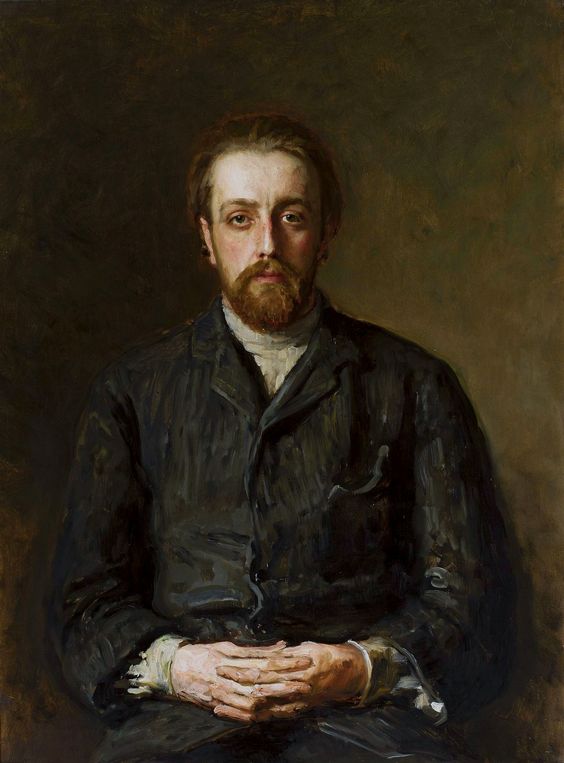
Two public-domain page facsimiles are rendered from the local PSS PDF and committed in extracts/ (the opening printed page and the first-manuscript autograph plate). Seven public-domain photographs and portraits are cached locally in the git-ignored visuals/ (re-fetchable with python3 docs/fetch_visuals.py 1908-i-cannot-be-silent); all carry a licence and source URL in the dossier visuals block.
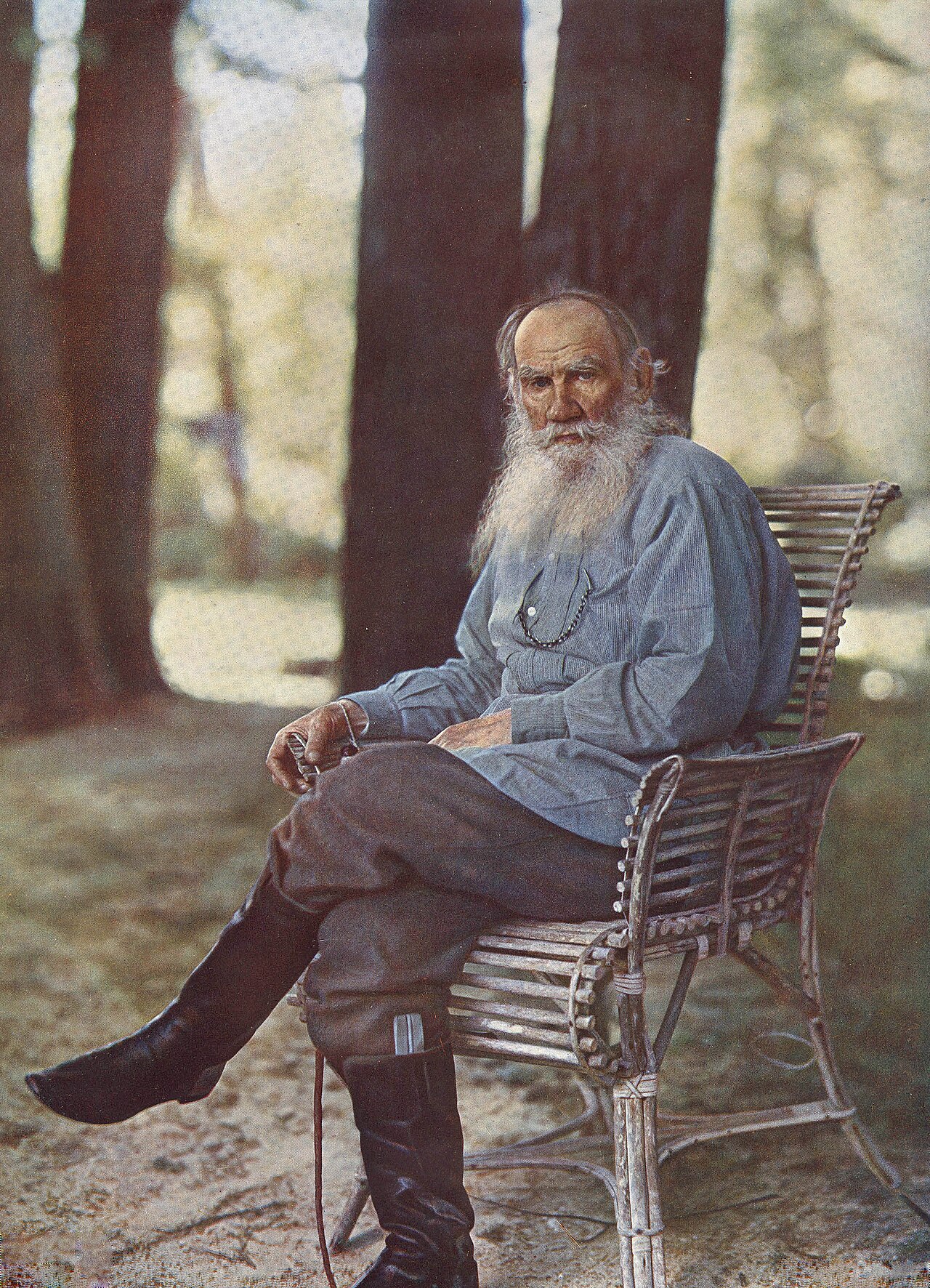
1908 was the most heavily photographed period of Tolstoy’s life, so portrait material is abundant and public-domain: the Prokudin-Gorsky colour photograph of 23 May 1908 (above) and a companion study-desk shot from the same session, Karl Bulla’s jubilee-year portraits, and Repin’s painted likeness of Chertkov. For context the dive also caches public-domain portraits of Stolypin (Bulla, 1906) and Nicholas II — the two figures named in the first draft.
What is not openly available, and where to request it:
- Title-page facsimiles of the first editions — the Free Age Press English edition, the Ladyzhnikov edition, and the censored Russian newspaper pages of July 1908. None was located on Commons or archive.org in this sweep; request from a research library or a newspaper archive.
- A portrait of N. N. Gusev (1907–1909). The secretary and diary-witness has no freely licensed period photograph located; request from the State Tolstoy Museum or the Yasnaya Polyana archive.
- A manuscript facsimile beyond the first-page plate (the seventeen manuscripts, or Chertkov’s red-ink copy рук. №15). Held at the State Tolstoy Museum, Moscow.
Method
This was a corpus-dive work-dive run on 2026-06-13, in-session (accept-edits), from a written scope handoff. Scope (Phase 0): a single-work dive on Не могу молчать (PSS Tom 37, pp. 83–96) read structurally; the composition reconstructed from the 1908 diary (Tom 56) and Eikhenbaum’s editorial history and manuscript description (comments/v37_425_427, v37_427_432); the variants (works/v37_391_399) read for the named first draft and the redaction story; the personal-complicity argument tested as the marquee question; the censorship/printing history covered as reception. Russian extraction used extract_tei.py --choice=reg --notes=auto (pre-1918 orthography resolved to modern). Two sub-sweeps ran in parallel (a scholarship + reception web sweep and a visual-materials sweep), each writing its deliverable to a file. Every quoteRu was checked byte-for-byte against its extract with verify_quotes.py (42/42 PASS, 2 facsimiles OK) before the verifier pass. Working-English translations are labelled and are the dive’s own; mainstream scholarship is attributed, not asserted. Because no works/ record exists yet, the dossier’s workRecord is record-creating (it proposes a full new record); it writes nothing to works/. The dive seeds the planned death-penalty theme-dive.
Links: twin/sibling dives — The Law of Violence and the Law of Love, A Letter to a Hindu, The Kingdom of God Is Within You, What I Believe, Bethink Yourselves!, fire-metaphor, christian-anarchism, tolstoyanism.
References
Primary (byte-faithful, from the local TEI corpus):
- Толстой Л. Н. Не могу молчать // ПСС в 90 тт. Т. 37. М., 1956. С. 83–96. (TEI
works/v37_083_096_Ne_mogu_molchat) - Толстой Л. Н. Не могу молчать. Планы и варианты // ПСС Т. 37. С. 391–399. (TEI
works/v37_391_399_Ne_mogu_molchat_Varianty) - Эйхенбаум Б. М. «Не могу молчать». История писания и печатания // ПСС Т. 37. С. 425–427. (TEI
comments/v37_425_427) - Эйхенбаум Б. М. «Не могу молчать». Описание рукописей // ПСС Т. 37. С. 427–432. (TEI
comments/v37_427_432) - Толстой Л. Н. Дневник 1908 г. // ПСС Т. 56. С. 117–133. (TEI
diaries/v56_117_117_1908_05_12,v56_117_118_1908_05_14,v56_130_132_1908_05_29,v56_132_133_1908_06_03)
Background (secondary; attributed, not asserted):
- Knapp, Liza. Leo Tolstoy: A Very Short Introduction. Oxford University Press, 2019 (chapter “Tolstoy cannot be silent”).
- Jones, W. Gareth, ed. Tolstoy: I Cannot Be Silent (Maude trans.). Bristol Classical Press, 1989.
- Bartlett, Rosamund. Tolstoy: A Russian Life. Profile Books, 2010.
- Maude, Aylmer. The Life of Tolstoy. 2 vols. Constable, 1908/1910; and the Maude English translation, Free Age Press, 1908.
- Kropotkin, Peter. The Terror in Russia, I.3 “Executions.” 1909.
- Trotsky, Leon. “Tolstoy, Poet and Rebel.” Die Neue Zeit, 18 September 1908.
- Lenin, V. I. “Leo Tolstoy as the Mirror of the Russian Revolution.” Proletary, September 1908.
- Gnatyuk, Kirill. “‘Abusive letters’ to Leo Tolstoy about his article ‘I Cannot Be Silent’” (Academia.edu, in Russian).
- Context: Stolypin’s field courts-martial (1906–07) and “Stolypin’s necktie” — Wikipedia “Pyotr Stolypin,” “Fedor Rodichev”; Spartacus-Educational. Full source list + URLs in
extracts/_scholarship_reception.md.
This dive feeds the LLM wiki-ingestion step (a separate, human-in-the-loop pass): the dossier.yaml entities and workRecord blocks plan the wiki pages and the record this research should become — including a new works record for the essay, which has none yet. It also seeds the planned death-penalty theme-dive. See the draft dev-blog note.