A work-subject dive on Tolstoy’s open letter «Письмо к индусу», written in 1908 as a reply to Tarak Nath Das, the émigré editor of the journal Free Hindustan. The dive grounds in the letter’s own text (PSS Tom 37), the composition-year diaries and the editorial history, and the Tolstoy–Gandhi correspondence — then tests the letter’s central claim against the Gandhi scholarship. No works/ record exists for the letter yet; the dossier proposes its creation.
Key findings
- The letter’s claim is an inversion. India is not held down by English force from outside; it is held, Tolstoy argues, because Indians themselves accept violence as a principle — “thirty thousand people... have enslaved 200 millions” only because the 200 millions participate. The lever of liberation is therefore not counter-violence but withdrawal of participation: “Do not resist evil, but also yourselves participate not in evil, in the violent deeds of the administration, of the law courts, the collection of taxes, and what is most important of the soldiers.”
- The whole letter answers Herbert Spencer. Free Hindustan flew a Spencer motto — “Resistance to aggression is not simply justifiable but imperative; non-resistance hurts both Altruism and Egoism.” The PSS commentary records that this is the line Tolstoy fixed on; the letter is built as its rebuttal. Most English editions drop the epigraph, and no scholarship discusses the frame — the corpus supplies it.
- Tolstoy thought the letter weak the whole time he wrote it. The composition diaries are a thread of self-disparagement: “began... but stumbled” (June), “all repetitions” (28 Nov), “rubbish and repetition” (6 Dec), “finished... weak, repetitions” (14 Dec). 413 manuscript sheets and 29 redactions lie behind a short open letter.
- Then he reversed himself — because of Gandhi. Receiving Gandhi’s printed Indian Opinion in March 1910, Tolstoy reread the letter and “very much approved” it. The historically decisive work is one he dismissed while writing and embraced only once Gandhi had made it a movement document.
- The reception is the point. Gandhi read the letter in London in 1909, asked Tolstoy’s permission, and reprinted it (with his own preface) in Indian Opinion, translating it into Gujarati on the same voyage he wrote Hind Swaraj. The 1909–1910 correspondence — three Tolstoy letters here — runs to his last long letter (7 Sep 1910), which calls Gandhi’s Transvaal campaign “the most central, the most important of all the affairs being done now in the world.”
- The addressee rejected it. Tarak Nath Das, a revolutionary who wanted Tolstoy to endorse the independence struggle, published an “Open Letter” in reply (16 Oct 1909) defending resistance to despotism as a duty. The letter that shaped Gandhi failed with the man it was written to.
Why this matters
This is the single document that most directly connects Tolstoy to the twentieth century’s history of nonviolent resistance. But the corpus shows the connection is neither simple nor the one Tolstoy intended. He wrote an argument for individual, anarchist non-participation and addressed it to a militant who rejected it; it reached, by accident of circulation, a reader who turned it into something Tolstoy never built — organised mass civil disobedience. Reading the letter against the diaries and the correspondence recovers what the Gandhi-origin story flattens: the work’s strangely low standing with its own author, its real target (Spencer, and the Westernising Indian leadership), and the gap between Tolstoyan non-resistance and Gandhian satyagraha.
Genesis & composition
Tarak Nath Das wrote to Tolstoy from Washington on 24 May 1908 (OS). The PSS commentary quotes the letter in full: Das invoked Tolstoy’s moral authority over the Russian government, set the Indian famines against the world’s war dead — “19 million Hindus died of famine in India in ten years (1891–1900)” — and appealed, “In the name of the starving millions I appeal to your Christian feeling — take up this cause.” He sent two issues of his journal. Free Hindustan carried, as its standing epigraph, a sentence from Herbert Spencer’s Sociology: that non-resistance “harms both altruism and egoism.” The commentary records that this last clause “especially caught Tolstoy’s attention.”
Composition began on 7 June 1908 (OS); the cover of the first drafts is dated “7, 8, 9 June 08.” It went badly at once. On 10 June Tolstoy wrote in his diary: “Began the letter to the Hindu, but stumbled” («Начал письмо к Индусу, да запнулся»). The work then stalled for months. A second letter from Das, on 31 October, restarted it, and from 17 November to 14 December Tolstoy worked at it almost daily — and recorded, almost daily, that it was no good: “Still writing the letter to the Hindu. All repetitions” (28 Nov); “Still digging away at the Letter to the Hindu. Seems like rubbish and repetition. Must finish it and tear myself away” (6 Dec). He finished on 14 December: “Finished the letter to the Hindu, weak, repetitions.” The same entry records his fury that day at news of executions — the Stolypin hangings that had driven his July 1908 cry «I Cannot Be Silent». The non-resistance he was prescribing for India was written against the gallows at home.
The editorial history is heavier than the short text suggests: 413 manuscript sheets, 45 of them autograph, in 29 numbered redactions.
The people around the work
The letter sits inside a network of correspondents. Tolstoy had been reading Indian religious books and writing to Indians for some time: a January 1908 letter to S. R. Chitale discusses the Bhagavad-Gita — “I appreciate very highly all my intercourse with Indian religious men... I have read with great interest and profit for my spiritual life all the Braminic religious books.” The Krishna epigraphs studding the letter come from Baba Premananda Bharati’s Sree Krishna: The Lord of Love (New York, 1904), passages Tolstoy translated himself — though he also names “Baba Bharatis” and Vivekananda in the body as “new interpreters” India does not need. The letter was partly dictated to his physician Dushan Makovitsky and his secretary Nikolai Gusev, who dated the manuscript covers. Vladimir Chertkov’s hand is in the Russian from June (“Chertkov corrected it splendidly”); he would make the authorized English translation.
What the work says
The letter is built in seven short numbered sections, each opening with an epigraph — from the Vedas, Krishna, the Indian Kural, the Upanishads — and then a stretch of argument. The opening puzzle (Section I) is the one the whole letter answers: a “people of 200 millions... highly endowed with spiritual and physical powers, in absolute subjection to a small clique... inferior to those whom they enslave.” How?
Tolstoy’s answer turns on the Spencer epigraph. In Section V he quotes Das’s motto back at him — “you insert as the basic principle which should direct the activity of your people the following thought as an epigraph” — and inverts it. Against Spencer’s “resistance is imperative,” he sets: “Love is the only means of saving people from all disasters... the only means of liberating your people from slavery lies in love.” And then the diagnosis: “But it is just the contrary. If the English have enslaved the Hindoos, it is just because the Hindoos recognised and do recognise coercion as the main and fundamental principle of their social order.”
The argument is made vivid by arithmetic and by an image. The arithmetic: “What does it mean that thirty thousand people... have enslaved 200 millions of vigorous, clever, strong, freedom-loving people? Do not the figures make it clear that not the English, but the Hindoos, have enslaved themselves?” The image — the rhetorical heart of the letter — is drink: “For the Hindoos to complain that the English have enslaved them, is equal to people who are addicted to drink, complaining that vendors of wine, who have settled in their midst, have enslaved them.” The wine-seller does not enslave; the drinking does.
The letter has a second front. Indian subjection is sustained, Tolstoy argues, not only by the old religious justifications of violence but by a new “scientific” superstition — historical law, struggle-for-existence, the will of the people — that the Westernising Indian leadership has imported wholesale. Both must go: “In order to save a sinking ship it is necessary to throw overboard the ballast.” Strip away both false religion and false science, and the plain law of love stands clear.
The marquee question
Claim under test: India is held by a handful of Englishmen only because Indians themselves participate in and consent to violence — so non-resistance, understood as the refusal to participate, is the lever of liberation.
The letter states the lever in full, and it is worth quoting exactly, because the form of the non-resistance it prescribes is the crux of everything that follows:
“If man lives only in accord with the law of love which includes non resistance... and hence does not participate in any form of violence, not only hundreds will not enslave millions but even millions will be unable to enslave one individual. Do not resist evil, but also yourselves participate not in evil, in the violent deeds of the administration, of the law courts, the collection of taxes, and what is most important of the soldiers, and no one in the world will enslave you.”
This is withdrawal, not confrontation: stop manning the army, the courts, the tax-collection — the machinery of your own subjection — and the subjection ends. It is the Tolstoyan, individual, anarchist form of non-resistance, the same doctrine worked out in The Kingdom of God Is Within You and restated, the same year, in The Law of Violence and the Law of Love.
Tested against the record, the claim splits three ways:
- Confirms — that the letter shaped Gandhi’s commitment to non-violent method in South Africa is strongly attested, by Gandhi himself and by scholars (Hazama 2023; Guha 2013; Doke’s 1909 “Undoubtedly Count Tolstoy has profoundly influenced him”).
- Complicates — but “shaped Gandhi in South Africa” is not “produced satyagraha.” Gandhi’s satyagraha was organised, mass, confrontational civil disobedience that engaged state power to change it; Tolstoy’s non-resistance was individual withdrawal from it. Hazama (2023) shows Gandhi did not even adopt the ahimsa/”non-violence” framework until after returning to India in 1915, and coined “non-violence” only in 1919; Mantena (2012) reads Gandhian nonviolence as contextual political realism, structurally unlike Tolstoy’s absolute spiritual imperative. The lever Gandhi pulled was not the one Tolstoy described.
- Contradicts — the claim’s intended audience rejected it outright. Tarak Nath Das, a member of the Anushilan Samiti and later the Ghadar Party, had wanted Tolstoy’s endorsement for the armed struggle. He answered with an “Open Letter to Count Leo Tolstoy” (16 Oct 1909): “Resistance to despotism is [the] first of all human duties.” The man the letter was addressed to read it as a betrayal.
So the marquee claim is true as Tolstoy meant it — and was made historically powerful by a reader who quietly rebuilt it into something else, while the reader Tolstoy actually wrote to threw it back.
Publication & translation
The first appearance anywhere was in Russian, in excerpts, during Tolstoy’s lifetime: «Киевские вести» (no. 103) and «Русские ведомости» (no. 89), both 19 April 1909 (OS). The full Russian text appeared only posthumously, in 1911, in S. A. Tolstaya’s collected works. In the meantime the letter circulated in typed copies («машинописные списки») — and one of those reached Gandhi.
The English “A Letter to a Hindoo” was translated by Chertkov and, per the PSS commentary, “corrected and edited” by Tolstoy — so the English the dive quotes alongside the Russian is authorized, not a working gloss. It was first printed in Gandhi’s Indian Opinion; the PSS dates this “January 1910,” and the Gandhi scholarship resolves it to a three-part serialization (25 December 1909; 1 and 8 January 1910). An authorized German translation, Brief an einen Hindu by Albert Škarvan with a foreword by Eugen Heinrich Schmitt, followed in 1910.
Reception & afterlife — the Gandhi story
The reception is the reason the letter matters, and it runs through the correspondence held in PSS Toms 80–82.
Gandhi, in London in the autumn of 1909, received a typed copy of the letter, wrote to Tolstoy to confirm it was genuinely his and to ask permission to reprint it (and to print 20,000 copies), and raised the question of the reincarnation passages. Tolstoy’s reply of 25 September / 7 October 1909 confirms authorship and endorses the plan: “The letter to a Hindu was written by me... the translation is a very good one.” On reincarnation he preferred to keep the passages but left the choice to Gandhi — “do as you like” — so Gandhi’s published version is, in a small documented way, an edited Tolstoy. The same letter ties Gandhi’s campaign to the Russian conscientious objectors: “that same struggle of the tender against the harsh, of meekness and love against pride and violence... especially in... refusals of military service.”
The exchange deepened into a two-way conversation. In April 1910 Tolstoy acknowledged Gandhi’s Hind Swaraj — “the question you treat in it: passive resistance — is a question of the greatest importance, not only for India but for the whole humanity.” And on 7 September 1910, eight weeks before his death, Tolstoy wrote his last and longest letter to Gandhi, from Kochety: a final statement that non-resistance “in essence is nothing other than the teaching of love undistorted by false interpretations,” and a verdict on Gandhi’s work that the primary Russian states more strongly than the familiar English translations — “your work in the Transvaal... is the most central, the most important of all the affairs being done now in the world.”
Against this stands Das’s rejection (above): the letter’s intended recipient published a formal rebuttal. The Gandhi reception was a reader Tolstoy never targeted; the targeted reader said no.
Scholarly context
The mainstream reads the letter almost entirely through Gandhi, as the trigger of the correspondence and a formative influence on his South African campaign (Green, Tolstoy and Gandhi, Men of Peace, 1983; Guha, Gandhi Before India, 2013). The dive does not dispute the influence; it resists the slide from “influence” to “origin of satyagraha.” The most careful recent work makes the same distinction from the other side: Eijiro Hazama (Modern Intellectual History, 2023) shows the ahimsa–satyagraha framework was a post-1915 Indian development with motives partly unrelated to Tolstoy, and Karuna Mantena (APSR, 2012) reads Gandhian nonviolence as a contextual political method, not Tolstoyan spiritual withdrawal. Where the dive extends past the scholarship is the letter’s own text: the Spencer-epigraph frame and the seven-section Krishna-epigraph structure are, as far as this sweep found, undiscussed — scholars cite the “thirty thousand” passage without tracing the argument that builds to it. Movement labels such as “Tolstoyan” belong to that outside literature; the dive keeps them as the mainstream’s word, not its own. (Full attributed layer and sources: extracts/_scholarship.md.)
The author’s later verdict
Tolstoy’s own judgment of the letter moved. Through composition it was “weak,” “repetition,” “rubbish.” But the Indian Opinion issue reached him in March 1910, and on 19 March he wrote: “Read my own letter to the Hindu and very much approved it.” The work he had wanted only to be rid of, he approved once he saw what it had become in another man’s hands.
Place in the cluster
The letter is one node in several of Tolstoy’s late lines of work. Its doctrine is the non-resistance of The Kingdom of God Is Within You — the book Gandhi also read — applied to colonial subjection, and it runs parallel to the same year’s systematic statement, The Law of Violence and the Law of Love (the article «Всему бывает конец», which the genesis commentary records Tolstoy thinking of shortening for Das). Its conscientious-objection thread connects to the Doukhobors, Tolstoy’s living model of non-participation. And as a gesture it belongs with his other open letters to the colonised East — Letter to a Chinese (1906, Tom 36) and An Address to the Chinese People (1900, Tom 34) — which form a cluster of their own. On the contested movement vocabulary around all of this, see the christian-anarchism and tolstoyanism dives.
Material not covered
- The 29 redactions are not individually collated; only the aggregate manuscript history is captured. The first June draft against the November–December rework would repay a closer look.
- Das’s rebuttals (“Open Letter…,” 16 Oct 1909; “Young India’s Reply to Count Tolstoy”) are known from scholarship (SAADA), not held in the corpus — flagged, not quoted from source.
- The Krishna epigraphs are confirmed as Bharati’s, but not collated page-by-page against Sree Krishna (1904).
- Letter to a Chinese and An Address to the Chinese People belong to their own cluster dive.
- Whether an earlier Free Age Press English printing preceded Indian Opinion is not resolved.
Visual & manuscript record
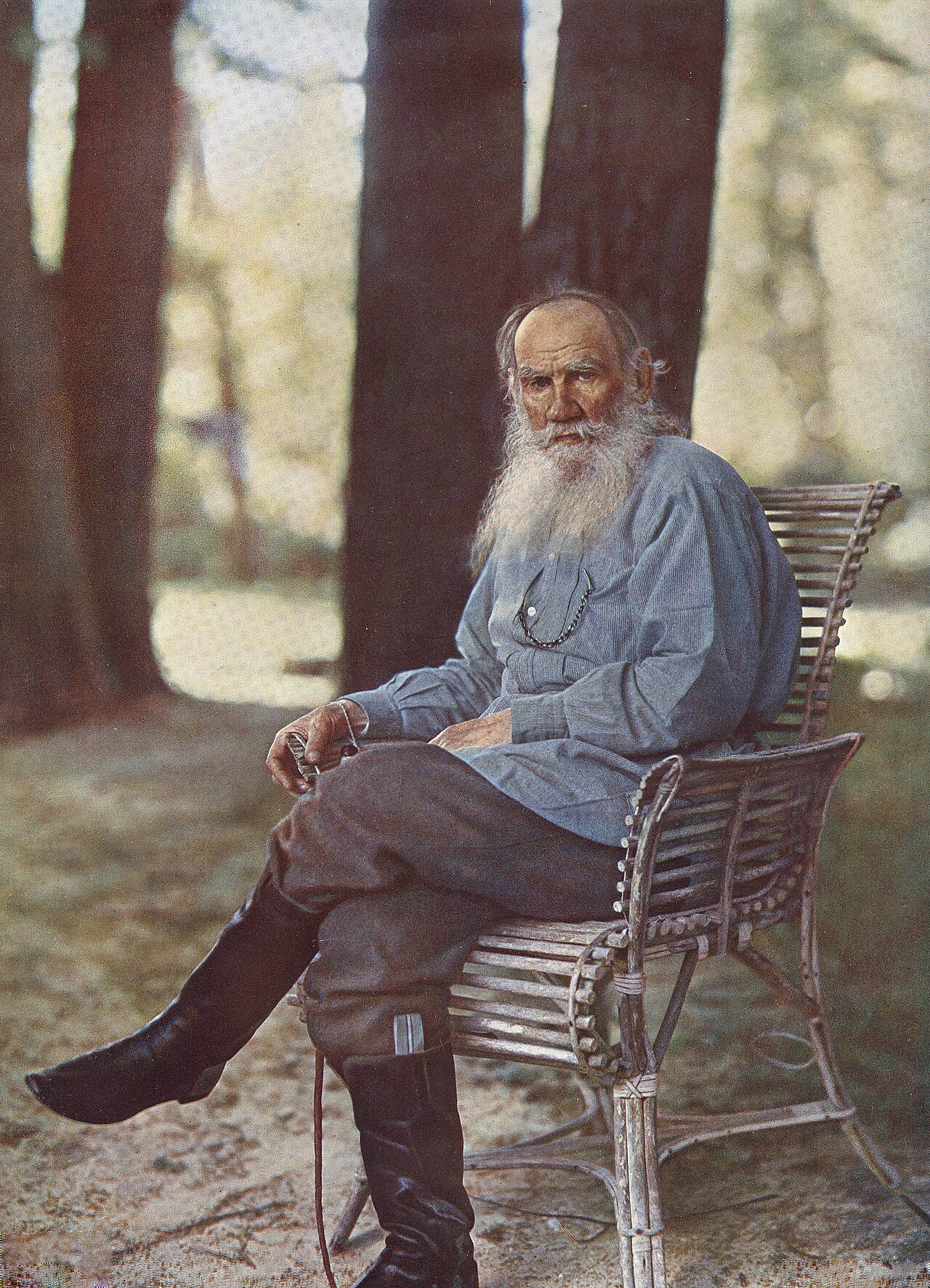
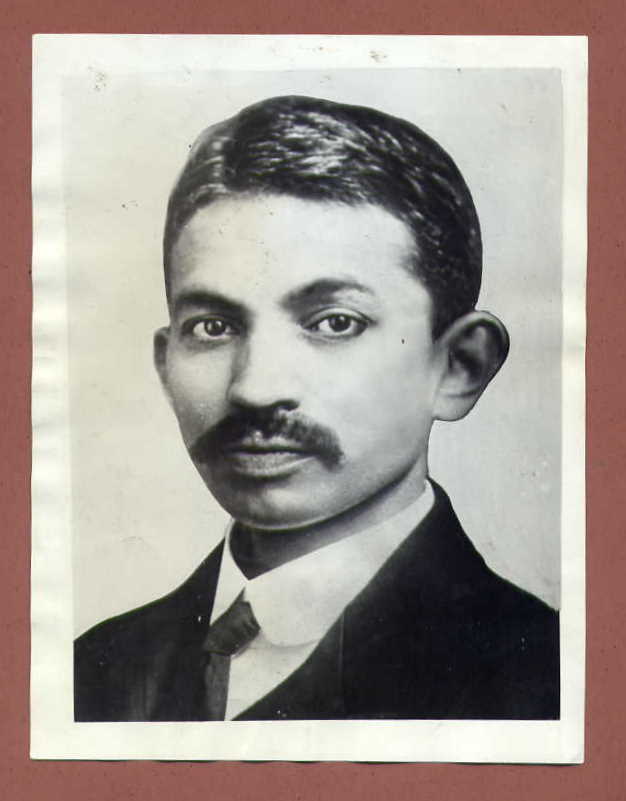
Six images are cached locally (PD/CC, provenance in dossier.yaml and visuals/_visuals.md): the 1908 Prokudin-Gorsky colour photograph of Tolstoy (above); Gandhi as a Johannesburg barrister, 1906; Tarak Nath Das; Chertkov (a Repin portrait and a 1909 photograph with Tolstoy); and the Linotype press Gandhi used to print Indian Opinion. No manuscript or first-edition facsimile of the letter is openly available — the manuscripts are at the State Tolstoy Museum (GTM), Moscow, where high-resolution scans would be requested. No local Russian PSS Tom 37 facsimile was rendered: the local jubilee-edition/vol37 directory is mislabelled (it holds PSS Tom 73), a known offset in the mirror.
Method
A work-subject dive (interactive, not --auto, not --novel). Scope: the letter’s own text (PSS Tom 37, extracted --choice=reg --notes=auto), the composition-year diaries (Tom 56) and the editorial history (the «История писания» commentary), and the Tolstoy–Gandhi correspondence (Toms 80–82), with the Chitale letter (Tom 78) for the wider Indian network. Byte-fidelity was checked mechanically — verify_quotes.py passes 29/29 — and then by a separate-pass verifier (see _verifier-report.md). The English alongside each Russian keystone is the authorized 1909 Chertkov/Tolstoy translation, carried in the same TEI; working English is labelled where used. Scholarship (Phase 3) is a contrast layer, English-first, attributed, grounded in the primary record first; several of its open questions (the Spencer frame, the translator, the “most important work” phrasing) were resolved from the corpus. Visuals: light Commons sweep. Links: sibling dives — Kingdom of God, Law of Violence and the Law of Love, Doukhobors, christian-anarchism, tolstoyanism.
References
Primary — L. N. Tolstoy, «Письмо к индусу» / “Letter to a Hindoo,” PSS Tom 37, pp. 245–272; V. S. Mishin, “«Письмо к индусу». История писания и печатания,” PSS Tom 37, pp. 444–446; Diary 1908, PSS Tom 56 (entries 10 June, 30 Oct, 28 Nov, 6 Dec, 14 Dec); Letters to M. Gandhi, PSS Tom 80 (no. 149, 25 Sep/7 Oct 1909), Tom 81 (no. 318, 25 Apr 1910), Tom 82 (no. 178, 7 Sep 1910); Letter to S. R. Chitale, PSS Tom 78, pp. 32–33 (21 Jan 1908).
Background — Hazama, Modern Intellectual History (2023); Mantena, APSR (2012); Guha, Gandhi Before India (2013); Green, Tolstoy and Gandhi, Men of Peace (1983) and The Origins of Nonviolence (1986); Murthy (ed.), Mahatma Gandhi and Leo Tolstoy Letters (1987); Doke, M. K. Gandhi: An Indian Patriot in South Africa (1909); Das, “Open Letter to Count Leo Tolstoy” (1909, SAADA); Hofmeyr, Gandhi’s Printing Press (2013); Collected Works of Mahatma Gandhi, vol. 10. Full list in extracts/_scholarship.md.
Draft dev-blog note: website/src/posts/notes/2026-06-13-a-letter-to-a-hindu.md (draft). Machine-readable dossier: dossier.yaml.