A multi-work corpus dive on the case Tolstoy built against capital punishment and state killing across the last decade of his life. It reads six works from their own texts in the tolstoydigital TEI corpus — Не убий / Thou Shalt Not Kill (1900), Царю и его помощникам / To the Tsar and His Assistants (1901), Единственное средство / The Only Means (1901), Не убий никого / Thou Shalt Not Kill Anyone (1907), Смертная казнь и христианство / Capital Punishment and Christianity (1909), and the trilogy Три дня в деревне / Three Days in the Village (1909–10) — and sets them around the cluster’s already-dived centrepiece, I Cannot Be Silent (1908), which it cross-references rather than re-reads.
The dive prepares ingestion-ready material (this index.md, a machine-readable dossier.yaml, byte-faithful extracts/, and a draft dev-blog note). It does not create vault pages or works records; it plans them. None of the six works has a works/ record yet, so the dossier carries six record-creating workRecord proposals (non-fiction / essays-and-criticism), the way the 1903 folk-tales dive proposed five at once.
Key findings
- The case is decade-long and continuous, not a single 1908 outburst. From the assassination of King Umberto in 1900 to Three Days in the Village in 1910, Tolstoy returned to the gallows again and again. I Cannot Be Silent (1908) is the loudest point of a line that runs through at least six other works — and the dive’s purpose is to read that line whole.
- A precise legal claim anchors the cluster: the death penalty was a newcomer to Russian law. In To the Tsar and His Assistants Tolstoy calls it «не признанная до этого в нашем законодательстве» — not recognised until now in our legislation. Scholarship confirms the substance: Empress Elizabeth’s de-facto moratorium (from 1744) was real and, by one account, unique in Europe; the ordinary 19th-century criminal code carried no death penalty for common crimes; execution survived only in military law and re-entered ordinary governance through the 1881 emergency statute and the post-1905 field courts. Tolstoy treats the gallows as both un-Russian and un-Christian.
- One logical kernel binds all six works: the state kills more, and kills in the citizens’ name. Не убий turns the horror at a regicide back on the kings who order war and execution «без сравнения более жестоки». Every later essay reapplies the move — to revolutionaries and government alike («Не убий» means kill no one, directly or indirectly), to the worker drafted into the army of killers, to the tax-collector, to the reader.
- “Execute me too” is in the cluster a full year before it became the marquee of 1908. Thou Shalt Not Kill Anyone (1907) already demands that the government, which jailed his publisher for reprinting Не убий, «должно казнить и меня» — execute me too. Capital Punishment and Christianity (1909) reuses the very title-phrase «не могу молчать», and its diary records that the passage on the Tsar was added «с тайной целью вызвать против себя гонения» — with the secret aim of provoking persecution against himself.
- The cluster has named, datable provocations, not abstract occasions. Umberto’s assassination (1900); the spring-1901 student repression; the 1907 jailing of the publisher N. E. Felten for reprinting Не убий; and, at the end of 1908, an article in Novoe Vremya by A. A. Stolypin — brother of the Prime Minister — that defended the gallows with the Gospel. To it Tolstoy replied in one word: «стыдно» (shame).
- Poverty and the gallows are two ends of one chain. The Only Means (1901) argues that the whole social order «держится только на возможности или на угрозе убийства» — rests only on the possibility, or the threat, of killing. Three Days in the Village (1910) draws the chain in full: the village elder who seizes a starving widow’s last sheep is the bottom link of a ladder whose top is the ministers «заняты… вешанию людей» — busy with the hanging of people.
- The reception history is one uniform censorship pattern. Every work was banned, cut, or confiscated in Russia and reached readers abroad through Chertkov’s Свободное слово / Free Age Press, then by hectograph and illegal print: Не убий and Царю and Единственное средство abroad (1900–01); Не убий никого in newspaper fragments (1907), full only in 1917; Смертная казнь и христианство cut in Новая Русь (1909) and whole in Berlin; Three Days censored in Вестник Европы (1910), its brochures ordered destroyed in 1912.
Why this matters
Tolstoy’s opposition to capital punishment is usually told through one essay, I Cannot Be Silent. That essay is the climax, but it is not the argument; the argument is spread across a decade of shorter, sharper, occasion-driven pieces that scholarship has rarely read as a single body. Set side by side they show something the marquee essay alone cannot: a sustained, developing case — legal, religious, and economic at once — that the death penalty is a recent imposition on Russia, incompatible with the Christianity its defenders claim, symmetrical in its guilt with the revolutionary terror it answers, and answerable only by the refusal to kill. For this project the cluster is also six works with no records yet — the occasion to create them — and the decade-long frame into which the 1908 centrepiece finally fits.
The argument, in six works
A chronological walk through the cluster, each work read from its own TEI text. The keystone passages are verbatim Russian with a working-English translation; full citations are in the dossier.
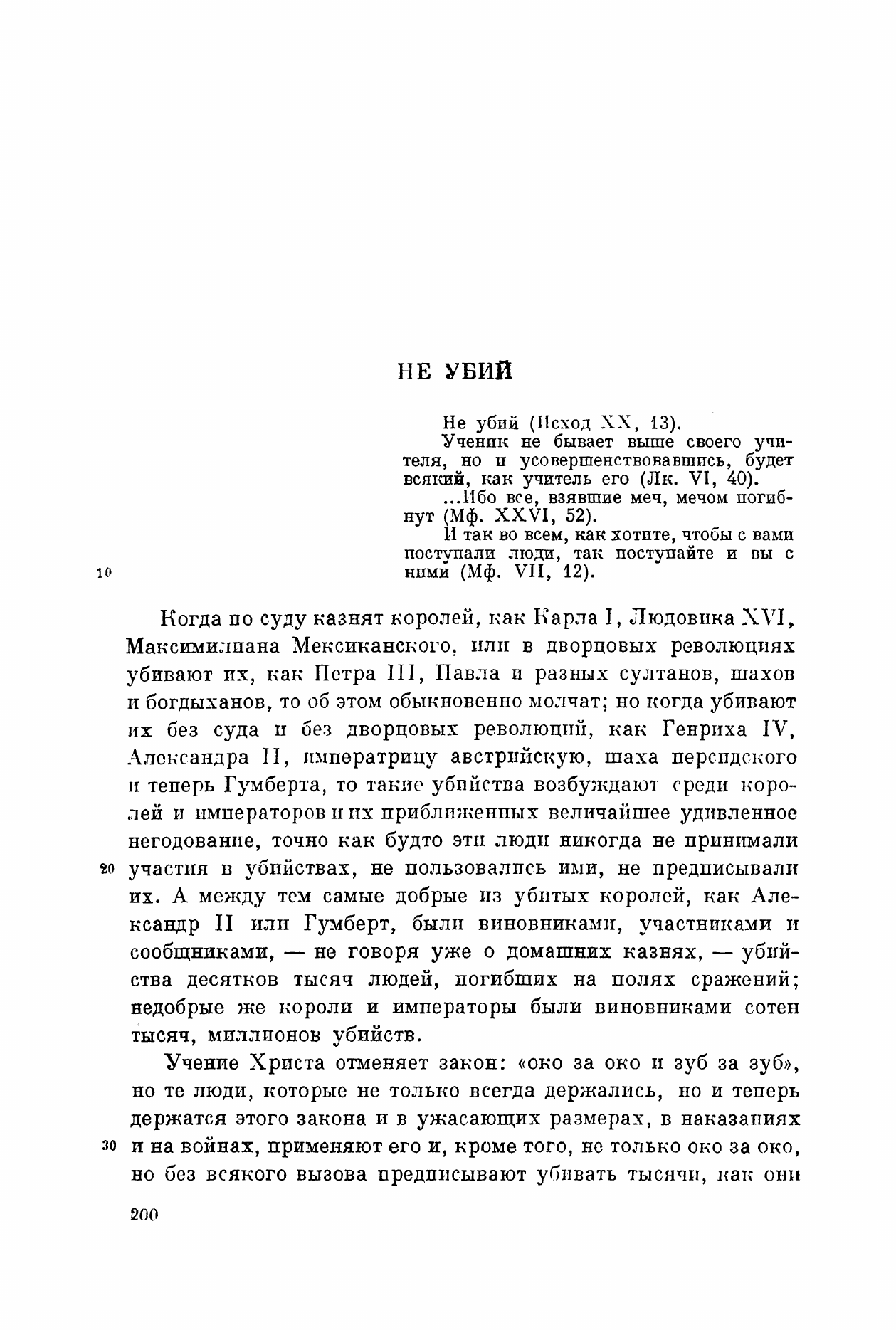
1 — Не убий / Thou Shalt Not Kill (1900)
Date: 8 August 1900 (OS), Yasnaya Polyana. PSS Tom 34, pp. 200–205 (TEI works/v34_200_205).
Context: written within days of the assassination of King Umberto I of Italy by the anarchist Gaetano Bresci (29 July 1900). The diary of 7 August records its dispatch alongside The Slavery of Our Time: «Кончил и отослал и Рабство нашего времени и о смерти Гумберта».
The essay refuses the horror that greets a regicide. The kings who recoil are themselves the great killers:
самые добрые из убитых королей, как Александр II или Гумберт, были виновниками, участниками и сообщниками, — не говоря уже о домашних казнях, — убийства десятков тысяч людей, погибших на полях сражений; недобрые же короли и императоры были виновниками сотен тысяч, миллионов убийств.
(working English) even the kindest of the murdered kings, such as Alexander II or Umberto, were the authors, participants and accomplices — to say nothing of executions at home — of the murder of tens of thousands of people who perished on the battlefields; while the unkind kings and emperors were the authors of hundreds of thousands, of millions of murders.
Killing the king is also useless, because the office refills itself — «как только выскочит одна пуля, другая мгновенно становится на ее место» (as soon as one bullet flies out, another instantly takes its place). The remedy is not regicide but refusal:
не убивать надо Александров, Карно, Гумбертов и других, а надо разъяснить им то, что они сами убийцы, и, главное, не позволять им убивать людей, отказываться убивать по их приказанию.
(working English) one must not kill the Alexanders, Carnots, Umbertos and others, but must make clear to them that they are themselves murderers, and, above all, not allow them to kill people — refuse to kill at their command.
2 — Царю и его помощникам / To the Tsar and His Assistants (1901)
Date: 15 March 1901 (OS). PSS Tom 34, pp. 239–244 (TEI works/v34_239_244).
Context: a public address to the Tsar, ministers, and the imperial family, written in the spring-1901 repression of student and worker unrest. The diary of 19 March names the trigger — «студенческия истории… заставившия меня написать обращение к Царю и его помощникам и программу» — and Tolstoy’s care over his own motive: to serve, «а не личным удовлетворением».
It asks for four reforms. The one that carries the cluster’s keystone legal claim is the second — to stop the “reinforced security” regime that had revived the death penalty:
только благодаря этой страшной мере всё чаще и чаще стала употребляться вернее всего развращающая людей, противная христианскому духу русского народа и не признанная до этого в нашем законодательстве смертная казнь, составляющая величайшее, запрещенное богом и совестью человека преступление.
(working English) only thanks to this terrible measure has the death penalty come to be used more and more often — the surest corrupter of people, contrary to the Christian spirit of the Russian people and not recognised until now in our legislation — constituting the greatest crime, forbidden by God and by the conscience of man.
The same address asks, first of all, to abolish for peasants «позорное телесное наказание» — shameful corporal punishment. State bodily violence on the lowest and the gallows at the top are read as one penal apparatus.
3 — Единственное средство / The Only Means (1901)
Date: 12 July 1901 (OS), Yasnaya Polyana. PSS Tom 34, pp. 254–269 (TEI works/v34_254_269).
Context: written for the labouring majority. It went through a dropped first stage — the «Народная программа» Tolstoy abandoned on 29 April («Народную программу бросил») — before he restarted it; on finishing it the diary’s verdict was «слабо» (weak).
It ties the death penalty to the whole economic order:
не были бы возможны ни войны, ни рабство, ни отнятие земли богатыми от бедных, ни обладание произведениями труда многих, потому что всё это держится только на возможности или на угрозе убийства.
(working English) neither wars, nor slavery, nor the taking of land by the rich from the poor, nor the possession of the labour-products of the many would be possible — because all of it rests only on the possibility, or the threat, of killing.
From which the “only means” of the workers’ liberation follows: not strikes or revolution, but the refusal to be made into killers — «отказ… от участия в войсках, имеющих целью убийство». The key «есть вера в бога и закон его».
4 — Не убий никого / Thou Shalt Not Kill Anyone (1907)
Date: 5 August 1907 (OS). PSS Tom 37, pp. 39–54 (TEI works/v37_039_054).
Context: an explicit sequel to Не убий, provoked by the arrest of N. E. Felten, editor of the «Обновление» press, for reprinting the 1900 pamphlet. The diary: «по случаю заключения в тюрьму Фельтена писал брошюру „Не убий никого”… прочел ее Черткову и другим».
В начале июля 1907 года человек, участвовавший в Петербурге в издательстве «Обновление», был посажен в тюрьму Петербургским судебным следователем по обвинению его в распространении написанной мною семь лет тому назад брошюры под заглавием «Не убий».
(working English) At the beginning of July 1907 a man involved in the “Obnovlenie” publishing house in St Petersburg was put in prison by a St Petersburg examining magistrate on the charge of distributing a brochure I had written seven years before, titled “Thou Shalt Not Kill.”
The title’s whole content is the symmetry: «„Не убий” значит только то, что христианам не должно убивать никого, ни непосредственно, ни посредственно, подсобляя убийствам» — kill no one, directly or indirectly. And the demand that I Cannot Be Silent would make famous a year later is already here:
Правительство преследует мою брошюру «Не убий» и сажает в тюрьму ее распространителя. Теперь оно неизбежно должно преследовать то, что я сейчас пишу, должно казнить и меня
(working English) The government prosecutes my brochure “Thou Shalt Not Kill” and jails its distributor. Now it must inevitably prosecute what I am writing now — it must execute me too.
It closes on the image I Cannot Be Silent would echo — the crowd heaving against a door «надеясь отворить ее наружу, когда он знает, что дверь отворяется только внутрь» (hoping to open it outward, when he knows the door opens only inward).
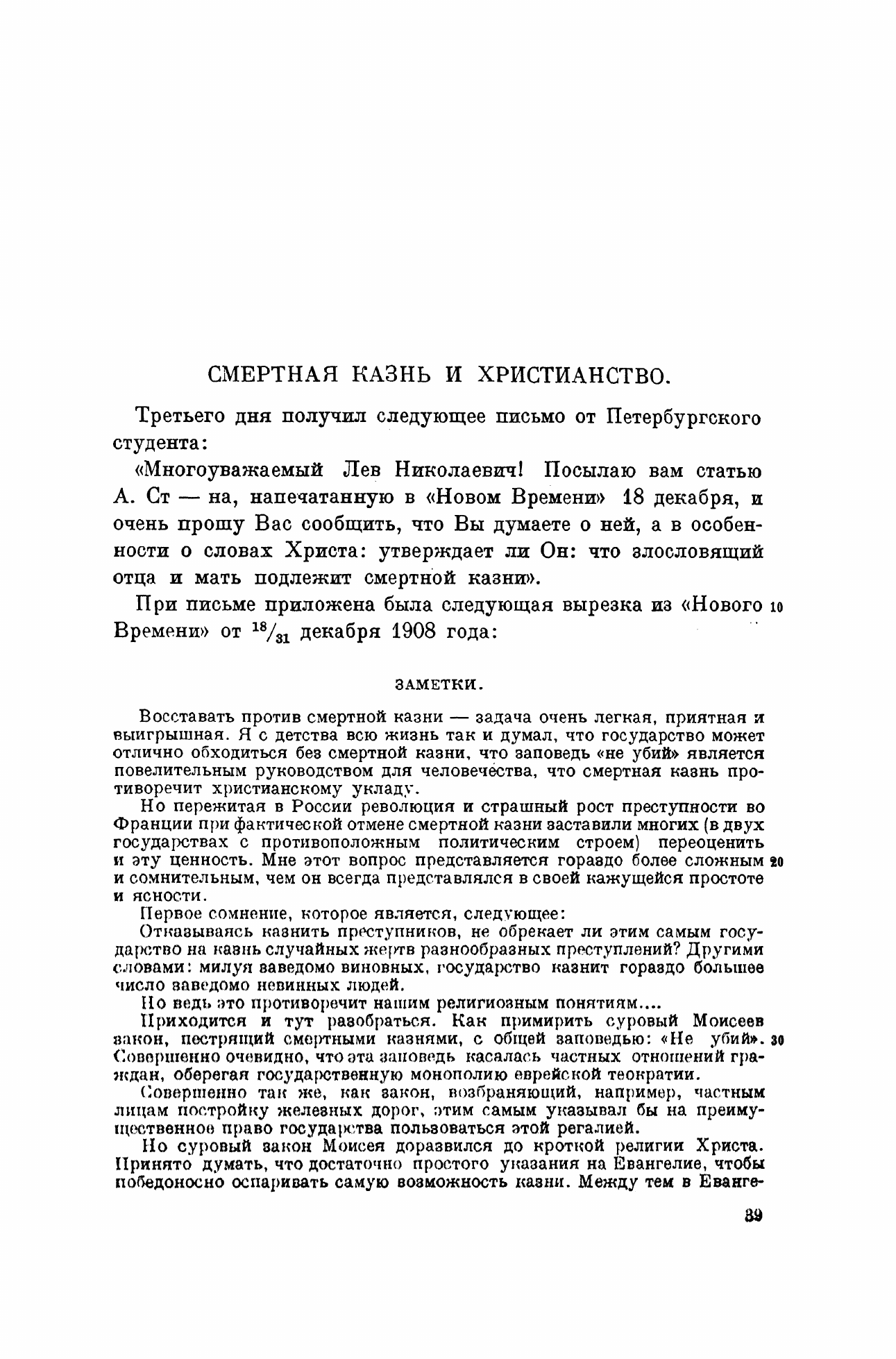
5 — Смертная казнь и христианство / Capital Punishment and Christianity (1909)
Date: 2 January 1909 (OS); a final addition on the Tsar, 18 January. PSS Tom 38, pp. 39–48 (TEI works/v38_039_048).
Context: an answer to an article in Novoe Vremya (18 Dec 1908) by A. A. Stolypin — journalist, brother of the Prime Minister — which argued that the Gospel does not forbid but sanctions the death penalty:
Между тем в Евангелии только в одном месте (Ев. от Марка гл. 7, ст. 9—13) упоминается о смертной казни и... в пользу ее:
(working English, quoting Stolypin) Yet in the Gospel the death penalty is mentioned in only one place (Mark 7:9–13) — and… in its favour.
Tolstoy’s reply, to the student who forwarded it:
Оправдывать смертную казнь словами Христа не решался до сих пор ни один изувер. Такое оправдание, кроме своей искусственности, и глупо, и бессовестно.
(working English) To justify the death penalty with the words of Christ no fanatic has dared until now. Such a justification, besides being contrived, is both stupid and shameless.
To Stolypin himself he wrote one word: «стыдно». The essay then turns to the Ekaterinoslav case — 32 men sentenced to death, of whom the Tsar «даровал жизнь» to some while thousands had already hanged — and to its diagnosis: «главное бедствие наше… в отсутствии религии у одних и в притворстве или самообмане других». It reuses the title and logic of the 1908 essay: «Не могу молчать я именно потому, что[…]я один могу говорить среди всех живущих в России с зажатыми ртами людей».
6 — Три дня в деревне / Three Days in the Village (1909–10)
Date: composed November 1909 – January 1910 (OS); first published September 1910. PSS Tom 38, pp. 5–22 (TEI works/v38_005_012, v38_012_018, v38_019_022).
Context: a trilogy of village sketches — Wandering People, The Living and the Dying, Taxes — born from Tolstoy’s visits to the poor around Yasnaya Polyana. The diary of 1 December 1909: «Положение голопузых у Курносенковой ужасно. Очень хочется написать три дня в деревне».
It is the cluster’s coda — the gallows as poverty’s end-point. Day 1 shows the state’s daily executions breeding the very violence they claim to suppress:
эта армия Стеньки и Емельки все больше и больше разрастается, благодаря таким же, как и пугачевские, деяниям нашего правительства последнего времени с его ужасами полицейских насилий, безумных ссылок, тюрем, каторги, крепостей, ежедневных казней.
(working English) this army of Stenka and Emelka [Razin and Pugachev] grows larger and larger, thanks to the deeds — like Pugachev’s own — of our government of late, with its horrors of police violence, insane exiles, prisons, hard labour, fortresses, daily executions.
Day 3 (Taxes) draws the whole chain of complicity, from the seizure of a widow’s sheep to its end:
Министры же, и те, которые занимаются торговлей водкой, и те, которые заняты обучением людей убийству, и те, которые заняты присуждениями к изгнаниям, тюрьмам, каторгам, вешанию людей… вполне уверены, что и самовары, и овцы, и холсты, и телки, отбираемые от нищих, находят самое свое лучшее помещение… в изготовлении орудий убийства, в устройстве тюрем.
(working English) And the ministers — those engaged in the vodka trade, and those engaged in teaching people to kill, and those engaged in sentencing people to exile, prison, hard labour, the hanging of people… are quite certain that the samovars, sheep, linens and calves taken from the destitute find their very best use… in the manufacture of instruments of murder, in the building of prisons.
The lowest link feels the sin the top denies — the village elder: «Тридцать рублей наше жалованье, а греха не оберешься» (thirty roubles is our wage, and there’s no end of sin to it).
The threads that bind the cluster
Five arguments recur across the six works (and the 1908 centrepiece):
- The death penalty is un-Russian and un-Christian. It is «не признанная до этого в нашем законодательстве» (Tsar) and «противна христианскому укладу» — a legislative newcomer and a contradiction of the faith its defenders invoke. Capital Punishment and Christianity is the fullest statement; To the Tsar the sharpest legal one.
- The state kills more, and kills in the citizens’ name. The horror at a regicide (Не убий) is hypocrisy; the executions are «без сравнения более жестоки» than the assassinations they answer, and they are done «для меня, живущего в России» (the marquee of the 1908 essay).
- The guilt is symmetric — government and revolutionaries alike. «Не убий» means kill no one (Не убий никого); the revolutionaries are «ваше произведение, ваши дети» (1908); both push the wrong way against the door.
- Complicity, and “execute me too.” Silence is consent, and the author asks to share the condemned man’s fate — «должно казнить и меня» (1907), the addition «о царе… с тайной целью вызвать против себя гонения» (1909), the hang-me demand (1908).
- The only remedy is the refusal to kill. Not regicide, not revolution, but «отказываться убивать по их приказанию» (Не убий) and «отказ… от участия в войсках» (The Only Means) — the door opens only inward.
Genesis & composition
The cluster’s occasions are documented and dated. Each work answers a specific event, and the composition is traceable in the per-work editorial histories (the PSS История писания / Комментарии, attributed below) and the 1900–1910 diaries (byte-faithful in extracts/).
- 1900 — Umberto. Не убий was begun within days of the 29 July assassination (first titles: «Убийство Гумберта», «Кто виноват?»), reworked at least seven times, and dispatched 7 August: «Кончил и отослал… о смерти Гумберта» (diary, Tom 54).
- 1901 — the student repression. Царю и его помощникам and Единственное средство both grew out of the spring-1901 unrest and a withheld «программа» (later printed only in Birukov’s biography, 1923). Chertkov proposed small cuts to Царю; A. K. Chertkova reworded the Alexander-II sentence (the Свободное слово text, which this extract follows).
- 1907 — Felten. Не убий никого displaced Tolstoy’s daily reading-anthology when N. E. Felten was jailed for reprinting Не убий; he read it aloud to Chertkov mid-draft (diary, Tom 56). The same surge planned a direct letter to PM Stolypin.
- 1908–09 — A. A. Stolypin and the Ekaterinoslav 32. Смертная казнь и христианство answers A. A. Stolypin’s Novoe Vremya article (18 Dec 1908), and is tied to the Ekaterinoslav trial of the Gorlovka strikers (32 sentenced to death, 19 Dec 1908). The 18 January addition on the Tsar was made, the diary says, «с тайной целью вызвать против себя гонения» — and Tolstoy at once caught the motive as «не совсем хороша».
- 1909–10 — village poverty. Три дня в деревне was conceived 1 December 1909 from visits to starving peasant households, completed in January 1910, and still being fed by observation in February (an exiled print-shop boy at the door) and stirred by Korolenko’s article on capital punishment in March.
The people around the cluster
- V. G. Chertkov — publisher and editorial confidant; printed the whole cluster abroad through Свободное слово / Free Age Press; proposed (mostly minor) edits. Vault page exists.
- N. N. Gusev — secretary 1907–09; diary-witness who read Stolypin’s article aloud and dated the drafts.
- N. E. Felten — editor of «Обновление»; his 1907 arrest is the trigger of Не убий никого.
- A. A. Stolypin — Novoe Vremya journalist, brother of the Prime Minister; the interlocutor of Capital Punishment and Christianity.
- P. A. Boulanger and P. I. Birukov — associates who handled the editing correspondence and (Birukov) the later printing of the withheld 1901 «программа».
- A. B. Goldenweiser and V. G. Korolenko surface in the genesis diaries — the pianist whose playing sparked a parallel piece in 1907, and the writer whose 1910 article on the death penalty moved Tolstoy as he finished Three Days.
Publication, censorship & translation
The cluster’s reception in Russia is its censorship history. The pattern is uniform — banned or cut at home, complete abroad through Chertkov, then by hectograph and illegal print:
| Work | First publication | In Russia (lifetime) | Censorship |
|---|---|---|---|
| Не убий (1900) | Листки Свободного слова №17 (England) | «Обновление» №13 (1906) | Confiscated from the 1911 collected works; its reprint led to Felten’s 1907 arrest |
| Царю и его помощникам (1901) | Листки Свободного слова №20 (England) | illegal copies only; legal 1917 | Confiscated from the 1911 collected works (19 April 1911 OS) |
| Единственное средство (1901) | Листки Свободного слова №24 (England) | not recorded (abroad only) | banned in Russia |
| Не убий никого (1907) | газета Слово №245 (excerpts, Sept 1907) | excerpts 1907; full text 1917 | printed only in fragments; complete only posthumously |
| Смертная казнь и христианство (1909) | Новая Русь №57 (cut) + Ladyzhnikov, Berlin | Новая Русь (1909), censored | large cuts in the legal Russian printing |
| Три дня в деревне (1910) | Вестник Европы, Sept 1910 | Вестник Европы (1910), cut | censorship cuts in Day 3; the brochures ordered destroyed, 8 March 1912 |
The English texts were Aylmer (and, for Three Days, Louise) Maude’s, issued through the Free Age Press; the 1900 Thou Shalt Not Kill leaflet was seized by German police at Russia’s request in 1903. The titles confirmed against the Maude/Free Age Press editions are: Thou Shalt Not Kill, To the Tsar and His Assistants, The Only Means, Thou Shalt Not Kill Anyone (also Thou Shalt Kill No One), Capital Punishment and Christianity, and Three Days in the Village.
Scholarly context
(The received view is attributed, not asserted; the dive’s spine is the primary text and the project’s own record. Where the mainstream reaches for a contested label, this dive points at the project’s Christian Anarchism and Tolstoyanism dives rather than adopting it.)
English-language scholarship treats Tolstoy’s opposition to capital punishment almost entirely through I Cannot Be Silent. Rosamund Bartlett (2010) frames that essay as the climax of his late political witness; Aylmer Maude (1911), the closest English source, arranged the Free Age Press translations of most of the cluster but treats the 1908 outburst as the defining moment. Studies of Tolstoy’s political non-fiction concentrate on the doctrinal treatises (The Kingdom of God Is Within You, The Law of Violence and the Law of Love); the polemic essays are read as applications, not as a body. Against the dive’s findings:
- The death-penalty-history claim (
confirms). Tolstoy’s “not recognised until now in our legislation” is usually read as rhetoric; it is substantively accurate for the ordinary civil code (Empress Elizabeth’s de-facto moratorium from 1744; no death penalty for common crimes in the 19th-century code), though it overstates the case for the military and political-crime provisions that persisted. (Attributed: Marasinova 2018; TASS; Wikipedia “Capital punishment in Russia.”) - The 1881 statute and the named catalysts (
extends). No secondary source found discusses the legal precision of To the Tsar (naming the «Положение о мерах к охранению» as the channel), or names the Felten arrest behind Не убий никого, or specifies the Mark 7:9–13 passage A. A. Stolypin used. These are corpus-and-commentary material. - The Gorlovka numbers (
confirms). The Ekaterinoslav trial (7–19 Dec 1908): 131 tried, 92 convicted, 32 sentenced to death, 24 commuted, 8 hanged on 4 September 1909 — corroborated by Russian-language sources and the PSS commentary. (The specific 1 January 1909 imperial resolution «Даровать жизнь» rests on the PSS commentary; see Material not covered.) (Attributed: Wikipedia RU «Горловское вооружённое восстание»; Sergeenko, PSS Tom 38.) - The cluster as a series (
extends). Scholarship has not read the six texts as one developing argument built on a single kernel; The Only Means (1901) in particular has attracted no separate English study. The corpus supplies the through-line. (Attributed: §4 of the scholarship sweep.)
The political context is well documented: the Stolypin field courts-martial (from August 1906) carried out the execution wave (Kropotkin’s contemporary tally: 280 in 1906, 508 in 1907, 802 in the first ten months of 1908), and the gallows had a Duma name by November 1907 — “Stolypin’s necktie,” coined by the Kadet F. Rodichev. (Attributed: Kropotkin 1909; Wikipedia “Pyotr Stolypin.” Full list in the scholarship sweep.)
Reception & afterlife
In Russia and the Church first. The cluster’s lifetime reception was structurally the censorship itself — the confiscations, the Felten arrest, the cut and fragmentary printings, the 1912 order to destroy the Three Days brochures. No discrete Synod or government pronouncement against these specific essays was found; the official response was administrative — fine the papers, jail the publishers, seize the editions — consistent with the state’s documented reluctance to make Tolstoy a martyr. Capital Punishment and Christianity records its own moment of reception inside the text: a policeman silencing a woman at a women’s congress for trying to speak against the death penalty, and the Duma’s «дикими воплями» at a member who protested the 32 sentences.
The cluster’s afterlife runs through I Cannot Be Silent, which made the same argument world news in 1908, and through the broader Tolstoy→Gandhi nonviolence lineage that scholarship routes mainly through A Letter to a Hindu and The Kingdom of God. The contemporaries who answered Tolstoy in 1908–09 (Kropotkin, Trotsky, Lenin) addressed the centrepiece, not these essays — see the centrepiece dive.
The author’s later verdict
Tolstoy held the cluster as discharge of a duty he could not escape, not as work he was proud of. Единственное средство he finished with a flat «слабо» (weak). Не убий никого and Смертная казнь и христианство he wrote partly to bring prosecution on himself, naming the second’s addition on the Tsar «с тайной целью вызвать против себя гонения» and at once distrusting the motive. The clearest verdict is the persistence itself: from 1900 to within months of his death he could not stop writing against the gallows — «не перестану кричать, умолять… до последней минуты моей жизни» (Capital Punishment and Christianity). The title of the 1908 centrepiece is the cluster’s whole stance: he could not be silent.
Place in the cluster
This dive is the decade-long frame for the project’s death-penalty centrepiece, I Cannot Be Silent (1908), which it cross-references throughout: Не убий никого (1907) anticipates its “execute me too”; Смертная казнь и христианство (1909) reuses its title and logic. It is the near-twin in subject of The Law of Violence and the Law of Love (the systematic statement of the same non-resistance doctrine), a sibling of A Letter to a Hindu, and an extension of the courts-and-punishment material in Resurrection. Единственное средство is the worker-question companion of The Slavery of Our Times (dispatched the same week as Не убий). The whole sits inside the territory the project examines under the contested mainstream labels Christian anarchism and Tolstoyanism — labels this dive points at rather than asserts.
Material not covered
- Сон (A Dream) — Tolstoy’s standalone anti-violence dream-vision, written alongside Three Days (Nov–Dec 1909) and partly substituted for in the censored Day 3. The cluster’s natural seventh member; out of the declared six-work scope.
- I Cannot Be Silent (1908) — the centrepiece, dived separately; cross-referenced, not re-extracted.
- The full letter-network of each work (to Rusanov, Mood, Birukov, Chertkov, the student Arseniev, A. A. Stolypin) — surfaced via the commentary, not all extracted byte-faithfully.
- Variant collation — none of the six works’ redaction variants were collated.
- Independent confirmation of the 1 January 1909 «Даровать жизнь» resolution — the commutation of the Ekaterinoslav sentences is corroborated, but the specific dated imperial act rests on the PSS commentary alone.
- The Slavery of Our Times (1900) and Ответ на определение Синода (1901) — the neighbouring works named in the commentaries; cross-referenced, not dived.
Visual & manuscript record
Two public-domain page facsimiles are rendered from the local PSS PDFs and committed in extracts/ (the opening pages of Не убий and Смертная казнь и христианство). Four public-domain images are cached in the git-ignored visuals/ (re-fetchable with python3 docs/fetch_visuals.py 1900-1910-against-the-death-penalty); all carry a licence and source URL in the dossier.
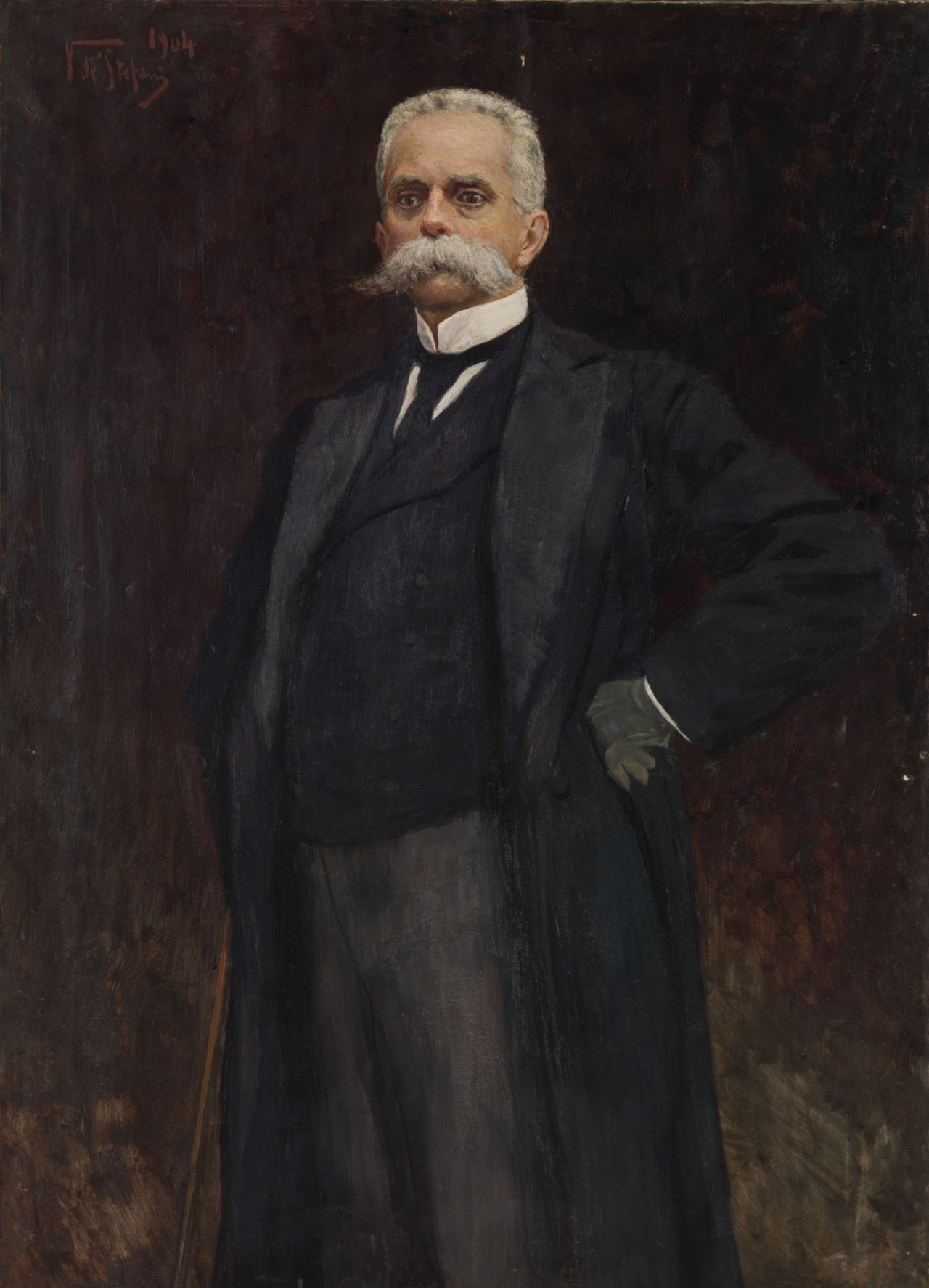
The cluster’s portrait material is abundant and public-domain: a 1900 Kazakov studio portrait (the year of Не убий) and a 1909 portrait (the year of Three Days) bracket the decade; the Prokudin-Gorsky and Bulla 1908 portraits and Repin’s likeness of Chertkov are cross-referenced from the centrepiece dive, as is the portrait of the Prime Minister Stolypin (which can stand in, with an explicit caption, for his brother A. A.).
What is not openly available, and where to request it:
- A public-domain image of the 1905–1909 execution wave / “Stolypin’s necktie” — no usable photograph or cartoon surfaced on Commons (both relevant categories returned empty). Request from a dedicated archive (Library of Congress, GARF, the 1905-revolution illustrated press / Sytin lubok). The one thematic gap in the visual record.
- A portrait of A. A. Stolypin (the Novoe Vremya journalist) and of N. E. Felten — no public-domain image located; likely needs a Russian-language source (RGALI; Novoe Vremya staff photos).
- First-edition title pages — Листки Свободного слова, the «Обновление» 1906 edition, and the Ladyzhnikov (Berlin 1909) Смертная казнь и христианство. Try archive.org and the émigré-scan pair vtoraya-literatura.com / imwerden.de.
Method
This was a corpus-dive multi-work theme-dive run on 2026-06-13, in-session (accept-edits), from a written scope handoff (six confirmed works, I Cannot Be Silent as the cross-referenced centrepiece). Scope (Phase 0): the death-penalty cluster of 1900–1910 read from its own texts (PSS Toms 34, 37, 38), with composition reconstructed from each work’s История писания / Комментарии (attributed) and a targeted 1900–1910 diary sweep (Toms 54, 56, 57, 58). Russian extraction used extract_tei.py --choice=reg --notes=auto (pre-1918 orthography resolved to modern). Three sub-sweeps ran in parallel (a genesis diary sweep, a scholarship + historical-context sweep, and a visual-materials sweep), each writing its deliverable to a file in extracts/. Every quoteRu was checked byte-for-byte against its extract with verify_quotes.py (30/30 PASS, 1 facsimile OK) before the verifier pass. Working-English translations are labelled and are the dive’s own; mainstream scholarship is attributed, not asserted. Because none of the six works has a works/ record yet, the dossier’s six workRecord blocks are record-creating; the dive writes nothing to works/.
Links: the centrepiece — I Cannot Be Silent; siblings — The Law of Violence and the Law of Love, A Letter to a Hindu, Resurrection, The Slavery of Our Times, The Kingdom of God Is Within You, christian-anarchism, tolstoyanism, 1903 folk-tales (the multi-workRecord model).
References
Primary (byte-faithful, from the local TEI corpus):
- Толстой Л. Н. Не убий // ПСС в 90 тт. Т. 34. М., 1952. С. 200–205. (TEI
works/v34_200_205_Ne_ubij) - Толстой Л. Н. Царю и его помощникам // ПСС Т. 34. С. 239–244. (TEI
works/v34_239_244) - Толстой Л. Н. Единственное средство // ПСС Т. 34. С. 254–269. (TEI
works/v34_254_269) - Толстой Л. Н. Не убий никого // ПСС Т. 37. М., 1956. С. 39–54. (TEI
works/v37_039_054) - Толстой Л. Н. Смертная казнь и христианство // ПСС Т. 38. М., 1936. С. 39–48. (TEI
works/v38_039_048) - Толстой Л. Н. Три дня в деревне // ПСС Т. 38. С. 5–22. (TEI
works/v38_005_012,v38_012_018,v38_019_022) - История писания и печатания / Комментарии to each (ПСС Т. 34 сс. 568, 572–574, 578–579; Т. 37 сс. 414–416; Т. 38 сс. 460–490, 494–497).
- Толстой Л. Н. Дневники 1900–1910 // ПСС Т. 54, 56, 57, 58 (genesis sweep).
Background (secondary; attributed, not asserted):
- Bartlett, Rosamund. Tolstoy: A Russian Life. Profile, 2010/2011.
- Maude, Aylmer. The Life of Tolstoy: Later Years. Constable, 1911; and the Free Age Press translations.
- Marasinova, Elena. “The Death Penalty Moratorium in 18th-Century Russia.” Quaestio Rossica 6/4, 2018.
- Kropotkin, Peter. The Terror in Russia. 1909 (the execution figures; “Stolypin’s necktie”).
- Wikipedia (RU): «Горловское вооружённое восстание»; Wikipedia “Pyotr Stolypin,” “Capital punishment in Russia,” “Thou Shalt Not Kill (essay).”
- Find a Grave 261205774 — Alexander Arkadyevich Stolypin (1863–1925).
- Full source list + URLs + open verification flags in the scholarship sweep (22 sources).
This dive feeds the LLM wiki-ingestion step (a separate, human-in-the-loop pass): the dossier.yaml entities block plans the wiki pages and the six workRecord blocks plan the new works records this research should become. See the draft dev-blog note.