The Great Sin (Великий грех)
A primary-source corpus-dive on Tolstoy’s 1905 essay on the private ownership of land — the work in which he calls land monopoly «великий грех», the great sin at the root of the people’s poverty, and endorses Henry George’s single tax as its remedy. Written during the 1905 Revolution. PSS Tom 36, pp. 206–230.
Key findings
-
The essay merges two pieces. Tolstoy began it on 21 April 1905 as «Народные заступники» (The People’s Defenders), an attack on the intelligentsia who claim to serve the people, and fused it with a separate essay on Henry George. The PSS editor calls it the “crossing of two plans.” The seam is still visible: chapters I–VII indict the false “defenders,” chapters II and IX hand the economic argument to George.
-
The thesis is moral before it is economic. The root evil of Russian (and European and American) life is not political oppression but the deprivation of every man’s natural right to the land he was born on. Tolstoy files land property in the same list as cannibalism, serfdom, judicial torture, capital punishment and war — institutions humanity has overcome or is overcoming. Land is the next on the moral ladder.
-
The single tax is a conditional answer, not a programme. Tolstoy endorses Henry George’s single tax only «при существующем государственном строе и обязательных податях» (under the existing state structure and obligatory taxes) — given a state and taxes that already exist, the least unjust way to hold land. The change he actually calls for is not fiscal but moral: as with serfdom, the sin ends when the people who profit from it wake to it (ch. VIII).
-
The remedy is conscience, not legislation. What unties the sin is not constitutions, socialism, revolution, or land-purchase schemes, but the consciousness of the complicit — exactly as serfdom fell (in Tolstoy’s reading) not by Alexander II’s decree but because private men understood its sin. This is how Tolstoy keeps an anti-statist account of a reform a state would in fact administer.
-
Tolstoy indicts himself. He folds the landowner-writer into the guilty class — «мы, русские паразиты». The day before he began the essay, a peasant reproached him to his face for preaching against land-owning while buying up land: «было и больно и хорошо».
-
Chertkov cut a paragraph, and recorded why. Preparing the first proofs, Chertkov — Tolstoy’s closest friend and editor — took one paragraph out of the first introduction; the introduction was printed in «Свободное слово» No. 17–18 as «Необходимый переворот», with the paragraph printed after it under an editor’s note. His reason, in a letter of 8 July 1905 and reported in the PSS commentary: the paragraph, which says the people’s life is independent of external forms, «стоит в противоречии со всем предыдущим» — it stands against all the preceding, where the essay insists the outward forms of land-use must change. The corpus shows the seam — the cut, the two merged pieces, the regretted excisions — that outside readers can only infer.
Why this matters
In The Great Sin Tolstoy names the private ownership of land a sin — «великий грех», the surviving form of slavery and the root of the people’s poverty — and locates the cure not in any reform a state could pass but in the awakened conscience of those who profit from it, exactly as he reads the fall of serfdom. Henry George’s single tax enters only as a conditional concession: given a state and taxes that already exist, the least unjust way to hold land. The dive’s value is that the corpus shows the editorial seam — Chertkov’s cut, the two merged pieces, the regretted excisions — that outside readers can only infer. It is also the gateway to the whole land-question cluster (the single tax, To the Working People, the Henry George prefaces) that the next theme-dive will gather.
The shape of the question
The essay is staged below in its own words — verbatim Russian, a working-English translation (labelled), and the source.
Stage 1 — the thesis: the basic evil is land deprivation, not political oppression.
«…есть лишение большинства народа несомненного, естественного права каждого человека пользоваться частью той земли, на которой он родился.»
(…is the deprivation of the majority of the people of the unquestionable, natural right of every man to use part of the land on which he was born.) — working English. PSS Tom 36, p. 206 (introduction); TEI v36_206_230_Velikij_greh.
Stage 2 — the ground: every peasant story reduces to the one cause.
«Хлеба не хватает, а хлеба не хватает оттого, что земли нет.»
(There is not enough bread, and there is not enough bread because there is no land.) — working English. Ch. I, p. 209. The road to Tula on Palm Saturday; reported peasant speech before Tolstoy reaches for George.
Stage 3 — the authority: Henry George, that land monopoly is the surviving form of slavery.
«Мы толкуем об отмене рабства, но мы не отменили рабства, мы отменили лишь более грубую форму его: личное рабство.»
(We talk of the abolition of slavery, but we have not abolished slavery, we have only abolished its cruder form: personal slavery.) — working English; Tolstoy quoting George (from Nikolaev’s Russian translation). Ch. II, p. 210.
Stage 4 — the remedy, conditionally stated: George’s single tax, given the state and its taxes.
«…при существующем государственном строе и обязательных податях невозможно придумать какого-либо другого лучшего, более справедливого, практического и мирного решения.»
(…under the existing state structure and obligatory taxes it is impossible to devise any other better, more just, practical and peaceful solution.) — working English. Ch. IX, p. 229. The single keystone clause: the single tax is the least-unjust shape of an order Tolstoy still wants abolished, not an embrace of the state.
Stage 5 — the mechanism of change: conscience, as with serfdom.
«…нужно только сознание своего греха всеми людьми, совершающими его или участвующими в нем, и желание избавления от него.»
(…only the consciousness of their sin is needed, by all who commit it or take part in it, and the desire to be free of it.) — working English. Ch. VIII, p. 227.
Genesis & composition
The dating is firm from the 1905 diary (PSS Tom 55) and the letters to Chertkov (Tom 89). The two strands appear first on 16 April 1905, when Tolstoy records wanting to write both an exposition of faith and a piece on George: «…очень хочется и изложение веры и о Генри Джорже, которого прочел по Николаеву и вновь восхищен» — “…I very much want both the exposition of faith and [to write] about Henry George, whom I read in Nikolaev’s [translation] and am again delighted by” (working English; Tom 55).
The next day, 17 April, Tolstoy confirmed the project to Chertkov, naming both strands together: «…как теперь начаты мною о заступниках народа и о неправедности земельной собственности и Генри Джордже» — “…as now begun by me — about the defenders of the people, and about the unrighteousness of land property, and Henry George” (working English; Tom 89). He filed it modestly, among «статьи на злобы дня» (topical articles) written «для своего удовлетворения» — a self-deprecating register that undersells what became one of his central land statements.
On 21 April the writing begins, under the first title: «Начал писать: Народные Заступники. Недурно. И Генри Джоржа» — “Began writing: The People’s Defenders. Not bad. And Henry George” (working English). The two pieces that the PSS says were later merged are here still two.
The same 21 April entry carries the essay’s moral signature. A peasant — Pyotr Osipov, in the company of the physician A. S. Buturlin — had reproached Tolstoy the day before (20 April) for preaching against land-owning while himself buying land: «…он жестко упрекал меня за то, что я говорю, а скупаю землю. Было и больно и хорошо» — “…he harshly reproached me for the fact that I speak [against it] yet buy up land. It was both painful and good” (working English). The first-person «мы, русские паразиты» of the closing is not rhetoric; it is this reproach absorbed.
The arc runs: «окончил» (finished) on 4 May; then weeks of revision; Chertkov’s arrival at Yasnaya Polyana on 24 May and his proposal of cuts; the regretted excisions on 6 June («Сократил Великий Грех, выбросил многое. Мне жалко» — “I shortened The Great Sin, threw out much. I regret it”); the introduction reworked into a second redaction through 18 June; and the final text sent to Русская мысль in early July 1905.
A diary note written while finishing (24 May) shows the intellectual ground for putting land, not capital, at the root — the distinction from socialism: «…владение землею включает неизбежно власть над людьми, живущими на ней, владение же орудиями труда дает власть только над теми людьми, которые подчиняются этой власти» — “…ownership of land inevitably includes power over the people living on it, whereas ownership of tools of labour gives power only over those who submit to that power” (working English).
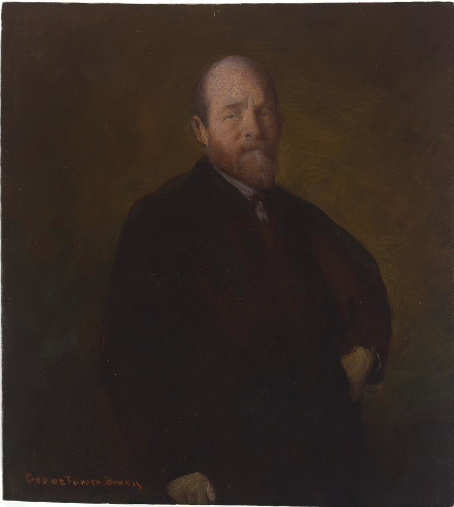
What the work says
The final redaction runs to nine chapters (an introduction + I–IX). The structural map:
- Introduction — Russia faces a great upheaval; liberals, social-democrats and revolutionaries all believe political reforms are the answer; but the basic evil is the denial of the natural right to land, which no political reform can touch.
- Ch. I — the road to Tula on Palm Saturday; reported peasant conversations, every one reducing to lack of land.
- Ch. II — Henry George quoted at length (man as an earth-animal who cannot live without land; the working class as the poor class; the manna-in-the-wilderness parable; land ownership at the root of all social questions).
- Ch. III — land property placed in the list of overcome evils; the reception story of George himself — Gladstone, Spencer (who recanted his Social Statics and bought up the old editions), Parnell, the Oxford students, the Catholic party and orthodox political economy all turned on him, but the chief weapon was замалчивание, killing the idea by silence: «Средство это, употребляемое и до сих пор по отношению к Джорджу, было замалчивание» (this means, used to this day with respect to George, was suppression by silence — working English, p. 216). Tolstoy reads George’s neglect as proof of his truth.
- Ch. IV — George’s teaching is not refuted but ignored; Europe and America are too far down the industrial road to turn; Russia, 80% agricultural, still stands at the turning.
- Ch. V — the keystone parable of the penned cows: people keep cows fenced from the pasture and devise endless “improvements” (gilding their horns, changing the milking hours) rather than break the fence. Russia, unlike colonial Europe, has no distant colony onto which to displace the exploitation: «Наши грехи всегда перед нами» (Our sins are always before us — working English, p. 220).
- Ch. VI — the «Народные заступники» chapter (epigraph Matthew 23:27–28, the whited sepulchres): those who once killed in God’s name now do the same evil «во имя „народа”» (in the name of “the people”); the new servants of the народ are the old false servants of God reborn, with the same three signs.
- Ch. VII — the diagnosis under the diagnosis: reformers governmental and anti-governmental alike miss the one thing because they «не имеют религии» (have no religion) and so cannot truly love and cannot know what others need. The chapter’s emblem is the old peasant who, hearing a newspaper article on the “agrarian” congress read aloud at Tula station, understands nothing of the jargon but grasps that «захват земли неработающими людьми есть великий грех» (the seizure of land by non-working people is the great sin — working English, p. 226) and crosses himself. The illiterate gesture carries the whole thesis.
- Ch. VIII — Mazzini’s epigraph (great social transformations follow great religious movements); the coming land emancipation framed as a religious, not political, movement; the non-political remedy stated.
- Ch. IX — Henry George on reform through awakened thought; the serfdom analogy (emancipation came from Novikov, Radishchev, the Decembrists, not the Tsar); the conditional endorsement of the single tax; Russia’s historical calling; the closing self-indictment, «мы, русские паразиты».
Redactions & textual history
The PSS apparatus (Gorbachev, Tom 36, pp. 656–665) describes sixteen manuscripts. The work began in the «Синий альбом» autograph titled «Народные заступники»; the print source was manuscript № 6 (the text Chertkov carried to England, marked «Последняя редакция, привезенная В. Г. Июнь 1905») plus manuscript № 16 (the final introduction, «Июль 1905»).
The decisive intervention was Chertkov’s. He came to Yasnaya Polyana on 24 May 1905 and «предложил Толстому сделать в статье ряд сокращений» — “proposed that Tolstoy make a series of cuts in the article” (working English; commentary). Two whole chapters and parts of others were cut; Tolstoy accepted and regretted it. The cut material is what the PSS prints as variants (Tom 36, pp. 464–475), which makes them more than discarded drafts — they are the essay Tolstoy would have preferred to print. They are sharper than the published text: the constitution «обезпечит право достаточных, праздных, паразитных сословий, но не права народа» (will secure the right of the propertied, idle, parasitic classes, but not the rights of the people — variant № 13); land property is «великий грех… и грех не прошедший, a настоящий, и не временный, а постоянно совершаемый» (a great sin… not past but present, not temporary but constantly committed — variant № 8).
One cut matters above all the others (next section): variant № 15 — the withdrawn first introduction, and the paragraph Chertkov set apart from it.
The great sin, and the one remedy
Read in Tolstoy’s own order, the essay is religious before it is economic. Private property in land is «великий грех», a sin of the same kind as serfdom — and, like serfdom, it falls only when the people who commit it and profit from it wake to it:
«…нужно только сознание своего греха всеми людьми, совершающими его или участвующими в нем, и желание избавления от него.»
(…only the consciousness of their sin is needed, by all who commit it or take part in it, and the desire to be free of it.) — working English; ch. VIII, PSS Tom 36, p. 227.
The single tax is not his programme but his answer to a narrower question — given a state and its compulsory taxes, institutions he does not himself endorse, what is the least unjust way to hold land? He states it conditionally, and the condition is the whole of it:
«…при существующем государственном строе и обязательных податях невозможно придумать какого-либо другого лучшего, более справедливого, практического и мирного решения.»
(…under the existing state structure and obligatory taxes it is impossible to devise any other better, more just, practical and peaceful solution.) — working English; ch. IX, p. 229.
The essay also carries, in its making, one fact the corpus can show and outside readers can only infer. Preparing the first proofs of the introduction for the «Свободное слово» edition, Chertkov — Tolstoy’s closest friend and editor — took one paragraph out of the withdrawn first introduction (variant № 15). The introduction was printed in «Свободное слово» No. 17–18 as «Необходимый переворот» (“A Necessary Revolution”), and the paragraph was printed after it with an editor’s note. Its key sentence:
«…жизнь народа слагается не вследствие внешних форм, которые могут быть наложены на него внешними влияниями, а внутренней деятельностью отдельных личностей.»
(…the life of the people is formed not as a result of external forms which may be imposed on it by external influences, but by the inner activity of individual persons.) — working English; PSS Tom 36, p. 474.
Chertkov gave his reason in a letter of 8 July 1905 (new style), reported in the PSS commentary: this paragraph, which asserts “the independence of the people’s life from external forms,” «стоит в противоречии со всем предыдущим, где утверждается необходимость внешнего изменения форм пользования землей» — stands in contradiction with all the preceding, where the necessity of an external change in the forms of land use is asserted. So Tolstoy’s two emphases — that the real change is inward and moral, and that the outward form of land-holding must change — were set side by side, and then, by his own editor and with his assent, gently parted: the inward-only statement lifted out of the article and printed on its own.
That is the primary record: what Tolstoy wrote, and what his closest friend did with it, in their own terms. Academic readers put it differently. Kenneth Wenzer (1997) frames the single-tax endorsement as a “concession” or “weakness” and treats it as a contradiction of Tolstoy’s “anarchism” — a puzzle of political theory Tolstoy himself never poses, and a label («anarchism») the project’s christian-anarchism dive interrogates rather than adopts. Set that reading beside Tolstoy’s own and they part ways at the root: his order is sin, conscience, the following of Christ, with the single tax downstream of all three.
Where the theme clusters
The work and its apparatus (PSS Tom 36):
| Genre | TEI id | Pages | Material |
|---|---|---|---|
| works | v36_206_230_Velikij_greh |
206–230 | the essay, 9 chapters |
| works (variants) | v36_464_475_Velikij_greh_Varianty |
464–475 | 16 cut passages incl. the withdrawn paragraph (№ 15) |
| commentary | v36_656_665_Velikij_greh |
656–665 | Gorbachev, история писания |
Diary (PSS Tom 55, 1905):
| Date (OS) | Material |
|---|---|
| 16 Apr | George + the exposition of faith named; read «по Николаеву», «вновь восхищен» |
| 21 Apr | composition begins («Народные Заступники»); the peasant reproach (complicity) |
| 4 May | «окончил Великий Грех» — first finished |
| 19 May | still revising — «всё еще не кончил» |
| 24 May | «Кажется, кончил»; the land-vs-tools distinction; Chertkov arrives |
| 6 Jun | «Сократил… выбросил многое. Мне жалко» — after Chertkov’s cuts |
| 18 Jun | «Написал только вступление» — the introduction reworked |
Letters (PSS Tom 89, to V. G. Chertkov):
| Tom | Date | Material |
|---|---|---|
| 89 | 17 Apr 1905 | the project named to his editor — both strands; filed as a «статья на злобы дня» |
Scholarly context
The specialist English study is Kenneth Wenzer’s “Tolstoy’s Georgist Spiritual Political Economy (1897–1910): Anarchism and Land Reform” (American Journal of Economics and Sociology, 1997) — the dive’s main scholarly point of contrast. On one point scholarship simply agrees with the corpus: the George commitment was lifelong and often-restated, not a one-off 1905 intervention. Tolstoy read George «по Николаеву» from about 1885 (Lebrun), became the movement’s foremost literary champion after George’s death in 1897 (Wenzer), and returned to the single tax repeatedly — To the Working People (1902), the 1906 prefaces to George (the Social Problems Russian edition Nikolaev translated), and the famous October 1909 diary entry recording a dream-conversation with Henry George.
Where scholarship turns the essay into a debate, the corpus does not follow it. Academics split over whether the single tax compromises Tolstoy’s “anarchism” — Wenzer reads the endorsement as a “concession/weakness” Tolstoy never resolved; the Georgist movement (Lebrun) reads it as foundational. Both are arguing his intent in the abstract, in a vocabulary (anarchism, concession, contradiction) that is theirs, not his. The corpus reaches below where the debate stops: it can point at the mechanism — the cut paragraph, Chertkov’s recorded reason, the regretted excisions, the two merged pieces — and let Tolstoy’s own terms (sin, conscience, the following of Christ) stand as written.
One scholarly convergence is worth flagging because the corpus corroborates it directly. The Русская мысль editors did not only add a disclaimer; they dropped the third introductory paragraph («Так думают либералы…»). So both the Russian liberal editors and Chertkov on the English/émigré side performed editorial surgery on the introduction — the Russians cutting the “liberals think” paragraph, Chertkov setting apart the inner-life paragraph. The PSS restored the «Так думают либералы…» paragraph from manuscript № 16, so the corpus main text carries the very passage the journal cut — the parallel is visible inside the project’s own sources.
Caveat: this was an English-first sweep. Named, quoted contemporary Russian critical replies (Kadet / Social-Democrat / Socialist-Revolutionary) to The Great Sin specifically were not surfaced — only the editors’ disclaimer and the single-tax-press amplification. A deeper Russian-language pass would strengthen the reception record. (See Material not covered.)
Publication, censorship & translation
First publication: the July 1905 issue of Русская мысль (Russian Thought), a liberal journal, with an editorial note specifying the editors’ divergence from the author «по существенным и важным вопросам» («…с редакционным примечанием, оговаривающим расхождение редакции с автором по существенным и важным вопросам» — working English; commentary). Reprinted the same year as a Posrednik brochure and via Chertkov’s «Свободное слово» (No. 98) under the title «Великий грех» with the subtitle «О земельной собственности».
In English it appeared as “A Great Iniquity” — translated by V. G. Chertkov and Isabella Fyvie Mayo — first in The Times of London on 1 August 1905, then as a Free Age Press pamphlet (1906) and across the single-tax press (The Public, Chicago, 19 Aug 1905; the British movement organ Land Values). The English title leans on the moral-economy register (“iniquity”) rather than the literal “sin.”
That the essay was published legally in Russia during Tolstoy’s lifetime distinguishes it from many of his late polemics. Its first appearance in a collected edition, however — the 12th edition of the Сочинения, part 16, 1911 — was confiscated.
Reception & afterlife
The essay landed in the middle of the 1905 Revolution, as the land question became the axis of Russian politics, and it cut against both main party programmes: the Socialist-Revolutionaries’ socialization of land (distribution to peasant communes) and the Marxists’ nationalization (state ownership). Tolstoy’s George-derived position rejected both as sinful — the single tax as the morally just route that liberates land from private ownership without violent redistribution or a coercive state apparatus.
The documented foreign uptake was movement amplification (The Times → the single-tax press) rather than independent critique; no substantial hostile foreign review surfaced in this sweep. The clearest contemporary reaction remains the Русская мысль editors’ disclaimer. The essay’s longer afterlife runs through the whole Georgist-Tolstoyan strand — To the Working People, the 1906 prefaces, Three Days in the Country — that the next dive will gather.
Place in the cluster
The Great Sin extends The Slavery of Our Times (the economic/labour critique, here turned onto land) and stands with The Kingdom of God Is Within You (the refusal of state coercion the single tax must answer to). It sits beside the christian-anarchism and christian-communism-socialism dives — where the labels academia attaches to this strand of Tolstoy’s thought are interrogated, not adopted — and the copyright-renunciation dive (the renunciation-of-property strand — Tolstoy gave up his own copyrights in the same spirit the essay asks landowners to give up land).
It is the central text of the land-question cluster and seeds the planned land-question-henry-george theme-dive (P9), which will carry the satellites cross-referenced but not deep-dived here: To the Working People (Tom 35, 1902), The First Step (Tom 29, 1891), The Only Possible Solution of the Land Question (Tom 36, 1906), the two Henry George prefaces (Tom 36, 1906), Letter to a Peasant on the Land (Tom 90, 1905), and How the Working People Can Free Themselves (Tom 90, 1905). The Henry George, S. D. Nikolaev and single-tax entities this dive routes are the cluster’s spine.
The author’s later verdict
The nearest contemporary verdict is the 6 June 1905 «Мне жалко» over Chertkov’s cuts — Tolstoy preferred the longer, sharper text. He never recanted the Georgist case: he restated it to the end of his life (the 1909 dream-conversation diary, per Wenzer), and the 1906 George prefaces and Three Days in the Country (1909–10) extend the same argument. A later judgment on this essay specifically was not sought in this dive.
Material not covered
- The P9 cluster satellites — To the Working People, The First Step, the George prefaces, etc. — cross-referenced only; they belong to the
land-question-henry-georgedive this one seeds. - Variant collation beyond the cut chapters — the 446-unit working bundle (рук. № 3) and the fine redaction differences are not collated; only the merger arc and the Chertkov cuts are traced.
- Named contemporary Russian critical replies — only the Русская мысль editors’ disclaimer was found; a Russian-language reception pass would add named respondents.
- The Fels / “Land Values Publication Department” question — whether Joseph Fels or a single-tax “Land Values” department specifically issued/funded the “A Great Iniquity” pamphlet is plausible but unconfirmed (only Free Age Press + The Public are confirmed).
- The Gandhi / Indian land-reform afterlife — out of scope; belongs with the Letter to a Hindu material.
Visual & manuscript record
A light sweep returned eight public-domain images (full manifest in visuals/_visuals.md; the visuals/ cache is git-ignored and regenerated on demand from the dossier url: fields). The keystone is Henry George himself (above). One image is doubly on-theme:
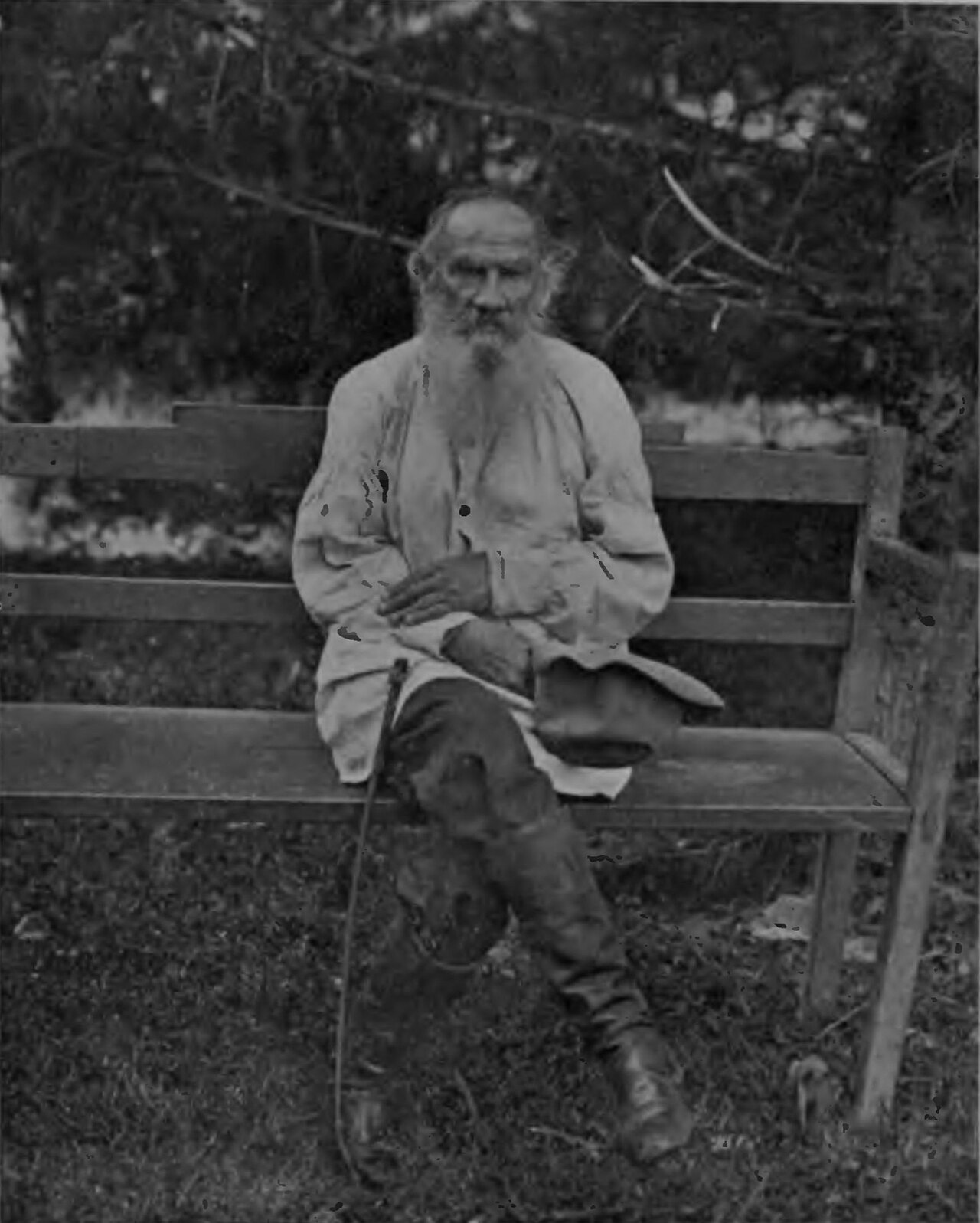
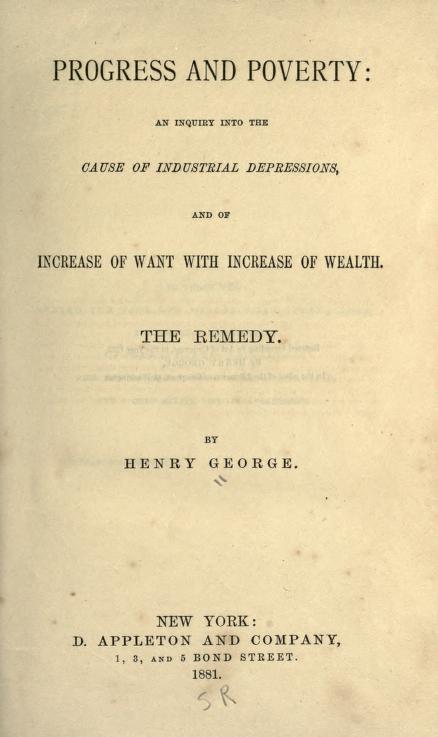
Also held: a 1888 oil portrait and an 1865 daguerreotype of George; the Repin portrait and an 1883 photograph of Chertkov; the 1908 Prokudin-Gorsky colour Tolstoy; and an American political cartoon of the 1905 agrarian unrest. Gaps: the S. D. Nikolaev Russian translation of George («Избранные речи и статьи», Posrednik 1904) that Tolstoy actually used was not found on Commons, and no clean PD photograph of Russian peasants c. 1905 surfaced in the light sweep — both worth a targeted look (RGB / Prokudin-Gorsky village plates) if a wiki page needs them. The manuscripts (GTM, фонд Черткова, and the АТБ) were not pursued for facsimiles.
Method
A work-subject corpus-dive (single work → one proposed workRecord), not --novel. The scope: pin the composition window from the corpus, route Henry George as the central person entity, let Tolstoy’s own framing lead (land as «великий грех»; conscience, not legislation, as the cure) with scholarship kept as an attributed contrast, and seed the P9 land-question dive without deep-diving its satellites. (Re-cut 2026-06-22 to lead with Tolstoy’s religious framing and demote the academic “anarchism vs. the single tax” puzzle to attributed contrast — see the dev-blog note.)
- Sources read: the essay, its variants and its composition-history commentary (PSS Tom 36); the 1905 diaries (Tom 55, seven entries 16 Apr–18 Jun); the 17 Apr 1905 letter to Chertkov (Tom 89). Extracted with
extract_tei.py --choice=reg --notes=auto(pre-reform orthography resolved to modern, as for every Prophet-period text; variants keep their pre-reform spelling where the TEI carries it). - Byte-fidelity:
verify_quotes.pypasses 28/28 — every cited Russian quotation appears verbatim in its extract. - Scholarship + visuals: an English-first scholarship sweep (anchor: Wenzer 1997) and a light Wikimedia-Commons visuals sweep, both run as separate passes.
- Verification: a separate-pass verifier (Phase 5), never self-approved.
- Links: prior dives cross-linked above — The Slavery of Our Times, The Kingdom of God Is Within You, christian-anarchism, christian-communism-socialism, copyright-renunciation. The dive proposes a
works/record (the-great-sin) but writes no vault pages — ingestion is a separate, human-in-the-loop step.
References
Primary
- Л. Н. Толстой, «Великий грех», ПСС Т. 36, с. 206–230 (TEI
v36_206_230_Velikij_greh). - Л. Н. Толстой, Варианты к статье «Великий грех», ПСС Т. 36, с. 464–475 (TEI
v36_464_475_Velikij_greh_Varianty). - Н. В. Горбачев, «Великий грех». История писания и печатания, ПСС Т. 36, с. 656–665 (TEI
v36_656_665_Velikij_greh). - Дневник 1905 г., ПСС Т. 55 (entries 16/21 Apr, 4/19/24 May, 6/18 Jun 1905); Письмо к В. Г. Черткову, 17 Apr 1905, ПСС Т. 89.
- Генри Джордж, «Избранные речи и статьи», пер. С. Д. Николаева, изд. «Посредник», М. 1904 (Tolstoy’s source for the George quotations).
Background
- Kenneth C. Wenzer, “Tolstoy’s Georgist Spiritual Political Economy (1897–1910): Anarchism and Land Reform,” American Journal of Economics and Sociology 56(4), 1997, 639–667 — the anchor specialist study.
- Leo Tolstoy (trans. V. G. Chertkov & Isabella Fyvie Mayo), “A Great Iniquity,” The Times (London), 1 Aug 1905; Free Age Press pamphlet, 1906 (Internet Archive
greatiniquity00tolsuoft). - Victor Lebrun, “Tolstoy and George” (1956; repr. Prosper Australia 2007) — the movement reading.
- tolstoy.ru — journalism guide, «Великий грех» (1905): Русская мысль July 1905, the editors’ disclaimer + the excised paragraph.
- “Henry George,” Encyclopædia Britannica + Wikipedia (1839–1897; Progress and Poverty 1879; the single tax; 1886 NYC mayoral run; died during the 1897 campaign).
- Rosamund Bartlett, Tolstoy: A Russian Life (2011); A. N. Wilson, Tolstoy (1988); Aylmer Maude (the transitional-stage “bridge” analogy, via Wenzer).
Draft dev-blog note: website/src/posts/notes/2026-06-21-the-great-sin.md (draft).