A single-work corpus dive on Tolstoy’s late, unfinished novella The Forged Coupon, run in the --novel mode. The dive’s centre is the work’s structure: a doubled chain of consequence. In Part I one forged 2½-rouble coupon, altered by a schoolboy, propagates evil outward from person to person — a framed peasant, a string of murders — until it reaches a woman who will not resist. In Part II good propagates back through the same kind of chain, from that woman’s death outward through the men who had been its links. It is Tolstoy’s most schematic dramatisation of how sin and redemption pass from one person to the next. The dive reads the work from its own text in the tolstoydigital TEI corpus (PSS Tom 36), reconstructs its long genesis from the Jubilee-Edition editorial history (Mishin’s commentary, Tom 36 pp. 557–581) and the 1886–1904 diaries and letters, traces the keystone variant — the allegorical “devils” Tolstoy built and then stripped — and follows the posthumous 1911 publication through its censorship cuts and its most famous afterlife, Robert Bresson’s film L’Argent.
Key findings
- The doubled chain was diagrammed first, in a dream. The structure is not a conceit Tolstoy fell into late: he sketched it whole in a programme of 15 September 1886, in which a “bright youth” shows a dreamer «всю историю поддельного купона: откуда он взялся и как разносилось зло и как пресеклось» — and the asymmetry that the finished novella executes is stated there in one line: «зло расходится, но не поборает добра. А добро также расходится и поборает зло» (evil spreads but does not conquer good; good also spreads and conquers evil).
- The mechanism is in the diaries, in plain physics. On 12 June 1898, the day he wrote «Рассказ Купон очень хочется дописать», Tolstoy set down the theory the tale enacts: evil travels «как передача движения упругими шарами» (like the transmission of motion by elastic balls) and is stopped only by «той силы, которая поглощает его» — the force that absorbs it. Non-resistance is that force. Maria Semyonovna’s refusal to resist is the absorbing collision that ends the chain of murder and starts the chain of good.
- The «очень sobre» form is what remained after he stripped the allegory. Tolstoy first wrote the spread of evil as a literal picture — little devils sitting on shoulders, swelling and dividing and leaping from one person to the next. On 22 January 1904 he wavered, then cut them all. The bare, fast, comment-less style he named on 25 December 1903 — «выясняется новая форма, очень sobre» — is the chain left to stand on plain human causation, the supernatural scaffolding removed.
- Two of the cast are documented from life. Prokofy, the peasant the courts destroy, carries Tolstoy’s own coachman Larion/Larivon, whose ruin he had already told in Notes of a Christian (1881). The killing of the manager Sventitsky, and the hanging of two peasants for it, reproduces the real killing of A. V. Stanislavsky on 14 April 1887 — a case that still disturbed Tolstoy in 1904.
- The most famous afterlife breaks the chain in half. Bresson’s L’Argent (1983) adapts only Part I and stops exactly where the redemptive Part II would begin. The work’s dominant reception keeps the chain of evil and discards the chain of good — the reverse of the dive’s reading, in which Part II is not a schematic appendage but the structural proof.
- For the vault. A record-creating
workRecord(noworks/record exists yet) plus a tiered cast —characternodes for Stepan, Maria Semyonovna, Prokofy (← Larivon), Smokovnikov father and son, Mahin, the Archimandrite Misail, Sventitsky (← Stanislavsky); agroupfor the icon-rejecting sect; supportingpersonpages. Ingestion is a separate, human step.
Why this matters
The Forged Coupon is the place where Tolstoy’s central ethic stops being argued and is shown working. The doctrine of non-resistance, stated at length in The Kingdom of God Is Within You, is here turned into a machine with visible parts: a first cause (a father’s contempt), a transmission (each wronged person wronging the next), a stop (a woman who will not strike back), and a reversal (the same people, touched by her, becoming conduits of good). It is the companion and completion of The Power of Darkness, written from the same 1880s notebook of plots: that play dramatises only the chain of sin — «коготок увяз, всей птичке пропасть» (a claw caught, the whole bird is lost); this novella adds the chain’s reversal. Read beside Resurrection, whose convict-murderer strand actually branched off from the coupon’s own material, it shows the late Tolstoy working one idea — moral regeneration passing person to person — across every long narrative he had left. And in its making it is a case study in the late voice: a truth pared to a bare form and routed, when the Russian censor cut it, through Berlin.
The marquee question
The claim this dive set out to test: The Forged Coupon is Tolstoy’s most schematic narrative proof of the non-resistance / kingdom-of-God ethic — the doubled chain dramatises the claim, which Tolstoy diagrammed in an 1886 dream-vision, that evil spreads but cannot conquer good, while good spreads and does conquer evil.
Confirmed — and extended past where the scholarship reaches. The schematic reading is the received one: critics call the work a “domino” or chain parable of non-resistance, and the most searching academic treatment — Ilya Kliger and Nasser Zakariya’s “Poetics of Brotherhood” (Slavic Review, 2011) — reads the doubled chain as a structure that “narrativises” human brotherhood, pairing the novella with Resurrection. But the corpus is more explicit than any of them about the intentionality of the structure, on three counts the secondary literature does not reach.
1. The structure was diagrammed before it was written. The earliest record of the theme, a programme of 15 September 1886 for a planned tale about a rich man named Mitasha, already contains the whole design as a dream:
И попался ему купон поддельный, и увидал он сон. Светлый юноша показал ему всю историю поддельного купона: откуда он взялся и как разносилось зло и как пресеклось. И он увидал, что зло расходится, но не поборает добра. А добро также расходится и поборает зло.
And a forged coupon came his way, and he saw a dream. A bright youth showed him the whole history of the forged coupon: where it came from, and how evil was carried about, and how it was cut short. And he saw that evil spreads, but does not conquer good. And good likewise spreads and conquers evil. (working English)
This is quoted in the PSS Tom 36 commentary (p. 558) from a record the local corpus does not independently hold — a provenance flag carried in the dossier — but it is the single most load-bearing genesis fact: the asymmetry the finished novella proves (good conquers; evil does not) is set down eighteen years before the main writing, as the structure of a dream.
2. The mechanism is stated in the diary, as physics. On 12 June 1898 — the same entry that ends «Рассказ Купон очень хочется дописать» — Tolstoy writes the law the tale obeys:
только одно непротивление прекращает зло, поглощая его в себе, нейтрализирует его, не позволяет ему идти дальше, как оно неизбежно идет, как передача движения упругими шарами, если только нет той силы, которая поглощает его.
only non-resistance puts an end to evil, absorbing it into itself, neutralising it, not letting it travel further, as it inevitably does — like the transmission of motion by elastic balls — unless there is the force that absorbs it. (working English)
(PSS Tom 53, p. 197.) Evil is momentum in a line of colliding balls; a non-resisting body absorbs the blow and the line stops. The novella is that diagram with names: Maria Semyonovna is the body that takes the blow without passing it on.
3. He removed the allegory on purpose. Tolstoy first drew the transmission literally — devils leaping shoulder to shoulder (see Redactions, below) — and then cut every one of them (22 January 1904), naming the result a «новая форма, очень sobre». The chain is left to work on plain cause and effect. The de-allegorisation is itself an argument: the moral physics needs no devils to be visible.
So the relation is confirms + extends: the parable reading is right, but the corpus shows the parable was engineered from a dated diagram and a stated law, and consciously stripped to its bare form — none of which the scholarship, even at its closest (Kliger/Zakariya), names. The one reading that actively pulls the other way is Bresson’s, treated under Reception.
Genesis & composition
The novella had the longest and most broken gestation of any of the late fiction — roughly eighteen years from germ to abandonment — and the diaries let us watch it surface and submerge.
The seed (1886–1891). The structural germ is the 15 September 1886 Mitasha programme quoted above. The murderer who would become Stepan arrives on 29 May 1889, and arrives, characteristically, out of an act of Tolstoy’s own cruelty: he had clubbed a wounded hare while hunting and reflected «как невинны должны быть убийцы. Они думают о другом и убивают без борьбы» — and then:
Как хороша могла бы быть история об убийце, раскаявшемся на незащищавшейся женщине.
How fine the story of a murderer who repents over an undefended woman could be. (working English)
(PSS Tom 50, pp. 86–87.) The “undefended woman” is Maria Semyonovna before she had a name. The watchman who became Vasily/Prokofy is sketched on 31 July 1891 — «история человека, бывшего в золотой роте и попавшего в сад караульщиком около господского дома». By the late 1880s a first chapter existed in autograph (Chertkov copied it), which is why the dive dates composition from 1889 rather than the main push: the coupon’s own text predates 1890.
The dormant 1890s. Through the decade the tale appears only on lists of things unfinished. On 12 March 1895, wanting «писать художественное», Tolstoy enumerates nine unfinished works and «Купон» is the fifth, between Resurrection and The Devil. On 14 November 1897 he plans it as a deliberate companion piece — «в pendant к Хаджи-Мурату написать другого русского разбойника Григория Николаева» — and on 13 December 1897 lists both «Фальшивый купон» and «Разбойник — убивающий беззащитных» (the latter marked прекрасно) among subjects worth working up. By mid-1898 part was written: «Рассказ Купон очень хочется дописать» (12 June 1898). The murderer strand was so alive that it spilled into the fourth redaction of Resurrection that same autumn. Then: «Думал нынче о «Купоне» — хорошо. Может быть напишу» (20 December 1899) — and silence until 1902.
The two pushes (1902–1904). Work resumed on 6 October 1902: «Вчера начал поправлять и продолжать Фальшивый купон» — the same day Gorky and the publisher Pyatnitsky were visiting Yasnaya Polyana. By November 1902 the first seven chapters stood (dated on the manuscript cover by his daughter M. L. Obolenskaya). Then it submerged again until the decisive push. On 2 December 1903 the coupon is one of three things he might do next — «или драму, или о религии, или кончить купон» — and on 25 December 1903 he begins in earnest and names the new manner:
Начал писать фальшивый купон. Пишу очень небрежно, но интересует меня тем, что выясняется новая форма, очень sobre.
Began writing The Forged Coupon. I write very carelessly, but it interests me because a new form is taking shape, very sober. (working English)
(PSS Tom 54, p. 202.) From here the work is dense and dated: «Понемногу подвигаюсь в «Фальшивом Купоне». Но очень уж беспорядочно» (3 January 1904), with his sons Sergei and aunt Tatyana Kuzminskaya in the house; a letter to his son L. L. Tolstoy of 19 January 1904 — «Я пишу и Фальшивый Купон, если помнишь, я давно начал, и дополнение о религии»; and nineteen dated work-sessions on the manuscript covers between 15 December 1903 and 4 February 1904. The last diary mention is 2 February 1904: «Работаю над Купоном, а о войне не пишется». Within days the work broke off at the start of Part II chapter XX, and Tolstoy never returned to it. It was left, as the commentary says, with loose ends untied — the fates of Turchaninova, Mahin and others unresolved.
The people around the work. The composition network is small and domestic: Gorky and Pyatnitsky as visitors at the 1902 restart; the daughters M. L. Obolenskaya and A. L. Tolstaya and the secretary Yu. I. Igumnova as copyists who dated the covers; Chertkov, who had copied the very first chapter back in the 1880s and would edit both posthumous editions; the pianist A. B. Goldenweiser, to whom Tolstoy was still speaking of the Stanislavsky execution in 1904; and the son L. L. Tolstoy as the letter’s addressee.
What the work says
The text is short and fast — forty-three chapters across two parts in some forty-eight pages, most chapters a page or two. The dive reads the hinge in full and maps the chain around it.
The first link — a father’s contempt (Part I, ch. I). Nothing begins with a crime. Fyodor Mikhailovich Smokovnikov, a provincial official of «неподкупной честности» and proud of it, comes home in a foul temper and refuses his schoolboy son a small advance, ending with a prophecy:
А я тебе скажу, что если ты так поведешь себя, ты будешь мошенник.
And I tell you that if you behave like this, you’ll be a swindler. (working English)
«Вон. Сечь вас надо», he shouts. The boy, «озлобился больше, чем испугался», broods on the word, and half to fulfil it alters the coupon — 2.50 becomes 12.50. Evil enters the world not as a great wickedness but as irritation passed downward, exactly the elastic-ball collision of the 1898 diary.
The hinge — Maria Semyonovna (Part I, ch. XXIII). The coupon’s chain has by now run through a defrauded shopkeeper, a framed and murdered peasant (Ivan Mironov), and the killer Stepan Pelageyushkin, who has learned that he can kill «так чисто и ловко, что никто не узнает». He breaks into the house of a poor widow, Maria Semyonovna, kills her son-in-law and daughter, and turns to her. This is the centrepiece, quoted in full:
За перегородкой лежала в постели Мария Семеновна и, поднявшись, смотрела на Степана испуганными, кроткими глазами и крестилась. Взгляд ее опять испугал Степана. Он опустил глаза. — Где деньги? — сказал он, не поднимая глаз. Она молчала. — Где деньги? — сказал Степан, показывая ей нож. — Что ты? Разве можно? — сказала она. — Стало быть, можно. Степан подошел к ней, готовясь ухватить ее за руки, чтобы она не мешала ему, но она не подняла рук, не противилась и только прижала их к груди и тяжело вздохнула и повторила: — Ох, великий грех. Что ты? Пожалей себя. Чужие души, а пуще свою губишь... О-ох! — вскрикнула она. Степан не мог больше переносить ее голоса и взгляда и полоснул ее ножом по горлу. — «Разговаривать с вами». — Она опустилась на подушки и захрипела, обливая подушку кровью.
Behind the partition Maria Semyonovna lay in bed and, rising, looked at Stepan with frightened, meek eyes and crossed herself. Her gaze frightened Stepan again. He lowered his eyes. “Where’s the money?” he said, not raising his eyes. She was silent. “Where’s the money?” said Stepan, showing her the knife. “What are you doing? How can you?” she said. “So it seems I can.” Stepan went up to her, ready to seize her hands so she would not hinder him, but she did not raise her hands, did not resist, and only pressed them to her breast and sighed heavily, and repeated: “Oh, a great sin. What are you doing? Have pity on yourself. You destroy others’ souls, and your own still more... O-oh!” she cried out. Stepan could no longer bear her voice and her gaze, and slashed her throat with the knife. — “Talking with you.” — She sank onto the pillows and rattled, soaking the pillow with blood. (working English)
(PSS Tom 36, ch. XXIII.) She does not resist, and she pities him in the act of being killed. This is the absorbing collision of the 1898 diary: he can pass the blow on no further. He robs the house, smokes a cigarette, cleans his clothes — and then, «не дойдя до ночлега», collapses into a ditch and lies there a night, a day and a night. The momentum has met the force that takes it up.
The reversal — conversion (Part II, chs. I–III). Part Two opens with Stepan haunted: her «кроткое, худое, испуганное лицо» before him, and «черные» (the black devils — the only survivors of the cut allegory) telling him to finish himself as he finished her. He gives himself up — «я сам в руки дался» — astonishes the investigators with a truthfulness that feels, to a man trained to fence with the guilty, «как в темноте на конце лестницы поднимаешь ногу на ступень, которой нету». He tries to hang himself; the strips tear; in a dream Maria Semyonovna at last looks at him and is silent, and «с тех пор ему легче стало». In the common cell the sectarian Chuev reads him the Gospel — Matthew 25 (the sheep and the goats: «так как вы сделали это одному из сих братьев моих меньших, то сделали мне») and Luke 23 (the thief on the cross). And:
И с этого времени Степан стал другим человеком.
And from that time Stepan became a different man. (working English)
Good travels back (Part II, chs. IV–VII). Now the chain runs in reverse, through the same machinery. Stepan converts the convict-executioner Makhorkin, who refuses to hang the two condemned peasants though threatened with flogging: «Что ж, плети — так плети, а убивать закона нет». The story of «странного преступника, который обратил палача» reaches Mahin — the very schoolboy who first taught how to alter the coupon, now an investigator — who repeats it, unmoved, at a soirée; and it transforms a listener, Lisa Eropkina, who resolves to give away her estate and «быть такой Марией Семеновной». When Mahin asks Stepan how he, a judge, can be his brother, Stepan answers the whole novella in two words:
— Оттого что понял, что все люди братья. […] — От непонятия.
— Because I understood that all men are brothers. […] — From not-understanding. (working English)
The node that began the chain of evil carries the chain of good. The work breaks off before the design is closed, but its last written page — Mitya Smokovnikov, the boy of chapter I, reconciling with his father — shows the chain returning to its source.
Redactions & textual history
The manuscript record survives complete («до последнего кусочка»), and the dive samples it rather than collating it. One variant is the keystone.
The devils (the cut allegory). In the layer of work that followed the first chapters, Tolstoy made the transmission of evil visible by drawing little devils — чертенята — onto the characters. The first appears in chapter I:
маленький чертенок, сидевший на бумаге, перескочил на плечо Федора Михайловича и, сидя на нем, несколько увеличился.
a little devil that had been sitting on the paper leapt onto Fyodor Mikhailovich’s shoulder and, sitting there, grew somewhat larger. (working English)
(PSS Tom 36 commentary, on the draft additions.) Through the drafts these devils swell, divide, and leap from shoulder to shoulder as malice passes — from the father to the son, from a cheated tradesman to the next man, from Pyotr Nikolaevich to the peasant Prokofy, settling into whole families as hatred spreads. They are the doubled chain made literal. On 22 January 1904 Tolstoy «колеблется, оставить или уничтожить чертей», and decides to destroy them, marking «пропустить» (omit) beside each — missing only three places, in Part II chs. X–XI, by oversight. The «очень sobre» form is precisely what is left when the allegory is gone: the moral physics carried by event alone.
Renumbering and loose ends. The commentary tracks chapters renumbered repeatedly with scissors as Tolstoy reordered the two parts; the robber’s role migrating from the name Prokofy to the dvornik Vasily (a seam the unfinished text never fully closed); and the figure of the tailor (the портной of variant № 5), who watches Maria Semyonovna’s life and begins to think, generating the sectarian strand. The PSS text is set from the autographs and the author-corrected copies, with eight editorial conjectures resolving contradictions Tolstoy left (a stray «Ваня» for «Митя»; «Михаил» for «Мисаил»; a place-name fixed from Penza to Simbirsk) — the present edition adopting three of them as indisputable.
Publication, censorship & afterlife
The Forged Coupon was first printed in 1911, the year after Tolstoy’s death, in vol. 1 of «Посмертные художественные произведения Льва Николаевича Толстого» (ed. V. G. Chertkov, pub. A. L. Tolstaya, Moscow) — but, as the commentary records, «однако с цензурными урезками»: with censorship cuts. The excised passages are precisely the anti-clerical and pro-sectarian ones — in Part I, the line «Наплевать мне на ваш сан» (ch. XII), the passage on Stepan’s contempt for authority (ch. XV), the peasants carrying their icons back to the priest (ch. XVIII), and most of the chapter on the sect (ch. XX); in Part II, the words on «истинную веру Христову» against the «обманщики-попы» (ch. III), and the whole of ch. XV. The simultaneous Berlin edition, also edited by Chertkov for «Свободное слово», carried the full uncensored text. The pattern is the one the late-voice dive traces: a truth the Russian censor would not pass, routed abroad through Chertkov — here, of a man already a year dead and a decade excommunicated (the Holy Synod’s decree of 20 February 1901).
Bresson’s L’Argent (1983). The novella’s dominant afterlife is Robert Bresson’s last film, L’Argent, “loosely inspired by the first part” of the tale. It transposes the chain to contemporary Paris — a forged 500-franc note for the altered coupon — and follows an innocent man destroyed by a chain of deceptions he did not begin, into murder and surrender. Bresson stops exactly where Tolstoy’s Part II would begin: the redemption — the non-resisting victim, the prison conversion, the good travelling back — is entirely omitted; the film ends without it. It shared a top directing prize at Cannes 1983 with Tarkovsky’s Nostalghia (reported as the Grand Prix du Cinéma de Création / the Prix de la mise en scène). The point for this dive is structural: the most famous reception of The Forged Coupon keeps the chain of evil and discards the chain of good, and has fed a critical habit of treating Part I as where the interest lies and Part II as a schematic appendage — the reverse of a primary-grounded reading, in which Part II is the proof the whole design was built to deliver. The pattern repeats: the one other notable screen adaptation, Aku Louhimies’s Frozen Land (Paha maa, 2005), transposes the same Part-I chain to contemporary Finland — a sacked schoolteacher setting off a cascade of ruin — and likewise stops before the redemption. No Soviet or pre-1983 adaptation was found; the work’s two-part moral structure has consistently been received as if only its first part existed.
English translations. First Englished in the 1911 Hagberg Wright collection (The Forged Coupon and Other Stories, Thomas Nelson; public domain), which fixed the canonical title; then Herman Bernstein (1912), David Patterson (Norton, 1986), and Hugh Aplin (Hesperus 2006 / Alma 2018). Notably the Maudes never issued a standalone, and there is no Pevear/Volokhonsky version — the novella sits just outside the most-circulated English Tolstoy.
Characters & prototypes
The cast is a long chain of links, most of whom appear for a chapter and pass the coupon — or the news of Stepan — onward; the dive mints a wiki node only for the principals, the figures with a documented prototype, and those who anchor a strand. Everyone else folds into the work’s overview prose. Routing follows wiki-schema v1.4.
- Stepan Pelageyushkin (
character) — the murderer whose killing ends at Maria Semyonovna and reverses into the chain of good; the novella’s pivot. His germ is the 29 May 1889 diary; no single named prototype. - Maria Semyonovna (
character) — the non-resisting widow; the absorbing force. The hinge of the whole structure. - Prokofy (
character, with a documentedprototypes[]edge) — the peasant the courts destroy; carries Tolstoy’s coachman Larion/Larivon, whose ruin Tolstoy had told in Notes of a Christian (1881): jailed and re-jailed for trivial offences «по указу его императорского величества», declining, «помер чахоткой». Author-stated, documented. (In the final text the role is partly merged into the dvornik Vasily.) - Pyotr Nikolaevich Sventitsky (
character, withprototypes[]) — the estate manager killed by peasants; the episode reproduces the real killing of A. V. Stanislavsky (14 April 1887; two peasants hanged), per the commentary. Editorial, documented. - Fyodor Mikhailovich Smokovnikov and Mitya Smokovnikov (
character) — the father whose contempt starts the chain, and the son who alters the coupon and, at the broken-off end, is reconciled. - Mahin (
character) — the schoolboy who teaches the forgery and later carries Stepan’s redemption-story outward: one node on both chains. - Archimandrite Misail (Mikhail Vvedensky) (
character) — the religion-teacher turned monk who persecutes the sectarians; the anti-clerical strand the censor cut. - The icon-rejecting sect (
group) — the peasant Gospel-Christians (штунда-adjacent) who, through Chuev, convert Stepan; the pro-sectarian material removed from the Moscow edition. Distinct from a concept (an idea) or institution (an organisation). This connects to Tolstoy’s wider sympathy with Russian sectarians — see the Doukhobors. - Supporting
personpages: Tolstoy; Chertkov (first-chapter copyist; editor of both editions); the daughters M. L. Obolenskaya and A. L. Tolstaya and the secretary Yu. I. Igumnova (copyists); L. L. Tolstoy (the letter); Gorky (the 1902 visit); and, peripherally, Robert Bresson.
The reverse life→fiction direction (Larivon’s page noting that he became Prokofy) is left to Obsidian backlinks; there is no reciprocal field on person.
Themes
- The chain of consequence. The governing structure: one act propagates through people, and the same channels carry both evil (Part I) and good (Part II). The completion of the chain-of-sin idea that The Power of Darkness dramatised only in its negative half.
- Non-resistance as the force that absorbs evil. Stated as physics in the 1898 diary, enacted in Maria Semyonovna’s death. Not passivity but the only thing that stops the transmission of harm.
- The violence of the state and its courts. Larivon destroyed by repeated trivial sentences «по указу его императорского величества»; two peasants hanged for a killing the system produced; the executioner who reads the Gospel and refuses to kill. The diary of 22 January 1904 names the politics: government as «шайка разбойников».
- The Gospel against the official Church. The convert’s faith comes from a persecuted sect and a prison Bible, not from the Archimandrite Misail — exactly the passages the 1911 censor removed.
- Moral regeneration. The same engine as Resurrection: a person remade from within, then remaking others.
Reception & afterlife
Because the work appeared posthumously and incomplete, it has no living-author reception; its “reception” is, first, the act of publishing it — and the 1911 split between the censored Moscow text and the uncensored Berlin one is itself the clearest contemporary statement of what in the work was found dangerous: its anti-clericalism and its sympathy for the sectarians, in a Russia whose Synod had excommunicated the author in 1901. Later reception runs in two channels that pull apart. Scholarship treats it as a late schematic parable of non-resistance and (Kliger/Zakariya) as a structural proof of brotherhood paired with Resurrection. Bresson’s film made Part I world-famous while discarding Part II, and the criticism around L’Argent — reading the chain as a critique of money and modern exchange, or as a Bressonian meditation on the absence of grace — has tended to confirm the view that Part II is the dispensable, didactic half. The dive’s primary-grounded reading is the dissent: the half Bresson cut is the half the whole design exists to reach.
Scholarly context
Grounded in the primary record first, the scholarship is a divergence map, not a confirmation. The received view (Troyat; Simmons; A. N. Wilson; the 1912 Bernstein introduction; popular criticism) reads the work as a late moral parable with a “domino” structure expressing Tolstoy’s non-resistance / Christian-anarchist ethic — the label that the dive confirms but finds under-described. Kliger and Zakariya (2011) come closest and extend it furthest, reading the doubled chain as narrative structure enacting human connectedness (“organic” vs “mechanistic” narrative) and pairing the novella with Resurrection; but they frame it narratologically and do not connect it to the 1886 dream-diagram or to the stated non-resistance mechanism — the gap the corpus fills. Simmons (1946) complicates the “didactic” charge by crediting the best late fiction with narrative craft over intrusion. A Bryn Mawr digital exhibit complicates the theological reading by foregrounding class and gender — Maria Semyonovna’s suffering as socially determined — a layer genuinely in the text but weighted differently from Tolstoy’s own frame. And the Bresson tradition contradicts the dive’s reading by treating Part I as the work and Part II as appendage. On two primary findings — the cut-devils de-allegorisation, and the 1898 “elastic balls” mechanism — no secondary source reached at all; these are the corpus speaking past the literature. (Note: English scholarship did not independently corroborate the Moscow/Berlin censorship divergence or the Stanislavsky and Larivon prototypes; those rest on the PSS commentary, which is the authoritative source.)
Where the material clusters
Genesis — diaries & notebooks (PSS Toms 50–55, 36).
| Tom · id | Date | Material |
|---|---|---|
| T.36 comm. (notebook) | 1886-09-15 | The Mitasha programme: the dream-diagram of the doubled chain |
T.50 v50_086_087 |
1889-05-29 | The murderer-repenting-over-an-undefended-woman germ (after the hare) |
T.52 v52_047_047 |
1891-07-31 | The watchman germ (Vasily/Prokofy) |
T.53 v53_010_013 |
1895-03-12 | «Купон» 5th of nine unfinished works |
T.53 v53_161_162 |
1897-11-14 | Planned as a pendant to Hadji Murat (Grigory Nikolaev) |
T.53 v53_170_171 |
1897-12-13 | «Фальшивый купон» + «Разбойник — убивающий беззащитных» listed |
T.53 v53_196_199 |
1898-06-12 | The non-resistance “elastic balls” theory + «очень хочется дописать» |
T.53 v53_234_235 |
1899-12-20 | «Может быть напишу» — last before the gap |
T.54 v54_145_145 |
1902-10-06 | Resumed; Gorky & Pyatnitsky visiting |
T.54 v54_199_199 |
1903-12-02 | Coupon weighed against drama / religion |
T.54 v54_202_202 |
1903-12-25 | «новая форма, очень sobre» |
T.55 v55_003_005 |
1904-01-03 | «Понемногу подвигаюсь… очень уж беспорядочно» |
T.55 v55_010_010 |
1904-01-22 | The decision to destroy the devils; government as «шайка разбойников» |
T.55 v55_012_012 |
1904-02-02 | Last work mention; broke off within days |
Letters (PSS Tom 75).
| Tom · id | Date | Addressee | Material |
|---|---|---|---|
T.75 v75_013 |
1904-01-19 | L. L. Tolstoy (son) | «Я пишу и Фальшивый Купон… я давно начал» |
Works & commentary (PSS Tom 36).
| id | Material |
|---|---|
v36_005_053 |
The text (Part I i–xxiii; Part II i–xx, breaking off) |
v36_419_422 |
Variants № 1–5 (Makhin; the земский-начальник quarrel; Stepan & Nikolaev in prison; the first sketch of the killings; the early Maria Semyonovna / tailor scene) |
v36_557_581 |
Mishin’s commentary: история писания, manuscripts, prototypes, publication & censorship |
The author’s later verdict
Tolstoy left no settled later judgment of a work he never finished and seems to have set aside without deciding it was done. The nearest thing is a subject-list of December 1904, ten months after he broke off, which still carries one of its central themes — «Убийца, ужаснувшийся непротивления» (the murderer horrified by non-resistance) — among ideas worth taking up; and the small 1907 tale of the robber Fedotka, written for the Children’s Circle of Reading, which reworks the repentant-murderer figure in miniature. Both suggest the design kept its hold on him; neither is a verdict on the novella as a made thing. (Honest partial.)
Material not covered
- The full collation of all redactions and variants (sampled, not collated — per novel mode).
- Independent verification of the 15 September 1886 programme and the Larivon passage against the original notebooks / Notes of a Christian; only the PSS commentary’s reproduction is held locally.
- The political/terrorist strand (Turchaninova shooting the minister) and the Misail/sectarian-persecution chapters, read thematically rather than close-read.
- Soviet-era and post-Soviet stage and screen adaptations beyond Bresson’s L’Argent.
Visual & manuscript record
A heavy four-channel sweep (provenance, access, rights recorded for each item; the rights gate is at publication, not at download into the git-ignored research cache). Twenty records; nine public-domain photographs downloaded.
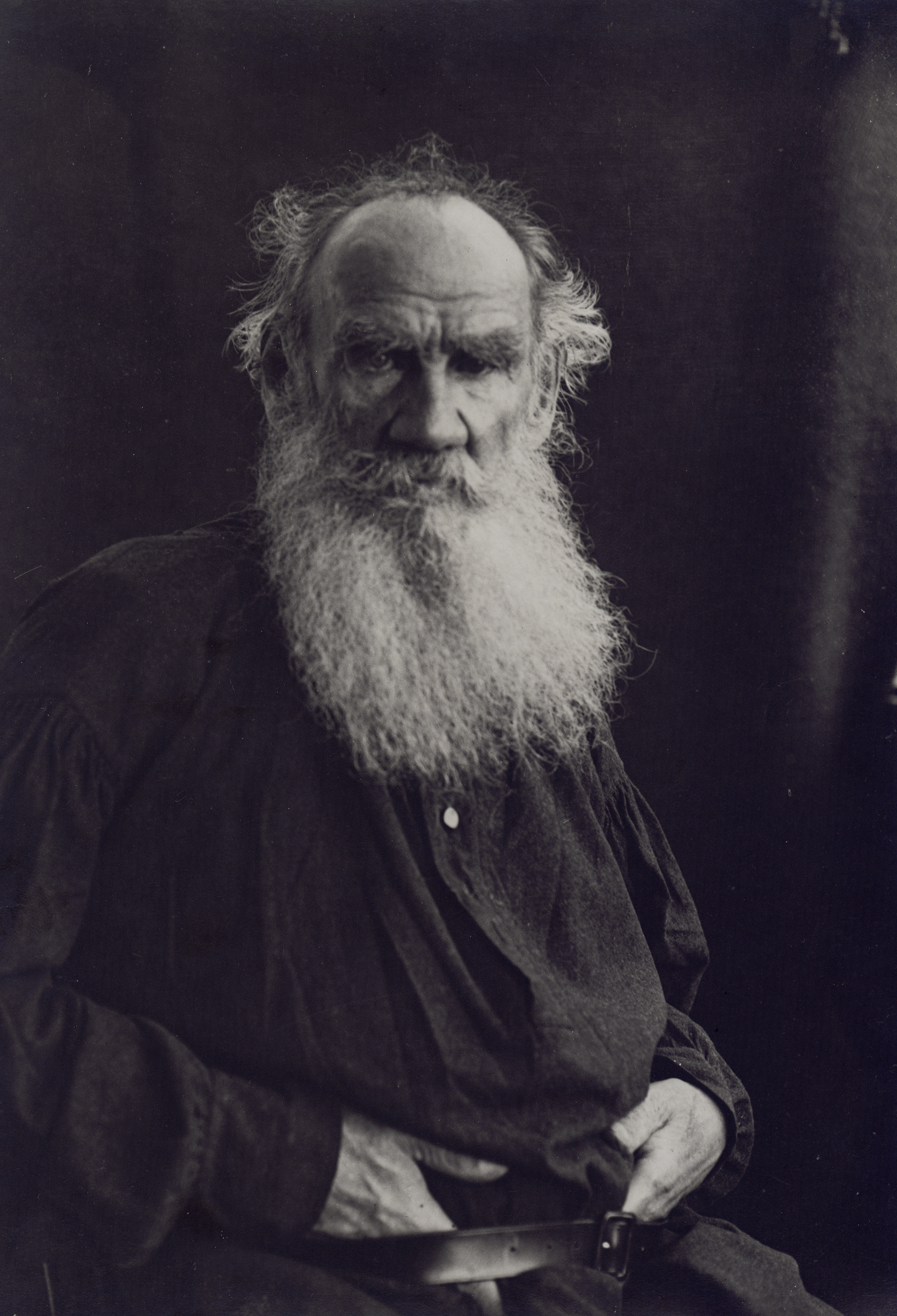
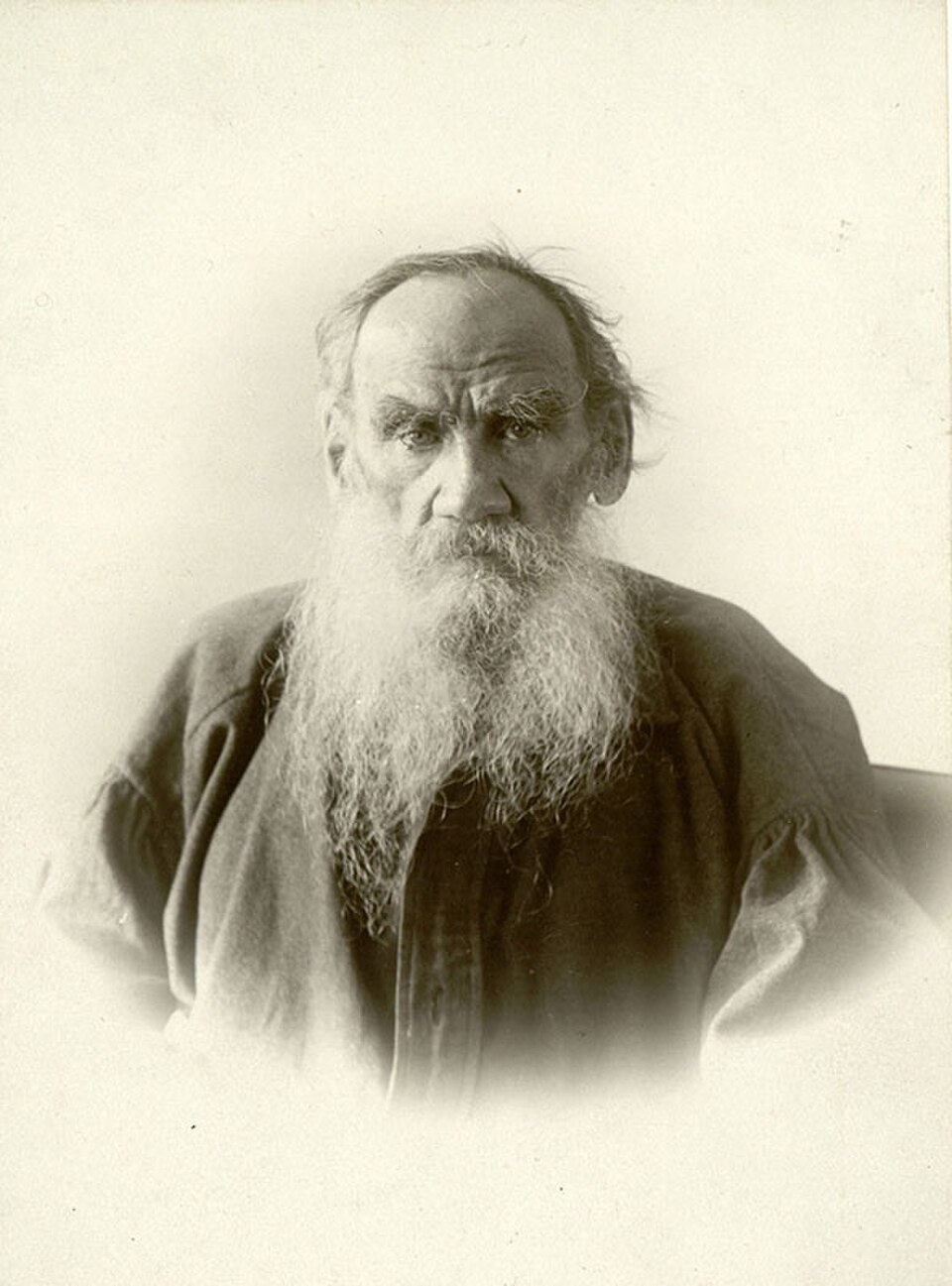
- Photographs of Tolstoy in the composition years (PD, usable). Nine public-domain images were fetched from Wikimedia Commons, clustering on 1902 (the restart) — the Scherer & Nabholz studio portrait, Sofia Tolstaya’s snapshot with their daughter Tatyana, the Gaspra convalescence with Sofia, the vegetarian-breakfast scene — plus the canonical late portraits (Chertkov 1906; Prokudin-Gorsky’s colour photograph and Bulla’s, both 1908). The best authorial connection is Chertkov’s 1906 portrait; the most precisely contemporaneous is the 1902 studio portrait.
- The first editions (metadata only — not freely digitised). The censored Moscow first printing — «Посмертные художественные произведения Л. Н. Толстого», vol. 1 (ed. Chertkov, pub. A. L. Tolstaya, Sytin press, Moscow 1911; the volume that also carried The Devil and After the Ball) — is held at the Russian National Library, description-only. The uncensored Berlin edition the PSS commentary names («Свободное слово», ed. Chertkov, published simultaneously) was not located digitised; a 1912 Berlin J. Ladyschnikow Verlag posthumous-works set surfaced at auction and may be a separate émigré printing (flagged in
needsReview). The first English edition (Hagberg Wright, Thomas Nelson, c. 1911) is fully scanned and public-domain at archive.org (forgedcouponothe00tolsuoft). - Manuscript facsimiles (access-gated). The complete autograph/copy record survives in six groupings at ИРЛИ (Pushkin House, shifr 22.5.16 — the opening autograph and the 151-page full complex) and ГТМ (the State Tolstoy Museum, Chertkov Archive, папки 78 & 82 — including the Chertkov-hand copy of chapter I). No public digital facsimile; reproduction by on-site or remote request (pushkinskijdom.ru; tolstoymuseum.ru; the KAMIS portal tolstoy-iss.kamiscloud.ru; Goskatalog).
- Adaptations (rights-reserved — metadata only). Bresson’s L’Argent (1983) and Louhimies’s Frozen Land (2005); stills and posters are held by the rights-owners (Criterion / the Bresson estate; the Finnish producers). Recorded for the afterlife, not for publication.
Method
A --novel-mode, work-subject corpus dive (interactive, in-session; commit, don’t push). The scope contract was taken from the user’s framing — subject, the structural angle, the marquee candidate, the cross-links — and confirmed in prose rather than gated on a picker. The composition window was pinned from the PSS Tom 36 commentary and the 1886–1904 diaries; the slug start was widened from the user’s proposed 1902 to 1889 (the firm date of the first-chapter autograph), with the 1886 theme-germ noted but held as the structural seed rather than the start of the coupon’s own text. Genesis and reception carried the most effort (the heaviest novel layers); the text was extracted once (extract_tei.py --choice=reg --notes=auto) and read by locating the pivotal scenes — origin, the centrepiece (Maria Semyonovna, quoted in full), and the reversal — with the rest mapped thematically. Quotes are byte-verified against the TEI extracts (verify_quotes.py); the one commentary-mediated genesis quote (the 1886 programme) is flagged. A heavy four-channel visuals sweep and an English-first scholarship/reception sweep ran in parallel as sub-agents writing to files; the verifier pass is separate. No vault pages or works/ records were written — the dossier’s entities and workRecord are a plan for the separate, human ingestion step.
Links. Sibling dives: The Power of Darkness · Resurrection · Hadji Murat · the late voice · the Doukhobors · Tolstoyanism (the contested label, interrogated there, not asserted here).
References
Primary.
- L. N. Tolstoy, «Фальшивый купон», PSS Tom 36, pp. 5–53 (text); pp. 419–422 (variants); pp. 557–581 (commentary, V. S. Mishin).
- L. N. Tolstoy, Diaries 1889–1904, PSS Toms 50–55 (the genesis entries above).
- L. N. Tolstoy, Letter to L. L. Tolstoy, 19 January 1904, PSS Tom 75, pp. 13–15.
- L. N. Tolstoy, «Записки христианина» (1881), quoted in the PSS Tom 36 commentary (the Larivon prototype).
Background (secondary — attributed, not asserted).
- Ilya Kliger & Nasser Zakariya, “Poetics of Brotherhood: Organic and Mechanistic Narrative in Late Tolstoi,” Slavic Review 70.4 (2011), 754–772.
- Ernest J. Simmons, Leo Tolstoy (1946); A. N. Wilson, Tolstoy (1988); Henri Troyat, Tolstoy (1965/67); Rosamund Bartlett, Tolstoy: A Russian Life (2010).
- Richard Gustafson, Leo Tolstoy: Resident and Stranger (1986); Donna Orwin, Tolstoy’s Art and Thought, 1847–1880 (1993).
- Herman Bernstein (intro), The Forged Coupon, and Other Stories (Ogilvie, 1912); Bryn Mawr College digital exhibit, “Crime or Punishment.”
- Tony Pipolo, Robert Bresson: A Passion for Film (Oxford UP, 2010); Paul Schrader, Transcendental Style in Film (1972) — on L’Argent (1983).
- English translations: C. T. Hagberg Wright (ed.), Thomas Nelson 1911 (first English, PD); David Patterson, W. W. Norton 1986; Hugh Aplin, Hesperus 2006 / Alma 2018.
Draft dev-blog note: website/src/posts/notes/2026-06-12-the-forged-coupon.md (draft).