A theme dive on how Одумайтесь! (Bethink Yourselves!, 1904) reached Swedish readers as Betänken Eder!, and on the Swedish peace society’s actual dealings with Tolstoy. It reads two kinds of primary source side by side: the Russian corpus (the Jubilee Edition, PSS, through the tolstoydigital TEI texts) and the Swedish press and catalogues of 1904–1910. Where a Swedish source shows something, the dive says so; where it is reasoning from what was found, it says inferred.
The Swedish text can be read in the reader edition, lined up with the 1904 English and the Russian: Betänken Eder! (Swedish, 1904) · Bethink Yourselves! (English, 1904).
The dive prepares ingestion-ready material (this page, a machine-readable dossier.yaml, byte-faithful extracts/, and a draft note). It writes no wiki pages.
Key findings
- No 1904 source ties SFSF to Betänken Eder!. The question began from the premise that the Swedish Peace and Arbitration Society took the initiative to the pamphlet. A full-text search of the 1904–05 Swedish press, the LIBRIS catalogue, Projekt Runeberg and the Russian corpus found no source that names SFSF, or any society, as initiator, financer or distributor. Every notice names only the Stockholm publisher Björck & Börjesson, and describes a commercial sale: trade discounts, sale-or-return, colporteurs and cigar shops. SFSF’s chair and the editor of its paper were at a peace meeting in Copenhagen the week the pamphlet appeared; the board’s report of that week, and its paper’s September contents, do not mention Tolstoy. What was not searched: SFSF’s own board minutes and the 1904 issues of Fredsfanan that are not digitised. Those could still show a role that left no mark in print; the archive’s location was not verified.
- The real SFSF–Tolstoy link is 1909–10. Johan corrected the question during the dive: he now places SFSF’s involvement around the Stockholm peace congress. That fits the evidence. In 1909 Tolstoy was elected honorary member of the XVIII Universal Peace Congress, set for Stockholm, accepted, and wrote a Report for it; the congress was postponed by the Swedish general strike; in 1910 he was invited again and declined. A short web check found that SFSF’s central board published his Report in Swedish in 1910 as Döda icke! (“Do not kill!”), and that the state grant for the congress had been requested in 1908 by the joint committee of Sweden’s peace associations. Whether the two men who invited him in 1910, Dr J. Bergman and Baron Carl Carlson Bonde, held SFSF office is not established.
- The Swedish text first appeared in a newspaper. Göteborgs Handels- och Sjöfartstidning (GHT) printed the whole letter on 1 July 1904, four days after The Times of London and four days before the pamphlet, with 13 titled chapters, chapter IX, the postscript and the datelines. Within days a dozen provincial papers reprinted it.
- The pamphlet came out on 5 July 1904, 40 pages at 25 öre, 10,000 copies; 35,000 in two weeks, over 20,000 of them in Stockholm. It was no. 1 of the publisher’s own series Fria ord (“Free Words”). It uses GHT’s Swedish chapter titles, so it was built on GHT’s translation (inferred; no credit is given).
- The pamphlet leaves out all of chapter IX, along with the chapter epigraphs, the datelines and the sailor’s postscript, while advertising itself as a “fullständig öfversättning” (complete translation). Chapter IX is the chapter of personal refusal: “I cannot take part in war.” No source says who cut it or why.
- “Till krig emot kriget!” (“War against war!”), the slogan on the cover, was common Swedish vocabulary from 1880 on, in peace papers, free churches and socialist placards alike. Nothing ties it to SFSF.
- Tolstoy’s own words show his distance from peace societies. He had told the Swedish press in 1897 that members of peace societies talk peace and then march when called, and told Bertha von Suttner in 1901 that “neither conferences nor peace societies” stop war. In 1910 he called his last text for Stockholm “a venomous article for the Peace Congress”, and his biographer reports that the congress, “scandalised”, did not read his Report aloud.
- What this changes in the Bethink Yourselves! work dive. It inferred that the Swedish followed Chertkov’s English. That still holds, and the route is now concrete: the translation is GHT’s of 1 July, made from the Times text (inferred from GHT’s own subtitle). It said the Swedish omits the epigraphs; it also omits all of chapter IX, the datelines and the postscript.
Why this matters
Betänken Eder! is the Swedish edition at the root of Johan’s own edition project and of the Swedish version in the reader edition. Knowing who made the text, and what was cut, decides how that edition is described. The answer also corrects an assumption: that a peace society published Tolstoy’s letter against the war. The record shows a fast commercial reprint in 1904, and a peace society that came to Tolstoy only later, around its own congress.
The question, and how the answer changed
Johan’s first question was why SFSF was involved in Betänken Eder! and why it took the initiative. The dive tested that premise first. The 1904 sources do not confirm it (see What SFSF was doing that summer, below). Midway through, Johan corrected his memory: the SFSF connection was later, around Tolstoy’s proposed visit to the Stockholm peace congress. The dive then added a short targeted check of the 1909–10 congress and gave it its own section. Both halves are kept here: the 1904 result stands as a negative finding, and the 1909–10 thread is where the society and Tolstoy did meet.
1904: how Betänken Eder! reached Swedish readers
Chertkov’s plan: one English text, many countries at once
The essay could not be printed in Russia. Its first edition was Chertkov’s, in England:
Статья вышла в издании «Свободного слова», в Крайстчерче, в Англии, в 1904 г.
(working English) The article came out in the Free Word edition, at Christchurch, England, in 1904.
PSS Tom 36, pp. 604–621 (commentary, N. V. Gorbachev) · TEI v36_604_621_Odumajtes. The same commentary records a second, popular edition the same year “intended for the people and soldiers, without epigraphs”, and a corrected third. It names no Swedish translation.
Chertkov told Tolstoy how the essay would go abroad:
Чертков писал, что статья «Одумайтесь!» набирается в его типографии, переведена им на английский язык и появится одновременно в разных странах.
(working English) Chertkov wrote that the article “Bethink Yourselves!” was being set in his press, that he had translated it into English, and that it would appear simultaneously in different countries.
PSS Tom 88, pp. 329–331, editorial note to Tolstoy’s letter to Chertkov of 13 May 1904 (OS) · TEI v88_720_maya13. In the same letter Tolstoy refused Chertkov’s proposal to gather the chapter epigraphs in one place: «на помещение эпиграфов¹ отдельно я не согласен. Мне кажется, это совсем лишит эпиграфы их значения.» (working English) “I do not agree to placing the epigraphs separately. It seems to me this would strip the epigraphs of their meaning entirely.”
The English appeared in The Times on 27 June 1904. The first Swedish summaries followed the next day (Ny Tid, Göteborg, 28 June, “Leo Tolstoj har i »Times» offentliggjort …”).
GHT, 1 July 1904: the first full Swedish text
On Friday 1 July, Göteborgs Handels- och Sjöfartstidning gave two full pages to the letter under a full-width headline:
Lev Tolstoj mot krigets män och tsaren: »BETÄNKEN EDER!« — Den ryktbare ryske tänkarens bref i världsbladet Times.
(working English) Lev Tolstoy against the men of war and the tsar: “Bethink yourselves!” The famous Russian thinker’s letter in the world paper the Times.
GHT, 1 July 1904, no. 149 (B), pp. 7–8 · tidningar.kb.se (read from the page image). GHT’s text runs in 13 numbered chapters, each with a Swedish title, from “KAPITEL I. Hur kunna kristna upplysta människor predika kriget?” to “KAPITEL XIII. »Hvart kan man komma undan?»”, then the sailor’s letter from Port Arthur, then a signature and dateline. Chapter IX is there. GHT splits Tolstoy’s chapter XI in two, so its XIII is Tolstoy’s XII.
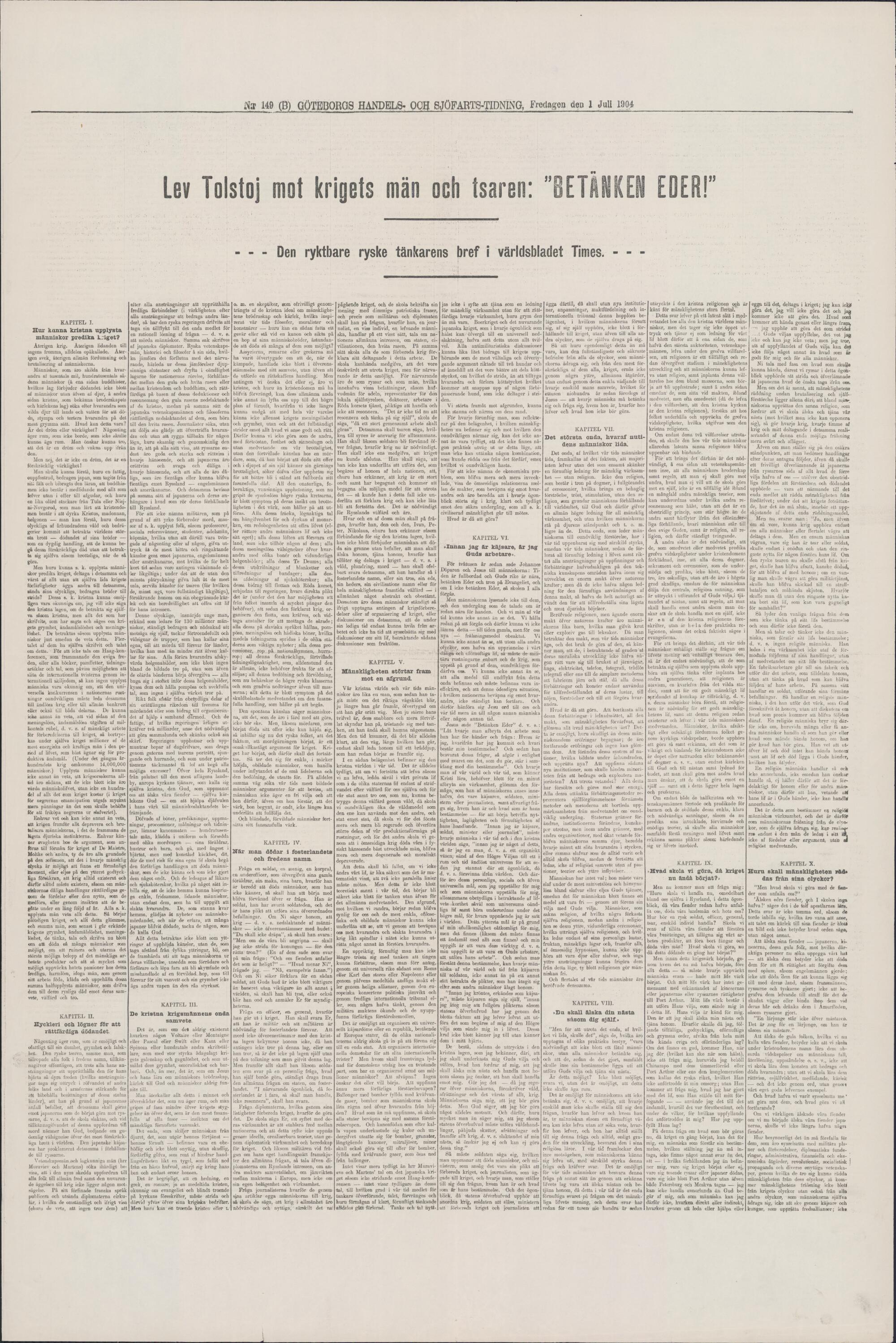
Who translated for GHT is not stated, there or anywhere else found. GHT’s own subtitle, “the letter in the world paper the Times”, points to the Times English as its source (inferred). That agrees with the work dive’s reading of the coda, where the Swedish follows Chertkov’s English at the three points where the English departs from the Russian.
A wave of reprints followed. Ystads Allehanda (4 July), the Västra Dagbladet group (4–5 July), Falköpingsposten, Hessleholms tidning, Örnsköldsviks Allehanda, Nya Lidköpingstidningen and Arbetet (Malmö) reprinted GHT’s text; Falköpingsposten, Hessleholms tidning and Nya Lidköpingstidningen are seen to print chapter IX; Hessleholms tidning even reproduced GHT’s subtitle. In Dalarna the whole GHT text came out as a separate printed part of Avestaposten, Södra Dalarnes tidning and Borlänge tidning (23–30 July); this is probably the 26-page Hedemora edition in LIBRIS (inferred). The Social Democratic daily Socialdemokraten began its own serial on 2 July, “Vi börja härmed att i sin helhet återge Tolstois sista uppseendeväckande bref mot tsaren och kriget” (working English: “We hereby begin to reproduce in full Tolstoy’s latest sensational letter against the tsar and the war”), with different wording at the start; its later instalments match GHT.
Björck & Börjesson, 5 July 1904: the pamphlet
On the morning of Tuesday 5 July the press carried a notice:
»Betänken Eder!», Leo Tolstoys uppseendeväckande bref “till tsaren och krigets män” utkommer redan i e. m. i fullständig öfversättning hos firman Björck & Börjesson.
(working English) “Bethink Yourselves!”, Leo Tolstoy’s sensational letter “to the tsar and the men of war”, comes out this very afternoon in complete translation from the firm Björck & Börjesson.
Svenska Dagbladet, 5 July 1904, p. 4 · tidningar.kb.se. The same release ran in Vårt Land, Dagens Nyheter, GHT, Stockholmstidningen, Arbetet, Sundsvalls tidning and others, 5–11 July.
The next day the publisher advertised in Socialdemokraten:
I går e. m. utkom 1:a upplagan i 10,000 ex. af Tolstoys uppseendeväckande bref, som i dag finnes till salu hos alla bokhandlare, tidningskontor, cigarraffärer samt genom kolportörer.
(working English) Yesterday afternoon the first printing of 10,000 copies of Tolstoy’s sensational letter came out; today it is on sale at all booksellers, newspaper offices and cigar shops, and through colporteurs.
Socialdemokraten, 6 July 1904, p. 1 · tidningar.kb.se.
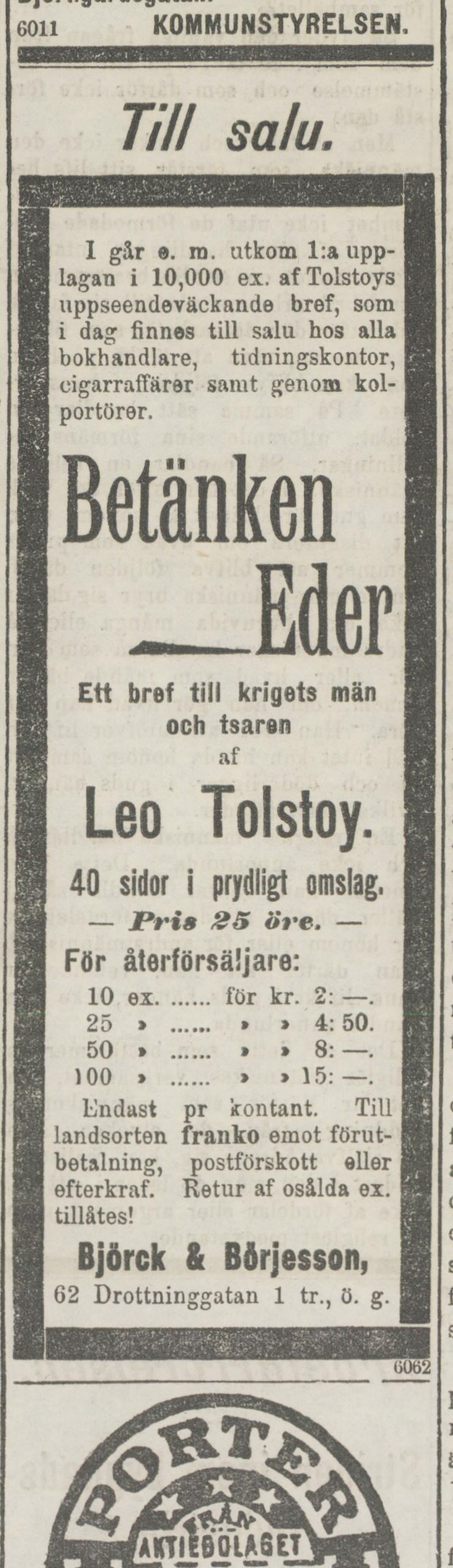
The numbers grew fast. By 9 July the advert read “10,000 exemplar rekvirerade på två dagar” (10,000 copies ordered in two days), with the 10th–15th thousand in press (Arbetarbladet, Gävle, 9 July, p. 2). On 26 July Stockholmstidningen reported a booksellers’ record: the pamphlet “har på den korta tiden af två veckor utgått i icke mindre än 35,000 ex., däraf i Stockholm sålts öfver 20,000” (working English: “has in the short space of two weeks gone out in no fewer than 35,000 copies, of which over 20,000 were sold in Stockholm”). The copy on Projekt Runeberg is the “31:sta–35:te tusendet”.
The publisher’s list shows what kind of firm this was. LIBRIS records the pamphlet as no. 1 of Björck & Börjesson’s series Fria ord. No. 2 was Tsaren i ny belysning, advertised as “a complementary light on Tolstoy’s Betänken Eder”, sold on “the same terms as Tolstoy’s book”, with sales agents wanted (Svenska Morgonbladet, 8 September 1904). Later numbers were Frida Stéenhoff on regulated prostitution, Bertha von Suttner’s Kriget och dess bekämpande, Algot Ruhe on Gorky, and Ryssland i revolution (Tolstoy, Kropotkin, Cherkezov). Other 1904 titles included August Palm’s memoirs and Stepniak’s En nihilist. The firm advertised steadily in the Social Democratic and Young Socialist press. Nothing in the series or its adverts mentions SFSF.
Chapter IX, and what else was cut
The pamphlet’s text is GHT’s, minus chapter IX, with the chapter numbers taken off: GHT’s 13 titled chapters less one leave the pamphlet’s 12 titled sections (inferred from a comparison of titles). The reader edition found the same gap from the text side: the Swedish chapter 8 ends exactly where Tolstoy’s VIII ends, and the Swedish chapter 9 opens with Tolstoy’s X (see the reader edition’s alignment notes, “The Swedish”). The pamphlet also has no chapter epigraphs, no datelines and no postscript; it ends “Låtom oss då icke släcka den, utan sprida och underhålla den! Leo Tolstoy.” (p. 40; Runeberg scan 0042).
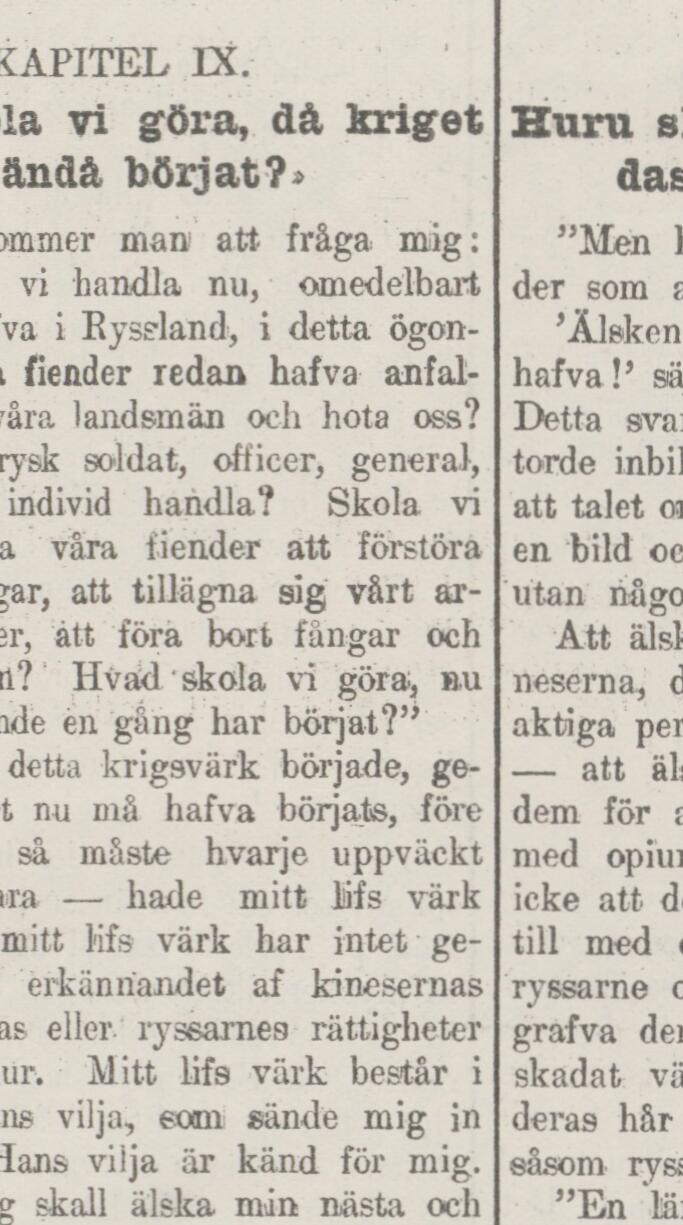
What the missing chapter says is plain from the Russian. In Tolstoy’s text its epigraphs are the letters of peasants who refused military service (P. A. Olkhovik, Kirill Sereda, E. N. Drozhzhin) and a passage from Ephesians. Its body opens with the reader’s objection:
Но как же поступить теперь, сейчас? — скажут мне, — у нас в России в ту минуту, когда враги уже напали на нас, убивают наших, угрожают нам, — как поступить русскому солдату, офицеру, генералу, царю, частному человеку?
(working English) “But how are we to act now, at once?” I shall be told. “Here in Russia, at the moment when enemies have already attacked us, are killing our people, threatening us: how should a Russian soldier, officer, general, tsar, private person act?”
PSS Tom 36, pp. 100–148, chapter IX · TEI v36_100_148_Odumajtes. The answer is a personal refusal:
я не могу поступить иначе как так, как того требует от меня Бог, и потому я, как человек, не могу ни прямо, ни косвенно, ни распоряжениями, ни помощью, ни возбуждением к ней, участвовать в войне
(working English) I cannot act otherwise than as God requires of me, and so I, as a man, cannot take part in war, neither directly nor indirectly, neither by orders, nor by help, nor by urging others to it.
PSS Tom 36, pp. 100–148, chapter IX · TEI v36_100_148_Odumajtes.
No source says who cut chapter IX or why; of the Swedish texts checked, only the Björck & Börjesson pamphlet lacks it (Socialdemokraten’s serial was not read in full). Three possibilities, all inference only:
- Page budget: a 40-page pamphlet at 25 öre. The epigraphs, datelines and postscript are gone too.
- Legal caution: chapter IX is the part most open to a charge of urging refusal of military service under Swedish law in 1904.
- Readership: buyers who were critical of the Tsar but not of national defence as such.
Swedish readers were not cut off from it. The provincial serials printed chapter IX, and the free-church daily Svenska Morgonbladet (13 July, p. 3) printed its central passage in its own wording (“Mitt lifs arbete består i att …”, “the work of my life consists in …”). Nothing found supports the idea that SFSF asked for the cut.
The slogan “Till krig emot kriget!”
The phrase is on the pamphlet from its first week: Falukuriren (8 July, p. 2) reports it was issued “som broschyr med titeln: “Till krig emot kriget! Betänken Eder!”” (working English: “as a pamphlet with the title ‘War against war! Bethink yourselves!’”). It has no counterpart in the Russian. A search of Swedish papers from 1880 to 1904 finds it everywhere: “frid på jorden! krig emot kriget!” (Stockholms Dagblad, 1880), “Kristendom är krig mot kriget” in the peace paper Fredsvännen (1887–89), W. T. Stead’s War against War reported as “Krig mot kriget” (1899), and “Krig mot kriget!” on socialist placards (1901; 1904). It reads as a stock phrase the publisher put on the cover (inferred). It is not a mark of SFSF.
What SFSF was doing that summer
SFSF’s chair in 1904 was med. dr N. A. Nilsson of Örebro, re-elected in January 1904 and January 1905. Its paper Fredsfanan was edited until late 1904 by Carl Sundblad. On 2–6 July, the week of the pamphlet, Nilsson, Sundblad and other Swedish peace leaders (Riksdag members Wavrinsky and Österberg, Professor Knut Wicksell) were at the 5th Nordic Peace Meeting in Copenhagen (Svenska Dagbladet, 5 July, p. 4). On the way home the board met aboard a steamer:
Centralstyrelsen för Svenska freds- och skiljedomsföreningen hade under resa från Köpenhamn till Helsingborg i onsdags sammanträde på ångaren Hven under ordförandeskap af d:r Nilsson från Örebro
(working English) The central board of the Swedish Peace and Arbitration Society met on Wednesday aboard the steamer Hven, travelling from Copenhagen to Helsingborg, with Dr Nilsson of Örebro in the chair.
Falukuriren, 8 July 1904, p. 2 · tidningar.kb.se. The business reported was a delegate to the Boston peace congress and an approach to Andrew Carnegie for support. Tolstoy is not mentioned, although the notice of his pamphlet stands on the same page.
In September, Fredsfanan no. 5 listed its contents in the press: the Copenhagen meeting, “Rysk-Japanska kriget och Sverges neutralitet — ett ord till Sverges tidningspräss. Ett billigt och godt försvar” (working English: “The Russo-Japanese war and Sweden’s neutrality: a word to the Swedish press. A cheap and good defence”), and Franco-Scandinavian peace work (Söderköpingsposten, 19 September 1904, p. 3). Tolstoy’s letter is not among them. The issue’s themes were neutrality and a cheap defence; in September it also petitioned the King against shooting drill in elementary schools. Its Christmas calendar for 1904 did carry a picture, “Leo Tolstoj vid plogen” (Tolstoy at the plough).
The wider reception, briefly
Within a week the letter was summarised in nearly every Swedish paper. The clergy of Skara deanery discussed it at a church meeting, where “Tolstoi har både sympatier och antipatier bland prästmännen” (Westgötaposten, 23 August, p. 2). A Finn tried to smuggle copies into Russian-ruled Finland through Torneå (Örnsköldsviks Allehanda, 7 September). Some conservative papers called it a fabrication of The Times. The summer’s mood was set by events in Finland: the governor-general Bobrikov was shot in Helsinki on 16 June, three weeks before the pamphlet.
The earlier Swedish thread, in Tolstoy’s words (1896–1906)
Before 1904, every Swedish contact in the corpus runs through named individuals and newspapers, not a society.
The family. In 1896 his son Lev Lvovich married Dora Westerlund, a Swedish doctor’s daughter. Tolstoy wrote to him:
Хотя я и стараюсь не иметь предилекции к людям и нациям, шведы мне всегда были, еще с Карла XII,¹ симпатичны.
(working English) Although I try not to have a predilection for peoples and nations, the Swedes have always been congenial to me, ever since Charles XII.
PSS Tom 69, pp. 43–45, letter to L. L. Tolstoy, 19 February 1896 (OS) · TEI v69_031_L_L_Tolstomu.
1897: the Nobel letter, with Langlet. When Swedish papers reported that Nobel’s will left money to those who had served peace best, Tolstoy wrote to Stockholms Tagblad proposing it go to the families of the Doukhobors who had refused military service. His French cover note names the Swede who helped: “Voldemar Langlet, c’est lui, qui m’a conseillé de m’adresser à votre journal.” (working English: “Voldemar Langlet is the one who advised me to address your newspaper.”) The diary: «Вчера докончил перевод с Langlet.» (working English: “Yesterday I finished the translation with Langlet.”) (PSS Tom 53, p. 152, 21 September 1897). Sofya Andreevna objected; he told P. A. Boulanger «были препятствия со стороны Софьи Андреевны» (there were obstacles from Sofya Andreevna). See also the Doukhobors dive.
1899: the Letter to the Swedes, through Stadling. A collective letter from Stockholm asked Tolstoy to support their plan to raise refusal of military service at the Hague conference. The PSS commentary gives the signatories only by occupation:
Четыре члена рейхстага, один журналист, один секретарь редакции, два профессора, пять пасторов, один военный врач, один директор миссии, один учитель и другие.
(working English) Four members of the Riksdag, one journalist, one editorial secretary, two professors, five pastors, one army doctor, one mission director, one teacher, and others.
PSS Tom 72, pp. 9–16, commentary · TEI v72_003_Gruppeshvedskojintelligencii (notes). Their concern was Swedish objectors: «более тридцати беспорочных молодых людей осуждены в тюрьму» (more than thirty blameless young men sentenced to prison) in a decade. Swedish papers of 1899 describe the senders as “flera personer i Stockholm och Upsala” (several persons in Stockholm and Uppsala); none names SFSF. Tolstoy agreed with them about refusal and disagreed about the conference:
Конференция может только отвести глаза народа от единственного средства спасения и освобождения.
(working English) The conference can only turn the people’s eyes away from the one means of salvation and liberation.
PSS Tom 90, pp. 60–66, «По поводу конгресса о мире. Письмо к шведам» · TEI v90_060_066_Po_povodu_kongressa_o_mire_Pismo_k_shvedam. He sent the reply to the writer Jonas Stadling to translate and place, and Stadling reported back: «Я перевел ваше письмо и напечатал его по-шведски (“Aftonbladt”), по-английски (“The Daily Chronicle”) и по-немецки (“Lokal Anzeiger”)» (working English: “I have translated your letter and printed it in Swedish (Aftonbladet), English (The Daily Chronicle) and German (Lokal-Anzeiger)”) (PSS Tom 90, pp. 367–368, commentary). Stadling also collected Swedish money for famine relief that autumn (PSS Tom 72, p. 214).
1902 and 1906: the Nobel Prize. Swedish writers and artists protested to him that the first literature prize had passed him over. He answered, in French, through Professor Oskar Levertin: «Я был очень доволен, что Нобелевская премия не была мне присуждена.» (working English: “I was very pleased that the Nobel Prize was not awarded to me.”) (PSS Tom 73, pp. 204–205). In 1906 he asked the Finnish writer Arvid Järnefelt to use his Swedish connections «постараться сделать так, чтобы мне не присуждали этой премии» (to try to see that this prize is not awarded to me) (PSS Tom 76, pp. 201–202).
What Tolstoy said about peace societies
The corpus is consistent across these years: peace societies and conferences are signs that people want peace, but they do not end war; only individual refusal does. In 1898 he listed «деятельности конгрессов и обществ мира» (the activity of congresses and peace societies) among signs of the times, but “above all” individual refusals of service (PSS Tom 31, pp. 78–86). In the 1897 letter to Stockholm he was sharper:
О мире говорят профессора, писатели, члены парламентов и обществ мира и те же профессора, писатели, члены парламентов и обществ мира при случае выражают патриотические чувства
(working English) Professors, writers, members of parliaments and of peace societies talk about peace, and the same professors, writers, members of parliaments and of peace societies express patriotic feelings when occasion arises.
PSS Tom 70, pp. 148–154, letter to the editor of Stockholms Tagblad, 23 September 1897 (OS) · TEI v70_175_RedaktorugazetyStokholmTagblatt.
To Bertha von Suttner, whose Die Waffen nieder! had made her the best-known voice of the peace societies, he wrote in 1901:
Pour que la guerre disparaisse il ne faut ni conférences, ni sociétés de paix, il ne faut qu’une chose: le rétablissement de la vraie religion et à la suite de cela le rétablissement de la dignité de l’homme.
(working English) For war to disappear, neither conferences nor peace societies are needed, only one thing: the restoration of true religion and, following from it, the restoration of human dignity.
PSS Tom 73, pp. 124–127, letter to Bertha von Suttner, 15/28 August 1901 · TEI v73_139_BerteZutnerBerthaSuttner (written in French; the PSS prints a Russian translation). He added that if a fraction of the energy spent on speeches «на конференциях и в обществах мира» (at conferences and in peace societies) went into schools and among the people, wars would soon become impossible.
Одумайтесь! itself faults the speeches that reconciled the war with the Hague conference, and a draft of it lists «общества мира, и международные суды» (peace societies and international courts) among the remedies “already tried” (PSS Tom 36, pp. 426–435, variants). For a society that worked for arbitration and, in its September 1904 paper, for neutrality and a cheap defence, this may have been hard material to put its name to (inferred). That does not prove SFSF kept its distance in 1904, but it fits the silence in its paper.
1909–10: the Stockholm peace congress — where SFSF and Tolstoy did meet
The invitation. The XVIII Universal Peace Congress was to open in Stockholm on 14/27 August 1909. The state grant for it had been asked for in 1908 by “Sveriges fredsförenings samarbetskommitté” (the joint committee of Sweden’s peace associations), and the Riksdag granted 10,000 kronor (Kungl. Maj:ts proposition nr 93, 1908, p. 3; Statsutskottets utlåtande nr 92, 1 May 1908) [found in the web check]. In July 1909 Tolstoy told a correspondent:
Господа эти избрали меня почетным членом и приглашают на конец августа в Штокгольм, в Швецию, где будет собрание.
(working English) These gentlemen have elected me an honorary member and invite me to Stockholm, in Sweden, at the end of August, where the meeting will be.
PSS Tom 80, pp. 13–14, letter to A. V. Varnavsky, 10 July 1909 (OS) · TEI v80_016_A_V_Varnavskomu. He meant to go, “to say there as clearly as I can that peace can be established among people only when people truly believe, in deed and not in words, in Christ’s law of love” (working English). His secretary N. N. Gusev had recorded on 9 July: «Сегодня же Л. Н. продиктовал мне письмо президенту конгресса» (that same day L. N. dictated to me a letter to the president of the congress) (PSS Tom 38, pp. 520–523, commentary). The letter, in French, accepts: “Si mes forces me le pormettent je ferai mon possible pour me rendre à Stockholm à la date indiquée” (working English: “If my strength allows, I will do everything possible to come to Stockholm on the appointed date”) (PSS Tom 80, pp. 22–24). The PSS calls the addressee only “the president of the XVIII peace congress”; it does not name him or his society.
The Report. He prepared from his earlier Swedish text:
Сейчас для Штокгольма перечитывал и письмо к шведам и Царство Божие. Всё как будто сказано.
(working English) Just now, for Stockholm, I re-read the letter to the Swedes and The Kingdom of God. Everything seems to have been said.
PSS Tom 57, pp. 97–98, diary, 20 July 1909 (OS) · TEI v57_097_098_1909_07_20. (See the Kingdom of God dive.) The Report opens «мы собрались здесь для того, чтобы бороться против войны» (we have gathered here to fight against war) and asks the congress to be the child in Andersen’s tale:
Как в сказке Андерсена, когда царь шел в торжественном шествии по улицам города и весь народ восхищался его прекрасной новой одеждой, одно слово ребенка, сказавшего то, что все знали, но не высказывали, изменило все.
(working English) As in Andersen’s tale, when the king walked in solemn procession through the streets and all the people admired his fine new clothes, one word from a child, who said what everyone knew but no one said, changed everything.
PSS Tom 38, pp. 119–125 · TEI v38_119_125_Doklad_prigotovlennyj_dlja_kongressa_mira_v_Stokgolme.
The postponement. Sofya Andreevna opposed the journey, and Tolstoy arranged for Järnefelt to read the Report in his place; then «4 августа было получено телеграфное извещение, что конгресс отложен до 1910 г.» (on 4 August a telegram came that the congress was put off until 1910) (PSS Tom 80, pp. 22–24, commentary). The official reason was the Swedish general strike. Tolstoy suspected more, as D. P. Makovitsky recorded on 6 August:
Я думаю — это нескромно с моей стороны, — что в том, что конгресс отложен, сыграли роль не одна забастовка рабочих в Швеции
(working English) I think (it is immodest of me) that it was not the workers’ strike in Sweden alone that played a part in the congress being put off.
PSS Tom 80, pp. 22–24, commentary quoting Makovitsky’s diary · TEI v80_029_OrganizacionnomukomitetuXVIIIMezhdunarodno (notes). He imagined the organisers asking «Как нам быть с ним? Прогнать нельзя» (“What are we to do with him? We can’t chase him away”). That is his guess; the Swedish side gave the strike as the reason (below).
SFSF publishes the Report (1910). This is the one place found where SFSF itself put Tolstoy’s words into print. Döda icke! Det tal som skulle hållits på fredskongressen i Stockholm (“Do not kill! The speech that was to have been given at the peace congress in Stockholm”), 16 pages, carries on its last page:
Denna skrift är utgiven av Svenska Freds- och Skiljedomsföreningens Centralstyrelse, Stockholm.
(working English) This publication is issued by the Central Board of the Swedish Peace and Arbitration Society, Stockholm.
Döda icke! (Stockholm 1910), p. 16 · runeberg.org; KB dark-21812337, catalogue date 15 January 1910 [found in the web check]. Its preface gives the Swedish account of the postponement: “var det meningen att Leo Tolstoj skulle närvara och hålla ett tal. Den stora ryska författarens hitkomst avvaktades naturligtvis med spänning, men så kom storstrejken emellan” (working English: “it was intended that Leo Tolstoy should attend and give a speech. The great Russian writer’s coming was of course awaited with excitement, but then the general strike intervened”). It says the translation is the one Dagens Nyheter printed after applying to Tolstoy for the text, and it opens “Älskade bröder! Vi ha samlats här för att kämpa mot kriget.” The preface dates the planned congress to “september förra året”, against the PSS’s late August.
1910: the second invitation and the unsent Addition. On 23 May 1910 Tolstoy received an invitation to the congress, now set for 1–6 August 1910 (NS), from:
Ж. Бергман — доктор филологических наук, секретарь организационного комитета XVIII Всеобщего конгресса мира в Стокгольме
(working English) J. Bergman, doctor of philology, secretary of the organising committee of the XVIII Universal Peace Congress in Stockholm.
PSS Tom 82, pp. 56–57, commentary · TEI v82_058_ZH_BergmanuJ_BergmaniKarluKarlsonuBonduCar (notes). Baron Carl Carlson Bonde repeated the invitation on 13 June (NS). Tolstoy’s draft reply declines: «Состояние моего здоровья не позволит мне предпринять путешествие в Стокгольм» (the state of my health will not allow me to undertake the journey to Stockholm). Then, on 19 July, he wrote what his diary calls «ядовитую статью в Конгресс мира» (“a venomous article for the Peace Congress”) (PSS Tom 38, p. 577, commentary). It begins «Вы желаете, чтобы я участвовал в вашем собрании» (you wish me to take part in your meeting) and says what he expected:
на всех конгрессах мира мои взгляды и не мои личные, а взгляды всех религиозных людей мира на этот вопрос считаются под названием неопределенного нового слова антимилитаризма исключительным, случайным проявлением личных желаний и свойств некоторых людей
(working English) ...at all the peace congresses my views (and not mine personally, but those of all religious people in the world on this question) are treated, under the vague new word “antimilitarism”, as an exceptional, chance expression of the personal wishes and traits of certain people.
PSS Tom 38, pp. 419–420, «Добавление к докладу на конгрессе мира», 20 July 1910 (OS) · TEI v38_419_420_Dobavlenie_k_dokladu_na_kongresse_mira. Against that he sets the men who refuse service, among them a Swede: «вчера только получил такое письмо от молодого Шведа, готовящегося к отказу» (only yesterday I received such a letter from a young Swede preparing to refuse). What is needed, he ends, is «не союзы, не конгрессы, устраиваемые императорами и королями» (not unions, not congresses arranged by emperors and kings) but the law of love. The Addition «осталась неоконченной и неотправленной» (remained unfinished and unsent).
At the congress. The congress met in August 1910. Biryukov, quoted in the PSS, reports what happened to the Report:
Статья Л. Н-ча, которую он послал на конгресс, была получена, но на конгрессе ее не читали.
(working English) L. N.’s article, which he sent to the congress, was received, but it was not read at the congress.
PSS Tom 38, pp. 520–523, commentary quoting P. I. Biryukov, «Биография Л. Н. Толстого», vol. IV (1923), p. 191 · TEI v38_520_523_Doklad_prigotovlennyj_dlja_kongressa_mir. His reason: «Умеренная и благонамеренная среда пацифистов, собравшихся на конгресс, была скандализирована «выходкой» Л. Н-ча» (the moderate and well-meaning milieu of pacifists gathered at the congress was scandalised by L. N.’s “escapade”), the view that for people not to make war there should be no army. “Pacifists” is Biryukov’s word.
What is still open. Whether the organising committee was SFSF’s or the joint committee’s, and whether Bergman and Bonde were SFSF officers, was not found. Bonde nominated candidates for the Nobel Peace Prize in 1911, and in 1913 on behalf of the Swedish group of the Inter-Parliamentary Union (Digitalarkivet, Norway); that places him in the peace movement but not in an SFSF office. “Dr J. Bergman” may be the Latinist and temperance leader Johan Bergman (1864–1951); that is not confirmed. SFSF’s Knut Sandstedt is said to have represented the society at the Stockholm congress of 1910 (Wikipedia, “Knut Sandstedt”). The Swedish press of July–August 1909 and of 1910 was not read for this dive.
Where the theme clusters
Letters
| Tom | Letter id | Date | Addressee | Material |
|---|---|---|---|---|
| 69 | v69_031 | 19 Feb 1896 (OS) | L. L. Tolstoy | “the Swedes have always been congenial to me” |
| 70 | v70_154 | 3 Sep 1897 (OS) | P. A. Boulanger | letter to Sweden finished despite Sofya Andreevna |
| 70 | v70_175 | 23 Sep 1897 (OS) | editor, Stockholms Tagblad | Nobel money for the Doukhobors; peace societies; Langlet |
| 84 | v84_687 | 21 Sep 1897 (OS) | S. A. Tolstaya | friction over “the letter to the Swedish papers” |
| 72 | v72_003 | 7–9 Jan 1899 (OS) | group of Swedish intelligentsia | covering letter; signatories by occupation |
| 72 | v72_011 | 12 Jan 1899 (OS) | Jonas Stadling | asks him to translate and print the reply |
| 72 | v72_187 | 9/21 Oct 1899 | Jonas Stadling | 250 roubles for famine relief |
| 73 | v73_139 | 15/28 Aug 1901 | Bertha von Suttner | “neither conferences nor peace societies” |
| 73 | v73_211 | 22 Jan/4 Feb 1902 | Swedish writers and scholars | glad the Nobel Prize passed him |
| 76 | v76_274 | 25 Sep 1906 (OS) | Arvid Järnefelt | keep the Nobel Prize from him |
| 88 | v88_720 | 13 May 1904 (OS) | V. G. Chertkov | keep the epigraphs; Chertkov’s simultaneous release |
| 80 | v80_016 | 10 Jul 1909 (OS) | A. V. Varnavsky | elected honorary member; wants to go |
| 80 | v80_029 | 12/25 Jul 1909 | president, XVIII peace congress | acceptance (French); postponement in commentary |
| 82 | v82_058 | 23 May–12 Jun 1910 (OS) | J. Bergman, C. C. Bonde | declines on health grounds |
Diaries
| Tom | Entry | Material |
|---|---|---|
| 53 | 21 Sep 1897 | “finished the translation with Langlet” |
| 53 | 21 Feb 1899 | “wrote … to the Swedish papers” |
| 57 | 20 Jul 1909 | re-read the letter to the Swedes for Stockholm |
Works and commentary
| Tom | Text | Material |
|---|---|---|
| 31 | «Приближение конца» (1898) | peace congresses and societies as signs; refusal first |
| 39 | «Carthago delenda est» (1898) | refusers in Sweden among other countries |
| 90 | «По поводу конгресса о мире. Письмо к шведам» (1899) + commentary | the 1899 letter and how Stadling printed it |
| 36 | «Одумайтесь!» (1904), variants, commentary | chapter IX; Hague; editions abroad |
| 38 | Report for the Stockholm congress (1909); Addition (1910); commentary | the 1909–10 thread |
Swedish sources
| Date | Source | Material |
|---|---|---|
| 28 Jun 1904 | Ny Tid | first Swedish summary from The Times |
| 1 Jul 1904 | GHT, pp. 7–8 | first full Swedish text, chapter IX included |
| 2 Jul 1904 | Socialdemokraten | own serial begins |
| 5 Jul 1904 | Svenska Dagbladet | pamphlet out “this afternoon”, “complete translation”; Copenhagen peace meeting |
| 6 Jul 1904 | Socialdemokraten | advert: 10,000 copies, trade terms |
| 8 Jul 1904 | Falukuriren | slogan on the pamphlet; SFSF board meeting without Tolstoy |
| 9 Jul 1904 | Arbetarbladet | 10,000 ordered in two days |
| 13 Jul 1904 | Svenska Morgonbladet | chapter IX passage printed |
| 26 Jul 1904 | Stockholmstidningen | 35,000 in two weeks |
| 23 Aug 1904 | Westgötaposten | Skara clergy discuss the pamphlet |
| 19 Sep 1904 | Söderköpingsposten | Fredsfanan no. 5 contents |
| 1904 | LIBRIS, Runeberg | Fria ord no. 1; 31st–35th thousand |
| 1908 | Riksdag prop. 93 | joint peace committee asks for the congress grant |
| 1910 | Döda icke! | SFSF central board publishes the Report |
What this corrects in the work dive
The Bethink Yourselves! work dive (2026-06-08) is left unchanged; this section records where it now needs a note.
- Source of the Swedish. It inferred from the coda that the Swedish followed Chertkov’s English rather than the Russian. That still holds. The concrete route is now known: the pamphlet’s text is GHT’s translation of 1 July 1904, which calls itself the letter “in the world paper the Times”.
- Translator. Still unnamed: not in the pamphlet, not in GHT, not in any reprint, not in five LIBRIS records. LIBRIS’s “from Russian” is a cataloguing code, and Runeberg’s note does not itself say “translated from the Russian”.
- What the Swedish omits. It said the Swedish omits the chapter epigraphs. It also omits all of chapter IX, the datelines and the sailor’s postscript.
- Editions. There were at least two Swedish book editions in 1904 (Stockholm, Björck & Börjesson, 40 pp.; Hedemora, 26 pp., a newspaper supplement), plus full printings in GHT and a dozen provincial papers.
Scholarly context
No academic scholarship was consulted; the question is answered by the 1904 newspapers and catalogues and by the corpus. Two Wikipedia articles were read for background on SFSF people: “Carl Sundblad” (editor of Fredsfanan 1898–1904, SFSF chair 1888–96) and “Knut Sandstedt” (a long-serving SFSF officer, said to have represented the society at the Stockholm congress of 1910). The main earlier account is the project’s own work dive, which this one extends.
Material not covered
- SFSF’s internal records: board minutes for summer 1904 and Fredsfanan 1904 nos. 4–6 (not in Svenska tidningar). These would settle the 1904 question either way. The archive’s location was not verified.
- The Times, 27 June 1904 and the Free Age Press popular edition: whether GHT translated from the Times text, and whether its chapter heads came from there.
- Who translated for GHT: GHT’s own columns of 30 June–2 July; Motala Tidning, 4 July 1904, p. 3, whose snippet may credit the translation.
- Socialdemokraten’s whole serial (2–9 July 1904): whether it printed chapter IX, and where it switches to GHT’s wording.
- Hvar 8 dag (Göteborg), 10 July 1904, pp. 5 and 7; the Hedemora edition’s pages; Svensk bokkatalog 1901–1905.
- Björck & Börjesson: the partners’ names, and whether they paid GHT.
- 1909–10: the organising committee’s roster; the proceedings of the 1910 congress; Swedish press on Tolstoy’s acceptance, the postponement and his 1910 refusal; whether Bergman and Bonde held SFSF office.
- The 1899 signatories’ names (Svobodnaya Mysl 1899 no. 1; Aftonbladet, February–March 1899).
Visual & manuscript record
All images are 1904 Swedish newspapers from Kungliga biblioteket’s Svenska tidningar, fetched through KB’s IIIF image service into the local visuals/ cache (not committed). Printed in 1904, they are public domain; KB offers pre-1906 material freely.
- GHT, 1 July 1904, p. 7, full page (embedded above) and a detail of “KAPITEL IX” (embedded above).
- GHT, 1 July 1904, p. 8, full page: chapters XI–XIII and the sailor’s letter.
- Socialdemokraten, 6 July 1904, p. 1: the first advert (embedded above).
- Arbetarbladet, 9 July 1904, p. 2: “10,000 exemplar rekvirerade på två dagar”.
Not downloaded but openly available: the Runeberg scan of the pamphlet (31st–35th thousand, with the slogan on the cover), and KB’s scan of Döda icke! (1910, marked Public Domain Mark 1.0). Johan’s own scan of a first-week copy is recorded in the work dive. Each item’s source URL and licence are in dossier.yaml.
Method
Theme dive, run 2026-10-24 from two finished sweeps. The corpus sweep (extracts/_sweep_corpus.md) searched the tolstoydigital TEI corpus for Swedish names, places and peace-society terms for 1895–1910, with the 1904 letters, diaries and the Tom 36 commentary read in full; extracts were made with extract_tei.py --choice=reg --notes=auto, and with --notes=force (.notes-force.txt) where the editorial notes under a letter mattered. The Swedish sweep (extracts/_sweep_swedish.md) used Svenska tidningar full-text search (June 1904–April 1905, plus phrase searches from 1880), LIBRIS, Projekt Runeberg and KB page images; it marks each point FOUND or INFERRED, and this page keeps that distinction. After Johan corrected the question, a short web check (seven searches, plus Runeberg, the KB data API and two Riksdag prints) looked at SFSF’s part in the 1909–10 congress; it found Döda icke! and the 1908 Riksdag print, but no committee roster. Every Russian or French quote in dossier.yaml is checked byte-for-byte against its extract with verify_quotes.py; Swedish quotes are as read from page images or, where marked, from OCR snippets. Working-English translations are the dive’s own. The PSS PDF cross-check was not run.
Links: Bethink Yourselves! work dive · The Kingdom of God Is Within You · Doukhobors · Free Age Press.
References
Primary, Russian: Толстой Л. Н. Полное собрание сочинений в 90 тт. (Jubilee Edition), Тт. 31, 36, 38, 39, 53, 57, 69, 70, 72, 73, 76, 80, 82, 84, 88, 90, via the tolstoydigital TEI corpus. Commentaries by N. V. Gorbachev (Tom 36), V. S. Mishin and N. K. Gudzy (Tom 38), M. A. Tsyavlovsky (Tom 90).
Primary, Swedish: Göteborgs Handels- och Sjöfartstidning, 1 July 1904; Socialdemokraten, 2 and 6 July 1904; Svenska Dagbladet, 5 July 1904; Falukuriren, 8 July 1904; Arbetarbladet, 9 July 1904; Svenska Morgonbladet, 13 July and 8 September 1904; Stockholmstidningen, 26 July 1904; Westgötaposten, 23 August 1904; Örnsköldsviks Allehanda, 7 September 1904; Söderköpingsposten, 19 September 1904 (all via tidningar.kb.se). Betänken Eder! Ett bref till krigets män och tsaren (Stockholm: Björck & Börjesson, 1904; Fria ord 1), runeberg.org/betanken; LIBRIS 2201876, 2090384, 8228618. Döda icke! Det tal som skulle hållits på fredskongressen i Stockholm (Stockholm: SFSF central board, 1910), runeberg.org/tldodaicke. Kungl. Maj:ts proposition nr 93 (1908) and Statsutskottets utlåtande nr 92 (1908), via weburn.kb.se.
Background: Wikipedia, “Carl Sundblad” and “Knut Sandstedt”. Digitalarkivet, NOBEL/NOM records 157381 and 157442. American Peace Society reprint of the Times text (Boston 1904), archive.org. The project’s Bethink Yourselves! work dive and the reader edition’s alignment notes (docs/reader/non-fiction/essays-and-criticism/bethink-yourselves/alignment-notes.md).
Dev-blog note (draft): website/src/posts/notes/2026-10-24-betanken-eder-in-sweden.md.