Date: 2026-06-03
Context: A primary-source survey of how Tolstoy, his family and circle, and his places were photographed — from the 1856 group portrait of the Sovremennik writers to the deathbed and funeral at Astapovo in 1910. The dive maps each major photograph to the date it was actually taken, checks whether a high-quality reproduction survives, and records whether it is public domain or held under institutional control. Its spine is Tolstoy’s own letters and diaries: who photographed him, what he sent and received, and — above all — how he behaved while being photographed. It is the photographic companion to the Tolstoy in art dive, which deliberately set photography aside. This is a research prototype: primary citations are byte-faithful; secondary claims are attributed, not asserted.
1. Key findings
- Tolstoy is among the most-photographed people of the nineteenth century, and the local corpus dates the turning points in his own hand. Sofia photographing the family and Kozlovka station (10–11 Oct 1896), the December 1894 group photograph destroyed in negative, the Prokudin-Gorsky colour session forwarded to Sofia (30 March 1908), the Tapsell photographs at Krekshino (Sept 1909) — each is fixed by a letter or diary entry.
- He began as an initiator and ended as the pursued. In 1856 Tolstoy says the literary group photograph was made “at my proposal”; by 1909 the camera is something that “pursues” him and makes him feel like “the vile Lev Nikolaevich.” The arc from agent to subject is in the corpus, not just in the scholarship.
- The deepest note is indifference, not vanity or refusal. The single clearest statement is to Molochnikov in his jubilee year, 1908: he forgot to send his portrait card “because I cannot attach any importance to it.” Around it cluster the shame of handing out cards (1889), the distaste at sending an open postcard of his own face (1906), and the self-reproach at “a show of vanity” over a picture of himself (1909).
- The fight over Tolstoy’s image was old, mutual, and photographic. The famous last-year struggle had a rehearsal at the end of 1894, when Sofia Andreevna seized and destroyed the negatives of Tolstoy photographed with Chertkov and four Tolstoyans. Tolstoy’s diary records only that “the story with the photograph is very sad.” Sofia was both the tender keeper of the family album and the destroyer of an unwanted negative.
- Almost everything is public domain; the obstacle is institutional photography, not copyright. Every photographer here — Levitsky (d. 1898), Bulla (d. 1929), Chertkov (d. 1936), Sofia Andreevna (d. 1919), Prokudin-Gorsky (d. 1944) — has been dead long enough that the images are PD in Russia (life+70) and the US (pre-1929). Yet the Russian holding institutions — the State Tolstoy Museum, TsGAKFFD, Yasnaya Polyana — treat their own high-resolution scans as controlled, charged-for assets regardless. This is exactly the pattern the art dive found for paintings.
- Reproduction quality is uneven and predictable. The Prokudin-Gorsky colour portrait survives at high resolution (the Library of Congress master is “no known restrictions on publication”); the Metropolitan Museum’s funeral album is CC0 at 4000 px; but the Bulla jubilee glass negatives, the bulk of the Chertkov archive, and the earliest 1849 daguerreotypes are absent from open repositories and must be requested from the institutions that hold them.
2. Why this matters
tolstoy.life is building a cited, public-domain reference vault around Tolstoy’s life and circle, and the photographic record is the densest visual evidence it has. The wiki pages for Chertkov, Sofia Andreevna, Prokudin-Gorsky, Bulla and the museums need a dated, rights-checked image catalogue; the persons-and-places map needs to know which sittings happened when and where; and the project’s account of Tolstoy’s last years turns on who controlled his image. Grounding that catalogue in Tolstoy’s own dated words — rather than the rounded years on gallery labels — lets the vault correct the record where the two diverge, and source images that are genuinely free to publish rather than ones an institution merely displays. The dive also meets head-on a question the project keeps returning to: how the family, the disciples and the press each tried to own the face of a man who wanted no importance attached to it.
3. The shape of the question
3.1 — 1856: the initiator
The earliest photographic event in the corpus is also a correction to a popular story. In April 1856, from Petersburg, the 27-year-old Tolstoy tells his sister that the group portrait of the Sovremennik circle was his own idea.
Date: 1856-04-14. To M. N. Tolstaya (his sister), PSS Tom 61, pp. 372–374 (TEI v61_444_M_N_Tolstoj).
«по моему предложению, все литераторы сделали фотографическую группу: Тургенев, Григорович, Дружинин, Гончаров, Островский и я, и эту группу я тебе пришлю»
“At my proposal, all the literary men had a photographic group made: Turgenev, Grigorovich, Druzhinin, Goncharov, Ostrovsky and I, and I will send you this group.” (working English)
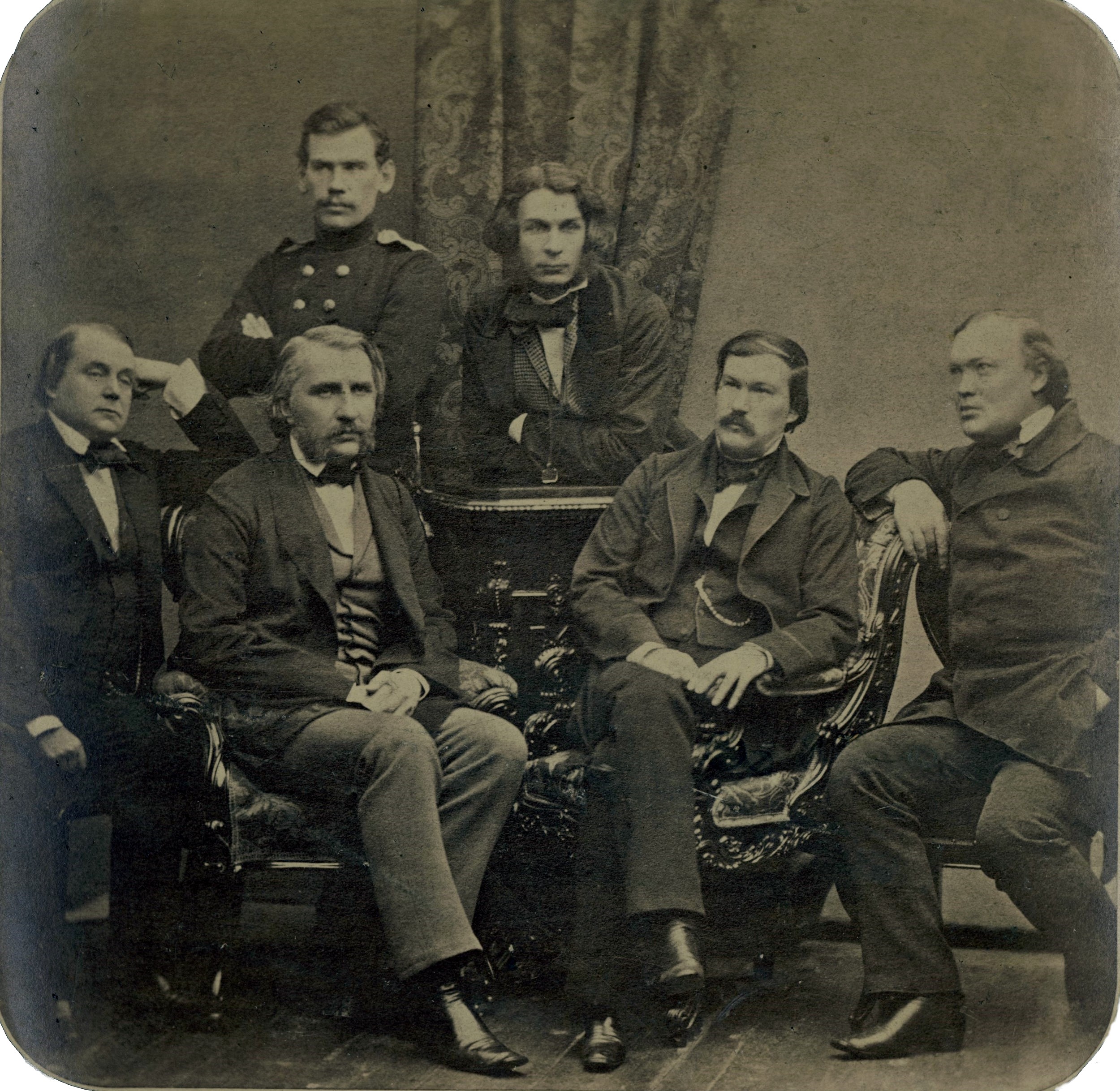
Popular sources sometimes credit the idea to Sofia Andreevna; she was eleven in 1856 and married Tolstoy only in 1862, so the corpus settles the point (§5).
3.2 — Reluctance, then card-sending
By the late 1870s Tolstoy was already evading the camera. PSS Tom 62 records his consent — given to Suvorin in February 1879 — to have a photographic copy made of the Kramskoy oil portrait, a work-around after he declined to sit for his own photograph; the photographic specifics survive in the editorial apparatus rather than his clean text. The willing register appears too: by 1894 he gladly sends a “photographic card” when one is wanted.
Date: 1894-10-17. To S. I. Plaksin, PSS Tom 67, p. 244 (TEI v67_250_S_I_Plaksinu).
«в письме вашем конверт для фотографической карточки. Если дело в карточке, то я очень рад»
“in your letter, an envelope for a photographic card. If it is the card you want, I am very glad.” (working English)
But the discomfort was there from the start, dated and concrete. In January 1889 the act of handing out his own cards felt shameful.
Date: 1889-01-28. Diary, PSS Tom 50, p. 30 (TEI v50_030_030_1889_01_28).
«Потом к Покровскому отдать ему свои карточки. И было ужасно стыдно.»
“Then to Pokrovsky, to give him my cards. And it was terribly shameful.” (working English)
And in 1906 he would not let his own face travel openly on a postcard.
Date: 1906-01-11. To T. A. Kuzminskaya, PSS Tom 76, p. 80 (TEI v76_113_T_A_Kuzminskoj).
«я нашел, что неприятно посылать открытую карточку с портретом. Вложил в конверт»
“I found it unpleasant to send an open card bearing a portrait. I put it in an envelope.” (working English)
3.3 — Sofia Andreevna’s camera, and the album
The fullest dated record of photography being made in the corpus is of Sofia Andreevna at work. In October 1896 Tolstoy reports her photographing all day at Yasnaya Polyana.
Date: 1896-10-10/11. To T. L. Tolstaya (daughter Tanya), PSS Tom 69, p. 161 (TEI v69_135_a).
«Мама целый день занимается фотографией. Она сняла несколько раз Козловку и группу нас всех.»
“Mama spends the whole day on photography. She photographed Kozlovka [station] several times, and a group of all of us.” (working English)
Her photographs were the family’s memory, and Tolstoy watched her keep them with tenderness — and, in 1895, read one himself as grief, the year little Vanichka died.
Date: 1891-03-13. Diary, PSS Tom 52, pp. 19–20 (TEI v52_019_020_1891_03_13).
«она разложила карточки всех детей, кроме Ванички, и гордится и любуется. Трогательно.»
“she laid out the cards of all the children except Vanichka, and takes pride and delight in them. Touching.” (working English)
The household had its working infrastructure too — a Moscow studio and a named retoucher near the Khamovniki house, in a 1898 letter to Sofia (TEI v84_705_a30): “Misha promised to go to the photographer’s on Tverskaya, next to Filippov’s, and ask the retoucher Krasnov.”
3.4 — December 1894: the negative destroyed
The struggle over Tolstoy’s image that is usually told as a story of his last year had a precise rehearsal at the end of 1894. Tolstoy was photographed in Moscow together with Chertkov and four Tolstoyan friends; Sofia Andreevna, learning of it, went to the studio and had the negatives destroyed. Tolstoy’s own record is a single grieving line.
Date: 1895-01-03. Diary, PSS Tom 53, p. 2 (TEI v53_002_002_1895_01_03).
«История с фотографией очень грустная. Все они оскорблены. Я написал письмо Черткову.»
“The story with the photograph is very sad. They are all offended. I wrote a letter to Chertkov.” (working English)
The vivid detail by which the episode is usually remembered — Sofia at night cutting Tolstoy’s face out of the negatives with a diamond earring — comes from her own account, preserved in the PSS apparatus; it is hers, not Tolstoy’s word. What the corpus fixes is that the friction was old, mutual, and about the control of his photographic image (§5), consistent with the project’s Biryukov–Sofia dive.
3.5 — 1908: the jubilee, and “no importance”
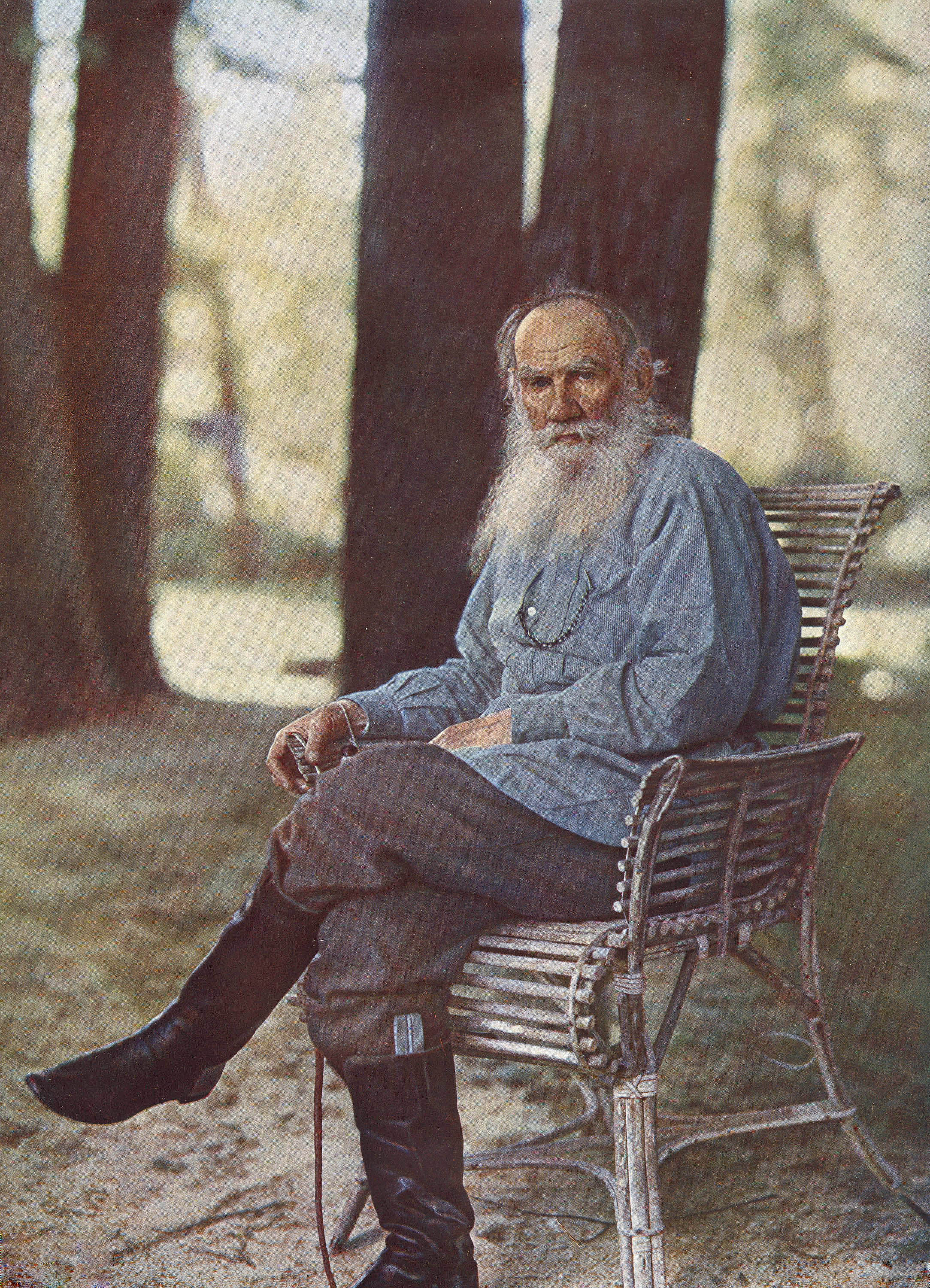
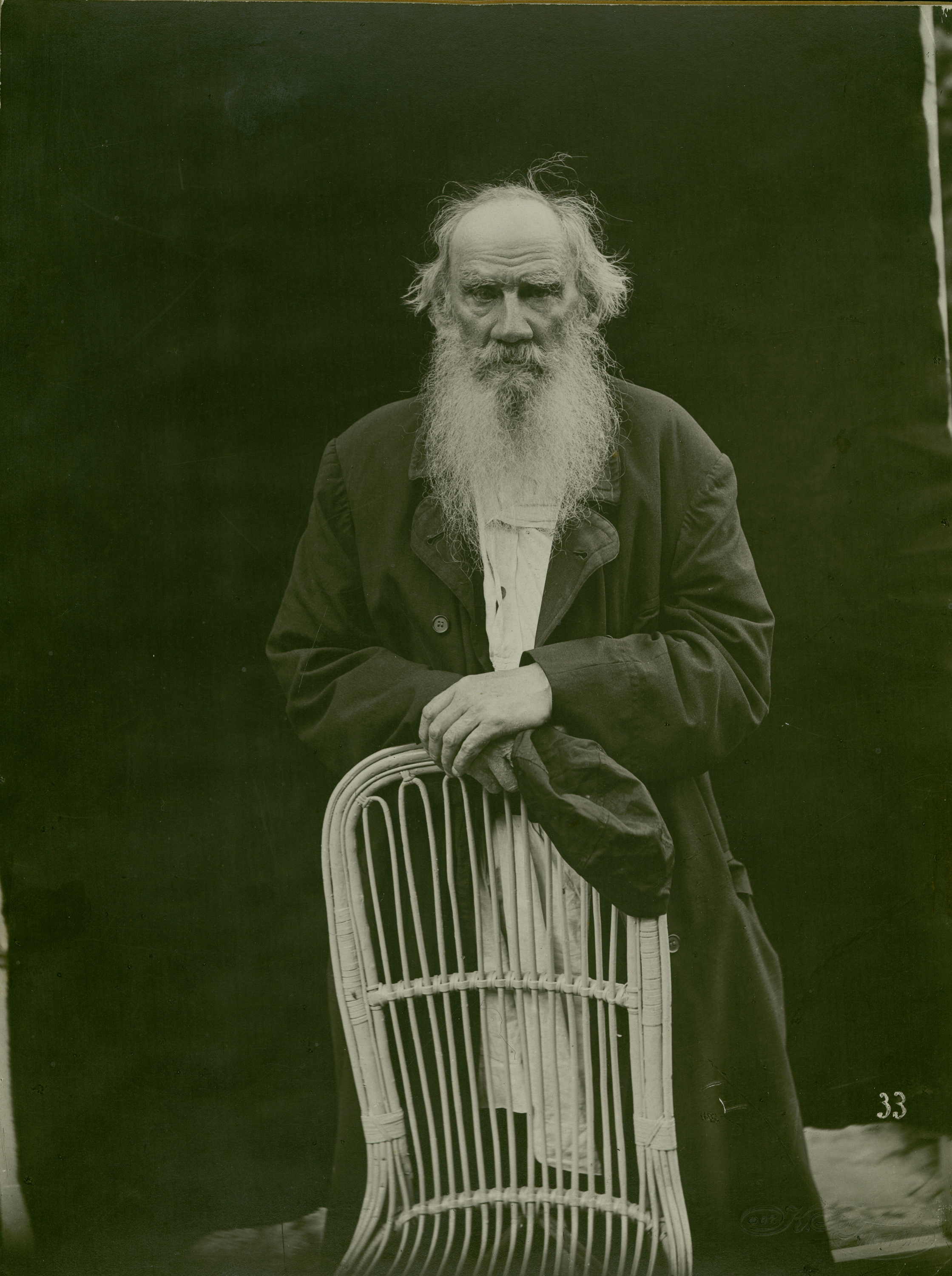
Tolstoy’s 80th birthday in 1908 was a photographic event: Karl Bulla came for the jubilee series, and Prokudin-Gorsky came to make the only colour photograph of him. Tolstoy met it with the same divided spirit. He forwarded Prokudin-Gorsky’s proposal to Sofia rather than decide himself (TEI v84_805_a30: “Forgive me for not deciding myself but troubling you”), and he signed and sent portrait cards on his daughter’s commission while calling the celebration “the noise around my signboard” (TEI v78_067). The clearest word is to Molochnikov.
Date: 1908-07-23. To V. A. Molochnikov, PSS Tom 78, p. 191 (TEI v78_213_V_A_Molochnikovu).
«Не прислал до сих пор карточки потому, что забыл, а забыл потому, что не могу приписать этому значения.»
“I have not sent the card until now because I forgot, and I forgot because I cannot attach any importance to it.” (working English)
3.6 — 1909: pursued by the camera
By 1909 the press camera and the cinematograph had become a kind of hunt, and the diary records the cost to his sense of himself. Meeting a photographer and a film operator on 17 September:
Date: 1909-09-17. Diary, PSS Tom 57, pp. 141–142 (TEI v57_141_142_1909_09_17).
«Неприятно и то, что вызывает сознание себя не божественного, а пакостного Льва Николаевича.»
“Unpleasant, too, in that it arouses the consciousness of oneself as not the divine but the vile Lev Nikolaevich.” (working English)
The next day, in Moscow, “the cinematograph man and photographers pursued [me]” (TEI v57_142_143). Yet the same autumn he warmly approved a different kind of photography — Chertkov’s, and that of the English photographer Thomas Tapsell whom Chertkov had brought over.
Date: 1909-09-26. To V. G. Chertkov, PSS Tom 89, pp. 143–146 (TEI v89_852_sentyabrya26).
«Фотографии Тапселя превосходны — нас с детьми.»
“Tapsell’s photographs are superb — of us with the children.” (working English)
The distinction is the dive’s quiet thread: the public press camera shamed him; the friendly, controlled camera of his own circle did not. Three years earlier he had told Chertkov why the celebration itself was dangerous (TEI v89_767_a26): “You cannot imagine what harm praise does me, given my vanity. It is drunkenness.”
3.7 — 1910: the most-photographed death
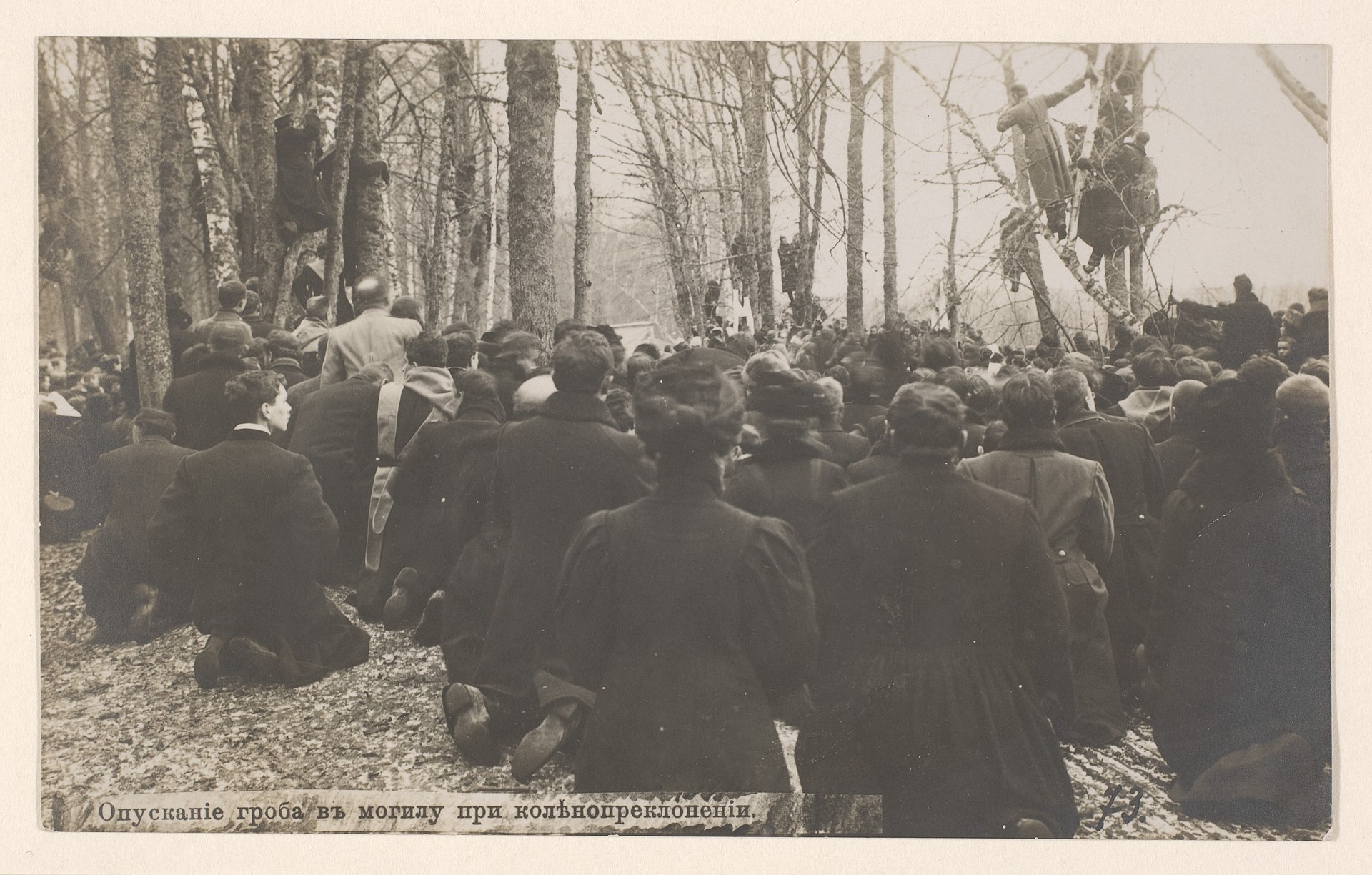
Tolstoy’s flight from Yasnaya Polyana and death at Astapovo station on 7 November 1910 (OS) became one of the first international media events of the century — staked out by press photographers and newsreel crews. The corpus stops at the threshold: the diary’s last photography note, on 25 September 1910, survives only OCR-corrupted (“фотограф… хорошо”). The visual record of the death and funeral is dense and, unusually, openly available (§7).
4. Where the theme clusters
Letters: sending, receiving, arranging
| Tom | TEI id | Date (OS) | Addressee | Material |
|---|---|---|---|---|
| 61 | v61_444_M_N_Tolstoj | 1856-04-14 | M. N. Tolstaya | “At my proposal” — the 1856 literary group photo |
| 62 | v62_490_A_S_Suvorinu | 1879-02-13 | A. S. Suvorin | Consent to photograph the Kramskoy oil (declined own sitting) |
| 67 | v67_250_S_I_Plaksinu | 1894-10-17 | S. I. Plaksin | Glad to send a “photographic card” |
| 69 | v69_135_a | 1896-10-10 | T. L. Tolstaya | Sofia photographing Kozlovka + the family group |
| 76 | v76_113_T_A_Kuzminskoj | 1906-01-11 | T. A. Kuzminskaya | Distaste at an open portrait-postcard |
| 78 | v78_067_T_L_Suxotiioi | 1908-03-10 | T. L. Sukhotina | Signed cards enclosed; “the noise around my signboard” |
| 78 | v78_213_V_A_Molochnikovu | 1908-07-23 | V. A. Molochnikov | “I cannot attach any importance to it” |
| 84 | v84_645_a12 | 1895-11-12 | S. A. Tolstaya | Reading a family photo: Andryusha like Vanichka |
| 84 | v84_705_a30 | 1898-04-30 | S. A. Tolstaya | The Tverskaya studio; retoucher Krasnov |
| 84 | v84_805_a30 | 1908-03-30 | S. A. Tolstaya | Forwarding Prokudin-Gorsky’s colour-photo proposal |
| 89 | v89_767_a26 | 1906-10-26 | V. G. Chertkov | “What harm praise does me… it is drunkenness” |
| 89 | v89_852_sentyabrya26 | 1909-09-26 | V. G. Chertkov | Tapsell’s photos “superb”; the cinematograph men |
Diaries: sittings, pursuit, verdicts
| Tom | TEI id | Date (OS) | Material |
|---|---|---|---|
| 50 | v50_030_030_1889_01_28 | 1889-01-28 | Handing out his cards “terribly shameful” |
| 52 | v52_019_020_1891_03_13 | 1891-03-13 | Sofia laying out the children’s photo-cards |
| 53 | v53_002_002_1895_01_03 | 1895-01-03 | The Dec-1894 photograph affair “very sad” |
| 57 | v57_050_051_1909_04_19 | 1909-04-19 | Self-reproach at “a show of vanity” over his picture |
| 57 | v57_079_079_1909_06_05 | 1909-06-05 | Henry George Jr. arrives “with a photographer” |
| 57 | v57_141_142_1909_09_17 | 1909-09-17 | The camera makes him “the vile Lev Nikolaevich” |
| 57 | v57_142_143_1909_09_18 | 1909-09-18 | Cinematograph man and photographers “pursued” him |
| 56 | v56_130_132_1908_05_29 | 1908-05-29 | “There were also photographers” (OCR-corrupted; §6) |
5. Scholarly context
The dominant English-language treatment is Katherine M. H. Reischl’s Photographic Literacy: Cameras in the Hands of Russian Authors (Cornell UP, 2018), whose opening chapter makes Tolstoy the exemplary case of an author caught in a “crisis of authorship”: at once a photographic subject shaped by others and an occasional agent of his own image, but overtaken by the mass-reproduction that dissociated his likeness from his person — a contest settled, after his death, in Chertkov’s favour, so that his image “passed into the property of the public sphere.” Reischl reads the last years as two competing photographic projects: Sofia Andreevna’s domestic, family-album photography (some thousand photographs from the late 1880s, catalogued in Bendavid-Val’s Song Without Words, 2007) against Chertkov’s public, prophet-among-peasants image-making. The corpus broadly confirms this picture and extends it with dated primary instances scholarship does not quote — the 1889 shame, the 1908 “no importance,” the 1909 “vile Lev Nikolaevich.”
The most useful divergence is over Sofia Andreevna. The popular framing of her as the jealous antagonist (Alexandra Popoff’s counter-pole Tolstoy’s False Disciple, 2014, recasts Chertkov instead; the film The Last Station fixes the wife-as-obstacle image) is a contested, attributed position, not a baseline. The corpus complicates it from both sides: the same woman who laid out the children’s cards “with pride and delight” (1891) also destroyed the December-1894 negatives — an episode largely absent from English scholarship, which treats the Sofia/Chertkov image-conflict only in general terms. She was image-keeper and image-controller at once; the friction over Tolstoy’s photographic image was old and mutual, the reading the project’s Biryukov–Sofia dive reaches independently. Tolstoy’s reluctance, which scholarship records behaviourally (the cameramen at the gates; Drankov’s hidden-camera filming), the diaries record from the inside.
On the 1856 group photograph the corpus contradicts a small, recurring error in popular sources that assigns the initiative to Sofia (chronologically impossible); Tolstoy’s letter is explicit that the idea was his. And on Thomas Tapsell the corpus, with the Leeds Russian Archive finding aid, extends past English scholarship, which does not identify him at all: he was the English photographer Chertkov brought over, and his Yasnaya Polyana and Krekshino negatives survive at Leeds (§7).
6. Material not covered
- Sofia Andreevna’s own albums and diaries — her photographic practice is documented in her own diaries (outside this PSS letters-and-diaries corpus) and in Bendavid-Val (2007); only Tolstoy’s side is read here.
- The earliest daguerreotypes — the c.1849 (Shenfeldt, St Petersburg) and c.1854 (Mazer, Moscow) portraits, and a c.1853 sixth-plate daguerreotype at the Metropolitan Museum, are documented in secondary sources but were not located in open repositories.
- The full Chertkov negative archive — the Lenin Library / RGALI fond 552 holdings and the State Tolstoy Museum’s print series; only a handful of Chertkov images are on Commons.
- The 1910 “фотограф” diary note (v58, 25 Sept 1910) is OCR-corrupted and is described, not quoted; the 1908 “Были еще фотографы” entry (v56) likewise needs PDF collation before ingestion.
- The moving image — Drankov’s 1908 footage, the 1909 station departures and the 1910 funeral newsreels are documented here (§7) but are film, not photographs, and were not retrieved as files.
- Visiting-card / postcard senses of «карточка» — more than seventy further letters use the word in non-photographic senses and were excluded after sense-checking.
7. Visual & manuscript record
Every photographer here died long enough ago that the images are public domain in Russia (life+70) and the United States (created before 1929). The recurring obstacle is institutional photography: the Russian holding institutions restrict and charge for their own high-resolution scans of these PD images — the same pattern the art dive found for paintings. A local research cache of 32 PD/CC0 files was assembled (git-ignored under visuals/); the tables record holding, online availability, reproduction quality and licence.
Photographs of Tolstoy
| Subject | Photographer | Year | Holding | Online / quality | Rights |
|---|---|---|---|---|---|
| Sovremennik writers’ group | S. Levitsky | 1856 | State Tolstoy Museum | Commons PD 2500×2436 | PD |
| Young officer (solo) | S. Levitsky | 1856 | — | Commons PD 1135×1506 | PD |
| Wedding-period portrait | unknown | 1862 | — | Commons PD 1630×2220 | PD |
| Standing portrait, heavy coat | Sass studio | c.1880–86 | — | Commons PD 2467×3362 | PD |
| Seated formal portrait | F. W. Taylor | 1897 | Library of Congress (37767u) | Commons PD 2156×2614 | PD |
| Full-length studio portrait | Scherer & Nabholz | 1901 | — | Commons PD 1989×3072 | PD |
| Colour portrait | S. Prokudin-Gorsky | 1908 | Library of Congress | LoC hi-res master; Commons 2167×3000 | PD (“no known restrictions”) |
| Jubilee standing portrait | K. Bulla | 1908 | State Tolstoy Museum; neg. TsGAKFFD | Commons PD 2239×3000 | PD |
| On horseback (Delir) | K. Bulla | 1908 | State Tolstoy Museum | Commons PD 951×1280 | PD |
| With granddaughter | V. Chertkov | 1910 | — | Commons PD 2466×3200 | PD |
| With Dushan Makovitsky | V. Chertkov | c.1900s | — | Commons PD 996×1280 | PD |
| At the Savelyev library opening | A. Savelyev | 1910 | russiainphoto.ru | Commons PD 605×800 (low) | PD |
| Near Krekshino | T. Tapsell | 1909 | Leeds Russian Archive | Commons PD 800×472 (low) | PD |
People, places and the death
| Subject | Photographer | Year | Holding | Online / quality | Rights |
|---|---|---|---|---|---|
| With Maxim Gorky, Yasnaya Polyana | S. A. Tolstaya (attrib.) | 1900 | — | Commons PD 2200×3156 | PD |
| With Anton Chekhov (Gaspra) | unknown | c.1901–02 | — | Commons PD 3185×2022 | PD |
| With Sofia Andreevna, Yasnaya Polyana | unknown | c.1890 | — | Commons PD 2010×2480 | PD |
| With Sofia, weeks before the flight | V. Bulgakov (attrib.) | 1910-09-23 | — | Commons PD 1009×1652 | PD |
| On his deathbed, Astapovo | unknown | 1910-11-07 | Kozlova Zaseka Museum | Commons PD 2752×1872 | PD |
| Funeral & burial album (6 views) | unknown | 1910-11-09 | Metropolitan Museum of Art | Commons CC0 4000 px | CC0 |
The moving-image record
Tolstoy was among the first world figures filmed. Aleksandr Drankov shot the 80th-jubilee footage in 1908 from a hidden camera after being refused permission; Pathé’s Russian operator Joseph Mundviller and Drankov both filmed station departures in 1909 (the “cinematograph men” of Tolstoy’s own letter); and multiple crews filmed the 1910 death and funeral, whose newsreel screenings drew such crowds they were banned in some cities. The surviving Russian footage is held at RGAKFD Krasnogorsk and licensed commercially via net-film.ru; a 1908 reel is on Wikimedia Commons (File:Leo_Tolstoy-1908.webm). The underlying material is old enough to be public domain, but per-clip rights are asserted by the licensors.
What is not openly available, and where to request it
- The earliest daguerreotypes (1849 / 1853 / 1854) — State Museum of L. N. Tolstoy, Moscow (info@tolstoymuseum.ru); the MET for the c.1853 plate.
- Karl Bulla’s 1908 jubilee glass negatives — TsGAKFFD St Petersburg (archive@photoarchive.spb.ru), or licensed via russiainphoto.ru / MAMM.
- The bulk of the Chertkov photographic archive — State Tolstoy Museum (prints); RGALI fond 552; the Lenin Library.
- Thomas Tapsell’s Yasnaya Polyana negatives — Leeds Russian Archive, LRA/MS 1381 (finding aid at archiveshub.jisc.ac.uk, ref. gb206-ms1381).
- High-resolution scans of the PD photographs generally — licensable from the holding institutions (the images are PD; the institutions’ scans are charged for).
- Prokudin-Gorsky colour master — Library of Congress, Prokudin-Gorsky Collection (the one major holding that is openly hi-res and unrestricted).
8. Method
Scope (the Phase-0 contract, confirmed in prose): the photographic record of Tolstoy, his family and circle, and his places, across 1856–1910, letters and diaries first-class with the post-1880 period emphasised; dating each major photograph, locating high-quality versions, and mapping public-domain vs institution-controlled status; the spine being Tolstoy’s own behaviour as a photographic subject. Painting and sculpture were excluded (they are the sibling art dive).
The corpus sweep was a fan-out over the tolstoydigital TEI: four letter passes (Toms 59–67, 68–76, 77–85, 86–90, the last covering the Chertkov correspondence) plus an inline diary pass over the seventeen photography entries. Anchors were фотограф·, карточк·, снимок/снять, Прокудин, кодак. Finalists were extracted verbatim with extract_tei.py; every Russian quote in the dossier is byte-checked against its extract by verify_quotes.py (21/21 PASS). Care was taken to keep quotations to clean letter-bodies: several photographic specifics (the Suvorin consent, the Prokudin-Gorsky name and date, the Shapiro refusal, Sofia’s destruction of the 1894 negatives) survive only in the PSS editorial apparatus and are attributed as such, not quoted as Tolstoy’s words. All ninety Jubilee-Edition volumes are held locally; no keystone facsimile was rendered because vol57’s PDF text layer is an unreliable single-blob OCR (recorded in needsReview).
The visual sweep was run “heavy” across four deduplicated channels — the Library of Congress (Prokudin-Gorsky), Wikimedia Commons (PD portraits 1856–1909), institutional rights-mapping (State Tolstoy Museum, Goskatalog, Yasnaya Polyana, TsGAKFFD, Leeds, RGALI, russiainphoto.ru), and the 1910 death-and-funeral plus moving image — yielding 32 cached PD/CC0 files, deduplicated by subject. The scholarship layer was gathered English-first and is attributed throughout, treated as a divergence map rather than corroboration.
Links: sibling dives — Tolstoy in art (the painted and sculpted record this one completes), Biryukov–Sofia (the contest over Tolstoy’s image), the crisis (the conversion years behind the prophet image).
Models: scope contract and synthesis on Opus; corpus extraction and translation on Opus; letter triage, visual triage and scholarship triage on Sonnet. Effective tier baseline: Opus.
9. References
Primary — Л. Н. Толстой, Полное собрание сочинений (Jubilee Edition): Tom 61 (1856 letters); Tom 62 (1879); Tom 67 (1894); Tom 69 (1896); Tom 76 (1906); Tom 78 (1908); Tom 84 (letters to S. A. Tolstaya); Tom 89 (letters to Chertkov); Toms 50, 52, 53, 56, 57 (diaries).
Background (attributed; secondary):
- Reischl, Katherine M. H. 2018. Photographic Literacy: Cameras in the Hands of Russian Authors. Cornell UP. (Ch. 1, “Tolstoy in the Age of His Technological Reproducibility.”)
- Reischl, Katherine M. H. 2012. “Photography and the Crisis of Authorship: Tolstoy and the Popular Photographic Press.” Jahrbücher für Geschichte Osteuropas 60:4.
- Bendavid-Val, Leah (ed.). 2007. Song Without Words: The Photographs & Diaries of Countess Sophia Tolstoy. National Geographic.
- Bartlett, Rosamund. 2011. Tolstoy: A Russian Life. Houghton Mifflin Harcourt.
- Popoff, Alexandra. 2014. Tolstoy’s False Disciple: The Untold Story of Leo Tolstoy and Vladimir Chertkov. Pegasus.
- “Pen and Pictures no. 7 — Leo Tolstoy.” The Bioscope, 22 February 2009.
- “The Only Color Picture of Tolstoy, Taken by Photography Pioneer Sergey Prokudin-Gorsky (1908).” Open Culture, September 2023.
- Wikipedia, “Aleksandr Drankov” (the hidden-camera 1908 filming; the January 1910 screening).
A short dev-blog note accompanies this dive: website/src/posts/notes/2026-06-03-tolstoy-in-photographs.md (draft).