---
layer: reference
lastUpdated: 2026-06-07
tags: [research, corpus-dive, work-dive, non-fiction, economics, slavery, non-resistance, the-slavery-of-our-times]
---
# The Slavery of Our Times (Рабство нашего времени) — a corpus work-dive
A single-work corpus dive on Tolstoy's economic and social treatise *The Slavery of Our Times* (*Рабство нашего времени*), written across 1900 (the first sketch is dated 27 December 1899, Old Style). It reads the work from its own text in the tolstoydigital TEI corpus (PSS Tom 34, pp. 144–199), reconstructs its genesis from the Jubilee-Edition editorial history and the 1900 diary and letters, traces its redactions through the two surviving variant sets, and follows it through its ban in Russia, its foreign first editions, and its place in the late anti-state and economic cluster. The occasion is concrete: a visit on 26 December 1899 to the Moscow–Kazan railway goods station, where Tolstoy saw freight loaders working thirty-six hours at a stretch. The keystone is the argument that modern wage labour is itself a form of slavery — "one means of enslavement is abolished only when another has already replaced it" — and that the remedy is not a new social order but each person's withdrawal from the violence that sustains the old one.
The dive prepares ingestion-ready material (this `index.md`, a machine-readable `dossier.yaml`, byte-faithful `extracts/`, and a draft dev-blog note). It does not create vault pages; it plans them.
---
## Key findings
- **The work is the sequel to *What Then Must We Do?*, written fifteen years later from a single concrete shock.** Its Introduction (signed 28 June 1900) names the 1886 book and declares the same answer reached by new arguments; its «Основная мысль … — отрицание насилия» ("the basic thought is the negation of violence"). The trigger was the Moscow–Kazan goods station: the former Yasnaya Polyana servant **Afanasy Ageev**, now a weigher there, told Tolstoy the loaders worked 36-hour shifts; Tolstoy went to see for himself (26 Dec 1899) and began the next day.
- **The argument is structural, not merely indignant: emancipation only ever swaps one slavery for a firmer one.** Two months before the chapters took shape, the diary of 13 March 1900 states the thesis in nucleus — "chattel slavery is abolished when serfdom is established; serfdom is abolished when the land has been taken and taxes set; now they free men from taxes, once the tools of labour have been taken." The published work builds this into a chain: misery → slavery → the three laws (land, taxes, property) → organized violence → government.
- **It names three causes of slavery — landlessness, taxes, and manufactured needs — and finds the third the firmest.** [Henry George](#scholarly-context)'s land-value tax could remove the first, taxes could be shifted to the rich; but the appetite for new "needs" caught from the rich re-sells the worker's freedom, and that, "science does not recognise," is the most ineradicable cause.
- **Tolstoy uses Marx against Marxism.** He quotes *Capital* (vol. I, ch. XXIV) on the bloody expropriation and vagrancy laws that forced the peasantry into wage discipline — he had read *Capital* (an annotated Russian copy is in the Yasnaya Polyana library) — and then turns that history against the socialist remedy: socialising the means of production must introduce a law compelling labour, "slavery in its primal form." A cut draft quotes *Capital* a second time, in German.
- **The remedy is individual non-participation, and the chain ends at the disciplined army.** Government is "organized violence"; it rules the many not by force but by a deception (*обман*) whose core is the disciplined soldier — "the destruction of reason and freedom in man." It is undone not by a new violence (which installs a new government) but by refusal: do not serve, do not pay voluntary taxes, do not call on the state to guard your property.
- **It was banned in Russia and reached the public abroad first.** First published by Chertkov's **Free Word** press in England, 1900 (Russian); reprinted in Berlin, 1901; translated by **Aylmer Maude** as *The Slavery of Our Times* (Free Age Press, 1900). In Russia *Severny Kurier* set the first chapters but was blocked by the Interior Minister; only excerpts appeared until the 1911 collected-works printing was confiscated; the full Russian text waited until 1917.
- **The late drafts were sharpened, and the first draft was de-named.** Tolstoy told his daughter on 11 July 1900 he was "making it more and more venomous." The first draft, «Самый дешевый товар» (The Cheapest Commodity), named the weigher Ageev; the final text anonymises him to "a weigher I know" — the same universalising revision found in the [Ivan Ilyich](../1884-1886-the-death-of-ivan-ilyich/index.html) and [Christianity and Patriotism](../1893-1894-christianity-and-patriotism/index.html) dives.
---
## Why this matters
*The Slavery of Our Times* is the hinge between Tolstoy's religious anarchism and his economics. [The Kingdom of God Is Within You](../1890-1893-the-kingdom-of-god-is-within-you/index.html) (1893) had argued that the Christian may not take part in state violence; [What Then Must We Do?](../1882-1886-what-then-must-we-do/index.html) (1886) had asked what the man of conscience owes the poor. This work fuses the two questions and answers them with a single chain of reasoning: the worker's misery is slavery; the slavery rests on laws; the laws rest on organized violence; the violence is government — and therefore the cure is not a better government or a better economy but the withdrawal of consent from the violence itself. It is the late prophet-period work in which Tolstoy is closest to, and most sharply divided from, the socialists, the Georgists, and Marx: he shares their diagnosis of capitalist society and rejects every one of their remedies as a fresh form of the disease. For this project it is the economic anchor of the cluster the [christian-communism-socialism](../christian-communism-socialism/index.html) theme dive maps, and the work the mainstream most often files, with a shrug, under [Christian anarchism](../christian-anarchism/index.html).
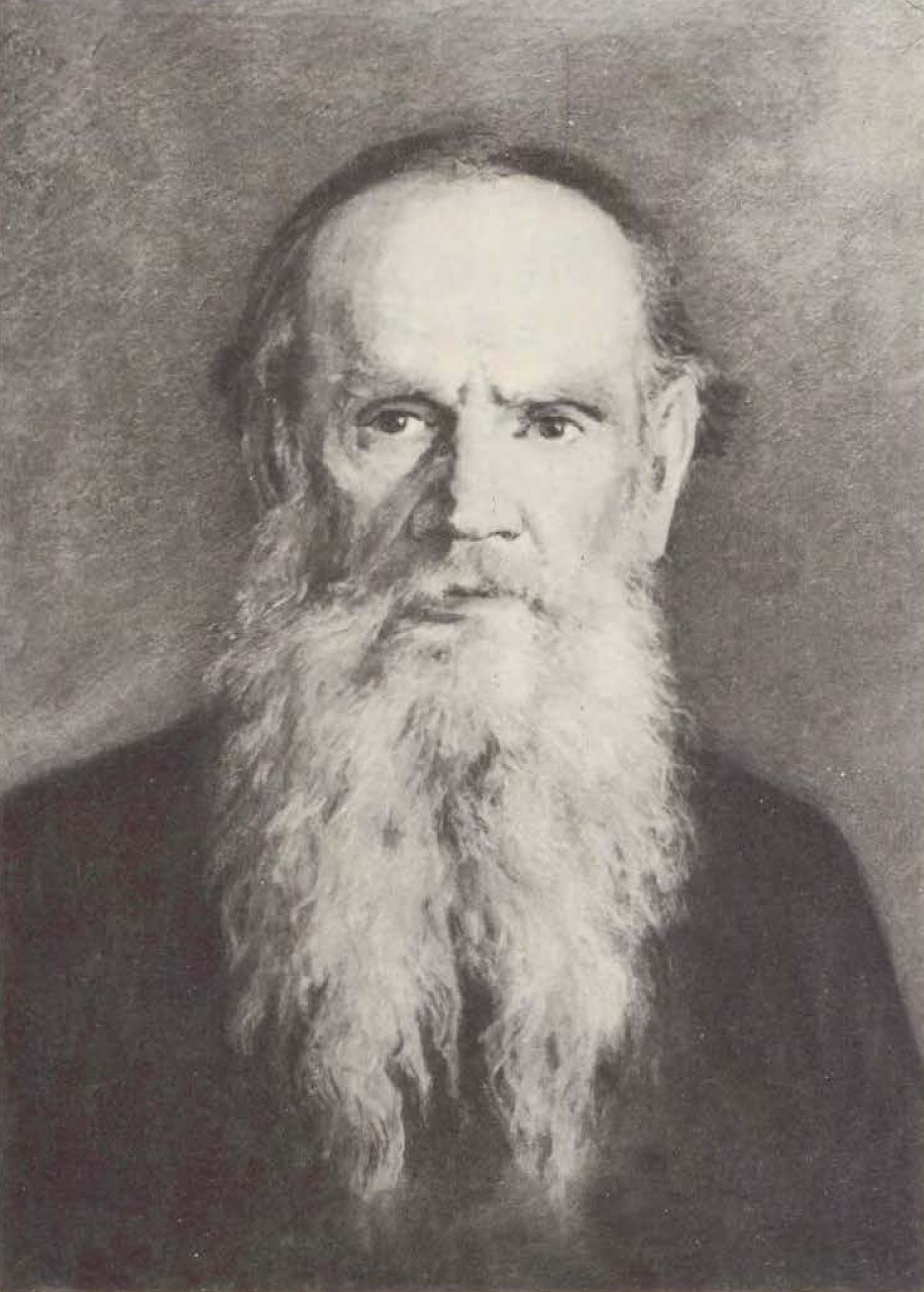
Leo Tolstoy, painted by I. S. Kazakov in 1900 (Odessa Art Museum, Ж-397; public domain) — the closest dated portrait to the year of composition.
---
## The shape of the question
The work moves from a single observed fact to a programme for the individual conscience, in one continuous argument. The stages below quote its own text (PSS Tom 34, pp. 144–199; tolstoydigital `works/v34_144_199`).
**1 · The fact (ch. I).**
> «за деньги, дающие только пропитание, люди, считающиеся свободными, находят нужным отдаваться в такую работу, в которую во времена крепостного права ни один самый жестокий рабовладелец не послал бы своих рабов»
> (working English) "for money that gives only subsistence, men considered free find it necessary to give themselves up to work to which, in the time of serfdom, no cruellest slaveholder would have sent his slaves."
**2 · The eclipse of conscience (ch. II).**
> «Что же за удивительное затмение находит на нас, как только дело касается тех миллионов рабочих, которые со всех сторон медленно и часто мучительно убиваются на тех работах, которыми мы пользуемся для своих удобств и удовольствий?»
> (working English) "What strange eclipse comes over us the moment it concerns those millions of workers who, on all sides, are slowly and often painfully killed at the labour we use for our comforts and pleasures?"
**3 · Science takes over from theology (ch. III–IV).**
> «Новые объяснения эти явились в виде науки — политической экономии, которая утверждает, что она нашла законы, по которым распределяются между людьми труд и пользование его произведениями.»
> (working English) "These new explanations appeared in the form of a science — political economy — which asserts that it has discovered the laws by which labour and the enjoyment of its products are distributed among men." — and behind those laws, the history Marx records: «Сельское население сначала насильственно обезземеливали, говорит К. Маркс …» / "The rural population was first forcibly deprived of its land, Marx says …"
**4 · Culture or freedom (ch. VII).**
> «пропади они пропадом, и не только они, но и железные дороги и все фабричные ситцы и сукна в мире, если для их производства нужно, чтобы 99/100 людей были в рабстве и тысячами погибали на работах, нужных для производства этих предметов»
> (working English) "let them perish — and not only they, but the railways and all the factory cottons and cloths in the world — if their production requires that 99/100ths of men be in slavery and perish by the thousand at the labour needed to produce these objects."
**5 · The thing itself, and its laws (ch. VIII, XII).**
> «все люди нашего времени разделяются на рабов и господ — так же определенно, как, несмотря на сумерки, разделяются сутки на день и ночь»
> (working English) "all men of our time are divided into slaves and masters — as definitely as, despite the twilight, the day is divided into day and night." — and the definition that follows: «Узаконения — это правила, устанавливаемые людьми, распоряжающимися организованным насилием …» / "Laws are rules established by people who command organized violence …"
**6 · The remedy (ch. XV).**
> «если человек — всё равно раб он или рабовладелец — точно хочет улучшить не одно свое положение, а положение людей, то должен сам не делать дурного, которое производит рабство его и его братьев»
> (working English) "if a man — whether slave or slaveholder — truly wishes to improve not his own position alone but the position of all, he must himself stop doing the evil that produces the slavery of himself and his brothers." — confirmed by the voice of conscience: «У меня одна жизнь … Не хочу и не буду» / "I have one life … I will not, and I shall not."
---
## Genesis & composition
*(The composition narrative is drawn from the editorial history of writing and printing in PSS Tom 34, `comments/v34_563_567` (A. I. Opulsky), and from the 1900 diary (Tom 54) and letters (Toms 72, 88). Editorial commentary is attributed; Tolstoy's own words are cited from the extracts in `extracts/`.)*
### The shock, December 1899
The work has an unusually exact origin. A weigher Tolstoy knew at the Moscow–Kazan railway goods station — Afanasy Ageev, a former Yasnaya Polyana servant — told him the freight loaders there worked thirty-six hours at a stretch. Tolstoy did not believe it, and went to see. He reported the visit to Chertkov in the letter the TEI dates 2 January 1900 (the editorial history dates the first mention 31 December 1899):
> «рассказал мне, что там грузчики работают 36 часов сряду. Я ездил туда и видел этих людей и эту работу и хочется рассказать то, что довелось думать об этом.»
> (working English) "[he] told me that the loaders there work 36 hours at a stretch. I went there and saw these people and this work, and I want to tell what I came to think about it." *(to V. G. Chertkov, 2 Jan 1900, T88)*
He began the next day after the 26 December visit, as a short note titled «Самый дешевый товар» (The Cheapest Commodity). By the diary of 8 January 1900 he was correcting "the article on the 36-hour day" and thought it near done — «Нынче подвинулся к окончанию» ("Today I moved on toward finishing it").
### The theme grows; the reading
It did not stay a note. On 27 January 1900 he wrote to his English translator Aylmer Maude for factory-condition books:
> «Пришлите мне, пожалуйста, книжку: The effects of the factory system, Allen Clarke, London»
> (working English) "Please send me the book: The Effects of the Factory System, Allen Clarke, London." *(to Aylmer Maude, 27 Jan 1900, T72)* — the same letter calls it "an article on the workers' question" that he hopes says "something new." Maude also sent George Haw's *No Room to Live* (London, 1900).
The structural insight arrived in the diary of 13 March 1900 — the chain of slavery that became the spine of the work:
> «Невольничество отменяется, когда утверждается крепостное право. Крепостное право отменяется, когда земля отнята и подати установлены; теперь освобождают от податей, когда орудия труда отняты.»
> (working English) "Chattel slavery is abolished when serfdom is established. Serfdom is abolished when the land has been taken and taxes set; now they free men from taxes, once the tools of labour have been taken." *(diary, 13 Mar 1900, T54)*
### Finished three times
The composition record is a series of premature endings. On 2 May 1900 the diary records «Все время был занят двумя статьями. И хочется думать, что кончил» ("the whole time I was occupied with two articles; and I want to think I have finished"); three days later, at Pirogovo, he had "thought *New Slavery* over from the beginning" and changed much — the diary preserving one of the working titles, «Новое рабство». By 12 July he was still at it: «Два раза думал, что готово. Теперь 3‑й раз думаю это» ("Twice I thought it was ready. Now I think so a third time"). The late drafts were not merely polished but hardened; to his daughter M. L. Obolenskaya on 11 July 1900:
> «Я все переделывал свою статью, которую думал, что кончил. И теперь еще поправляю и все делаю ее ядовитее и ядовитее.»
> (working English) "I kept reworking my article, which I thought I had finished. And I am still correcting it, and making it more and more venomous." *(to M. L. Obolenskaya, 11 Jul 1900, T72)*
He sent the work to Chertkov on 30 July 1900, added a short afterword and the epigraphs around 9 August, and made final corrections (to chapter XIV) into September.
---
## What the work says
The work runs to fifteen chapters with an Introduction and a short Afterword, and three sets of epigraphs — Gospel passages on non-resistance and common ownership (Matt. v.38–41; Acts ii.44; "he who takes the sword shall perish by the sword"), **Robert Owen**, and **Ruskin**. Its own table of contents gives the chapter titles; the movement is a single descending argument from a fact to a law to a duty.
- **Introduction.** The work continues *What Then Must We Do?* of "almost fifteen years ago"; its basic thought is "the negation of violence," learned from the Gospel.
- **I–II · The fact and the eclipse.** The 36-hour loaders, reported as eyewitness; the silk factory of 3,000 women opposite his house; the foundry men who drink to last 24 hours; English life expectancy of 55 for the well-off, 29 for the unhealthy trades. The "astonishing eclipse" by which humane, animal-loving people of the propertied class consume these lives unmoved.
- **III–V · Justification by "science."** Where theology once told the poor that God willed their station, political economy now supplies "laws" — supply and demand, capital, rent, wages — that let one class live calmly off another. The capitalists-seized-the-means-of-production story does not even fit Russia, where the workers still have land, horses, ploughs; the real question is *what drives them off the land*. Marx's history of the bloody expropriation (*Capital* I, ch. XXIV) answers it. And the economists assert an untruth because they belong to the propertied class — even the socialists imagine the same factories continuing, with themselves as managers (designers, scholars, artists), and pass over who will be the stokers and cesspit-cleaners.
- **VI–VII · The untenability of the socialist ideal; culture or freedom.** A free society cannot determine needs, direct production, or sustain the present division of labour without compulsion — so the socialist ideal hides "an obvious internal contradiction." Hence the choice: not *fiat cultura — pereat justitia* but *fiat justitia — pereat cultura*; let the electric light and the railways perish before the slavery that makes them. (Yet, he adds, *useful* culture will not perish: freed of slavery, technique can be redirected.) In chapter VI the Free Word editors altered Tolstoy's «сенокосом» (hay-mowing) to «науками» (sciences); the PSS restores his word.
- **VIII–XI · Slavery exists among us; its causes and its laws.** Society divides into slaves and masters "as definitely as … day and night," unrecognised as serfdom was at the end of the eighteenth century. Its causes are three — landlessness, taxes, and the manufactured needs of luxury (the last the firmest); its supports are three laws — land as private property, obligatory taxes, the property of acquired goods. Every reform merely substitutes one slavery-law for another, "like a jailer shifting a prisoner's chains from neck to hands, from hands to feet" — the socialists' own project must end by adding a law compelling labour.
- **XII–XIV · Laws, government, and the deception.** A law is nothing but "a rule established by people who command organized violence"; "organized violence is government." Can men live without it? The brick-column image answers: that a structure collapses at a touch proves it badly built, not necessary. Governments are destroyed not by a new violence but by exposing the deception (*обман*) on which the few rule the many — chiefly the disciplined army, "the destruction of reason and freedom in man." Following Eugen Schmitt's *Ohne Staat*, the state is shown to be "just such a robber institution," only more complex and more immoral.
- **XV + Afterword · What each must do.** Not to design society for the slaves — the propertied reflex — but for each person to stop doing the evil: refuse government office, refuse voluntary taxes, refuse the state's protection of property. The voice of the honest man — "I have one life … I will not, and I shall not" — confirms what the reasoning reaches. The Afterword answers the charge that this is "the old preaching of non-doing": as an alcoholic's only cure is abstinence, society's only cure is abstinence from violence.
---
## Redactions & textual history
The manuscript dossier is very large: the editorial history counts **1,889 leaves** and **20 galley proofs**, arranged as redactions **№1–144**. The title evolved across them — **Самый дешевый товар** (The Cheapest Commodity) → **Денежное рабство** (Money Slavery) → **Насилие и рабство** (Violence and Slavery) → **Новое рабство** (New Slavery, the title still in the diary on 5 May) → **Рабство нашего времени** (рук. №43). Chapters first appear from рук. №25. The copyists' work introduced 81 substantive errors, which the PSS corrects.
Two features stand out, and both are visible in the surviving variant sets:
**The de-naming of the opening.** The first draft, «Самый дешевый товар» (PSS Tom 90, pp. 169–173), is markedly more autobiographical: the weigher is named — Ageev — and addresses the loader directly: «Никита! — сказал, не отвечая мне, Агеев …» ("'Nikita!' said Ageev, not answering me …"). The final text strips the weigher's name to "a weigher I know," keeping only the worker's. This is the same universalising revision the project has found before — the de-localising of [The Death of Ivan Ilyich](../1884-1886-the-death-of-ivan-ilyich/index.html) and the name-encryption of [Christianity and Patriotism](../1893-1894-christianity-and-patriotism/index.html).
**What was cut.** The chapter-keyed variants in Tom 34 (pp. 491–502) preserve material trimmed from the final text: a draft (рук. №86) that quotes Marx a *second* time, in the original German — «С развитием капиталистического производства … общественное мнение Европы потеряло последний остаток стыда и совести» (Tolstoy's rendering of *Capital* on capitalist accumulation losing "the last remnant of shame and conscience") — and a chapter-X draft that distils the property argument to «Причина рабства лежит не в собственности, а в ограждении насилием того, что считается собственностью» ("the cause of slavery lies not in property but in the guarding by violence of what is considered property"), elsewhere invoking Proudhon's *la propriété c'est le vol*. The Marx-in-German and the Proudhon citation both fell away; the final text keeps the single expropriation passage and folds the property point into the laws-and-violence argument of chapters X–XII.
**The Chertkovs' editing.** Publishing the work at Free Word, V. G. and A. K. Chertkov made stylistic and semantic changes; the most-cited is chapter VI's «сенокосом» altered to «науками». Chapter XIV they edited more heavily — Tolstoy first gave A. K. Chertkova "carte blanche," then in a letter of 13 October 1900 restricted the licence and asked that the "старичок из 1001 ночи" comparison, which he had moved to *Is It Really Necessary?* (*Неужели это так надо?*), be removed from this work. The PSS prints chapter XIV from Tolstoy's last sent text and removes the Chertkovs' alterations except those he sanctioned.
---
## Publication, censorship & translation
Banned in Russia from the outset, the work reached the public abroad and in translation first:
- **Russian (first):** Chertkov's **Свободное слово** (Free Word) press, England, 1900.
- **Russian reprints:** Berlin, 1901, in two editions (Caspari; Hugo Steinitz).
- **English:** **Aylmer Maude**'s translation, *The Slavery of Our Times*, Free Age Press (Maldon, Essex), 1900 — made from the Russian manuscript. (Maude added an introduction to the work in *Tolstoy and His Problems*, 1902. The singular variant title *The Slavery of Our Time* appears in some later digital reproductions; the 1900 printed title is the plural.)
In Russia the work was suppressed. At the request of *Severny Kurier*, Tolstoy gave its editor V. V. Baryatinsky the first chapters (then still titled "New Slavery") in March 1900; they were set and corrected in proof but never printed, because the Minister of the Interior warned Baryatinsky on 13 April 1900 that the paper would be closed if it appeared. Only **excerpts** were printed in Russia in Tolstoy's lifetime — in *Russkie Vedomosti* (no. 245, 1900), and the first part in the *Nedelya* supplement (1906). When the work was included in S. A. Tolstaya's 1911 collected works (part 16), the volume was **confiscated by order of the Moscow Court of Justice, 19 April 1911**. The full Russian text was published only in **1917** (two editions, Edinenie and Posrednik). The PSS Tom 34 text (1952) follows the Free Word edition, corrected against рук. №143.
---
## Reception & afterlife
*(The corpus establishes the censorship and circulation history above; the contemporary critical reception is thin and is drawn, attributed, from the Phase-3 scholarship pass.)*
The work's first "reception" in Russia was the censor's: blocked from the press, policed at the border, confiscated when collected. Its public life from 1900 was therefore a translated and émigré one. Aylmer Maude's 1900 translation and his 1902 essay are the chief lifetime readings of it in English; no systematic study of its Western newspaper reception in 1900–01 was recovered, and it circulated less as a book than as a movement pamphlet, among Georgist, anarchist and labour readers.
**The Church and the 1901 excommunication.** A clarification worth making precisely, since the dates are close: the Holy Synod's excommunication decree of February 1901 does **not** cite *The Slavery of Our Times*. Its grounds were doctrinal — Tolstoy's rejection of the Orthodox sacraments and dogma, sharpened by *Resurrection* (1899) and its satire of church ritual. This economic treatise is part of the corpus that established his heterodoxy, but it is not implicated in the decree; the excommunication should not be presented as a response to his social writings.
---
## Place in the cluster
- **[What Then Must We Do?](../1882-1886-what-then-must-we-do/index.html)** (1882–1886) — the predecessor the work names in its first sentence: the same answer to the question of poverty and labour, reached "more calmly and in detail" fifteen years on.
- **[The Kingdom of God Is Within You](../1890-1893-the-kingdom-of-god-is-within-you/index.html)** (1890–1893) — the foundation of non-resistance that the economic argument here rests on: government is organized violence, and the Christian withdraws from it.
- **[Christianity and Patriotism](../1893-1894-christianity-and-patriotism/index.html)** (1893–1894) — the sibling late anti-state treatise; its verdict «Патриотизм есть рабство» ("patriotism is slavery") is the conceptual bridge this work picks up and generalises from the nation to the economy.
- **[The christian-communism-socialism theme dive](../christian-communism-socialism/index.html)** — already reads chapter VI ("The Untenability of the Socialist Ideal") and places the work in Tolstoy's anti-socialist arc (1889 diary → *Slavery* 1900 → *To Political Activists* 1903 → *The End of the Century* 1905 → *The Law of Violence and the Law of Love* 1908 → the 1910 Gandhi letter). That socialist-critique reading is **cross-linked, not repeated** here.
- **Companions without dives:** *Is It Really Necessary?* (*Неужели это так надо?*, 1900), the direct twin to which the "старичок из 1001 ночи" passage migrated; and the Georgist pamphlet *The Great Sin* (*Великий грех*, 1905).
- **Mainstream label:** the position is usually filed under [Christian anarchism](../christian-anarchism/index.html) — kept visible here as the mainstream's word while the dedicated dive interrogates it (see "Scholarly context").
---
## The author's later verdict
Within the composition itself Tolstoy's judgment oscillates — three times "finished," each time reopened, the late drafts made deliberately "more and more venomous." The diary preserves no settled disavowal; the continuity is in the works themselves. He returned to the economic question in *To the Working People* (1902), *To Political Activists* (1903) and *The End of the Century* (1905), and — the one position this work breaks with — came back to Henry George's single tax in *The Great Sin* (1905) after rejecting it here. The trajectory shows not retreat but sharpening, with that single Georgist exception (see below). A dedicated sweep of the post-1900 diaries for an explicit later verdict on this work was not made and is flagged in `needsReview`.
---
## Scholarly context
The received scholarly view treats *The Slavery of Our Times* as illustrative rather than central — a specimen of Tolstoy's late pamphlet production, its diagnosis granted and its individual-non-participation remedy set aside as earnest but inoperative. Aylmer Maude's own 1900 introduction (framing the work through non-resistance, in a lineage with Woolman and Thoreau) and his 1902 essay remain the fullest lifetime readings; Ernest Simmons (1946) calls it a "trenchant sequel" to *What Then Must We Do?* but does not analyse its argument; Rosamund Bartlett (2010) and A. N. Wilson (1988) treat Tolstoy's late political economy biographically. Reading the work on its own terms, the dive's findings sit against that view as follows:
- **The chain-of-causation argument *extends* the scholarship.** Biographers register the slavery/serfdom parallel as a rhetorical figure; the structural claim — that each emancipation (chattel → serfdom → tax-and-land → means-of-production) is a *managed substitution* — is not analysed at the resolution the corpus gives it (the 13 March 1900 diary states it in nucleus). (Maude 1900; Simmons 1946.)
- **The rejection of Henry George *complicates* the simple "Tolstoy the Georgist" picture.** This is the dive's highest-value scholarly point. Kenneth Wenzer (*Tolstoy's Georgist Spiritual Political Economy*, 1997) documents that *The Slavery of Our Times* is the **one work in which Tolstoy "comes out against George's economics"** — privately calling George "a concession, a weakness" — an anomalous trough between *Resurrection*'s Georgist peak (1899) and *The Great Sin* (1905), to which he returned. Wenzer records the fact of the rejection; the dive supplies the internal reason from the text — that an obligatory land-rent is still a legal compulsion backed by violence (ch. XI), so George's remedy is structurally continuous with the socialists' (W13, W15). The work credits George's land project (ch. IX) and rejects his mechanism in the same breath.
- **"Marx against Marxism" *extends* it.** That Tolstoy read and annotated *Capital* is attested by S. M. Breitburg's 1935 study of the Yasnaya Polyana marginalia (cited in the PSS apparatus); but no accessible scholarship analyses the move by which he uses Marx's own history of expropriation (*Capital* I, ch. XXIV) to ground his argument and then turns it against Marx's solution. A cut draft quoting *Capital* in German (V2) makes the engagement still plainer.
- **The chain "laws → organized violence → government" the scholarship *confirms*.** Maude's framing and Alexandre Christoyannopoulos's "Economic enslavement" subsection (2012) both treat this as the work's central contribution.
- **The epigraph sources the PSS apparatus, not scholarship, supplies.** No secondary work comments on them; the apparatus alone establishes that the Owen epigraph reached Tolstoy through Morrison Davidson's *Annals of Toil* (1899) — his own 25 August 1900 letter to Maude says so — and that the Ruskin epigraph is from *Stones of Venice* (II.iv), both added after the main text was sent.
**Labels to attribute, not assert.** The mainstream charges Tolstoy's economic thought with being "utopian" (Bartlett 2010, via review; Wilson 1988), and reports the post-mortem Western habit of dividing his life into the novelist and the period "when he was 'a crank'" (Simmons 1946) — none of these applied specifically to *this* work, which the biographical tradition does not distinguish from his pamphlets. These are the outside's words; the dive keeps them visible as such rather than adopting them.
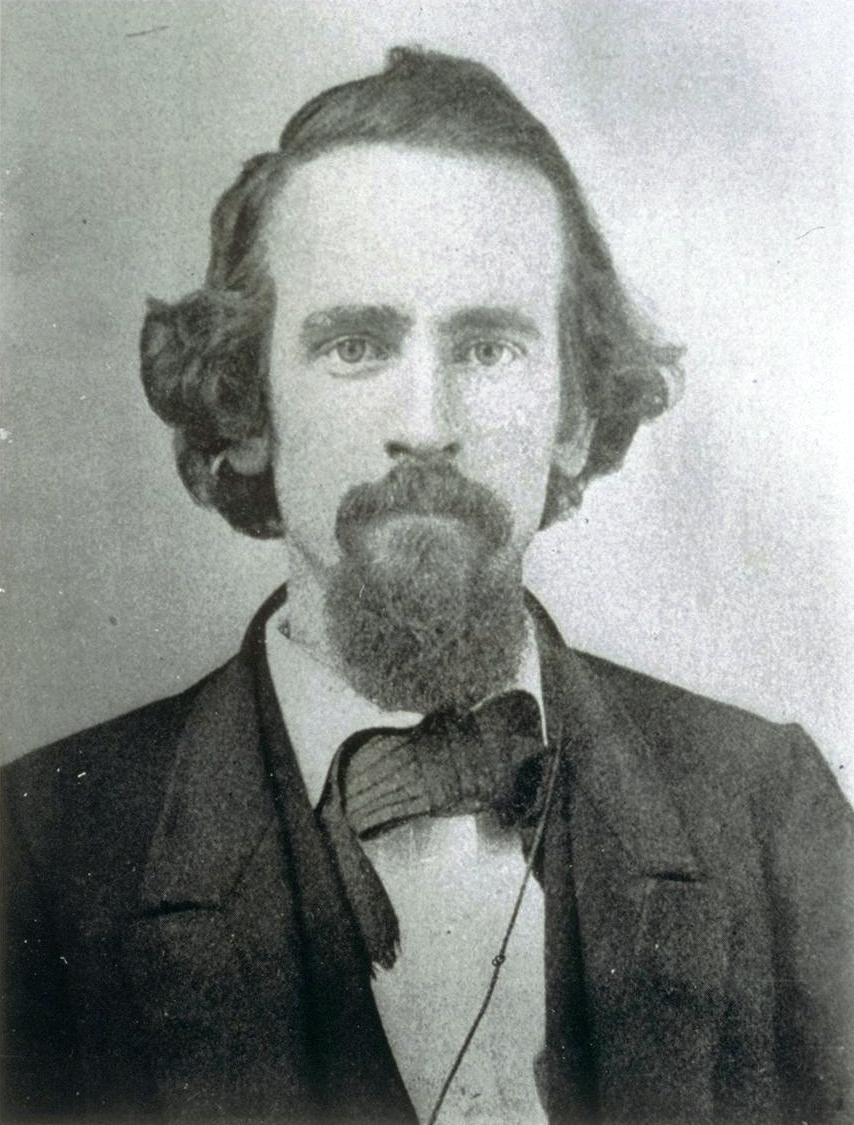
Henry George (c.1865; public domain). Tolstoy was broadly a Georgist, but The Slavery of Our Times is the documented trough in that engagement (Wenzer, 1997): it credits George's land reform yet rejects the single-tax as a residual slavery.
---
## Material not covered
- The full redaction-by-redaction collation of the 144 manuscripts (1,889 leaves, 20 galley proofs) — only the title evolution, the Chertkov editing of chapter XIV, and a sample of chapter variants are taken from the apparatus and the two variant sets.
- A page-by-page cross-check against the printed PSS Tom 34 PDF (not confirmed held locally) — extraction relied on the tolstoydigital TEI (`needsReview`).
- The full socialist-critique reading of chapter VI — covered by the [christian-communism-socialism](../christian-communism-socialism/index.html) theme dive and deliberately not repeated.
- *Is It Really Necessary?* (1900) and *The Great Sin* (1905) — direct companions, cross-linked not dived.
- The translation history beyond Maude's 1900 English and the 1901 Berlin reprints; and a dedicated sweep of the post-1900 diaries for Tolstoy's settled later verdict.
---
## Visual & manuscript record
Six openly-licensed portraits were cached locally (in the git-ignored `visuals/`; rights recorded in `dossier.yaml` for any later publication). On a fresh clone, `python3 docs/fetch_visuals.py 1900-the-slavery-of-our-times` repopulates them from the dossier `url:` fields.
- **Leo Tolstoy, 1900** (I. S. Kazakov; Odessa Art Museum) — **PD**. Painted the year of composition. *(embedded above)*
- **Robert Owen** (Wellcome Collection) — **CC0**. The first epigraph author (via Davidson's *Annals of Toil*).
- **John Ruskin, 1882** (H. R. Barraud) — **PD**. The second epigraph author (*Stones of Venice*).
- **Karl Marx, c.1875** (J. J. E. Mayall) — **PD**. Quoted in the work; Tolstoy read *Capital*.
- **Henry George, c.1865** — **PD**. Endorsed in chapter IX. *(embedded above)*
- **Aylmer Maude, 1919** (Lafayette; V&A) — **CC BY-SA 4.0**, attribution required. The translator and book-supplier.
**Identified, not held.** A Commons engraving of **Montaigne and La Boétie** (CC BY-SA) was rate-limited during the sweep (fetch via `docs/fetch_visuals.py` if wanted). **Not openly available.** No PD photograph of Russian railway/freight loaders (the scene of chapters I–II) was found on Commons; and the **Free Word 1900 first edition** and Maude's **Free Age Press 1900** title pages are not on Commons — a targeted search of archive.org / imwerden.de / vtoraya-literatura.com is recommended (`needsReview`).
**Manuscript record.** The 1,889 leaves of the redactions are held in the Tolstoy manuscript collections (GMT / RGB); no facsimile was rendered for this dive.
---
## Method
This dive followed the `corpus-dive` skill. **Scope:** a single-work dive on *The Slavery of Our Times*, corpus surface = PSS Tom 34 (work pp. 144–199, variants pp. 491–502; Tom 90 variants pp. 169–173) and the editorial history (pp. 563–567) as the spine, with a composition-window witness sweep of the 1900 diary (Tom 54) and letters (Toms 72, 88), the La Boétie Circle-of-Reading intertext (Toms 41, 42), and a light visuals sweep. **Phase 0:** the slug was confirmed as `1900-the-slavery-of-our-times` (the work is essentially of 1900; the first sketch of 27 Dec 1899 is a four-day embryonic note). **Phase 1–2:** a full structural read of the work text; extraction of the cited diary and letter passages (guarding against the TEI filename-date artifact — the genesis Chertkov letter is filed under 2 Jan 1900, the worker-genesis carried across the New Year), and of both variant sets; all pre-1918 text extracted with `extract_tei.py --choice=reg`. **Phase 3:** an English-first scholarship and reception gather (see "Scholarly context"), grounded against the [christian-communism-socialism](../christian-communism-socialism/index.html) theme dive. **Phase 5:** `verify_quotes.py` PASS (35/35 quotes byte-faithful) plus an independent opus verifier pass.
**Links (sibling dives):** [What Then Must We Do?](../1882-1886-what-then-must-we-do/index.html) · [The Kingdom of God Is Within You](../1890-1893-the-kingdom-of-god-is-within-you/index.html) · [Christianity and Patriotism](../1893-1894-christianity-and-patriotism/index.html) · [The Death of Ivan Ilyich](../1884-1886-the-death-of-ivan-ilyich/index.html) · [christian-communism-socialism](../christian-communism-socialism/index.html) · [christian-anarchism](../christian-anarchism/index.html).
---
## References
**Primary**
- Л. Н. Толстой. *Рабство нашего времени.* ПСС, Т. 34, с. 144–199. М.: ГИХЛ, 1952. (Варианты: Т. 34, с. 491–502; Т. 90, с. 169–173.)
- А. И. Опульский. *«Рабство нашего времени». История писания и печатания и описание рукописей.* ПСС, Т. 34, с. 563–567.
- Л. Н. Толстой. *Дневник 1900 г.* ПСС, Т. 54 (записи 8 янв., 13 марта, 2 мая, 5 мая, 12 июля).
- Л. Н. Толстой. *Письма 1900 г.* ПСС, Тт. 72, 88 (В. Г. Черткову, Э. Мооду, М. Л. Оболенской).
- Этьен де Ла Боэти. *Добровольное рабство* (пер. Л. Н. Толстого). *Круг чтения*, ПСС, Т. 41, с. 426–434; комментарий Т. 42, с. 613.
**Background**
- Maude, Aylmer (trans., intro.). *The Slavery of Our Times.* Free Age Press, Maldon, 1900; and "Tolstoy's Teaching," in *Tolstoy and His Problems* (1902).
- Wenzer, Kenneth C. "Tolstoy's Georgist Spiritual Political Economy (1897–1910)." *Pennsylvania History* 64 (1997) — the Georgist trough.
- Christoyannopoulos, Alexandre. *Tolstoy's Political Thought* (Routledge, 2012); Simmons, Ernest J. *Leo Tolstoy* (1946); Bartlett, Rosamund. *Tolstoy: A Russian Life* (2010); Wilson, A. N. *Tolstoy* (1988).
- Брейтбург С. М. «Лев Толстой за чтением «Капитала» Маркса» // *Звенья* V (1935) — the *Capital* marginalia.
- Davidson, J. M. *The Annals of Toil* (1899); Clarke, Allen. *The Effects of the Factory System* (1899); Haw, George. *No Room to Live* (1900).
- Wikisource, *Decree of Excommunication of Leo Tolstoy* (1901) — does not cite this work.
---
*Draft dev-blog note: [`website/src/posts/notes/2026-06-07-the-slavery-of-our-times.md`](../../../../../../website/src/posts/notes/2026-06-07-the-slavery-of-our-times.md) (`draft: true`).*