---
layer: reference
lastUpdated: 2026-06-13
tags: [research, corpus-dive, work-dive, religion, prophet-period, christian-teaching]
---
# The Christian Teaching (Христианское учение)
A corpus work-dive on the treatise Tolstoy called, for two and a half years, his «катехизис» — the calm, ordered restatement of the religion that *The Kingdom of God Is Within You* (1890–93) had argued at polemical heat. Written 1894–96, published unfinished abroad by Chertkov in 1898; PSS Tom 39, pp. 117–191. Sources are the work's own text, its composition-history commentary, the 1894–96 diaries and letters, and the project's prior dives, read before the mainstream.
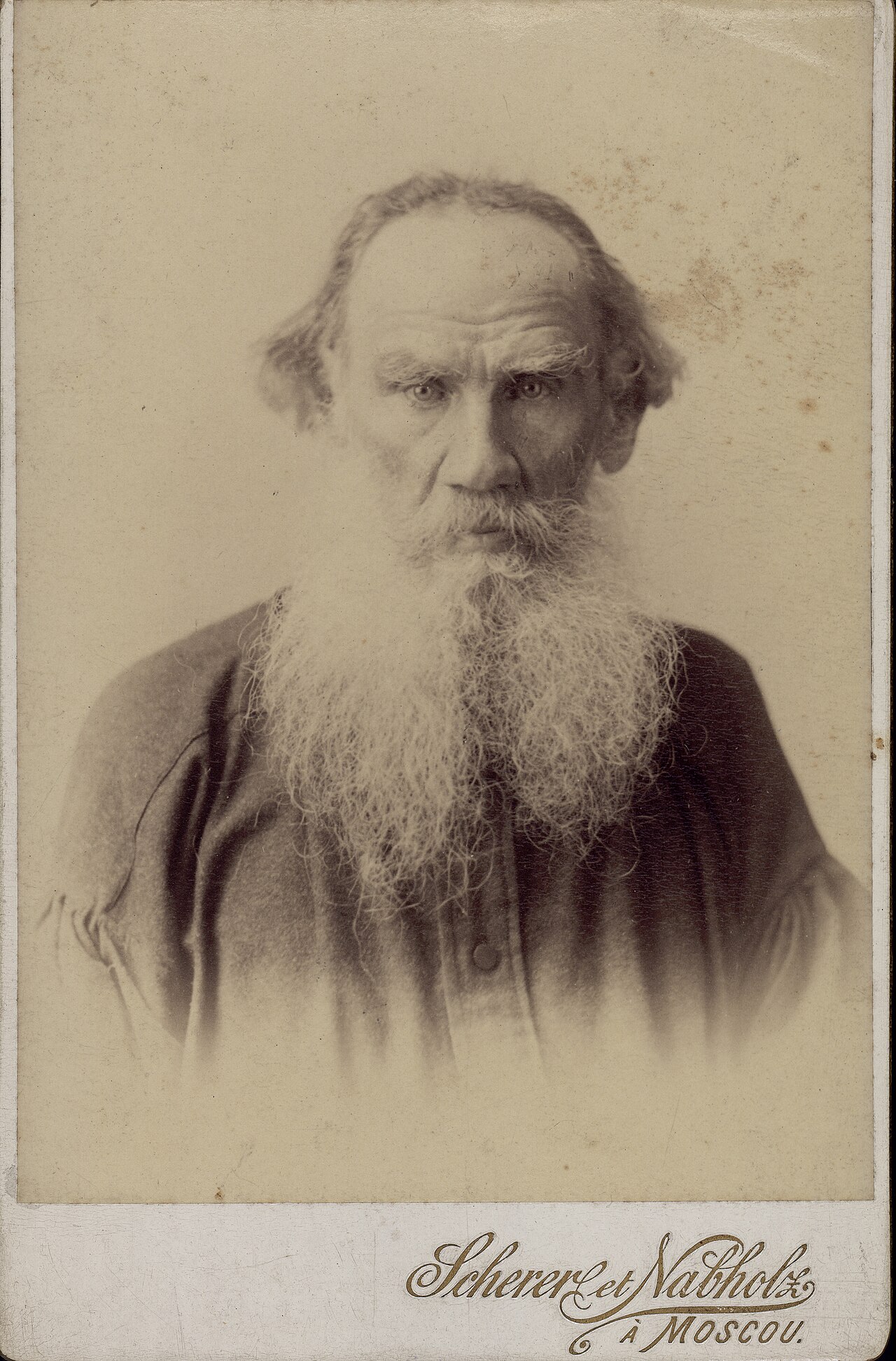
Leo Tolstoy, Moscow, 1896 — the exact composition year (Scherer, Nabholz & Co.; State Tolstoy Museum). Public domain, via Wikimedia Commons.
## Key findings
- **It systematises the doctrine without softening it.** The same ethic that *The Kingdom of God Is Within You* hurled against church and state is here laid out as an architecture: God known within as love → the birth of the spiritual self out of the animal → the true life → a three-part anatomy of what obstructs it → liberation, struggle and prayer → the present and the future. The anti-state passage (ch. 31) and the anti-church passage (chs 33–43) are as radical as anything in *Kingdom of God*; what changed is the form and the temperature, not the content.
- **It began as a catechism and stopped being one.** Tolstoy started in 1894 in question-and-answer form and called the work «катехизис» for two years. On 2 November 1894 he decided «нужно бросить катехизическую форму» ("the catechism form must be abandoned") and rebuilt it as numbered propositions grouped into titled chapters — an «изложение веры» ("exposition of faith"). The work's own history is a movement *from* catechism *toward* system.
- **The risk he feared was abstraction, never radicalism.** The keystone genesis letter names it: «опасность отвлеченного умствования» ("the danger of abstract reasoning"). His one test was accessibility — «чтобы было понятно Ваничке и дворнику» ("so that it be comprehensible to Vanichka and the yard-keeper"). By his own 1896 verdict the book failed that test — «совсем недоступно простолюдину и ребенку» ("quite inaccessible to the common man and the child").
- **He ranked it with his novels, and the world ignored it.** On 12 March 1895 the catechism heads his entire late-period to-do list, set above *Father Sergius*, *The Forged Coupon* and *Hadji-Murat*. Yet the published book landed almost silently — no contemporary review surfaced, and it was not singled out in the 1901 excommunication. The neglect is the reception's judgment, not the author's.
- **The taxonomy of evil is the systematic core.** Three categories, in order of depth: грехи (sins — the animal pull), соблазны (seductions — the false reasonings that excuse sins), обманы веры (deceptions of faith — the religious lies that let the seductions stand). Liberation runs in reverse: free reason from the deceptions of faith first, then the seductions dissolve, then the sins can be fought.
- **Prayer is rebuilt, not dropped.** Not petition for worldly relief but a means of strengthening in the struggle — молитва временная (occasional, in solitude) and молитва ежечасная (hourly, the constant awareness of being God's messenger). Grace, atonement and petitionary prayer are explicitly set aside as no help.
- **It is unfinished by the author's own word, and published anyway.** Tolstoy gave Chertkov permission to print only with an editor's caveat, calling it «писание неконченным» ("an unfinished writing"). The 1898 text is also Chertkov's re-shaping: he split the 64-chapter manuscript into 8 titled parts and renumbered the paragraphs 1–404 "for the reader's convenience"; the PSS prints the manuscript's own chapter form.
- **For the works record.** No `works/` record exists yet; this dive proposes its creation (Non-Fiction · Treatises). Provenanced corrections to the prompt's framing: the 1898 publisher was the **Brotherhood Publishing Co.** (London) with a **Frederick A. Stokes Co.** co-edition (New York), **not** Free Age Press (founded 1900). Ingestion is a separate, human step — the dossier is the plan, not the page.
## Why this matters
*The Kingdom of God Is Within You* is the book everyone reads for Tolstoy's late religion; *What Is Religion?* is the one scholars reach for next. Between them sits a work that does something neither does — it states the whole faith positively and in order, as a single connected structure rather than an argument against opponents or a comparison across world religions. Reading it answers a question the polemics leave open: when Tolstoy was not fighting, what exactly did he say the Christian life *was*? It also tests a tempting shorthand — that the calmer late Tolstoy is the milder late Tolstoy. The text refutes that: the heat dropped, the demands did not.
## The shape of the question — does it soften or systematise?
The marquee question of this dive is whether *The Christian Teaching* softens the Kingdom-of-God ethic or merely re-files it — doctrine as catechism versus doctrine as polemic. Tested against the text and its genesis, the answer is precise: **it systematises and calms the doctrine; it does not soften it.** Three things move independently, and only two of them move.
**The form changes.** The book is built as a sequence, each link justifying the next. Stage one is the metaphysical knot:
> Человек хочет быть зверем или ангелом, но не может быть ни тем, ни другим
> Man wants to be a beast or an angel, but can be neither *(working English)* — ch. 4, PSS 39:120
The Christian resolution is not to kill the animal nor to deny the spirit but to understand life as a birth:
> ангел, рождающийся из зверя, — духовное существо, рождающееся из животного
> an angel being born out of a beast — a spiritual being born out of an animal *(working English)* — ch. 4, PSS 39:120
From there the structure unfolds without a polemical addressee: God known within as «желание блага всему существующему … есть любовь, есть бог» (the desire for the good of all that exists … is love, is God; ch. 7), the work of life as «установление царства божия» (the establishment of the kingdom of God; ch. 9), and then the long ordered middle — the anatomy of what obstructs love.
**The temperature drops.** Where *Kingdom of God* indicts, *The Christian Teaching* explains. The book opens on Tolstoy's own crisis (the *Confession* compressed into a preface) and closes not on judgment but on consolation — on Christ's dying words, "Into thy hands I commit my spirit":
> я радостно возвращаюсь к нему
> I joyfully return to him *(working English)* — ch. 64, PSS 39:191
**The content does not move.** The state still rests on a trick of diffused responsibility:
> я делаю это не на свою ответственность, а потому, что исполняю волю высшей власти
> I do this not on my own responsibility, but because I am carrying out the will of a higher power *(working English)* — ch. 31 (the state seduction), PSS 39:143
The church's cruellest instrument is still the catechizing of children, and the answer is still the unconditional supremacy of reason:
> Истина не может войти в человека помимо разума
> Truth cannot enter a man except through reason *(working English)* — ch. 38, PSS 39:157
So the relation to the polemic sibling is best stated three ways at once. The corpus **confirms** that the work is "abstract" — Tolstoy says so himself — but **extends** the charge by showing he named and fought that very risk while writing. It **complicates** the scholarly reflex that reads "less polemical" as "lesser." And against the filing of the book as a minor restatement it **contradicts** the record: Tolstoy ranked it at the head of his late work. (Triangulation detail in *Scholarly context*, below.)
## Genesis & composition
Tolstoy began the work between 23 March and 21 April 1894 — «приступил между 23 марта и 21 апреля 1894 г.», in the PSS commentary's words. The first diary mention, on 21 April, is already rueful:
> катехизис, который напрасно затеял
> the catechism, which I undertook in vain *(working English)* — diary, 21 Apr 1894, PSS Tom 52
The scope outgrew the label almost at once:
> серьезнее и важнее и труднее, чем я думал
> more serious and important and difficult than I had thought *(working English)* — diary, 3 May 1894, PSS Tom 52
The design brief was constant: answer the questions that arise identically in all children and simple people, briefly and convincingly. To the painter's son N. N. Ge he names both titles in one breath — «катехизиса — изложения веры» (the catechism — the exposition of faith; 8 May 1894). To his Orthodox kinswoman A. A. Tolstaya, whom he expects to dislike the content, he gives the cleanest statement of the aim:
> изложение в самой короткой и всем понятной форме
> the exposition, in the shortest and universally comprehensible form *(working English)* — to A. A. Tolstaya, 4 Sept 1894, PSS Tom 67
Then the keystone — the project's stated method and its self-correction in a single passage, written to E. I. Popov:
> опасность отвлеченного умствования
> the danger of abstract reasoning *(working English)* — to E. I. Popov, 22 Oct 1894, PSS Tom 67
> чтобы было понятно Ваничке
> so that it be comprehensible to Vanichka [and the yard-keeper] *(working English)* — same letter
The Vanichka of the test is Tolstoy's own youngest son, Ivan, who would die four months later. The test would haunt the work; by 1896 Tolstoy judged the book had failed it (see *The author's later verdict*).
On 2 November 1894 came the formal turn. He told Chertkov the same thing he told his diary:
> хочется писать не в катехизической форме
> I want to write [it] not in the catechism form *(working English)* — to V. G. Chertkov, 2 Nov 1894, PSS Tom 87
The work then stalled for most of 1895 — interrupted by Vanichka's death in February and by competing fiction — but it never left his mind. On 12 March 1895 the catechism stands at the head of his entire late-period to-do list, set against *Father Sergius*, *The Forged Coupon*, *Hadji-Murat* and the rest:
> Рядом с этим кончать Катехизис
> Alongside these — to finish the Catechism *(working English)* — diary, 12 Mar 1895, PSS Tom 53
By December 1895 the rename had happened in his own usage — he was rewriting «то, чтó было катихизис» (what was the catechism) from scratch. Through 1896 he worked it toward a rough completion (13 June in draft; last authorial review of the full copy on 5 October), then, the moment it was "done," began again in a shorter form he never finished.
**The people around the work.** The genesis is unusually peopled for a treatise. **V. G. Chertkov** is the running confidant — Tolstoy reports the rename, the restarts and the near-clean copy to him, and Chertkov is repeatedly at Yasnaya Polyana during composition. The daughters **Tatyana** and **Maria Lvovna** copy the chapters (Maria dates the manuscripts; Tatyana copies what he writes the same day and routes it to Chertkov). **E. I. Popov** is the addressee of the keystone letter and one of the copyists; **S. A. Tolstaya** receives the granular struggle and the completion news; **A. A. Tolstaya**, **N. N. Ge** and **D. A. Khilkov** are correspondents whose exchanges feed the work. The PSS apparatus names the wider copying circle — Biryukov, Strakhov, Kandidov, Ushakov, Schmidt.
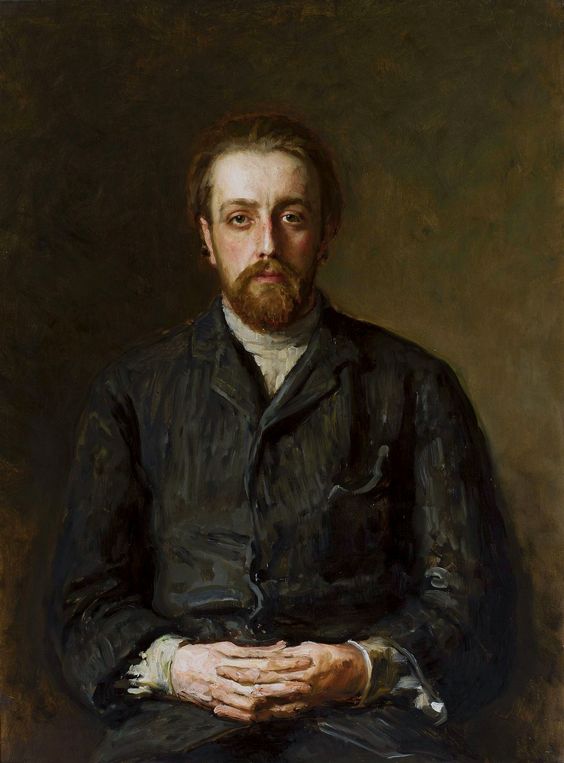
Vladimir Chertkov in the 1890s (Ilya Repin) — the work's editor, English translator and first publisher. Public domain, via Wikimedia Commons.
## What the work says
The PSS prints the work as a Preface and 64 short numbered chapters. The architecture is a single descent-and-return.
**The frame (Preface).** The autobiographical opening retells *A Confession* in miniature — the crisis to the edge of suicide, the rescue in the Gospel read plainly — and grounds the recovered truth not in Tolstoy's authority but in the common witness of mankind's best minds, «начиная с Моисея, Исаии, Конфуция, древних греков, Будды, Сократа и до Паскаля, Спинозы, Фихте, Фейербаха» (from Moses, Isaiah, Confucius, the ancient Greeks, Buddha, Socrates down to Pascal, Spinoza, Fichte, Feuerbach). He disclaims the doctrine as his own: «если я говорю истину, то истина эта не моя, а божья» (if I speak the truth, this truth is not mine but God's).
**The positive doctrine (chs 1–11).** Ancient creeds, their insufficiency, the need for a creed matching humanity's degree of enlightenment; then the resolution — the contradiction of beast-and-angel, the birth of the spiritual being, God known within (as love) and without (as the cause that enclosed love in separate bodies), and the true life as the unceasing widening of love's reach. Love needs its limits the way steam needs the boiler:
> подобна пару, сжатому в паровике
> like steam compressed in a boiler *(working English)* — ch. 13, PSS 39:125
**The anatomy of evil (chs 12–36).** What obstructs love comes in three orders. First the sins:
> Есть три рода грехов, мешающих любви
> There are three kinds of sins that obstruct love *(working English)* — ch. 15, PSS 39:127
Each sin is dissected identically — in its innate (прирожденный), inherited (наследственный) and personal/contrived (личный) forms — across six headings: lust, idleness, greed, love of power, fornication, intoxication. Above the sins stand the seductions, the false reasonings that excuse them:
> Соблазн по-гречески σκάνδαλον — означает западню, ловушку
> Soblazn — in Greek σκάνδαλον — means a snare, a trap *(working English)* — ch. 24, PSS 39:133
There are five — personal, family, work, comradeship and state — and the state seduction is the gravest, because it launders mass violence through diffused responsibility (ch. 31, quoted above). Beneath both lies the deepest order, the deceptions of faith — false belief instilled by five methods, of which the cruellest is the catechizing of children:
> Пятый прием самый жестокий
> The fifth method is the cruellest *(working English)* — ch. 35, PSS 39:150
For the child, Tolstoy says with Tertullian, arrives ready for truth — «душа человеческая по природе христианка» (the human soul is by nature Christian) — and is poisoned by the lie.
**The way out (chs 37–62).** Liberation runs in reverse order. Free reason from the deceptions of faith first — «Истина не может войти в человека помимо разума» (truth cannot enter a man except through reason; ch. 38) — then the seductions lose their cover, then the sins can be fought, in a defined sequence (intoxication first, then idleness, lust, greed, fornication, the struggle of power) and within each sin from the contrived form down to the innate. The instrument of the whole struggle is prayer, rebuilt:
> молитва необходима не как средство избавления от мирских бедствий
> prayer is necessary not as a means of deliverance from worldly afflictions *(working English)* — ch. 60, PSS 39:186
> молитва христианская бывает двоякая
> Christian prayer is of two kinds *(working English)* — ch. 60, PSS 39:186
— the occasional prayer that clarifies one's place before God, and the hourly prayer that keeps a man aware, at every act, of being a messenger (each elaborated in chs 61–62).
**The return (chs 63–64).** Life lived this way is neither joy nor suffering but the growth of the spiritual self; and the question of what comes after death is wrongly posed, because the divine essence is outside time and place — «Прежде чем был Авраам, я есмь» (Before Abraham was, I am). The book ends, as quoted above, on Christ's serene "into thy hands," and on Tolstoy's "I joyfully return."
## Redactions & textual history
The manuscript record is vast: 2154 leaves across 115 numbered manuscripts (рук. №№ 1–115), the labour of two and a half years and a circle of copyists. The work's identity migrated across that record — the titles track the change of conception, from «Закон божий» (Law of God, May 1894) through «Учение блага» (the Teaching of the Good, the first rough redaction of 3 August 1894) to «Изложение веры» (Exposition of Faith, from late 1895) and finally «Христианское учение». The pivot was the abandonment of the catechism form: through August 1894 Tolstoy completed a first Q&A redaction and was dissatisfied; in November 1894 he resolved to drop the form; in late 1895 he restarted as ordered propositions. His relief at not having finished the earlier version is explicit:
> Как хорошо, что я не кончил катехизиса
> How good that I did not finish the catechism *(working English)* — Tolstoy's diary, 5 Nov 1895, quoted in the PSS commentary, Tom 39
The print source was manuscript №113, the full copy his daughter Maria dated «5 окт. 1896». Even after that he kept revising, and on 12 October 1896 began a shorter version in conspectus form — eight chapters in a day, Tatyana copying — «более простом и сокращенном виде» (in a simpler and shortened form). It went no further.
## Publication, censorship & translation
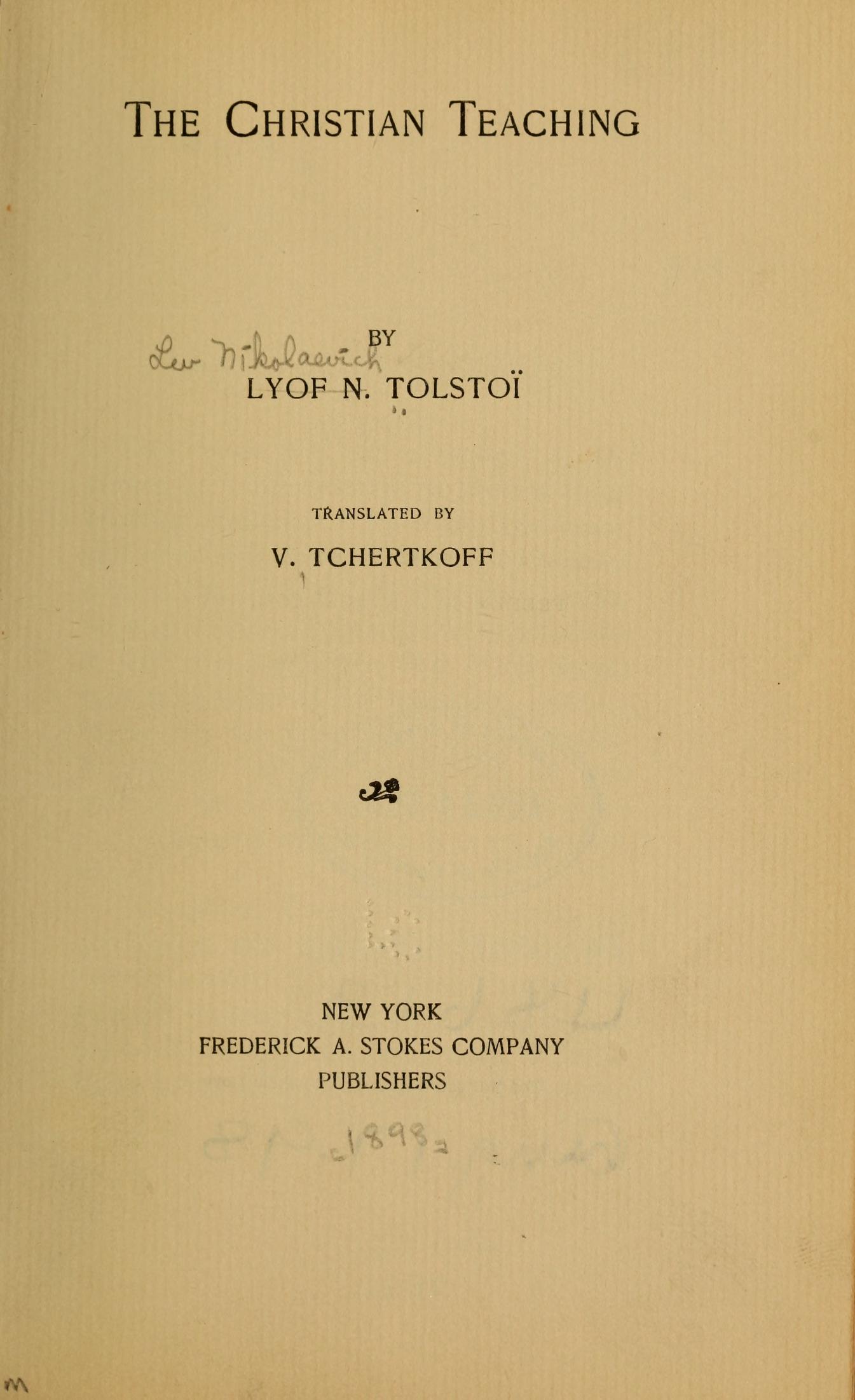
Tolstoy never brought the work to the clarity he wanted and never submitted it to Russian censorship; it reached print abroad through Chertkov, who had begun translating it into English in May 1897 and sought permission to publish with an editor's preface explaining that the text was unfinished. The 1898 editions are: the Russian «Христианское учение» (V. Chertkov, Purleigh, Essex, England), the English *The Christian Teaching* (Brotherhood Publishing Co., London, ed. V. Tchertkoff), and a US co-edition (Frederick A. Stokes Co. / Knickerbocker Press, New York, "translated by V. Tchertkoff"). The prompt's "Free Age Press 1898" is a slip — Chertkov's Free Age Press was not founded until 1900; the 1898 imprint is Brotherhood Publishing Co.
The 1898 first-edition title page — the New York co-edition (Frederick A. Stokes Company), "translated by V. Tchertkoff." Library of Congress copy, via Internet Archive / Wikimedia Commons. Public domain.
The published text is also Chertkov's editorial re-shaping. He set type from a copy of №113 "with some departures," divided the work into **eight titled parts** and introduced **continuous paragraph numbering across all chapters (1–404)** «для удобства читателя» (for the reader's convenience):
> Статья разбита Чертковым на восемь частей
> The article was divided by Chertkov into eight parts *(working English; PSS commentary, Tom 39)*
The popular English text still carries Chertkov's eight-part shape; the scholarly PSS prints the manuscript's own 64-chapter form. The work reached legal print inside Russia only posthumously — in the 12th edition of the *Сочинения* (part 14, Moscow 1911) and the Biryukov-edited collected works (vol. XV, 1913).
## Reception & afterlife
The honest finding is that reception was thin, and the thinness is itself the result. Set beside *The Kingdom of God Is Within You* — smuggled, debated, "overwhelming" to Gandhi in 1894 — and *What Is Religion?*, caught in the 1901–02 excommunication storm, *The Christian Teaching* landed quietly. No contemporary review, English or Russian, surfaced in this sweep; the corpus commentary records the work's *publishing* history in detail but no *review* history. So far as can be sourced, the work was **not** singled out in the Holy Synod's February 1901 excommunication decree (whose surviving transcription does not enumerate specific titles, and whose proximate trigger is usually taken to be *Resurrection*). Three causes, each documented in the record, account for the silence: Tolstoy disowned the book as unfinished; it broke no new doctrinal ground after *Kingdom of God*; and it was, by his own admission, too abstract. One caveat: open-web absence of an 1898 review is not proof of absence in poorly-digitised periodical archives — but the verdict "thin" is well-supported relative to the work's siblings and consistent with every cause in the record.
## Scholarly context
The Anglophone scholarship represents Tolstoy's late religion almost entirely through *Kingdom of God* and *What Is Religion?*; *The Christian Teaching* is rarely treated as a text in its own right. The diagnostic case is Elena Stepanova's 2020 study of *Tolstoy's faith*, which cites the work exactly once, in passing — a dedicated study of the topic using the book only as a quote-quarry. Aylmer Maude, the contemporary who knew the circumstances best, gave the filing the literature inherited: a work "written later, put on one side, and published in 1898 without final revision" (Maude 1910). That framing — minor, abstract, unfinished — is the dive's own worry turned into a verdict, and it should be **attributed, not adopted**. The adjacent "two Tolstoys" reflex, which treats the religious treatises as the dry output of a man who had stopped being an artist, is what makes the book easy to skip; Medzhibovskaya and Gustafson are the standard counter-authorities for reading the religious work as central rather than aberrant.
Against the received view, the primary record supplies what the scholarship mostly skips. Where the literature recognises a polemic and a compression but not the calm systematic middle term, the corpus **extends** it by identifying that form as a distinct achievement. Where "less polemical" is read as "lesser," the corpus **complicates** the inference — the tone changed while the content held. The "abstract" charge the corpus **confirms** (Tolstoy says it himself), and **extends** by showing him naming and fighting that risk in the keystone letter. And the "minor / put on one side" filing the record flatly **contradicts**: on 12 March 1895 the catechism heads his late-period to-do list, co-equal with the novels he never finished. (Whether the doctrine amounts to "Christian anarchism" — a political label Tolstoy refused and used himself only once, third-person — is adjudicated in the dedicated dive, not restated here.)
## Place in the cluster
- [The Kingdom of God Is Within You](../1890-1893-the-kingdom-of-god-is-within-you/index.html) (1890–93) — the great polemical statement of the same doctrine, written immediately before; *The Christian Teaching* restates that ethic calmly and in order. (The phrase "Christian Teaching" even briefly lived inside *Kingdom of God*'s own draft-title chain — a different thing from this treatise.)
- [What Is Religion?](../1901-1902-what-is-religion/index.html) (1901–02) — the later, comparative compression of the same positive creed into four propositions found across the world religions; the downstream synthesis to this fuller earlier statement.
- [Tolstoy and the Gospels](../gospel-translation/index.html) (1879–84) — the textual base: having re-translated and harmonized the Gospels and expounded the recovered teaching in *What I Believe*, Tolstoy had the creed in hand that this catechism sets out free-standing.
- [Tolstoy and "Christian anarchism"](../christian-anarchism/index.html) — the dive that owns the contested label; send the reader there for the label debate rather than re-arguing it here.
## The author's later verdict
Tolstoy's own judgment is the most exacting reception the book received. Authorising publication in September 1897, he was blunt:
> считаю это писание неконченным
> I consider this writing unfinished *(working English; to Chertkov, 2 Sept 1897, quoted in the PSS commentary)*
— far short, he added, of what the same "I" would have demanded of it twenty years earlier, yet with "something useful to people" in it even so. The deepest verdict, though, is the one he wrote against his own clarity test while still composing:
> совсем недоступно простолюдину и ребенку
> quite inaccessible to the common man and the child *(working English)* — diary, 19 July 1896, PSS Tom 53
— "but still, everything I know is stated, coherently and consecutively." And to his wife, finishing in rough:
> если умру, не исправив
> if I die without correcting it [they will still understand what I wanted to say] *(working English)* — to S. A. Tolstaya, 26 Sept 1896, PSS Tom 84
The book he ranked with his novels he could neither finish to his own standard nor stop trying to simplify.
## Material not covered
- The variants across the 115 manuscripts are not collated — only the rename arc and the print-source copy (№113) are traced; the textual differences between redactions would need the PSS variants apparatus or the RGB holdings.
- The paragraph Tolstoy asked Chertkov to delete (chapter X §5, in his 5 April 1898 letter) and then let stand is not identified here — Chertkov's renumbering complicates the reference. Pointer: PSS commentary; cross-check рук. №113.
- The Spir / Kant / Berkeley idealist reading that feeds the book's metaphysics (diary, May & October 1896) is noted but not pursued as a sub-theme.
## Visual & manuscript record
Three keystone images carry the dive, all public domain and embedded above: Tolstoy photographed in 1896, the exact composition year (Scherer & Nabholz; State Tolstoy Museum); Chertkov in the 1890s (Repin); and the 1898 first-edition title page (the New York Stokes co-edition, naming Chertkov as translator; Library of Congress copy via the Internet Archive scan `christianteachin01tols`). Secondary PD images gathered into the git-ignored cache include Repin's 1887 Tolstoy portrait and an early photograph of Tatyana Tolstaya. The **manuscript itself** — 2154 leaves at the State Tolstoy Museum (GTM) and the Russian State Library (RGB) — has **no openly-licensed facsimile**; it is documented as a gap, to be requested from GTM if a manuscript image is wanted for the works record. (Full provenance, licences and URLs in `dossier.yaml`; on a fresh clone, `python3 docs/fetch_visuals.py 1894-1896-the-christian-teaching` repopulates the cache.)
## Method
This is an interactive work-subject dive (not `--auto`, not `--novel`). The subject text and holding volume were given; extraction used `extract_tei.py --choice=reg --notes=auto` (modern orthography for the pre-1918 text) on the work (`v39_117_191`) and its composition-history commentary (`v39_242_247`), and on the 1894–96 diaries (Toms 52–53) and letters (Toms 67, 84, 87) for genesis. Every primary quotation is byte-faithful to its extract file and gated by `verify_quotes.py`; working-English glosses are the dive's own, labelled as such. The composition window (begun 23 March – 21 April 1894; rough completion 5 October 1896) is pinned from the PSS commentary. Scholarship was read as a foil after the primary record, not as a baseline; secondary claims are attributed. The dive writes no vault pages — the entity and work-record proposals in `dossier.yaml` plan the later, human ingestion step.
**Links.** Sibling dives: [The Kingdom of God Is Within You](../1890-1893-the-kingdom-of-god-is-within-you/index.html), [What Is Religion?](../1901-1902-what-is-religion/index.html), [Tolstoy and the Gospels](../gospel-translation/index.html), [Christian anarchism](../christian-anarchism/index.html). Tom → local-PDF lookups: [pss-volume-mapping.md](../pss-volume-mapping.md).
## References
**Primary.** Л. Н. Толстой, «Христианское учение», ПСС Т. 39, с. 117–191 (`v39_117_191_Hristianskoe_uchenie`); В. С. Мишин, «Христианское учение». История писания и печатания и описание рукописей, ПСС Т. 39, с. 242–247 (`v39_242_247`); diaries 1894–96 (ПСС Т. 52–53); letters 1894–96 (ПСС Т. 67, 84, 87).
**Background.** Aylmer Maude, *The Life of Tolstoy: Later Years* (1910); Maude, "Tolstoy's Teaching" (1902); Elena Stepanova, "Leo Tolstoy's Faith…," *State, Religion and Church* 2020(2), 24–47; Inessa Medzhibovskaya, *Tolstoy and the Religious Culture of His Time* (2008); Richard F. Gustafson, *Leo Tolstoy: Resident and Stranger* (1986); Rosamund Bartlett, *Tolstoy: A Russian Life* (2010); Tolstoyans, "Publishing Enterprises" (Brotherhood Publishing Co. from 1895; Free Age Press from 1900); *The Christian Teaching*, 1898, ed./trans. V. G. Chertkov (Internet Archive `christianteachin01tols`).
---
*Draft dev-blog note: [website/src/posts/notes/2026-06-13-the-christian-teaching.md](../../../../../../website/src/posts/notes/2026-06-13-the-christian-teaching.md) (draft).*