---
layer: reference
title: "On Shakespeare and the Drama (О Шекспире и о драме) — a corpus work-dive"
description: "Tolstoy's 1903–04 essay attacking Shakespeare's reputation, read as the practical sequel to What Is Art? Genesis, the King Lear demolition, the 'epidemic suggestion' thesis, the redactions, publication, reception, and a marquee test of whether it confirms or over-extends the art doctrine."
lastUpdated: 2026-06-13
---
# On Shakespeare and the Drama (О Шекспире и о драме) — a corpus work-dive
A work-subject dive on the essay Tolstoy wrote in the autumn of 1903 and published in 1906 — the famous frontal attack on Shakespeare's reputation, built around a scene-by-scene demolition of *King Lear*. The dive reads it as the **practical sequel to *What Is Art?*** ([the 1897–98 dive](../1897-1898-what-is-art/index.html)): the place where Tolstoy takes the single most celebrated name in European literature and runs it through the criteria of his art theory to see what survives.
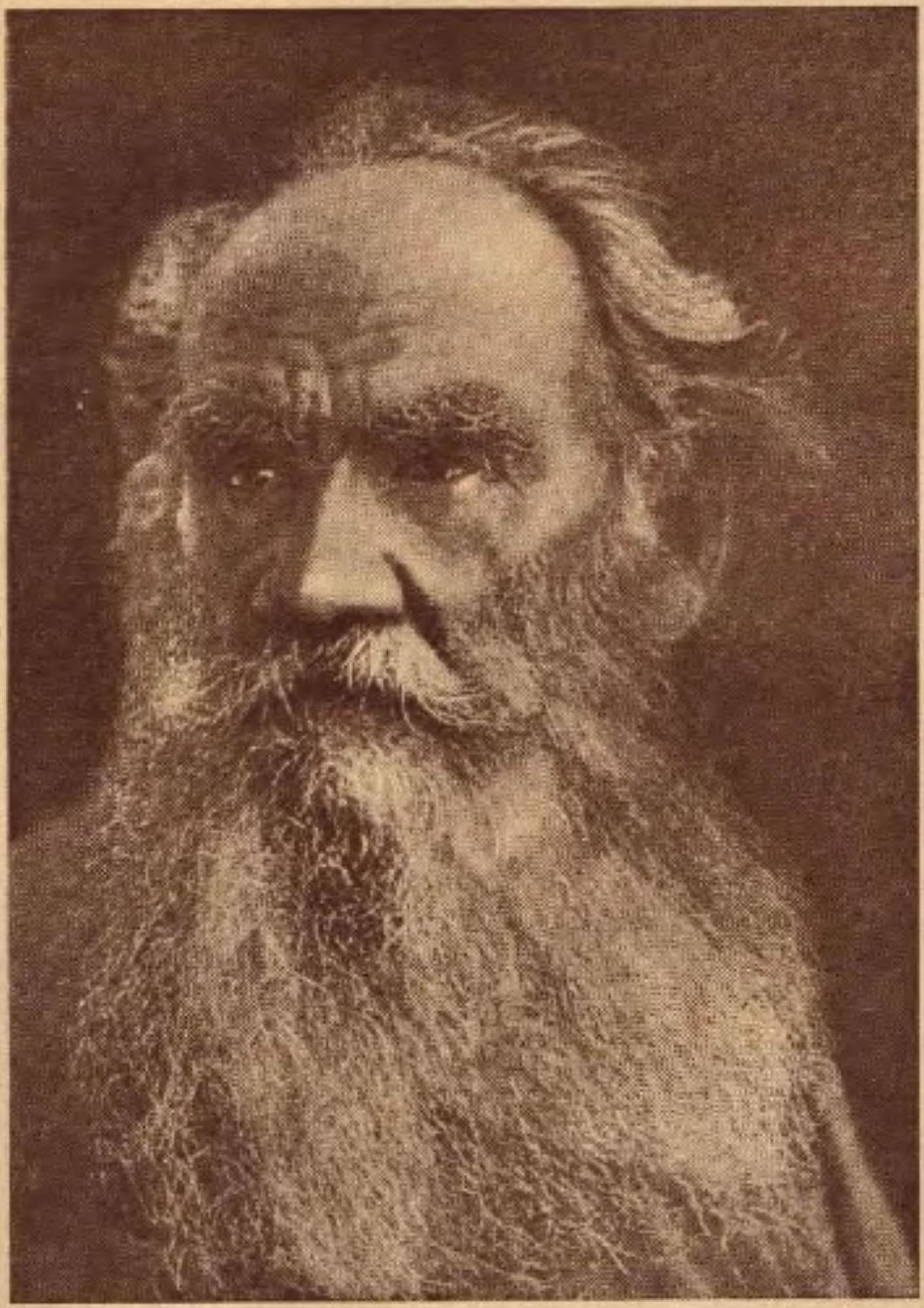
Leo Tolstoy, 1906 — the year the essay reached print, two to three years after he wrote it. (Wikimedia Commons, public domain.)
No `works/` record exists for this essay yet, so the dive's `workRecord` **proposes creating one** (Non-Fiction → Essays and Criticism; genre *essay*). All quotes below are byte-checked against the corpus (`verify_quotes.py`, 28/28); the working-English translations are mine and labelled, pending the published Tchertkoff & Mayo translation (1906).
## Key findings
- **The essay is the application of *What Is Art?* to one case, not a separate crank-piece.** Tolstoy judges Shakespeare by the three criteria of the treatise — content, technique, and above all **sincerity**, which he defines exactly as the treatise does: "the essence of art consists in infecting the perceiver… with the author's feeling" (Ch VI). Shakespeare fails all three; the verdict that he "does not believe what he says" is the *infection* theory turned on its most famous counter-example. The PSS editor calls the essay "directly connected [to *What Is Art?*], being as it were its continuation."
- **The marquee thesis is that Shakespeare's fame is a "collective epidemic suggestion."** Tolstoy lists it beside the Crusades, witch-belief, torture-for-truth, and the Dutch tulip mania, and argues the press magnifies such manias "like a snowball" — with **the Dreyfus affair** as the worked recent example (Ch VII). "Suggestion is always a lie, and every lie is evil" (Ch VIII).
- **He pins the fame on a genealogy, not on the plays.** Until the late 18th century, he says, Shakespeare ranked *below* Jonson, Fletcher and Beaumont; the cult "began in Germany" when **Goethe** — "the dictator of aesthetic opinion" — proclaimed him great, and the German critics, "like crows on carrion," built the theory of "objective art" (art indifferent to good and evil) *out of* Shakespeare (Ch VIII).
- **It began life literally as a preface.** The first draft is titled *ПРЕДИСЛОВИЕ* (Preface) to the American Tolstoyan Ernest Crosby's *Shakespeare and the Working Classes*; it "outgrew Crosby's article and cost me much labour" (to Chertkov, 6 Oct 1903). Tolstoy did not intend to publish it; Chertkov got his consent.
- **The diary shows a man who couldn't stop writing something he kept calling a distraction.** Begun ~13 Sept 1903, "finished" 19 Dec 1903, still being corrected to 19 Jan 1904 — all the while reproaching himself for "messing with Shakespeare" instead of "more necessary works."
- **The most interesting moves were cut.** The drafts contain a frank psychological portrait of Shakespeare-the-man, an explicit *infection/union* mechanism explaining why even gifted readers are deceived, the Koran-chanting analogy, and the Turgenev anecdote — all dropped from the published text.
- **Scholarship is overwhelmingly hostile — and largely begs the question.** From Orwell (1947) to A. N. Wilson and Harold Bloom, the mainstream treats the essay as a brilliant failure, usually by taking the pleasure readers find in Shakespeare as the fact that settles the matter — which is exactly what Tolstoy's essay denies. Catherine Brown (2015) is the one who names the circularity.
## Why this matters
*What Is Art?* defines art and condemns most of European high culture in the abstract; the Shakespeare essay is what the theory looks like when it picks a single, maximally famous target and presses all the way down. It is therefore the cleanest test the corpus offers of whether Tolstoy's aesthetics is a working instrument or a machine that can only produce the verdict it was built to produce. It also preserves, in its drafts, the psychological argument — fame as manufactured aesthetic feeling — that Tolstoy lost his nerve about and cut, and which is the sharpest thing in the whole project.
## The shape of the question
The essay states its own stakes plainly: the fame is not a harmless overvaluation but an *untruth*, and untruth does damage.
Date: Chapter I, written 1903. Context: the opening declaration, after he describes fifty years of failing to share the world's admiration.
> та непререкаемая слава великого, гениального писателя… **есть великое зло, как и всякая неправда**
>
> *(working English)* the indisputable fame of a great, genius writer [that Shakespeare enjoys]… **is a great evil, like every untruth.**
>
> — *On Shakespeare and the Drama*, Ch I · PSS Tom 35, p. 216
The criterion that does the killing is sincerity — and Tolstoy defines it as the *infection of feeling*, the core thesis of *What Is Art?*
> Искренностью, т. е. тем, чтобы автор сам живо чувствовал изображаемое им. Без этого условия не может быть никакого произведения искусства, так как **сущность искусства состоит в заражении воспринимающего произведение искусства чувством автора**.
>
> *(working English)* Sincerity — that is, that the author himself vividly feel what he depicts. Without this condition there can be no work of art, since **the essence of art consists in infecting the perceiver of the work of art with the author's feeling.**
>
> — Ch VI · PSS Tom 35, p. 260
And the explanation of the fame — the marquee claim:
> Объяснение этой удивительной славы есть только одно: **слава эта есть одно из тех эпидемических внушений, которым всегда подвергались и подвергаются люди.**
>
> *(working English)* There is only one explanation of this astonishing fame: **this fame is one of those epidemic suggestions to which people have always been, and still are, subject.**
>
> — Ch VII · PSS Tom 35, p. 263
The chain closes by making the aesthetic question a moral one:
> **Внушение же всегда есть ложь, а всякая ложь есть зло.**
>
> *(working English)* **But suggestion is always a lie, and every lie is evil.**
>
> — Ch VIII · PSS Tom 35, p. 270
## Genesis & composition
The occasion was a small one. The American [Tolstoyan](../tolstoyanism/index.html) Ernest Crosby had written a short study, *Shakespeare's Attitude toward the Working Classes*, arguing that Shakespeare sided with the powerful against the poor; his daughter-in-law (the wife of his son Mikhail) was translating it under Tolstoy's eye. Tolstoy sat down in mid-September 1903 to write a short preface — and could not stop.
The manuscript covers date the start to **13 September 1903** (Old Style), and the diary catches it a week in:
> Date: 22 September 1903 (OS), Yasnaya Polyana.
>
> Пишу несколько дней (больше недели) предисловие о Шекспире.
>
> *(working English)* I have been writing a preface about Shakespeare for several days (more than a week).
>
> — Diary · PSS Tom 54, p. 192
To Chertkov, three weeks later, he described what had happened to the "preface":
> Date: 6 October 1903 (OS), to V. G. Chertkov.
>
> Это начатое мною предисловие к статье Crosby об отношении Шекспира к рабочему народу, **которое переросло статью Crosby** и стоило мне большого труда… Мне хотелось высказать мое много раз и очень добросовестно проверенное впечатление о Шекспире, совершенно противоположное установившемуся.
>
> *(working English)* This is the preface I began to Crosby's article on Shakespeare's relation to the working people, **which has outgrown Crosby's article** and cost me much labour… I wanted to express my many-times and very conscientiously verified impression of Shakespeare, completely opposite to the established one.
>
> — Letter · PSS Tom 88, pp. 308–310
To Stasov — who had supplied him with the Shakespeare scholarship (Brandes's book, the German critics) and had just visited Yasnaya Polyana — he drew the line that separates his essay from Crosby's:
> Date: 9 October 1903 (OS), to V. V. Stasov.
>
> **Дело не в аристократизме Шекспира, а в извращении, посредством восхваления нехудожественных произведений, эстетического вкуса.** …но мне нужно было высказать то, что сидело во мне полстолетия.
>
> *(working English)* **The point is not Shakespeare's aristocratism, but the perversion of aesthetic taste through the praise of non-artistic works.** …but I needed to express what has been sitting in me for half a century.
>
> — Letter · PSS Tom 74, pp. 202–203
That distinction matters: Crosby's case was social (Shakespeare and the working classes); Tolstoy's deeper charge is aesthetic and moral — that the worship of Shakespeare *corrupts taste itself*. It is the [*What Is Art?*](../1897-1898-what-is-art/index.html) argument, not Crosby's.
The diary then records a strange, sustained reluctance. Across the autumn the essay "kept growing" (14 Nov), he was "still messing with Shakespeare" (2 Dec), and he repeatedly framed it as a distraction from work he judged "more necessary." He declared it done on 19 December — "I have finished with Shakespeare and begun on the meaning of religion" — yet was still adding to it on 18 January 1904, the day before the last manuscript date. He was simultaneously at work on *The Forged Coupon*, a Garrison preface, and his essay on religion; the Shakespeare piece was the one he kept apologising to himself for.
### The people around the work
- **Ernest Howard Crosby** (1856–1907) — American Tolstoyan; his essay is the occasion. Tolstoy had known him since 1894 (the memoir `works/v40_339_340`) and wrote to him warmly before (1 Dec 1902) and after (30 Apr 1904, taking one of Crosby's poems as the epigraph to his Russo-Japanese-War essay).
- **V. V. Stasov** (1824–1906) — critic and tireless supplier of books; sent the Brandes *Shakespeare* (Russian, 1901) and other scholarship, much of it borrowed from the Moscow Shakespeare scholar **N. I. Storozhenko**; visited Yasnaya Polyana that September.
- **V. G. Chertkov** (1854–1936) — obtained Tolstoy's consent to publish and arranged the English edition.
- **Aylmer Maude** — Tolstoy's authorised English translator (busy in the same weeks with the folk tales).
## What the work says
The essay runs to eight chapters (PSS Tom 35, pp. 216–272). It is built as a single demonstration: take the most-praised play, retell it until it looks absurd, then generalise.
- **I — The charge.** Fifty years of trying and failing to admire Shakespeare; a re-reading of the whole canon at seventy-five "to check myself once more." He quotes the praise of Johnson, Hazlitt, Hallam, Shelley, Swinburne, Hugo and Brandes, and picks *King Lear* as the test case.
- **II — The demolition.** A long, deadpan, scene-by-scene paraphrase of *King Lear* (the centrepiece) — the arbitrary abdication, the unrecognised Kent, the fool's unfunny jokes, Gloucester's leap from a flat stage, the closing pile of corpses — designed to strip the play of the glamour that quotation lends it.
- **III — The conditions of drama.** The situations are arbitrary (they don't flow from character), anachronistic, and dressed in crude effects. Goethe is turned against Shakespeare: *"Man sieht die Absicht und man wird verstimmt."*
- **IV — No characters, no language.** Everyone speaks the one artificial "Shakespearean" tongue; the characters are borrowed (from the old *King Leir*, from an Italian novella for *Othello*) and *weakened*. He rates the anonymous old play higher:
> вся эта старая драма без всякого сравнения во всех отношениях лучше переделки Шекспира
>
> *(working English)* this whole old play is, beyond all comparison and in every respect, better than Shakespeare's reworking of it.
>
> — Ch IV · PSS Tom 35, p. 239
Hamlet, in this chapter, has no character at all; "blind worship… unreasoning hypnosis" forbids saying so, and critics have turned the void into a virtue.
- **V — The "deep sayings" rebutted.** Aphorisms belong in a treatise, not a drama, whose business is illusion; Shakespeare lacks the "sense of proportion" without which "there never was and cannot be an artist." Against Homer, the foil who *believes* and never exaggerates, Shakespeare shows that "one sees at once that he does not believe what he says."
- **VI — The worldview, and the three criteria.** A long summary of Gervinus's reading of Shakespeare as supreme moral teacher (activity is good; the golden mean; reject Christian "excess"; property and state are sacred; equality is madness), then the three tests of any poetic work — content, technique, sincerity — and Shakespeare's failure of all three. His content is "the lowest, most vulgar worldview… despising the crowd, i.e. the working class."
- **VII — Why the fame, then?** Because fame of this kind is *epidemic suggestion* (the marquee passage above), magnified by the press, with the Dreyfus affair as the lived example; and because Shakespeare's irreligious worldview "fit" the educated public that maintains it. Drama, Tolstoy argues, was always religious in origin and decayed into entertainment for the powerful.
- **VIII — Goethe and the harm.** Goethe canonised him; the German critics built "objective art" out of him; suggestion is a lie and a lie is evil; the harm is the fall of drama into "vulgar and immoral amusement" and the corruption of the young, who are taught to call their teacher of life a man with no religious content. The last words point forward: "the teaching of life, until there is a true religious drama, must be sought in other sources."
## Redactions & textual history
The variants (PSS Tom 35, pp. 557–577; drafts № 1–28, drawn from a fond of 1,151 manuscript units) show the essay assembling itself fast and then being pruned of its most personal moves.
The **first draft is titled *ПРЕДИСЛОВИЕ*** — it is, word for word, a preface:
> **Печатая** прекрасное основательное исследование г-на Э. Кросби об отношении Шекспира к рабочему народу, я считаю не лишним высказать и мое отношение к произведениям Шекспира… [мне бы не хотелось умереть, не высказав его]
>
> *(working English)* **In printing** Mr. E. Crosby's excellent, thorough study of Shakespeare's attitude to the working people, I think it not superfluous to express my own attitude to Shakespeare's works… [I should not like to die without having expressed it.]
>
> — Variant № 1 (рук. № 1) · PSS Tom 35, p. 557
By **25 September** (a date Tolstoy wrote on draft № 6, per Grossman's manuscript description) the argument's spine was already a numbered list of eleven "defects" — confused plot, anachronism, absent characters, misplaced speeches, no individual language, bombast, exaggeration, false poeticality, indecent jokes, immorality — the skeleton the eight chapters flesh out.
What Tolstoy *cut* is the striking part. Three excisions stand out:
- A blunt psychological **portrait of Shakespeare-the-man** — "a very clever man, but not in the sense of original thought… utterly lacking taste and a sense of proportion… with the most vulgar worldview of a servant and entertainer of the powerful" (draft № 10).
- An explicit **infection/union mechanism** — the passage that most directly welds the essay to *What Is Art?*:
> всякое художественно воспринимаемое впечатление есть заражение тем чувством, которое испытывает художник
>
> *(working English)* every artistically perceived impression is an infection with the feeling the artist experiences…
>
> — Variant № 24 (рук. № 12) · PSS Tom 35, p. 571
The cut argument was that the *feeling of union with the many who praise Shakespeare* counterfeits the genuine aesthetic feeling of union — which is why even gifted readers (he names Goethe, Hugo, Turgenev) are taken in. It is the sharpest thing in the drafts, and it did not make the final text.
- A critique of **"objectivity in art"** — that the "Olympianism of Goethe and the soaring of Shakespeare above life's events" only proves "they are not in earnest," sealed with the proverb *"Шила в мешке не утаишь"* ("you can't hide an awl in a sack" — a worldview always shows through). Objectivity survives only obliquely in the published Ch VIII.
Also cut: the **Turgenev anecdote** (Turgenev examining a young dramatist with the *Macbeth* "He has no children" passage — Tolstoy's draft slips and writes "Duncan"), and a **Koran analogy** borrowed from the Arabist A. Krymsky (after hearing the Koran chanted in a mosque many times, one begins to feel "something like aesthetic pleasure") — his model for how repetition manufactures a false response.
## Publication, censorship & translation
Tolstoy "set the essay aside among the many works he did not intend to release in his lifetime," in Chertkov's words; "he kindly gave his consent to friends' request to publish it." It then appeared, by the PSS editor's account, **first in the Moscow daily *Русское слово* (Russkoe Slovo)** across seven issues in November 1906 (Old Style, nos. 277–285, 12–23 Nov); then as a separate Russian edition, *О Шекспире и о драме. Критический очерк* (I. D. Sytin, Moscow, 1907); and in English, bound together with Crosby's companion essay, as *Tolstoy on Shakespeare* — the Free Age Press, Christchurch, 1907, and a Funk & Wagnalls (New York) edition of 1906, translated by V. Tchertkoff and I. F. Mayo. (An English appearance in *The Fortnightly Review* is recorded for December 1906; the strict priority among these near-simultaneous 1906 printings is left to `needsReview`.)
There was no ban: in the post-1905 relaxation it printed freely. Catherine Brown (2015) notes the essay "courted, though didn't quite meet, censorship" — attacking the very author whom Russian writers used as cover to slip past the censor was itself faintly subversive. Brown also flags a translation point worth keeping: the 1906 English version **restored Shakespeare's actual verse** where Tolstoy had given flat prose paraphrase — softening the central deflation device, so that English readers met a partly transformed argument.
> **On the launch framing.** This dive was set up with the note "published 1906 as the preface to Crosby's book." The record is more precise: it was *conceived* as a preface (draft № 1) but *outgrew* it into a standalone essay published on its own (Russkoe Slovo 1906, Sytin 1907). It was the **English editions** that bound it together with Crosby's piece — which is where "with Crosby" is true.
## The marquee question — does it confirm or over-extend *What Is Art?*
Set up as a hypothesis to test against the text, not a verdict to assert. The honest answer the evidence supports is **both confirms and extends** — with a third edge the essay exposes against itself.
**It confirms.** The essay is not a separate eccentricity; it is the doctrine running. Tolstoy reaches for the treatise's exact apparatus — the three criteria, with *sincerity-as-infection* decisive — and the *What Is Art?* dive's own finding holds here: such verdicts "follow rigorously from the infection-criterion," and reading them as arbitrary usually means judging by the beauty-criterion Tolstoy rejects. The PSS editor agrees the essay is *What Is Art?*'s "continuation." Whatever one thinks of the conclusion, it is internally consistent with 1897–98.
**It extends.** Two things here reach past the treatise. First, the **"epidemic suggestion"** thesis generalises what *What Is Art?* had said narrowly (it called Wagner's effect "hypnotism") into a full social-contagion theory of *canonical fame itself* — press-amplified, historicised (the Goethe genealogy), and illustrated from current events (Dreyfus). That is a new and larger claim than the treatise made. Second, the cut draft № 24 supplies the *mechanism* the treatise only implied: the counterfeit aesthetic feeling is the **feeling of union with the admiring crowd** — primary grounding for a point the theory had left at the level of assertion.
**And it over-reaches at one exposed joint.** The criterion that does the work — sincerity — is the one Tolstoy cannot establish from the text. He convicts Shakespeare of "not believing what he says," but that verdict rests on his own fifty-year certainty, not on anything a reader could check. The drafts know this: draft № 24's union-mechanism is an *attempt to ground the charge*, and Tolstoy cut it, leaving the published essay to assert what the draft had tried to explain. This is the doctrine's vulnerability laid bare — and it is exactly the joint the hostile scholarship attacks (see below), though usually by begging the opposite question.
## Reception & afterlife
The essay's afterlife is mostly its scholarly rebuttal; the contemporary 1906–07 press reaction is thinly documented in the sources reachable here (the 1907 Free Age Press edition advertised a section, "The Press against Shakespeare," whose contents this dive did not recover — `needsReview`). What survives is a long argument among critics, which is treated as a divergence map below rather than as corroboration.
The single most influential response is **George Orwell's "Lear, Tolstoy and the Fool" (1947)**, which still sets the terms: Orwell grants that much of Tolstoy's structural case is fair, then neutralises it two ways — a *survival* argument (enduring admiration is the only available test of merit) and an *autobiographical* one (Tolstoy's own life so resembled Lear's — renunciation, flight, a death among strangers — that the hatred reads as self-reproach). Orwell also claimed Tolstoy sought not to ban Shakespeare but to "do dirt on" him, to "kill his enjoyment by every trick he can think of."
## Scholarly context
This is a divergence map: where the received scholarly view stands relative to the dive's primary-sourced reading. The mainstream is overwhelmingly hostile to the essay — so it is attributed, not adopted, and the recurring weakness in it is flagged.
- **The essay as the sequel to *What Is Art?*** — *confirms.* George Gibian's *Tolstoj and Shakespeare* (1957), the only book-length study, places Tolstoy's criteria in a coherent (French neoclassical) tradition rather than treating them as a private crotchet; Orwell too reads the essay as continuous with the art theory. The dive's central framing is not contested.
- **The "epidemic suggestion" explanation of the fame** — *complicates.* Orwell (1947) calls it close to a conspiracy theory, a substitute for argument; Harold Bloom (*The Western Canon*, 1994) substitutes his own psychology — Tolstoy "could not handle the influence of Shakespeare… and had to disavow him," the attack as a strong writer's anxiety of influence. Both replace Tolstoy's social explanation with a different single cause.
- **"The fame began in Germany / Goethe canonised him"** — *complicates.* Gibian's placing of Tolstoy himself in a *French* neoclassical line slightly undercuts the Germany-as-villain story; Orwell treats the historical claim as beside the point rather than false.
- **Shakespeare's class politics / drama and the "crowd"** — *confirms.* This is the one place the mainstream agrees: **George Bernard Shaw** — who coined "bardolatry" — coincided with Tolstoy on Shakespeare's missing social conscience (his 1906 letter is printed in the combined volume), while defending the "word-music" Tolstoy's criteria do not cover; Crosby's companion essay makes the same social case.
- **The *King Lear* demolition / Hamlet has no character** — *contradicts.* Orwell, Bloom and A. N. Wilson read the scene-by-scene method as wilfully obtuse — missing verbal texture, symbolic depth, and (Orwell's point) the Fool, whom Tolstoy omits. Wilson (*Tolstoy*, 1988) calls the essay "fifteen thousand words of nonsense."
- **The autobiographical Lear/Tolstoy parallel** — *extends.* Orwell (1947) develops a reading — renunciation followed by resentment — that Tolstoy's own account does not make; Brown (2015) and others ground the essay in his life-circumstances similarly.
The pattern the dive flags, following **Catherine Brown (2015)**: the hostile mainstream — Orwell's survival test, Bloom's self-evident pleasure, Wilson's "nonsense" — repeatedly takes the enjoyment readers find in Shakespeare as the brute fact that settles the question. That is precisely the claim the essay contests: that cultivated aesthetic pleasure is a reliable guide to worth rather than, in part, a product of social suggestion. Whatever the essay's faults, the commonest reply does not answer it; it restates the thing in dispute. (On the contested label "[Tolstoyan](../tolstoyanism/index.html)" attached to Crosby and Chertkov, see the project's dedicated dive.)
## Place in the cluster
The essay sits downstream of [*What Is Art?* (1897–98)](../1897-1898-what-is-art/index.html), whose dive supplies the governing theory — the *infection* definition and the religious criterion this essay applies — and already noted that "a January 1896 letter… shows the anti-Shakespeare strand active" before the treatise was even finished. The two are proposed as `relatedWorks` (sequel). The essay also rhymes with the [crisis](../crisis/index.html) dive's account of the post-conversion programme — drama, like all art, is to be re-grounded in religious consciousness — and with the [fire-metaphor](../fire-metaphor/index.html) dive's transmission imagery, of which "infection" is the aesthetic face. The companion text proper, Crosby's *Shakespeare and the Working Classes*, is not Tolstoy's and is out of corpus.
## The author's later verdict
Tolstoy left no recorded recantation. The diary three years later (30 Sept 1906, quoted by the PSS editor) shows the conviction undimmed — he was still tracing "all the harmful influence" of Goethe and the cult of "false great men" on the generation he had grown up in, "especially poor Turgenev, with his admiration for *Faust*… and Shakespeare." The essay's own framing — "I should not like to die without having expressed it" (cut from the final text) and "what has been sitting in me for half a century" — presents it not as a late opinion but as a lifelong one he finally discharged.
## Material not covered
- The anonymous old play *King Leir* (Tolstoy's preferred text) — outside this corpus; needs an external Elizabethan-drama source.
- Crosby's companion essay *Shakespeare's Attitude toward the Working Classes* — not Tolstoy's text; available in the 1906/1907 volumes (Internet Archive).
- The full 1,151-unit manuscript fond (Tolstoy Museum, Moscow) — only the dated covers and key drafts (№ 1, 6, 8, 11, 12) are characterised here, from Grossman's description.
- Fine-grained collation of which published sentence derives from which redaction.
- The contemporary 1906–07 press reaction (Russian and English) and the "Press against Shakespeare" section of the 1907 edition — thin in open sources.
## Visual & manuscript record
Four public-domain images are cached for this dive (in the git-ignored `visuals/`), with one title page documented for fetching:
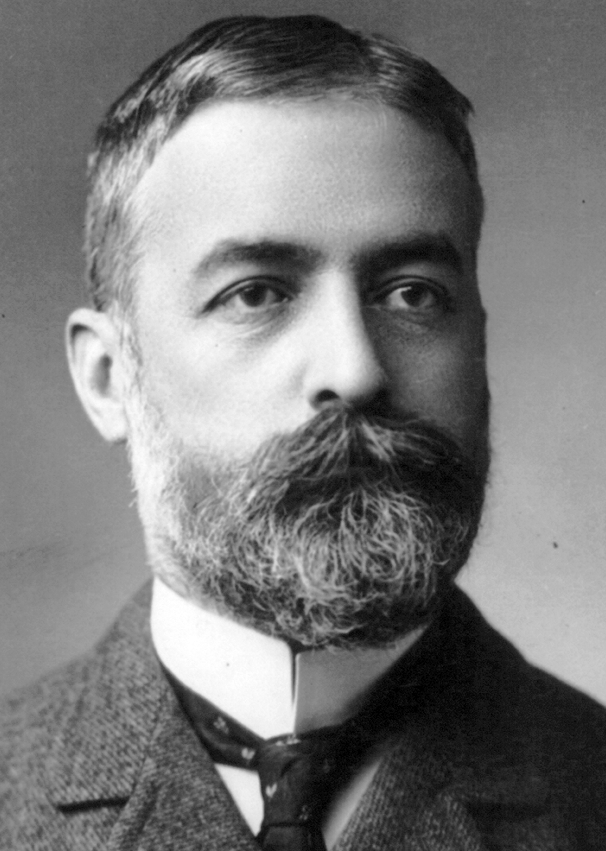
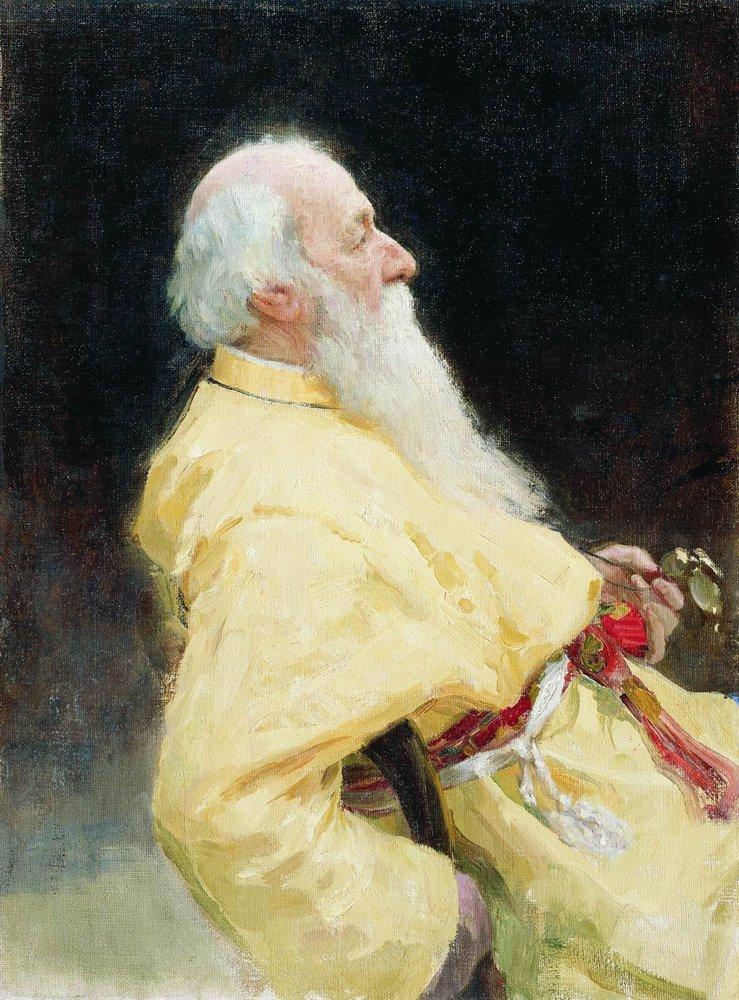
Ernest Howard Crosby (1856–1907), photographed by James E. Purdy in 1904 — the year Tolstoy was finishing the essay that began as a preface to Crosby's work. (Wikimedia Commons, public domain.)Vladimir Stasov (1824–1906), by Ilya Repin, 1905 — closest in time to Stasov's September 1903 visit to Yasnaya Polyana, when he brought Tolstoy the Brandes Shakespeare scholarship. (Wikimedia Commons, public domain.)
- **Leo Tolstoy, 1906** (keystone, above) — Wikimedia Commons, PD. The closest firmly-dated PD photograph to the composition years.
- **Tolstoy on Shakespeare (Funk & Wagnalls, New York, 1906)** — title page *not* downloaded; the Internet Archive scan (`tolstoyonshakesp00tols`) exposes only a thumbnail. Fetch recipe in the dossier (download the PDF, `pdftoppm` page 1). A *visuals work-order* item.
- **Shakespeare, Droeshout engraving (1623)** — cached, PD; an optional visual counterpoint.
The Russian first edition (Sytin, Moscow 1907) was not located on Commons or IA in this sweep and would need a Russian digital-library search.
## Method
A work-subject dive (not `--novel`), run interactively. The reader's framing named the work, the angle (the practical sequel to *What Is Art?*), the dates, and the cross-links, so the scoping contract was confirmed in prose and the dive proceeded.
- **Corpus surface.** The essay and its variants (PSS Tom 35, via the tolstoydigital TEI); the composition-window diaries (Toms 54–55, Sept 1903 – Jan 1904) and letters (Toms 74, 88 — Stasov, Chertkov, Crosby); Grossman's editorial commentary (Tom 35, pp. 680–685).
- **Extraction.** `extract_tei.py --choice=reg --notes=auto` (pre-reform orthography resolved; note-apparatus recovered). A local `.dive-venv` was created for `lxml`/`pyyaml`.
- **Gates.** `verify_quotes.py` → 28/28 verbatim, exit 0. Separate-pass verifier (Phase 5). No vault writes; `visuals/` is git-ignored; only PD facsimiles would go in `extracts/`.
- **Grounding.** Primary record + the [*What Is Art?* dive](../1897-1898-what-is-art/index.html) first; mainstream Shakespeare scholarship (hostile to this essay) attributed and read critically, never adopted as a baseline.
- **Links.** Sibling dives: [What Is Art?](../1897-1898-what-is-art/index.html) · [crisis](../crisis/index.html) · [fire-metaphor](../fire-metaphor/index.html) · [tolstoyanism](../tolstoyanism/index.html).
- **Open items** are in the dossier's `needsReview` (publication priority; the daughter-in-law translator; Knight's pamphlet; Shaw's letter text; the 1906–07 press).
Draft dev-blog note: [`website/src/posts/notes/2026-06-13-on-shakespeare-and-the-drama.md`](../../../../../../website/src/posts/notes/2026-06-13-on-shakespeare-and-the-drama.md) (`draft: true`).
## References
**Primary (corpus):**
- Толстой Л. Н. *О Шекспире и о драме* // ПСС, Т. 35. М.: ГИХЛ, 1950. С. 216–272.
- Толстой Л. Н. *Варианты к статье «О Шекспире и о драме»* // ПСС, Т. 35. С. 557–577.
- Гроссман Л. П. *«О Шекспире и о драме». История писания и печатания; Описание рукописей* // ПСС, Т. 35. С. 680–685.
- Толстой Л. Н. *[Дневник 1903–1904]* // ПСС, Т. 54 (с. 190–203), Т. 55 (с. 2–12).
- Толстой Л. Н. *Письма* В. В. Стасову (Т. 74) и В. Г. Черткову (Т. 88), сентябрь–октябрь 1903.
**Background (secondary — attributed, not adopted):**
- George Orwell, "Lear, Tolstoy and the Fool," *Polemic* No. 7 (1947).
- G. Wilson Knight, *Shakespeare and Tolstoy* (English Association Pamphlet No. 88, 1934).
- George Bernard Shaw, letter in *Tolstoy on Shakespeare* (Funk & Wagnalls, 1906 / Free Age Press, 1907).
- George Gibian, *Tolstoj and Shakespeare* (The Hague: Mouton, 1957).
- Harold Bloom, *The Western Canon* (1994); *Shakespeare: The Invention of the Human* (1998).
- Catherine Brown, "Revisiting Tolstoy's *On Shakespeare and on Drama*" (catherinebrown.org, 2015).
- A. N. Wilson, *Tolstoy* (1988); Rosamund Bartlett, *Tolstoy: A Russian Life* (2010); Ernest Crosby, *Shakespeare's Attitude toward the Working Classes* (1902).
---
*Dive note: this research prepares ingestion-ready material; it does not create vault pages. The `entities` routing map and the record-creating `workRecord` in [`dossier.yaml`](dossier.yaml) are the plan; turning them into `website/src/wiki/**` pages and a `works/` record is a separate, human-in-the-loop step.*