---
layer: reference
lastUpdated: 2026-06-08
tags: [research, work-dive, novel-dive, resurrection, voskresenie, doukhobors, excommunication, censorship]
---
# Resurrection (Воскресение), 1889–1899 — a novel-dive
A primary-source dive on Tolstoy's third and last novel: its long gestation and the Doukhobor-funded sprint that finished it; its central church-service satire; and the causal chain from that satire to the 1901 excommunication. This is a **novel-dive** — the corpus-dive spine re-weighted for fiction: the genesis/biographical layer carries the most weight, the textual layer is a thematic map plus a few scenes read closely, and the marquee question (did the communion chapter trigger the excommunication?) is tested against the record rather than asserted.
All Russian is verbatim from the tolstoydigital TEI corpus (PSS — the 90-volume *Полное собрание сочинений*), extracted with modern orthography (`--choice=reg`). English in parentheses is a working translation, labelled as such. Foreign titles are kept verbatim.
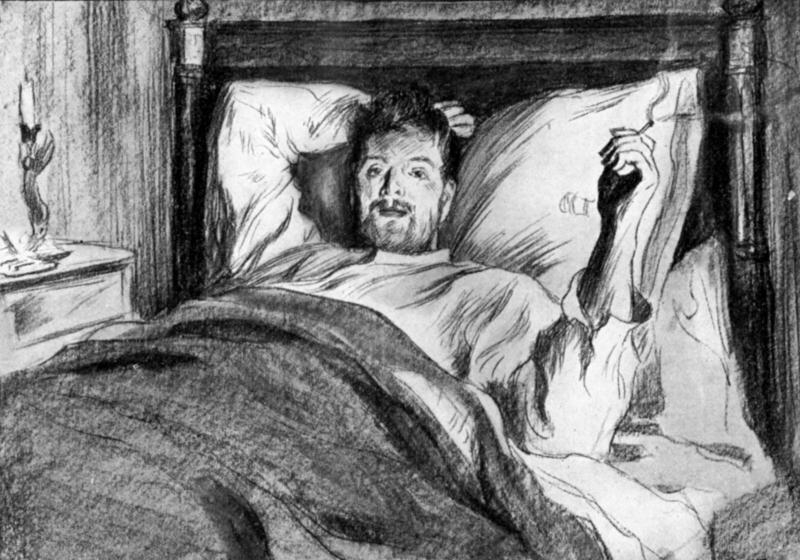
Leonid Pasternak, "The Awakening" — Prince Nekhlyudov in the opening scene. One of Pasternak's illustrations for the 1899 «Нива» serialisation. (Wikimedia Commons, public domain.)
## Key findings
- **The novel was finished to fund a rescue.** Tolstoy reopened the stalled book in July 1898 and drove it to completion expressly to fund the Doukhobor emigration to Canada — reversing his own post-1881 refusal of literary fees. The corpus fixes the hard financial datum (the 12 Oct 1898 «Нива» contract: 1,000 roubles per printer's sheet, 12,000 roubles advance) and shows the proceeds being routed straight to Chertkov for the emigration. The single lump-sum "total raised" figures that circulate (≈30,000–34,200 r.) are secondary and not mutually consistent — treated here as approximate, not asserted.
- **The funding deadline reshaped the novel.** Its sharpest social material — the prison-church satire, the political prisoners, the Toporov caricature — entered only in the 1898 redactions, after the deadline forced Tolstoy to reopen and radically expand a book he had meant only to lightly retouch.
- **The communion centrepiece is exactly where the handoff placed it** (Part I, chs XXXIX–XL): the Orthodox liturgy rendered in flat, defamiliarised terms, with two paragraphs of explicit authorial indictment, and a structural hammer-blow in ch XLI (the city's bells call the free population "to the same service now performed in the prison").
- **That scene was the single most heavily censored passage in the novel.** The 1899 «Нива» censorship cut chs XXXIX–XL *wholesale* — two entire chapters reduced to the four words «Началось богослужение», the part renumbered to hide the gap. Russian serial readers never saw the satire; it survived only in Chertkov's complete text abroad.
- **On the excommunication, the evidence *complicates* the popular prior.** The Synod's «Определение» of 20–22 February 1901 indicts Tolstoy broadly (Trinity, Christ's divinity and resurrection, the virgin birth, the afterlife, *all* sacraments) and names the Eucharist as «последняя и высшая степень» — the rhetorical *climax* of that list, not its basis. The corpus's own PSS editor calls *Resurrection* the «толчок» (impulse) to *publish* an act conceived in the 1880s, and locates its sting as much in the Pobedonostsev caricature as in the Mass scene. The defensible synthesis: *Resurrection* was the proximate trigger that made the Synod publish, in 1901, an excommunication whose doctrinal substance had been accumulating for two decades.
## Why this matters
*Resurrection* is the bridge between the two halves of Tolstoy's life — the novelist of *War and Peace* and *Anna Karenina*, and the religious dissident of the Prophet period. It is the one late work where the fiction and the campaign are the same act: a novel written to ransom a persecuted sect, carrying the most direct assault on the official Church Tolstoy ever published, and standing at the centre of the event — the 1901 excommunication — that formalised his break with Russian Orthodoxy. It is also the project's first flagship novel-dive, and the test case for whether the corpus-dive method, built on the non-fiction treatises, can be re-weighted for a 500-page work of fiction.
## Genesis & composition — the heaviest layer
### The seed: the «Коневская повесть» (1887)
The plot was a gift. In June 1887 the jurist **A. F. Koni** (Анатолий Фёдорович Кони), a guest at Yasnaya Polyana, told Tolstoy a real case from his time as a St Petersburg prosecutor: a juror recognised, in the woman in the dock, a girl he had once seduced — the real "Rozalia Oni," who had fallen from a gentry household into prostitution, was tried for theft, and (in the real case) died of typhus before the juror's offer of marriage could be acted on. Tolstoy first urged Koni to write it up himself for «Посредник» (Posrednik), and for years the working title was the «Коневская повесть» — the Koni tale. Koni ceded the subject in 1888.
The PSS editors (N. V. Gorbachev, «История писания и печатания "Воскресения"», PSS Tom 33) date the first sustained work to **26 December 1889**, recorded in the diary: *«Неожиданно стал писать Коневскую повесть и, кажется, недурно»* ("Unexpectedly began writing the Koni tale, and not badly, it seems"). The title «Воскресение» was fixed on 15 December 1890, and the hero became Nekhlyudov. Then the book stalled for most of the 1890s.
### The engine: the Doukhobors (1898)
What finished *Resurrection* was an emergency. The Doukhobors — a pacifist peasant sect persecuted for refusing military service — had been granted permission to emigrate, and Tolstoy threw himself into raising the money to move them to Canada. Realising private donations would not be enough, he reversed his long-standing refusal of literary fees and resolved to sell his unfinished fiction for the fund. The decision is in the diary of **17 July 1898**:
Date: 17 July 1898 (PSS Tom 53; `extracts/v53_203_204_1898_07_17.txt`).
Context: the resolution to publish, and the first day of resumed work after a spring illness.
> Решил отдать свои повести: Воскресение и Отец Сергий в печать для духоборов. […] Взялся за Воскресение, и сначала шло хорошо, но с тех пор как встревожили — два дня ничего не мог сделать. […] Приди и вселися в ны. Возбуди воскресение во мне.
(working English) "I decided to give my tales — *Resurrection* and *Father Sergius* — to print for the Doukhobors. […] I took up *Resurrection* and at first it went well, but from the moment I was disturbed — two days I could do nothing. […] Come and dwell within us. Kindle resurrection in me." — the entry fuses the novel's title with a prayer.
Through the autumn of 1898 the work was total. The diary of **2 November 1898** records both the transaction and the immersion:
Date: 2 November 1898 (PSS Tom 53; `extracts/v53_210_211_1898_11_02.txt`).
> Продажа повести и получение 12-ти тысяч, которые отдал духоборам, устроилось хорошо. […] Дела очень много, но я весь поглощен Воскресением, берегу воду и пускаю только на Воскресение.
(working English) "The sale of the tale and the receipt of twelve thousand, which I handed over to the Doukhobors, worked out well. […] I have a great deal of work, but I am wholly absorbed in *Resurrection*, I husband my water and let it flow only onto *Resurrection*."
The PSS editors make the causal point sharp: Tolstoy had meant only to lightly retouch the short pre-1898 draft, but once he reopened it he *radically reworked and expanded* it. The funding deadline both forced completion and triggered the expansion into the socially and politically sharp final novel — the prison-church service, the political prisoners, and the Toporov caricature were all absent before 1898.
### The people around the work
The genesis network is a roster of wiki-worthy figures: **A. F. Koni** (the plot's source); **V. G. Chertkov**, who ran the complete edition abroad and managed the foreign rights for the Doukhobor fund, and whom the editors also read as a partial spiritual prototype for Nekhlyudov; **A. F. Marks** (Адольф Маркс), publisher of «Нива», who bought first-printing rights and pushed Tolstoy to finish; **P. I. Biryukov** ("Posha"), intermediary to the Doukhobor colony; **L. O. Pasternak**, who illustrated the serialisation; the copyists (Maria Lvovna Tolstaya and the household); the fact-suppliers among the jurists (**N. V. Davydov**, **V. A. Maklakov**); and the prototypes the editors identify — Nekhlyudov as heavily autobiographical (Tolstoy's own youthful seduction of a household maid), and **Toporov** as an unmistakable caricature of **K. P. Pobedonostsev**, Over-Procurator of the Holy Synod.
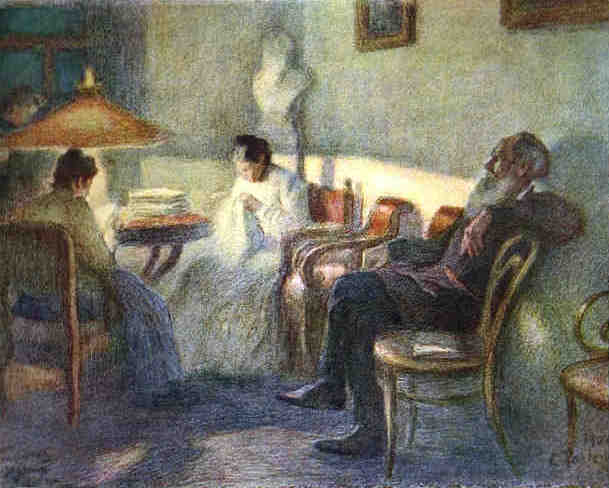
Leonid Pasternak, "Tolstoy under the lamp" (1902). Pasternak's long collaboration with Tolstoy began with the «Воскресение» illustrations. (Wikimedia Commons, public domain.)
## What the work says
The novel-dive does not read *Resurrection* chapter by chapter. It maps the themes and reads a handful of pivotal scenes closely. The structural device is plain once seen: Nekhlyudov's moral "resurrection" is refracted through institutions in sequence — the court, the prison, the land, the Church — each an institution he is implicated in, each a station of his awakening; and the final Gospel chapter steps outside all of them.
### The centrepiece: the communion scene (Part I, chs XXXIX–XL)
In the prison church the convicts are marched to the Mass, and Tolstoy describes the Orthodox liturgy by refusing every sacred name for it. The service "consisted in" physical actions:
> Богослужение состояло в том, что священник, одевшись в особенную странную и очень неудобную парчевую одежду, вырезывал и раскладывал кусочки хлеба на блюдце и потом клал их в чашу с вином, произнося при этом различные имена и молитвы.
(working English) "The service consisted in this: the priest, having dressed in a peculiar, strange and very uncomfortable brocade garment, cut up and laid out little pieces of bread on a saucer and then put them into a cup of wine, pronouncing meanwhile various names and prayers."
The chasuble is a "brocade sack"; the consecration is "manipulations"; the central act is the priest waving a napkin over the saucer. The Eucharist itself is rendered as ingestion — the priest "ate a piece of the body of God and drank a gulp of His blood," then drains the cup, "diligently sucked his moustache," and walks out cheerful, "the thin soles of his calfskin boots squeaking." Then, in ch XL, Tolstoy drops the flat register and states the indictment directly:
> Никому в голову не приходило того, что золоченый крест с эмалевыми медальончиками на концах, который вынес священник и давал целовать людям, был не что иное, как изображение той виселицы, на которой был казнен Христос именно за то,что он запретил то самое, что теперь его именем совершалось здесь.
(working English) "It occurred to no one that the gilded cross with enamel medallions on its ends, which the priest had carried out and gave people to kiss, was nothing other than the image of that gallows on which Christ was executed precisely for forbidding the very thing that was now being performed here in his name."
The priest's psychology is given as complicity, not malice — he believes not in transubstantiation but "that one must believe in this faith," and what confirms him in it is that "for performing the rites of this faith he had for 18 years already been receiving an income." And the satire's reach is total: in ch XLI, as Nekhlyudov leaves, the city's church-bells call the free population to the same rite —
> Со всех сторон дрожал воздух от разнообразного звона и гула колоколов,призывающих народ к присутствованию при таком же служении, какое совершалось теперь в тюрьме.
(working English) "From all sides the air trembled with the varied ringing and din of bells, calling the people to attend the same kind of service as was now being performed in the prison."
Church and prison are one institution. (Full verbatim passages with translations: `extracts/_communion_centrepiece.md`.)
### The other pivotal scenes (read lightly)
**The wrongful verdict (Part I).** Maslova is convicted by a procedural blunder, not malice: the exhausted jury frames its answer to drop the robbery motive but forgets the parallel qualifier on intent to kill —
> Все так устали, так запутались в спорах, что никто не догадался прибавить к ответу: да, но без намерения лишить жизни.
(working English) "Everyone was so tired, so tangled in arguments, that no one thought to add to the answer: yes, but with no intention of taking life." On paper she has poisoned a man for no reason; the presiding judge "spread his hands" in surprise; she is sentenced to katorga.
**The land question (Part II).** Nekhlyudov tries to divest his inherited land on the Henry George single-tax model. The scene's point is the peasants' reception: not gratitude but suspicion, settled only by an old woman's folk-theological reading that "the master had begun to think of his soul." Tolstoy keeps the scheme provisional in Nekhlyudov's own mouth — "a transition from a cruder to a less crude form of violence," not the solution.
**The ending (Part III, ch XXVIII).** The "resurrection" of the title is realised not as plot (Maslova does not marry him; she chooses Simonson) but as a private reading of the Gospel — the Sermon on the Mount reread as practicable law:
> С этой ночи началась для Нехлюдова совсем новая жизнь […]. Чем кончится этот новый период его жизни, покажет будущее.
(working English) "From that night a wholly new life began for Nekhlyudov […]. How this new period of his life will end, the future will show." The awakening is interior and the ending deliberately left open. The text is dated «16 декабря 1899 года. Конец.» (Thematic map and the scene passages: `extracts/_thematic_map.md`.)
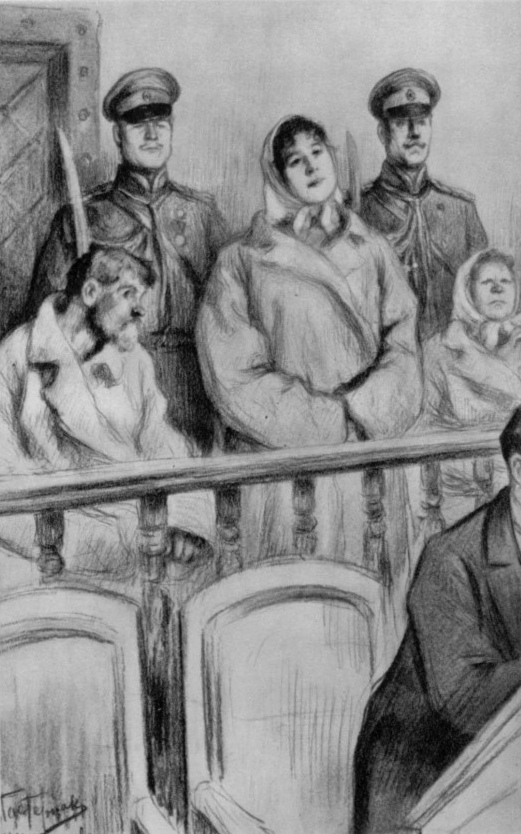
Katyusha Maslova at the prisoner's dock — the trial. Leonid Pasternak, 1899, for «Нива». (Wikimedia Commons, public domain.)
## Redactions & textual history
The PSS editors organise the manuscripts into six redactions across a 12-year span; the holding files are PSS Tom 33 (`v33_003_018` … `v33_261_321`). A light sampling confirms the textual fact that matters most for this dive: **the detailed prison-church service first appears in the third redaction (27–28 August 1898)** — the editors state «В конечной стадии работы над третьей редакцией впервые дано подробное описание богослужения в тюремной церкви» — and it appears there as *two adjacent drafts*, with the explicit "pagan idolatry" commentary later transferred into Nekhlyudov's interiority and the narratorial voice. The centrepiece was a deliberately-worked late addition, a product of the 1898 reopening, not an original feature of the Koni tale. (Sampling: `extracts/_redactions.md`.)
## Publication, censorship & translation
*Resurrection* was serialised in the mass-circulation "family" weekly «Нива» from No. 11 (13 March 1899), illustrated by Pasternak, under a contract with A. F. Marks. The complete, uncensored Russian text was printed simultaneously abroad by Chertkov's «Свободное слово» (Purleigh, Maldon, Essex), from the «Нива» galleys — the same banned-at-home / complete-abroad pattern as the non-fiction. Foreign first editions were arranged through Chertkov for the Doukhobor fund: in England, Louise Maude's translation (Brotherhood Publishing) sold in penny parts "in aid of the Doukhobors… settling now in Canada"; in France, *Echo de Paris* (which, being clerical, dropped the church-service scene) and a fuller Flammarion edition; in Germany and the United States (where *Cosmopolitan* bowdlerised the seduction and Chertkov broke the contract).
The censorship was the heaviest of any Tolstoy work. V. D. Bonch-Bruevich counted **497 distortions, omissions and paraphrases affecting 10,240 words**; only 25 of the 123 chapters were printed without distortion. The censor's targets were sexual content, anti-state material, the prison-and-justice critique, and — most severely — the Church. The communion scene received the most extreme treatment available:
Source: «Воскресение. Цензурные варианты», PSS Tom 32 (`extracts/v32_471_505_Tsenzurnye_varianty.txt`, line 589).
> От главы XXXIX I части в Н. сохранилась только первая фраза: Началось богослужение., присоединенная к главе XXXVIII. Глава XL в Н. выпущена целиком.
(working English) "Of chapter XXXIX of Part I, only the first sentence survived in «Нива»: 'The church service began.', appended to chapter XXXVIII. Chapter XL was dropped entirely." The part was renumbered to hide the two-chapter gap. The satire was not softened — it was removed in full, and restored only by Chertkov abroad. The imperial censor — institutionally aligned with the Synod — singled out this passage, above the anti-monarchy and anti-prison material, for total suppression. (Analysis: `extracts/_censorship_variants.md`.)
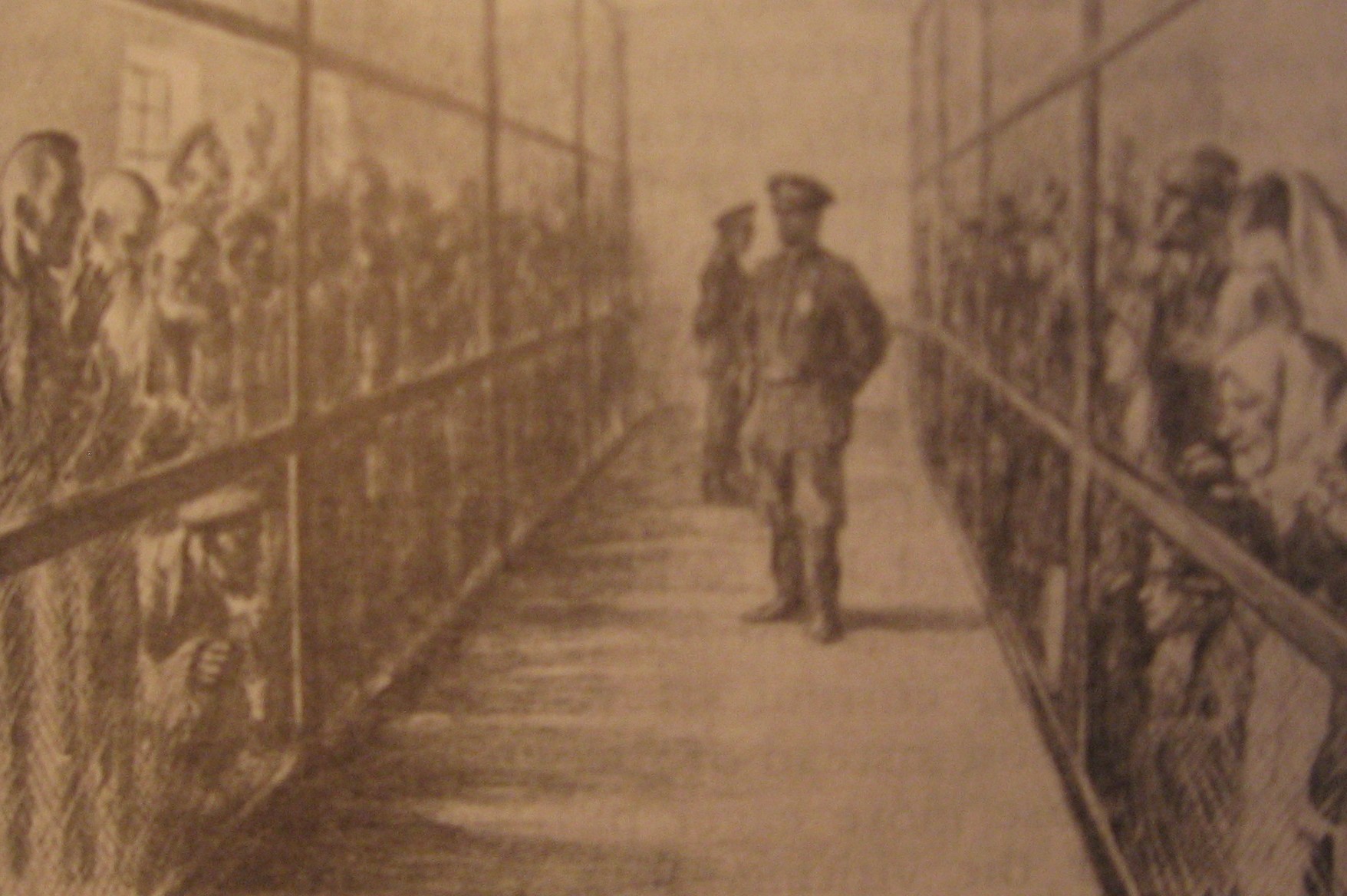
The prison visiting corridor — convicts pressed against the cage-fencing. Leonid Pasternak, 1899. (Wikimedia Commons, public domain.)
## The communion scene and the 1901 excommunication — a hypothesis tested
The handoff carried a strong prior: that the communion chapter was the *specific trigger* of the excommunication. Built from the primary record — the decree's own wording, Tolstoy's diary, and his «Ответ Синоду» — the honest verdict is **complicates** (with an *extends* component). The full case is in `extracts/_excommunication.md`; in brief:
**The decree is doctrinally broad.** The Holy Synod's «Определение» No. 557 of 20–22 February 1901 (O.S.), quoted verbatim by Tolstoy inside his Reply, charges that he "rejects the personal living God… denies the Lord Jesus Christ… denies the seedless conception… does not acknowledge the life beyond the grave… rejects all the sacraments of the Church." This is the standing content of the religious works of the 1880s–90s — [*A Confession*](../1879-1882-a-confession/index.html), [*What I Believe*](../1882-1884-what-i-believe/index.html), [*The Kingdom of God Is Within You*](../1890-1893-the-kingdom-of-god-is-within-you/index.html). None of it turns on *Resurrection*.
**The Eucharist is the climax, not the basis.** The decree names the communion satire — but, in Tolstoy's own verbatim quotation of it, "as the last and highest degree of my guilt" (*«как последняя и высшая степень моей виновности»*): that he "did not shudder to subject to derision the most holy of the sacraments — the Eucharist." The Synod itself frames the Eucharist as the rhetorical capstone of a doctrinal list, not its foundation.
**The corpus distinguishes long-laid intent from proximate occasion.** The PSS editor (A. I. Opulsky) states it plainly: *«Отлучение Толстого от церкви было задумано царским правительством еще в 1880-х гг. Толчком к опубликованию отлучения послужило появление в 1899 г. романа «Воскресение»…»* — "The excommunication was conceived by the tsarist government as far back as the 1880s. The impulse to *publish* the excommunication was the appearance in 1899 of the novel *Resurrection*." The editor locates the personal sting in the Toporov caricature of Pobedonostsev as much as in the Mass scene.
**Tolstoy read it as doctrinal, not as fallout from one chapter.** His first diary reaction (19 March 1901) is strikingly cool — *«странное отлучение от церкви»*, "the strange excommunication," listed in one breath between his work and the student unrest; on 28 March he writes that "all our Orthodoxy is sorcery out of fear." In the Reply he concedes the church-renunciation and the rejection of *all* sacraments, and answers the Eucharist charge by defending exactly the *Resurrection* manner — that he "did not shudder to describe simply and objectively what the priest does… but that to describe it simply, as it is done, is blasphemy — that is perfectly untrue."
So the communion satire is real, named, and rhetorically central to the decree — and it was the single passage the censor judged most intolerable. But it is the capstone of a two-decade doctrinal case, not its cause. The careful synthesis: *Resurrection* — its Pobedonostsev caricature foremost, with the communion satire as the most-quoted single offence — was the **proximate trigger that made the Synod publish, in February 1901, an excommunication whose substance had been accumulating since the 1880s.**
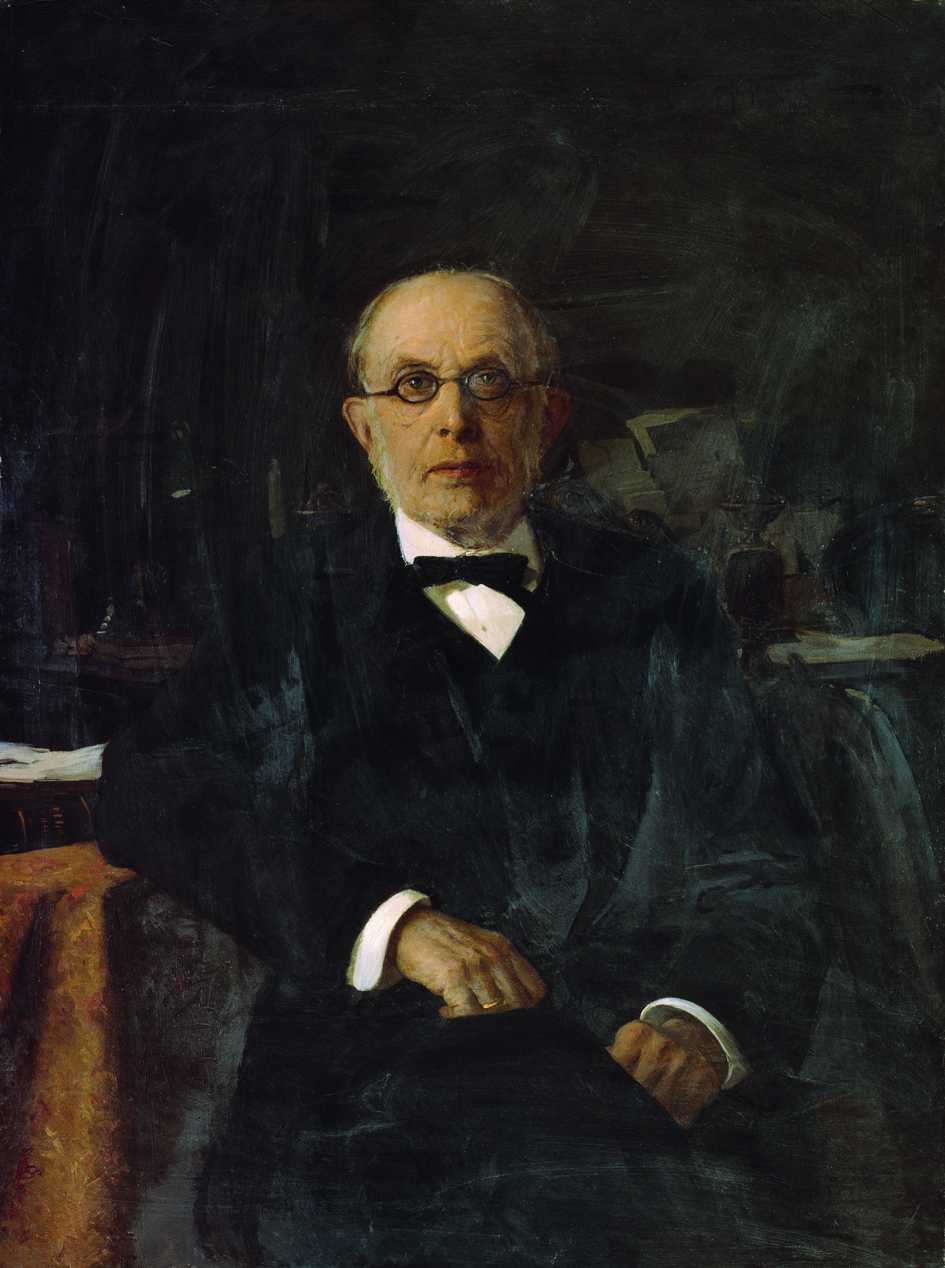
K. P. Pobedonostsev, Over-Procurator of the Holy Synod — the model for the novel's Toporov. Aleksandr Makovsky, 1899, the year «Воскресение» was completed. (Wikimedia Commons, public domain.)
## Reception & afterlife
**In Russia**, the serialisation was a cultural event — the first full-length Tolstoy novel in roughly twenty-five years, from an author now as famous for his religious dissent as for his fiction — and it outsold both earlier novels. The institutional reaction *was* the censorship: the systematic removal of the church chapters is the clearest record of how the state read the book. Anton Chekhov, who had heard an early draft read aloud in 1895, praised the prison-and-convict scenes but found the Gospel-resolution "too theological" (per the reception summaries — `extracts/_reception.md`); V. V. Stasov was wholehearted. The excommunication two years later provoked a public response largely *adverse to the Synod* — sympathy demonstrations, a flood of letters — with Archbishop John of Kronstadt taking the opposite line. (Named 1899–1900 Russian press reviews remain a gap — see Material not covered.)
**Abroad**, the Doukhobor-funded simultaneous publication across five countries made *Resurrection* Tolstoy's most widely and rapidly translated late work (twelve German translations in 1900 alone; fifteen French editions). **Afterlife**, briefly: Franco Alfano's opera *Risurrezione* (1904); stage adaptations (Nemirovich-Danchenko, Moscow Art Theatre, 1930); and films including Mamoulian's *We Live Again* (1934). (Reception detail and sources: `extracts/_reception.md`.)
## Scholarly context
The received scholarly view is attributed here, not adopted — read as a contrast to the primary record.
On the novel's standing, the handbook line is "the third novel, lesser than the two great ones, because didactic": Ernest J. Simmons (1968) calls the didacticism its "major artistic fault"; a minority dissents upward (Brian Aldiss called it "the greatest of Tolstoy's novels"). The dive *extends* this with a primary datum the criticism rarely cites — Tolstoy's own contemporaneous verdict in the completion diary (18 December 1899): *«Кончил "Воскресение". Нехорошо. Не поправлено. Поспешно. Но отвалилось и не интересует более.»* ("Finished *Resurrection*. Not good. Uncorrected. Rushed. But it has fallen away and no longer interests me.")
On the excommunication, the *popular* line is the simplification this dive tests: Rosamund Bartlett (2010) attributes the act to the Church being "finally exasperated by Tolstoy's blistering satire of a mass in one of its chapters." The dive's primary-record reading **contradicts** that strong formulation and **confirms** the more careful secondary strand (which sets the decree inside the long arc of Tolstoy's heterodoxy). On **Pobedonostsev's** exact role — author and prime mover (the Soviet PSS line) versus a reluctant participant who feared the decree would amplify Tolstoy (a revisionist strand) — the secondary literature is itself split; this dive reports the split without adjudicating it, and does not let either label harden.
A standing accuracy note: the lump-sum "amount Tolstoy raised for the Doukhobors" (Wikipedia's 34,200 r.; other sources ≈30,000 r.; the 22,000 r. Marks figure) is *secondary and inconsistent*. The corpus anchors only the 1,000 r./sheet rate and the 12,000 r. advance; no single total is asserted here. (Triangulation and references: `extracts/_scholarship.md`.)
## Place in the cluster
This dive sits at the centre of the project's church-critique and Doukhobor clusters. Its genesis ties directly to the [doukhobors](../doukhobors/index.html) and [copyright-renunciation](../copyright-renunciation/index.html) dives (the novel was the instrument of the emigration fund, and its fee-sale is a pointed exception to Tolstoy's renunciation of literary property). Its church critique extends the line of [*Examination of Dogmatic Theology*](../1879-1880-examination-of-dogmatic-theology/index.html), [*What I Believe*](../1882-1884-what-i-believe/index.html), [*The Kingdom of God Is Within You*](../1890-1893-the-kingdom-of-god-is-within-you/index.html), and [*Christianity and Patriotism*](../1893-1894-christianity-and-patriotism/index.html) into fiction. As a literary text it is the sibling of the project's only other fiction dive, [*The Death of Ivan Ilyich*](../1884-1886-the-death-of-ivan-ilyich/index.html). Where the mainstream reaches for the contested label "Tolstoyan," see the dedicated [tolstoyanism](../tolstoyanism/index.html) dive, which interrogates it.
## The author's later verdict
Tolstoy's own judgment is the completion-diary line above — *«Нехорошо. Не поправлено. Поспешно»* — and his mid-work admission to Chertkov that *Resurrection* was «пустяки» ("trifles") next to the Doukhobor cause it was funding. He had reopened the book reluctantly, as a means to an end, and disowned its art even as he finished it. That the most savage church-critique he ever published, and the proximate occasion of his excommunication, came out of a book he regarded as hack-work done for charity is one of the dive's sharper ironies.
## Material not covered
- **Named Russian press reviews, 1899–1900** (*Русская мысль*, *Новое время*, *Вестник Европы*): not recovered; would require period press archives.
- **The Koni genesis letter** (Tolstoy ↔ Koni, 1887): in PSS Tom 64, outside the swept Toms — the seed quotation is reported via the editorial commentary, not from the letter itself.
- **The full six-redaction collation**: only a light sample was taken (the third-redaction church scene). A full collation of the communion scene's drafts is a discrete follow-up.
- **The autograph of the censored church chapters**: the highest-value manuscript visual (the blue-pencilled proofs of chs XXXIX–XL) is held at the State Tolstoy Museum and is not digitised — catalogue-only (see below).
- **Aylmer Maude's *Life of Tolstoy***: the obvious first-hand secondary source on both the novel and the Doukhobor fund; not consulted this session.
## Visual & manuscript record
The dive's visual sweep was deliberately heavy, and the collection is large: **85 distinct items**, of which roughly 66 are openly public-domain or CC-licensed and cached for local viewing. Four groups:
- **Pasternak's *Resurrection* illustrations** (19 distinct compositions, all public domain). Leonid Pasternak (d. 1945) drew them for the 1899 «Нива» serialisation; his works entered the public domain in 2016. They cover the opening, the trial, the prison, the estate/land scene, the Siberian march, the Easter-night procession, and the political prisoners — a near-complete visual gloss on the novel.
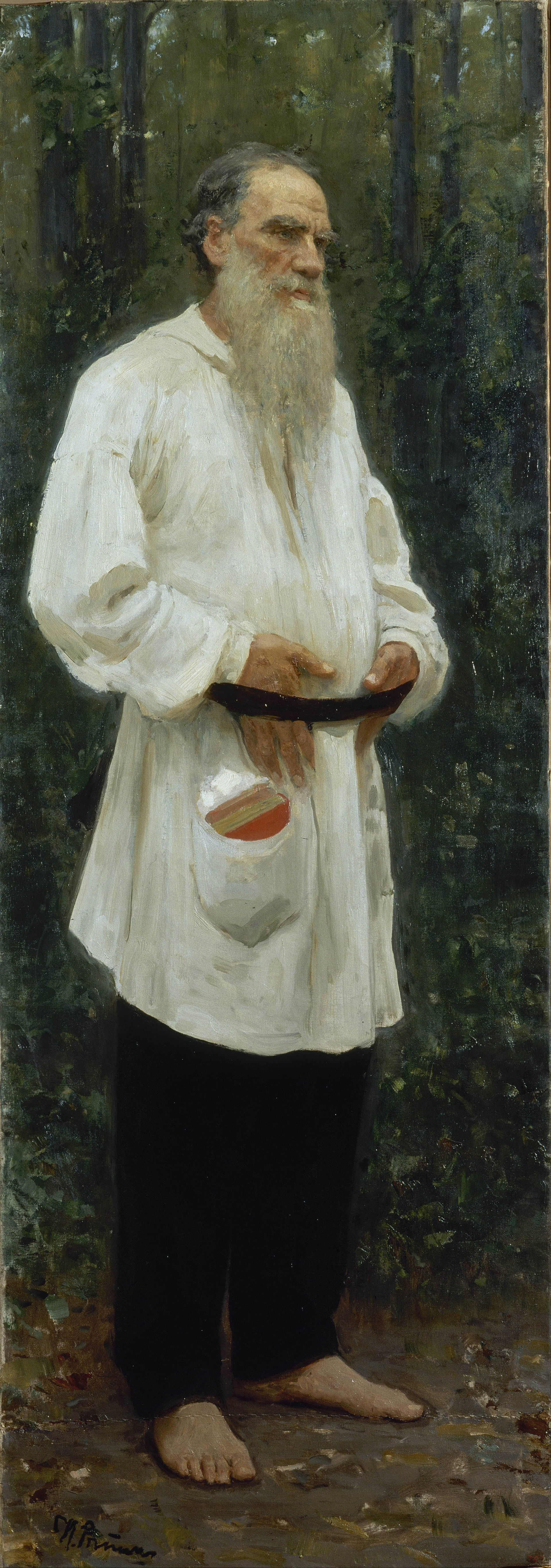
- **Photographs and portraits of Tolstoy and his circle (~1895–1901)**, including the Scherer & Nabholz 1901 studio portrait and Repin's iconic barefoot Tolstoy (1901, the excommunication year), plus portraits of Chertkov, Koni, Pobedonostsev, and Biryukov.
- **Manuscripts, proofs, and museum originals** at the State Tolstoy Museum and ИРЛИ — the earliest dated autograph (26 Dec 1889), the fair copy, and the censored proof set with the blue-pencil deletions for chs XXXIX–XL. These are rights-reserved and request-only; their provenance is recorded for a future reproduction request.
- **Print artefacts** — open scans (archive.org / Wikimedia) of the English (Maude/Henderson, Dodd Mead, Crowell), German (Fontane), and French (Flammarion) first editions and of Tolstoy's *Reply to the Synod*; the 1899 «Нива» run and the «Свободное слово» editions are catalogue-only.
Rights are recorded per item in the dossier `visuals:` block; publishing any image to the public site is a separate, rights-gated step. The git-ignored local cache repopulates from the dossier with `python3 docs/fetch_visuals.py 1889-1899-resurrection`.
Ilya Repin, "Leo Tolstoy Barefoot" (1901) — painted the year of the excommunication. State Russian Museum; Google Art Project scan. (Wikimedia Commons, public domain.)
## Method
This was an interactive novel-dive run autonomously after a checkpoint. Phase 0 confirmed the corpus surface from the scope handoff (Tom 32 → vol01, Tom 33 → vol02, diaries Tom 53/54, letters Toms 71/72/88/89; no `works/` record → record-creating). The core (genesis layer + communion centrepiece + excommunication hypothesis) was locked and reviewed before the lighter layers. Extraction used `extract_tei.py --choice=reg --notes=auto` (mandatory for pre-1918 orthography); every cited corpus quote has a committed extract file under `extracts/`, and the byte-fidelity gate `verify_quotes.py` was run before the verifier pass. The visuals sweep fanned out across four channels (Wikimedia Commons ×2, Russian museums, émigré/print archives) and was deduped by subject. The excommunication question was treated as a hypothesis to test against the primary record, per the project rule to ground in the primary sources before the mainstream and to attribute contested framing rather than assert it.
Links: sibling dives are cross-linked inline above. Re-balancing notes for a possible `novel-dive` skill mode are recorded in the dive folder.
## References
**Primary (corpus).**
- *Воскресение*, PSS Tom 32, pp. 3–445 (`v32_003_445_Voskresenie.xml`).
- *Воскресение. Цензурные варианты*, PSS Tom 32, pp. 471–505.
- The six redactions, PSS Tom 33, pp. 3–321.
- N. V. Gorbachev, «История писания и печатания "Воскресения"», PSS Tom 33, pp. 329–422.
- Diaries, PSS Tom 53 (1895–1899) and Tom 54 (1900–1903).
- Letters to A. F. Marks, P. I. Biryukov (PSS Toms 71–72) and to V. G. Chertkov (PSS Toms 88).
- *Ответ на определение Синода от 20–22 февраля…*, PSS Tom 34, pp. 245–253 (+ commentary, pp. 575–577).
**Background (secondary).** Full list with URLs in `extracts/_scholarship.md` and `extracts/_reception.md`. Key voices: Simmons (1968); Bartlett (2010); McLean, in Orwin ed., *The Cambridge Companion to Tolstoy* (2002); the Synod decree as printed in Skvortsov (1901). Secondary claims are attributed in the text; serve.py renders no footnotes.
---
*Draft dev-blog note: [`website/src/posts/notes/2026-06-08-resurrection.md`](../../../../../../website/src/posts/notes/2026-06-08-resurrection.md) (draft).*