---
layer: reference
title: "Master and Man (Хозяин и работник) — a novella-dive"
lastUpdated: 2026-06-10
tags: [research, corpus-dive, novel-dive, master-and-man, on-life, self-sacrifice, conversion]
---
# Master and Man (Хозяин и работник) — a novella-dive
A primary-source dive on the novella Tolstoy conceived in bed on the morning of 6 September 1894, drafted in a week, set aside for three months, and remade in two weeks at a neighbour's estate that January — a merchant and his workman lose their way in a blizzard, and the merchant, Vasily Brekhunov, dies covering his servant Nikita with his own body, dying in the man's place. The dive reads the novella against its own composition and redaction record — the September 1894 to March 1895 diaries, the letters to Strakhov and the Severny Vestnik editors, and the PSS Tom 29 redactions and «История писания» — to test three claims the work invites: that it gives narrative flesh to the doctrine of [*On Life*](../1886-1887-on-life/index.html); that it routes salvation through the exploiter, the master, not the meek peasant; and that it is a lived specimen of the "universal religious art" Tolstoy would define two years later in [*What Is Art?*](../1897-1898-what-is-art/index.html).
The dive leads with Tolstoy's own words and the manuscript record, and treats the mainstream framings (the tidy conversion parable; the Ivan-Ilyich diptych) as positions to attribute, not baselines to confirm. Working-English translations are labelled and provisional; the Russian is byte-verified against the corpus extracts.
## Key findings
- **The story's spiritual climax was the last thing Tolstoy wrote into it.** In the first rough redaction (рук. 2, 6–13 September 1894), Brekhunov's awakening is solitary and self-regarding — «Он поднялся над всем миром» — and the story ends with Nikita rolling the frozen master off «как чурбан» (like a log) and walking to a village *alone*. The substitutionary death, the deliberate warming of Nikita, and the self-dissolution «он — Никита, а Никита — он» were built across the December–January redactions and reached final form only at the *Severny Vestnik* galley-proof stage (вариант № 33, рук. 11, February 1895). The diary agrees to the day: on 6 January 1895 Tolstoy wrote «Нет характера ни того, ни другого. Теперь знаю, что сделать» — *now I know what to do.*
- **The doctrine the death dramatizes is that of [*On Life*](../1886-1887-on-life/index.html).** Brekhunov's dying recognition — that «жизнь его не в нем самом, а в Никите» (his life is not in himself but in Nikita) — is the treatise's thesis given a body: the boundary of the separate "animal personality" (личность) is the illusion, and real life is found in love for another.
- **Salvation is routed through the exploiter.** The figure who is transfigured is the calculating merchant who underpays his workman and believes himself a benefactor — not the equable peasant who has already made his peace with God and death. The хозяин of the title becomes, in the snow, the servant of his работник; the closing image is the warmed Nikita alive beneath the dead master. Scholarship notes the merchant's transformation but reads it as *parallel* salvation; the dive's asymmetry — Brekhunov saved, Nikita the instrument — is grounded in the redaction record.
- **It was an instant popular phenomenon, and Tolstoy disliked it.** Published 5 March 1895 (Old Style) simultaneously in *Severny Vestnik*, in two *Posrednik* editions (20 and 3 kopecks), and in S. A. Tolstaya's collected Works, it sold 15,000 copies in four days. Tolstoy's own verdict, three weeks after his son's death: «слышу со всех сторон похвалы, а мне не нравится» — *I hear praise from all sides, but I do not like it.* It was not censored.
- **The writing is shadowed by two domestic events.** The publication coincided with the gravest marital crisis of the year — S. A. Tolstaya's distress at the story being given gratis to *Severny Vestnik* and her baseless jealousy of its editor L. Ya. Gurevich, which Tolstoy described to Strakhov as «почти безумный припадок» that left her «близка к самоубийству» — and, days later, the death of their youngest child, Vanechka, on 23 February 1895, as the final proofs were being sent.
- **Marquee verdict.** That the death dramatizes the [*On Life*](../1886-1887-on-life/index.html) doctrine is broadly agreed (`confirms`); the dive's own contribution is to `extend` the scholarship — grounding the specific treatise-linkage, the exploiter-asymmetry, and the proto–[*What Is Art?*](../1897-1898-what-is-art/index.html) reading below where the accessible literature stops, and using the redaction history as evidence for the reading, not only as biography.
## Why this matters
*Master and Man* is the work in which Tolstoy, after a decade of treatises, returned to pure fiction and found that the doctrine and the art could be the same thing. It is short, concentrated, and outwardly simple — a sledge-ride that goes wrong — and it carries, without preaching, the whole argument of his religious philosophy: that the self that calculates and accumulates is not where life is, and that life is found only in the moment the self is given away. Because the manuscript record survives in unusual completeness, the novella is also a rare chance to watch a doctrine *enter* a story: the spiritual climax that everyone remembers was not the seed but the last addition, written in at the proof stage. And because its writing ran straight through the *Severny Vestnik* crisis and Vanechka's death, the work sits where Tolstoy's fiction, his doctrine, and the hardest weeks of his family life intersect — a parable of dying well composed in the shadow of a child's dying.
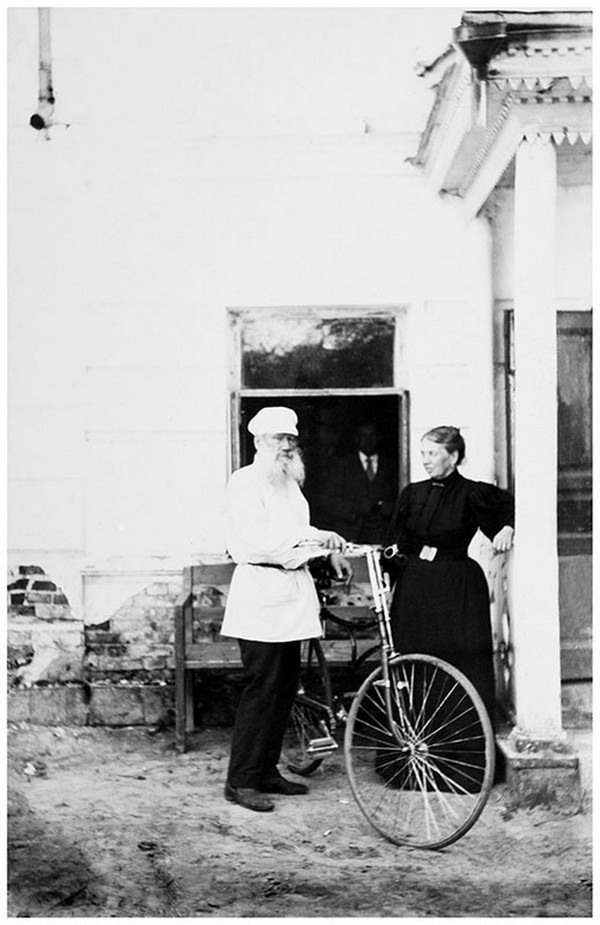
Leo Tolstoy and S. A. Tolstaya at Yasnaya Polyana, 1895 — the year of the novella's publication and of the crisis around it. Photograph by S. A. Tolstaya. Public domain (Wikimedia Commons).
## The marquee question
This dive carries three linked hypotheses, stated up front and tested against the text, the redactions, and the scholarship. They nest: the first is the doctrine, the second the mechanism by which the story delivers it, the third the kind of art it turns out to be.
**Hypothesis 1 — On Life, given flesh.** *The novella dramatizes the thesis of [On Life](../1886-1887-on-life/index.html) (1887): that true life is the renunciation of the separate "animal personality" (личность) for love. Brekhunov's death is that renunciation enacted, not argued.*
The death-dream resolves into the dissolution of the separate self:
> И он вспоминает, что Никита лежит под ним и что он угрелся и жив, и ему кажется, что он — Никита, а Никита — он, и что жизнь его не в нем самом, а в Никите. Он напрягает слух и слышит дыханье, даже слабый храп Никиты. «Жив Никита, значит жив и я», — с торжеством говорит он себе.
(working English) "And he remembers that Nikita is lying beneath him and that he has warmed and is alive, and it seems to him that he is Nikita and Nikita is he, and that his life is not in himself but in Nikita. He strains to hear, and hears the breathing, even the faint snoring, of Nikita. 'Nikita is alive, so I too am alive,' he says to himself with triumph." *(PSS Tom 29, ch. IX)*
This is *On Life*'s argument in narrative form — the личность boundary experienced, at the threshold of death, as the illusion it always was; life relocated from the self to the love of another. **Outcome: `extends`.** Scholarship agrees the story dramatizes Tolstoy's late religious philosophy, but the explicit grounding in *On Life*'s vocabulary of личность-renunciation is asserted thematically, never traced to the treatise (Gustafson's theological realism is the nearest instrument). The corpus supplies that grounding directly.
**Hypothesis 2 — Salvation through the exploiter.** *The one who is transfigured is the master, the calculating acquirer — and he is saved by becoming the servant of his workman.* Brekhunov is established at the outset as the exploiter, and the mechanism of his exploitation is self-deception:
> И, говоря это, Василий Андреич был искренно уверен, что он благодетельствует Никите.
(working English) "And, saying this, Vasily Andreich was sincerely convinced that he was a benefactor to Nikita." *(ch. I — he pays Nikita 40 roubles where the work is worth 80, mostly in overpriced shop goods.)*
The salvation is then a literal, bodily reversal of the title: the master makes himself the covering that keeps the man alive —
> Выгребши снег, Василий Андреич поспешно распоясался, расправил шубу и, толкнув Никиту, лег на него, покрывая его не только своей шубой, но и всем своим теплым, разгоряченным телом.
(working English) "Having scraped away the snow, Vasily Andreich hastily unbelted, spread open his fur coat, and, pushing Nikita down, lay on him, covering him not only with his fur coat but with his whole warm, heated body." *(ch. IX)*
**Outcome: `complicates` → `extends`.** The mainstream notes the merchant's transformation but reads it as *parallel* salvation: Nikita "had known salvation all along," Brekhunov arrives at it. The dive's asymmetry — that Brekhunov is saved in the full sense while the already-grounded Nikita is the *instrument* of that salvation — is named only in passing (Deresiewicz; the church-reader Austin) and is not argued. The redaction record (below) grounds it: the substitution was the deliberate late addition, the thing the story was rebuilt *to* do.
**Hypothesis 3 — Religious art before the theory.** *The 1894–95 novella is a prior enactment of the "universal religious art" Tolstoy would define in [What Is Art?](../1897-1898-what-is-art/index.html) (1897–98): art that transmits, infectiously and across all class lines, the feeling of human brotherhood.* The story's form is exactly the spare, "biblical" simplicity that treatise would prescribe; its reception — 15,000 copies in four days, a 3-kopeck edition for the masses — reads as the proof of concept for infectious, universal art. **Outcome: `extends`.** The *What Is Art?* connection is noted as chronological proximity and thematic consistency (Deresiewicz is the clearest pointer), but the claim that *Master and Man* is a prior *enactment* of religious art in Tolstoy's technical sense is not made in the accessible scholarship.
## Genesis & composition
This is the layer a novel-dive weights most heavily, and *Master and Man* rewards it: the manuscript record is unusually complete, and it tells a story the finished novella conceals — that the parable of substitutionary death began as something much plainer.
**The seed: a blizzard, lived.** The biographer P. I. Birukoff dated the idea to the winter of 1892/93, when Tolstoy was directing famine relief at Begichevka (Ryazan province) and the unusually fierce blizzards brought stories of travellers frozen on the roads; the landowner E. I. Raevskaya recalled Tolstoy himself getting lost in a storm and being found on foot in a snowfield, his horse gone. The «История писания» notes that Birukoff offers no proof, "but his words cannot be left without attention, as he was living at Begichevka then and could have heard from Tolstoy of the story's design."
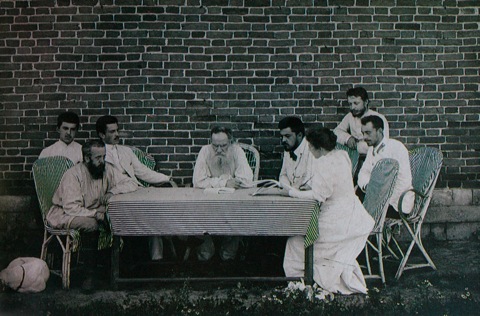
Tolstoy organising famine relief, 1891 — the Begichevka winters of severe blizzards and frozen travellers are the lived seed of the novella. Public domain (Wikimedia Commons).
**The conception, and the first draft.** The first record is the diary of 6 September 1894:
> Утром в постели, после дурной ночи, продумал очень живой художественный рассказ о хозяине и работнике.
(working English) "In the morning, lying in bed after a bad night, I thought through a very vivid artistic story about a master and a workman." *(diary, 6 Sept 1894)*
He began the next day and finished a rough draft within the week. The diary of 14 September names it for its setting and judges it on the spot: «Вечером сел писать и написал рассказ о метели. Нехорошо» — *in the evening I sat down and wrote the story about the blizzard. Not good.* Ten days later he told his wife he had written "a draft of a very uninteresting story" and had no desire to revise it. Then it went silent for three months.
**The remaking at Nikolskoye-Gorushki.** Tolstoy returned to the story around Christmas and worked at it intensely through the week, still unsatisfied — «Не знаю, хорошо ли. Довольно ничтожно» (31 December: *I don't know if it is good. Rather insignificant.*). On 1 January 1895 he travelled with his daughter Tatyana to the estate of the Olsufyevs, Nikolskoye-Gorushki, where the decisive revision happened. He separated the problem cleanly on 3 January — «Стало порядочно по художественности, но по содержанию еще слабо» (*tolerable artistically, but in content still weak*) — and three days later, after reading the story aloud to the household, located it exactly:
> Третьего дня вечером читал свой рассказ. Нехорошо. Нет характера ни того, ни другого. Теперь знаю, что сделать.
(working English) "The evening before last I read my story aloud. Not good. There is no character in either one or the other. Now I know what to do." *(diary, 6 Jan 1895)*
"Neither one nor the other" — neither the master nor the man had depth. What he then did, the redactions show, was to fuse them: to make the master's death an act of saving the man, and the man the place where the master's life continues. The content that was "still weak" became the substitutionary death.
**The people around the work.** The composition network is dense and well-named. The manuscript was copied by his daughters **Maria** and **Tatyana Lvovna**, by **P. I. Birukoff**, and — at the final stage — by a young woman he had met at the Olsufyevs', **Baroness M. Meyendorf**, who also carried it to Petersburg. He routed it not to the journal directly but through his old friend **N. N. Strakhov**, to whom he gave a veto and asked for blunt judgment:
> Во-1-х, вы просмотрите его и скажете, можно ли его печатать… Если вы скажете, что нехорошо, я нисколько не обижусь.
(working English) "First, you will look it through and tell me whether it can be printed… If you say it is no good, I shall not be in the least offended." *(to Strakhov, 14 Jan 1895)*
The journal was *Severny Vestnik*, edited by **L. Ya. Gurevich** and **A. L. Volynsky (Flekser)**, through whom three rounds of proofs passed in January–February. **V. G. Chertkov**, whose December visit had framed the drafting (and seeded the marital quarrel), waited in Petersburg for an early copy to translate into English; his **Posrednik** would publish the story simultaneously.
**The two shadows.** The publication ran straight through the worst weeks of the Tolstoy marriage. S. A. Tolstaya, who administered the family's publishing rights, was distressed that the story was given gratis to a journal, and was seized by a jealousy of Gurevich that Tolstoy, in a confidential postscript he asked Strakhov to burn, called baseless and severe:
> рассказ мой наделал мне много горя… к этому присоединился почти безумный припадок (не имеющий никакого подобия основания) ревности к Гуревич… Она была близка к самоубийству.
(working English) "My story has caused me much grief… to this was added an almost insane fit (without the slightest rational basis) of jealousy towards Gurevich… She was close to suicide." *(to Strakhov, confidential postscript, 14 Feb 1895)*
Days later, on 23 February, their six-year-old son **Vanechka** died of scarlet fever, as the final proofs were going out. The diary of 26 February rewrites itself mid-sentence: «Похоронили Ваничку. Ужасное — нет, не ужасное, а великое душевное событие» — *we buried Vanichka. A terrible — no, not terrible, but great spiritual event.* The novella of a good death was finished in the house of a child's.
## What the work says
The novella is ten short chapters. The dive close-reads the centrepiece in full and maps the rest.
**The frame: an exact economic relation.** Brekhunov is a second-guild merchant, church elder and innkeeper, leaving on the day after the winter feast to close the purchase of the Goryachkin forest at a third of its value before rival buyers can reach it — taking 2,300 roubles of church money to make up the sum. Nikita is his workman, a fifty-year-old reformed drunk, paid «не 80 руб., сколько стоил такой работник, а рублей 40» — half his worth, mostly in overpriced goods — and knowing he is cheated, but accepting it. The master cheats and believes himself generous (ch. I); the man is cheated and bears no grievance. The relation of the title is established as exploitation before it is dissolved in the snow.
**The middle: the storm, the wrong turns, the two equanimities.** They lose the road, return twice to the same village, set out again against advice; the chapters turn on the contrast between Brekhunov's mounting terror and Nikita's calm. Nikita meets the prospect of freezing without protest —
> «Господи, батюшка, видно и меня зовешь, — говорит себе Никита. — Твоя святая воля. А жутко. Ну, да двух смертей не бывать, а одной не миновать. Только поскорее бы…»
(working English) "'Lord, Father, it seems Thou art calling me too,' Nikita says to himself. 'Thy holy will. But it is fearful. Well, there are not two deaths to die, and the one cannot be escaped. Only let it be soon…'" *(ch. IX)*
— and accepts his own sins without despair: «Известно, грехи. Да что же, разве я сам их на себя напустил? Таким, видно, меня бог сделал» (*of course, sins; but did I bring them on myself? such, it seems, God made me*). This is the unselfconscious faith the story sets against the master's calculating ego — and the reason the scholarship reads Nikita as already saved.
**The centrepiece: the covering and the death.** After riding off alone to save himself, meeting a wolf, and circling back to the sledge in terror, Brekhunov digs Nikita out and lies on him — and for the first time stops thinking of himself (ch. IX, quoted in *The marquee question* above). The death-dream follows: he is called by someone he has been waiting for, wakes unable to move, understands it is death and is not grieved, and recognises what his life was actually for —
> «Что ж, ведь он не знал, в чем дело, — думает он про Василья Брехунова. — Не знал, так теперь знаю. Теперь уж без ошибки. Теперь знаю».
(working English) "'Well, he did not know what it was about,' he thinks of Vasily Brekhunov. 'Did not know, so now I know. Now without mistake. Now I know.'" *(ch. IX)*
The chapter closes on the tableau that inverts the title:
> Кругом всё так же курило. Те же вихри снега крутились, засыпали шубу мертвого Василия Андреича, и всего трясущегося Мухортого, и чуть видные уже сани, и в глубине их лежащего под мертвым уже хозяином угревшегося Никиту.
(working English) "All around the snow still swirled. The same eddies whirled, covering the fur coat of the dead Vasily Andreich, and the shivering Mukhorty, and the now barely-visible sledge, and, deep within it, Nikita, warmed, lying beneath the master who was now dead." *(ch. IX)*
**The coda (ch. X): the good death mirrored.** Nikita is dug out alive the next day, crippled, lives twenty more years and dies content, «как желал, под святыми и с зажженной восковой свечкой в руках» — *as he had wished, under the icons, a lighted candle in his hand* — "truly rejoicing that by his death he was relieving his son and daughter-in-law of a burden." His good death rhymes with Brekhunov's: the two are one passage seen twice, which is why the novella is so often paired with [*The Death of Ivan Ilyich*](../1884-1886-the-death-of-ivan-ilyich/index.html) (a bad death and a good one).
## Redactions & textual history
The PSS Tom 29 «Варианты» and «Описание рукописей» preserve fourteen manuscripts and the first rough redaction in full — and they hold the dive's keystone finding: **the spiritual climax was built last.**
**The first draft had no substitution.** In the first rough redaction (рук. 2, 6–13 September 1894), Brekhunov's awakening is solitary and inward-turned, with no relation to Nikita:
> И вдруг ему стало светло, радостно. Он поднялся над всем миром… Он узнал себя, узнал в себе что-то такое высокое, чего он в 40 лет ни разу не чувствовал в себе.
(working English) "And suddenly it became bright, joyful for him. He rose above the whole world… He recognised himself, recognised in himself something so high, which in forty years he had never once felt in himself." *(Первая черновая редакция)*
And the draft ends not on the master at all, but on the workman surviving alone — Nikita wakes, finds the "cold wood" on his back is the dead master, rolls him off «как чурбан» (like a log), and walks away:
> Никита вылез из саней, огляделся и в 100 саженях увидал, что чернеется, и пошел туда. Это была деревня.
(working English) "Nikita climbed out of the sledge, looked round, and saw something dark some hundred sazhens off, and walked towards it. It was a village." *(Первая черновая редакция)*
There is no deliberate warming, no merging of selves, no "Nikita is alive, so I too am alive." The story began, as the diary says, as «рассказ о метели» — a blizzard story.
**The conversion was assembled across the December–February redactions.** The «Варианты» let one watch it form. In the December drafts the master's contempt is sharpened first — «А на что ему жить? Какая его жизнь» (var. 18, рук. 4: *what is there for him to live for? what kind of life is his?*) — deepening the reversal to come. Then pity is engineered as a transfer of the master's own dread: «Тот ужас смерти, который он испытывал… он перенес на Никиту» (var. 26, рук. 5). And the self-dissolution itself — the doctrinal heart — appears in its final form only at the galley-proof stage:
> …и ему кажется, что он Никита, а Никита — он, и что жизнь его не в нем самом, а в Никите… — Жив Никита, значит я жив.
(working English) "…and it seems to him that he is Nikita, and Nikita is he, and that his life is not in himself but in Nikita… 'Nikita is alive, so I am alive.'" *(вариант № 33 — рук. 11, the Severny Vestnik galley proofs, February 1895)*
So the line everyone remembers was written into the proofs, after the manuscript had already gone to the journal. The diary breakthrough of 6 January («Теперь знаю, что сделать») and the manuscript record agree: the marquee is not only an interpretation of the death scene but a documented fact about how it was made.
**Other textual notes.** The chapter divisions (I–X) appear only in the final stages — «Деления на главы, как и во всех предыдущих рукописях, нет», the editor notes of the manuscripts. The PSS base text is the *Posrednik* printing (pp. 233–248), which carried a further 184 Tolstoy corrections after the *Severny Vestnik* text; the two are not line-collated here (novel-mode samples rather than collates).
## Publication, censorship & translation
The novella appeared on 5 March 1895 (Old Style) in three places at once: the March issue of *Severny Vestnik* (no. 3, pp. 137–175); two *Posrednik* editions (at 20 and, from 9 March, 3 kopecks, for a mass readership); and vol. 14 of S. A. Tolstaya's collected *Works of Count L. N. Tolstoy*. The three-way simultaneity was itself the settlement of the marital crisis — giving the journal its text while restoring the family's editions neutralised the exclusivity S. A. Tolstaya resented. The *Posrednik* first edition carried the censor's permission of 17 February 1895: the story was **not** censored. It sold 15,000 copies in four days.
English translations followed within the year — A. Hulme Beaman (Chapman & Hall, 1895), a competing Rapoport/Kenworthy version, and the Maude translation that became canonical — Chertkov having asked for an early copy expressly to translate it.
## Characters & prototypes
The cast is small, and routes cleanly. Two figures are titular and carry the whole work; the rest of the dossier's people are the *real* network around its making (see *Genesis*), routed as `person`.
- **Vasily Andreich Brekhunov** — the master (`character`). The principal figure the marquee turns on. His surname is an authorial, characterising name (from *брехать*, to lie or bluster); no single real prototype is documented, and the dive routes the prototype edge as `editorial` / `conjectured` — he is a type drawn from the post-Emancipation provincial merchant world Tolstoy knew at Begichevka and around Tula, not a portrait of one man.
- **Nikita** — the workman (`character`). The equable, self-effacing peasant who lives by surrender; drawn from the Yasnaya Polyana peasantry, with no documented single model (`conjectured`). The figure-type recurs in the late fiction (cf. Platon Karataev) but Nikita is not a re-use of a named person. His wife Marfa folds into his page rather than minting a node.
Routing principle (wiki-schema v1.4 tiering): only Brekhunov and Nikita earn standalone `character` nodes (principal/titular); everyone else in the *story* folds into their pages, while everyone in the *making* of the story routes as `person`. No `group` entity arises — there is no sect or people in the novella (the merchant class and peasantry are social settings, not named groups).
## Themes
- **True life versus false life.** The spine: the calculating, accumulating self (Brekhunov totting up the Goryachkin forest, his kabaks, his mills) set against the life that is found only when that self is given away. The doctrine of [*On Life*](../1886-1887-on-life/index.html), dramatized.
- **Master and servant, inverted.** The economic relation of the title (хозяин / работник) is exact and then reversed: the master becomes the one who serves, covers, and dies for the man.
- **The good death.** Both deaths in the story are good — Brekhunov's sudden, Nikita's twenty years later — against the bad death of [*Ivan Ilyich*](../1884-1886-the-death-of-ivan-ilyich/index.html). Dying well is the renunciation made final.
- **The blizzard as the medium of revelation.** The storm strips away calculation, road, direction, and at last the body — the conditions under which the false self can be seen through.
## Reception & afterlife
The contemporary reception was, first, a popular event: 15,000 copies in four days, a 3-kopeck edition for the masses, and immediate international translation. The story was read as a return to art after the polemical tracts — moral without preaching. The critical response split broadly between realist-humanist readers who welcomed it and the Symbolist circle around *Severny Vestnik* itself (Volynsky, and later Merezhkovsky and Gippius), who admired the craft but were uneasy with Tolstoy's moralism; specific 1895 reviews from that camp were not retrieved for this dive (see *Material not covered*). A reported reaction from N. S. Leskov is not asserted here: Leskov died on 5 March 1895, the very day of the *Posrednik* release, so any reaction was private and pre-publication, and could not be sourced.
There is no church or Synod dimension to this reception — the novella is not anti-clerical, and the 1901 excommunication does not bear on it. What dominates the *afterlife* in the popular biographies is instead the domestic drama of its publication — the *Severny Vestnik* crisis and Vanechka's death — which is told (Bartlett; Meek) as the human centre of the episode, sometimes at the expense of the text.
## Scholarly context
This is a divergence map, not corroboration; the dive grounds its reading in the primary record first, and reads the secondary literature critically.
The biographical and critical mainstream (Troyat, Bartlett, Simmons, Wilson) reads *Master and Man* as Tolstoy's most controlled late story and as a conversion tale, routinely paired with [*The Death of Ivan Ilyich*](../1884-1886-the-death-of-ivan-ilyich/index.html). Richard Gustafson's *Resident and Stranger* (1986) supplies the best scholarly instrument for taking the death-merging as a theological proposition rather than sentiment — his "emblematic realism" reads Tolstoy's concrete detail as the enactment of doctrine — though he does not trace it to *On Life* specifically. William Deresiewicz (2010) comes closest to the dive's own three threads: he reads the story as renunciation-to-death, names the "biblical simplicity" that links it to [*What Is Art?*](../1897-1898-what-is-art/index.html), and notes that Nikita "holds his life cheap" while Brekhunov arrives at salvation by an extreme act — but without the language of *On Life* or личность. George Saunders (2021) gives the most developed account of *how the form enacts the change*: the transformation happens "not through the total remaking of the sinner… but by a redirection of his (same old) energy" — which is exactly the mechanism the redactions show Tolstoy building (the terror "transferred onto Nikita").
Where the dive `extends` the literature: none of these maps the death scene onto *On Life*'s specific argument; none argues the soteriological asymmetry (the *exploiter* saved, the peasant the instrument) rather than a parallel salvation; and none uses the redaction record to show the substitution was a late, deliberate addition. The scholarship reaches the story thematically; the corpus supplies the primary grounding beneath it.
## Where the material clusters
**The work and its apparatus (PSS Tom 29).**
| Genre | TEI / source | What it holds |
|---|---|---|
| Work — final text | `v29_003_046` | The novella, ch. I–X (pp. 3–46) |
| Work — printed variant | `v29_233_248` | The Posrednik printing (PSS base text), pp. 233–248 |
| Work — variants | `v29_295_324` | The first rough redaction in full + variants № 1–33, pp. 295–324 |
| Commentary | `v29_375_378` | «История писания и печатания» (Gudzy) |
| Commentary | `v29_378_380` | «Описание рукописей» — the 14 manuscripts |
**Diaries (composition window).**
| Tom | Date (OS) | Material |
|---|---|---|
| 52 | 6 Sept 1894 | The conception («продумал… рассказ о хозяине и работнике») |
| 52 | 14 Sept 1894 | First drafting session («рассказ о метели. Нехорошо») |
| 52 | 25, 31 Dec 1894 | The return to the story; «Довольно ничтожно» |
| 53 | 3, 6 Jan 1895 | The Olsufyev breakthrough («Теперь знаю, что сделать») |
| 53 | 7, 15, 21 Feb 1895 | The SAT crisis; final proofs |
| 53 | 22, 26 Feb; 12 Mar 1895 | Vanechka's death and burial; the reception («мне не нравится») |
**Letters (composition & publication).**
| Tom | Letter id | Date (OS) | Addressee | Material |
|---|---|---|---|---|
| 84 | `v84_613_a7` | 7 Sept 1894 | S. A. Tolstaya | First sitting-down to the story |
| 84 | `v84_618_a18` | 18 Sept 1894 | S. A. Tolstaya | "a very uninteresting story… no desire to revise" |
| 68 | `v68_010` | 14 Jan 1895 | L. Ya. Gurevich | The gift to *Severny Vestnik*, via Strakhov |
| 68 | `v68_012` | 14 Jan 1895 | N. N. Strakhov | The veto and the request for blunt judgment |
| 68 | `v68_027` | 9 Feb 1895 | L. Ya. Gurevich | The attempted withdrawal ("недобросовестный поступок") |
| 68 | `v68_030` | 14 Feb 1895 | A. L. Volynsky | Second proofs |
| 68 | `v68_031` | 14 Feb 1895 | N. N. Strakhov | The confidential crisis postscript |
## The author's later verdict
Tolstoy never came round to the story he had been so praised for. The diary of 12 March 1895, three weeks after Vanechka's burial, sets the two against each other in a single breath: «За это время вышел Хозяин и Работник, и слышу со всех сторон похвалы, а мне не нравится, и несмотря на то, чувство мелкого тщеславного удовлетворения» — *during this time Master and Man came out, and I hear praise from all sides, but I do not like it — and yet, despite that, a feeling of petty, vain satisfaction.* The judgment is consistent from the first drafting («Нехорошо») to the final reception: he valued the story's art more than its content, and the public's enthusiasm least of all. The dive carries that as his own verdict, attributed — not as the dive's evaluation of the work.
## Material not covered
- Variant-by-variant collation of all 33 printed «Варианты» (sampled, not collated — novel-mode policy).
- The *Posrednik* printed text vs the *Severny Vestnik* text — the 184-correction divergence not line-collated.
- Specific 1895 critical reviews from the Symbolist / *Severny Vestnik* circle — named as a camp, individual reviews not retrieved.
- The local archive-org Wiener English facsimile (Boston 1904) — not consulted; it is Wiener's edition, not the Russian PSS.
- Film and stage adaptations beyond a note (Bernard Rose's *Boxing Day*, 2012; early Russian/Soviet films unconfirmed).
## Visual & manuscript record
Thirteen public-domain images were gathered into the (git-ignored) local cache; the keystone, the famine-relief seed, the only PD illustration tied to the text, and the principals' portraits are listed here. Each carries a licence and source URL in the dossier; nothing rights-reserved was committed.
- **Tolstoy and S. A. Tolstaya, 1895** (keystone; photo by S. A. Tolstaya) — Commons, PD. Embedded above.
- **Tolstoy organising famine relief, 1891** — Commons, PD. The Begichevka seed. Embedded above.
- **Tolstoy studio portrait, 1892** (André & Sloss) — Commons, PD. The best firmly-dated portrait near the composition period.
- **Frontispiece to *Master and Man*, Charles Copeland (Crowell ed., 1899)** — Commons, PD. The only located illustration tied to the text; no Orlov illustration to this novella is documented.
- **N. V. Orlov, «Подати» (The Taxes), 1895** — Commons, PD. Coeval peasant genre by Tolstoy's later "favourite artist" — the visual world of the novella.
- **Portraits of N. N. Strakhov and L. Ya. Gurevich** (GRW, 1901) — Commons, PD. The first reader and the editor at the centre of the crisis.
**Not openly available:** a freely-licensed scan of the 1895 *Posrednik* wrappers or the *Severny Vestnik* March issue (the dealer scan is rights-reserved); the Olsufyev estate Nikolskoye-Gorushki; PD portraits of Volynsky, the Olsufyevs, Baroness Meyendorf, and Vanechka. Recommended next lookup: the State Tolstoy Museum (tolstoy-iss.kamiscloud.ru) and Goskatalog (web.goskatalog.ru).
## Method
This dive followed the corpus-dive `--novel` overlay. **Scope (interactive):** the subject is one work (a `workRecord` fill — the record already existed); the marquee was set to all three linked hypotheses at the reader's direction; reception flexed to the "acclaimed legal publication" case (`bans: []`); visuals heavy-ish. **Sweep & extract:** all PSS Tom 29 texts extracted with `extract_tei.py --choice=reg --notes=auto`; the composition-years diaries (Toms 52–53) and letters (Toms 67–68, 84) swept for work-mood and the named network; the full text close-read by locating pivotal scenes (centrepiece quoted in full). **Scholarship & reception:** an English-first web sweep, triangulated against the three hypotheses; grounded in the primary record first. **Visuals:** a Commons-led sweep (13 PD images). **Verify:** `verify_quotes.py` — 24/24 quotes verbatim (PASS) — then a separate-pass verifier. All Russian byte-verified against the extracts; working-English translations are the dive's own and provisional.
**Dates** are given in Old Style (Julian), as the corpus records them; the `workRecord` proposals carry both Old- and New-Style values, flagged for human confirmation.
**Links.** Sibling dives interlinked: [*On Life*](../1886-1887-on-life/index.html) (the doctrine dramatized), [*What Is Art?*](../1897-1898-what-is-art/index.html) (the aesthetic pre-enacted), [*The Death of Ivan Ilyich*](../1884-1886-the-death-of-ivan-ilyich/index.html) (the diptych on dying). The dive prepares material for ingestion; it creates no vault pages.
## References
**Primary** — L. N. Tolstoy, *Хозяин и работник*, PSS Tom 29 (work pp. 3–46; printed variant pp. 233–248; «Варианты» pp. 295–324; «История писания и печатания» pp. 375–378; «Описание рукописей» pp. 378–380); Diaries, PSS Toms 52–53 (1894–95); Letters, PSS Toms 67–68 (Strakhov, Gurevich, Volynsky, Olsufyeva) and 84 (S. A. Tolstaya).
**Background (secondary, attributed)** — Deresiewicz, *The Renunciation Artist* (The Nation, 2010); Saunders, *A Swim in a Pond in the Rain* (2021); Gustafson, *Leo Tolstoy: Resident and Stranger* (1986); Troyat, *Tolstoy* (1965/1967); Bartlett, *Tolstoy: A Russian Life* (2010); Simmons, *Leo Tolstoy* (1946); Wilson, *Tolstoy* (1988); Meek, *Some Wild Creature* (LRB, 2010); Austin, *An Advent Sermon on Love* (2022); Valiunas, *Godlike, Godly Tolstoy* (2012/13); PY Rare Books catalogue (1895 first edition).
---
*Draft dev-blog note: [`website/src/posts/notes/2026-06-10-master-and-man.md`](../../../../../../website/src/posts/notes/2026-06-10-master-and-man.md) (draft). This dive prepares ingestion-ready material; turning the dossier into vault pages is a separate, human-in-the-loop step.*