---
layer: reference
title: "The late voice — encryption & compression (1900–1910)"
lastUpdated: 2026-06-12
tags: [research]
---
# The late voice — encryption & compression (1900–1910)
A theme-dive across the whole late period, following one phenomenon through every genre and channel: how the late Tolstoy said what he was forbidden to say. Two threads, encryption leading. **(1) Encryption under censorship** — which truths he encoded because he could not state them in legal Russian print, and how *genre* (parable/legend/fiction vs treatise) and *channel* (legal Posrednik print vs Chertkov's «Свободное слово» (Free Age Press) abroad vs posthumous vs withheld) served concealment or directness. **(2) Compression** — how the late metaphysics distilled argument → story → aphorism, ending in the four wisdom-anthologies (Мысли мудрых людей / *Thoughts of Wise People* 1903 → Круг чтения / *Circle of Reading* 1906 → На каждый день / *For Every Day* 1909 → Путь жизни / *The Path of Life* 1910).
This dive is synthesis-first: it mines nineteen finished sibling dives for reusable evidence, then adds fresh sweeps of the un-mined late letters (Toms 73–82), the Chertkov correspondence (Toms 88–89), the late diaries (Toms 55–58), and a structural read of the four anthologies. The grain of the argument is Tolstoy's own words; the scholarship is read as a divergence map, not a baseline to confirm.
*Throughout, the English in quotation marks (and the parenthetical title translations) are working cribs — see Method — not finished published translations.*
## Key findings
- **One constraint, two solutions.** A truth that could not pass the legal Russian censor could still be told — if it changed either its **genre** (a legend or parable says what a treatise would have had banned) or its **channel** (abroad through Chertkov, posthumous, or withheld). *Encryption* (change the form) and *routing* (change the venue) are two answers to the same wall.
- **The constraint, named.** The keystone is the 6 May 1903 letter to Sholom Aleichem: the culprit of the Kishinev pogrom is «одно правительство» — the government alone — and «этого-то я не могу сказать в русском легальном издании» ("this is precisely what I cannot say in a legal Russian publication"). What he could not say as statement he published as legend. He says «нельзя печатать» ("it cannot be printed") to a newspaper that offered to run a cut version; he calls all censored literature «праздное занятие» ("an idle occupation").
- **The channel was a built system with a stated rule.** To Chertkov, 1900: everything going abroad passes «только через вас» ("only through you"). He sets an all-or-nothing condition against partial printing («печатать всю или ничего» — "to print the whole thing or nothing"), names the abroad route in one sentence («не пройдет в России, но может быть напечатано за границей» — "it won't get through in Russia, but can be printed abroad"), and reserves the posthumous estate to Chertkov from a written 1895 instruction. The result is an **eight-tier channel spectrum**, from legal-uncensored down to author-withheld.
- **Fiction did the encryption a treatise could not.** *Resurrection*'s prison-Eucharist survived the legal «Нива» (*Niva*) serial as four words — «Началось богослужение.» ("The church service began.") — while the complete text was printed simultaneously at Chertkov's Purleigh press; the same passage is both the most-censored in Russia and the «последняя и высшая степень» ("the last and highest degree") named in the 1901 excommunication. The народный рассказ (folk tale) is the form built to carry a forbidden truth.
- **Compression is the same impulse turned inward.** The late metaphysics distils to a formula (the four-proposition religion; «Патриотизм есть рабство» — "Patriotism is slavery"; the title-as-doctrine of *The Law of Violence and the Law of Love*) and finally to the wisdom-anthologies — one project squeezed four times. Across 1903→1910 the attributions drop away (in *Путь жизни* / *The Path of Life* he «нахожу неудобным подписывать их именами их авторов» — "finds it inconvenient to sign them with their authors' names"), the calendar is abandoned for thirty thematic chapters, and whole paragraphs carry verbatim from book to book.
- **The two threads fuse.** The daily-anthology form let the church-and-state critique sit as one unsigned numbered maxim among foreign sages — and the publisher still cut some entries «по цензурным соображениям» ("for reasons of censorship"). Tolstoy proposed publishing the complete *Круг чтения* (*Circle of Reading*) abroad «без цензурных соображений» ("without censorship considerations"), and suggested filling the legal Readings with «из запрещенных моих» ("from my banned") works. The wisdom-book is also a smuggling vessel.
- **Scholarship confirms the plumbing, not the design.** English scholarship documents the abroad channel (Alston 2014; Holman 1988) and the *Resurrection* mutilation, but does not reach the dive's three live findings — genre-as-encryption, the explicit 1900 protocol, and compression-as-encryption. The corpus supplies primary grounding for points the literature only gestures at.
## Why this matters
The standard picture of the late Tolstoy is of a writer who renounced art for doctrine and simplified himself into dull tracts. The corpus shows something else: a writer running a sophisticated system of concealment and distillation, forced on him by a censorship that would not let him speak plainly at home. The folk tale, the abroad press, the posthumous reserve, and the aphorism are not a retreat from craft — they are the craft a constraint produced. Seen together, encryption and compression are one gesture: the late voice is the sound of a man getting an unsayable truth past a wall, either by disguising its form or by routing it around the guard — and, at the end, by pressing it small enough to hide in a calendar of wise sayings.
## The shape of the question
**Stage 1 — the constraint named.** The truth exists; the legal channel will not carry it.
> «этого-то я не могу сказать в русском легальном издании»
> "this is precisely what I cannot say in a legal Russian publication" *(working English)*
Date: 6 May 1903. To S. N. Rabinovich (Sholom Aleichem), declining to name in print what he names in the letter — that the Kishinev pogrom's culprit is «одно правительство» ("the government alone"). PSS Tom 74, pp. 118–119 (`v74_144`). The sentence was cut from all Russian reprints; the contribution he *did* make came as three folk tales. This is the seed of the whole theme: the forbidden statement becomes an encoded legend.
The same wall, stated barest of all, to a newspaper that offered to print a cut version of «Не убий никого» (*Thou Shalt Not Kill Anyone*):
> «В таком случае нельзя печатать.»
> "In that case it cannot be printed." *(working English)*
Date: 5–6 September 1907. To the editors of «Час» (*Chas*). PSS Tom 77 (`v77_218`). Incomplete truth is no truth; silence is preferred to mutilation.
**Stage 2 — the first solution: change the channel.** When the truth cannot print at home, route it abroad. The rule, stated to the man who ran the route:
> «чтобы за границу все мои писания проникали только через вас»
> "that all my writings reach abroad only through you" *(working English)*
Date: 12 December 1900. To V. G. Chertkov. PSS Tom 88 (`v88_607`). The abroad channel is not improvised; it is a protocol Tolstoy commits to keeping strictly.
**Stage 3 — the second solution: change the genre.** What a treatise could not get past the censor, a legend could. From «Разрушение ада и восстановление его» (*The Destruction of Hell and Its Restoration*), the devil explaining how the Church was built on a forged gospel:
> «я боялся, как бы они не увидали слишком очевидного обмана, и тогда я выдумал церковь»
> "I feared they might notice the too-obvious deception — and so I invented the Church" *(working English)*
PSS Tom 34 (`v34_100_115`, reused from `1903-folk-tales`). The charge would never have passed as a statement; as a satirical legend it was merely unprintable in Russia until 1917 — and printed abroad in 1903. The genre *is* the encryption.
And the sharpest exhibit of all, where fiction carries what a treatise could not — the whole prison-liturgy of *Resurrection*, reduced by the «Нива» censor to four words:
> «Началось богослужение.»
> "The church service began." *(working English)*
PSS Tom 32 (`v32_003_445`, reused from `1889-1899-resurrection`). Part I, chapters XXXIX–XL were cut wholesale and the part renumbered to hide the gap; the complete text was printed at the same moment by Chertkov's press at Purleigh. The defamiliarised Eucharist is both the most-censored passage in the legal text and the «последняя и высшая степень» ("the last and highest degree") the Synod named in excommunicating him.
**Stage 4 — compression: the same impulse, turned on the doctrine itself.** The late metaphysics contracts to a formula. The unity of all life, stated in a 1903 parable as a two-word self-naming:
> «выражается словами: это ты»
> "expressed in the words: this is you" *(working English)*
PSS Tom 34 (`v34_138_140`, reused from `1903-folk-tales`). *Tat tvam asi* — argument, story, and bald proposition in a single cluster, where Thread 1 (the encoded form) and Thread 2 (the compressed doctrine) meet.
**Stage 5 — the endpoint, and the fusion.** The compression ends in the wisdom-anthologies; and the anthology form is itself a hiding place. The method, stated in the *Круг чтения* preface:
> «дать большому числу читателей доступный им ежедневный круг чтения, возбуждающего лучшие мысли и чувства»
> "to give a large number of readers an accessible daily round of reading that arouses the best thoughts and feelings" *(working English)*
PSS Tom 41 (`v41_009_009`). The source text is raw material, deliberately re-cut and re-worded; fidelity to the original is subordinated to the daily effect. By *Путь жизни* (1910) the named voices have been re-worked so far into his own diction that he drops the attributions outright — and the very form lets a church-and-state critique stand as one unsigned maxim among foreign sages. The wisdom-book is the last encryption.
## Where the theme clusters
### The channel spectrum (Thread 1) — ordered most-direct to most-hidden
| Tier | What it means | Worked example |
|---|---|---|
| 1 · legal Russian, uncensored | content was sayable; published cheaply at home | *Master and Man* (1895), 15,000 copies in four days |
| 2 · legal Russian, censored | printed but cut / softened / distorted | *What Is Art?* journal serial; the народные рассказы (folk tales); two of the five 1903 tales |
| 3 · print free / stage banned (genre as channel) | the medium itself splits | *The Power of Darkness* (stage ban 1887–95); *The Fruits of Enlightenment* (stage-only ban) |
| 4 · abroad-first / abroad-only | foreign edition precedes or replaces the Russian | *The Kingdom of God* (Paris 1893); *What Is Religion* (Christchurch 1902); «Разрушение ада» (*The Destruction of Hell*, Russia 1917 only) |
| 5 · underground / samizdat | banned text circulates hand-copied | *The Kreutzer Sonata* (8th redaction, lithographed/hectographed) |
| 6 · legal Russia by personal dispensation | reaches print only by special grace | *The Kreutzer Sonata* (Sofia's audience with Alexander III → Collected Works only) |
| 7 · posthumous, cut at home / restored abroad | a dead author still censored | *Hadji Murat* (Moscow 1912 cut / Berlin uncensored); *Father Sergius* (Moscow 1911 cut / Berlin 1912) |
| 8 · withheld / secret (author-suppressed) | the author himself holds it back | *Hadji Murat* (not in his lifetime); *The Devil* (secret twenty years) |
The mechanism that makes tiers 4–8 possible is the 1891/1910 copyright renunciation (anyone may reprint, in Russia or abroad) — documented in the `copyright-renunciation` dive.
### The "can't say it" letters (Thread 1, fresh sweep)
| Tom | id | Date | Addressee | What it shows |
|---|---|---|---|---|
| 73 | `v73_317` | 1902-08-20 | A. P. Naugolnikov | works «запрещенных в России и печатаемых в Англии» ("banned in Russia and printed in England") — the two-state corpus |
| 74 | `v74_144` | 1903-05-06 | Sholom Aleichem | **keystone** — «не могу сказать в русском легальном издании» ("I cannot say it in a legal Russian publication") |
| 74 | `v74_346` | 1903-12-18 | M. A. Taube | the two-track workaround (soften for home / publish whole abroad) |
| 76 | `v76_116` | 1906-01-14 | press (public notice) | Chertkov declared the sole node for everything abroad |
| 77 | `v77_218` | 1907-09-05 | «Час» (*Chas*) editors | «В таком случае нельзя печатать.» ("In that case it cannot be printed.") |
| 79 | `v79_109` | 1909-03-05 | V. A. Posse | «неюбилейно и нецензурно» ("non-jubilee and uncensorable") — the double bind |
| 80 | `v80_112` | 1909-08-30 | P. A. Stolypin | abroad publication as a dated political weapon |
| 80 | `v80_370` | 1909-12-19 | N. N. Ge (son) | Chertkov «заведует печатанием всего мною писанного» ("is in charge of the printing of everything I have written") |
| 81 | `v81_116` | 1910-02-09 | M. G. Bolkvadze | predicts his own text will be «нецензурно» ("uncensorable") |
### The Chertkov channel (Thread 1, Toms 88–89)
| Tom | id | Date | What it shows |
|---|---|---|---|
| 88 | `v88_607` | 1900-12-12 | the protocol as a rule — everything abroad «только через вас» ("only through you") |
| 88 | `v88_719` | 1904-05-13 | reaffirms the 1895 written instruction reserving the posthumous papers to Chertkov |
| 89 | `v89_738` | 1905-04-17 | «не пройдет в России, но может быть напечатано за границей» ("it won't get through [the censor] in Russia, but it can be printed abroad") |
| 89 | `v89_757` | 1906-02-13 | «печатать всю или ничего» ("to print the whole [article] or nothing") |
| 89 | `v89_809` | 1908-06-01 | «Не могу молчать» (*I Cannot Be Silent*) — abroad first, Russia gets excerpts a day later |
### The compression arc (Thread 2) — one project, squeezed four times
| Year | Book | The unit | What tightened |
|---|---|---|---|
| 1903 | Мысли мудрых людей на каждый день (*Thoughts of Wise People for Every Day*) | a bouquet of *attributed* sayings per day | no preface; a commonplace book |
| 1906 | Круг чтения (*Circle of Reading*) | a dated *chord* of signed sayings + a weekly story/essay | the method preface added; the story layer still present |
| 1909 | На каждый день (*For Every Day*) | a day = one theme, mostly his own *unsigned* prose | named voices recede to a near-monologue |
| 1910 | Путь жизни (*The Path of Life*) | 30 *thematic chapters* of numbered aphorisms; calendar gone | attributions dropped; the preface is the whole metaphysics in 31 points |
The diaries record the project from inside: the 400-day calculation he was «почти уверен, что этого не проживу» ("almost certain I will not live to see it") (`v56_078`, 1907); «Чем ближе смерть, тем сильнее чувствую обязанность сказать то, что знаю» ("The closer death comes, the more strongly I feel the obligation to say what I know") (same); and the recognition that the truth is «до глупости простая» ("simple to the point of stupidity") and the whole labour is the form (`v55_172`, 1905). Verbatim carry-over proves it is one text: the «суеверие государства» ("the superstition of the state") paragraph passes from *На каждый день* into *Путь жизни* ch. XVII, «суеверие» ("superstition") sharpened to «лжеучение» ("false teaching"); the water-vessels unity simile is re-cut between the two books.
## Scholarly context
The received scholarly view is a divergence map, not a confirmation. Where it agrees, it agrees on the plumbing; the dive's live findings lie below its resolution.
**Confirmed.** That the abroad channel existed and mattered is well documented: **Alston (2014)** treats Chertkov's «Свободное слово» / Free Age Press as an organised international movement, and **Holman (1988)** gives its operational record — managed by Arthur Fifield from Tuckton House near Christchurch, 43 publications and roughly 209,000 copies between 1900 and 1902. The *Resurrection* mutilation (the ~497 «Нива» distortions; the complete text only from Purleigh, and in Russia only in 1936) is also documented. On these the corpus *confirms*.
**Extended.** Three findings reach below the scholarship. First, **genre-as-encryption**: scholars read the folk turn aesthetically and through access (cheap booklets for peasant readers) and record the Kishinev–Sholom-Aleichem contribution biographically — but none reads those 1903 tales as encoding the pogrom-condemnation Tolstoy *said* he could not publish legally. Second, **the explicit 1900 protocol**: Alston and Holman describe the operation but not the named rule that *all* writings abroad pass only through Chertkov — a procedural architecture the PSS correspondence states outright. Third, **compression-as-encryption**: the four anthologies are acknowledged as one sustained project (and **Tulyakova et al. 2018** show the second *Круг чтения* was polemically active), but the reading that dropped attributions and a thematic re-ordering also lowered the collection's censorship profile is absent from the English literature. English coverage of the anthologies is itself thin.
**Read critically.** **Popoff (2014)** supplies the contested frame of Chertkov as a controlling editor-censor who extracted the posthumous will «under duress» — the same Chertkov-as-antagonist framing the project interrogates elsewhere (see `biryukov-sofia-relationship` and `tolstoyanism`). The primary record here complicates that reading rather than confirming it: Tolstoy states the channel as his own settled wish, freely and repeatedly, across 1900–1910, and reaffirms the 1895 papers-instruction in his own hand in 1904 — years before the contested 1909–1910 legal will. The "two censors" framing (the state *and* the liberal press that mutilated his articles) is Chertkov's, from his 1909 article «Две цензуры для Толстого» ("Two Censorships for Tolstoy"); it is carried here as his attributed idea, not asserted in the dive's voice.
## Material not covered
- **The un-dived direct-treatise comparators** in Toms 34–35 («Царю и его помощникам» / *To the Tsar and His Assistants*, «К духовенству» / *To the Clergy*, «Не убий» / *Thou Shalt Not Kill*, «Ответ на определение Синода» / *Reply to the Synod's Edict*, «К рабочему народу» / *To the Working People*, «О Шекспире и о драме» / *On Shakespeare and Drama*) — left as a future light pass; the direct/abroad pole is already carried by four full dives and the threadmap.
- **The 1905–06 Круг чтения weekly tales treated *as* tales** (genre-craft, sources, redactions) — reserved for a planned sibling dive; this dive treats the anthology only as the compression endpoint.
- **Full publication histories** of the four anthologies (editions, print runs, translation lineage) — only first-publication outlines are captured; needed before the proposed work-records are finalised.
## Visual & manuscript record
A light sweep (Wikimedia Commons; licences read from the file metadata, not assumed). The local `visuals/` cache is git-ignored — these are for local viewing and the rights metadata is the gate for any later publication to the public site.
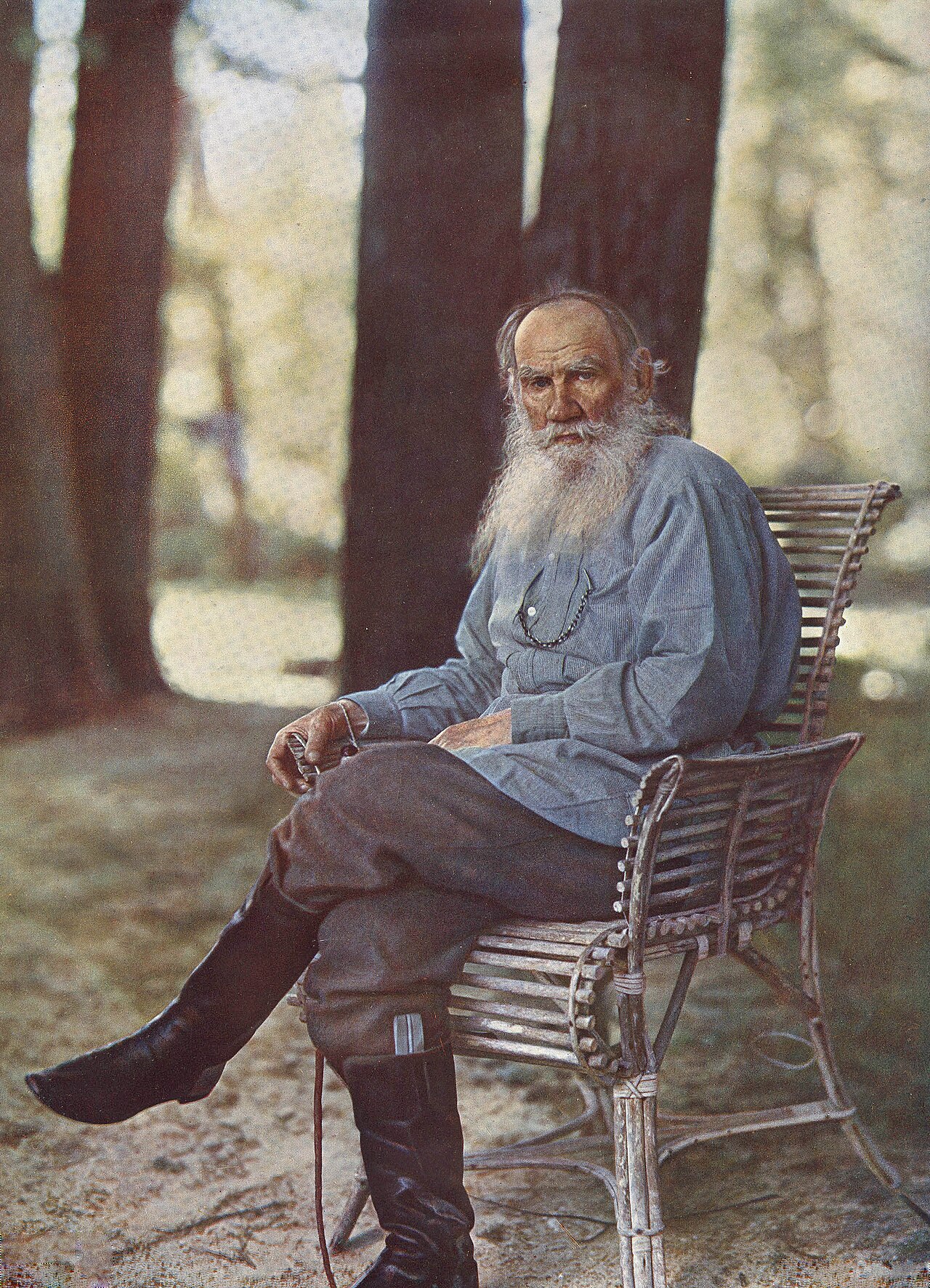
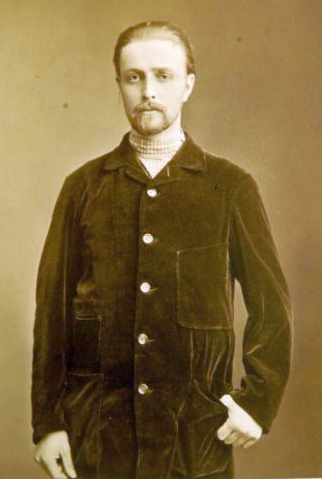
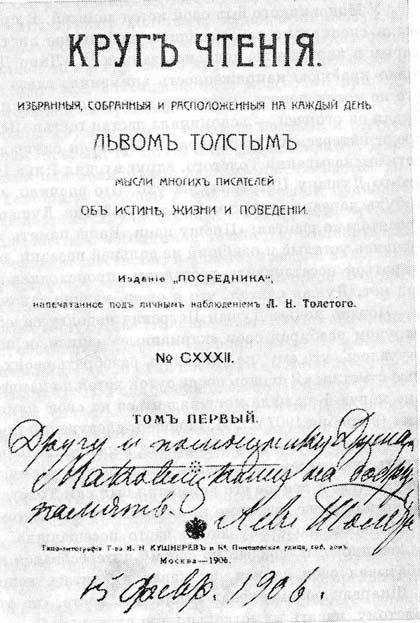
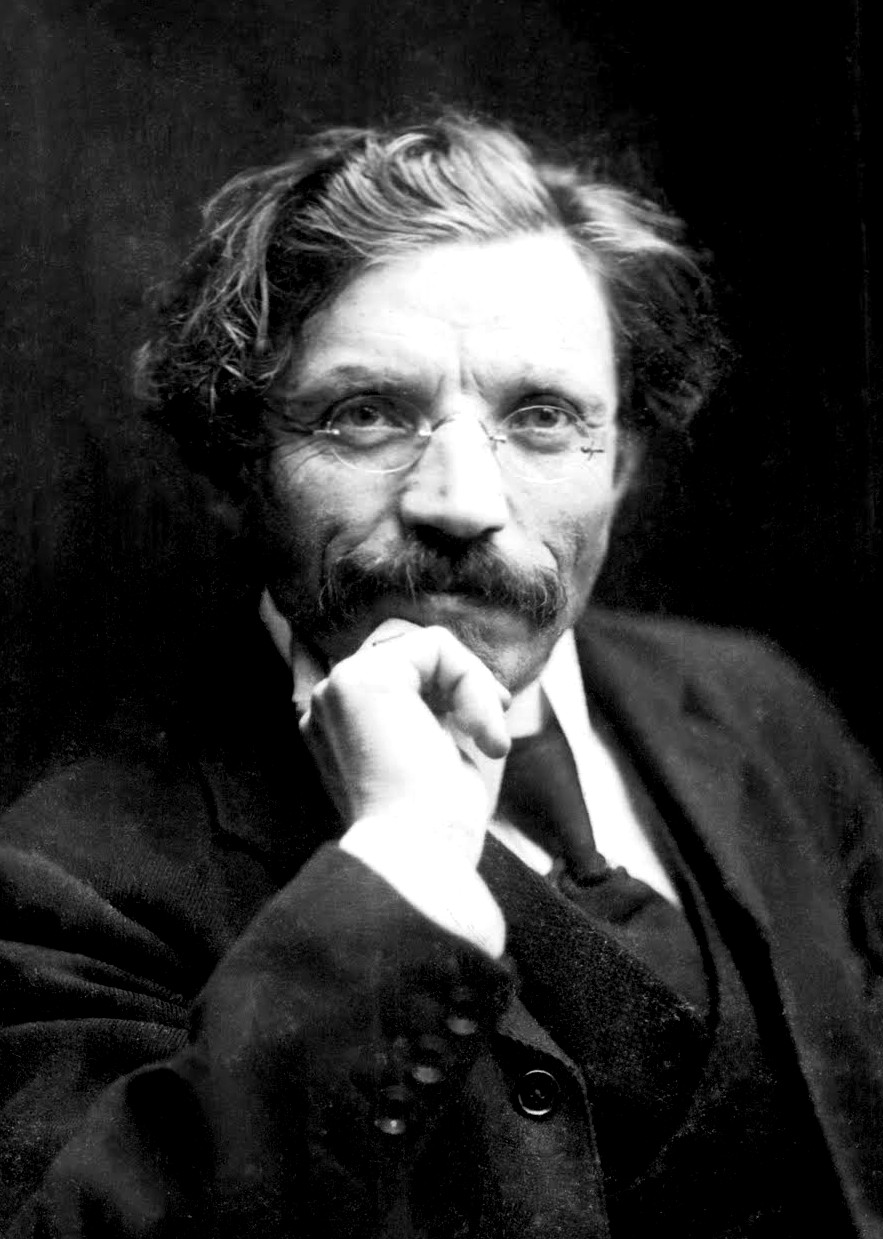
Leo Tolstoy at Yasnaya Polyana, 23 May 1908 — Sergei Prokudin-Gorsky's colour portrait, the first taken in Russia. The canonical image of the late voice. Public domain (photographer d. 1944). Commons: File:L.N.Tolstoy_Prokudin-Gorsky.jpg.V. G. Chertkov (photograph by A. F. Eichenwald, 1883) — the man who ran the abroad channel and held the posthumous reserve. Public domain. Commons: File:Vladimir_Chertkov.jpg. (A Repin oil portrait of Chertkov, National Museum Warsaw, is also cached.)Круг чтения, first-edition title page (1906) — the compression endpoint, representative for the whole calendar-of-wisdom cluster. Public Domain Mark. Source: feb-web.ru. Commons: File:Ma1-055-.jpg.Sholom Aleichem (S. N. Rabinovich), New York 1907 — recipient of the keystone letter. PD-US; may not be public domain in all jurisdictions, so clear rights before any publication outside the cache. Commons: File:Sholem_Aleichem_1907_(cropped).jpg.
The one genuine gap: **no «Свободное слово» / Free Age Press masthead exists on Commons.** The closest surrogate is the Free Age Press *Pamphlets* title page (`File:Tolstoy_-_Pamphlets.djvu`, Christchurch), a DJVU with no standalone cover image; the press is otherwise documented bibliographically (British Library, Hoover Institution). Acquiring a masthead or a Tuckton-House photograph is a visuals work-order for a later pass.
## Method
The Phase-0 contract (settled with the reader, handed off from the `1903-folk-tales` dive): synthesis-first; both threads with encryption leading; window 1900–1910 core, with 1880s–90s roots admitted only through existing dives. Executed as: regenerate the cross-dive evidence index (36 dives, 894 rows); mine nineteen sibling dossiers into two thread-maps (76 reusable rows, classified by genre × channel × thread); fan-out fresh sweeps over letters Toms 73–82 + Chertkov 88–89 + diaries 55–58 (62 finalists from ~390 candidates) and a structural read of the four anthologies; a Phase-3 scholarship pass (19 sources) for the divergence map; a light visuals sweep. All pre-1918 text extracted with `extract_tei.py --choice=reg --notes=auto`; every quoteRu byte-checked by `verify_quotes.py` (56/56 PASS); a separate-context opus verifier closed the dive. Reused citations point at the sibling dives' own extracts by relative path; fresh citations sit in this dive's `extracts/`.
**Links.** Sibling dives this one rests on: `1903-folk-tales` (the seed), `copyright-renunciation` (the legal mechanism), `1889-1899-resurrection` (the mutilated-legal/full-abroad keystone), `1897-1898-what-is-art` (the theory of the encoded form), `stories-for-the-people`, `1886-the-power-of-darkness`, `1886-1890-the-fruits-of-enlightenment`, `1887-1889-the-kreutzer-sonata`, the posthumous-fiction cluster (`1896-1904-hadji-murat`, `1890-1898-father-sergius`, `1889-1909-the-devil`), the direct-treatise dives (`1900-the-slavery-of-our-times`, `1901-1902-what-is-religion`, `1904-bethink-yourselves`, `1908-the-law-of-violence-and-the-law-of-love`, `1890-1893-the-kingdom-of-god-is-within-you`, `1893-1894-christianity-and-patriotism`), and `fire-metaphor` (the anthology compression datapoints). For the contested Chertkov framing, see `biryukov-sofia-relationship` and `tolstoyanism`.
## References
**Primary.** L. N. Tolstoy, Полное собрание сочинений (Jubilee Edition / PSS): works & anthologies Toms 26–45; diaries Toms 52–58; letters Toms 64–66, 71–82; letters to Chertkov Toms 87–89 — via the tolstoydigital-TEI corpus, extracted with `--choice=reg --notes=auto`. Full citation ledger in `dossier.yaml`.
**Background (read critically, attributed).** Alston, *Tolstoy and His Disciples* (2014); Holman, "Translating Tolstoy for the Free Age Press," *SEER* 66/2 (1988); Popoff, *Tolstoy's False Disciple* (2014) — the contested frame; Bartlett, *Tolstoy: A Russian Life* (2010); Chertkov, *The Last Days of Tolstoy* (1911); Emerson, "Theater," in *Tolstoy in Context* (2021); Hapgood, "Count Tolstoi and the Public Censor" (1887); Tulyakova et al., *Slověne* (2018); Wenzer (1997); Simmons, *Introduction to Tolstoy's Writings*. Full list in `dossier.yaml`.
---
*Draft dev-blog note: [`website/src/posts/notes/2026-06-12-late-voice-encryption-compression.md`](../../../../website/src/posts/notes/2026-06-12-late-voice-encryption-compression.md) (held `draft: true`).*