---
layer: reference
lastUpdated: 2026-06-03
tags: [research]
title: "Fire and light in Tolstoy: the metaphor, and his rewriting of the Gospels"
---
A corpus-dive across the local Tolstoy corpus (tolstoydigital TEI + the 90-volume Jubilee Edition) on a single image-cluster: **fire**, and the **light** axis next to it. The occasion is practical — fire is being considered as an emblem for tolstoy.life — but the question is textual: where, and how, does Tolstoy use fire and light, and what does he do to the Bible's own fire-and-light language when he translates the four Gospels himself?
The two starting points the reader supplied both hold. *Bethink Yourselves!* (1904) closes on Luke 12:49; the second volume of Biryukov's biography closes on the *«Я верю»* credo from *What I Believe* — and that credo turns out to fuse **both** axes in one sentence.
## Key findings
- **Light becomes reason.** In his Gospel harmony Tolstoy lays down a single rule — *«свет … означает истинное разумение жизни»* (light = the true understanding of life) — and applies it throughout: the Logos/*«Слово»* of John 1 is rendered *«разумение жизни»*, "I am the light of the world" becomes light-as-reason, and the personal, incarnate Light is depersonalised. Specialist scholarship (Matual 1992) confirms the *razumenie* rendering of the Logos.
- **Fire splits in two.** Where the Gospel's fire is **judgment** — Gehenna, "eternal fire", "unquenchable fire", the furnace — Tolstoy excises or naturalises it (*«огонь вечный»* → *«тьма внешняя»*; Gehenna → a judgment, an abyss, a historical valley). Where fire is **generative** — Luke 12:49 — he keeps and amplifies it.
- **One keystone, everywhere.** Luke 12:49 ("I came to cast fire on the earth, and how I wish it were already kindled") is Tolstoy's single most-recurrent fire-anchor: it runs through the harmony, *What I Believe*, *The Kingdom of God Is Within You*, *Bethink Yourselves!*, his last book *Path of Life*, and at least five letters — always read not as judgment but as the **spark that kindles conscience**, contagious and unquenchable.
- **The duty is to burn.** In the letters and diaries the ethic is consistent: *«в себе разжечь огонь: гореть самому»* — kindle the fire in yourself; others ignite of their own accord. His image for the movement is **scattered fires on a dry steppe**: the more dispersed, the faster it spreads.
- **The credo fuses both.** *What I Believe* ends: faith is *«огонь, который только тогда огонь, когда он жжет»* (a fire that is only a fire when it burns) and the task is *«жить в том свете, который есть во мне»* (to live by the light that is in me) — fire and light in one confession. This is the passage Biryukov chose to close volume II.
- **The metaphor became fact.** In 1895 the Doukhobors burned their weapons in a single bonfire as a refusal to kill — the literal fire of conscience Tolstoy had been describing. Tolstoy used the fire image for it in his own words.
## Why this matters
For the site's purposes the finding is clean: fire is not a decorative motif in Tolstoy but a load-bearing one, and it is **his own** — the figure he reached for to describe what he thought Christ actually brought, what conscience does, and what he hoped his own life and writing would do. It is also double-edged in a way worth knowing before adopting it as a mark: in the Gospel he is *removing* one kind of fire (the fire of hell and judgment) at the very moment he is *magnifying* another (the fire of awakened conscience). The emblem, if chosen, carries that whole argument.
For the wiki, the dive opens a cluster of missing pages — the Gospel harmony, *What I Believe*, *On Life*, *Path of Life*, the concepts "light of reason" and "the fire of conscience", and the Doukhobor *Burning of Arms* — and shows exactly which primary passages anchor each.
## The shape of the question
Each stage gives the verbatim Russian, a working-English translation (labelled), and the source. Translations are the dive's own working renderings, not published ones.
### 1 — Light becomes reason
The hermeneutic key is a translator's footnote to John 1:
> *«9) Φῶс — свет — по всем контекстам означает истинное разумение жизни.»*
> "9) Φῶς — light — in all contexts means the true reason/understanding of life." (working English)
> — Gospel harmony, *Соединение и перевод четырёх Евангелий*, PSS Tom 24
Applied to the prologue, the Word itself becomes reason, and the person becomes a principle:
> *«И разумение-то жизни стало Бог.»*
> "And the reason/understanding of life became God." (working English) — Tom 24 (John 1:1)
> *«Так же как свет в темноте светит, и темнота его не поглощает.»*
> "Just as light shines in the darkness, and the darkness does not swallow it." (working English) — Tom 24 (John 1:5)
The *Gospel in Brief* states the equation outright, and again in *What I Believe*:
> *«Разумение — это свет истины. А свет светит в темноте, и темнота не может погасить его.»*
> "Reason/understanding is the light of truth. And the light shines in the darkness, and the darkness cannot extinguish it." (working English) — *Краткое изложение Евангелия*, Tom 24
> *«в человеке живет божественный свет, сошедший с неба, и свет этот есть разум»*
> "in man there lives a divine light, come down from heaven, and this light is reason" (working English) — *В чём моя вера?*, Tom 23
### 2 — Fire splits in two
**Judgment-fire is removed.** The clearest single instance: at Matthew 25:41 the "eternal fire" becomes "outer darkness."
> *«идите от меня прочь вы, нелюбимые, в тьму внешнюю»*
> "go away from me, you unloved ones, into the outer darkness" (working English) — Tom 24 (cf. Synodal *«идите от Меня, проклятые, в огонь вечный»*)
The baptism "with the Holy Spirit and fire", and the chaff burned "with unquenchable fire" (Matt 3:11–12), become cleansing by spirit, with "unquenchable" simply gone:
> *«очищаю вас водой, но после меня тот, кто сильнее меня, очистит вас духом … пшеницу соберет, а мякину сожжет.»*
> "I cleanse you with water, but after me the one stronger than me will cleanse you with spirit … the wheat he will gather, and the chaff he will burn up." (working English) — Tom 24
Gehenna is demythologised to a historical place, and explicitly denied any next-world meaning:
> *«была долина, в которой, принося жертву Молоху, жгли людей. В геенну отдать — значить сжечь.»*
> "was a valley in which, offering sacrifice to Moloch, they burned people. To give over to Gehenna means to burn." (working English) — Tom 24, footnote to Matt 5:22
And in the *Critique of Dogmatic Theology* he attacks the doctrine of eternal hell-fire head-on:
> *«Как благой бог за грехи может казнить вечным огнем? Или он не правосуден, или он не благ.»*
> "How can a good God punish with eternal fire for sins? Either he is not just, or he is not good." (working English) — *Исследование догматического богословия*, Tom 23
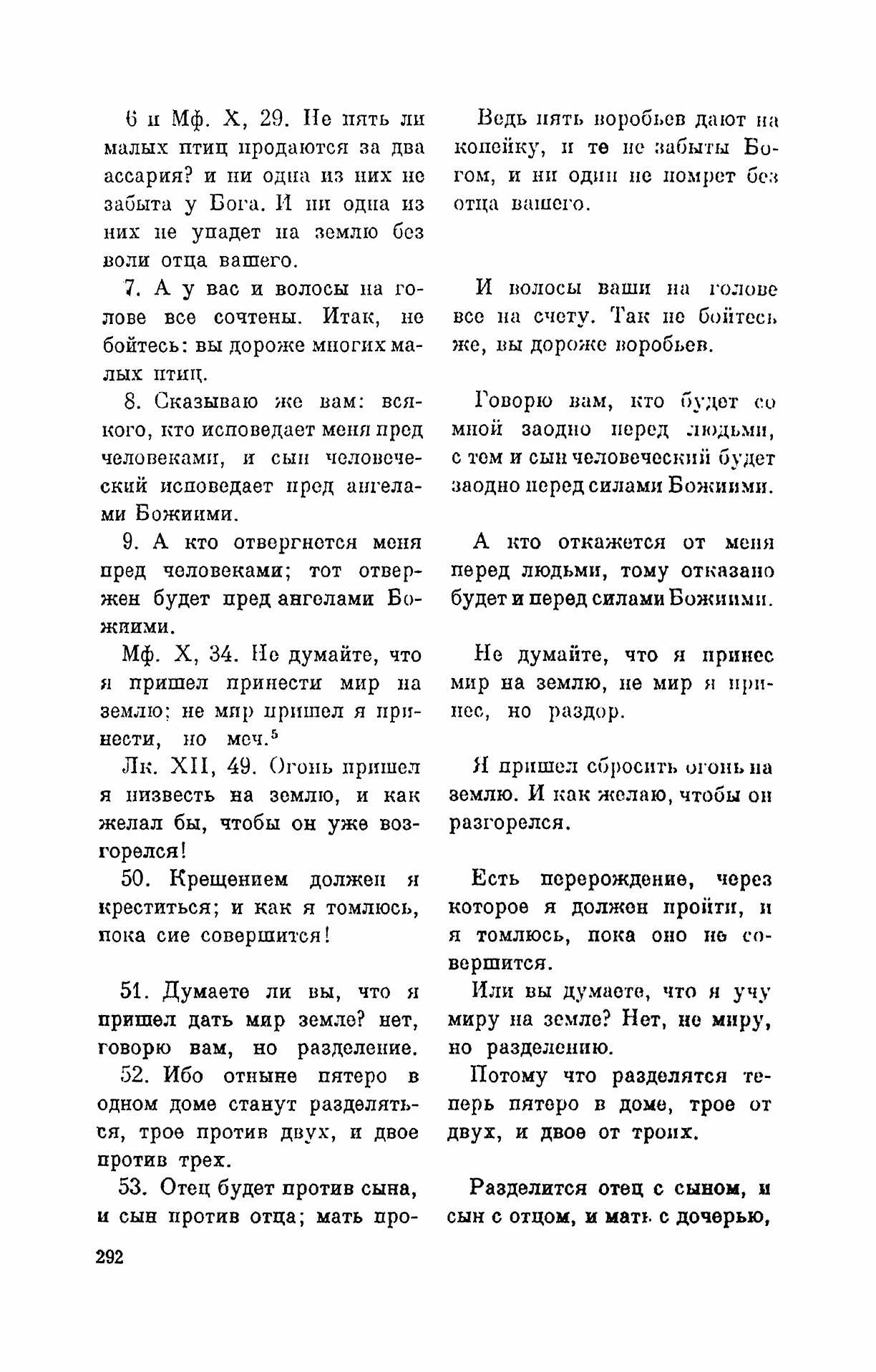
**Generative fire is kept and amplified.** At Luke 12:49 the verse stands close to the original, but the commentary turns it inward:
> *«Я пришел сбросить огонь на землю. И как желаю, чтобы он разгорелся.»*
> "I came to cast fire upon the earth. And how I wish that it would blaze up." (working English) — Tom 24 (Tolstoy's rendering)
> *«он знал, что его учение — не учение, но искра, которая зажигает сознание Бога в сердцах людей и, раз загоревшись, не может потухнуть.»*
> "he knew that his teaching was not a doctrine but a spark that kindles the consciousness of God in people's hearts and, once lit, cannot go out." (working English) — Tom 24, commentary
The facsimile shows the divergence in the edition's own two-column layout — the standard text on the left, Tolstoy's rendering on the right:
Gospel harmony, PSS Tom 24, p.292 (rendered from the Jubilee Edition, public domain). Left: the standard text — Luke 12:49 ending «…чтобы он уже возгорелся». Right: Tolstoy's rendering «Я пришел сбросить огонь… чтобы он разгорелся», and Luke 12:50's baptism rendered as «Есть перерождение, через которое я должен пройти» (a rebirth I must pass through).
### 3 — One keystone, everywhere
Luke 12:49 recurs across two decades. In *What I Believe* it is the slow fire of history:
> *«Но мир горит уж 1800 лет … я огонь низвел на землю; и как томлюсь, пока он не разгорится, — и будет гореть, пока не спасутся люди.»*
> "But the world has been burning for 1800 years now … I brought fire down to the earth; and how I am in anguish until it blazes up — and it will burn until people are saved." (working English) — Tom 23
In *The Kingdom of God Is Within You* it is the new consciousness already catching:
> *«„Огонь принес я на землю, — сказал Христос, — и как томлюсь, когда он возгорится".»*
> "'Fire I brought to the earth,' said Christ, 'and how I am in anguish for it to blaze up.'" (working English) — Tom 28
In *Bethink Yourselves!* (1904), the passage the reader found at the close of the Swedish edition:
> *«Чего желал Христос, совершается. Огонь возгорается. Не будем же противиться, а будем служить ему.»*
> "What Christ wished for is coming to pass. The fire is blazing up. Let us then not resist it, but serve it." (working English) — *Одумайтесь!*, Tom 36
*(Note: the Swedish edition renders this coda "let us not extinguish it, but spread and sustain it" — a free translation, not a different source. See Method.)*
And one last time in *Path of Life* (1910), his final book, now as a question:
> *«„Огонь пришел я низвесть на землю …" (Луки XII, 49). Но почему же огонь этот так медленно разгорается?»*
> "'Fire I came to cast upon the earth …' (Luke XII, 49). But why does this fire blaze up so slowly?" (working English) — *Путь жизни*, Tom 45
### 4 — The credo: fire and light fused
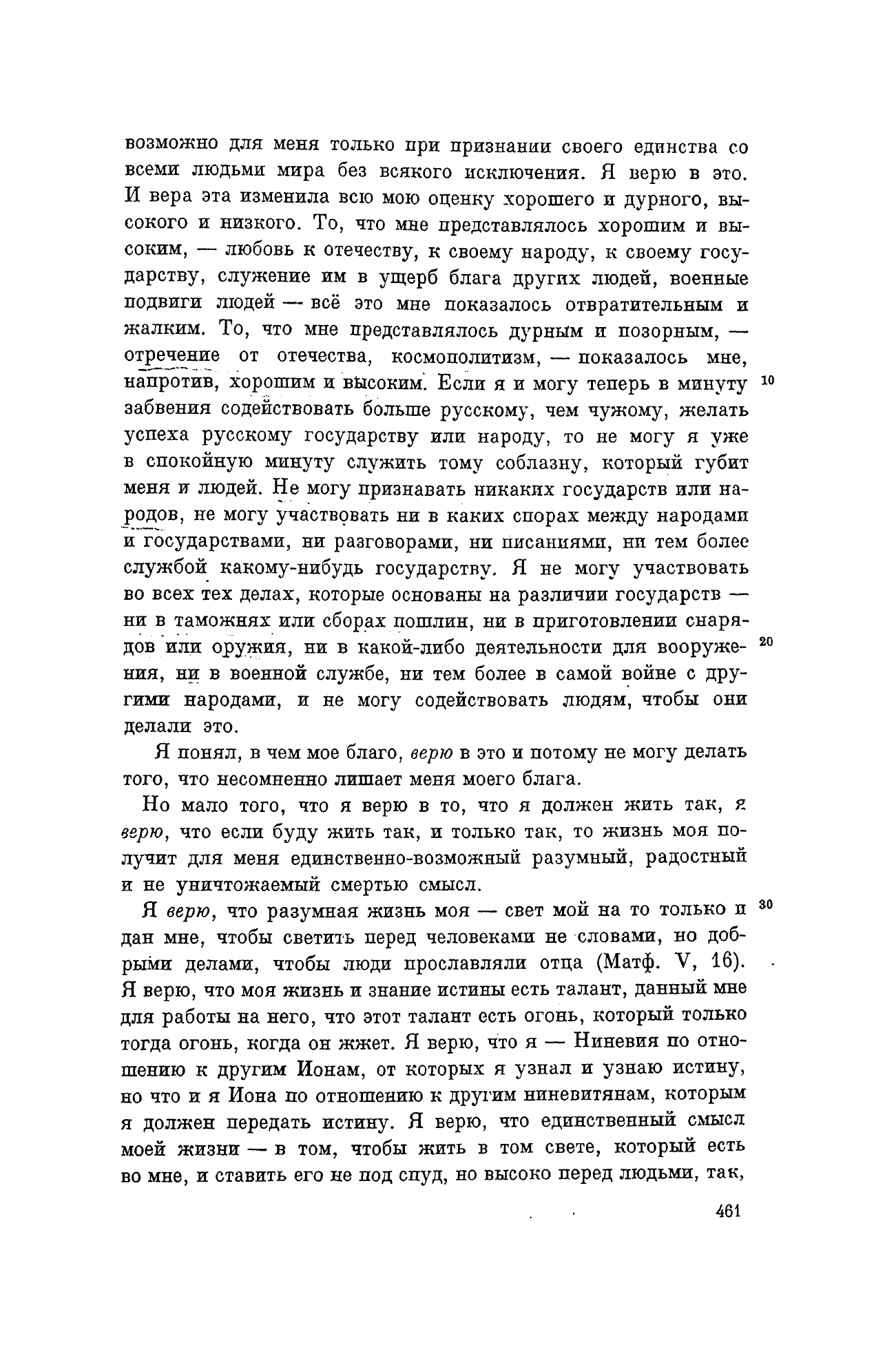
The close of *What I Believe* (1884) — the passage Biryukov chose to end volume II of his biography:
> *«…этот талант есть огонь, который только тогда огонь, когда он жжет. … единственный смысл моей жизни — в том, чтобы жить в том свете, который есть во мне, и ставить его не под спуд, но высоко перед людьми, так, чтобы люди видели его.»*
> "…this talent is a fire which is only a fire when it burns. … the only meaning of my life is to live by the light that is in me, and to set it not under a bushel but high before people, so that people may see it." (working English) — Tom 23 (echoing Matt 5:15–16)
The *«Я верю»* (I believe) credo, *What I Believe*, PSS Tom 23, p.461 (public domain). The fire-and-light confession, citing Matthew 5:16.
### 5 — The living metaphor: letters and diaries
The ethic is the same wherever he states it plainly. To a disciple in 1904:
> *«Наше дело только в том, чтобы в себе разжечь огонь: гореть самому, и тогда окружающие нас сами собой будут согреваться и зажигаться.»*
> "Our task is only to kindle the fire in ourselves: to burn oneself, and then those around us will of their own accord be warmed and set alight." (working English) — to A. I. Turchaninov, 1904, Tom 75
The diary gives the same idea its sharpest form — and shows fire and light as interchangeable:
> *«грех ни в чем ином, как только в том, чтобы тушить тот свет, который горит в тебе. Еще хуже грех — тушить свет, который горит в других.»*
> "sin is in nothing other than this: to put out the light that burns in you. Worse still is the sin of putting out the light that burns in others." (working English) — diary, 20 Feb 1890, Tom 51
His image for the movement is scattered fire on a steppe (here in the pre-reform spelling the source prints):
> *«Всѣ мы разбросаны, какъ огни, кот[орые] зажигаютъ степь, и чѣмъ болѣе мы раскиданы, тѣмъ лучше»*
> "We are all scattered like fires that set the steppe alight, and the more we are dispersed, the better." (working English) — to A. V. Yushko, 1900, Tom 72
### 6 — The fire made fact: the Doukhobors
In 1895 the Doukhobors burned their firearms in one bonfire rather than serve as soldiers. The smallest version of that refusal — a conscript's private doubt — is, in *Bethink Yourselves!* and in a 1904 letter to draftees, the very spark of Christ's fire:
> *«это искра того огня, который Христос низвел на землю и который начинает возгораться.»*
> "this is a spark of that fire which Christ brought down to the earth and which is beginning to blaze up." (working English) — *Одумайтесь!* (Tom 36) and to V. G. Chertkov for the soldiers (Tom 88), both 1904
### 7 — In the fiction
The image predates the religious turn. Anna's death is a candle (1877):
> *«И свеча … вспыхнула более ярким, чем когда-нибудь, светом, осветила ей всё то, что прежде было во мраке … и навсегда потухла.»*
> "And the candle … flared up with a brighter light than ever before, lit up for her everything that had before been in darkness … and went out forever." (working English) — *Anna Karenina*, Tom 19
And as early as 1858, the artist in *Albert* is consumed by "the sacred fire we all serve":
> *«Он, как соломинка, сгорел весь от того священного огня, которому мы все служим»*
> "He, like a wisp of straw, burned up entirely in that sacred fire which we all serve" (working English) — *Albert*, Tom 5
The same images recur across the later fiction. In *The Death of Ivan Ilyich* (1886) the dying man names life as light and death as its loss:
> *«То свет был, а теперь мрак.»*
> "Once there was light, and now there is darkness." (working English) — *The Death of Ivan Ilyich*, Tom 26
In the folk-tale *What Men Live By* (1881) the angel emits a visible light at the moment he understands:
> *«И видят хозяева, что от Михайлы свет идет.»*
> "And the masters see that light comes from Mikhaila." (working English) — *What Men Live By*, Tom 25
In *Father Sergius* the "burning lamp" of holiness dims the more it is performed for people — the light = truth equation turned into a moral danger:
> *«он был светильник горящий … потухание божеского света истины, горящего в нем.»*
> "he was a burning lamp … the dying-out of the divine light of truth burning within him." (working English) — *Father Sergius*, Tom 31
And in *Walk in the Light While There Is Light* — whose title is John 12:35 — faith is a fire kept alive by adding fuel:
> *«как огонь никогда не потухнет, когда на него подкладывают дрова. В этом-то и вера.»*
> "as a fire never goes out when wood is laid on it. That is exactly what faith is." (working English) — *Ходите в свете, пока есть свет*, Tom 26
### 8 — In the daily-wisdom anthologies
In *On Every Day* (На каждый день, 1909–10) the credo's fire returns as a maxim on truth — the exact sibling of *What I Believe*'s "a fire that is only a fire when it burns":
> *«бывает огонь только тогда, когда он жжет, так и истина не бывает немножко истина, немножко ложь, а всегда истина»*
> "fire is fire only when it burns, and so truth is never a little truth, a little falsehood, but is always truth." (working English) — *На каждый день*, Tom 44
The same anthology argues human equality through the unity of fire, and states the light-of-reason equation plainly:
> *«огонь в печи, на пожаре, в свече неравны между собою. В каждом человеке живет дух Божий.»*
> "fire in a stove, in a conflagration, in a candle [are not] unequal to one another. In every person lives the spirit of God." (working English) — *На каждый день*, Tom 44
> *«Нет в человеке ничего драгоценнее, нужнее ему света разума.»*
> "There is nothing in a person more precious, more needful to him, than the light of reason." (working English) — *На каждый день*, Tom 43
## Where the theme clusters
**By genre** (the densest sources):
| Genre | Where it clusters | Character of the image |
|---|---|---|
| Gospel harmony (Tom 24) | John 1 prologue; the hell-fire passages; Luke 12:49 | the systematic rewrite: light = reason; judgment-fire removed; generative fire kept |
| Religious treatises | *What I Believe* (23), *On Life* (26), *Kingdom of God* (28), *What Is Religion* (35), *Law of Violence* (37), *Path of Life* (45) | fire = spreading conscience; light = reason vs the darkness of the flesh |
| Polemic | *Critique of Dogmatic Theology* (23) | the eternal-hell-fire doctrine quoted and refuted |
| Letters (1880s–1910) | a tight disciple circle; peaks 1889–1900 and 1904–07 | "kindle the fire in yourself"; scattered fires; the world already burning |
| Diaries (1880–1910) | richest 1895–98 | the inner fire of conscience; sin as quenching the light |
| Fiction | *Anna Karenina* (19), *War and Peace* (9, 12), *Albert* (5), *Death of Ivan Ilyich* (26), *What Men Live By* (25), *Father Sergius* (31), *Walk in the Light* (26) | the candle/light of a life; the divine light from within; death as light or its extinction |
| Daily-wisdom anthologies | *Circle of Reading* (41–42), *On Every Day* (43–44) | the credo recast as maxims: truth-is-fire, one fire in all people, the light of reason |
**The gospel divergence** (the special-attention centrepiece) — Tolstoy's renderings beside the standard (Synodal / Church-Slavonic) text:
| Passage | Standard text | Tolstoy's rendering | Effect |
|---|---|---|---|
| John 1:1 | "the Word (Слово) was God" | *«разумение-то жизни стало Бог»* | the personal Logos → impersonal reason |
| John 1:4–9 | light = the incarnate life of the Word | light = *«истинное разумение жизни»* (by rule) | light → human reason |
| Matt 3:11–12 | baptise "with the Holy Spirit and fire"; chaff burned "with unquenchable fire" | *«очистит вас духом»*; "unquenchable" deleted | fire of judgment → inner cleansing |
| Matt 5:22 | "subject to fiery Gehenna" | *«подлежит суду»*; Gehenna = a historical valley | hell-fire → a degree of guilt in this life |
| Matt 25:41 | "depart … into the eternal fire" | *«идите … в тьму внешнюю»* | eternal fire → exclusion from life |
| Luke 12:49 | "I came to cast fire on the earth …" | kept; commentary makes it the spark of conscience | judgment-fire → kindled conscience |
| Luke 12:50 | "I have a baptism to be baptised with" | *«Есть перерождение, через которое я должен пройти»* | fiery baptism → inner rebirth |
**The full harmony vs the condensed Gospel.** Tolstoy made more than one redaction, and Luke 12:49 fares differently in each. Only the full harmony keeps the verse's first-person yearning and amplifies it; the condensed *Gospel in Brief* — and its English and French versions — cut the longing and fold the fire straight into the prophecy of discord.
| Redaction | Luke 12:49 rendering | What happens to the fire |
|---|---|---|
| Synodal (standard) | *«Огонь пришел Я низвести на землю, и как желал бы, чтобы он уже возгорелся!»* | fire cast down + the personal yearning, both kept |
| Full harmony (Tom 24) | *«Я пришел сбросить огонь на землю. И как желаю, чтобы он разгорелся»* + the commentary on the spark of God-consciousness | yearning kept and **amplified** into the unquenchable inner spark |
| Gospel in Brief (Tom 24) | *«Учение мое, как огонь, запалит мир»* | "I" → "my teaching"; metaphor → simile; **yearning gone**; fire = coming discord |
| Abrégé (French) | *«Mon enseignement est comme le feu jeté dans le monde. Il fera beaucoup de ravages…»* | yearning gone; adds the harsher "great damage" before it envelops all |
The English Maude translation of the *Gospel in Brief* follows the condensed Russian exactly — "My teaching, like fire, will kindle the world. And from it strife must arise" — so the abridgement, not the translator, drops the longing. Both the systematic hell-fire excisions (§2) and this preserved-and-amplified Luke 12:49 live in the **full** harmony; the condensation already simplifies them away.
**Letters** (the fire/light correspondence):
| Tom | Date | Addressee | The image |
|---|---|---|---|
| 64 | 1889 | L. G. Wilson (Quaker) | "the world is already burning … unite with other burning points" |
| 64 | 1889 | L. F. Annenkova | "the world is set alight by Christ and burns" |
| 68 | 1895 | M. V. Aleksin | spark → fan → flame; the full flame left to God |
| 70 | 1897 | P. A. Bulanzhe | "only let us quietly burn up in it" |
| 72 | 1900 | A. V. Yushko | scattered fires igniting the steppe |
| 73 | 1902 | Nicholas II | "from darkness to light" as the law of history |
| 75 | 1904 | A. I. Turchaninov | "kindle the fire in yourself; others ignite of themselves" |
| 81 | 1910 | V. G. Korolenko | the ideal "blazes ever brighter" — a final-year letter |
| 85 | 1886 | V. G. Chertkov | "amid the darkness sparks are now catching fire" |
| 88 | 1904 | (draftees, via Chertkov) | the conscript's doubt as "a spark of that fire" |
## Scholarly context
The dive's spine is the primary record; conventional scholarship is read here as a contrast, not a baseline. Where the corpus and the literature meet, the picture is this.
On the Gospel project as a whole, the received view is that Tolstoy produced a deliberately de-supernaturalised, rationalist rendering in which ethics displaces theology. A. N. Wilson (*Tolstoy*, 1988) puts it bluntly — Tolstoy "actually rewrote the gospels", keeping the teaching and discarding "mumbo-jumbo"; Rosamund Bartlett (*Tolstoy: A Russian Life*, 2010) treats him as "always a religious writer" and resists the two-Tolstoy split. This **confirms** the dive's framing at the general level.
On **light = reason**, the one book-length study of the full harmony, David Matual's *Tolstoy's Translation of the Gospels* (1992), is the precise witness: Matual shows that for John 1:1 Tolstoy weighed eleven senses of *λόγος* and settled on *«разумение»* (comprehension), and titles his chapters "God as Logos" and "A Gnostic Christ". The Maude translation of *The Gospel in Brief* even opens "The understanding of life is God … Understanding is the light of truth, and the light shines in the darkness." So the scholarship **confirms** the rendering — though the dive's sharper point, that the same move fuses two distinct Greek terms (*φῶς* and *λόγος*) into one epistemic category, is more granular than the secondary summaries.
On **the removal of hell-fire**, scholarship notes the general stripping of the supernatural but does not, in the accessible literature, itemise the Gehenna / "eternal fire" / "unquenchable fire" excisions as a distinct, systematic operation; the dive **extends** the received view here, with the *Critique of Dogmatic Theology* supplying Tolstoy's explicit rationale for what the harmony enacts silently.
On **the fire-of-conscience leitmotiv**, the dive most clearly **extends** the literature: no English-language study assembles Luke 12:49 across *What I Believe*, *The Kingdom of God Is Within You*, *Path of Life*, and the letters into one image-system. The closest is Bartolf and Miething's 2023 article "Flame of Truth", which quotes Tolstoy's own fire-allegory for the Doukhobors but does not trace the biblical genealogy. The **credo** of *What I Believe* is, similarly, under-discussed — a sharp gap, given how widely that text is read. (For the work's most consequential reception, see Wittgenstein, who carried *The Gospel in Brief* as a "talisman" in the First World War; cf. Thompson, 1997.)
A note on framing. The popular Sofia-centred picture of the late Tolstoy (Popoff; the film *The Last Station*) reduces this religious-political core to domestic drama, and the movement-label ["Tolstoyan"](../tolstoyanism/index.html) is one Tolstoy himself rejected as "a great and gross error"; both are attributed here, not endorsed.
## Fire as emblem — an interpretive reading
*This section is interpretive — offered for the logo decision, not as a claim about the texts.*
If fire is taken as the site's mark, the evidence supports it on Tolstoy's own terms, with one caveat to hold consciously.
In its favour: fire is the image Tolstoy used for the thing he cared about most — the kindling of conscience — and he used it of his **own** vocation ("our task is only to burn", "burning points"), not only of Christ's. It is unquenchable and contagious by design ("once lit, cannot go out"; "scattered fires"). It fuses naturally with light, which for Tolstoy is reason and truth — so a fire/flame mark also carries the *свет разума*, the light of reason, without a second symbol. And it has a concrete historical referent the project already documents: the Doukhobor *Burning of Arms*, fire as the refusal to kill.
The caveat: in the Gospel, Tolstoy is *removing* the fire of hell and judgment in the same breath as he magnifies the fire of conscience. A flame read as wrath or punishment is precisely the meaning he worked to delete. An emblem should lean on the kindled-spark sense — small, inward, spreading — rather than the conflagration. The single sentence that captures the whole is the credo's: *a fire that is only a fire when it burns.*
## Material not covered
- *Круг чтения* proper (Tom 41–42, 444 daily files) was swept in the follow-up: fire-terms appear in roughly 34 of those files and a light-of-reason/truth fusion in about 17, but the hits are sparse and scattered. The four richest daily-wisdom maxims — all from the denser *На каждый день* (Tom 43–44) — were entered (§8); a full *Круг чтения* pass remains.
- *Master and Man* and a complete reading of *Resurrection* remain. *Resurrection* and *Hadji Murat* were spot-checked in the follow-up and yielded only literal or incidental fire (sunburn, lighting a pipe), so neither produced an evidence row.
- The candle / spark / lamp side-imagery stays de-scoped to the fire-and-light axis, so *«Свечка»* (The Candle) and the *искра Божия* threads are touched only where they intersect the fire (the *Father Sergius* "burning lamp" and the *На каждый день* "fire… in a candle" cross that line only because the light-of-truth / one-fire point is what carries them).
## Visual & manuscript record
**Held and public-domain (committed facsimiles, rendered from the Jubilee Edition):**
- The Luke 12:49 page of the Gospel harmony (Tom 24, p.292) — shows the two-column divergence directly. `extracts/facsimile-harmony-luke12-49-tom24.png`
- The *«Я верю»* credo page of *What I Believe* (Tom 23, p.461). `extracts/facsimile-credo-what-i-believe-tom23.png`
**Public-domain photographs and portraits (local cache; refetch via `docs/fetch_visuals.py fire-metaphor`):**
- Prokudin-Gorsky's 1908 colour portrait (Library of Congress / Commons) — the strongest portrait-scale candidate for a mark.
- Chertkov's 1910 photograph of Tolstoy with his granddaughter — on-theme provenance (Chertkov carried the fire-of-conscience letters).
- Nikolai Ge's 1884 portrait of Tolstoy *writing*, painted during the composition of *What I Believe* (Tretyakov Gallery / Commons).
- Two depictions of the 1812 Moscow fire (Pasternak; Smirnov) — the literal conflagration of *War and Peace*.
**Not openly available — would have to be requested:**
- A contemporary image of the **Doukhobor Burning of Arms (1895)**: no public-domain photograph or artwork was located (the one known painting, M. Voykin 1974, is in copyright). The best public-domain witness is Chertkov & Tolstoy's pamphlet *Christian Martyrdom in Russia* (1895/96). A picture would need a Doukhobor Heritage / Tarasoff-estate enquiry.
- **Autograph manuscript** pages of the harmony or *What I Believe* from the State Tolstoy Museum or Goskatalog were not retrievable in this run (the committed facsimiles are print-edition pages, not autograph drafts).
## Method
Scope (confirmed with the reader before the sweep): the **fire + light axis** (candle/spark/lamp side-imagery de-scoped), gospel texts first-class, post-1880 default with letters and diaries first-class, plus an interpretive emblem reading for the logo question. Sweep mode: fan-out — five parallel read-only subagents over non-overlapping territory (gospel zone Tom 23–24; late works 25–45; letters; diaries; early fiction + *Круг чтения*), deduplicated centrally. Finalists were extracted with `extract_tei.py`, every quotation checked byte-for-byte against its extract by `verify_quotes.py` (51/51 verbatim), and the two keystone facsimiles rendered at 220 dpi from the public-domain Jubilee Edition PDFs (Tom 23, Tom 24). Scholarship was a separate, lighter web sweep, attributed and triangulated, never used as a baseline to confirm. A human-judgment verifier pass ran in a fresh context.
**Follow-up sweep (2026-06-03).** A second session extended the dive additively (the original evidence and voice were left untouched): the daily-wisdom anthologies were swept (four *На каждый день* maxims entered, §8); the fuller fiction pass was completed (*The Death of Ivan Ilyich*, *What Men Live By*, *Father Sergius*, *Walk in the Light* entered; *Resurrection* and *Hadji Murat* spot-checked clean); the cross-language Luke 12:49 comparison was added (full harmony vs the condensed *Gospel in Brief*, the Maude English, and the French *Abrégé*); and the pre-reform / extractor-degraded entries were PDF-collated. The ledger now holds 61 byte-verified rows (`verify_quotes.py`: 61/61).
Two fidelity notes carried into `needsReview`: (1) the *Bethink Yourselves!* coda translation variant noted above; (2) the pre-1918-orthography letters/diaries (Tom 72, 85, 54, 53), where `extract_tei.py` drops pre-reform word-pairs, were PDF-collated against the Jubilee Edition print in the follow-up. The quoted fragments stay verbatim against the TEI extracts (so `verify_quotes` is green) and the print readings are recorded in `needsReview` for ingestion. The collation also corrected a misattribution — the 1886 Tom-85 letter is to **V. G. Chertkov**, not S. A. Tolstaya (Tom 85 is the Chertkov correspondence) — and recovered a dropped word in two entries (the print reads «Я **ихъ** вижу и радуюсь» and «душа **человѣка** есть божеская искра»).
Links: sibling dives — [the Doukhobors](../doukhobors/index.html), [the crisis](../crisis/index.html) (the conversion behind *Confession* and *What I Believe*), [Christian anarchism](../christian-anarchism/index.html), [the "Tolstoyan" label](../tolstoyanism/index.html), and [Biryukov & the biography](../biryukov-sofia-relationship/index.html).
## References
**Primary** — L. N. Tolstoy, *Полное собрание сочинений* (Jubilee Edition, 90 vols): *Соединение и перевод четырёх Евангелий*, *Краткое изложение Евангелия* and *Abrégé de l'Évangile* (Tom 24); *Исповедь*, *Исследование догматического богословия*, *В чём моя вера?* (Tom 23); *О жизни* (Tom 26); *Царство Божие внутри вас* (Tom 28); *Что такое религия* (Tom 35); *Одумайтесь!* (Tom 36); *Закон насилия и закон любви* (Tom 37); *Круг чтения* (Tom 41), *На каждый день* (Tom 43–44); *Путь жизни* (Tom 45); *Война и мир* (Tom 9, 12), *Анна Каренина* (Tom 19), *Альберт* (Tom 5), *Смерть Ивана Ильича* (Tom 26), *Чем люди живы* (Tom 25), *Отец Сергий* (Tom 31), *Ходите в свете, пока есть свет* (Tom 26); Letters (Tom 64, 68, 70, 72, 73, 75, 81, 85, 88); Diaries (Tom 49, 51, 53, 54). Cross-language: *The Gospels in Brief*, trans. Aylmer Maude (Internet Archive, PD).
**Background** — David Matual, *Tolstoy's Translation of the Gospels: A Critical Study* (Edwin Mellen, 1992); Richard F. Gustafson, *Leo Tolstoy: Resident and Stranger* (Princeton, 1986); Inessa Medzhibovskaya, *Tolstoy and the Religious Culture of His Time* (Lexington, 2008); Rosamund Bartlett, *Tolstoy: A Russian Life* (2010); A. N. Wilson, *Tolstoy* (1988); Donna Orwin, *Tolstoy's Art and Thought, 1847–1880* (Princeton, 1993); Christian Bartolf & Dietmar Miething, "Flame of Truth: the global significance of Doukhobor Pacifism," *Russian Journal of Church History* (2023); Caleb Thompson, "Wittgenstein, Tolstoy and the Meaning of Life," *Philosophical Investigations* (1997); Leo Tolstoy, *The Gospel in Brief*, trans. Aylmer Maude (1921) and trans. Dustin Condren (HarperCollins, 2011).
---
*Companion dev-blog note: [`website/src/posts/notes/2026-06-03-fire-metaphor.md`](../../../../website/src/posts/notes/2026-06-03-fire-metaphor.md) (draft). Machine-readable dossier: `dossier.yaml`.*