---
layer: reference
lastUpdated: 2026-05-29
tags: [research]
---
# "Crisis": how Tolstoy named — and did not name — his transformation of 1879–1882
Date: 2026-05-29
Context: A focused corpus dive into the word *crisis* (Russian кризис) and its near-neighbours across the local Tolstoy corpus (the *Слово Толстого* / tolstoydigital TEI edition of the 90-volume Jubilee Edition, cross-checked against the Jubilee Edition PDFs). The dive was prompted by a photographed page from Pavel Birukoff's biography in its Swedish edition (*Leo Tolstoj: Hans liv och verk*) — Book IV, «Kritisk period» (The Critical Period), chapter 14, titled simply **«Krisen»** (The Crisis), p. 262 — in which the biographer reports that Tolstoy himself denied that any crisis «i egentlig mening» (in the proper sense) had ever taken place. The question is whether "crisis" is Tolstoy's own word for the transformation of his late forties, or a label applied to him from outside — the same gap the project has already noted for [*"Tolstoyanism"*](../tolstoyanism/index.html).
---
## 1. Key findings
- **Tolstoy's own word is «переворот», not "crisis".** In *A Confession* and *What I Believe* — the works where he narrates the transformation himself — the noun **кризис** never appears once (nor **перелом**). At the pivot he reaches for **переворот** (an upheaval, an overturning); elsewhere for **остановка жизни** (life coming to a stop) and **переменилась** (life "suddenly changed").
- **He denies it was a datable rupture.** The *A Confession* upheaval "had long been preparing" and its "seeds had always been in me"; "when and how this upheaval took place in me, I could not say." The change is gradual, imperceptible, and a *return* to something old rather than the arrival of something new.
- **When Tolstoy did write «кризис», it was never about his own transformation** — either the plain medical sense (a dying friend's pneumonia, 1894) or a *plural, universal* one ("these crises," the spiritual life-stages everyone passes through). The singular "crisis of Tolstoy" is not in his own vocabulary.
- **The "crisis" label is supplied from outside** — by the Jubilee Edition's editorial apparatus («кризис своих воззрений», 1883) and by biography (Birukoff's chapter "Krisen"). The very page that prompted the dive (Birukoff, p. 262) has the biographer reporting Tolstoy's own denial that any crisis "in the proper sense" ever took place.
- **Against the scholarship: confirmed thematically, sharpened lexically.** Popular and reference works keep "crisis/conversion" (Britannica, Wikipedia, Maude, Wilson), but specialist scholarship (Gustafson, Medzhibovskaya, Orwin, Christian, Kelly) already argues the change was gradual and continuous. None engages the *vocabulary*; the word-level finding — that Tolstoy avoided the word — is this dive's own contribution.
- **For the vault.** Grounds the *A Confession* and "transformation" pages in Tolstoy's own term (переворот) and flags "crisis" as the biographer's label, not the subject's. Ingestion is a separate, human step.
---
## 2. Why this matters for tolstoy.life
The transformation Tolstoy underwent around 1878–1882 — from the author of *War and Peace* and *Anna Karenina* to the religious teacher of the last three decades — is conventionally called his "crisis" or "conversion". The convention is so settled that Birukoff's biography gives it a chapter under that name. But the project's editorial voice tries to prefer Tolstoy's own framing over received labels, and to flag where a familiar term is the biographer's rather than the subject's. "Crisis" turns out to be exactly such a term.
This document records one focused sweep of the primary sources for the vocabulary of that transformation: which words Tolstoy used for it in the works where he narrated it himself (*A Confession*, *What I Believe*), how he used the word кризис when he did reach for it (in his letters), and where the "crisis" label actually clusters (in the editorial apparatus and in biography). The finding is narrow and textual, and it is meant to be picked up later for the wiki pages on *A Confession* and on the transformation itself.
A companion file, [pss-volume-mapping.md](../pss-volume-mapping.md), resolves Tom-number citations here to the local PDF paths under `primary-sources/jubilee-edition/` (the folder names are **not** Tom numbers — e.g. PSS Tom 23 is `vol83/`).
---
## 3. The shape of the question in Tolstoy's own words
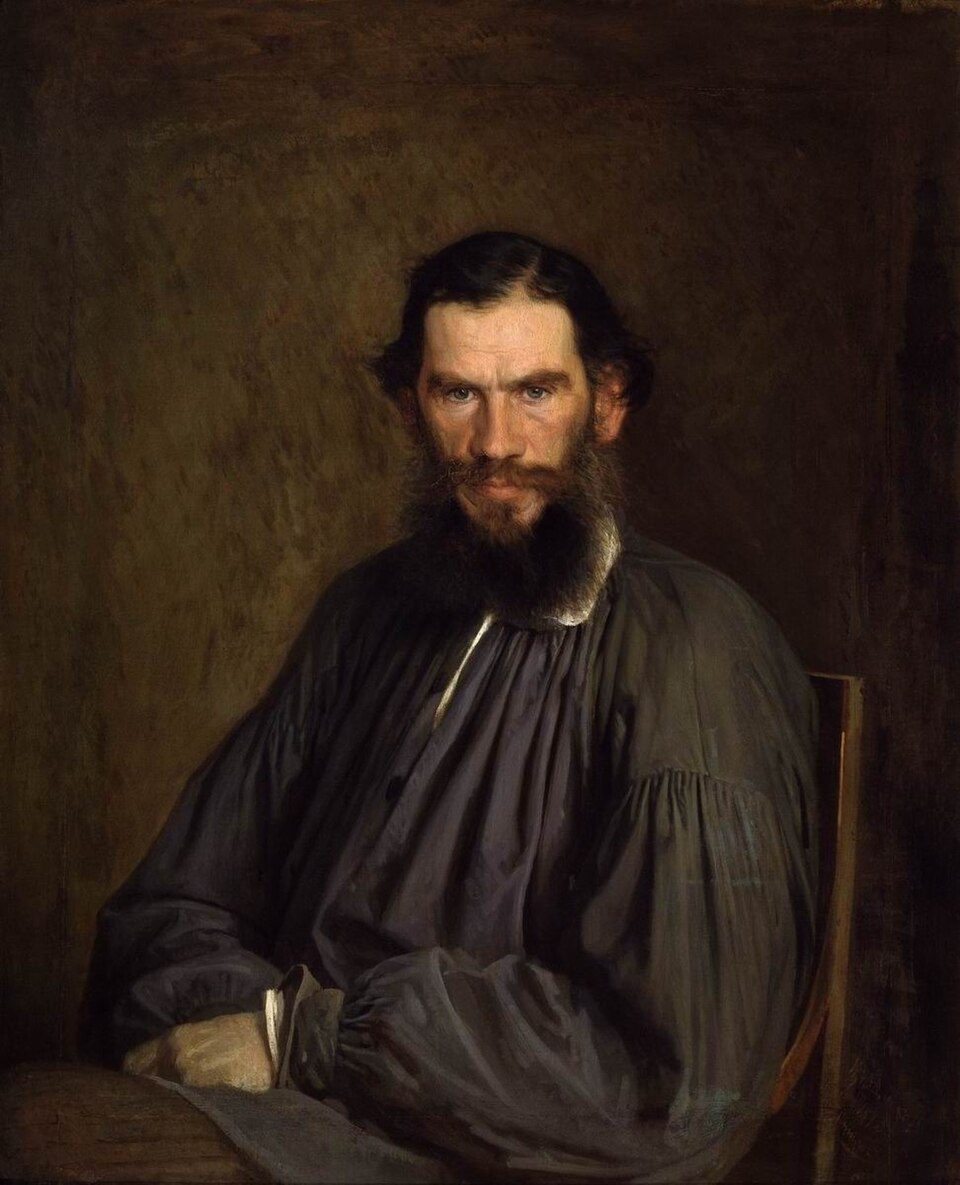
Leo Tolstoy in 1873 (Ivan Kramskoy, State Tretyakov Gallery) — the novelist of Anna Karenina, a few years before the transformation he would later narrate in A Confession. Public domain.
### 3.1. The keystone — *A Confession*: a "переворот", not a "crisis"
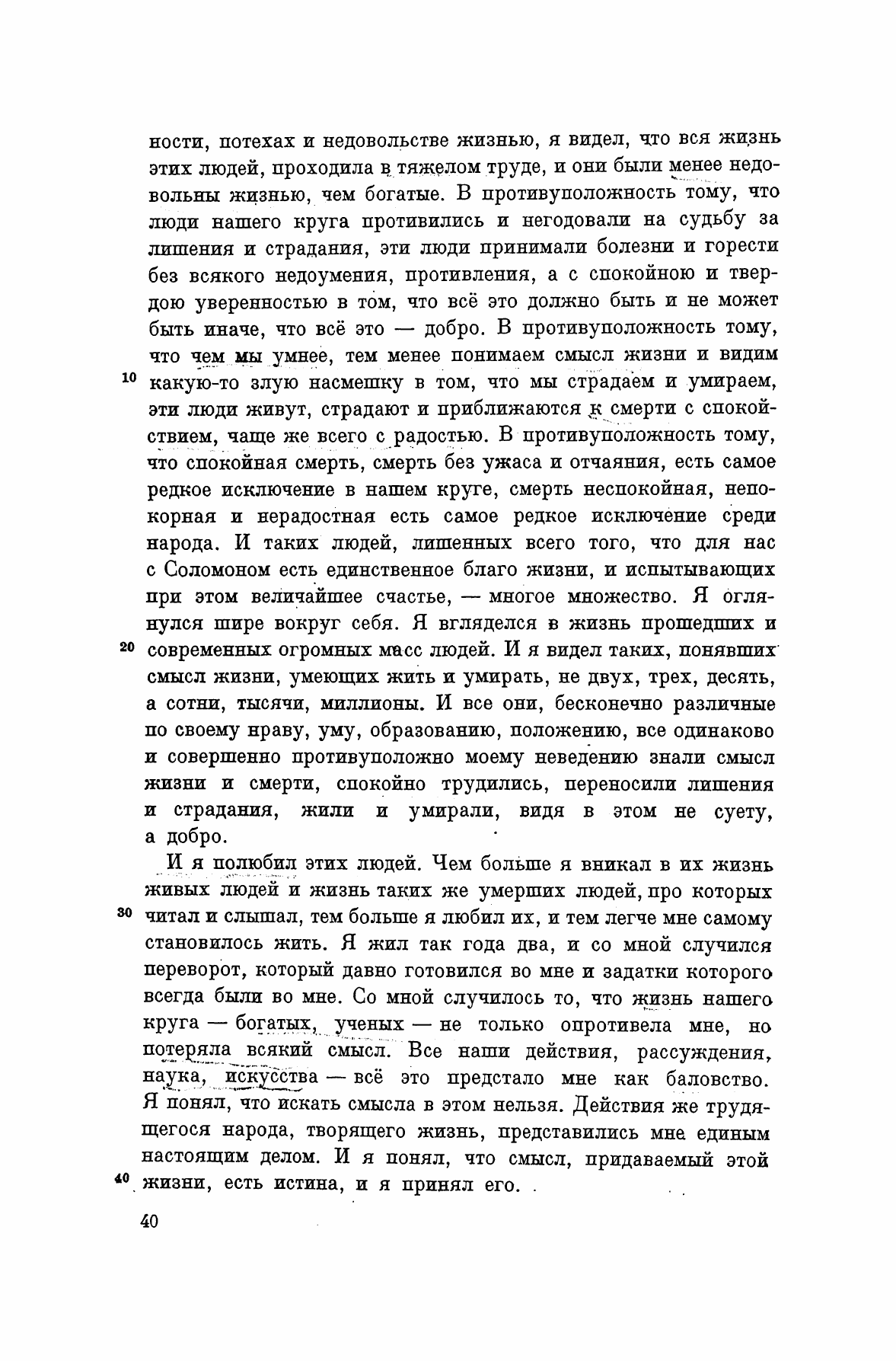
*A Confession* (*Исповедь*, written 1879–1882, PSS Tom 23, pp. 1–59) is the work in which Tolstoy tells the story of the transformation himself. Across its whole length the word **кризис does not appear once**; neither does **перелом** (a "break" or "turning-point"). The word he reaches for, at the pivot of the narrative, is **переворот** — an upheaval, an overturning. PSS Tom 23, p. 40:
> Я жил так года два, и со мной случился переворот, который давно готовился во мне и задатки которого всегда были во мне. Со мной случилось то, что жизнь нашего круга — богатых, ученых — не только опротивела мне, но потеряла всякий смысл.
> *I lived like that for a couple of years, and there occurred in me an upheaval [переворот] that had long been preparing within me, and whose seeds had always been in me. What happened to me was that the life of our circle — the rich, the learned — not only grew repugnant to me, but lost all meaning.* (working English)
PSS Tom 23, p. 40 — «…со мной случился переворот, который давно готовился во мне…». Rendered from the local Jubilee Edition (vol83); the printed text matches the digital corpus verbatim. Public domain.
Two things in this one sentence answer the question. First, the word is **переворот**, not кризис. Second, Tolstoy explicitly denies that it was a sudden rupture: it "had long been preparing" and "its seeds had always been in me". This is precisely the position Birukoff reports him taking — that there was no crisis "in the proper sense", only the eruption of forces that had always been there.
### 3.2. The transformation as un-datable
The same point — that this was not a datable event — is made directly when Tolstoy describes climbing back out of despair (PSS Tom 23, p. 46):
> И я спасся от самоубийства. Когда и как совершился во мне этот переворот, я не мог бы сказать. […] так же постепенно, незаметно возвратилась ко мне эта сила жизни. И странно, что та сила жизни, которая возвратилась ко мне, была не новая, а самая старая, — та самая, которая влекла меня на первых порах моей жизни.
> *And I was saved from suicide. When and how this upheaval [переворот] took place in me, I could not say. […] just as gradually, imperceptibly, the force of life returned to me. And it is strange that the force of life which returned to me was not a new one, but the very oldest — the same that had drawn me in the first days of my life.* (working English)
"When and how this upheaval took place in me, I could not say" is the strongest single statement against reading the transformation as a dated crisis. The change is gradual, imperceptible, and a *return* to something old rather than the arrival of something new.
### 3.3. What it felt like — "остановка жизни"
Where biographers reach for "crisis", Tolstoy's own image is **остановка жизни** — life coming to a stop. The famous opening of the crisis narrative (PSS Tom 23, p. 10):
> Так я жил, но пять лет тому назад со мною стало случаться что-то очень странное: на меня стали находить минуты сначала недоумения, остановки жизни, как будто я не знал, как мне жить, что мне делать, и я терялся и впадал в уныние. […] Эти остановки жизни выражались всегда одинаковыми вопросами: Зачем? Ну, а потом?
> *So I lived, but five years ago something very strange began to happen to me: at first there came over me moments of bewilderment, of life coming to a stop, as though I did not know how to live or what to do, and I lost my footing and fell into dejection. […] These stoppages of life always expressed themselves in the same questions: Why? And then what?* (working English)
His vocabulary for the whole episode is narrative and figurative — **остановка жизни** (the arrest of life), **отчаяние** (despair — the отчая- family appears 16 times), the loss and recovery of **смысл жизни** (the meaning of life, 22 occurrences) — never the clinical noun "crisis".
### 3.4. *What I Believe* — "my life suddenly changed"
The companion confessional work, *What I Believe* (*В чём моя вера?*, 1884, PSS Tom 23, pp. 304–465), opens with the same event told from the other side — the turn *toward* Christ's teaching rather than the fall into despair. Again the word is not кризис but **переменилась** (changed):
> Пять лет тому назад я поверил в учение Христа — и жизнь моя вдруг переменилась […] Со мной случилось то, что случается с человеком, который вышел за делом и вдруг дорогой решил, что дело это ему совсем не нужно,— и повернул домой.
> *Five years ago I came to believe in Christ's teaching — and my life suddenly changed […] What happened to me was what happens to a man who goes out on some errand and then suddenly decides on the way that the errand is of no use to him at all — and turns back home.* (working English)
Note the small tension between the two accounts: *A Confession* says the upheaval "had long been preparing", while *What I Believe* says life "suddenly [вдруг] changed". The two works describe slightly different things — the long erosion of meaning versus the abrupt re-orientation toward faith — but neither calls the episode a crisis.
### 3.5. How Tolstoy *did* use the word "кризис"
Tolstoy did use кризис — but, in the body text of his letters, never about his own transformation. The corpus sweep surfaced two clean instances in his own hand, and both point elsewhere:
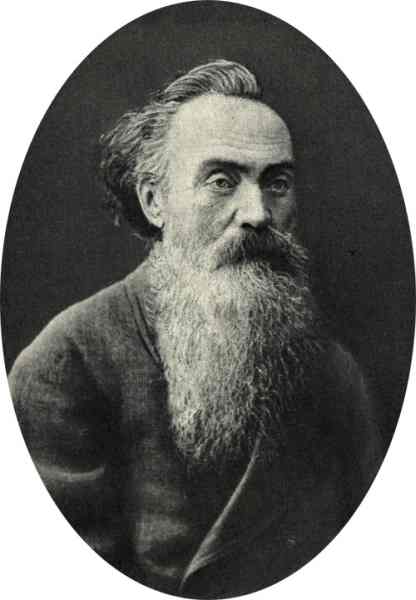
N. N. Strakhov (1885) — philosopher and close correspondent, to whom Tolstoy used кризис in its plain medical sense (a dying friend's pneumonia). Public domain.
- **Medical.** To N. N. Strakhov, 16 March 1894 (PSS Tom 67, p. 84), of the dying Marya Petrovna Fet:
> Вы знаете, что Марья Петровна Фет при смерти — крупозное воспаление легких. До сих пор нет кризиса, и шансов смерти, говорят, больше, чем жизни.
> *You know that Marya Petrovna Fet is dying — lobar pneumonia. So far there is no crisis, and the chances of death, they say, are greater than of life.* (working English)
Here кризис is the clinical term — the turning-point of a fever.
- **Developmental, plural, universal.** To L. F. Annenkova, 4 September 1894 (PSS Tom 67, pp. 213–214):
> …я, к счастию, этого отчаяния никогда не знал с тех пор, как родился вновь […] то каждый, проходя эти возрасты, эти кризисы, не будет пугаться, а будет ждать следующего состояния, будет знать, что то же было и с другими.
> *…I, fortunately, have never known this despair since I was born anew… so that everyone, passing through these ages, these crises, would not take fright, but would wait for the next state, knowing that the same was so for others.* (working English)
When Tolstoy uses кризис of the spiritual life, it is **plural** ("these crises"), it is one of the recurring **возрасты духовные** (spiritual ages) that **everyone** passes through, and the thing to do is not to dramatise it but to "wait for the next state". This is the opposite of *the* singular great crisis of 1876–1880. In the same breath he describes his own change with a different word — **родился вновь** ("born anew").
### 3.6. Where the "crisis" label actually lives — apparatus and biography
The word that biography uses for Tolstoy is supplied, in the corpus, by the **editorial apparatus**, not by Tolstoy. In the notes to the Chertkov correspondence the Jubilee Edition editors write, of the year 1883 (PSS Tom 85, editorial note):
> …21 мая 1883 г. Толстой, пережив уже кризис своих воззрений и отстраняясь от всяких дел материального характера, выдал ей нотариально засвидетельствованную доверенность…
> *…on 21 May 1883 Tolstoy, having already lived through the crisis of his views and withdrawing from all affairs of a material character, issued her a notarised power of attorney…* (working English; editorial voice, not Tolstoy's)
And the framing source for this dive is Birukoff's biography itself. In the Swedish edition (*Leo Tolstoj: Hans liv och verk*), Book IV is «Kritisk period» (The Critical Period) and chapter 14 is titled **«Krisen»** (The Crisis) — and the chapter opens by dating "Tolstoy's spiritual crisis [andliga kris]" to 1876. Yet the same page (p. 262) reports Tolstoy himself contradicting the label:
> I ett af sina själfbiografiska arbeten förklarar Leo Nikolajevitsch själf, att någon kris i egentlig mening aldrig existerat, att han *alltid* kämpat för att finna lifvets sanna mening och att det endast var komplicerade yttre tilldragelser och hans egna passioner och förirrelser, som sköto åt sidan lösningen af lifvets frågor och koncentrerade hans inre, hemliga krafter i en mäktig eruption, som omsider kullkastade hela den bräckliga byggnaden.
> *In one of his autobiographical works Leo Nikolaevich himself declares that no crisis in the proper sense ever existed, that he had* always *struggled to find life's true meaning, and that it was only complicated outward events and his own passions and errancies that pushed aside the solution of life's questions and concentrated his inner, hidden forces into a mighty eruption, which at last overturned the whole fragile edifice.* (working English, from the Swedish)
Birukoff then lays out the biographer's two options: either (1) "Leo Nikolaevich has always been the same as he now is", or (2) "at the end of the 1870s a change took place within him that all at once formed a turning-point [vändpunkt] in his life". Two details make this page the hinge of the dive. First, the autobiographical work Birukoff alludes to — "no crisis in the proper sense … the seeds always in him" — is almost exactly the *A Confession* passage quoted in §3.1 («задатки которого всегда были во мне»); Tolstoy's own texts lean hard toward option (1). Second, the Swedish renders the change as a «mäktig eruption» — a *mighty eruption* — which is the translator's word for Tolstoy's own **переворот**: an upheaval, an overturning, not a "crisis".
**Summary of the lexical finding:** in the works where Tolstoy narrates the transformation, the words are **переворот**, **остановка жизни**, and **переменилась** — and the episode is explicitly long-prepared and un-datable. кризис, in his own use, is a *medical* word or a *plural, universal* one. The singular "crisis of Tolstoy" is the apparatus's word and the biographer's chapter title, not the subject's.
---
## 4. Where the theme clusters
Frequencies are file-counts from the modern-orthography TEI body (16,573 files). "кризис" is rare; "переворот" is common but mostly political/narrative (e.g. *War and Peace*) and was triaged, not exhausted.
| Term | Files | Reading for this theme |
|---|---|---|
| кризис | 40 | Medical, political, or (in apparatus) the editors' label for Tolstoy; never Tolstoy's own word for his transformation |
| перелом | 62 | Half are «перелом руки» (his 1864 broken arm); the rest mostly editorial/third-party "turning-point" |
| переворот | 172 | Mostly political/narrative; **2 occurrences in *A Confession* name the transformation** |
| пробуждение / возрождение | 167 / 64 | Not used for the transformation in the keystone texts (checked: 0 in *A Confession*, *What I Believe*, *My Life*) |
| остановка (bare) | all files | False positive — matches «постановка задач» in the digitisation credit boilerplate; use the phrase «остановка жизни» |
### Keystone texts (PSS Tom 23 = local `vol83/`)
| Work | TEI id | PSS pp. | Crisis-vocabulary |
|---|---|---|---|
| *Исповедь* / A Confession | `v23_001_059_Ispoved` | 1–59 | переворот ×2 (pp. 40, 46); «остановки жизни» ×3 (остановк- lemma ×5); кризис 0; перелом 0 |
| *В чём моя вера?* / What I Believe | `v23_304_465_V_chem_moja_vera` | 304–465 | переменилась/изменилось; кризис 0; перелом 0; переворот 0 |
| *Моя жизнь* / My Life (fragment) | `v23_469_474_Moja_zhizn` | 469–474 | none of the crisis vocabulary |
### Letters (Tolstoy's own hand, body text)
| Tom | Letter id | Date | Addressee | Material |
|---|---|---|---|---|
| 67 | `v67_083_H_N_Straxovu` | 1894-03-16 | N. N. Strakhov | кризис used **medically** (Fet's pneumonia) |
| 67 | `v67_214_L_F_Annenkovoj` | 1894-09-04 | L. F. Annenkova | «эти кризисы» as universal spiritual life-stages; «родился вновь» |
### Editorial / biographical usage (the label applied to him)
| Source | Locus | Phrase |
|---|---|---|
| PSS Tom 85 (Jubilee Edition apparatus) | note to Chertkov letter, 10–11 May 1885 | «кризис своих воззрений» (1883) |
| PSS Tom 82 (Jubilee Edition apparatus) | note to L. D. Semenov letter | «религиозного перелома» (of the addressee Leonid Semenov, not Tolstoy) |
| Birukoff, *Life of Tolstoy*, Book IV | ch. 14 | chapter titled **"The Crisis"** / "Krisen" |
---
## 5. Scholarly context
In the reference literature and in popular biography, the transformation of 1879–1882 is almost always called Tolstoy's "spiritual crisis" or his "conversion". The modern *Encyclopædia Britannica* files the period under a section headed "Conversion and religious beliefs"; the *Encyclopedia of Philosophy* calls it his "spiritual crisis", "dramatically described in *My Confession*" and then "resolved"; English Wikipedia opens with "a profound moral crisis, followed by … an equally profound spiritual awakening". The chapter-title convention that prompted this dive is not Birukoff's alone — Aylmer Maude, Tolstoy's own translator and a major source of his English-language reception, titled his approach chapter "Nearing the Crisis" (1908), and A. N. Wilson (1988) frames the episode as a "religious conversion". On its face the received view is settled, and it runs against this dive's finding that Tolstoy avoided the word.
Specialist scholarship, however, largely **confirms** the dive's deeper claim. A long current of academic work holds that the change was gradual and continuous, not a sudden, datable rupture. Richard Gustafson's *Leo Tolstoy: Resident and Stranger* (1986) argues that "the man is not two, but one", reading the religious thought as present across the whole career rather than installed by a crisis. Inessa Medzhibovskaya subtitles her monograph *A Biography of a Long Conversion, 1845–1887* (2008) and describes the change as "a search for a new outlook rather than a crisis-begotten tragic moment". Donna Orwin's *Tolstoy's Art and Thought, 1847–1880* (1993) traces the long philosophical trajectory across the decades before the change. R. F. Christian, introducing *Tolstoy's Letters* (1978), set out to "dispose of the persistent fallacy" that the conversion was a "sudden *volte-face*"; Aileen Kelly (1978) reads it as a culmination of longstanding tensions rather than a sudden break. Even biographers who keep the word register the build-up: Rosamund Bartlett (2010) argues for Tolstoy's life as "an organic whole" and rejects the two-halves story, and Ernest Simmons (1946) calls *A Confession* the tale of a crisis "the ingredients of which had been fermenting in the man since his youth". This is the position of §3.1–3.2 — a переворот that "had long been preparing", whose date Tolstoy "could not say".
What the scholarship does **not** do is engage the lexical evidence. None of the works surveyed notes that Tolstoy's own word was *переворот*, that *кризис* never appears in *A Confession*, or that when he did use *кризис* it was medical or plural (§3.5). The continuity is argued from the shape of the life and the letters, not from the vocabulary. The word-level finding of this dive is in that sense its own contribution: it supplies textual grounding for what specialist scholars had argued thematically.
One outside detail corroborates the dive's own evidence. Tolstoy's daughter Tatyana recorded that "what is termed Tolstoy's conversion or religious crisis" was something "he himself called … his second birth" (*Tolstoy Remembered*, 1977) — close to the self-description the dive found in the 1894 letter to Annenkova, «родился вновь» (born anew, §3.5). The quotation reaches us second-hand and is held for verification against the book.
The one scholar who rejected the "crisis" label outright did so on grounds opposite to Tolstoy's. Boris Eikhenbaum — whose *Tolstoy in the Seventies* is the background entry point named below — argued that Tolstoy's "crises" were driven by his search for new artistic form, not by spiritual upheaval. He agrees the dramatic "crisis" reading overstates the case, but dissolves the episode into literary development rather than crediting Tolstoy's own account of it. The "crisis" is contested within the scholarship as well — from a different direction than Tolstoy's own.
---
## 6. Material not covered
- The full triage of **переворот** (172 files) and **перелом** (62) across the *works* — mostly political/narrative senses; only the *A Confession* occurrences were run to ground.
- An exhaustive **пробуждение / возрождение** sweep (checked only in the keystone texts).
- The **crisis-years diaries** beyond a vocabulary probe: Toms 48–49 (1878–1884) contain **no** кризис / перелом / переворот for the transformation, but the *resumption* of regular diary-keeping around 1881 and the faith/despair entries of those years were not deep-read.
- One ambiguous кризис hit — to V. I. Alekseev (PSS Tom 65), on a "сришис" of a life-period — sits in a regular editorial footnote whose voice (Tolstoy quoted vs. editor) could not be settled; held in `needsReview`, not cited above.
- Secondary scholarship on the "conversion" debate (this is a primary-source dive). Eikhenbaum's *Tolstoy in the Seventies* is the obvious background entry point.
---
## 7. Visual & manuscript record
Images in this dive sit in two places. **Facsimiles we render ourselves** from the local Jubilee Edition (public domain — Tolstoy's own text) live in `extracts/` and are committed. **Third-party images** (portraits, photographs) we fetch live in `visuals/`, which is **git-ignored** — a local research cache, not redistributed by the public repo. Provenance, source URL, and licence for every item are recorded in `dossier.yaml`; the gate on putting any image on the public website (`website/src/`) is rights, checked there, not here. (Because `visuals/` is git-ignored, the two portraits below render in a local working copy but not on a fresh clone until re-fetched — run `python3 docs/fetch_visuals.py` from the repo root to repopulate every dive's `visuals/` from the dossier URLs (or `python3 docs/fetch_visuals.py crisis` for just this one); the keystone facsimile, being in `extracts/`, is always present.)
**Held and embedded above:**
- **[extracts/pss-tom23-page-040-perevorot.png](extracts/pss-tom23-page-040-perevorot.png)** — PSS Tom 23, p. 40 (the «случился переворот» passage), rendered from `vol83/vol83.pdf`. PD (Tolstoy's text); committed.
- **`visuals/kramskoy-tolstoy-1873.jpg`** — Ivan Kramskoy, *Portrait of Leo Tolstoy*, 1873 (State Tretyakov Gallery). Licence **PD** (PD-Art / PD-old-100). Source: Wikimedia Commons, `File:Ivan Nikolayevich Kramskoi - Portrait of Leo Tolstoy, 1873.jpg`.
- **`visuals/strakhov-1885.jpg`** — N. N. Strakhov, 1885. Licence **PD**. Source: Wikimedia Commons, `File:Nikolay Strakhov.jpg`.
**Mapped, not fetched** (in `dossier.yaml`):
- **Photographs of Tolstoy c. 1878–1885** (Wikimedia Commons, *Category:Photographs of Leo Tolstoy*; Shapiro's 1880s studio portraits) — a crisis-years likeness of Tolstoy himself; per-file PD check still needed.
- **V. G. Chertkov portrait** (Kramskoy, 1881) — correspondent; licence to confirm.
- **Manuscript facsimile of *A Confession*** — State Museum of L. N. Tolstoy (GMT, `tolstoy-iss.kamiscloud.ru`); **rights-reserved**, request-only.
- Six Tolstoy Digital timeline images under `primary-sources/tolstoydigital-TEI/images/timeline_tolstoy_life/` — no per-image licence; flagged unknown.
Full provenance and rights for every item are in `dossier.yaml` (`visuals:`).
---
## 8. Method
- **Question (Phase 0 contract):** does Tolstoy frame his 1879–1882 transformation as a "crisis" (кризис), or is that a label from the apparatus and biography? Focused, single session; post-1880 "Prophet" period first-class, with the autobiographical works as keystone.
- **Keywords (Russian, modern orthography lead):** anchors кризис / перелом / переворот; combinable пробуждение, возрождение, «остановка жизни», отчаяние, «смысл жизни»; pre-reform variants (кризисъ etc.) found in only ~5 files. Bare `остановка` dropped (boilerplate); `обращение` demoted (518 files, too polysemous).
- **Sweep:** inline grep across `works / letters / diaries / notes / comments / krug_chtenija` (492 candidate hits), triaged in context.
- **Extract & verify:** `docs/research/lib/extract_tei.py` for byte-faithful Russian; voice attribution (Tolstoy's body text vs. `` apparatus) settled with the extractor's `inside_note()` rule and, where ambiguous, an lxml ancestor check. The keystone (PSS Tom 23, p. 40) was cross-checked against the Jubilee Edition PDF (`vol83`, physical page 78 = printed p. 40) and matches the TEI verbatim.
- **One method note worth keeping:** the local `jubilee-edition/volNN/` folder numbers are **not** PSS Tom numbers (verified: vol22→Tom 56, vol23→Tom 57, vol24→Tom 58, vol49→Tom 40, vol57→Tom 80, vol83→Tom 23). Always resolve via [pss-volume-mapping.md](../pss-volume-mapping.md), never by assuming folder = Tom.
- **Links.** The "label applied from outside" pattern recurs for the movement-name in [tolstoyanism](../tolstoyanism/index.html); the framing biography (Birukoff) and its editions are mapped in [biryukov-biography-editions](../biryukov-biography-editions/index.html), and the dedication-and-diaries questions around it are the [biryukov-sofia-relationship](../biryukov-sofia-relationship/index.html) dive.
---
## 9. References
**Primary**
- Толстой Л. Н. *Исповедь*; *В чём моя вера?*; *Моя жизнь* // ПСС в 90 тт. Т. 23. М.: Худож. лит., 1957. (local: `primary-sources/jubilee-edition/vol83/`)
- Толстой Л. Н. Письма Н. Н. Страхову (16.03.1894) и Л. Ф. Анненковой (04.09.1894) // ПСС. Т. 67. (sources.yaml: `jubilee-edition`)
- Editorial apparatus, ПСС Тт. 82, 85 (the «кризис своих воззрений» / «религиозного перелома» notes).
- tolstoydigital TEI corpus (*Слово Толстого* / HSE Moscow), CC BY-SA. (local: `primary-sources/tolstoydigital-TEI/`)
**Background**
*Framing source*
- Birukoff (Бирюков) P. I. *Leo Tolstoj: Hans liv och verk* (Swedish ed.), Book IV «Kritisk period», ch. 14 «Krisen», p. 262 — **the framing source**, provided by the user as a photograph this session. NB: the local English archive-org file `primary-sources/archive-org/leotolstoyhislif00biriiala/` is **Vol I** (childhood–youth) of a different edition and does **not** contain this chapter; do not cite it for the "Crisis" framing. See also [biryukov-biography-editions](../biryukov-biography-editions/index.html) for the edition map.
*Scholarship on the transformation* (Phase 3 secondary layer; English-first, prototype-light rigor — attributed, not byte-verified)
- Gustafson, Richard F. *Leo Tolstoy: Resident and Stranger: A Study in Fiction and Theology*. Princeton University Press, 1986 — the continuity thesis ("the man is not two, but one").
- Medzhibovskaya, Inessa. *Tolstoy and the Religious Culture of His Time: A Biography of a Long Conversion, 1845–1887*. Lanham, MD: Lexington Books, 2008 — describes the change as "a search for a new outlook rather than a crisis-begotten tragic moment".
- Orwin, Donna Tussing. *Tolstoy's Art and Thought, 1847–1880*. Princeton University Press, 1993 — a gradual philosophical trajectory toward the "religious conversion of 1880".
- Christian, R. F. (ed., trans.). *Tolstoy's Letters*, 2 vols. London: Athlone Press, 1978 — editor's introduction sets out to "dispose of the persistent fallacy" of a "sudden *volte-face*" (quoted via Kelly 1978).
- Kelly, Aileen. "Tolstoy in Doubt." *The New York Review of Books*, 29 June 1978. — reads the change as a culmination of longstanding tensions, not a sudden break.
- Eikhenbaum, Boris. *Tolstoi in the Seventies* (Eng. trans., Ardis, 1982) and the essay «О кризисах Толстого» / "On Tolstoy's Crises" (1920) — questions the "crisis" reading, relocating its driver to artistic form (sources.yaml: `eikhenbaum-tolstoy-70s`).
*Biographies*
- Maude, Aylmer. *The Life of Tolstoy*, 2 vols. London: Constable, 1908–10 — approach chapter titled "Nearing the Crisis".
- Wilson, A. N. *Tolstoy*. London: Hamish Hamilton, 1988 — frames the episode as a "religious conversion".
- Bartlett, Rosamund. *Tolstoy: A Russian Life*. London: Profile Books, 2010 — uses "spiritual crisis" but argues for the life as "an organic whole".
- Simmons, Ernest J. *Leo Tolstoy*. Boston: Little, Brown, 1946 — *A Confession* the tale of a crisis "the ingredients of which had been fermenting in the man since his youth".
- Tolstaya (Sukhotina-Tolstaya), Tatyana. *Tolstoy Remembered*. Trans. Derek Coltman. New York: McGraw-Hill, 1977, p. 19 — records that Tolstoy "called it his second birth" (quotation reaches us second-hand; held in `needsReview` for verification).
*Reference works* (accessed May 2026)
- *Encyclopædia Britannica*, "Leo Tolstoy" — period filed under the section "Conversion and religious beliefs".
- *Encyclopedia of Philosophy*, "Tolstoy, Lev (Leo) Nikolaevich" (via Encyclopedia.com) — "spiritual crisis … resolved".
- English Wikipedia, "Leo Tolstoy" — "a profound moral crisis, followed by … an equally profound spiritual awakening".
---
A short, plain-language recap of this dive is drafted for the dev-blog at [`website/src/posts/notes/2026-05-29-crisis.md`](../../../../website/src/posts/notes/2026-05-29-crisis.md) (held as `draft: true`).