---
layer: reference
lastUpdated: 2026-06-02
tags: [research]
---
# Tolstoy in art: paintings, drawings and sculpture of Tolstoy and his circle, 1873–1910
Date: 2026-06-02
Context: A primary-source survey of how Tolstoy and the people and places around him were depicted in fine art — oil portraits, drawings, prints and sculpture — between Kramskoy's 1873 portrait and Tolstoy's death in 1910. The dive maps each work to the date it was actually made, checks whether a high-quality reproduction exists, and records whether it is public domain or held under institutional control. It is grounded in Tolstoy's own letters and diaries: what he wrote about sitting for these artists, about the works themselves, and about being depicted at all. Photography (the Chertkov and Sofia Tolstaya record, the 1908 Prokudin-Gorsky colour plate) is out of scope by design — it is a large separate dive. This is a research prototype: primary citations are byte-faithful; secondary claims are attributed, not asserted.
---
## 1. Key findings
- **Tolstoy is the most-depicted writer of the nineteenth century, and the local corpus dates the major works in his own hand.** The week-long Kramskoy sittings of September 1873, the Repin portrait "packed and sent off" in September 1887, the Repin-paints-while-Ginzburg-sculpts session of July 1891 — each is fixed by a letter or diary entry, not by external catalogue alone.
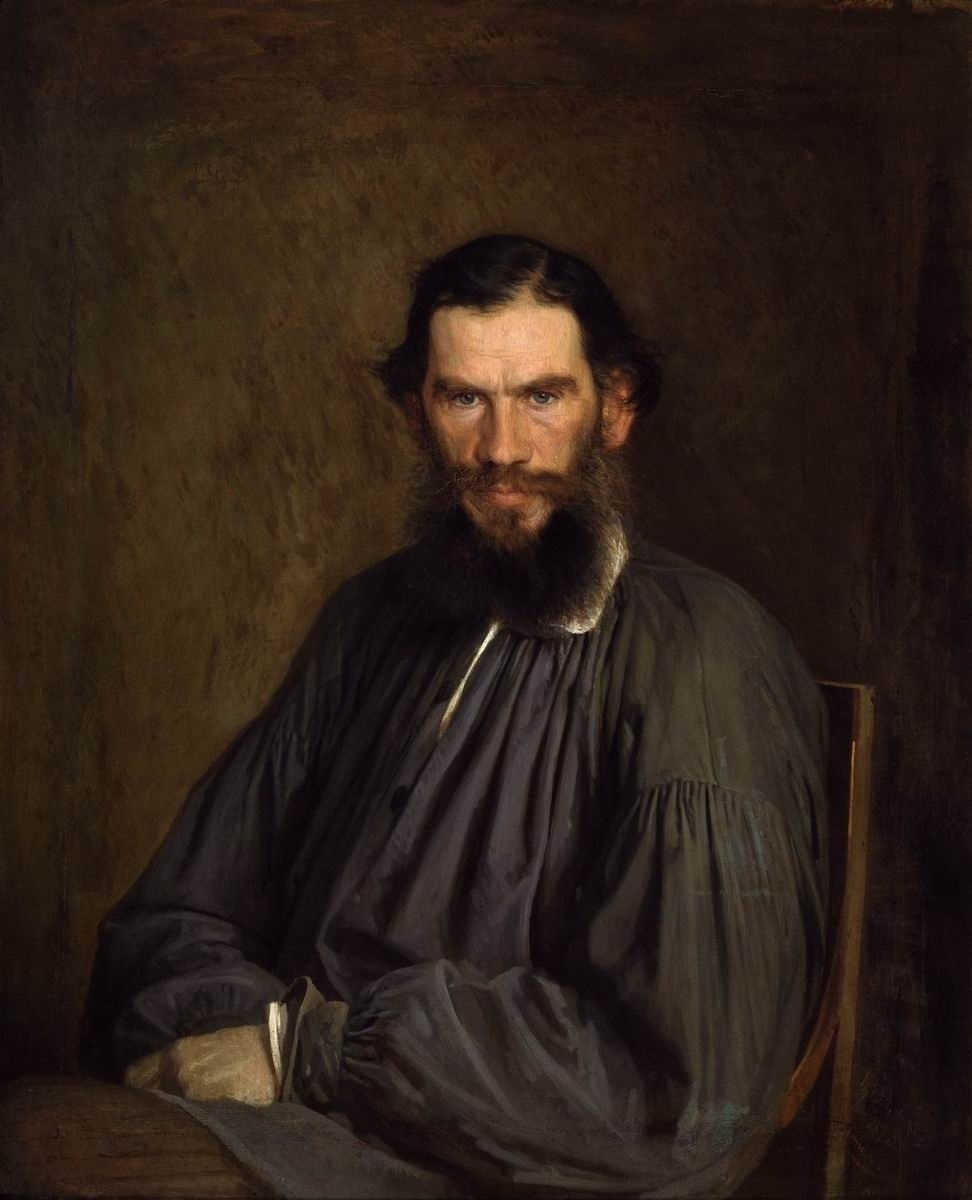
- **The painted record begins with reluctance and bargaining, not reverence.** Tolstoy agreed to Kramskoy's 1873 commission only because the painter came in person and offered a cheaper second canvas for the family, "and my wife talked me into it." Two portraits were made at once: the Tretyakov version and a family version still at Yasnaya Polyana.
- **Nikolai Ge, not Repin, is the artist the corpus documents most deeply** — as friend, portraitist, sculptor and the maker of religious canvases Tolstoy shaped by direct instruction. The 1884 desk portrait that became iconic is, paradoxically, *absent* from the local letters and diaries; what the corpus records is the late religious cycle and Ge's 1890–91 bust, which Tolstoy ranked above the busts by Ginzburg and Repin.
- **Tolstoy was a sharp, not a flattering, sitter.** He called one Repin canvas "impossible — all made up" the same season he found Ge "very good," and in *What Is Art?* (1897) he held up a Kramskoy drawing and a Ge picture — the two men who painted him — as models of true art, while damning most professional painting as class amusement. The most-portrayed man of his age was also the age's fiercest critic of portraiture's milieu.
- **Almost everything is public domain; the obstacle is institutional photography, not copyright.** Every artist here died before 1955, so the works are PD in Russia (life+70) and the US (created pre-1929). The Russian holding museums (Tretyakov, Russian Museum, the State Tolstoy Museum) nonetheless restrict and charge for their own high-resolution photographs of these PD works.
- **Reproduction quality is uneven and predictable.** Repin's "Tolstoy Barefoot" (1901) exists as a superb 2281×6490 Google Art Project scan; the Kramskoy 1873 and Nesterov 1907 portraits survive online only as middling uploads; the Trubetskoy sculptures and the Yaroshenko, Serov and Aronson works are absent from open repositories and must be requested from the institutions that hold them.
## 2. Why this matters
tolstoy.life is building a cited, public-domain reference vault around Tolstoy's life and circle. The visual record is a load-bearing part of that: the wiki pages for Kramskoy, Ge, Repin, Trubetskoy and the museums that hold their work all need a dated, rights-checked image catalogue, and the persons-and-places map needs to know which sittings happened when and where. Grounding that catalogue in Tolstoy's own dated words — rather than in the often-rounded years printed on gallery labels — lets the vault correct the record where the two diverge, and lets it source images that are genuinely free to publish rather than ones a museum merely displays. The dive also surfaces a question the project will meet again: who controlled Tolstoy's image, and how the painted icon, the photographic cult and the family all competed for it.
## 3. The shape of the question
### 3.1 — 1873: Kramskoy, and the bargain behind the first portrait
The earliest depiction in scope is also the best-documented sitting in the corpus. In September 1873, while finishing *Anna Karenina*, Tolstoy sat for Ivan Kramskoy at Yasnaya Polyana — and reported it twice in one day, to Fet and to Strakhov.
Date: 1873-09-23 (Old Style). To A. A. Fet, PSS Tom 62, pp. 48–49 (TEI v62_034_A_A_Fetu).
Context: Tolstoy explains why he agreed to be painted.
> «У меня каждый день, вот уже с неделю, живописец Крамской [...] делает мой портрет в Третьяковскую галлерею, и я сижу и болтаю с ним и из Петербургской стараюсь обращать его в крещеную веру.»
"Every day now, for a week already, the painter Kramskoy has been making my portrait for the Tretyakov gallery, and I sit and chat with him and try to convert him from the Petersburg faith to the baptized one." *(working English)*
To Strakhov the same day, he records that two canvases were under way at once — the commissioned one and a cheaper family version his wife asked for.
Date: 1873-09-23/24 (Old Style). To N. N. Strakhov, PSS Tom 62, pp. 49–51 (TEI v62_035_N_N_Straxovu).
> «Он теперь кончает оба портрета и ездит каждый день, и мешает мне заниматься. Я же во время сидений обращаю его из петербургской в христианскую веру и, кажется, успешно.»
"He is now finishing both portraits and comes every day, keeping me from my work. During the sittings I am converting him from the Petersburg to the Christian faith — successfully, it seems." *(working English)*
Ivan Kramskoy, Portrait of L. N. Tolstoy, 1873 (State Tretyakov Gallery). The Tretyakov-commissioned canvas of the two Tolstoy mentions; the second, family version remains at Yasnaya Polyana. Public domain; Commons scan 972×1200.
The same years produced the corpus's literary counterpart to the encounter. In *Anna Karenina*, Part 5 — written 1875–76 — the painter Mikhailov captures Anna's inner truth after the fifth sitting, beside Vronsky the dilettante who abandons his own portrait as superfluous.
To no addressee. PSS Tom 19, Part 5 (TEI v19_003_399_Anna_Karenina_Chasti_5_8).
> «Портрет с пятого сеанса поразил всех, в особенности Вронского, не только сходством, но и особенною красотою. Странно было, как мог Михайлов найти ту ее особенную красоту.»
"The portrait, after the fifth sitting, struck everyone, Vronsky especially, not only by its likeness but by a particular beauty. It was strange how Mikhailov could have found that particular beauty of hers." *(working English)*
Biographers identify Kramskoy as the model for Mikhailov (§5). The corpus carries the text but does not name him — the link is scholarship, not Tolstoy's word.
### 3.2 — Nikolai Ge: the deepest art friendship
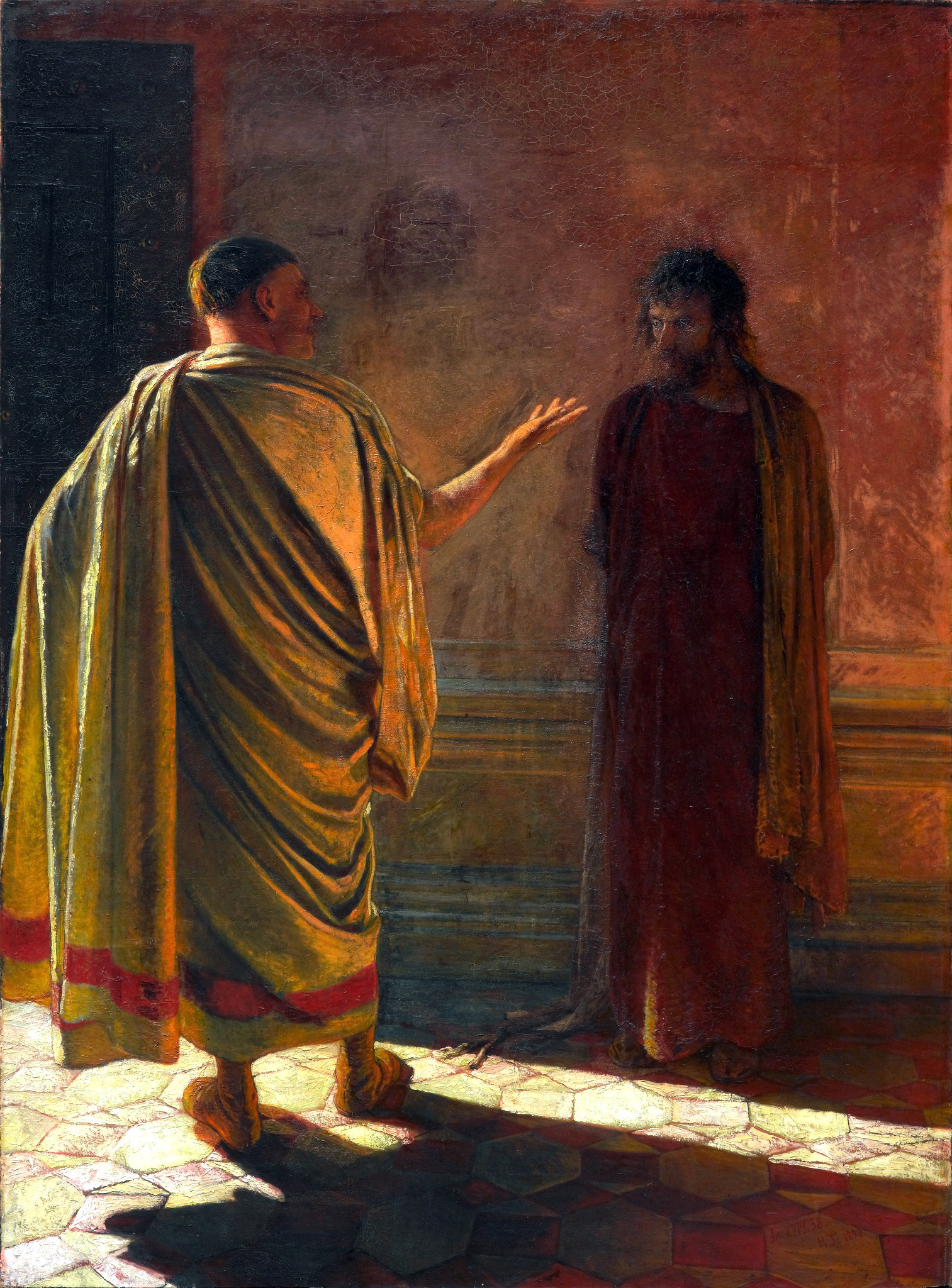
No artist appears in the corpus as often, or as intimately, as Nikolai Ge (1831–1894). The relationship ran from the early 1880s to Ge's death and covered portraiture, sculpture and a cycle of religious paintings Tolstoy treated almost as his own. By January 1889 Tolstoy knew Ge was at work on a major canvas — the picture that became *What Is Truth?*.
Date: 1889-01-31 (Old Style). To N. N. Ge (the painter), PSS Tom 64, pp. 217–218 (TEI v64_307_N_N_Ge_otcu).
> «...которая хороша не потому, что я ее люблю, а всем хороша будет, потому что очень задушевна.»
"...which is good not because I love it but because it will be good for everyone, since it is very heartfelt." *(working English)*
In April 1889 he saw a finished Ge Gospel canvas — "The Exit from the Last Supper" — and set it directly against a Repin painting, in a letter and, six days earlier, in a one-line diary verdict.
Date: 1889-04-21 (Old Style). To N. N. Ge, PSS Tom 64, pp. 248–250 (TEI v64_358_N_N_Ge_otcu).
> «Я знал эскиз, слышал про картину, но когда увидал, я умилился. Картина делает то, что нужно — раскрывает целый мир той жизни Христа, вне знакомых моментов...»
"I knew the sketch, had heard about the picture, but when I saw it I was moved to tenderness. The picture does what is needed — it opens up a whole world of that life of Christ, outside the familiar moments..." *(working English)*
Date: 1889-04-15 (Old Style). Diary, PSS Tom 50, pp. 67–68 (TEI v50_067_068_1889_04_15).
> «Картина Репина невозможна — всё выдумано. Ге хорош очень.»
"Repin's picture is impossible — it is all made up. Ge is very good." *(working English)*
Nikolai Ge, What Is Truth? (Christ and Pilate), 1890 (State Tretyakov Gallery). Banned from exhibition by order of the censorship in 1890; Tolstoy championed it to Tretyakov. Public domain; Commons scan 1513×2048.
The corpus shows Tolstoy not merely admiring but directing the late Passion canvases. In September 1892 he tells Ge to repaint Christ.
Date: 1892-09-22 (Old Style). To N. N. Ge, PSS Tom 66, pp. 258–259 (TEI v66_341_N_N_Geotcu).
> «"Повинен смерти" необходимо переписать Христа: сделать его с простым, добрым лицом и с выражением сострадания»
"['Guilty of Death'] — Christ must be repainted: make him with a simple, kind face and an expression of compassion." *(working English)*
When Ge died in June 1894, Tolstoy wrote to the collector Pavel Tretyakov — both a eulogy and a plea to keep Ge's work in the national gallery.
Date: 1894-06-07/14 (Old Style). To P. M. Tretyakov, PSS Tom 67, pp. 153–155 (TEI v67_161_P_M_Tretyakovu).
> «Я нынче зимою был три раза в вашей галлерее и всякий раз невольно останавливался перед "Что есть истина"»
"This winter I was three times in your gallery and each time involuntarily stopped before 'What Is Truth?'." *(working English)*
Scholarship tends to call Ge a Tolstoy "disciple" or [Tolstoyan](../tolstoyanism/index.html) follower; the correspondence reads more like a two-way working dialogue, and Ge's religious turn followed the same conversion years the project's [crisis](../crisis/index.html) dive traces in Tolstoy himself.
### 3.3 — Ilya Repin: the most prolific, and not the most trusted
Repin painted, drew and modelled Tolstoy for nearly three decades — around twelve portraits, twenty-five drawings and three busts by later counts. The corpus pushes the first working contact back earlier than the usual "first Yasnaya visit, 1887": in April 1883, in Moscow, Tolstoy already sat with Repin "at work."
Date: 1883-04-03/15 (dual-dated). Diary, PSS Tom 49, p. 77 (TEI v49_077_077_1883_04_03).
> «Дома Репин. С ним очень хорошо говорил, за работой.»
"At home — Repin. Talked with him very well, while he was at work." *(working English)*
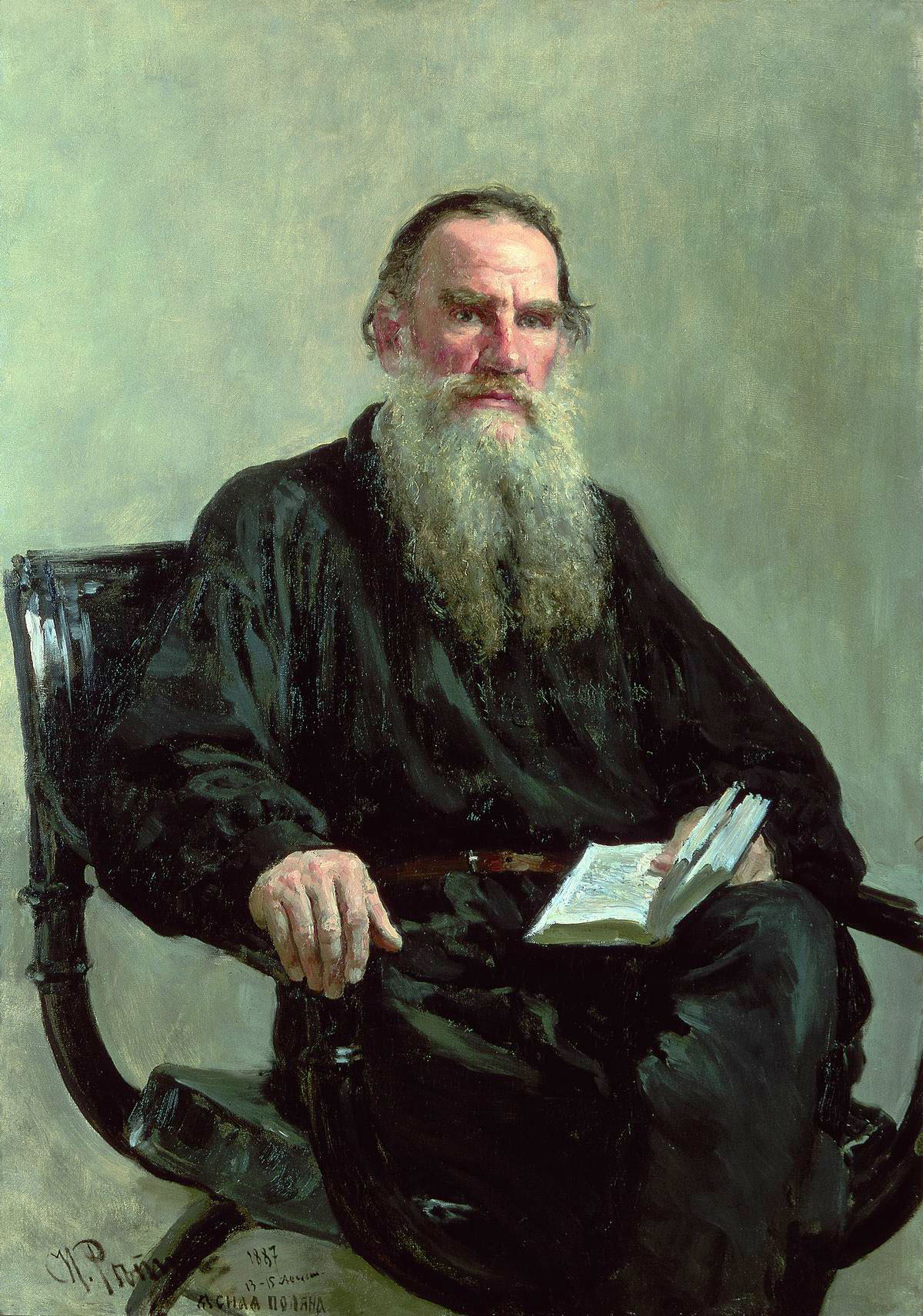
The canonical 1887 Tretyakov portrait is anchored by a note to the critic Stasov: the finished portrait leaving Yasnaya.
Date: 1887-09-08 (Old Style). To V. V. Stasov, PSS Tom 64, pp. 66–67 (TEI v64_115_V_V_Stasovu).
> «Портрет Репина уложен и завтра отсылается.»
"Repin's portrait is packed and is being sent off tomorrow." *(working English)*
Ilya Repin, Portrait of L. N. Tolstoy, 1887 (State Tretyakov Gallery) — painted in a week at Yasnaya Polyana and shipped that September. Public domain.
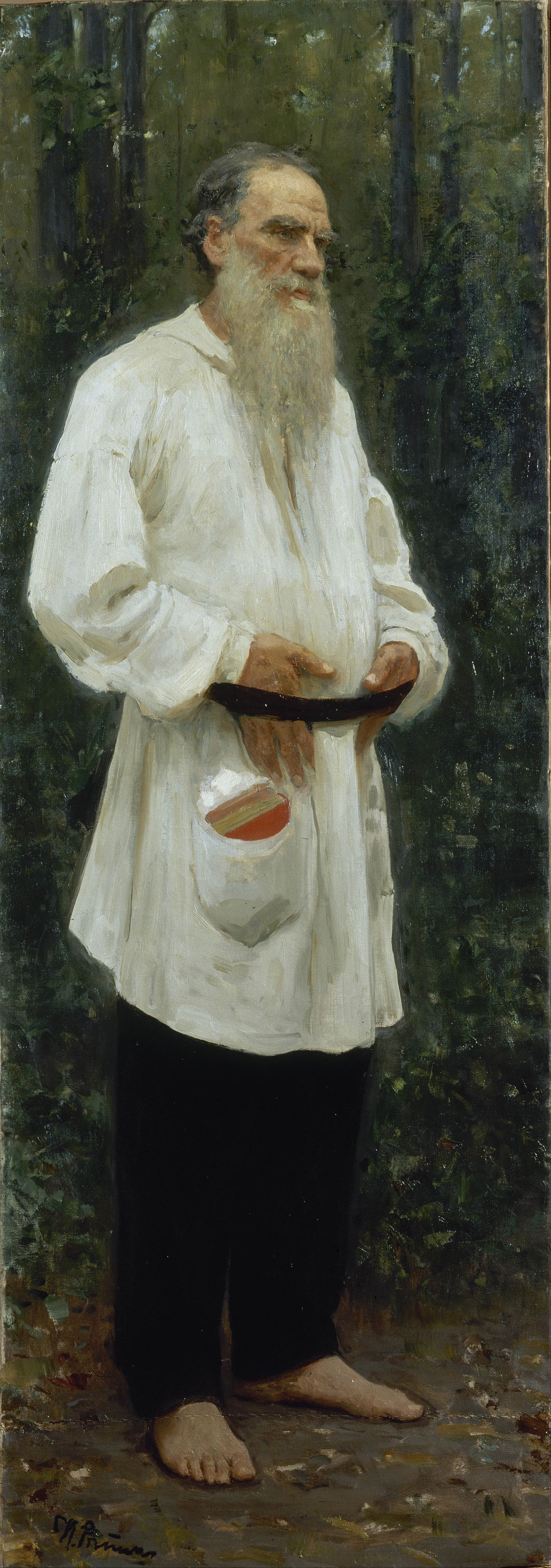
The single richest depiction record is the July 1891 visit, when Repin painted and the sculptor Ginzburg modelled Tolstoy at the same time — in Tolstoy's own words, "they sculpt and paint me."
Date: 1891-07-13 (Old Style). Diary, PSS Tom 52, p. 44 (TEI v52_044_044_1891_07_13).
> «Приехал Репин и Гинзбург. За это время они меня лепят и пишут, а я написал статью об обжорстве и много подвинулся в большой статье.»
"Repin and Ginzburg have arrived. During this time they sculpt and paint me, while I have written an article on gluttony and made much progress on the big article." *(working English)*
Ilya Repin, Tolstoy Barefoot, 1901 (State Russian Museum, Ж-4010) — begun as an 1891 study, finished as the large standing canvas in 1901. The finest open reproduction in this dive: a 2281×6490 Google Art Project scan. Public domain.
That the most prolific painter of Tolstoy was also the one he most often doubted is the corpus's quiet correction to the "reverent friend" story. Yet the bond was real and aesthetic: in 1898 Tolstoy wrote to Repin that if *What Is Art?* had clarified art's questions "for an artist such as Repin," the book was not written in vain (TEI v71_090_I_E_Repinu).
### 3.4 — The depicted iconoclast: *What Is Art?* (1897)
The paradox at the centre of the dive is in Tolstoy's own treatise. The most-portrayed man of his age, writing the century's most sweeping attack on professional art, names two of the painters who painted him — Kramskoy and Ge — as exemplars of the real thing.
Date: 1897. *What Is Art?*, PSS Tom 30, pp. 27–203 (TEI v30_027_203_Chto_takoe_iskusstvo).
> «Таков рисунок Крамского, стоящий многих его картин [...] Образцами же в области живописи произведений, вызывающих негодование, ужас пред нарушением любви к Богу и ближнему, могут служить картина Ге — суд»
"Such is Kramskoy's drawing, worth many of his paintings [...] As models in painting of works that arouse indignation and horror at the violation of love of God and neighbour, Ge's picture 'The Judgement' can serve." *(working English)*
The work Tolstoy praises is Ge's *earlier* "Judgement," not the late Passion canvases he championed privately — a distinction the popular reading of *What Is Art?* tends to lose (§5).
### 3.5 — The portrait as a thing to be fought over
A portrait of Tolstoy could be an object of conflict long before the famous final-year struggle. As early as the last day of 1894, a portrait set off a clash between Chertkov and Sofia Andreevna.
Date: 1894-12-31 (Old Style). Diary, PSS Tom 52, pp. 157–159 (TEI v52_157_159_1894_12_31).
> «Был здесь Чертков. Вышло очень неприятное столкновение из-за портрета. Как всегда, Соня поступила решительно, но необдуманно и нехорошо.»
"Chertkov was here. A very unpleasant clash arose over a portrait. As always, Sonya acted decisively but rashly and badly." *(working English)*
By 1910 the conflict over Tolstoy's image had become open warfare between his wife and Chertkov — the theme the project's [Biryukov–Sofia](../biryukov-sofia-relationship/index.html) dive treats in detail. The September 1910 diary entry recording Sofia rehanging and burning portraits survives only in a badly corrupted form in the digital text and is held back here pending collation (§6, needsReview).
And occasionally the depiction turned the mirror on Tolstoy himself.
Date: 1895-04-26 (Old Style). Diary, PSS Tom 53, pp. 25–26 (TEI v53_025_026_1895_04_26).
> «Вчера видел свой портрет, и он поразил меня своей старостью. Мало остается времени.»
"Yesterday I saw my portrait, and it struck me by its old age. Little time remains." *(working English)*
## 4. Where the theme clusters
### Letters to and about the artists
| Tom | TEI id | Date (OS) | Addressee | Material |
|---|---|---|---|---|
| 62 | v62_034_A_A_Fetu | 1873-09-23 | A. A. Fet | The Kramskoy sittings; two 1873 portraits |
| 62 | v62_035_N_N_Straxovu | 1873-09-23 | N. N. Strakhov | "Both portraits"; converting Kramskoy during sittings |
| 64 | v64_115_V_V_Stasovu | 1887-09-08 | V. V. Stasov | Repin's 1887 portrait packed and shipped |
| 64 | v64_307_N_N_Ge_otcu | 1889-01-31 | N. N. Ge | Ge painting a new canvas ("What Is Truth?") |
| 64 | v64_358_N_N_Ge_otcu | 1889-04-21 | N. N. Ge | Seeing "Exit from the Last Supper"; Ge vs Repin |
| 66 | v66_012_N_N_Geotcu | 1891-07-30 | N. N. Ge | Three busts ranked: Ge above Ginzburg and Repin |
| 66 | v66_341_N_N_Geotcu | 1892-09-22 | N. N. Ge | Iconographic direction: "repaint Christ" |
| 67 | v67_161_P_M_Tretyakovu | 1894-06-14 | P. M. Tretyakov | Ge eulogy; plea to acquire his estate |
| 71 | v71_090_I_E_Repinu | 1898-03-24 | I. E. Repin | *What Is Art?* and Repin |
| 75 | v75_262_L_O_Pasternaku | 1904-11-22 | L. O. Pasternak | Praise of Pasternak's drawings |
| 37 | v37_273_277_...Orlova | 1908 | (preface) | "Orlov is my favourite artist" |
### Diaries: sittings and verdicts
| Tom | TEI id | Date (OS) | Material |
|---|---|---|---|
| 49 | v49_077_077_1883_04_03 | 1883-04-03 | Repin "at work" — earliest contact |
| 50 | v50_067_068_1889_04_15 | 1889-04-15 | "Repin's picture impossible... Ge very good" |
| 51 | v51_015_015_1890_01_28 | 1890-01-28 | Ge brings a study to Yasnaya |
| 51 | v51_095_096_1890_10_23 | 1890-10-23 | "Ge keeps sculpting" (his bust) |
| 52 | v52_044_044_1891_07_13 | 1891-07-13 | Repin paints + Ginzburg sculpts |
| 52 | v52_063_063_1892_02_24 | 1892-02-24 | Repin at Begichevka (famine sketches) |
| 52 | v52_116_117_1894_05_03 | 1894-05-03 | Closeness with Yaroshenko (portrait year) |
| 52 | v52_157_159_1894_12_31 | 1894-12-31 | A portrait sparks a Chertkov–Sofia clash |
| 53 | v53_025_026_1895_04_26 | 1895-04-26 | "I saw my portrait... struck by its old age" |
### Works
| Tom | TEI id | Material |
|---|---|---|
| 19 | v19_003_399_Anna_Karenina_Chasti_5_8 | The painter Mikhailov (Kramskoy's literary counterpart) |
| 30 | v30_027_203_Chto_takoe_iskusstvo | *What Is Art?* — names Kramskoy and Ge as exemplars |
| 37 | v37_273_277_...Orlova | Preface to Orlov's album *Russian Peasants* |
## 5. Scholarly context
English-language scholarship treats Tolstoy as the most-depicted writer of his age and reads the late Repin images — at the plough, barefoot in prayer, writing in spartan calm — as the machinery that built the "sage of Yasnaya Polyana." Rosamund Bartlett (*Tolstoy: A Russian Life*, 2011) describes Repin "reverently" depicting his friend "like an Old Testament prophet"; Margarita Vaysman ("Tolstoy as the Subject of Art," in *Tolstoy in Context*, 2022) argues Repin's bearded-elder type displaced Kramskoy's younger Tolstoy as the dominant image. The corpus broadly **confirms** the iconographic point — but **complicates** the "reverent sitter" reading behind it: Tolstoy's diaries judge individual Repin canvases harshly ("невозможна — всё выдумано"), and Elizabeth Valkenier (*Ilya Repin and the World of Russian Art*, 1990) likewise frames the two men as admirers who rejected each other's view of art's purpose.
On *What Is Art?*, popular treatments read an undifferentiated attack on elite art; the primary text **extends** past that, naming Kramskoy and Ge as positive examples — though, tellingly, the *earlier* Ge "Judgement," not the late Passion works. Here the corpus pushes back on a softened scholarly habit: where biographies cast Ge as Tolstoy's "follower," the letters show Tolstoy giving concrete compositional instruction ("repaint Christ"), which **contradicts** the claim — common in accessible secondary sources (Gatrall; Yudenkova 2011) — that Tolstoy was only a spiritual catalyst and never a hand in the pictures. Jefferson Gatrall's "interarts" framing, treating the bond as bidirectional, is the closer fit.
The Kramskoy→Mikhailov identification in *Anna Karenina* is a received tradition carried by biographies (Bartlett 2011) rather than established from archive, and Vladiv-Glover complicates it by reading Mikhailov partly through Baudelaire's "painter of modern life." The dive attributes the link; it does not assert it.
On the contest over Tolstoy's image, Katherine Reischl (*Photographic Literacy*, 2018) reads the last years as a struggle between Sofia Andreevna's domestic photography and Chertkov's public, prophet-among-peasants vision — both of them active image-makers, not a passive subject and a manipulator. The familiar framing of Sofia as the jealous antagonist (Alexandra Popoff's *Sophia Tolstoy*, 2010; the film *The Last Station*) is itself a contested, attributed position — and the corpus's 1894 "clash over a portrait" shows the friction was old, mutual, and about control of the image, not simply temperament. This dive treats those labels as the outside view, consistent with the project's [Biryukov–Sofia](../biryukov-sofia-relationship/index.html) dive.
## 6. Material not covered
- **Photography** — the Chertkov and Sofia Tolstaya photographic record and the 1908 Prokudin-Gorsky colour plate are excluded by scope; they warrant their own dive. (One diary note of Chertkov "making portraits" — photographs — in 1909 was extracted but set aside as out of scope.)
- **Pre-1873 images** — the 1848/1850s youth portraits fall outside the declared 1873–1910 window.
- **Death masks and posthumous monuments** — Merkurov's 1910 death mask and later statuary are at the edge of scope and not catalogued.
- **The 1910 "portrait war" diary** (v58_107, 26 Sept 1910) is severely OCR-corrupted in the digital text and is described, not quoted; it needs PDF collation before ingestion.
- **Tatyana Lvovna Tolstaya's own paintings of her father** — attested in external biography but silent in the corpus; a separate vault/archive pass.
- **Corpus-silent depictions** — Serov (1892), Aronson's bust (1901), Nesterov's portrait (1907) and Trubetskoy's sculptures are real and dated, but Tolstoy's own words do not document them; their data here is web-sourced and flagged for confirmation.
## 7. Visual & manuscript record
All artists below died before 1955, so every work is **public domain** in Russia (life+70) and the United States (created before 1929). The recurring obstacle is not copyright but institutional photography: the Russian holding museums restrict and charge for their own high-resolution images of these PD works. A local research cache of public-domain reproductions (17 files) was assembled from Wikimedia Commons under `visuals/` (git-ignored); the table records the holding, online availability, reproduction quality and licence for each.
### Paintings of Tolstoy
| Work | Artist | Year | Holding | Online / quality | Rights |
|---|---|---|---|---|---|
| Portrait (Tretyakov version) | Kramskoy | 1873 | Tretyakov Gallery | Commons PD 972×1200; Tretyakov hi-res licensable | PD |
| Portrait (family version) | Kramskoy | 1873 | Yasnaya Polyana | Not online — request | PD |
| Portrait at his desk | Ge | 1884 | Tretyakov; 2nd version Russian Museum (Ж-6624) | Commons PD 1529×2048; GRM hi-res | PD |
| Portrait | Repin | 1887 | Tretyakov | Commons PD 1200×1711 | PD |
| Tolstoy Ploughing | Repin | 1887 | Tretyakov (Инв.748) | Commons PD 1784×1200 | PD |
| Resting in the Forest | Repin | 1891 | Tretyakov (Инв.6313) | Commons PD 1682×2038 | PD |
| In his Study | Repin | 1891 | Tretyakov | Oil absent; 1893 woodcut proxy only | PD |
| Tolstoy Barefoot | Repin | 1901 | Russian Museum (Ж-4010) | Commons PD 2281×6490 (best) | PD |
| In the Pink Armchair | Repin | 1909 | State Tolstoy Museum (GMT) | Not online — request | PD |
| Portrait | Yaroshenko | 1894 | Russian Museum | Absent — request | PD |
| Portrait/sketch | Serov | 1892 | Uncertain (Tretyakov graphics?) | Absent; location unconfirmed | PD |
| Resurrection illustrations | Pasternak | 1898–99 | GMT (originals) | Commons PD plates | PD |
| Reading by a lamp | Pasternak | 1902 | GMT / Russian Museum | Commons PD 609×488 (low) | PD |
| Portrait (against pond) | Nesterov | 1907 | GMT | Commons PD 776×952 (low) | PD |
| Portrait ("l'homme de la vérité") | Jan Styka | c.1909–12 | Various (non-Russian) | Commons PD 2500×3693 | PD |
### Sculpture of Tolstoy
| Work | Artist | Year | Holding | Online / quality | Rights |
|---|---|---|---|---|---|
| Bust | Ge | 1890 | GMT (Khamovniki) | Not online | PD |
| Statuette "Tolstoy at Work" | Ginzburg | 1891 | GMT (51 works) | 1891 not online; CC0 photo of 1908 cast (Helsinki) | PD / CC0 |
| Bust (Ск-556) | Trubetskoy | 1899 | Russian Museum | Museum portal, multi-angle; absent from Commons | PD |
| Tolstoy on Horseback | Trubetskoy | 1899–1900 | Musée d'Orsay (+ Detroit 16.18, GMT) | Orsay portal medium-res | PD |
| Bust | Aronson | 1901 | GMT (+ Petach Tikva) | Absent — request | PD |
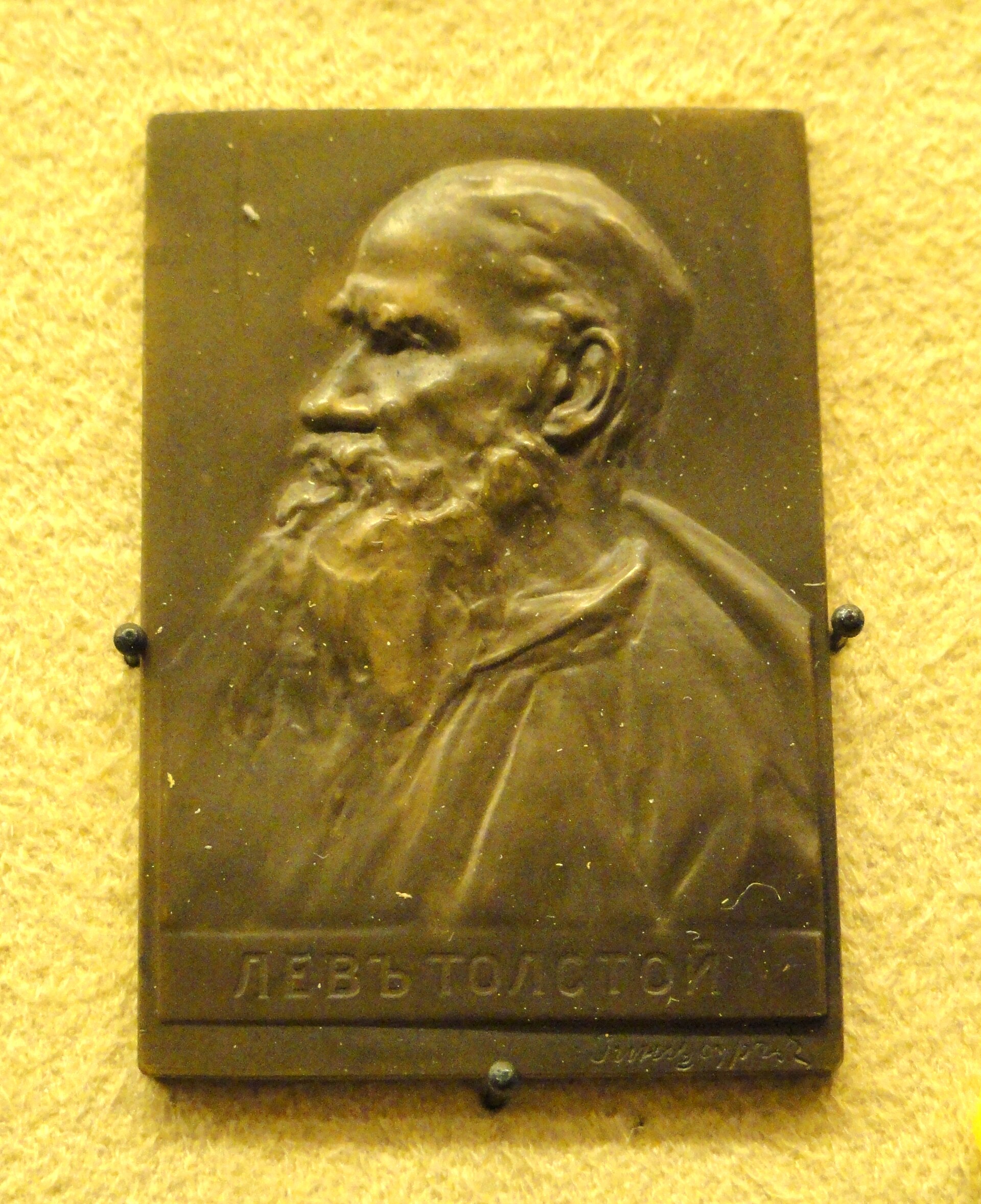
Ilya Ginzburg, statuette of Tolstoy (1908 cast, National Museum of Finland). Ginzburg first modelled Tolstoy at Yasnaya in July 1891, alongside Repin painting. Photograph released CC0; the sculpture is public domain. The 1891 statuette itself is at the State Tolstoy Museum.
### People and places around him
| Work | Artist | Year | Holding | Online / quality | Rights |
|---|---|---|---|---|---|
| Russian Peasants (album) | N. Orlov | to 1909 | Scattered (Tretyakov, Russian Museum, Tula); album at Cornell | Partial | PD |
| Portrait of Sofia Andreevna | Ge | 1886 | — | Commons PD 520×884 (low) | PD |
| Portrait of Tolstoy by Sofia herself | S. A. Tolstaya | 1904 | — | Commons PD 2526×3420 | PD |
### What is not openly available, and where to request it
- **Kramskoy 1873 (family version)** — Yasnaya Polyana Museum-Estate (ypmuseum.ru).
- **Yaroshenko 1894; Repin "Barefoot" hi-res** — State Russian Museum photo-library (rusmuseum.ru).
- **Ge bust; Repin 1909; Nesterov 1907; Pasternak Resurrection originals; Ginzburg 1891; Aronson 1901** — State Museum of L. N. Tolstoy, Moscow (tolstoymuseum.ru).
- **Trubetskoy equestrian hi-res** — Musée d'Orsay photo library.
- **Serov 1892** — location needs archival confirmation; Tretyakov graphics department is the first probability.
- **High-resolution Tretyakov scans of the PD oils** — licensable from the Tretyakov Gallery (the works are PD; the museum's photographs are charged for).
## 8. Method
Scope (the Phase-0 contract, confirmed interactively): fine art **and sculpture** — paintings, drawings, prints and sculpture of Tolstoy, his circle and Yasnaya Polyana — across **1873–1910**, with the letters/diaries sweep emphasising the post-1880 period but reaching back to Kramskoy 1873. Photography was excluded by choice.
The corpus sweep was a fan-out over the tolstoydigital TEI: the Ge correspondence (Toms 64–67), the Repin letters and diary mentions, and a third pass over the other portraitists and sculptors plus a diary portrait-vocabulary sweep. Finalists were extracted verbatim with `extract_tei.py`; every Russian quote in the dossier is byte-checked against its extract by `verify_quotes.py` (22/22 PASS). All 90 Jubilee-Edition volumes are held locally, so PSS page references are exact; the one facsimile that would have illustrated the keystone could not be rendered because the local vol62 PDF is an image-only scan with no searchable text layer (recorded in needsReview).
The visual sweep was run "heavy": a Wikimedia Commons channel (API `imageinfo`+`extmetadata`, 17 PD/CC0 images cached and verified as real files) and a separate institutional-holdings-and-rights channel (Tretyakov, Russian Museum, Musée d'Orsay, GMT, Yasnaya Polyana, Goskatalog), deduplicated by work in the main context. The scholarship layer was gathered English-first and is attributed throughout, treated as a divergence map rather than corroboration.
Links: sibling dives — [Biryukov–Sofia](../biryukov-sofia-relationship/index.html) (the contest over Tolstoy's image), [Tolstoyanism](../tolstoyanism/index.html) (the "disciple" label), [the crisis](../crisis/index.html) (the conversion years behind Ge's religious turn).
Models: scope contract and synthesis on Opus; corpus extraction and translation on Opus; visual and scholarship triage on Sonnet. Effective tier baseline: Opus.
## 9. References
Primary — Л. Н. Толстой, Полное собрание сочинений (Jubilee Edition): Tom 62 (letters 1873); Toms 64–67 (letters to Ge and Tretyakov); Toms 71, 75, 37 (Repin, Pasternak, Orlov); Toms 49–53, 58 (diaries); Tom 19 (*Anna Karenina*); Tom 30 (*What Is Art?*).
Background (attributed; secondary):
- Bartlett, Rosamund. 2011. *Tolstoy: A Russian Life*. Houghton Mifflin Harcourt.
- Vaysman, Margarita. 2022. "Tolstoy as the Subject of Art." In *Tolstoy in Context*, ed. A. Berman, 323–335. Cambridge UP.
- Taroutina, Maria. 2022. "The Visual Arts." In *Tolstoy in Context*. Cambridge UP.
- Valkenier, Elizabeth Kridl. 1990. *Ilya Repin and the World of Russian Art*. Columbia UP.
- Gambrell, Jamey. 1993. "Art and the Great Utopia." *New York Review of Books*, 22 April.
- Gatrall, Jefferson J. A. "Tolstoy, Ge, and Two Pilates: A Tale of the Interarts." Montclair State University.
- Yudenkova, T. 2011. "Pavel Tretyakov and Nikolai Ge." *Tretyakov Gallery Magazine* 3 (32).
- Reischl, Katherine M. H. 2018. *Photographic Literacy: Cameras in the Hands of Russian Authors*. Cornell UP.
- Popoff, Alexandra. 2010. *Sophia Tolstoy: A Biography*. Free Press.
---
A short dev-blog note accompanies this dive: `website/src/posts/notes/2026-06-02-tolstoy-in-art.md` (draft).